Disclosure: airfryerkitchensupply.com is reader-supported. When you buy through links on our site, we may earn an affiliate commission at no extra cost to you.
Where to buy
The best design charcoal smokers are the ones where the shape itself does the work — a bullet’s stacked airflow, a kamado’s ceramic mass, a drum’s hanging geometry. Design in this category is not decoration; it decides how the fire breathes, how the heat distributes, and how the cooker looks on your patio for the next decade. Start with the Weber bullet if you want the most proven silhouette in charcoal smoking, and read the kamado and drum picks closely if your patio — and your eye — want something different.
- Weber Smokey Mountain Cooker 22-Inch — check price on Amazon; choose the listing sold or shipped by Amazon or the brand’s own store, and confirm the exact model name before you order.
- Kamado Joe Classic Joe Series II 18-Inch — check price on Amazon; choose the listing sold or shipped by Amazon or the brand’s own store, and confirm the exact model name before you order.
- Pit Barrel Cooker Premier Series 18.5-Inch — check price on Amazon; choose the listing sold or shipped by Amazon or the brand’s own store, and confirm the exact model name before you order.
- Weber Smokey Mountain Cooker 18-Inch — check price on Amazon; choose the listing sold or shipped by Amazon or the brand’s own store, and confirm the exact model name before you order.
- Oklahoma Joe’s Bronco 18-Inch Drum Smoker and Grill — check price on Amazon; choose the listing sold or shipped by Amazon or the brand’s own store, and confirm the exact model name before you order.
- Weber Smokey Mountain Cooker 14-Inch — check price on Amazon; choose the listing sold or shipped by Amazon or the brand’s own store, and confirm the exact model name before you order.
The best design charcoal smokers reward a way of thinking about this purchase that spec sheets discourage. Two smokers can list the same grate diameter and the same fuel, and cook completely differently, because one was designed as a system — fire, airflow, water, meat and exhaust arranged to cooperate — and the other was assembled from parts that merely fit. This guide is about the first kind. Every pick below earned its place because its design solves a real smoking problem elegantly: holding low heat steady for hours, moving smoke across meat evenly, or disappearing into a small patio without giving up real capacity.
Design also means the object itself. A charcoal smoker lives outside, in view, for years. Porcelain enamel that shrugs off weather, a ceramic shell that becomes patio furniture, a drum whose industrial plainness is the whole point — these are legitimate reasons to choose one cooker over another, and this guide treats them that way instead of pretending only grate area matters. What it will not do is reward styling that fights the cooking: chrome trim on a thin-walled box is not design, and no pick here survives on looks alone.
One honest note about the field: charcoal smoker design clusters into a few mature families — bullets, kamados, drums and offsets — and genuine innovation is rare. The designs below are proven architectures, refined over many seasons, rather than novelties. That is a strength for a buyer. A mature design has known behaviour, known fixes and a community that has already made every mistake you are about to make, in public, with photographs.
In this guide
Quick Picks
Six charcoal smokers chosen for design intelligence first and everything else second — three sizes of the definitive bullet, the benchmark ceramic kamado, and two drums that turn a steel barrel into a precision instrument.
- Best Overall Design: Weber Smokey Mountain Cooker 22-Inch — the bullet perfected — a three-section stacked design with a water pan at its heart, dual grates and porcelain enamel that still looks right after a decade outside.
- Best Premium Design: Kamado Joe Classic Joe Series II 18-Inch — the ceramic egg as patio sculpture — thick ceramic walls, a counterbalanced hinge and a two-tier grate system in the category’s most finished object.
- Best Minimalist Design: Pit Barrel Cooker Premier Series 18.5-Inch — the drum reduced to first principles — meat hangs vertically over the coals in a porcelain-coated barrel with almost nothing to adjust and nothing to break.
- Best Classic Mid-Size Design: Weber Smokey Mountain Cooker 18-Inch — the original bullet at its most balanced size — the same stacked, water-pan design as the 22, scaled to the patio and the household most people actually have.
- Best Convertible Drum Design: Oklahoma Joe’s Bronco 18-Inch Drum Smoker and Grill — the drum that converts — a heavy-gauge barrel that hangs meat like a Pit Barrel, then flips its charcoal bed up to become a direct grill.
- Best Compact Design: Weber Smokey Mountain Cooker 14-Inch — the bullet shrunk without apology — the full three-section, water-pan design at a size that fits a balcony rail’s worth of floor and a small car’s boot.
How These Picks Were Chosen
Products whose listings could not be confirmed were left out rather than described from memory, however famous they are.
Design was judged on five criteria, in order. First, thermal architecture: does the shape manage heat and smoke as a system? Second, control: can the cook make small, repeatable adjustments? Third, material honesty: enamel, ceramic and heavy steel where they matter, no cosmetic substitutes. Fourth, footprint efficiency: cooking capacity per unit of patio. Fifth, longevity of the design itself — spare parts, community knowledge, and whether the cooker will still make sense in ten years. Styling counted only after all five, which is why some handsome thin-walled boxes are not here.
Prices and star ratings are deliberately absent. Prices move, ratings inflate, and neither tells you whether a bullet’s water pan suits your cooking. Check the current price on Amazon from the links provided, and judge design with the criteria above.
The 6 Best Design Charcoal Smokers

Weber Smokey Mountain Cooker 22-Inch — Best Overall Design
The 22-inch Smokey Mountain is the reference design for charcoal smoking, and its layout explains why. Three porcelain-enameled sections stack vertically: a charcoal bowl at the base, a middle cooking section with a water pan suspended over the fire, and a domed lid. Heat and smoke rise through the water pan’s moderating mass, pass two cooking grates, and exit at the top — a chimney of controlled, humid, even heat that forgives beginner mistakes and rewards experienced ones. Nothing about the design is decorative, and the result is an object so resolved it has become the category’s visual shorthand.
Strengths
- Stacked three-section design separates for cleaning, transport and grate access
- Water pan architecture buffers temperature swings better than any rival at this size
- Porcelain-enameled steel shrugs off weather and wipes clean
Trade-offs
- Access door is the design’s known weak seam for heat and smoke leaks
- Two-grate layout means the lower grate is always the awkward one to reach
- Footprint is compact but the tall silhouette needs headroom under covers and eaves
| Format | 22-inch vertical bullet smoker |
| Cooking grates | Dual cooking grates (from listing) |
| Construction | Porcelain-enameled kettle and sections |
| Temperature control | Dampers (from listing) |
What elevates the Smokey Mountain from appliance to design object is how each decision serves the cook. The door in the middle section exists so you can add charcoal and water mid-cook without lifting the lid and dumping your heat — the one interruption a long smoke cannot afford. The dampers are placed and sized to make small adjustments meaningful: a quarter-turn changes the fire’s breathing in a way you can learn and repeat. Even the lid’s rolled edge and the bowl’s depth reflect decades of small corrections. Owners talk about these smokers the way people talk about cast-iron pans — as permanent equipment.
Capacity is the 22-inch version’s quiet advantage. The dual grates take full packer briskets laid flat, multiple pork shoulders, or rib racks standing in a holder, and the vertical design means that capacity costs very little patio: the footprint is barely wider than the grate itself. For design-led buyers with small outdoor space, that ratio — cooking area per square foot of patio — is the Smokey Mountain’s most modern quality, arrived at long before small-space living made it fashionable.
Best for: most charcoal smokers: the default, best-resolved design in the category / Not suited for: buyers who want a flat grilling surface or a wide offset firebox experience

Kamado Joe Classic Joe Series II 18-Inch — Best Premium Design
If the bullet is engineering, the kamado is architecture. The Classic Joe Series II wraps its fire in thick ceramic that absorbs heat and radiates it back evenly, so the cooking chamber behaves less like a metal box with a fire in it and more like a masonry oven. The design language is complete: the red ceramic shell, the cart with side shelves, stainless steel grates, and a hinge engineered to make a very heavy lid feel nearly weightless. It grills and sears as seriously as it smokes, which is the kamado bargain — one beautiful object replacing two plain ones.
Strengths
- Ceramic mass holds low smoking temperatures with remarkable stability
- Counterbalanced hinge and finished cart make it genuine patio furniture
- Two-tier grate system layers capacity inside a compact footprint
Trade-offs
- Ceramic is heavy and unforgiving of drops or careless moves
- 250 sq in of grate is modest next to the big bullet and drums
- Cooling an overshot kamado is slow — the same mass that holds heat keeps it
| Format | 18-inch ceramic kamado grill and smoker |
| Cooking area | 250 sq in (from listing) |
| Grates | Stainless steel (from listing) |
| Included | Cart and side shelves (from listing) |
The kamado’s design intelligence is thermal. Thin steel smokers chase temperature; a ceramic cooker settles into it, because the walls themselves become part of the heating system. For smoking, that means a small charcoal load and minimal vent adjustment hold a low temperature for many hours, and the moisture that metal smokers vent away stays in the chamber longer. The Divide and Conquer-style two-level grate arrangement answers the kamado’s one structural limit — a round, modest grate — by cooking in storeys: ribs below, beans or vegetables above, each at a slightly different height and heat.
Ownership design matters too. The air-lift hinge is not a gimmick; it is the difference between a lid you open one-handed while holding a tray and a lid that dictates how you stand. The cart rolls, the shelves fold into the silhouette, and the whole object reads as intentional from every angle — which, for a cooker that will sit beside your back door for fifteen years, is a real specification. Choose it knowing the trade: you are buying the finest single-chamber design in charcoal, at a footprint that asks you to cook in batches for a crowd.
Best for: buyers who want one beautifully made cooker for smoking and grilling / Not suited for: high-volume cooks feeding large groups from a single grate

Pit Barrel Cooker Premier Series 18.5-Inch — Best Minimalist Design
The Pit Barrel is the boldest design statement in this guide precisely because it refuses to make one. A porcelain-coated steel drum, a charcoal basket at the bottom, hooks and rods across the top — and the design insight that meat hung vertically over a fire cooks evenly in its own dripping smoke, self-basting as it goes. There are no dampers to learn in the usual sense; the barrel’s vents are preset by design, and the cooker’s famous instruction is essentially to light it and trust it. For buyers exhausted by adjustable everything, that restraint is the luxury.
Strengths
- Hanging design cooks ribs, chickens and briskets vertically with superb evenness
- Almost no controls: the airflow design is preset at the factory
- Porcelain-coated drum is light, compact and easy to store
Trade-offs
- Hanging format asks for hooks and confidence; flat-laying purists must adapt
- Temperature is managed by design, not by you — fine control is limited
- Capacity is real but unconventional; whole large briskets may need trimming or hanging tricks
| Format | 18.5-inch vertical drum smoker |
| Construction | Porcelain coated steel (from listing) |
| Cooking method | Hanging hooks over charcoal basket |
| Style | Ugly drum smoker (UDS) architecture |
The hanging method deserves explanation because it is the design. In a conventional smoker, meat sits on a grate and the side facing the fire cooks faster; in the Pit Barrel, meat hangs in the round, surrounded by rising heat and smoke on all sides, dripping onto the coals so the drippings themselves become part of the smoke. Ribs in particular emerge with a uniformity that grate cooks work hard to match. The drum runs hotter than a low-and-slow purist’s default, and the design embraces that: cooks finish sooner, with bark and moisture that converted many sceptics.
As an object, the barrel is honest industrial design — one material, one coating, no panel gaps, no electronics, nothing to update. It stores in a corner, travels to a tailgate in a car boot’s worth of space, and cleans with a scrape and a wipe. If your design taste runs to Dieter Rams rather than to chrome, this is your smoker: every element present is load-bearing, and the beauty is entirely in the proportions and the idea.
Best for: minimalists and ribs specialists who value a design with nothing spare / Not suited for: cooks who want digital control, flat grates and low-and-slow by the dial
Weber Smokey Mountain Cooker 18-Inch — Best Classic Mid-Size Design
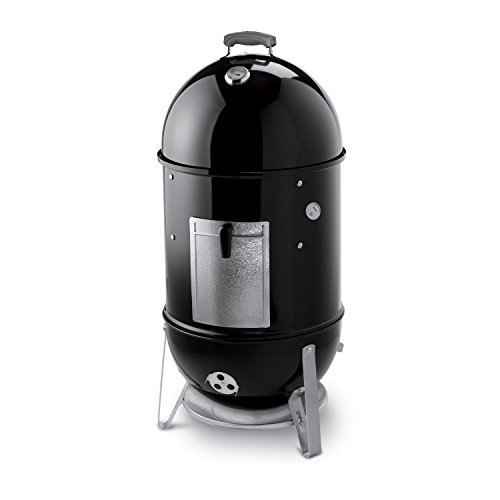
The 18-inch Smokey Mountain is the design in its purest proportions — the size the bullet architecture was drawn around. Everything said about the 22 applies: three porcelain-enameled sections, water pan over the fire, dual grates, damper control. What changes is fit. The 18 takes a whole chicken, a pork shoulder or a trimmed brisket with room to work, sips charcoal compared with its bigger sibling, and sits on a small patio or balcony-adjacent deck without dominating it. For a two-to-four-person household, this is not the smaller compromise; it is the correctly sized original.
Strengths
- The bullet design at its most economical size — less charcoal per cook
- Same water-pan stability and damper control as the 22-inch
- Proportions suit small patios, and it stores under a standard cover easily
Trade-offs
- Full untrimmed packer briskets are a squeeze and may need a rib rack trick or a bowl to drape
- Same access-door seam and lower-grate reach as the whole bullet family
- Crowd cooking means batches, where the 22 would simply fit more
| Format | 18-inch vertical bullet smoker |
| Cooking grates | Dual cooking grates (from listing) |
| Construction | Porcelain-enameled kettle and sections |
| Temperature control | Dampers (from listing) |
Sizing is a design decision buyers underrate. An oversized smoker wastes fuel heating empty air, takes longer to stabilise, and discourages the weeknight shoulder that builds skill. The 18-inch bullet is the size that gets used weekly: quick to light, quick to settle, big enough for the cooks that make up ninety percent of real smoking life. Its design maturity shows in the details shared with the 22 — the same door, the same damper logic, the same enamel — so skills and accessories transfer if you ever scale up.
It is also the friendliest entry into the bullet ecosystem. The community knowledge base was largely written on this size; charcoal quantities, vent settings and timings in countless guides assume the 18. A design that arrives with a decade of documented behaviour is, in practical terms, a better-designed product than a theoretically superior cooker you must reverse-engineer alone.
Best for: households of two to four who want the classic bullet, used weekly / Not suited for: cooks regularly smoking for eight or more people at once

Oklahoma Joe’s Bronco 18-Inch Drum Smoker and Grill — Best Convertible Drum Design
The Bronco takes the drum idea and designs in the one thing drums usually lack: a second act. In smoker mode it works like its minimalist rivals — charcoal low, meat hanging from hooks or resting on the grate, smoke rising through a sealed barrel. But the charcoal bed adjusts upward, and with the heat close under the grate the same barrel becomes a direct-heat grill for steaks and burgers. The heavy-duty steel construction gives it a planted, substantial feel that lighter drums do not attempt, and the sealed, gasket-minded build shows a designer thinking about smoke control rather than just smoke production.
Strengths
- Convertible design: hanging drum smoker and raised-bed grill in one barrel
- Heavy-gauge steel and sealed construction hold smoke and heat with authority
- 284 sq in grate plus hanging capacity covers family cooks comfortably
Trade-offs
- Heavier than minimalist drums — this is a park-it cooker, not a portable
- Conversion hardware adds parts to clean and keep track of
- Drum airflow has a learning curve distinct from bullet dampers
| Format | 18-inch drum smoker and grill |
| Cooking area | 284 sq in (from listing) |
| Construction | Heavy duty charcoal drum (from listing) |
| Modes | Hanging smoke / raised-bed grill |
Convertibility is a design risk — most two-in-one cookers do both jobs at eighty percent — and the Bronco’s answer is mechanical honesty. Nothing about the conversion is electronic or delicate: the bed physically moves, the grate physically sits at two heights, and each mode is a complete, simple cooker in itself. In hanging mode it matches the minimalist drums rib for rib; in grill mode it sears with the direct intensity that a bullet cannot reach. For a one-cooker patio, that completeness in both modes is the design achievement.
The weight cuts both ways and this guide will not pretend otherwise. Heavy steel smooths temperature swings and will outlast thin barrels, and it also means the Bronco lives where you put it. Buy it as patio infrastructure — a permanent station — and the mass is all benefit. Buy it expecting to haul it to picnics and it will teach you otherwise exactly once.
Best for: one-cooker patios wanting drum smoking plus real grilling / Not suited for: anyone who needs to move their smoker often or store it in a small shed
Weber Smokey Mountain Cooker 14-Inch — Best Compact Design
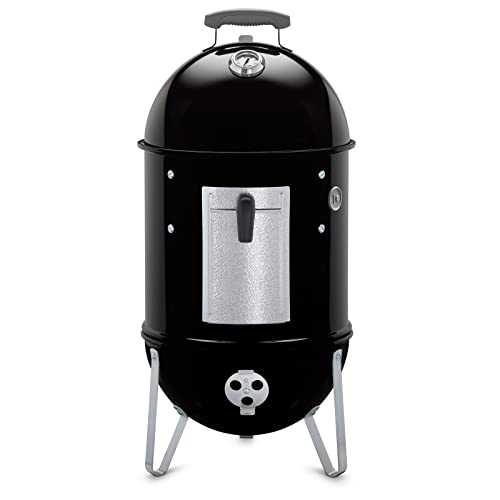
Most compact smokers are redesigned — simplified, cheapened, rethought into a different and lesser product. The 14-inch Smokey Mountain is instead scaled: the same three-section bullet architecture, the same water pan, the same dual grates and porcelain enamel, drawn smaller. That fidelity is its design virtue. It smokes a chicken, a small shoulder, a rack or two of ribs cut to fit, with the same temperature behaviour its big siblings are famous for, and it does so on a footprint that fits apartment-adjacent living — then comes apart and travels like luggage.
Strengths
- Full bullet design at true portable size — nothing essential removed
- Dual grates still fitted, so small-batch layering works as designed
- Breaks down for transport to campsites, tailgates and friends’ gardens
Trade-offs
- Capacity is honestly small: plan cooks around one main item
- Small charcoal loads mean shorter unattended runs than the 18 or 22
- Ribs need cutting or curling to fit the grate diameter
| Format | 14-inch vertical bullet smoker |
| Cooking grates | Dual cooking grates (from listing) |
| Construction | Porcelain-enameled (from listing) |
| Sections | Three-section stack, portable |
The 14 rewards a particular kind of cook: the one smoking for two, learning the craft, or taking the show on the road. Because the architecture is unchanged, everything you learn — damper discipline, water pan management, charcoal arrangement — is the real skill, transferable to any bullet at any size. Many owners keep the 14 after buying bigger smokers, the way photographers keep a small camera: it is the one that actually goes places.
Design honesty requires the capacity caveat in full. This is not a brisket machine and not a party machine, and its shorter fuel runs mean overnight unattended cooks are not its party trick. Judged as what it is — the complete bullet design at the smallest viable scale — it has no real rival, and its enamelled sections will still be stacking true long after folding novelty smokers have warped.
Best for: couples, learners and travellers who want the real bullet design, small / Not suited for: brisket-first cooks and anyone feeding a crowd from one cooker
Comparison Table
The six designs side by side. Note how little the key specs overlap — each architecture buys its advantages with different currency: footprint, mass, capacity or simplicity.
| Pick | Badge | Key spec | Best for |
|---|---|---|---|
| Weber Smokey Mountain Cooker 22-Inch | Best Overall Design | 22-inch bullet, dual grates, water pan | Most households wanting the proven design |
| Kamado Joe Classic Joe Series II 18-Inch | Best Premium Design | 18-inch ceramic kamado, 250 sq in, cart included | Design-led buyers who grill as much as they smoke |
| Pit Barrel Cooker Premier Series 18.5-Inch | Best Minimalist Design | 18.5-inch drum, hanging-hook design | Minimalists who want set-and-trust charcoal smoking |
| Weber Smokey Mountain Cooker 18-Inch | Best Classic Mid-Size Design | 18-inch bullet, dual grates, water pan | Small households wanting the classic design, correctly sized |
| Oklahoma Joe’s Bronco 18-Inch Drum Smoker and Grill | Best Convertible Drum Design | 18-inch convertible drum, 284 sq in | Buyers who want a drum that also grills, built heavy |
| Weber Smokey Mountain Cooker 14-Inch | Best Compact Design | 14-inch bullet, dual grates, portable stack | Small spaces and portable smoking with no design compromise |
How to Choose a Charcoal Smoker by Design
Start with the architecture, not the brand. Bullets stack the fire below the meat with water between, giving the most forgiving temperature behaviour and the smallest footprint per rack. Kamados wrap the fire in ceramic, giving the steadiest heat and real grilling range in the most finished object. Drums hang or rack meat over coals in a sealed barrel, giving simplicity and speed. Offsets — the one family not represented among the picks, because their best designs are heavy, expensive and space-hungry — burn a side fire and demand the most skill. Choose the family whose daily behaviour matches your patience, then choose the model within it.
Footprint, headroom and the patio test
Measure your space in three dimensions. Bullets and drums are tall and narrow: they need little floor but real headroom, and their lids lift high. Kamados on carts are wide with shelves out, narrow with shelves folded. Then picture the cooker in February, under a cover, in the rain: porcelain enamel and ceramic shrug that life off; thin painted steel begins its decline. The best design for your patio is the one that still looks intentional in year five, and that is a materials question before it is a shape question.
Materials: what the shell is telling you
Porcelain enamel on steel, as on the Weber bullets and the Pit Barrel, is the pragmatic classic: light, weatherproof, repairable by touch-up, and proven over decades. Ceramic, as on the Kamado Joe, is the thermal champion and the fragile one — superb in place, unforgiving in transit. Heavy-gauge plain steel, as on the Bronco, trades a little weather vanity for mass and longevity, and asks for seasoning and the occasional oil wipe as rent. None is best in the abstract; each is best for a pattern of life.
Airflow: The Invisible Half of Every Design
Every charcoal smoker is an air pump with a fire in it. Intake air feeds the coals; exhaust carries smoke across the meat and out. Designs differ in how precisely you conduct that flow. The bullets’ dampers give fine, learnable control — the reference standard. The kamado’s vents work on a smaller, more sensitive range because the ceramic holds so much heat that small air changes have large, lasting effects. The Pit Barrel removes the question, fixing airflow at the factory setting that its hanging geometry was tuned around. The Bronco seals its barrel so the air that enters is air you admitted on purpose.
When comparing designs in a showroom or a listing, look at the seams. Smoke leaking from every joint is flavour and heat leaving without doing work, and it signals a design — or a build — that treats airflow as an accident. Gasketed lids, tight section fits and latches are not luxury trim; they are the visible evidence that the invisible half of the design was taken seriously. This is also why the bullet’s access door is criticised in its review above: it is the one seam on an otherwise disciplined design that owners commonly seal with an aftermarket gasket.
A practical airflow test for any design you are considering: can you choke the fire down fully when the cook ends? Cookers that seal well let you snuff the coals and reuse the unburned charcoal next time — a small economy that compounds across a season, and a reliable proxy for how well the whole airflow system was thought through.
Capacity Honestly: Grates, Hangers and Real Food
Square inches lie politely. A grate’s diameter decides what actually fits: a full packer brisket needs length, ribs need either length or a rack, and chickens need height. Vertical designs cheat capacity honestly — the bullet’s second grate and the drums’ hanging hooks add a dimension flat cookers lack. When a drum claims hanging capacity, picture the food: ribs hang beautifully, chickens hang beautifully, and a brisket may hang folded or go on the grate. Match the design’s natural shapes to the food you actually cook, not the food in the brochure photograph.
Budget tiers in this category track materials more than features. The entry tier buys thin steel and simple bullets; the middle buys enamel, mass and the proven designs in this guide; the premium tier buys ceramic and heavy fabrication. Because this guide prints no prices, use the tiers qualitatively when you check price on Amazon: if a ceramic kamado appears at a thin-steel price, read the listing twice — the design families have honest cost structures, and outliers usually resolve into smaller sizes or lighter construction than the headline suggests.
How to Set Up and Run a Charcoal Bullet or Drum Smoker
The routine below covers the bullet and drum picks — the majority of this guide — and the kamado variation is noted at the end. The goal of a first cook is not brilliance; it is learning your cooker’s airflow with forgiving food. Choose a pork shoulder, season it simply, and let the design do what it was built to do.
- Assemble and inspect the stack. Seat each section fully, check the door or lid fit, and confirm dampers or vents move freely before any fire exists to complicate the lesson.
- Load charcoal with the minion method. Fill the charcoal ring or basket with unlit briquettes and a few wood chunks buried among them, then pour a small chimney of lit coals on top; the fire spreads slowly through the fuel for hours of steady heat.
- Fill the water pan (bullets) or set the barrel’s preset vents (drums). Hot water in the pan brings the cooker to temperature faster; in a drum, simply confirm the factory vent setting and the charcoal basket position.
- Assemble the cooker and let it settle. Twenty to thirty minutes of patience here buys hours of stability: wait until the temperature holds near your target and the smoke runs pale and thin, not white and billowing.
- Load the food and close it down. Meat on the grate — or on hooks in a drum — lid on, and then discipline: no peeking for the first hours. Every opening is heat and smoke the design must rebuild.
- Adjust in quarters. If temperature drifts, move one damper a quarter-turn and wait fifteen minutes. Designs with good airflow reward small inputs; chasing the needle with big ones teaches nothing.
- Refuel through the door, not the lid (bullets). Add charcoal or water via the access door so the cooking chamber keeps its heat; in drums, a planned basket usually outlasts the cook.
- Finish, rest and shut down. Rest the meat wrapped and warm, then close every vent fully. A well-sealed design snuffs the coals, leaving reusable charcoal and a clean conscience.
For the kamado, the same logic runs slower: light a smaller fire than you think, bring the ceramic up gradually, and once the mass is hot, make vent changes earlier and smaller than feels natural — and never overshoot far, because a hot kamado cools on its own schedule, not yours. Whichever design you own, keep a notebook for the first season. Designs become predictable only when you record what you did; after a dozen cooks, your notes are worth more than any guide, including this one.
Design Details That Matter More Than They Look
Handles and hinges decide daily happiness. A lid you can lift one-handed, a hinge that holds position, handles that stay cool enough to use — these small mechanisms are used at every cook, unlike the extra grate used twice a year. Thermometer placement matters similarly: a lid thermometer reads the lid’s air, not the grate’s, and thoughtful designs either place the probe near grate level or expect you to run a grate-level probe of your own — one reason the thermometer guides in this programme pair so naturally with a smoker purchase.
Finally, look at how the design ages. Enamel chips can be touched up; ceramic glazes craze gracefully; plain steel develops patina that owners either love or fight. Ash management — a pan that slides, a bowl that lifts — decides whether cleanup is a two-minute ritual or a chore that quietly ends your smoking habit. The best design charcoal smokers are, in the end, the ones still being used in year ten, and they earn that with these unglamorous details as much as with their silhouettes.
Maintaining the Design: Covers, Gaskets and Small Rituals
Good design asks for little, but it asks consistently. A cover is the single highest-value accessory for any cooker in this guide: enamel and ceramic both shrug off weather better under one, and dampers, hinges and latches stay free-moving instead of seasoning themselves shut. Once a season, work the moving parts — damper discs on the bullets, the kamado’s hinge and latch, the Bronco’s bed mechanism — and clear ash completely rather than letting it cake in the bowl, where it holds moisture against the steel it was meant to protect.
Gaskets deserve a word of their own. The bullet’s door and many drum lids seal better with an inexpensive high-heat gasket kit, and fitting one is best understood as completing the design rather than modifying it: the airflow discipline the engineers intended assumes seams that close. Likewise, a grate-level thermometer — the subject of this programme’s thermometer guides — completes a design whose lid gauge reads lid air. None of this is upgrade culture; it is the small ritual by which a well-designed object stays well-designed in your ownership, season after season, instead of slowly becoming the leaky, sticky version of itself that gives charcoal smoking a bad name.
Common Buying Mistakes
Buying the silhouette, not the system. A cooker that photographs like a bullet but lacks the water pan, damper quality or section fit of the real design will cook like the parts bin it is. Architecture is a system; copies usually keep the shape and lose the tolerances.
Oversizing for the twice-a-year party. The big cooker sits mostly empty, burning extra charcoal to heat air, while the correctly sized design would have been lit weekly. Rent or borrow for the party; buy for your Tuesdays.
Ignoring headroom and storage. Tall bullets under low eaves, wide kamado carts in narrow side yards — measure the cooker’s working envelope, lid open and cook standing, not its catalogue footprint.
Chasing temperature with the lid. Lifting the lid to ‘check’ is the most common design-defeating habit in charcoal smoking. Trust the design, watch the thermometer, and let the airflow work.
Skipping the gasket fix on a leaky door. If your bullet’s door leaks, a simple gasket kit restores the design’s intent for very little money. Modifying a proven design back to its specification is maintenance, not sacrilege.
Final Recommendation
For most buyers, the recommendation is the Weber Smokey Mountain Cooker 22-Inch — the best-resolved charcoal smoker design in production, with the 18-inch version the smarter buy for smaller households and the 14-inch the traveller’s delight. Choose the Kamado Joe Classic Joe Series II if one beautiful ceramic object should grill and smoke for you, the Pit Barrel Cooker if minimalism is your aesthetic and your philosophy, and the Oklahoma Joe’s Bronco if your drum must also grill and you like your steel heavy.
Whichever design you choose, check price on Amazon before ordering and confirm the exact model and size on the listing — the bullet family in particular spans three sizes under one famous name. Then keep exploring the cluster: Best Charcoal Smokers Under $500 for the budget-tier view of this same design question, Best Bullet Smokers for a deeper dive into the bullet family, and Best Ceramic Smokers Green Egg for the kamado world’s wider field. If your design journey started with fuel questions rather than shapes, Best Charcoal And Wood Smokers covers the fire side of the story, and Best Backyard Charcoal Smokers looks at these same architectures from the patio-planning angle.
To act on this guide: start with Weber Smokey Mountain Cooker 22-Inch, then compare Kamado Joe Classic Joe Series II 18-Inch, and finally Pit Barrel Cooker Premier Series 18.5-Inch — check price on Amazon on each listing, confirm the exact model name and size, and choose by the design logic above rather than by the headline discount.
Frequently Asked Questions
What makes a charcoal smoker ‘well designed’ rather than just good-looking?
System thinking: airflow you can control in small steps, a chamber shape that evens out heat, materials matched to outdoor life, and details — doors, hinges, ash handling — that respect the cook. Looks that survive are a by-product of those decisions, as the bullet and kamado in this guide demonstrate.
Bullet, kamado or drum — which design is easiest for a beginner?
The bullet, by a clear margin. The water pan forgives temperature mistakes, the dampers teach airflow gently, and the documentation for every situation is unmatched. Drums are a close second for cooks who prefer the hanging method and minimal controls.
Does the water pan in a bullet smoker actually matter?
Yes. It buffers the fire’s swings, adds humidity that helps smoke adhere and bark form, and catches drippings before they flare. Some experienced cooks run it empty or filled with sand for certain cooks, but as designed — with water — it is central to the bullet’s forgiving behaviour.
Are kamado smokers worth it if I mostly smoke?
If you only smoke and never grill, a bullet gives you more capacity per amount spent. The kamado earns its place when one cooker must do both jobs beautifully and live as patio furniture — its smoking performance itself is excellent, particularly for temperature stability on long cooks.
How long will a well-designed charcoal smoker last?
Enamelled bullets and porcelain drums routinely serve beyond a decade with cover use and basic care; ceramic kamados can outlast their owners if the shell is never dropped or cracked. The design families in this guide are all buy-it-for-years purchases, which is precisely why design quality deserves the weight this guide gives it.
Can a drum smoker really cook without temperature controls?
The Pit Barrel’s preset airflow is tuned to its geometry, and in practice it settles into its working range and stays there. You give up fine adjustment and gain near-zero management. Cooks who want a dial and a display should choose a bullet with a thermometer setup instead — design honesty means matching the control style to the cook.


