Disclosure: airfryerkitchensupply.com is reader-supported. When you buy through links on our site, we may earn an affiliate commission at no extra cost to you.
Where to Buy
Every cooler in this guide was verified against Amazon’s catalog data — brand, capacity, cooling technology, and 12 volt operation — before inclusion. Use the Check on Amazon links to confirm availability and check the current price on Amazon; we do not print static prices. One warning that will save you money and possibly a stomach ache: this category mixes two different technologies under the word “cooler.” Compressor models refrigerate to a set temperature and can freeze. Thermoelectric models cool a fixed amount below the surrounding air and cannot freeze. Both appear below, each labelled plainly, because each has a job it does well — and a job it must never be trusted with.
Start with our top three: Alpicool 10 Quart Compressor, Alpicool C15 16 Quart, Wagan EL6214 Cooler/Warmer.
The best 12 volt small cooler is a study in honest physics. Small 12 volt coolers promise cold food and drinks anywhere a vehicle goes, but they deliver that promise through two completely different technologies with completely different limits — and the listings rarely volunteer which one you are buying. This guide separates them ruthlessly, because the right choice depends entirely on which technology your mission actually needs.
Compressor coolers are miniature refrigerators. A small DC compressor circulates refrigerant, the box reaches a temperature you set, and it holds that temperature in a heatwave. The two Alpicool picks in this guide work this way, and they can freeze. Thermoelectric coolers use a solid-state Peltier module: silent, simple, and cheap, but capable only of cooling roughly 30 to 40 degrees below the surrounding air. On a mild day that feels like refrigeration. On a hot day it is a drinks box, not a food box. The Wagan, Koolatron, and Igloo picks work this way, and each review says so in plain language.
Size is the second honesty test. “Small” in this guide means 6 to 24 litres — personal and two-person boxes that fit footwells, back seats, and the gaps in a camper van build. If you need family capacity or week-long storage, you do not need a bigger small cooler; you need the refrigerator class covered in our 12 volt RV refrigerator guide. Everything here is verified against Amazon’s catalog data, and every pick runs natively on 12 volts.
Read the Quick Picks for the short answer. Read the full guide if you are choosing between compressor and thermoelectric for the first time — that single decision matters more than brand, capacity, or any feature list, and getting it wrong is the most common regret in this category.
In this guide
Quick Picks
Short on time? These are the six best 12 volt small cooler options we would actually buy — two true compressor refrigerators and four thermoelectric boxes, each matched to the job its technology can honestly do. Every pick was verified against Amazon’s catalog data, and every link lets you check the current price on Amazon.
- Alpicool Car Refrigerator 10 Quart — Best Overall: The smallest true compressor fridge in this guide: a 10 quart (9 litre) 12 volt refrigerator-freezer with AC/DC power that keeps food at a set temperature instead of hoping the weather cooperates. — Check on Amazon
- Alpicool C15 Portable Car Freezer 16 Quart — Best Small Compressor for Two: The step-up compressor pick: 16 quarts (15 litres) with a verified -4°F to 68°F range on 12/24V DC and 100-240V AC — the smallest box we would call a complete two-person solution. — Check on Amazon
- Wagan EL6214 Personal Thermoelectric Cooler/Warmer 14L — Best Thermoelectric with Warming: A 14 litre thermoelectric cooler that also warms — the honest powered-cooler pick for drinks and lunches on driving days, with 12/24V DC power and a personal size that lives on a seat or floor. — Check on Amazon
- Koolatron 12V Iceless Cooler & Warmer 18 qt — Best for Long Driving Days: An 18 quart iceless thermoelectric cooler and warmer from a brand that has made 12V coolers for decades — the road-trip drinks box, sized for a back seat and a full day of driving. — Check on Amazon
- Igloo IE24 Thermoelectric Cooler & Warmer 24L — Best Home-and-Car Versatility: A 24 litre thermoelectric cooler/warmer with both 12V vehicle power and AC home power in the concept — the biggest small cooler here, holding 32 cans by the maker’s count. — Check on Amazon
- Wagan EL6206 12V 6 Quart Personal Thermoelectric Cooler Warmer — Best Budget and Smallest: The minimalist option: a 6 quart (6 litre) personal thermoelectric cooler/warmer on 12/24V DC — just enough for one person’s lunch, drinks, and a long shift, at the budget tier. — Check on Amazon
How These Picks Were Chosen
We verified every candidate against Amazon’s catalog data and applied three filters. First, native 12 volt operation in a vehicle — no household mini-fridges with inverter workarounds. Second, honest technology labelling: we identified each model’s cooling technology from its verified specification, and any model whose listing implied refrigeration it could not deliver was either labelled correctly here or excluded. Third, genuinely small: a ceiling of roughly 24 litres, because beyond that you are shopping for a refrigerator, not a small cooler.
Within those filters we ranked on mission fit. Compressor picks were judged on temperature range, capacity realism, and power flexibility. Thermoelectric picks were judged on stated cooling margin (the honest ones publish it, like Igloo’s 36°F-below-ambient figure), warming capability, size-to-mission fit, and the maker’s track record in the category — Koolatron and Wagan have built 12V coolers for decades, and it shows in the basics.
What we excluded matters too: unbranded boxes with no stated cooling margin, “car fridges” whose specifications dissolved under cross-checking, and oversized models riding the small-cooler search term. If a pick is not here, it failed verification or honesty, not marketing.
The 6 Best 12 Volt Small Cooler Options, Reviewed

Alpicool Car Refrigerator 10 Quart — Best Overall
Check the current price on Amazon
Most “small coolers” are thermoelectric, and thermoelectric has a ceiling: it cools a fixed amount below the air around it. The Alpicool 10 Quart breaks that ceiling by being a genuine compressor refrigerator in miniature. The verified listing describes a 10 quart (9 litre) car refrigerator-freezer running on AC and DC power, sized for a truck, van, RV, or SUV footwell and cabin.
That distinction — set temperature versus relative cooling — is the entire argument of this guide, and this little Alpicool is its clearest proof. Set it to refrigerator temperature in the morning and it is at refrigerator temperature at noon in August, holding sandwiches, insulin-adjacent supplies that need cool (not frozen) storage, baby food, and leftovers with a discipline no thermoelectric box can promise.
Strengths
- True compressor refrigeration and freezing in a 10 quart footprint
- AC and DC power — pre-chill at home, run on 12V in the vehicle
- Set-and-forget temperature control instead of ambient-dependent cooling
Trade-offs
- Ten quarts disappears fast once drinks join the food
- Compressor cost per litre is high — you pay for the technology, not the space
- Small internal height limits tall bottles; measure what you carry
| Spec | Detail |
|---|---|
| Capacity | 10 quarts (9 litres) |
| Type | Compressor refrigerator-freezer |
| Power | AC/DC, 12V in vehicle |
Who is a 9 litre compressor box for? The solo road-tripper whose alternative is a gas-station diet. The sales rep whose territory is a hot car. The couple whose camper van has exactly one cooler-shaped gap and a strong preference for real food safety. In those roles the Alpicool replaces both the ice run and the food-poisoning gamble, and it does so on a power draw small enough that an ordinary day of driving replaces what it used.
Use it as a fridge, not a freezer, for best efficiency — freezing a tiny box hard in a hot cabin is the most expensive mode it has. Keep the vents clear, keep the lid seal clean, and let it pre-chill on AC before a trip. Owners who treat mini compressors with the same basic respect as big ones get years from them.
One honest limit: at this size, the Alpicool competes with simply buying a bigger box. If your vehicle has the room, the Alpicool C15 below gives you half again the capacity and the same technology. The 10 Quart wins only where space is truly the binding constraint — and in that niche, it has almost no real rivals.
Best for: solo drivers and couples who want real refrigeration in the smallest box / Not suited for: anyone feeding more than two people from one cooler

Alpicool C15 Portable Car Freezer 16 Quart — Best Small Compressor for Two
Check the current price on Amazon
The Alpicool C15 is the smallest cooler in this guide that we would trust as the only refrigeration on a multi-day trip for two people. The verified specification explains why: 16 quarts (15 litres) of compressor capacity, a temperature range from -4°F to 68°F, and dual power — 12/24V DC in the vehicle, 100-240V AC anywhere else.
The C15 has been a default recommendation in the van and overland world for years for a simple reason: it hits the minimum viable size for real food — a couple of days of fresh ingredients, drinks around the edges — while staying small enough to live behind a seat or in a footwell.
Strengths
- Verified freezer floor of -4°F — genuine freezing, not marketing cold
- 15 litres is the practical minimum for two-person multi-day food
- Dual voltage on both sides: 12/24V DC and 100-240V AC
Trade-offs
- Single zone — one temperature for everything inside
- Still compact: a weekend of food plus drinks requires packing discipline
- Basic feature set compared with app-controlled rivals
| Spec | Detail |
|---|---|
| Capacity | 16 quarts (15 litres) |
| Temperature range | -4°F to 68°F |
| Power | 12/24V DC; 100-240V AC |
Packing a 15 litre box is a skill worth learning once. Freeze flat: sauces, chilli, and marinated meat in flat bags stack like books and thaw evenly. Drinks go around the walls where the cold is strongest. The top layer is tomorrow’s food, so the lid opens for seconds, not minutes. Run that discipline and two people eat properly for three days from a box the size of a carry-on.
Power expectations are friendly. As a refrigerator in temperate weather, a box of this class sips modestly; as a freezer in heat, it works harder, like every compressor. If the C15 is your only fridge on a house battery, the battery math in our RV refrigerator guide applies in miniature — a single 100Ah battery and ordinary driving will keep this box fed indefinitely.
Against the 10 Quart above, the C15 is the better default for anyone with the space. Against thermoelectric rivals below, it is a different species. Buy it when food safety across seasons matters more than the last few dollars or the last few litres.
Best for: couples and van lifers who need a real fridge-freezer for multi-day trips / Not suited for: families, who should jump straight to the 40+ quart class
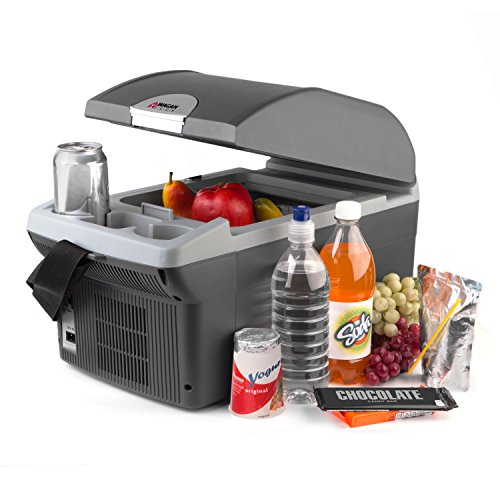
Wagan EL6214 Personal Thermoelectric Cooler/Warmer 14L — Best Thermoelectric with Warming
Check the current price on Amazon
The Wagan EL6214 earns its place by being honest about what it is: a 14 litre thermoelectric cooler/warmer, not a refrigerator. The verified listing describes a personal electric car cooler with 12/24V DC power, sized for a car, RV, or camp day use. Its party trick is the warming mode — flip the function and the same box keeps a casserole, takeaway, or baby bottles warm on the drive.
Thermoelectric cooling follows the physics explained throughout this guide: the interior lands a fixed margin below the surrounding air. On a mild driving day that margin is plenty for drinks, fruit, chocolate, and sandwiches eaten the same day. That is a legitimate job, and this Wagan does it well.
Strengths
- Cooler and warmer in one box — genuinely useful for food transport
- 14 litre personal size fits a seat, footwell, or between front seats
- Simple, silent, solid-state operation with no compressor to protect
Trade-offs
- Cannot freeze, and cannot guarantee refrigerator temperatures in summer heat
- Cooling performance collapses as cabin temperature climbs
- No battery protection sophistication — unplug it when parked for hours
| Spec | Detail |
|---|---|
| Capacity | 14 litres |
| Type | Thermoelectric cooler/warmer |
| Power | 12/24V DC |
The warming mode is the reason to choose this Wagan over a basic cold-only box. Potluck transport, keeping a rotisserie chicken at serving temperature on the way to a picnic, warming towels in a work truck — these are real use cases that compressor fridges structurally cannot serve, because a refrigerator only goes one direction. If your driving life includes moving hot food, this is your pick.
Respect the limits and it will not disappoint you. Load it with items that start cold (or hot), keep it out of direct sun, and run it while driving rather than parked. A thermoelectric box draws steadily whenever it is on, with no thermostat cycling to save you, so parked-and-plugged is how starter batteries die.
Families sometimes buy this size as a second box — the drinks-and-snacks satellite that keeps the main fridge closed during the drive. In that supporting role, with the compressor box doing the safety-critical work, the EL6214 is a smart, inexpensive addition.
Best for: commuters and day-trippers who want cold drinks and a warm lunch option / Not suited for: summer food storage — thermoelectric cannot hold safe fridge temps in heat
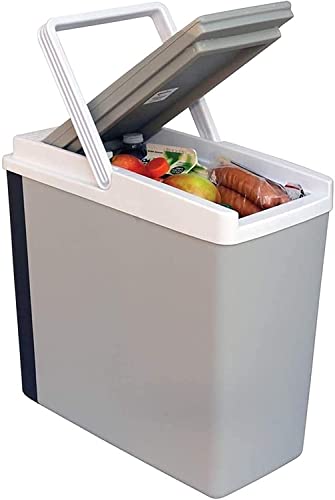
Koolatron 12V Iceless Cooler & Warmer 18 qt — Best for Long Driving Days
Check the current price on Amazon
Koolatron is one of the original names in 12 volt coolers, and this 18 quart iceless model is its classic formula: a hard-sided thermoelectric box that cools without ice and warms when asked, sized for the back seat of a family vehicle. The verified listing describes an 18 quart electric cooler and warmer positioned as a mini fridge alternative for car, truck, camper, and boat day use.
The 18 quart size is the thermoelectric sweet spot: big enough for a day of drinks and picnic food for a family, small enough to lift loaded and to fit where families actually put coolers.
Strengths
- No ice, ever — no meltwater, no soggy packaging, no ice stops
- 18 quarts covers a family’s full driving day of drinks and picnic food
- Warming mode adds hot-food transport to the same box
Trade-offs
- Thermoelectric limits apply in full: ambient-relative cooling only
- Steady power draw while running — a driving-hours appliance
- Not a food-safety device for multi-day perishables in warm weather
| Spec | Detail |
|---|---|
| Capacity | 18 quarts |
| Type | Thermoelectric cooler/warmer |
| Power | 12V DC |
The iceless proposition deserves a fair hearing. Ice is heavy, expensive across a season, and it converts your cooler into soup by day two. For the driving-day mission — cold drinks at every stop, sandwiches that stay pleasant, fruit that does not cook in a hot trunk — a thermoelectric box like this Koolatron simply removes a chore. Families who road-trip monthly feel that difference immediately.
Where owners go wrong is mission creep: the drinks box becomes the camping fridge because it is already in the car. Resist that. In a parked vehicle at a summer campsite, cabin temperatures soar and a thermoelectric interior follows them up into the range where perishable food should not live. Pair this box with ice discipline or a small compressor for overnight food, and each technology does the job it is good at.
Koolatron’s long history in the category shows in the basics: a proper sealing lid, a carry-friendly shape, and a power lead long enough to reach a rear cargo outlet. None of that is glamorous; all of it is what ownership actually feels like.
Best for: road-trippers who want a full day of cold drinks without ice / Not suited for: campers storing perishable food for days off-grid

Igloo IE24 Thermoelectric Cooler & Warmer 24L — Best Home-and-Car Versatility
Check the current price on Amazon
The Igloo IE24 is the largest box in this small-cooler guide at 24 litres, and the verified listing states its thermoelectric performance plainly: it cools to 36°F below ambient and heats to 136°F, holding 32 cans. That honesty about the ambient-relative number is exactly what buyers should look for — it tells you precisely what the box can and cannot do.
Igloo also builds this as a home-and-car product, with AC power for house duty alongside the 12V vehicle lead. As a party overflow cooler, a garage drinks box, or a spare-room unit that then rides along on trips, that dual life is the point.
Strengths
- Largest capacity here at 24 litres / 32 cans
- Stated performance is honest: 36°F below ambient, heats to 136°F
- AC and DC power covers home, office, and vehicle roles in one purchase
Trade-offs
- On a 95°F day, 36°F below ambient means a 59°F interior — drinks-cool, not food-safe
- Bigger box, bigger steady draw while running
- Thermoelectric fan noise is present, if modest
| Spec | Detail |
|---|---|
| Capacity | 24 litres (32 cans per maker) |
| Cooling | 36°F below ambient (per listing) |
| Heating | To 136°F (per listing) |
| Power | 12V DC and AC |
Do the arithmetic the listing invites you to do. Spring road trip, 70°F cabin: the IE24 interior sits near 34-40°F — genuinely refrigerator-like, and your picnic is safe and cold. August traffic jam, 100°F cabin: the interior is in the 60s, fine for drinks, wrong for raw chicken. The box did not change; the mission did. Buyers who run that one calculation before purchasing are never disappointed by thermoelectric coolers.
The warming ceiling of 136°F is a food-transport feature, not a cooking feature — it holds hot food at serving temperature. Combined with the size, this makes the IE24 the potluck and team-snack champion of the list: a full tray run across town, kept properly hot, in a box that then keeps drinks cold at the field.
At home on AC, it becomes overflow refrigeration for parties and holiday prep — the exact weeks when a household fridge runs out of room. That second life is why this pick exists despite sharing thermoelectric limits with smaller rivals.
Best for: households wanting one powered cooler for car trips, parties, and spare-room duty / Not suited for: buyers who need guaranteed cold in hot climates (choose compressor)

Wagan EL6206 12V 6 Quart Personal Thermoelectric Cooler Warmer — Best Budget and Smallest
Check the current price on Amazon
The Wagan EL6206 is the smallest and most affordable way into powered cooling: six quarts (six litres) of thermoelectric cooler/warmer, running on 12/24V DC, built for one person. The verified listing positions it exactly that way — a personal small fridge alternative for car, RV, and camp use.
There is a real elegance to the personal size. It fits a footwell or sits on a passenger seat, sips less power than its bigger thermoelectric siblings, and holds precisely what one driver needs: lunch, two or three drinks, and snacks, cold from departure to arrival.
Strengths
- Genuinely personal footprint — fits where no other powered cooler can
- Cooler and warmer modes for lunch-duty flexibility
- Budget tier: the lowest-cost entry in this guide
Trade-offs
- Six quarts fills instantly; this is a one-person box by design
- Thermoelectric limits: ambient-relative cooling, no freezing
- Steady draw while on — unplug during long parked stops
| Spec | Detail |
|---|---|
| Capacity | 6 quarts (6 litres) |
| Type | Thermoelectric cooler/warmer |
| Power | 12/24V DC |
The EL6206’s natural habitat is the working vehicle: delivery vans, service trucks, rideshare cars, and the commuter who eats lunch in the car four days a week. For that life, a cold drink and a properly chilled sandwich at hour six of a shift is not a luxury; it is the difference between eating well and eating whatever is fried nearby. The warming mode extends the same logic to hot lunches in winter.
Manage the power honestly. Thermoelectric boxes draw continuously, and a small box still draws enough to matter overnight. The routine is simple: plug in when the engine runs or when you are actively using the box, unplug when parked for hours. Drivers who build that habit never think about the box again; drivers who do not, meet their jumper cables.
If one person is the mission and the budget is firm, stop here — this is the pick. If a second person joins the mission even occasionally, step up to the Koolatron or the Alpicool C15 instead of trying to stretch six quarts into a relationship.
Best for: solo commuters, truck drivers, and anyone whose cooler serves exactly one person / Not suited for: sharing — six quarts is a personal ration, not a family supply
Comparison Table
| Pick | Badge | Key Spec | Best For |
|---|---|---|---|
| Alpicool Car Refrigerator 10 Quart | Best Overall | 10 qt (9L) compressor, AC/DC power | solo drivers and couples who want real refrigeration in the smallest box |
| Alpicool C15 Portable Car Freezer 16 Quart | Best Small Compressor for Two | 16 qt (15L), -4°F to 68°F, 12/24V DC + AC | couples and van lifers who need a real fridge-freezer for multi-day trips |
| Wagan EL6214 Personal Thermoelectric Cooler/Warmer 14L | Best Thermoelectric with Warming | 14L thermoelectric, cools and warms, 12/24V DC | commuters and day-trippers who want cold drinks and a warm lunch option |
| Koolatron 12V Iceless Cooler & Warmer 18 qt | Best for Long Driving Days | 18 qt thermoelectric, cooler/warmer, hard-sided | road-trippers who want a full day of cold drinks without ice |
| Igloo IE24 Thermoelectric Cooler & Warmer 24L | Best Home-and-Car Versatility | 24L, holds 32 cans, cools 36°F below ambient, AC/DC | households wanting one powered cooler for car trips, parties, and spare-room duty |
| Wagan EL6206 12V 6 Quart Personal Thermoelectric Cooler Warmer | Best Budget and Smallest | 6 qt (6L) thermoelectric, cooler/warmer, 12/24V DC | solo commuters, truck drivers, and anyone whose cooler serves exactly one person |
How to Choose a 12 Volt Small Cooler
Choose the technology first, using one question: must this box keep perishable food safely cold in summer? If yes, you need a compressor model — the two Alpicools in this guide — full stop. Refrigerator-safe temperatures in a hot vehicle are a compressor-only promise. If the mission is drinks, snacks, same-day lunches, and hot-food transport, thermoelectric does the job for less money and with total mechanical simplicity.
Choose the size second, by people and hours. One person, one shift: 6 to 10 litres. Two people, a weekend: 15 to 18 litres. A family’s driving day of drinks: 18 to 24 litres. Remember that drinks consume volume brutally — a dozen cans alone is roughly 4.5 litres — so count your cans before you count your sandwiches.
Choose the power behaviour third. Compressor boxes cycle and rest; thermoelectric boxes draw continuously while on. If the cooler will run parked for hours, compressor efficiency and battery protection matter. If it runs only while driving, thermoelectric simplicity wins and the alternator carries the load.
Finally, check the physical fit: internal height for your bottles, a lid that opens where the box will live, and a power lead that reaches your 12V outlet. Small coolers fail more often on centimetres than on specifications.
Compressor vs Thermoelectric: The Only Decision That Really Matters
A compressor cooler contains the same refrigeration cycle as your kitchen fridge: compressor, refrigerant, evaporator. It cools to a set point — 38°F stays 38°F whether the cabin is 70°F or 105°F — and it freezes to 0°F and below. It costs more, weighs more, and contains moving parts that deserve basic respect in transport. For food safety across seasons, there is no substitute.
A thermoelectric cooler contains a Peltier module and a fan. It has no refrigerant and almost nothing to break, runs quietly, and often adds a warming mode a compressor cannot offer. Its interior temperature floats with the weather: roughly 30 to 40°F below ambient for a good unit. That is a feature with a boundary, and the boundary is summer. In a 95°F vehicle, a thermoelectric interior can sit near 60°F — pleasant for cola, unsafe for chicken salad held for hours.
The hybrid strategy many experienced travellers land on: a small compressor box as the food-safe core, and a thermoelectric box as the drinks satellite that keeps the compressor’s lid closed during drives. If the budget allows only one, let the food-safety question decide it.
Power Draw and Your Battery: Small Coolers, Honest Numbers
Thermoelectric boxes draw a steady current the entire time they run — commonly in the 40 to 60 watt neighbourhood for this size class. Eight parked hours at that draw is a meaningful bite from a starter battery, which is why every thermoelectric review in this guide repeats the same advice: run it while driving, unplug it when parked for hours, or power it from a house battery that exists for the purpose.
Compressor boxes of this size draw more while the compressor runs but cycle off when at temperature, so their average draw across a day is often lower than a thermoelectric’s — and they protect the battery with low-voltage cut-offs. For overnight and multi-day use, the compressor is not just the colder choice; it is the kinder-to-batteries choice.
Whichever technology you choose, pre-chill or pre-warm the contents. Loading a small cooler with room-temperature drinks and asking 12 volts to do all the work is the slowest, most power-hungry pattern there is. Start cold, stay cold.
How to Use a 12 Volt Small Cooler Well
Small coolers reward a few habits disproportionately. Build these into your routine and any pick in this guide performs at its best.
- Start with cold (or hot) contents. Chill drinks and food in a home fridge first; warm-mode food should go in already hot. The box maintains temperature far better than it creates it.
- Pre-run the box. Switch the empty cooler on 30 to 60 minutes before loading, on AC if your model supports it, so the interior and walls are already at temperature.
- Pack tight and in order. A full box holds temperature better than a half-empty one. Last-needed items go at the bottom; today’s lunch rides on top so the lid opens briefly.
- Keep it shaded and ventilated. A cooler baking in direct sun through glass works twice as hard. Crack a window or use a sunshade, and never bury the fan or compressor vents under luggage.
- Obey the parked rule. Engine off for more than a short stop means thermoelectric boxes get unplugged, unless they run from a dedicated house battery.
- Clean the seal and dry the interior. After each trip, wipe the lid seal, leave the lid ajar in storage, and the box will smell like nothing for years.
One troubleshooting note covers most “my cooler stopped cooling” stories: check the vehicle outlet’s fuse and the plug’s contact first, confirm the vents are unblocked, and let a compressor box rest upright after a rough ride before restarting it. The majority of field failures are power delivery and airflow, not dead coolers.
Matching the Cooler to the Trip: Four Common Patterns
Pattern one, the working day: one person, one vehicle, eight to twelve hours. The mission is lunch, drinks, and snacks, cold at hour six. This is thermoelectric home ground — the Wagan EL6206 for the solo minimalists, the EL6214 when warming a lunch matters — run while driving, unplugged when parked. Compressor power is wasted here unless the days are hot and the food is precious.
Pattern two, the weekend for two: two people, two to three days, real food. This is the Alpicool C15’s designed mission, and the smallest pattern where food safety across a hot Saturday is guaranteed. Add the discipline of pre-chilling and flat-frozen meals and the little compressor outperforms coolers three times its price that rely on ice.
Pattern three, the family driving day: many people, many drinks, one long drive, picnic at the end. Volume is the requirement and the day is the limit — the Koolatron 18 qt and Igloo IE24 patterns, where thermoelectric simplicity and capacity beat compressor precision, because nothing in the box needs to survive past sundown.
Pattern four, the satellite system: a vehicle that already owns real refrigeration adds a small cooler to protect it. The thermoelectric drinks box by the seats keeps the compressor fridge closed and cold in the back. Owners who travel far in heat converge on this pattern, because it assigns each technology the job physics gave it.
What “Holds Temperature” Really Means Over a Long Day
A cooler’s day is a battle between heat leaking in and the cooling system carrying it out. Insulation sets the leak rate; that is why two boxes of identical technology can perform so differently, and why a well-made thermoelectric box with thick walls beats a flimsy one with a bigger fan. Judge build by the lid seal, the wall thickness you can feel at the rim, and the weight — in coolers, honest weight is often honest insulation.
Loading is the other half of the battle. A box loaded with pre-chilled contents starts the day with a reservoir of cold in the food itself; a box loaded warm starts in debt. The prosumer habit — everything enters cold, the box is pre-run, the lid opens rarely and briefly — routinely doubles real-world holding performance compared with casual use of the same hardware.
Finally, position the box like it matters, because it does: out of direct sun, off a hot floor pan above an exhaust run, with its vents breathing. Small coolers live hard lives in footwells and cargo piles; the ones that are given air and shade repay it in colder food and longer service.
Care, Cleaning, and Getting Years From a Small Cooler
Small coolers die of neglect more often than of defects. The lid seal is the first maintenance item: it collects dust, sand, and the occasional sauce, and a dirty seal leaks cold all day while the motor works to replace it. A weekly wipe with a damp cloth keeps the seal honest. The interior wants the same treatment after any spill — a sealed box that carried raw meat juice in July will remind you of it in August if it is not washed and dried properly.
Between trips, store the box clean, dry, and with the lid ajar. That one habit prevents the stale, sealed-box smell that owners otherwise fight with bicarbonate and regret. Compressor models additionally deserve a few minutes upright after rough transport before being switched on, so their refrigerant oil settles where it belongs — a small patience that compressor makers have recommended for decades.
Cables and plugs are the third item: the 12V plug’s contacts oxidise, the cable chafes where it leaves the box, and the vehicle outlet’s fuse is a consumable. A cooler that “stopped working” in the field is very often a two-minute cable or fuse story. Carry the spare fuse, inspect the lead each season, and the little box will outlast several of the vehicles it rides in.
Common Buying Mistakes
The defining mistake of this category is expecting thermoelectric cooling to behave like refrigeration in summer. It cannot, by physics, and no brand’s photography changes that. Run the ambient arithmetic in the Igloo review before you trust any thermoelectric box with perishable food on a hot day.
- Buying by litre count alone: a tall 15 litre box that cannot fit your bottles is smaller than a squat 10 litre box that can.
- Leaving a thermoelectric box plugged in overnight: the classic route to a flat starter battery and a warm cooler — the worst of both worlds.
- Blocking the vents: small coolers live in footwells and cargo piles; their fans and compressors still need air.
- Loading warm drinks at departure: hours of maximum draw to achieve what a home fridge does for free overnight.
- Using a small cooler as a family fridge: when the mission outgrows 24 litres, the answer is the refrigerator class, not a second small box.
Match the technology to the mission, the size to the crew, and the power habit to the battery, and a small 12 volt cooler becomes one of the most satisfying small purchases in vehicle life.
Final Recommendation
For most buyers, the Alpicool C15 is the default answer: the smallest box that refrigerates and freezes for real, for two people, for days. Where space is the hard limit, the Alpicool 10 Quart delivers the same compressor honesty in miniature. If your mission is drinks, lunches, and hot-food transport rather than food safety, save the money and take the thermoelectric that fits your pattern — the Wagan EL6214 for warming versatility, the Koolatron 18 qt for family driving days, the Igloo IE24 for home-and-car double duty, or the Wagan EL6206 for one person on a budget.
The category’s only real trap is the blurred middle: paying compressor money for thermoelectric performance, or trusting thermoelectric physics with refrigerator responsibilities. This guide has labelled every pick so you never have to. When the mission grows — longer trips, more people, real freezing for a week — step up to Best 12 Volt Rv Refrigerator. For keeping drinks cold beside the driver on a working day, the picks above are the whole story. Travellers building a full 12 volt setup may also want Best 12 Volt Rv Refrigerator, Best 12 Volt Slow Cooker, and Best 12 Volt Smart Tv For Rv to complete the picture.
Shop the picks: Alpicool 10 Quart · Alpicool C15 16 Quart · Wagan EL6214 14L · Koolatron 18 qt · Igloo IE24 24L · Wagan EL6206 6 Quart
One last sizing sanity check before you buy: photograph the space the cooler will live in, with a tape measure in frame, and compare it against the listed dimensions of your shortlisted box — including the lid’s opening arc and the cable’s exit side. More small coolers are returned for fit than for cooling, and the photograph takes thirty seconds.
Frequently Asked Questions
What is the difference between a 12 volt cooler and a 12 volt refrigerator?
A 12 volt refrigerator uses a compressor to reach and hold a set temperature, including freezing. A 12 volt cooler usually means a thermoelectric box that cools a fixed amount below the surrounding air and cannot freeze. The words are used interchangeably in listings, which is why this guide names the technology in every review.
Can a small 12 volt cooler keep food safe on a summer road trip?
A compressor model can, indefinitely, on vehicle power. A thermoelectric model can on mild days but not reliably in summer heat, because its interior temperature rises with the cabin. For perishable food in hot weather, choose one of the compressor picks.
Will a 12 volt cooler drain my car battery?
It can if left running while parked for hours — thermoelectric models draw continuously, and even efficient compressor models consume real energy. Run the cooler while driving, unplug thermoelectric models during long stops, and use a house battery or battery-protection settings for parked and overnight use.
How many drinks fit in a 16 quart cooler?
Roughly, a 16 quart (15 litre) box holds around 20 standard cans with no food, and a realistic mixed load of a two-person day or weekend once food joins the drinks. Count on drinks consuming about a third of a litre each including packing inefficiency.
Why does my thermoelectric cooler feel cold in spring but warm in August?
Because its interior is anchored to the air around it: about 30 to 40 degrees below ambient. A 70°F spring cabin gives a refrigerator-like interior; a 100°F August cabin gives an interior in the 60s. The cooler is working exactly as designed — the season changed the math.
Is a warming cooler actually useful?
Surprisingly, yes. Keeping takeaway, casseroles, and rotisserie chicken at serving temperature on the drive home or to a gathering is a job no refrigerator can do. If you regularly transport hot food, the warming picks in this guide earn their place on that feature alone.


