Disclosure: airfryerkitchensupply.com is reader-supported. When you buy through links on our site, we may earn an affiliate commission at no extra cost to you.
Where to Buy
Every hood in this guide was verified against Amazon’s catalog data — brand, model, width, ducting type, and native 12 volt operation — before inclusion, and only models with a verifiable listing are ranked, per this guide’s standing rule for the category. Use the Check on Amazon links to confirm availability and check the current price on Amazon; we do not print static prices. One structural note: RV range hoods divide into ducted models, which exhaust air outside, and ductless models, which filter and recirculate. The ranked picks are ducted, because ducting is the correct default where a vent path exists; the buying guide explains the ductless case honestly, including the ductless sibling of one ranked brand.
Start with our top three: Furrion FHO23SACR-BL 12V Ducted Hood, Greystone 22 Inch Super Slim Hood, CAMPLUX 22 Inch Ducted Hood.
The best 12 volt rv range hood does a job whose importance scales inversely with the size of the kitchen. In a house, cooking smoke drifts into a volume of air large enough to forgive it. In an RV, the kitchen shares a few hundred cubic feet with the bed, the sofa, and everything you own — and one round of fried fish can move into the soft furnishings for a week. The range hood is the appliance that stands between cooking and that outcome, and in an RV it runs on the 12 volt house system like everything else in the galley.
This category has a healthier shape than some in the 12 volt world: several genuine RV appliance brands compete here. Furrion and Greystone supply the RV industry itself; RecPro serves the renovation market; CAMPLUX and FOGATTI bring stated specifications — decibels, CFM, wattage — that let buyers compare with numbers instead of adjectives. Every pick in this guide is a model whose listing we verified, with the specs used in its review drawn from that verification. Where a maker states a figure, the review attributes it; where a maker does not, the review does not invent one.
The first decision is ducting, and it is made by your RV, not by you. A ducted hood exhausts cooking air outside the vehicle — the complete solution. A ductless hood filters grease and odour and returns the air — a partial solution for rigs with no vent path. Most RVs built with a factory hood have the duct already; replacements should use it. The guide’s ducting section shows how to determine which RV you own before you spend anything.
The second decision is size and profile: the near-universal 22 inch width for standard RV cooktops, slim profiles for headroom, and a compact 13 inch class for van conversions. The picks cover each, and every one runs natively on 12 volts.
In this guide
Quick Picks
Short on time? These are the six best 12 volt rv range hood options we would actually buy — all ducted, all verified, each matched to a galley and a cooking style. Every pick was checked against Amazon’s catalog data, and every link lets you check the current price on Amazon.
- Furrion FHO23SACR-BL 12V RV Ducted Range Hood — Best Overall: The RV-industry standard: a 12V ducted range hood from Furrion, the brand fitted as original equipment across the RV industry, with LED lighting and a replaceable charcoal filter in its under-cabinet variant line. — Check on Amazon
- Greystone 22 Inch Super Slim Range Hood, Vented, 12V — Best Slim Profile: The space-saver from another RV-appliance house brand: a 22 inch super slim vented range hood on 12V, in black, for galleys where headroom and cabinet depth are rationed. — Check on Amazon
- CAMPLUX RV Range Hood 22 Inch Ducted 12V — Best Quiet Operation: The quiet pick: a 22 inch ducted 12V DC range hood with a stated 51 dB operating level, slim design, and a removable 3-layer grease filter for camper, van, and trailer kitchens. — Check on Amazon
- RecPro RV Stove Range Hood Vent 22 Inch Stainless — Best Stainless Finish: The finish and value pick: a 22 inch stainless low-profile hood with charcoal filter and LED lamp on 12V DC at 60W, from RecPro, the RV renovation supplier. — Check on Amazon
- FOGATTI RV Camper Range Hood Ducted 22 Inch 12V — Best Airflow: The extraction pick: a 22 inch ducted 12V hood with a stated 96 CFM high-volume fan, LED light, and charcoal filter, in a slim under-cabinet design for RV kitchens. — Check on Amazon
- FOGATTI RV Range Hood 13 Inch Ducted 12V — Best for Tiny Kitchens: The compact specialist: a 13 inch ducted 12V hood with the same stated 96 CFM fan family, LED light, and charcoal filter — full extraction for van conversions and micro-galleys. — Check on Amazon
How These Picks Were Chosen
We verified every candidate against Amazon’s catalog data and applied the category rule stated for this guide: only models with a verifiable listing were eligible for ranking — no catalogue ghosts, no household hoods in RV costume, no 120V appliances with adapter suggestions. Within the verified field, filters were native 12V DC operation, genuine RV design intent (under-cabinet mounting, vehicle-appropriate construction), and a ducted configuration for the ranked list.
Ranking then followed the evidence each maker published: extraction figures where stated (FOGATTI’s 96 CFM), acoustic figures where stated (CAMPLUX’s 51 dB), power draw where stated (RecPro’s 60W), profile (Greystone’s super slim brief), and channel strength (Furrion’s OEM position). Where brands compete on the same axis, the reviews say so; where a pick wins on a single axis, its badge names that axis rather than pretending all-round supremacy.
A ductless model — FOGATTI’s 22 inch ductless sibling of the ranked ducted hood — is discussed in the buying guide rather than ranked, because ductless is a compromise configuration chosen by the RV’s construction, not a preference to rank against ducted extraction. That is a guide-structure decision, stated openly.
The 6 Best 12 Volt RV Range Hood Options, Reviewed
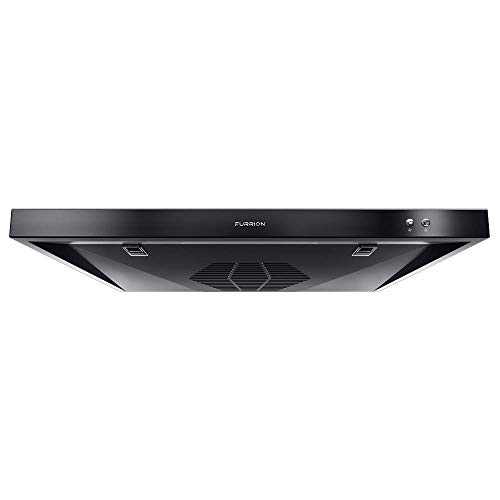
Furrion FHO23SACR-BL 12V RV Ducted Range Hood — Best Overall
Check the current price on Amazon
Furrion is the name RV manufacturers reach for when they build the kitchen, and the FHO23SACR-BL is its 12 volt ducted range hood: the verified listing confirms a 12V RV ducted range hood in black, from the brand whose appliances fill more factory RV kitchens than any other. Choosing it is choosing the industry’s default answer, with the parts availability and familiarity that follow an OEM brand.
The wider Furrion hood line — detailed in its companion listing — fills in the ownership picture: under-cabinet mounting, a replaceable charcoal filter, LED lighting over the cooktop, an exhaust fan built for the RV’s 12V system, and vibration-resistant design intent for road life. This is equipment designed by people who know the cabinet it is going into.
Strengths
- OEM brand: the hood the RV industry itself specifies, with matching support
- True ducted extraction on native 12V power
- LED cooktop lighting and replaceable charcoal filtration in the line
Trade-offs
- Ducted design requires a vent path — confirm your RV’s ducting before ordering
- Black finish only in this listing; interiors vary
- Premium positioning versus the value brands below
| Spec | Detail |
|---|---|
| Type | Ducted RV range hood |
| Power | 12V DC native |
| Maker | Furrion (model FHO23SACR-BL) |
| Lighting | LED (line feature) |
Why does the OEM brand matter in a range hood? Because the hood is a fitted appliance, not a countertop gadget. It must match a cabinet cut-out, a duct position, and a wiring run that the RV builder chose years ago. The industry-standard hood is the one most likely to match the industry-standard hole — and when filters, switches, or a fan motor need attention in year five, the OEM part is the one that exists.
Ducted extraction is the performance headline. A ducted hood moves cooking smoke, steam, and grease-laden air out of the RV entirely; a ductless hood filters and returns the air, better than nothing and worse than a duct. If your RV has the vent path — most with factory hoods do — the ducted Furrion is the correct default, and the guide’s ducting section explains how to check.
As the overall pick, it asks only one question of the buyer: does your installation support ducting? If yes, the industry has already made this decision, and it made it well.
Best for: most RV owners replacing or upgrading a factory hood / Not suited for: ductless-only installations (see the guide’s ducting section before buying)

Greystone 22 Inch Super Slim Range Hood, Vented, 12V — Best Slim Profile
Check the current price on Amazon
Greystone is a familiar name in RV kitchens — the brand behind many factory cooktops and ovens — and its entry here is a 22 inch super slim vented range hood running on 12V, in black. The verified listing’s emphasis is the profile: super slim, for the galleys where the standard hood’s depth steals headroom from the cook and presence from the room.
In a small RV kitchen, the range hood hangs directly over the workspace at face height. Every centimetre of its depth is a centimetre of the cook’s forehead clearance. A super slim hood is not a styling preference in that geometry; it is ergonomics.
Strengths
- Super slim profile — the headroom pick for compact galleys
- Vented (ducted) extraction rather than recirculation
- RV-appliance brand with factory-fit familiarity
Trade-offs
- Slim cabinets trade some extraction volume for their profile
- 22 inch width suits standard RV cooktops, not oversized ranges
- Feature set is functional rather than luxurious
| Spec | Detail |
|---|---|
| Width | 22 inch |
| Profile | Super slim |
| Type | Vented (ducted) |
| Power | 12V |
Choose the Greystone when the tape measure makes the decision. Low ceilings, a hood mounted under a shallow cabinet, a cook who is tall in a kitchen designed for the average — these are the installations where slimness is the specification that matters most, and where a standard-depth hood is a daily annoyance measured in bumped heads.
It remains a vented hood, which keeps it in the extraction class this guide recommends wherever ducting exists. Slim and ducted is the combination small galleys actually need: real removal of cooking air, in a cabinet that respects the room.
As with the Furrion, verify your duct position and cut-out before ordering; slim hoods forgive many things, but not a duct on the wrong wall.
Best for: compact RV galleys and low-clearance installations / Not suited for: cooks who generate heavy smoke daily and need maximum extraction (see Furrion/FOGATTI ducted)

CAMPLUX RV Range Hood 22 Inch Ducted 12V — Best Quiet Operation
Check the current price on Amazon
CAMPLUX built its name on RV and outdoor hot-water and cooking gear, and its range hood brief is acoustic: the verified listing states a 22 inch ducted hood on 12V DC with a quiet 51 dB operating level, a slim design, powerful suction intent, and a removable 3-layer grease filter, aimed at campers, vans, and travel trailers.
The 51 dB figure matters because of where RV hoods live. In a house, the kitchen is a room. In an RV, the kitchen is the room — the same air as the sofa, the bed, and the conversation. A hood that drones at full voice taxes every meal; a hood specified for quiet can run for the whole cook, which is what hoods are for.
Strengths
- Stated 51 dB quiet operation — the acoustic pick of the roundup
- Removable 3-layer grease filter: washable maintenance, not disposable
- Ducted extraction in a slim 22 inch cabinet
Trade-offs
- Quiet-first tuning may concede peak suction to the airflow pick below
- CAMPLUX support footprint is thinner than the OEM brands
- 51 dB is the maker’s figure; installation quality still decides real-world noise
| Spec | Detail |
|---|---|
| Width | 22 inch |
| Type | Ducted |
| Power | 12V DC |
| Noise | 51 dB (per listing) |
| Filter | Removable 3-layer grease filter |
A removable, washable grease filter is the maintenance feature owners feel monthly. Grease is what a range hood actually manages — it is in the steam, it coats the cabinet, and in an RV it coats a small, shared living space. A filter that comes out, washes, and goes back turns hood hygiene into a five-minute sink job instead of a replacement-part order, and a clean filter is also a quieter, stronger hood.
Installation note specific to quiet claims: a hood is only as quiet as its duct. Undersized, kinked, or long duct runs make any fan work harder and louder. If you buy the quiet pick, honour it with a clean, short, correctly sized duct path — the guide’s installation section covers the details.
For open-plan rigs where cooking happens inside the living space, this is the hood we would fit. Extraction you can talk over is extraction you will actually use.
Best for: open-plan RVs where the kitchen is also the living room and bedroom / Not suited for: buyers who prioritise maximum suction over acoustics

RecPro RV Stove Range Hood Vent 22 Inch Stainless — Best Stainless Finish
Check the current price on Amazon
RecPro is the renovator’s supplier — the place RV owners go when they are rebuilding interiors — and its range hood is a 22 inch stainless, low-profile unit with a charcoal filter and LED lamp, running on 12V DC at a stated 60W. The verified listing gives renovators exactly the numbers they plan with.
Stainless is a functional finish in a galley, not merely a look: it tolerates heat, wipes clean of grease without ceremony, and matches the stainless cooktops and sinks that renovation projects usually install alongside the hood.
Strengths
- Stainless, low-profile cabinet suits modernised galleys
- Stated 60W draw — easy to plan into the 12V budget
- Charcoal filter and LED lamp included in the brief
Trade-offs
- RecPro is a renovation channel brand, not an OEM fit guarantee
- Verify your duct arrangement; renovation rigs vary more than factory ones
- Stainless shows fingerprints — the eternal trade of the finish
| Spec | Detail |
|---|---|
| Width | 22 inch |
| Finish | Stainless |
| Power | 12V DC, 60W (per listing) |
| Extras | Charcoal filter, LED lamp |
Renovation context is where this pick shines. A factory-original RV is a known quantity; a renovated one is a custom project, and custom projects need components with stated dimensions and stated power, from a supplier whose whole business is the project market. The RecPro’s published 60W draw and low-profile stainless brief are planned-for data, and planners will recognise the courtesy.
The 60W figure also deserves a translation: on a 12 volt system that is a 5 amp draw while the fan and light run — a modest, well-behaved load that any house system absorbs without planning drama, and a useful benchmark when comparing the category.
If your galley project is stainless-led and your current hood is the last dated appliance in it, this is the natural finishing piece.
Best for: RV renovators modernising a galley and owners who prefer stainless / Not suited for: buyers who need the OEM brand’s dealer network

FOGATTI RV Camper Range Hood Ducted 22 Inch 12V — Best Airflow
Check the current price on Amazon
FOGATTI — another RV appliance specialist, known for tankless water heaters — fields the airflow entry: a 22 inch ducted range hood on 12V with a stated 96 CFM high-volume fan, LED lighting, and a charcoal filter, in a slim under-cabinet cabinet. The verified listing leads with the CFM figure, and so does this review: extraction volume is this hood’s argument.
CFM (cubic feet per minute) is the honest currency of range hoods. In an RV’s tiny air volume, even modest CFM turns the kitchen air over quickly — which is precisely why RV hoods do not need household-scale numbers to be effective, and why a stated 96 CFM in a small galley is a lot of air movement.
Strengths
- Stated 96 CFM — the highest extraction figure in this roundup
- Ducted design moves the air out of the RV entirely
- Slim under-cabinet format with LED light and charcoal filter
Trade-offs
- Airflow-first tuning is not the quiet-first choice
- Ducted only in this model — ductless needs are served by its sibling (see guide)
- Newer brand presence than the OEM names
| Spec | Detail |
|---|---|
| Width | 22 inch |
| Airflow | 96 CFM (per listing) |
| Type | Ducted, slim under-cabinet |
| Power | 12V |
| Extras | LED light, charcoal filter |
Who needs the airflow pick? The RV cook who actually cooks: frying fish, searing steaks, blackening spices — the techniques that fill a small rig with smoke and grease in ninety seconds. In that kitchen, extraction is not about comfort; it is about whether the smoke alarm hosts dinner. A ducted 96 CFM hood in a few hundred cubic feet of RV is a fast, decisive clearing of the air.
FOGATTI also fields a ductless sibling of this hood (charcoal-filter recirculation) for rigs without a vent path — the guide’s ducting section explains when that compromise is the right one. Within the ducted class ranked here, though, this is the volume choice.
Pair airflow with behaviour: start the hood before the pan gets hot, and let it run a few minutes after cooking ends. Extraction is a system of fan plus timing, and the FOGATTI gives you the strongest fan in this guide to time with.
Best for: serious RV cooks who fry, sear, and generate real cooking smoke / Not suited for: quiet-first buyers (the CAMPLUX is your pick)

FOGATTI RV Range Hood 13 Inch Ducted 12V — Best for Tiny Kitchens
Check the current price on Amazon
Not every RV kitchen is 22 inches wide. Van conversions, truck campers, and compact trailers often run a narrow two-burner cooktop in a galley measured in centimetres, and a full-width hood simply does not fit the cabinetry. FOGATTI’s 13 inch ducted hood — verified with the same 96 CFM high-volume claim, LED light, and charcoal filter in a slim under-cabinet design — is the pick built for those kitchens.
A correctly sized small hood beats a large hood abandoned in the planning stage. Extraction that exists, over the burners that exist, in the cabinet that exists: that is the entire design brief, and this model meets it.
Strengths
- 13 inch width fits van and micro-galley cabinetry nothing else here fits
- Stated 96 CFM matches its full-size sibling’s extraction claim
- Ducted, with LED light and charcoal filter, despite the size
Trade-offs
- Coverage is for narrow cooktops; wide pans overhang its capture area
- Small-kitchen buyers must verify duct routing in very tight builds
- Same newer-brand caveat as its sibling
| Spec | Detail |
|---|---|
| Width | 13 inch |
| Airflow | 96 CFM (per listing) |
| Type | Ducted, slim under-cabinet |
| Power | 12V DC |
Van conversions are where this pick earns its existence. A converted van’s galley is a bespoke piece of furniture, and its hood must be chosen from the short list of appliances designed for vehicle kitchens at vehicle sizes. A ducted 13 inch hood that clears steam and grease from a two-burner cooktop transforms van cooking from a door-open, fan-in-the-window improvisation into a civilised routine — in February as well as July.
Capture geometry matters at this size: centre the hood over the burners, keep the mounting height within the maker’s guidance, and prefer back-burner cooking for the smokiest work, where the hood’s capture is strongest. Small hoods reward placement discipline disproportionately.
If your kitchen is measured in the teens of inches, this is not the compromise pick. It is the only pick — and on verified specification, a good one.
Best for: van conversions, truck campers, and micro-galleys with narrow cooktops / Not suited for: standard 22 inch RV cooktops, which need the full-width picks
Comparison Table
| Pick | Badge | Key Spec | Best For |
|---|---|---|---|
| Furrion FHO23SACR-BL 12V RV Ducted Range Hood | Best Overall | 12V ducted, RV OEM brand, LED light | most RV owners replacing or upgrading a factory hood |
| Greystone 22 Inch Super Slim Range Hood, Vented, 12V | Best Slim Profile | 22in super slim, vented, 12V | compact RV galleys and low-clearance installations |
| CAMPLUX RV Range Hood 22 Inch Ducted 12V | Best Quiet Operation | 22in ducted, 12V DC, 51 dB (per listing), 3-layer grease filter | open-plan RVs where the kitchen is also the living room and bedroom |
| RecPro RV Stove Range Hood Vent 22 Inch Stainless | Best Stainless Finish | 22in stainless, low profile, 12V DC 60W, LED lamp | RV renovators modernising a galley and owners who prefer stainless |
| FOGATTI RV Camper Range Hood Ducted 22 Inch 12V | Best Airflow | 22in ducted, 96 CFM (per listing), LED, charcoal filter | serious RV cooks who fry, sear, and generate real cooking smoke |
| FOGATTI RV Range Hood 13 Inch Ducted 12V | Best for Tiny Kitchens | 13in ducted, 96 CFM (per listing), slim under-cabinet | van conversions, truck campers, and micro-galleys with narrow cooktops |
How to Choose a 12 Volt RV Range Hood
Start with the duct question, answered by inspection: look at your current hood and the wall or roof behind it. A vent cap on the exterior wall, a duct in the cabinet above, or a factory hood that exhausts outside all mean you own a ducted installation — replace in kind from the ranked picks. No vent path at all means ductless is your configuration, and the next section is written for you.
Measure the width and the cut-out before falling for any specification. RV cooktops standardise around the 22 inch hood width, but renovations and van builds vary, and the cabinet’s depth decides whether a slim profile is a preference or a necessity. Record width, depth, duct position, and the existing wiring before ordering; hoods are fitted appliances, and fitted appliances punish assumptions.
Then weigh the three performance axes against your cooking. Extraction (CFM) for the serious fryer. Acoustics (stated dB) for the open-plan rig where the kitchen is the living room. Profile for the low galley. Most buyers need one axis badly and the others adequately — buy for the axis you need.
Finally, the electrical check is mercifully simple in this category: these are modest 12V loads (the one stated figure in the field is 60W, a 5 amp draw). Confirm the circuit and switch arrangement your RV provides, and the hood joins the house system without drama.
Ducted vs Ductless: The Decision Your RV Mostly Makes for You
A ducted hood removes the problem: smoke, steam, grease aerosol, and cooking odour leave the vehicle through the vent. Nothing else fully substitutes, because filtration — however good — returns the air, and with it the moisture and the finest fraction of the grease. In a small sealed volume that sleeps people, removal beats recirculation every time it is available.
Ductless exists for the rigs where it is not available: no vent path, a wall that cannot be cut, a conversion layout that puts the galley against an interior partition. There, a charcoal-filter ductless hood (FOGATTI fields a 22 inch ductless sibling of its ranked ducted model, with charcoal filtration and LED lighting) still captures grease, tames odour, and lights the cooktop — a real improvement over no hood, bought with open eyes about its ceiling.
The hybrid truth: many owners of ductless hoods eventually cut the vent. If your renovation is already opening the wall, price the duct into the project. The best ductless hood is the one you fit while planning the ducted one.
CFM, Decibels, and Watts: Reading RV Hood Specifications
CFM — cubic feet per minute — is extraction volume. Household guidance ties CFM to range size, but RV air volumes are so small that the stated figures in this category (96 CFM at the top) exchange a galley’s air rapidly. Judge CFM relatively within the category, and remember that duct quality multiplies or divides the fan’s work: a short, straight, correctly sized duct lets a modest fan outperform a strong fan strangled by bad ducting.
Decibels are the maker’s measured noise at a stated setting — comparable only loosely across brands, but useful: the CAMPLUX’s stated 51 dB marks it as the quiet-intent design in this field. In open-plan RVs, treat acoustics as a first-order specification, because a hood too loud to talk over is a hood that gets switched off mid-fry, which is when it was needed.
Watts translate directly into your 12V budget: divide by twelve for amps. The category’s stated example, 60W, is 5 amps while running — trivial beside a refrigerator’s daily account, but worth the arithmetic when a rig’s galley circuit is shared. Specifications in this category are sparse enough that the makers who publish them deserve the credit this guide gives them.
How to Replace an RV Range Hood
Replacement is one of the more satisfying RV jobs: an hour or two, basic tools, and a kitchen transformed. The sequence below assumes a like-for-like ducted replacement, the common case.
- Measure and verify first. Width, cabinet depth, duct position and size, and the wiring arrangement of the old hood — confirmed against the new hood’s requirements before anything is ordered or removed.
- Kill the power. Switch off the 12V circuit at the distribution panel and verify the hood’s light and fan are dead before touching a wire.
- Remove the old hood. Support it (a second pair of hands earns its keep), disconnect the wiring noting colours and positions, release the duct connection, and undo the mounting screws in an order that never leaves the hood hanging by one corner.
- Prepare the opening. Clean the duct of accumulated grease, confirm the exterior vent flap moves freely, and test-fit the new hood dry. Adjust the duct connection now, not with the hood half-screwed.
- Mount and connect. Lift the new hood into place, engage the duct, secure the mounting screws evenly, then connect the wiring as noted, with proper connectors and strain relief.
- Test like a cook. Fan on every speed, light on, a kettle of boiling water underneath: watch the steam’s path. It should vanish into the hood, not escape around it. Check outside that the vent flap opens under airflow.
Finish with the maintenance baseline: note the filter type and cleaning method in the RV’s records, and set the habit — grease filters cleaned monthly in cooking season are what keep a good hood good.
Grease, Steam, and Smoke: What an RV Hood Actually Manages
It helps to separate the three enemies, because a hood fights each differently. Grease is the long-term enemy: vaporised cooking fat that condenses on every cool surface it meets — cabinets, ceiling, the television, the bedding in a small rig. The hood’s filter is the grease weapon, and its real work is interception at the source, before the aerosol disperses. This is why filter maintenance dominates hood ownership: the fan gets the credit, but the filter does the capturing.
Steam is the volume enemy. A boiling kettle or a pasta pot releases water vapour that an RV’s small, sealed volume cannot absorb; it condenses on windows and walls, and in cool weather it feeds the condensation problems that RV owners fight all winter. Ducted extraction is the only complete answer to steam, because it exports the moisture itself. Ductless hoods, for all their grease and odour value, return steam to the room — a limitation worth knowing in January.
Smoke is the acute enemy: the seared steak, the overheated oil, the toast incident. Smoke is what sets off alarms and ends dinners, and it is beaten by capture speed — hood on early, at full power, before the pan smokes. The airflow pick in this guide exists for smoke; the quiet pick exists for the other twenty-three hours of the day. Knowing which enemy your cooking creates most is the shortest route to the right hood.
Filters, Lights, and Switches: The Ownership Details
Filters divide into two families. Mesh and baffle grease filters are washable — the CAMPLUX’s removable 3-layer design is the type specimen — and they ask only for a sink, hot water, and a degreasing wash on a monthly rhythm. Charcoal filters are consumables: the charcoal that absorbs odour exhausts itself over months and cannot be washed back to life. Ductless hoods depend on charcoal entirely; ducted hoods use it as a supplement. Know which family your hood eats before the first replacement comes due.
Lighting is the second detail owners underrate at purchase and appreciate nightly. The cooktop is the RV’s most task-critical work surface, often lit otherwise by a ceiling light behind the cook — which is to say, shadowed by the cook. A hood’s LED lamp puts the light where the knives are. Every ranked pick here carries LED lighting in its brief; treat it as a safety feature, not a garnish.
Switches and speeds are the third. Grease-covered fingers and membrane buttons are enemies; positive, cleanable controls win in a galley. Multiple speeds matter for the reason the quiet pick exists: low for the simmer and the conversation, high for the sear. A hood with one loud speed will be a hood used reluctantly, and a hood used reluctantly is furniture, not ventilation.
When the Hood Is Not Enough: Ventilation Partners
A range hood is a point solution: it captures cooking emissions at the cooktop. The RV’s wider air — shower steam, overnight humidity, the general closeness of a small sealed box — belongs to the ventilation system as a whole: roof vents, vent fans, and the habit of cracking a window on the lee side while cooking to give the hood replacement air to work with. That last habit is the one owners miss. A hood exhausting air from a sealed RV is fighting a vacuum of its own making; a slightly open window near the galley lets it breathe, and extraction measurably improves. Seal the RV tight for the air-conditioning and the hood’s job gets harder in exact proportion.
Pairing is the practical conclusion. The hood handles the fry; the roof vent fan handles the evening; the window handles the physics. Owners who think of the three as one system stop having condensation mysteries and lingering dinners, because each tool is doing the third of the job it was designed for. The range hood remains the only one of the three that manages grease — which is why, of the three, it is the one this guide ranks with the most care.
Common Buying Mistakes
The expensive mistake in this category is ordering by width alone. Two 22 inch hoods can differ in depth, duct position, and wiring, and the differences are discovered with the old hood already on the dinette. Measure the whole installation, not the headline dimension.
- Buying ductless for a ducted RV: surrendering extraction you already own the plumbing for. Check for the vent before choosing the compromise.
- Strangling a good fan with bad ducting: crushed flex duct and long runs tax CFM and add noise. Short, smooth, and sized is the rule.
- Ignoring the exterior flap: a flap painted shut or blocked by a nest turns a ducted hood into a recirculating one with extra steps.
- Never cleaning the filter: a grease-logged filter cuts extraction and raises noise month by month, and owners blame the hood.
- Skipping the steam test: five minutes with a kettle proves the installation; skipping it leaves the first fish fry to do the diagnostics.
- Household hood improvisation: a 120V household hood on an inverter is the wrong appliance in the wrong country. The native 12V category exists and is ranked above.
Measure fully, honour the duct, clean the filter, and a 12 volt range hood will quietly keep an RV kitchen — and everything the kitchen shares air with — fresh for years.
Final Recommendation
For most RV owners, the Furrion FHO23SACR-BL is the default: the industry’s own hood, ducted and native 12V. Tight galleys should take the Greystone super slim, open-plan rigs the quiet CAMPLUX, renovators the stainless RecPro, serious cooks the high-airflow FOGATTI 22 inch, and van builders the FOGATTI 13 inch that fits where nothing else does.
Complete the RV galley with the rest of this series’ verified guides: Best 12 Volt Rv Refrigerator to keep ingredients cold, Best 12 Volt Slow Cooker for the honest rolling-cooking brief, Best 12 Volt Small Cooler for drinks duty, and Best 12 Volt Smart Tv For Rv for the evening after the cooking is done.
Shop the picks: Furrion FHO23SACR-BL · Greystone 22 Inch Super Slim · CAMPLUX 22 Inch Ducted · RecPro 22 Inch Stainless · FOGATTI 22 Inch Ducted · FOGATTI 13 Inch Ducted
A closing word on expectations: no hood in this guide will make an RV kitchen behave like a restaurant line, and none needs to. The air volume is small, the cooking is domestic, and a verified 12V hood matched to your duct, your width, and your cooking style closes the gap between the galley you have and the galley you want. Measure the installation, choose the axis you actually need — extraction, quiet, slimness, finish, or fit — and the category will not disappoint you.
And a note for renovators in particular: the hood is often the last appliance chosen in a galley rebuild and the first one whose dimensions constrain the cabinets around it. Choose it early, build the cabinet to its verified measurements, and let the cooktop and the counter follow. Kitchens, like electrical systems, reward the planner who sequences the fixed points first.
Keep the old hood until the new one has passed its steam test. A verified replacement that fits is a certainty only after the kettle boils; until then, the old unit is your insurance policy, and it costs nothing but a week of storage space.
It is the same lesson as the electrical one: in an RV, the system is the product.
Frequently Asked Questions
Do I need a ducted or ductless RV range hood?
If your RV has a vent path — most factory-hood installations do — ducted is the correct choice, because it removes smoke, steam, and grease from the vehicle entirely. Ductless (charcoal-filter recirculation) is the fallback for rigs with no vent path. Check for an exterior vent cap or duct above your current hood before deciding.
How much power does a 12 volt range hood use?
These are modest loads. The one maker-stated figure in this guide’s field is 60W, which is 5 amps on a 12V system while the fan runs. Even without a stated figure, RV hoods are among the lightest draws in the galley — the refrigerator’s daily budget dwarfs the hood’s per-meal cost.
What size range hood does my RV need?
Most RV cooktops take a 22 inch hood, the standard width of five picks in this guide. Narrow van and truck-camper cooktops take the 13 inch class. Measure your cooktop width, cabinet depth, and duct position before ordering — fitted appliances reward measuring and punish assuming.
Why is my RV range hood so loud?
Some combination of a loud-intent fan, a dirty grease filter, and ducting that makes the fan work against resistance. Clean the filter first, check the duct for crushing or blockage and the exterior flap for free movement, and if the hood is simply a loud design, the quiet-specified pick in this guide (stated 51 dB) is the replacement path.
How often should I clean the grease filter?
Monthly in cooking season is the honest rhythm for an RV that cooks daily; less often for weekend rigs. A removable washable filter (like the CAMPLUX’s 3-layer design) makes it a sink job. Charcoal filters in ductless and combination hoods are consumables — replace them on the maker’s schedule, because exhausted charcoal filters nothing.
Can I install an RV range hood myself?
A like-for-like replacement is a realistic owner job: basic tools, an hour or two, power off, measurements verified, and a steam test at the end — the installation section walks through it. Cutting a new vent path or altering wiring runs is the point where a professional stops being optional for most owners.


