Disclosure: airfryerkitchensupply.com is reader-supported. When you buy through links on our site, we may earn an affiliate commission at no extra cost to you.
Where to buy
The most reliable place to buy the best elevated toilets for elderly in this guide is Amazon, where bowl, tank, seat and rough-in configuration are stated on one listing and returns are straightforward if the porcelain arrives damaged. Start with the best overall pick, the Los Flexi 17.9-Inch ADA Two-Piece Elongated Comfort Height Toilet: Check on Amazon. Every linked pick below was verified against the retailer catalogue for this site on 2026-11-21; any model we could not verify is written about honestly as a pick with no purchase link, rather than given an invented link. Always confirm the exact configuration on the listing before ordering, because toilets are heavy, freight-damaged returns are a hassle, and a wrong rough-in cannot be fixed at install time.
- Los Flexi 17.9-Inch ADA Two-Piece Elongated Comfort Height Toilet (Best Overall Fixture) — Check on Amazon
- Drive Medical 2-in-1 Raised Toilet Seat with Removable Padded Arms (Best Raised Seat with Arms) — Check on Amazon
- Carex 3.5-Inch Raised Toilet Seat with Arms, Elongated (Best Simple Raised Seat) — Check on Amazon
- DeerValley Elongated One-Piece ADA Dual Flush Toilet (Best One-Piece Fixture) — Check on Amazon
- Gerber Avalanche Select Chair Height Elongated Two-Piece Toilet (Best Trade-Brand Fixture) — Check on Amazon
- Laveo by Dry Flush Portable Bedside Commode (Best Bedside Comfort Option) — Check on Amazon
Introduction: What Shoppers Need to Know First
The best elevated toilets for elderly users make one of the day’s most frequent routines — sitting down and standing up in the bathroom — more comfortable and more manageable, through height that reduces the depth of the sit and the effort of the rise. This guide approaches that goal strictly as comfort and everyday practicality: higher bowls, raised seats that add height to an existing toilet, and a portable option for rooms where a fixture cannot go. It makes no medical claims and treats no conditions; it simply matches verified products to the real preferences older users and their families describe — a seat that feels steady, a height that suits their legs, and a bathroom that stays easy to use and easy to clean.
Two routes lead to the same comfort, and choosing between them is the guide’s first job. Replacing the toilet with a taller fixture is the permanent, stable, best-looking answer, and suits a home being adapted for the long term. Adding a raised seat to the existing toilet is faster, far cheaper and reversible — ideal for testing whether extra height helps, for a recovering period at home, or for a rented property. Both routes are represented here with verified products, plus a bedside option for nights and rooms where walking to the bathroom is the part to make easier.
Every pick was verified on 2026-11-21. Because comfort is personal, the buying guide includes the same sitting test used across this programme: simulate the height at home before spending, involve the person who will use it in that test whenever possible, and let their report — not a product label — make the final decision. A toilet that its user trusts is the one that gets used with confidence, and confidence is a comfort feature no specification can print.
Key Takeaways
- Let the actual user sitting-test the height — their verdict outranks every label, including ‘elderly’ and ‘ADA’.
- Start reversible when the need may change: a raised seat first, a tall fixture when it is settled.
- Raised seats must match bowl shape and be fitted to feel rock-steady; check them weekly.
- This guide is about comfort and everyday practicality only — no medical claims are made for any pick.
- One-piece fixtures minimise cleaning effort, a real comfort factor for the whole household.
- The bedside commode answers distance and night-time needs; it complements, never replaces, adapting the bathroom.
In this guide
Quick Picks
- Los Flexi 17.9-Inch ADA Two-Piece Elongated Comfort Height Toilet — Best Overall Fixture: A tall, comfortable fixture at an efficient flush — the permanent upgrade done properly. — Check on Amazon
- Drive Medical 2-in-1 Raised Toilet Seat with Removable Padded Arms — Best Raised Seat with Arms: Adds height to the existing toilet, with padded arms for a steadier sit and rise. — Check on Amazon
- Carex 3.5-Inch Raised Toilet Seat with Arms, Elongated — Best Simple Raised Seat: A clearly stated 3.5-inch lift with padded handles, sized for elongated bowls. — Check on Amazon
- DeerValley Elongated One-Piece ADA Dual Flush Toilet — Best One-Piece Fixture: One-piece easy-clean body at ADA height with dual flush — the tidy permanent option. — Check on Amazon
- Gerber Avalanche Select Chair Height Elongated Two-Piece Toilet — Best Trade-Brand Fixture: Chair height from a plumber’s brand — the fixture tradespeople install and service. — Check on Amazon
- Laveo by Dry Flush Portable Bedside Commode — Best Bedside Comfort Option: A full-size bedside commode with support arms and a sealed dry-flush system — comfort where the bathroom is far. — Check on Amazon
How These Picks Were Chosen
We selected for verified height or verified raising function, stability of design, ease of cleaning, and how realistically each option fits the way older users’ bathrooms are actually adapted — often gradually, often by family members, and often starting with the reversible option before committing to a fixture. Raised seats were judged on their attachment security and whether their added height is stated plainly; tall fixtures on the same flush and parts standards as every toilet in this programme.
We deliberately excluded anything that frames comfort as treatment. The products here do not diagnose, prevent or treat anything, and this guide does not suggest otherwise; they raise a seat, steady a routine and make a room more pleasant to use. Where a product’s own marketing reaches further, our reviews stay with what the product physically does. That discipline protects readers, and it also produces better buying advice, because physical facts — height, stability, cleaning — are what decide satisfaction.
The 6 Best Elevated Toilets for Elderly Users

Los Flexi 17.9-Inch ADA Two-Piece Elongated Comfort Height Toilet — Best Overall Fixture
When a household decides to adapt the bathroom properly and permanently, this is the kind of fixture to build around: a tall two-piece elongated toilet whose height takes the depth out of sitting and much of the effort out of rising, while remaining, in every other respect, an ordinary modern toilet — efficient flush, standard rough-in, serviceable parts. That ordinariness is a virtue for older users and their families: no special routines, nothing to learn, nothing that marks the bathroom as equipment. It simply fits its user better than the standard fixture it replaces.
Treat the purchase as the project it is. The user should sitting-test the approximate height first (the buying guide explains how), the household should confirm the height does not strand a much shorter partner, and installation should include the stability checks any tall fixture deserves. Do that groundwork and this becomes one of those home adaptations that is appreciated several times a day, every day — the definition of money well spent on comfort.
Strengths
- Generous height that most older users find makes sitting and rising easier
- Elongated bowl gives comfortable, unhurried room
- Efficient flush and standard rough-in keep it a normal, serviceable toilet
Trade-offs
- A fixture change is a bigger project than a raised seat — plan the install
- Height should be sitting-tested by its actual user before ordering
- Brand support is younger than the legacy names
| Specification | Verified detail |
|---|---|
| Height | 17.9 inch ADA-format, verified from Amazon title |
| Flush | 1.28 GPF siphon jet, verified from Amazon title |
| Configuration | Two-piece, elongated, 12-inch rough-in |
Best for: Homes adapting a bathroom for the long term around an older user / Not suited for: Short-term or trial needs — start with a raised seat instead
Check on Amazon — check price on Amazon for the current listing, configuration and delivery options.

Drive Medical 2-in-1 Raised Toilet Seat with Removable Padded Arms — Best Raised Seat with Arms
For many families this is where adaptation sensibly starts: a raised seat that locks onto the existing toilet, lifts the sitting position, and adds padded arms that give the user something reassuring to hold while sitting and standing. No plumber, no fixture change, fully reversible — and if the extra height turns out not to suit, it unclips as easily as it arrived. The removable arms matter more than they appear to: they let the seat adapt as confidence grows, and they clear space for sideways transfers of position or for cleaning.
Fit it with care, because an accessory’s steadiness is earned at installation: follow the locking instructions exactly, check it is firm before first use, and re-check periodically as part of normal bathroom cleaning. It will never look as seamless as a tall toilet, and it adds surfaces to wipe — the honest costs of a reversible step. As the first, fastest and most flexible comfort upgrade in this guide, though, it is the pick we would hand most families first.
Strengths
- Raises the existing toilet without any plumbing work
- Padded arms give hands somewhere supportive on the way down and up
- Locking attachment and removable arms adapt it to the user and the room
Trade-offs
- An accessory never feels as integrated as a tall fixture
- Must be fitted and checked correctly to feel fully steady
- Adds a cleaning step around the seat fixings
| Specification | Verified detail |
|---|---|
| Type | Raised toilet seat with removable padded arms, verified from Amazon title |
| Attachment | Secure locking attachment, verified from Amazon title |
Best for: Testing whether extra height helps, recovery periods at home, and rented bathrooms / Not suited for: Homes ready to commit to a permanent tall fixture instead
Check on Amazon — check price on Amazon for the current listing, configuration and delivery options.

Carex 3.5-Inch Raised Toilet Seat with Arms, Elongated — Best Simple Raised Seat
The Carex earns its place on clarity: its lift is a stated three and a half inches, a moderate, sensible amount that suits many users who find a standard seat just too low, delivered on an elongated riser with padded handles and a slip-resistant design focus. In a category where vague promises abound, a number you can simulate at home before ordering — three and a half inches of books beside your current toilet tells you almost exactly how it will feel — is a genuine consumer service, and the sitting test in our buying guide uses precisely that trick.
Respect its specifications as printed: it is made for elongated bowls within its stated capacity, and a riser that does not match the bowl is a riser that does not sit properly. Fit it firmly, include its fixings in your cleaning routine, and it delivers the category’s core comfort — a higher, handled, steadier seat — without ceremony. Households unsure between this and the Drive Medical pick should decide on bowl shape and whether removable arms matter; both are sound, and the user’s preference between them is the right tiebreaker.
Strengths
- Height is stated plainly — 3.5 inches — so you know the lift you are buying
- Padded handles support a comfortable sit and rise
- Slip-resistant design focus and elongated fit for common bowls
Trade-offs
- Check bowl shape and the stated capacity against your user and toilet
- Accessory cleaning and periodic fit checks apply
- Fixed lift height — no adjustment if you want more or less
| Specification | Verified detail |
|---|---|
| Lift | 3.5 inch raised seat, verified from Amazon title |
| Fit | Elongated, universal positioning in listing |
| Handles | Padded handles, slip-resistant design — from Amazon title |
Best for: Elongated-toilet households wanting a defined, moderate lift with handles / Not suited for: Round-bowl toilets — verify fit, or choose the Drive Medical pick
Check on Amazon — check price on Amazon for the current listing, configuration and delivery options.

DeerValley Elongated One-Piece ADA Dual Flush Toilet — Best One-Piece Fixture
Cleaning is a comfort issue in older users’ bathrooms — for the user and often for family who help keep the room pleasant — and one-piece design is the cleaning upgrade: no tank-to-bowl seam, smooth transitions, a fixture that wipes down in moments. This DeerValley pairs that body with ADA-format height, an elongated bowl and dual flush, making it the tidy-minded permanent option in this guide: raise the seat, simplify the upkeep, modernise the water use, all in one installation.
Its height is comfortable rather than maximal — households chasing the tallest possible fixture should cross-shop the nineteen-inch models in this programme’s elevated toilets guide, using the internal links at the end of this article. Here, the balance is the point: enough height to ease the daily routine, in the easiest-to-keep format, at an efficient flush. For a bathroom being adapted thoughtfully and for the long term, that balance is very often the right answer.
Strengths
- One-piece body wipes clean quickly — fewer seams and ledges
- ADA-format height in a comfortable elongated shape
- Dual flush keeps water use modern
Trade-offs
- One-piece units are heavy; installation is a two-person lift
- Not as tall as the tallest fixtures in the sibling elevated guide
- Value-brand support runs through the seller
| Specification | Verified detail |
|---|---|
| Flush | Dual flush 1.1 / 1.28 GPF, verified from Amazon title |
| Configuration | One-piece, elongated, ADA format |
Best for: Long-term adaptations where easy cleaning is a top priority / Not suited for: Users who need maximum height — see the 19-inch picks in the elevated guide
Check on Amazon — check price on Amazon for the current listing, configuration and delivery options.
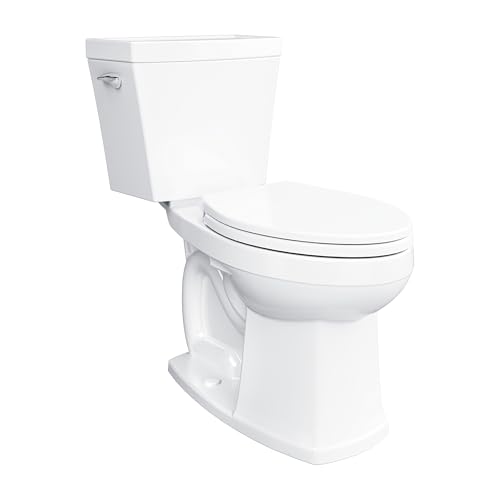
Gerber Avalanche Select Chair Height Elongated Two-Piece Toilet — Best Trade-Brand Fixture
Gerber is a name plumbers know better than consumers do, and that is its recommendation: fixtures designed to be installed, serviced and lived with, in a chair-height elongated format that a wide range of older users find comfortable without going to the extremes of the tall category. For a family adapting a parent’s bathroom — often at a distance, often through a local plumber — specifying a trade-familiar fixture at a sensible height is a quietly excellent decision, because every future service visit gets easier.
Be clear about its rung on the ladder: chair height is the moderate elevation, ideal for users who find standard height low but do not need or want the tallest fixtures, and the sitting test will tell you if it is enough. Its looks are workmanlike and its specification conventional, both by design. If the Los Flexi at the top of this guide is the full adaptation, the Gerber is the professional’s standard one — and for many homes, standard done properly is exactly right.
Strengths
- Chair height suits a wide range of adult users comfortably
- Trade brand with a service-first reputation and parts support
- Efficient flush in a conventional, familiar format
Trade-offs
- Chair height is a step up, not the tallest option here
- Styling is functional rather than decorative
- Seat configuration should be confirmed on the listing
| Specification | Verified detail |
|---|---|
| Height | Chair height format, verified from Amazon title |
| Flush | 1.28 GPF, verified from Amazon title |
| Configuration | Two-piece, elongated |
Best for: Households wanting a professionally familiar fixture at a comfortable height / Not suited for: Users who have sitting-tested and know they need maximum height
Check on Amazon — check price on Amazon for the current listing, configuration and delivery options.

Laveo by Dry Flush Portable Bedside Commode — Best Bedside Comfort Option
Sometimes the comfort problem is not the bathroom’s height but its distance — at night, during a recovery period at home, or in a house where the only bathroom is a floor away. The Laveo bedside commode answers with dignity: a full-size toilet format with support arms, at a proper sitting height, using a sealed dry-flush system that wraps waste away at the press of a button so the bedroom stays a bedroom. It asks for no plumbing and no buckets, which is precisely the point for the families who need it.
Its economics are cartridge economics — refills are an ongoing cost, and households should price them honestly before choosing it as a long-term arrangement rather than a night-time or recovery solution. It also complements rather than replaces bathroom adaptation: the main bathroom still deserves its raised seat or tall fixture for daytime life. Judged for its actual job — comfortable, hygienic, close-at-hand sanitation when the bathroom is far — it is in a class above the basic commode, and it closes this guide as the option families are most relieved to discover exists.
Strengths
- Brings a full-size toilet experience to the bedside — no plumbing needed
- Support arms and a proper seat height make night use more comfortable
- Sealed dry-flush system keeps the room fresh between services
Trade-offs
- Uses refill cartridges — an ongoing consumable cost to budget
- It is a bedside unit, not a replacement for adapting the main bathroom
- Premium tier for a portable product
| Specification | Verified detail |
|---|---|
| Type | Portable bedside commode, dry flush, verified from Amazon title |
| Seat | Full-size toilet format with safety and support arms, from Amazon title |
Best for: Nights, recovery periods at home, and rooms far from a bathroom / Not suited for: Households whose need is the main bathroom itself — adapt that instead
Check on Amazon — check price on Amazon for the current listing, configuration and delivery options.
Comparison Table
| Pick | Badge | Key spec | Best for |
|---|---|---|---|
| Los Flexi 17.9-Inch ADA Two-Piece Elongated Comfort Height Toilet | Best Overall Fixture | 17.9 inch ADA-format, verified from Amazon title | Homes adapting a bathroom for the long term around an older user |
| Drive Medical 2-in-1 Raised Toilet Seat with Removable Padded Arms | Best Raised Seat with Arms | Raised toilet seat with removable padded arms, verified from Amazon title | Testing whether extra height helps, recovery periods at home, and rented bathrooms |
| Carex 3.5-Inch Raised Toilet Seat with Arms, Elongated | Best Simple Raised Seat | 3.5 inch raised seat, verified from Amazon title | Elongated-toilet households wanting a defined, moderate lift with handles |
| DeerValley Elongated One-Piece ADA Dual Flush Toilet | Best One-Piece Fixture | Dual flush 1.1 / 1.28 GPF, verified from Amazon title | Long-term adaptations where easy cleaning is a top priority |
| Gerber Avalanche Select Chair Height Elongated Two-Piece Toilet | Best Trade-Brand Fixture | Chair height format, verified from Amazon title | Households wanting a professionally familiar fixture at a comfortable height |
| Laveo by Dry Flush Portable Bedside Commode | Best Bedside Comfort Option | Portable bedside commode, dry flush, verified from Amazon title | Nights, recovery periods at home, and rooms far from a bathroom |
How to Choose an Elevated Toilet for an Older User
Start with the user, at home, with the sitting test. Simulate candidate heights beside the existing toilet using firm books or a stable chair — a few inches of lift, then a tall-fixture height — and let the actual user sit and stand at each, feet flat, at their normal pace. Their verdict governs: the right height is where sitting feels controlled rather than a drop, standing feels like standing rather than climbing, and their feet stay planted throughout. Comfort and confidence reported by the user are the specifications that matter; product labels merely shortlist what to simulate.
Then choose the route. A raised seat is the trial, the temporary answer and the rental-friendly answer — fitted in minutes, removed as easily, and the correct first step whenever the need might change. A tall fixture is the permanent answer for a home being adapted for years: steadier, cleaner, better looking, and worth its installation effort exactly when the need is settled. Many households do both in sequence — riser now, fixture at the next bathroom refresh — and that sequence is not indecision, it is good planning. The bedside commode answers a different question (distance, nights, recovery) and can accompany either route.
Finally, sweat the fit details. Raised seats must match bowl shape — elongated and round are not interchangeable — and respect their stated capacity. Tall fixtures must match rough-in and be checked for stability at install, because a tall fixture magnifies any floor unevenness. Handles and arms should be where the user’s hands naturally reach. And involve the user in every one of these choices that you can: adaptation done with someone, rather than to them, is the kind that gets used happily — which is, in the end, the only metric this guide is really optimising.
One practical arrangement deserves emphasis: keep the path and the room ready before the product arrives. If a raised seat or fixture is being fitted by family, clear the bathroom, have the tools and a torch ready, and schedule the job for a calm part of the day when the user can test the result unhurriedly and ask for adjustments. Adaptation done at leisure, with the user participating, succeeds socially as well as mechanically — and the social success is what gets the product used with confidence.
Comfort, Steadiness and the Bathroom Around the Toilet
Height works best as part of a room that makes sense. A higher seat changes small geometries: the toilet roll should fall easily to hand from the new sitting position, and anything the user habitually steadies themselves on should be genuinely sturdy rather than a towel rail pressed into service it was not designed for. This guide offers no medical advice and prescribes no equipment; it simply observes that five minutes spent sitting in the finished room, reaching for things, and standing as one normally would, reveals more about an adaptation’s success than any product page can.
Cleaning deserves a place in the comfort conversation, because a bathroom that is easy to keep fresh is more pleasant for everyone and kinder to whoever does the cleaning — often a spouse or family member of similar vintage. One-piece fixtures minimise seams; raised seats add fixings to wipe around; bedside units trade plumbing for cartridge changes. None of these burdens is large, but choosing with them in view prevents the slow resentment of a product that helps in one way and hinders in another. The reviews score cleaning honestly for exactly this reason.
Lighting and night routine complete the picture in the simplest ways: a clear, familiar path to the bathroom, a night light where the household likes one, and — where nights are the hard part — the bedside option in this guide removing the journey altogether for a season. Comfort for older users is rarely one product; it is a small system of considerate decisions, of which the right seat height is the centre. Buy the centre here, then tune the room around it with the same unhurried attention.
Consider a spare of the small things. A raised seat’s fixings, a toilet seat’s bumpers, the commode’s cartridges — the minor consumables of adaptation are exactly the items whose absence on a Sunday evening turns a solved problem back into a problem. A small labelled box in the bathroom cupboard, stocked once, removes that failure mode for years.
How to Fit a Raised Seat or Install a Tall Toilet
For a raised seat, fitting is careful rather than difficult. Clean the bowl rim first so the attachment seats honestly, follow the manufacturer’s locking sequence exactly — these products earn their steadiness from correct fitting, not from being sat on hopefully — and test firmly in every direction before first use. Position arms or handles where the user’s hands naturally land, which you can discover by watching one unassisted sit before final tightening. Afterwards, build a ten-second firmness check into weekly bathroom cleaning, and include the fixings in that clean; an accessory that is checked stays trustworthy.
For a tall fixture, installation follows the standard toilet sequence with tall-specific attention: verify rough-in, set a fresh sealing ring, shim any floor unevenness so the taller body sits absolutely steady — its higher centre of gravity makes this non-negotiable — and tighten fixings evenly without forcing porcelain. Connect a new supply line, set the tank waterline to the maker’s mark, and commission with several real sit-and-stand cycles by the user before considering the job finished. If anything rocks, shifts or feels uncertain, correct it now; steadiness is the product.
For the bedside commode, siting is the installation: a stable floor position within easy reach of the bed, cartridges loaded as directed, and a servicing rhythm agreed by the household so the unit is never left wanting attention. Whichever route you have chosen, finish by filing the product details and keeping any spare fixings — adaptations serve longest when the household treats them as part of the home’s fabric, maintained like anything else that matters.
Revisit the fit as seasons and circumstances change. The height that suited in spring may want review after a winter of less activity, or as a partner’s needs evolve; raised seats make such review easy, which is another argument for their place in the sequence. An adaptation is a standing arrangement with a person, not a one-time installation, and a five-minute annual check keeps it honest.
Adapting Gradually: A Sensible Sequence for Families
Most successful adaptations share a shape: they begin with observation, not purchase. A family notices the bathroom routine becoming a negotiation — a hand reaching for the bath edge, a pause before standing — and names it kindly and practically: the seat is low, and seats can be raised. Framed that way, as furniture rather than frailty, the conversation stays easy and the user stays in charge of it, which predicts whether the eventual product is welcomed or quietly resented.
The first purchase is usually the reversible one. A raised seat, fitted in an afternoon and tested over weeks, answers the essential question — does height help this user, and how much — with evidence instead of speculation. If the answer is a clear yes and the need looks permanent, the household graduates to a tall fixture at its own pace, often at the next natural bathroom refresh, with the riser moving to a second bathroom or into storage against a future need. Nothing is wasted; the sequence is the economy.
Alongside the seat, the room gets its small attentions in the same spirit: the toilet roll moved to its natural reach, the night path kept clear and familiar, the cleaning routine adjusted to the new fixture’s shape. Each is trivial alone; together they are the difference between a product installed and a bathroom adapted. Families consistently report that the small attentions are remembered with as much gratitude as the headline purchase — a useful calibration for where to spend effort.
And the sequence has a final stage that good families plan for: review. Needs change in both directions — strength returns after a recovery, or a partner’s needs join the original user’s — and a bathroom adapted gradually can be re-adapted just as gradually. The products in this guide were chosen to support that rhythm: reversible where possible, permanent where valuable, and honest about which is which.
Dignity by Design: Choosing Products That Look Like Furniture
A recurring preference among older users deserves to shape every purchase in this category: the bathroom should still look like a bathroom. Products that read as furniture — a well-proportioned tall toilet, a raised seat in clean white with tidy lines, a bedside unit that resembles a small cabinet more than a hospital prop — are accepted into daily life in a way that clinical-looking equipment often is not. This is not vanity; it is the psychology of home, and makers have largely risen to it, as the picks in this guide show.
Colour and finish matching is the cheapest dignity available: a seat or fixture matched to the existing suite disappears, while a mismatched one announces itself at every visit. When replacing a fixture, matching the room’s ceramic white — there are several, and they differ — is worth the sample-check it takes. The same applies to the bedside unit’s placement and presentation: positioned thoughtfully, kept serviced and fresh, it reads as a considered piece of the room’s furniture, which is exactly how its user should be able to regard it.
Language matters in the same direction, and families can choose it deliberately: this is a higher toilet, a more comfortable seat, a bedside convenience for the recovery weeks — descriptions of objects and comfort, not of persons and conditions. This guide has written that way throughout, deliberately, because the words around an adaptation become part of how it feels to live with. Products bought as comfort are used as comfort.
The market rewards this framing too: the best-selling products in the category are precisely the ones that look domestic, which is why this guide’s picks — trade-brand fixtures, clean-lined risers, a commode designed like furniture — read as a bathroom catalogue rather than a care catalogue. Buy for the room your user wants to live in, and the function will be used more, for longer, with better grace.
When Two Users Need Different Heights
Shared bathrooms complicate every height decision, and older households often contain the sharpest version of the problem: one partner who needs the lift, another for whom the same lift is a perch. The honest options deserve laying out. A moderate fixture height — the chair-height rung — plus a quality raised seat used only by the partner who needs more, splits the difference with hardware. Two bathrooms, where the house allows, each tailored to its main user, is the luxurious resolution and often the real one in adapted homes.
A sturdy step for the shorter user is the simplest mediator and should not be dismissed as makeshift: a stable, purpose-made step restores flat feet and confidence completely, stores neatly, and costs less than any fixture decision it might rescue. What matters is that it is genuinely stable and always in its place — a mediator that wanders is worse than none. Households using one should treat its position as part of the bathroom’s fixed geography.
The sitting test, run for both users, turns this from an argument into a measurement exercise: test the candidate fixture height for both, then test the mediators, and choose the combination in which both partners report comfort. That joint test, done once with good humour, prevents the slow domestic failure mode of a bathroom silently annexed by one person’s needs while the other quietly makes do — an outcome no product in this guide intends.
And revisit the arrangement as a couple, periodically, in the same practical spirit as the rest of the adaptation. Needs converge and diverge over the years of a long household; the bathroom that keeps being fitted to both its people, in small adjustments, is the one that serves a marriage rather than a moment. That, more than any single product, is the craft this category is really teaching.
A Note for Adult Children Buying at a Distance
A large share of purchases in this category are made by adult children for a parent’s home, sometimes from another city, and that situation has its own good practice worth stating plainly. Start with a conversation, not a catalogue: the parent’s own account of what would make the bathroom easier is the specification, and arriving with a product already chosen reverses the proper order in a way that even loving purchases suffer for. If distance allows one visit before buying, spend it on the sitting test together — it is a practical, even companionable exercise, and it produces the number that makes every later decision easy.
Where a local plumber or fitter will do the work, choose them as carefully as the product: someone who will fit a raised seat patiently, adjust it with the user present, and return if it needs a tweak is worth more than a marginally cheaper fixture fitted in a hurry. Ask the parent afterwards — a week later, not an hour — whether the result feels steady and comfortable; the honest review arrives after the politeness of install day has faded, and any good fitter would rather adjust once than leave a doubt in place for years.
Resist the understandable urge to solve everything in one visit. A seat height fixed well, a bathroom path kept clear, a bedside option agreed for the recovery weeks — three things done properly and accepted happily outweigh a wholesale transformation that makes a parent’s home feel administered. Adaptation succeeds at the speed of consent, and consent, in a parent’s own house, is not a formality: it is the mechanism by which a product becomes a comfort instead of an imposition.
Finally, write down what was fitted and leave the note where the household keeps such things — model, lift, fitter’s name, date. If you are ever coordinating a replacement part or a second adaptation from that other city, that single page is the difference between a phone call and a detective story. Care at a distance runs on exactly such small, deliberate kindnesses of documentation — and on the products in this guide doing their quiet work, every day, in a bathroom that still feels like home.
Common Buying Mistakes
The commonest mistake is buying for a label — ‘elderly’, ‘ADA’, ‘comfort’ — instead of for the person. Heights and lifts differ by inches between products wearing identical words, and only the sitting test with the actual user converts marketing into a decision. The second mistake is the wrong bowl shape for a raised seat, which guarantees a poor fit no matter how good the product. The third is skipping the fit check after installation: a riser or tall fixture that is almost steady will be trusted less each week, quietly defeating the entire purpose of the purchase.
Fourth, families sometimes over-adapt in one step — tallest fixture, every accessory — when the user’s need is a modest lift and time to adjust; start with what the sitting test supports, because an adaptation that feels like equipment can be resisted where a simple height change would have been welcomed. Fifth, the opposite: a decorative mini-riser bought for looks when the user plainly needs real height and handles. Sixth, forgetting the consumables and upkeep in the budget — cartridges for the bedside unit, a replacement seat years hence — small numbers that should never arrive as surprises.
Avoid those, and the pattern of every successful adaptation in this category appears: test with the user, choose the least complicated route that truly fits, install it to feel rock-steady, and review it as needs change. Comfort bought that way compounds daily — which is more than can be said for most purchases in any guide in this programme.
And record what was bought and why, in the house file, in plain words: model, lift or height, bowl shape, date. If a different family member ever needs to replace a part or replicate the setup in another home, that note is the difference between an afternoon’s errand and a research project conducted under pressure.
Final Recommendation
For a permanent adaptation, choose the Los Flexi for full height, the DeerValley for one-piece easy cleaning, or the Gerber for a trade-familiar chair height. To start, to test, or to keep things reversible, fit the Drive Medical raised seat with arms or the Carex riser for a clearly stated moderate lift. For nights and recovery, the Laveo bedside commode brings the toilet to the user with dignity.
Whichever route you take, let the user’s own sitting test make the final call. A bathroom fitted to its person is a daily kindness — and that, stated plainly and without medical promises, is what every pick here is for.
Start your shortlist here: Los Flexi 17.9-Inch ADA Two-Piece Elongated Comfort Height Toilet for the guide’s main recommendation, and Drive Medical 2-in-1 Raised Toilet Seat with Removable Padded Arms as the first alternative to compare on configuration and current pricing — check price on Amazon for both before deciding.
Related guides in this programme: Best Elevated Toilets · Best Elongated 14.5 Inch Tall Toilets · Best Electric Toilets · Best Efficient Toilets · Best Electric Compost Toilets
Frequently Asked Questions
How much height do older users usually need?
It varies by person, which is why this guide insists on a sitting test. Many users find a moderate lift of a few inches — the raised-seat range — transforms the routine; others prefer a full tall fixture. Simulate both at home and let the user’s comfort and confidence decide.
Is a raised seat or a tall toilet better?
A raised seat is faster, cheaper and reversible — ideal for trials, recovery periods and rentals. A tall toilet is steadier, easier to clean and better looking as a permanent adaptation. Many households use a raised seat first and fit a tall toilet when the need is settled.
Are these products medical devices?
No. The products in this guide are comfort and convenience products: they raise a seat, add handles, or bring a commode to the bedside. This guide makes no medical claims, and nothing here diagnoses, prevents or treats any condition.
How do I make sure a raised seat fits my toilet?
Match the bowl shape — elongated risers for elongated bowls, round for round — and respect the stated capacity in the listing. Fit the locking attachment exactly as directed and check firmness before use and periodically afterwards.
What if the bathroom is far from the bedroom?
That is the bedside commode’s job. The Laveo pick provides a full-size, arm-supported toilet at the bedside with a sealed dry-flush system, which suits nights and recovery periods. It complements rather than replaces adapting the main bathroom.
Can a tall toilet be too tall for an older user?
Yes — if their feet cannot rest flat, it will feel unsteady rather than helpful. Height is a fit, not a maximum: the sitting test, with feet planted and a rise that feels controlled, is the reliable way to choose.


