Disclosure: airfryerkitchensupply.com is reader-supported. When you buy through links on our site, we may earn an affiliate commission at no extra cost to you.
Where to buy
All six electric food mixers below are current Amazon listings whose model details were verified against Amazon’s catalog data before they earned a link. Stand mixer line-ups change colors and bundle contents often, so use the links to check price on Amazon for the exact finish and accessory set you want — and treat any price printed anywhere else, including older reviews, as out of date the moment you read it.
- KitchenAid 5.5-Qt Bowl-Lift Stand Mixer (KSM55, Porcelain White) — Check the current price on Amazon
- Bosch Universal Plus Stand Mixer (500 Watt, 6.5 Quarts, Bundle) — Check the current price on Amazon
- Ankarsrum Original Stand Mixer (AKM6230, Jubilee Silver) — Check the current price on Amazon
- Cuisinart Stand Mixer (SM-50, 5.5 Quart, White Linen) — Check the current price on Amazon
- Hamilton Beach 4 Qt Electric Stand Mixer (7 Speeds, Black) — Check the current price on Amazon
- KitchenAid 9 Speed Hand Mixer (KHM926, Contour Silver) — Check the current price on Amazon
The best electric food mixers are the machines that take over the jobs hands and wooden spoons do badly: kneading bread dough until it turns smooth and elastic, whipping cream and egg whites to real peaks, creaming butter and sugar into cake batter that actually rises. ‘Food mixer’ is the broad, honest term for the category — it covers the stand mixer that lives on the counter and does the heavy work, and the hand mixer that comes out of the drawer for everything else — and this guide treats both seriously, because most kitchens genuinely need one of each at different moments.
What separates the machines below is not marketing tiers but mechanics. Bowl-lift versus tilt-head changes how the bowl locks in and how much dough the frame can handle. Motor design — direct drive, belt drive, bottom-drive — changes where the power goes and how the machine behaves under a stiff load. Bowl capacity in quarts is the number everyone shops by and the number that misleads most, because usable dough capacity is always lower than the bowl’s brim volume. The picks here span the real range: a 5.5-quart bowl-lift all-rounder, two dough specialists, a mid-range tilt-head, a budget stand mixer that is better than it has any right to be, and the hand mixer we would buy first if a kitchen had nothing.
Every model was verified against Amazon’s catalog before being linked, and the spec boxes use only that verified information — capacities, speed counts and included attachments as listed. There are no printed prices in this article; they go stale, and the links exist so you can check the live figures yourself.
In this guide
Quick Picks
Six machines, six clear jobs — from the bowl-lift all-rounder to the dough specialists and the one hand mixer that covers everything a stand mixer is too much for.
- Best Overall — KitchenAid 5.5-Qt Bowl-Lift Stand Mixer (KSM55, Porcelain White): the modern all-rounder — an 11-speed bowl-lift machine with a 5.5-quart stainless bowl and the full beater, hook and whip set in the box. Check price on Amazon.
- Best for Bread Dough — Bosch Universal Plus Stand Mixer (500 Watt, 6.5 Quarts, Bundle): the bottom-drive dough specialist — a 6.5-quart bowl and a belt-driven design that kneads batch after batch of bread without drama. Check price on Amazon.
- Best Premium — Ankarsrum Original Stand Mixer (AKM6230, Jubilee Silver): the Swedish rotating-bowl original — the bowl spins, the tools stay still, and big dough batches are handled with unusual gentleness and strength. Check price on Amazon.
- Best Mid-Range — Cuisinart Stand Mixer (SM-50, 5.5 Quart, White Linen): 12 speeds, a 5.5-quart bowl and a splash guard with pour spout — the well-judged middle of the market from a brand that knows countertop appliances. Check price on Amazon.
- Best Budget Stand Mixer — Hamilton Beach 4 Qt Electric Stand Mixer (7 Speeds, Black): planetary mixing, a 4-quart bowl and a full tool set at the budget tier — plus a carry handle, because this one is light enough to actually move. Check price on Amazon.
- Best Hand Mixer — KitchenAid 9 Speed Hand Mixer (KHM926, Contour Silver): nine speeds with a soft start, a pro whisk and dough hooks — the hand mixer that covers the 80 percent of mixing jobs a stand mixer is overkill for. Check price on Amazon.
How These Picks Were Chosen
We chose these picks around the work food mixers actually do in a week: bread and pizza dough, cake and cookie batters, whipped cream and meringue, mashed potatoes and shredding cooked chicken with a paddle, and the long tail of mixing tasks that are five minutes of misery by hand and forty seconds by machine. A pick had to be genuinely good at its assigned job, not merely present in the category.
We weighted dough performance first, because it is where weak mixers fail expensively — stalling, walking across the counter, or burning out a motor on a stiff whole-wheat load. After that came bowl handling (can you add flour without wearing it?), speed control at the low end (folding and starting without a flour cloud matters more than a tenth speed), attachment quality, and the ecosystem behind the machine: a stand mixer is a ten-year purchase, and the brand’s attachment and parts support is part of what you are buying.
- Dough capacity in practice: not bowl volume, but how much flour the machine can knead continuously without straining, stalling or climbing.
- Low-speed control: a true slow start and gentle fold speed, so dry ingredients stay in the bowl and delicate mixtures are not beaten to death.
- Bowl and head design: bowl-lift stability for heavy loads versus tilt-head convenience for everyday access — matched to the buyer’s actual baking.
- Attachments included and available: flat beater, dough hook and wire whip in the box, plus a real ecosystem of optional tools behind them.
- Cleaning and storage reality: dishwasher-safe bowls and beaters, a footprint the counter can actually spare, and a weight you can move without regret.
The 6 Best Electric Food Mixers

KitchenAid 5.5-Qt Bowl-Lift Stand Mixer (KSM55, Porcelain White) — Best Overall
The KSM55 is KitchenAid’s current answer to ‘just tell me which one to buy.’ The bowl-lift design clamps the 5.5-quart stainless bowl to a lifting arm instead of tilting the head, which keeps the frame rigid under dough loads, and the 11-speed range includes the kind of genuinely slow start that keeps flour in the bowl. Flat beater, dough hook and wire whip are all in the box, and behind them sits the deepest attachment ecosystem in the category.
Strengths
- Bowl-lift frame stays planted and rigid on dough loads that make tilt-head machines flex and walk
- 11 speeds with a gentle low end for folding and a proper top end for whipping
- Full core attachment set included, plus compatibility with KitchenAid’s large powered-attachment ecosystem
Trade-offs
- Bowl-lift machines are taller — check clearance under your cabinets with the bowl raised
- Removing the bowl takes a fraction more effort than a tilt-head’s lift-off bowl
- The machine is heavy; most owners will give it a permanent counter home rather than store it
| Design | Bowl-lift stand mixer |
| Bowl | 5.5 qt stainless steel |
| Speeds | 11 |
| Included | Flat beater, dough hook, wire whip |
The bowl-lift versus tilt-head question is really a question about your heaviest load. For cakes, cookies and whipped work, both designs are fine. For a double batch of sandwich dough or a stiff bagel dough, the lift design’s fixed head and clamped bowl simply flex less, and that rigidity is what you feel as confidence — the machine mixes instead of wrestling. The KSM55 also handles the small end well: the bowl shape and beater geometry keep a single batch of cookies or a cup of cream engaged rather than stranded below the beater.
Ownership is the other half of this pick. KitchenAid stand mixers are the category’s default for a reason that has little to do with any single spec: parts, attachments, service knowledge and resale value all follow the installed base. A pasta roller, grain mill or ice cream maker bought for this machine will fit the next KitchenAid too. Buy the KSM55 and you are buying into the platform, not just the mixer — for a ten-year appliance, that is a rational thing to pay for.
Ownership of the KSM55 is dominated by one fact: support never ends. Bowls, beaters, hooks and whips are stocked as ordinary items, the powered attachment range keeps growing the machine’s job list, and any appliance technician in the country knows the platform. Keep the bowl-lift rail clean, store the core tools in the bowl, and the mixer settles into the kitchen’s infrastructure — the appliance other purchases get planned around rather than the other way round.
Best for: most home bakers who want one stand mixer for bread, cakes and everything between / Not suited for: kitchens with low cabinets that cannot fit a bowl-lift machine, or buyers who will only ever whip cream
Check on Amazon — check price on Amazon before you buy, since configurations and included accessories change.
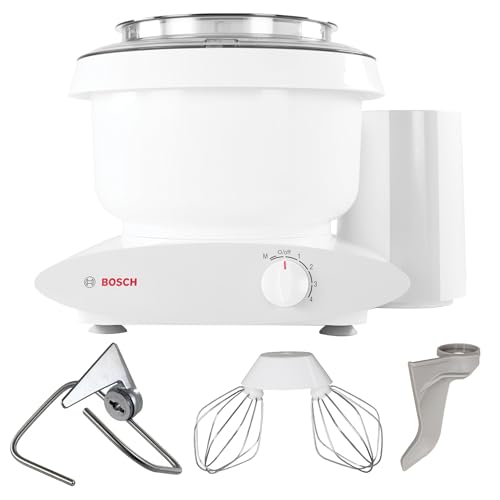
Bosch Universal Plus Stand Mixer (500 Watt, 6.5 Quarts, Bundle) — Best for Bread Dough
The Bosch Universal Plus approaches mixing from the opposite direction: the motor sits below and drives the bowl’s center shaft from underneath, so the top of the bowl is completely open and the dough hook works the load against the bowl’s center column. For bread bakers — especially anyone making multiple loaves, whole grains, or big pizza-dough batches — this design has a devoted following for a simple reason: it kneads serious quantities of dough without the strain theatrics of head-drive machines.
Strengths
- Bottom-drive design kneads large, stiff dough batches continuously — the strongest bread brief in this line-up
- Completely open bowl top makes adding flour and checking dough development easy mid-mix
- This bundle includes wire whips, the dough hook and a dough hook extender for smaller batches
Trade-offs
- The plastic bowl and unconventional layout look and feel different from a classic stand mixer — try to see one before buying if aesthetics matter
- Whipping small quantities is less its party trick than dough is; tiny batches can hide from the whips
- The accessory ecosystem is strong for baking but narrower than KitchenAid’s everything-platform
| Design | Bottom-drive stand mixer |
| Motor | 500 watt |
| Bowl | 6.5 qt |
| Included | Wire whips, dough hook, dough hook extender |
Dough is where the Bosch earns its reputation in measurable ways. The center-column bowl and bottom drive keep the hook engaged through the whole load, so a big whole-wheat batch comes together evenly instead of riding up a hook or slapping the bowl sides. Bakers who bake weekly in quantity tend to describe the same experience: the machine simply does batch four the way it did batch one. If your mixer exists mainly to serve a bread habit, this is the architecture to beat.
The trade is versatility at the delicate end. The open bowl is wonderful for dough and batters, but the Bosch is less naturally gifted at a small bowl of whipped cream than a planetary stand mixer, and its look is honest-appliance rather than counter jewelry. Buy it as a baker’s tool — which is a compliment — and pair it with the hand mixer below for the small, quick jobs.
Bosch ownership runs through the baking channel rather than the department store: NutriMill and Bosch kitchen dealers stock the bowls, whips, hooks and the blender and slicer attachments that extend the system. The bottom-drive unit itself is famously durable — owners measure service in decades — and its parts are molded and mechanical rather than electronic. Keep the drive shaft and bowl center clean after dough work and the machine simply continues, batch after batch, year after year.
Best for: bread bakers making large or frequent dough batches, including whole grains / Not suited for: buyers who want a classic tilt-head look, or who mostly whip and cream small quantities
Check on Amazon — check price on Amazon before you buy, since configurations and included accessories change.
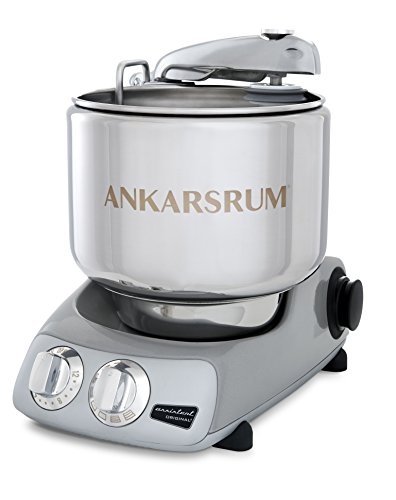
Ankarsrum Original Stand Mixer (AKM6230, Jubilee Silver) — Best Premium
The Ankarsrum is the category’s beautiful eccentric: a Swedish design, descended from the Electrolux Assistent, in which the large stainless bowl rotates and the roller, scraper and hook work against the moving dough. It handles very large batches with a kneading action bakers describe as closer to hand work than any planetary machine, and it doubles as a platform for an extensive set of optional attachments. The Jubilee Silver AKM6230 is the current Original model.
Strengths
- Rotating-bowl action kneads very large dough batches thoroughly and gently — a favorite of serious bread bakers
- Open, rotating bowl makes adding ingredients mid-mix the easiest in the category
- Exceptional build quality and longevity; these machines are measured in decades
Trade-offs
- Premium pricing across the machine and its attachments
- A learning curve: the roller-and-scraper technique is different from every other mixer and takes a few batches to master
- Large footprint and a design that dominates a counter rather than blending in
| Design | Rotating-bowl stand mixer |
| Model | AKM6230 Original |
| Finish | Jubilee Silver |
| Known for | Large-batch dough, attachment platform |
What the Ankarsrum does to dough is genuinely different. Because the bowl turns and the roller presses the dough against the bowl wall in a rolling fold, gluten develops with less tearing and less heat than aggressive hook action — bakers chasing open-crumb loaves care about exactly that. The capacity is equally real: this is the machine people buy after a planetary mixer has twice failed to handle the holiday batch, and it does not fail.
The honest costs are money and adaptation. The first loaves involve watching the dough climb, adjusting the roller arm, and learning how this machine wants to be fed flour. Owners who push through that curve tend to become lifers; owners who wanted a familiar tilt-head with a prettier badge should buy the KitchenAid and be happy. This is a specialist’s premium machine, recommended here for exactly the bakers who will use what makes it special.
Ankarsrum ownership is a long relationship by design. The machine is built to be serviced rather than replaced, its attachment family — from grain mills to pasta tools to a blender — is engineered to the same standard, and the owner community’s accumulated technique is a genuine resource for the learning curve. Register the machine, keep the roller and scraper adjusted as the manual directs, and expect this to be the mixer your household hands down rather than wears out.
Best for: serious bakers who regularly make large dough batches and keep appliances for decades / Not suited for: first-time stand mixer buyers or anyone who wants familiar controls from day one
Check on Amazon — check price on Amazon before you buy, since configurations and included accessories change.

Cuisinart Stand Mixer (SM-50, 5.5 Quart, White Linen) — Best Mid-Range
The Cuisinart SM-50 is what a sensible mid-range stand mixer looks like: a tilt-head design with 12 speeds, a 5.5-quart stainless bowl, and the full tool set — chef’s whisk, mixing paddle and dough hook — plus a splash guard with a pour spout that turns out to be the accessory you use most. It does not chase the KitchenAid ecosystem or the Bosch dough brief; it simply covers the standard home baking repertoire competently and completely.
Strengths
- 12 speeds give fine control from folding to whipping
- Splash guard with pour spout is genuinely useful — flour goes in without the cloud, liquids without the splash
- Full attachment set in the box: whisk, paddle and dough hook, with a 5.5 qt bowl that suits family-size batches
Trade-offs
- Tilt-head frame is not the choice for repeated heavy dough batches — it handles standard loaves, not a bakery schedule
- Attachment ecosystem beyond the basics is thinner than KitchenAid’s
- Design is functional rather than iconic; it will not be the visual centerpiece of the kitchen
| Design | Tilt-head stand mixer |
| Bowl | 5.5 qt stainless steel |
| Speeds | 12 |
| Included | Chef’s whisk, mixing paddle, dough hook, splash guard |
The SM-50’s competence is broad rather than deep, and for most households broad is what matters. Cookie dough, cake batter, buttercream, mashed potatoes, a standard loaf, whipped cream for a pie — it does all of it without a weak spot, and the 12-speed dial gives a slower, safer start than many rivals, which anyone who has worn a cup of flour will appreciate. The tilt head makes bowl access and beater swaps easy, which encourages using the machine for small jobs instead of reserving it for projects.
Buy it with clear eyes about the ceiling: this is a home mixer for home volumes. Weekly bread for the family, yes; four-loaf Saturdays and stiff bagel dough as a lifestyle, look at the Bosch or the bowl-lift KitchenAid. Within its brief, the SM-50 is the pick for buyers who want the full standard repertoire, from a mainstream brand, without paying for platform ecosystems they will never use.
The SM-50’s ownership virtues are simplicity and availability: the core tools are standard, replacement bowls and beaters are ordinary Cuisinart parts, and the machine asks nothing exotic of its owner. Keep flour dust out of the head vents, run heavy dough in standard rather than heroic batch sizes, and it will hold its mid-range brief for years — the appliance equivalent of a reliable family car, maintained with parts from any shelf.
Best for: households wanting the full standard baking repertoire at a mid-range commitment / Not suited for: heavy dough specialists or attachment collectors
Check on Amazon — check price on Amazon before you buy, since configurations and included accessories change.

Hamilton Beach 4 Qt Electric Stand Mixer (7 Speeds, Black) — Best Budget Stand Mixer
Budget stand mixers usually cut the wrong corners. The Hamilton Beach 4 Qt instead keeps the essentials — true planetary mixing action so the beater reaches around the bowl, seven speeds, a splash guard, and whisk, flat beater and dough hook all included — and saves money on size and power instead. The result is a 4-quart, 300-watt machine with an easy-carry handle that suits smaller households honestly, rather than a big machine pretending.
Strengths
- Planetary mixing action at a budget price — full bowl coverage instead of a beater that misses the edges
- Complete tool set included: whisk, flat beater and dough hook, plus splash guard
- Light enough, with a carry handle, to store in a cupboard — rare honesty in a stand mixer
Trade-offs
- 300 watts and a 4 qt bowl set a real ceiling: single standard loaves and normal batters, not double batches or stiff dough marathons
- Build materials are a step below the mid-range picks
- Seven speeds are plenty, but low-speed finesse is cruder than the Cuisinart’s or KitchenAid’s
| Design | Tilt-head stand mixer, planetary action |
| Bowl | 4 qt |
| Motor | 300 watts |
| Speeds | 7 |
| Included | Whisk, flat beater, dough hook, splash guard |
The question with any budget stand mixer is whether it is a real stand mixer or a hand mixer on a pedestal. The Hamilton Beach passes the test that matters: the planetary action works, the bowl coverage is real, and for the core domestic repertoire — cakes, cookies, frostings, whipped cream, a single loaf — it performs like a machine, not a toy. The carry handle sounds like a gimmick until you live with a small kitchen; a stand mixer you can put away is a stand mixer you will actually use in a small space.
Respect the ceiling and it will serve well. Double batches overflow its bowl and strain its motor; stiff dough should be finished by hand for the last minutes rather than forced. Buyers whose baking grows can graduate later with clear knowledge of what they actually use — which makes this a rational first stand mixer, not just a cheap one.
Hamilton Beach ownership is refreshingly unceremonious: the machine is light enough to move without planning, its tools rinse or dishwash clean, and replacement beaters and bowls are inexpensive when life happens to them. The discipline it asks is load discipline — single batches, dough within its brief — and in exchange it avoids the two failures of budget mixers: it neither pretends to be bigger than it is, nor demands to be treated like furniture.
Best for: small households, first-time stand mixer buyers and cupboard-storage kitchens / Not suited for: double batches, stiff dough in quantity, or daily heavy use
Check on Amazon — check price on Amazon before you buy, since configurations and included accessories change.

KitchenAid 9 Speed Hand Mixer (KHM926, Contour Silver) — Best Hand Mixer
Every stand mixer above has the same flaw: it is a production to get out, set up and wash for a two-minute job. The KHM926 is the answer — a 9-speed hand mixer with KitchenAid’s soft-start feature that brings the beaters up to speed gradually instead of slinging batter at the wall, stainless Turbo Beater II beaters, a pro whisk attachment and dough hooks for small batches. It lives in a drawer and earns its space weekly.
Strengths
- 9 speeds with soft start — gentle enough for folding, strong enough for cookie dough and mashed potatoes
- Pro whisk attachment makes it a real whipping tool, not just a beater
- Accessories are dishwasher-safe and the whole kit stores in a drawer, unlike any stand mixer
Trade-offs
- Your arm is the stand: long kneading or big batches are tiring and genuinely beyond its brief
- Dough hooks handle small, soft doughs only — bread belongs to the stand mixers above
- Corded, like all full-power hand mixers; keep an outlet within reach of your mixing spot
| Type | Corded hand mixer |
| Speeds | 9, with soft start |
| Included | Turbo Beater II beaters, pro whisk, dough hooks |
| Cleaning | Dishwasher-safe accessories |
The soft start deserves emphasis because it changes how often you reach for the machine. Ordinary hand mixers lurch from off to full speed, which is why batter ends up on the cupboards and why people avoid the mixer for small jobs. The KHM926 ramps up smoothly, so a quick whipped cream, a box-mix batter or a pan of scrambled eggs gets mixed without the mess tax. Nine speeds sound like marketing until you use the genuinely slow first speed for folding chocolate chips without breaking them.
Pairing advice: if you bake occasionally, this hand mixer plus a good whisk may be all the electric mixing you need, and it costs a fraction of any stand mixer. If you bake seriously, it is still the right second machine — the one that handles the sauce, the topping and the small batch while the stand mixer does the main work. Either way, it is the highest-usefulness-per-drawer-inch purchase in this entire guide.
The KHM926 asks for a drawer and nothing else. Its beaters, whisk and hooks dishwash clean, the cord wraps for storage, and there is no bowl to store, no head to calibrate, no counter to surrender. Owners consistently report the same surprise: the hand mixer bought as a supplement becomes the most-used mixer in the house, precisely because its ownership cost in space and effort is zero. Keep the attachments together in one pouch and it is always a ten-second deployment.
Best for: everyday small-to-medium mixing, whipped work, and as the essential partner to a stand mixer / Not suited for: bread dough in quantity or any job measured in kilograms
Check on Amazon — check price on Amazon before you buy, since configurations and included accessories change.
Comparison Table
| Pick | Badge | Key spec | Best for |
|---|---|---|---|
| KitchenAid 5.5-Qt Bowl-Lift Stand Mixer (KSM55, Porcelain White) | Best Overall | 5.5 qt bowl-lift, 11 speeds | most home bakers who want one stand mixer for bread, cakes and everything between |
| Bosch Universal Plus Stand Mixer (500 Watt, 6.5 Quarts, Bundle) | Best for Bread Dough | 6.5 qt bottom-drive, 500W | bread bakers making large or frequent dough batches, including whole grains |
| Ankarsrum Original Stand Mixer (AKM6230, Jubilee Silver) | Best Premium | Rotating bowl, large-batch dough specialist | serious bakers who regularly make large dough batches and keep appliances for decades |
| Cuisinart Stand Mixer (SM-50, 5.5 Quart, White Linen) | Best Mid-Range | 5.5 qt tilt-head, 12 speeds | households wanting the full standard baking repertoire at a mid-range commitment |
| Hamilton Beach 4 Qt Electric Stand Mixer (7 Speeds, Black) | Best Budget Stand Mixer | 4 qt planetary, 300W, 7 speeds | small households, first-time stand mixer buyers and cupboard-storage kitchens |
| KitchenAid 9 Speed Hand Mixer (KHM926, Contour Silver) | Best Hand Mixer | 9 speeds, soft start, pro whisk included | everyday small-to-medium mixing, whipped work, and as the essential partner to a stand mixer |
How to Choose the Best Electric Food Mixers for the Way You Bake
Start from your heaviest regular job and buy for that, not for your average job. Average jobs are easy for every machine here; the heaviest job — the double loaf, the stiff dough, the holiday quadruple cookie batch — is what stalls motors and flexes frames. If bread is weekly, the Bosch, Ankarsrum or bowl-lift KitchenAid are your shortlist. If bread is monthly and cakes are weekly, the Cuisinart or a tilt-head will make you happier day to day. If bread is never, a hand mixer and honesty will save you money and counter space.
Then settle bowl size by flour weight, not quarts. As a working rule, a 4–5.5 qt bowl handles a standard single-loaf or family cake batch comfortably; 6.5 qt and rotating-bowl designs are for bakers who think in multiple loaves. Oversizing has a cost too: small batches get lost in big bowls, with beaters skating over a cup of cream instead of whipping it. The right size is the one where your typical batch fills the bowl a third to two-thirds — enough room to work, not so much that the tools cannot reach.
- Mostly cakes, cookies, frostings: tilt-head stand mixer or the 9-speed hand mixer — convenience wins.
- Weekly bread, standard batches: bowl-lift KitchenAid KSM55 — rigidity plus the attachment platform.
- Serious or large-batch bread: Bosch Universal Plus or Ankarsrum — dough-first architectures.
- Small kitchen, small batches: Hamilton Beach 4 Qt, or the hand mixer alone until your baking proves it needs more.
Stand Mixer vs Hand Mixer: The Honest Division of Labor
A stand mixer’s real product is not power — it is freedom. It kneads for ten minutes while you clean up, scale ingredients or do nothing at all, and it applies that power consistently in a way a hand-held machine cannot. A hand mixer’s real product is immediacy: out of the drawer, into the bowl, rinsed and back in under a minute of overhead. Most mixing jobs in a real week are hand-mixer jobs; most memorable baking projects are stand-mixer jobs.
That is why this guide refuses to crown one category over the other, and why the common advice — ‘just save for the stand mixer’ — is wrong for occasional bakers, who end up with an expensive sculpture and still whisk cream by hand because the big machine feels like a production. Buy in the order you will use things: hand mixer first for almost everyone, stand mixer when your baking demonstrably outgrows it. If your focus narrows to the countertop classics specifically, our companion guide to Best Electric Kitchen Mixers goes deeper on that single category, and Best Dough Mixers For Bread Baking is the specialist read for the dough-first crowd.
Attachments: Buying the Platform, Not Just the Mixer
A stand mixer’s second life is its attachments, and the six machines here split into two philosophies. KitchenAid runs the broadest platform — pasta rollers and cutters, grain mills, ice cream makers, slicers, grinders and more, all driven from the front hub or the bowl. Bosch and Ankarsrum run baker-centric platforms with excellent blenders, slicers and grain tools of their own. Cuisinart and Hamilton Beach cover the core tools well but stay closer to mixing itself.
The buying rule is to pay for the platform only if your cooking will use it. A household that will genuinely roll pasta and mill flour gets real value from the ecosystem; a household that will not is paying for a hub that stays capped. Either way, the core trio — flat beater for batters and creaming, dough hook for kneading, wire whip for aerating — is non-negotiable and is included with every pick in this guide, which is exactly as it should be.
Reading a Mixer Spec Sheet Without Being Fooled
Mixer spec sheets reward a skeptical reader. Wattage is the most abused number: it describes electrical draw under laboratory conditions, not kneading strength at the bowl, which is why a well-geared 500W bottom-drive machine out-kneads higher-wattage rivals. Speed counts mislead similarly — what matters is the spread between a genuinely gentle first gear and a top gear that whips, not whether the dial offers six stops or twelve between them. And bowl capacity, as this guide has repeated, is a brim measurement; the working capacity for dough is set by the frame and motor, and is always lower.
The numbers worth trusting are the physical ones you can verify: bowl volume in quarts against your recipes’ flour weights, the attachment list in the box against the trio you actually need, the machine’s height against your cabinets, and its weight against your willingness to move it. Everything else — planetary touchpoints, pulse features, designer finishes — is secondary to those four measurements. A buyer who checks them in that order will choose well from any brand’s line-up, including the six machines reviewed above, and will understand exactly which compromise they accepted and why.
- Trust: quarts versus your flour weights, included attachments, height, weight.
- Discount: headline wattage, speed counts, and any capacity claim that does not say ‘dough’ next to a number.
- Verify in person when you can: the feel of the lowest speed and the sound under load tell you more than a page of specifications.
How to Use an Electric Food Mixer Without the Flour Cloud
Most mixer frustration is technique, not machinery. This routine works for stand and hand mixers alike and fixes the three classic problems — flying flour, overworked batter and dough that climbs the hook.
- Start slower than you think: begin every mix at the lowest speed until dry ingredients are dampened, then increase. Soft-start models help; the habit helps more.
- Add flour in thirds: add, mix to just combined, repeat. Dumping the full amount guarantees a cloud and a gummy, overworked crumb.
- Use the right tool: flat beater for creaming and batters, whip only for aerating eggs and cream, hook only for yeast doughs. The whip is not a stronger beater — it is a different instrument.
- Watch dough, not the clock: knead until the dough is smooth, elastic and clears the bowl sides — then stop. Over-kneaded dough turns slack and tears, and no recipe time overrides what the dough is telling you.
- Scrape once, properly: stop midway, scrape the bowl bottom and sides with a spatula, then finish. One honest scrape beats any ‘planetary action’ marketing claim.
- Rest the motor on heavy work: on long dough runs with mid-range machines, a two-minute pause mid-knead keeps motors in their comfort zone.
- Wash beaters immediately: batter and dough set like cement. A rinse now is ten seconds; a soak later is a chore.
Store the core attachments in or beside the bowl so the machine is always ready — a mixer that takes five minutes to assemble is a mixer that gets skipped for five-minute jobs.
Common Buying Mistakes
- Shopping by bowl quarts alone. Usable dough capacity is far below brim volume. Buy by the flour weight of your biggest regular batch, not by the biggest number on the box.
- Using the whip for everything. Whips aerate; they also break on cookie dough and shred what should be creamed. Match the tool to the task — beater, hook, whip, in that order of everyday use.
- Forcing a stalled dough. If a mid-range machine strains, divide the batch or finish by hand. Motors remember abuse, and a burned-out mixer costs more than ten minutes of hand kneading.
- Skipping the low speeds. Half of mixing quality lives in the gentle gears — folding, starting, combining. A mixer that cannot go truly slow will cost you texture and redecorate your kitchen.
- Buying the platform you’ll never use. Attachment ecosystems are valuable only if your cooking uses them. Otherwise the mid-range machine that covers the core repertoire is the smarter spend.
- Storing it where you can’t use it. A stand mixer exiled to a high shelf or a garage is a hand mixer with extra steps. Measure the counter home before you buy — especially bowl-lift height under cabinets.
Final Recommendation
If you want one recommendation: the KitchenAid KSM55 bowl-lift is the best electric food mixer for most households — rigid where it counts, gentle where it matters, and backed by the deepest platform in the category. Bread-first bakers should step sideways to the Bosch Universal Plus for standard serious volume, or up to the Ankarsrum if large batches and decades of service justify the premium.
On a budget, the Hamilton Beach 4 Qt is a real stand mixer at a fair tier, and the Cuisinart SM-50 is the comfortable middle for the full standard repertoire. And whatever else you buy, buy the KitchenAid 9-speed hand mixer too — it will quietly become the most-used mixer you own. Check price on Amazon for the exact finish you want, then keep exploring the cluster: Best Electric Kitchen Mixers for the countertop deep-dive, Best Dough Mixers For Bread Baking for dough specialists, Best Electric Drink Mixers for the spindle side of the counter, and Best Egg Mixers for the smallest mixing jobs of all.
Shop the shortlist: KitchenAid 5.5-Qt Bowl-Lift Stand Mixer (KSM55, Porcelain White), Bosch Universal Plus Stand Mixer (500 Watt, 6.5 Quarts, Bundle), Ankarsrum Original Stand Mixer (AKM6230, Jubilee Silver).
Frequently Asked Questions
What is the difference between a food mixer and a kitchen mixer?
In practice, very little — ‘food mixer’ is the broader term covering stand mixers and hand mixers used for food preparation, while ‘kitchen mixer’ usually means the countertop stand mixer specifically. This guide covers both, and our kitchen mixer guide goes deeper on stand mixers alone.
How many watts do I need in a stand mixer?
Wattage alone misleads, because drive design matters as much as the number. Judge by the job: mid-range motors handle cakes and standard loaves easily, while repeated stiff, large dough batches call for the dough-first designs — the Bosch’s 500W bottom drive or a bowl-lift frame — regardless of headline watts.
Is bowl-lift or tilt-head better?
Bowl-lift is more rigid and stable for heavy dough and suits bakers who keep the mixer parked on the counter. Tilt-head is easier for adding ingredients, swapping bowls and storing under cabinets. Match the design to your heaviest job and your kitchen’s clearance.
Can a hand mixer replace a stand mixer?
For occasional baking — cakes, frostings, whipped cream, small soft doughs — yes, and the 9-speed pick here is excellent at it. For weekly bread, big batches or hands-free kneading, no: your arm becomes the limiting factor long before the motor does.
What attachments should come in the box?
Three are essential: a flat beater for batters and creaming, a dough hook for yeast doughs, and a wire whip for eggs and cream. Every pick in this guide includes all three. Everything beyond that — pasta rollers, mills, grinders — is platform value you should only pay for if you will use it.
How long should a good stand mixer last?
A quality stand mixer is a ten-to-twenty-year appliance with ordinary care: don’t force stalled loads, keep the attachments clean and dry, and let heavy motors rest on marathon dough days. The premium picks here, particularly the Ankarsrum and KitchenAid bowl-lift, are built with that horizon in mind.


