Disclosure: airfryerkitchensupply.com is reader-supported. When you buy through links on our site, we may earn an affiliate commission at no extra cost to you.
Where to buy
The six picks below are our verified shortlist of the best egg mixers. All six picks below are listed on Amazon and verified before linking — use the links to check price on Amazon. ‘Egg mixer’ covers three real product families — corded hand mixers with whisk attachments, cordless electric egg beaters, and mini whisks — and this guide tests all three against the jobs eggs actually demand, from a Tuesday omelette to a tray of meringues.
- KitchenAid 9-Speed Hand Mixer KHM926 (Best Overall) — check price on Amazon
- KitchenAid 5-Speed Ultra Power KHM512 (Best for Everyday Eggs) — check price on Amazon
- Hamilton Beach 6-Speed Hand Mixer 62682G (Best Budget Corded) — check price on Amazon
- Hamilton Beach 6-Speed Easy Clean 62636J (Best for Easy Cleanup) — check price on Amazon
- CHIDOYII Cordless Hand Mixer (Best Cordless) — check price on Amazon
- Wynboop Mini Cordless Hand Mixer (Best Mini for Small Kitchens) — check price on Amazon
The best egg mixers solve a deceptively specific problem. Eggs are not one ingredient but several: yolks that need gentle emulsifying, whites that need to trap air and hold a peak, whole eggs that need to be beaten uniformly without being turned to foam when the recipe wants custard, not soufflé. The best egg mixers give you control at the slow end for yolks and custards, and clean, fast aeration at the top end for whites — and they do it in the bowl you already own.
Shoppers use ‘egg mixer’ for three different tools, so this roundup covers all three honestly. Corded hand mixers with whisk attachments (the KitchenAid and Hamilton Beach models) are the versatile answer: they beat eggs brilliantly and also happen to run the rest of your baking. Cordless electric egg beaters (CHIDOYII, Wynboop) are the egg specialists: light, grab-and-go whisks for omelettes, scrambles and small whipping jobs. Choosing between them is about how much of your kitchen the tool must serve.
Every pick was verified before earning its link, and the egg-specific judgements below — meringue capacity, yolk-gentle low speeds, whisk design — come from each model’s actual configuration, not from generic hand-mixer praise. No prices are printed; check price on Amazon and put the change toward better eggs.
In this guide
Quick Picks
Six ways to beat an egg properly, from a nine-speed flagship hand mixer to a pocket cordless whisk. Badges match the full reviews.
- KitchenAid 9-Speed Hand Mixer KHM926 — Best Overall. Nine speeds with a true slow start and a dedicated Pro Whisk: the hand mixer that treats egg whites like a speciality, not an afterthought. — Check on Amazon
- KitchenAid 5-Speed Ultra Power KHM512 — Best for Everyday Eggs. The daily-driver: five well-chosen speeds and Turbo Beaters that scramble, whisk and mix without flagship cost or complexity. — Check on Amazon
- Hamilton Beach 6-Speed Hand Mixer 62682G — Best Budget Corded. A 250-watt motor, QuickBurst boost and a snap-on storage case at the friendliest tier in this guide — the budget egg mixer that is actually good. — Check on Amazon
- Hamilton Beach 6-Speed Easy Clean 62636J — Best for Easy Cleanup. Easy Clean beaters that egg residue rinses off, plus a whisk and dough hooks in the box — the full kit for cooks who hate washing up. — Check on Amazon
- CHIDOYII Cordless Hand Mixer — Best Cordless. A rechargeable, cord-free egg beater with twin detachable whisks and three speeds — the omelette-station specialist. — Check on Amazon
- Wynboop Mini Cordless Hand Mixer — Best Mini for Small Kitchens. A self-standing, USB-rechargeable mini whisk with four speeds — the dorm, camper and tiny-kitchen egg mixer. — Check on Amazon
How These Picks Were Chosen
We judged these as egg tools first. The tests that matter: can the whisk attachment whip two egg whites to a firm peak without spraying the kitchen (low-speed control), can it hold six whites for a pavlova base (power and whisk geometry), can it stir yolks and sugar to the ribbon stage without incorporating unwanted air, and does it emulsify a hollandaise or mayonnaise without breaking a sweat or the sauce.
Practicalities ranked next: weight in the hand (you hold an egg mixer the whole time it works), how the beaters eject and wash, whether the cord — or the battery — suits a real kitchen’s layout, and storage. A mixer that lives in a drawer it fits will beat more eggs than a superior machine exiled to a high shelf.
Verification was by the standing rule: Amazon listing data confirmation for every ASIN, no invented wattage or speed claims beyond what the listings state, no static prices, no ratings. All six picks verified.
The 6 Best Egg Mixers

KitchenAid 9-Speed Hand Mixer KHM926 — Best Overall
The KHM926 suits the baker whose egg work spans the whole repertoire — meringues and angel food cakes at the top end, custards and zabaglione at the gentle end — and who wants one hand mixer that never asks for help.
Strengths
- Pro Whisk attachment is purpose-built for aerating whites and cream
- Nine speeds with a soft, slow first gear that folds yolks without foaming them
- Turbo Beaters handle the rest of baking, so this is the only hand mixer you need
Trade-offs
- Premium tier among hand mixers
- Corded — the cordless picks below are freer for a quick two-egg scramble
- More speeds than a scramble-only cook will ever touch
| Speeds | 9 |
| Attachments | Pro Whisk attachment, Stainless Steel Turbo Beaters (per listing) |
| Colour | Contour Silver (this listing) |
Egg whites expose cheap mixers twice: first at the start, when a violent first speed sprays yolk-flecked white up the bowl, and again at the peak, when a weak whisk stalls as the foam thickens. The KHM926’s nine-speed range is the answer to both — a genuinely gentle first speed for controlled starts, and enough top-end whisk action, through a whisk actually shaped for aeration, to take a bowl of whites to firm, glossy peaks.
The Pro Whisk is the detail that earns Best Overall. Most hand mixers treat the whisk as a bonus attachment; KitchenAid designs this one as a primary tool, and meringue makers feel the difference in how evenly the foam builds. Add the soft-grip handling for long whipping sessions and the beater set that covers cakes and doughs, and this is the egg mixer for people whose eggs become desserts.
A storage detail that matters more than it sounds: the KHM926’s attachments and cord stow neatly enough that the mixer can live in a standard kitchen drawer rather than a cupboard expedition — and tools that live within reach get used for the two-egg jobs where a lesser cook would settle for a fork. Its soft-start also protects the first second of every custard: no splash, no flour-cloud equivalent, just a controlled beginning.
Best for: bakers who whip whites seriously and want one flagship hand mixer / Not suited for: scramble-only cooks who need nothing beyond a quick whisk
Check on Amazon — check the current price on Amazon before you buy, as bundles and included accessories change over time.
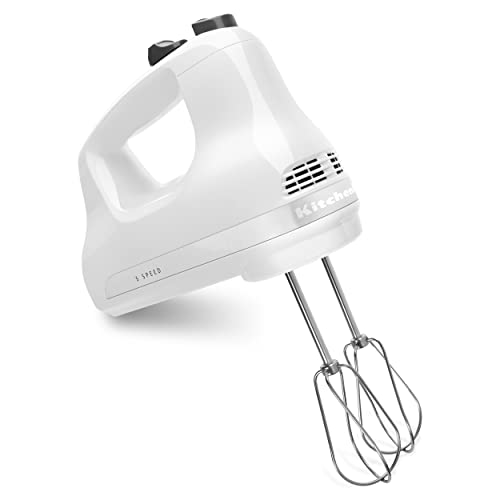
KitchenAid 5-Speed Ultra Power KHM512 — Best for Everyday Eggs
The KHM512 fits the everyday cook: omelettes and scrambles daily, pancakes and muffins weekly, the occasional whipped-cream moment — egg work as a habit rather than a hobby.
Strengths
- Five speeds cover the whole egg range for normal home cooking
- Lockable swivel cord keeps the cord out of the bowl from either hand
- Dishwasher-safe beaters and easy-release button make cleanup a non-event
Trade-offs
- No dedicated Pro Whisk — whites whip well with the beaters but less efficiently
- Five speeds mean bigger steps between gears than the 9-speed model
- Serious meringue batches will make you wish for the flagship
| Speeds | 5 |
| Attachments | Turbo Beaters (per listing) |
| Details | Lockable swivel cord, easy-release button, dishwasher-safe beaters |
Most egg mixing is not meringue. It is three eggs for an omelette, two for fried rice, a quick scramble that must be uniform in twenty seconds. The KHM512 is calibrated for that reality: enough speed range to whisk whites respectably and stir yolks gently, in a body that is light enough for daily use and simple enough that nobody avoids it.
KitchenAid’s small kindnesses compound at this duty cycle — the swivel cord that locks to the side your hand is not using, beaters that eject without greasy fingers, and a motor that starts softly instead of jumping. If your egg ambitions are honest everyday ones, this is the pick that will still be pleasing you in five years of breakfasts.
Left-handed cooks should note the lockable swivel cord specifically: it routes the cord to whichever side keeps it out of the bowl and off the hob, a small ergonomic mercy that right-handed reviewers routinely underrate. The KHM512 also shares its beater design language with the flagship line, so the upgrade path, if meringue fever ever strikes, is about the whisk and the speeds — not about relearning the tool.
Best for: everyday cooks whose egg work is daily but not elaborate / Not suited for: meringue and soufflé specialists who need a dedicated whisk
Check on Amazon — check the current price on Amazon before you buy, as bundles and included accessories change over time.

Hamilton Beach 6-Speed Hand Mixer 62682G — Best Budget Corded
The 62682G is for the budget-conscious cook equipping a first kitchen, a rental, or a second setup — anywhere eggs get beaten daily and money should stay in the grocery budget.
Strengths
- 250-watt motor with QuickBurst for the final push on thickening whites
- Bowl-rest design parks on the bowl rim instead of dripping on the counter
- Snap-on storage case keeps beaters and mixer together in the drawer
Trade-offs
- Traditional beaters aerate whites more slowly than a dedicated whisk
- Budget build — lighter and louder than the KitchenAid models
- Six speeds with less low-end finesse for delicate custards
| Motor | 250 watt |
| Speeds | 6, plus QuickBurst |
| Details | Bowl rest, snap-on storage case (per listing) |
Budget egg mixers usually fail at the two ends of the job: too violent at low speed for yolks, too weak at high speed for whites. The 62682G’s 250-watt motor and QuickBurst button address the top end honestly — there is a real burst available when a foam needs the last push — while the six speeds give enough gradation for daily egg work.
The design details punch above the tier: the bowl rest, which lets the mixer perch on the bowl’s edge mid-recipe, is the kind of feature you miss forever once you have had it, and the snap-on case ends the lost-beater drawer rummage permanently. As a complete egg-and-baking tool at budget money, this is the pick to beat — and in this guide, nothing at its level beats it.
The snap-on case deserves a second mention because it changes where the mixer can live: with beaters cased underneath, the 62682G stores upright in a shallow drawer or even on a shelf without the usual tangle. In small kitchens and rentals — this pick’s natural habitat — that storage discipline is the difference between a mixer that is used daily and one that migrates to a box in the hall cupboard.
Best for: first kitchens and budget setups that beat eggs daily / Not suited for: quiet-kitchen seekers or heavy meringue producers
Check on Amazon — check the current price on Amazon before you buy, as bundles and included accessories change over time.
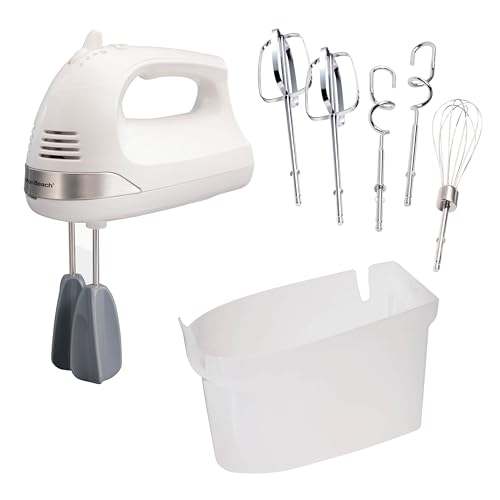
Hamilton Beach 6-Speed Easy Clean 62636J — Best for Easy Cleanup
This 62636J variant suits the cook who beats eggs constantly and washes beaters just as constantly — the Easy Clean beater coating is aimed squarely at egg’s talent for cementing itself to wire.
Strengths
- Easy Clean beaters shed egg and batter residue with a rinse instead of a scrub
- Whisk included alongside beaters and dough hooks — the complete attachment set
- Six speeds cover the egg range from custard-gentle to white-whipping
Trade-offs
- Coated beaters ask for non-metal utensils and gentle storage to protect the finish
- Same budget-class motor character as its sibling — capable, not silent
- Dough hooks are a bonus, not a bread solution
| Speeds | 6 |
| Attachments | Easy Clean beaters, traditional beaters, dough hooks, whisk (per listing) |
Dried egg on a wire beater is one of kitchen life’s small miseries: it sets like glue and hides in every joint. Hamilton Beach’s Easy Clean beaters attack exactly that, with a finish that releases egg and batter under the tap. For a tool whose whole life is eggs, that is not a gimmick — it is the feature you will appreciate most often.
The box completeness helps too: with a whisk for whites, beaters for general work and hooks for light doughs, this is the most self-sufficient budget package here. If your egg mixing is frequent, your sink patience is limited and your budget is real, the 62636J is the pragmatic champion of this roundup.
Treat the Easy Clean beaters kindly and they repay it: hand-wash or top-rack only, no scouring pads, and store them clicked into the mixer or in a pouch rather than rattling in the utensil drawer. The coating’s whole value is release — egg sliding off under the tap — and that value survives years if the surface does. The included whisk, meanwhile, makes this the only budget pick here that whips whites with a proper tool.
Best for: frequent egg beaters who prioritise fast cleanup / Not suited for: cooks who store beaters loose in a utensil crock (the coating prefers care)
Check on Amazon — check the current price on Amazon before you buy, as bundles and included accessories change over time.

CHIDOYII Cordless Hand Mixer — Best Cordless
The CHIDOYII is for the breakfast specialist: the cook who beats two to four eggs several times a week, at a stove or counter with no free outlet, and wants the tool in hand in three seconds.
Strengths
- Fully cordless — beat eggs in the pan-side bowl, the camper, anywhere
- Twin detachable whisks cover scrambles, omelettes and light whipping
- Three speed modes are honestly matched to egg-sized jobs
Trade-offs
- Battery power is for egg-scale work, not cake batters or big meringue batches
- Must be recharged — a dead battery at breakfast is a fork’s moment to shine
- Whisks are lighter-gauge than corded mixer attachments
| Power | Cordless, rechargeable |
| Speeds | 3 speed modes |
| Attachments | 2 detachable stir whisks (per listing) |
Cordless egg beaters live or die on friction: if the tool is not faster than a fork, it is a gadget. The CHIDOYII clears the bar by being genuinely instant — grab, whisk, rinse, done — with two proper whisks that incorporate air into a scramble the way a fork never quite does, producing the uniform, pale-gold eggs that distinguish a good omelette.
Know its parish: eggs, egg whites in small numbers, whipped cream for two, pancake batter for the family. Inside that parish it is arguably the most-used tool in this entire guide. Outside it — a pavlova for eight, a genoise sponge — the corded KitchenAids take over, and the reviews above say so plainly.
Battery routine for breakfast reliability: give the CHIDOYII a home — a small tray or hook near the stove with its cable — and top it up on a weekly rhythm rather than waiting for it to die mid-omelette. Its detachable whisks rinse in seconds, which matters because a cordless tool’s entire promise is low friction; a whisk left eggy in the sink quietly taxes the next use until the tool stops being grabbed at all.
Best for: omelette and scramble specialists who value cordless speed / Not suited for: bakers needing sustained power for large foams and batters
Check on Amazon — check the current price on Amazon before you buy, as bundles and included accessories change over time.

Wynboop Mini Cordless Hand Mixer — Best Mini for Small Kitchens
The Wynboop mini is for small-space cooks: dorm rooms, RVs, office kitchens, and anyone whose ‘mixer drawer’ is a shoebox. It stands on its own end between uses and charges from USB like a phone.
Strengths
- Self-standing design and tiny footprint suit the smallest kitchens
- USB rechargeable — charges from the same cable ecosystem as your phone
- Four speeds and two whisks cover eggs, cream and light batters
Trade-offs
- Mini means mini: two-to-three-egg jobs are its natural territory
- Lightweight build is a travel virtue and a durability question mark
- Not a candidate for any batter thicker than pancake mix
| Power | USB rechargeable, cordless |
| Speeds | 4 |
| Attachments | 2 whisks (per listing) |
| Design | Self-standing, lightweight portable |
The mini cordless category exists because most egg beating is small: one omelette, one mug cake, one portion of whipped cream. The Wynboop leans into that scale with a body that stands upright on the counter (no beater-prints on the worktop), charges over USB, and offers four speeds — one more than its cordless rival here — for a touch more control over small foams.
It will not raise a meringue for a dinner party and does not claim to. Judged on its actual beat — the daily small jobs in small spaces — it is charming, useful and honest value. Students and van-lifers: this is your egg mixer, and the bigger kitchens can stop smirking, because their flagship mixers cannot come camping.
The self-standing design has an unadvertised virtue in tiny kitchens: it parks whisk-up on the counter between tasks without a drip tray or a rest, so a one-person breakfast production line — eggs, then pancake batter, then whipped cream for coffee — runs without washing anything mid-service. For dorm and RV cooks, that park-anywhere quality is worth as much as the fourth speed.
Best for: dorms, RVs, tiny kitchens and travel cooking / Not suited for: anyone whose egg jobs regularly exceed three eggs
Check on Amazon — check the current price on Amazon before you buy, as bundles and included accessories change over time.
Comparison Table
| Pick | Badge | Key spec | Best for |
|---|---|---|---|
| KitchenAid 9-Speed Hand Mixer KHM926 | Best Overall | 9 speeds, dedicated Pro Whisk | Meringues and full baking range |
| KitchenAid 5-Speed Ultra Power KHM512 | Best for Everyday Eggs | 5 speeds, swivel cord, Turbo Beaters | Daily omelettes and scrambles |
| Hamilton Beach 6-Speed Hand Mixer 62682G | Best Budget Corded | 250W, 6 speeds + QuickBurst, storage case | Budget all-round egg mixing |
| Hamilton Beach 6-Speed Easy Clean 62636J | Best for Easy Cleanup | 6 speeds, Easy Clean beaters + whisk | Egg-heavy, wash-light kitchens |
| CHIDOYII Cordless Hand Mixer | Best Cordless | Cordless, 3 speeds, twin whisks | Quick daily egg beating |
| Wynboop Mini Cordless Hand Mixer | Best Mini for Small Kitchens | Mini cordless, USB charging, 4 speeds | Small-space egg whisking |
How to Choose the Best Egg Mixers for the Way You Cook Eggs
Start with your most frequent egg job, not your most ambitious one. If eggs mean breakfast — scrambles, omelettes, fried-rice eggs — a cordless whisk (CHIDOYII, Wynboop) will be used ten times more than a flagship mixer, and frequency of use is the truest measure of a kitchen tool. If eggs mean baking — meringues, sponges, soufflés — you need whisk power and speed range, which is corded KitchenAid territory.
Whites and yolks want opposite things. Whites want a whisk with many thin wires and a fast top speed, building foam quickly and evenly. Yolks — for custards, curds and emulsions — want a slow, controlled start that stirs without aerating. A mixer whose first speed is a hurricane fails the yolk test no matter how it whips; that is why the guides above keep mentioning low-speed manners.
Then be honest about volume. Two whites whip in anything here. Six whites for a pavlova want the KHM926’s Pro Whisk and motor. Twelve whites want a stand mixer, and no hand tool in this guide pretends otherwise — egg honesty is still honesty.
- Primary job: breakfast eggs vs baking foams
- Whisk quality: dedicated whisk attachment beats beater-only for whites
- Low-speed control: essential for yolks, custards and emulsions
- Power source: corded for stamina, cordless for frequency
- Cleanup: ejectable, dishwasher-safe or easy-clean beaters
Egg Technique: What Your Mixer Is Actually Doing
Beating whole eggs is about uniformity: yolk and white fully integrated, with just enough air for a fluffy scramble but not so much that an omelette turns spongy. A hand mixer at low-to-medium speed for twenty seconds achieves the uniformity a fork approaches in a minute — and uniformity is why mixer-beaten scrambles cook evenly instead of streaking.
Whipping whites is about architecture: the whisk stretches egg-white proteins into a foam of tiny bubbles, and sugar (added gradually) stabilises it. The stages — foamy, soft peak, firm peak, glossy stiff peak — are judged by eye, and a mixer with fine speed steps lets you approach the peak slowly instead of overshooting into dry, broken foam. That control is the KHM926’s nine speeds justifying themselves.
Emulsions — mayonnaise, hollandaise — are about patience: oil or butter added in a thread while the mixer runs at a steady low-medium speed. Corded mixers win here because the job takes minutes of continuous running and both your hands are busy. Attempting hollandaise with a nearly-flat cordless is a story you tell later, laughing, about the sauce that split.
Corded vs Cordless Egg Mixers: The Honest Trade
Cordless wins the daily referendum. No outlet hunt, no cord dragging through the batter bowl, no coiling afterwards — for the two-minute egg jobs that make up 90% of egg mixing, the cordless picks here are simply more likely to be used, and a used tool beats a superior drawer ornament every single morning.
Corded wins everything long, thick or large. Meringue for a crowd, sponge batters, cookie doughs, the second consecutive batch — sustained power with no battery anxiety is what the plug is for. Corded mixers also live longer in calendar terms, because there is no battery to age out in three years.
The two-tool household is the quiet consensus among serious home cooks: a cordless whisk living by the stove for eggs, and a corded hand (or stand) mixer for baking days. This guide’s badges effectively describe that pairing — Best Cordless for the stove-side, Best Overall for the baking — and there is no rule that says you must choose only one philosophy.
Caring for Whisks, Beaters and Batteries
Egg residue is protein, and protein sets with heat: rinse beaters and whisks in cold or lukewarm water first, then wash hot. Hot water first cooks the egg onto the wires — the single most common cleanup mistake with these tools, and the reason easy-clean coatings still benefit from a cold rinse.
Dry attachments before storage; whisk wires trap water at the joints and reward a shake and a minute on a tea towel. Eject beaters with the button rather than pulling — the shafts and sockets stay true longer, and a wobbling beater whips unevenly forever after.
For cordless models, treat the battery like a phone’s: charge before it is empty when you can, store it neither flat nor baking in a hot drawer, and expect the tool to be a three-to-five-year companion rather than a decade machine. The corded picks invert that bargain — heavier daily friction, far longer life — which is the whole corded/cordless trade in one sentence.
Eggs by the Numbers: Matching Mixer Power to Batch Size
Egg work scales in a way recipes rarely warn about. Two whites whip in a mug with a wand; four whites want a medium bowl and a real whisk; six to eight whites — pavlova, angel food, a big soufflé — want the KHM926’s Pro Whisk, a wide bowl, and headroom above the foam, because whites can expand to eight times their liquid volume. Choosing the tool by the largest batch you make monthly, rather than the largest you can imagine, keeps you out of both failure modes: the wand drowning in a banquet foam, and the flagship bought for a two-egg life.
Yolk-side work scales differently: emulsions fail by temperature and addition rate, not by volume, until you reach catering quantities. A hollandaise for two and a hollandaise for eight ask the same of the mixer — a steady low-medium speed and stamina for several minutes — which is why the corded models’ continuous power, not their top speed, is the emulsion specification that matters.
From Fork to Mixer: When the Upgrade Actually Changes Breakfast
A fork is a legitimate egg tool, and this guide will not pretend otherwise: for a single scrambled egg, the fork wins on washing-up alone. The mixer earns its drawer at three thresholds. The first is uniformity — two or more eggs beaten truly homogeneous cook into the even, custardy scramble that streaky fork-beaten eggs never quite reach. The second is air: any dish whose name includes whisked, whipped or soufflé has left fork territory entirely. The third is volume: breakfast for four is where the fork becomes a chore and the cordless whisk becomes the best-used tool in the kitchen.
That is why this guide’s badges split the way they do — cordless picks for the daily thresholds, corded flagships for the air-and-volume thresholds. The honest purchase is the one matched to the threshold you actually cross each week, and for most households that crossing happens at the stove, every morning, two eggs at a time.
Troubleshooting Egg Mixing: Foam Failures, Splits and Their Fixes
Problem: whites whip to a foam and then collapse or weep liquid. The usual causes are fat contamination (a yolk speck or a greasy bowl), sugar added too early in large amounts, or a foam whipped past its peak and left standing while the rest of the recipe caught up. The fix is procedural: scrupulously clean equipment, sugar added gradually after soft peaks, and the base recipe ready before the whites are — foam waits for nobody.
Problem: scrambled eggs come out watery or rubbery despite good beating. Beating is rarely the culprit; heat is. Eggs beaten to perfect uniformity still weep if cooked hard and fast, and turn rubbery if held hot. Cook mixer-beaten eggs low and slow, pull them while they look slightly underdone, and let carryover finish them — the mixer’s contribution (uniformity) then shows up as the creamy, even curd you were promised.
Problem: an emulsion splits — the mayonnaise thins, the hollandaise breaks. Warmth and addition rate are the levers: a split hollandaise often re-forms with a spoon of hot water whisked in at low speed; a split mayonnaise can be rebuilt by starting a fresh yolk and whisking the broken sauce into it slowly, treating it as the oil. The mixers in this guide, run at their gentle low speeds, are ideal for both rescues — one more reason low-speed manners mattered so much in our selection.
Eggs Beyond Breakfast: Baking Projects Ranked by Mixer Demand
If you are choosing an egg mixer with baking ambitions, it helps to see the repertoire ranked by what it asks of the tool. At the gentle end sit custards, curds and crème anglaise: low speed, patience, no aeration — every pick here, including the cordless pair for small quantities, handles them. The middle tier is where most home baking lives: sponge cakes and genoise (whole eggs whipped warm to the ribbon), chiffon (a yolk batter plus a white foam, folded together — two techniques in one cake), and meringue-topped pies, where a modest foam crowns a filled base.
The demanding end is smaller than its reputation. Pavlova and angel food cake ask for large, stable foams — flagship territory, the KHM926’s home ground. Soufflés ask for a foam at exactly soft-to-firm peak, folded with confidence; the mixer’s fine speed steps matter more than its power. Macarons ask for an aged-white foam whipped to a precise stiffness and then deliberately deflated — a control exercise that rewards the nine-speed’s granularity and punishes brute force.
Read your own ambitions against that ladder honestly. A cook whose ceiling is chiffon and lemon meringue pie is fully served by the mid-range picks; the flagship earns its premium only when the top rung is a regular address. Egg mixers, like eggs themselves, reward those who know exactly what they are making.
How to Whip Egg Whites to Perfect Peaks With a Hand Mixer
The technique below works with any pick in this guide that carries a whisk or beaters, and it is the skill that separates mixer owners from mixer users. Bowl and eggs matter as much as the machine.
- Start with a spotlessly clean, dry bowl — glass, ceramic or metal, never plastic (plastic holds grease films that kill foam). A wipe of lemon juice or vinegar on the bowl and whisk removes the last traces.
- Use room-temperature whites; they whip faster and to a greater volume than fridge-cold ones. Separate carefully: one speck of yolk (fat) can halve your foam.
- Begin at low speed until the whites turn foamy and opaque — about 30 seconds. Starting fast throws unwhipped white up the sides where the whisk cannot reach it.
- Raise to medium-high and whip to soft peaks: the foam holds a peak whose tip flops over. This is the stage for folding into soufflés that want lightness.
- For firm or stiff peaks, continue while adding sugar a spoonful at a time if the recipe uses it; stop the moment peaks stand straight with glossy, smooth sides.
- Stop early rather than late: over-whipped whites turn dry, grainy and watery at the edges, and no amount of mixing brings them back. Fold them into your base immediately, with a spatula, in two additions.
If a foam does fail — yolk contamination is the usual culprit — do not throw the whites at the recipe anyway. Use them for scrambles, start the foam again with fresh whites, and let the cordless whisk by the stove enjoy its moment.
Common Buying Mistakes
Whipping whites in a plastic bowl. Plastic retains grease films that destabilise foam no mixer can overcome. Glass or metal, wiped clean, every time — this one habit fixes most ‘my whites won’t whip’ mysteries.
Starting at full speed. A violent start sprays unmixed egg up the bowl and over-aerates the surface while the bottom stays liquid. Low first, then climb — the mixers with gentle first speeds exist precisely for this.
Using a cordless whisk for a banquet meringue. Battery beaters are egg-scale tools. A six-plus-white foam wants corded power and a real whisk; respect each tool’s parish and both will serve you well.
Washing beaters in hot water first. Heat sets egg protein onto the wires like cement. Cold rinse first, then wash — or choose the Easy Clean model and still rinse cold, because physics does not read marketing.
Judging peaks by the clock. Peak stages are visual, and time varies with egg age, temperature and bowl. Lift the whisk and look: floppy tip, soft peak; straight and glossy, stiff. The clock is a liar; the peak is the truth.
Final Recommendation
If you buy one egg mixer, buy the KitchenAid KHM926: its Pro Whisk and nine speeds make it the best tool here for everything eggs can become, from custard to meringue. If your egg life is everyday rather than elaborate, the KHM512 does the daily work with less fuss and less money, and most households will never outgrow it.
Budget buyers are genuinely well served this time: the Hamilton Beach 62682G brings real power and a storage case, and its Easy Clean sibling, the 62636J, adds the whisk and the rinse-off beaters. And for the stove-side daily scramble, the cordless pair — CHIDOYII for normal kitchens, Wynboop mini for small ones — will quietly become the most-used tools in this entire guide.
Decide by your most frequent egg, check price on Amazon for the matching pick, and your breakfasts and your baking both improve the day it arrives.
Shop the linked picks again here: KitchenAid 9-Speed Hand Mixer KHM926, KitchenAid 5-Speed Ultra Power KHM512, Hamilton Beach 6-Speed Hand Mixer 62682G, Hamilton Beach 6-Speed Easy Clean 62636J, CHIDOYII Cordless Hand Mixer, Wynboop Mini Cordless Hand Mixer — each opens its Amazon listing so you can check the current price and the exact bundle on offer.
Keep researching the cluster: Best Electric Coffee Mixers Best Mixers For Bread Dough Best Dough Mixers For Bread Baking Best Hand Mixers Best Electric Cocktail Mixers Best Stand Mixers
Frequently Asked Questions
What is the difference between an egg mixer and a hand mixer?
An egg mixer is any tool specialised for beating eggs — cordless egg beaters and mini whisks sit in that category. A hand mixer is the broader tool that also handles batters and doughs, and with a whisk attachment it is an excellent egg mixer too. This guide covers both, because shoppers use the term for both.
Can a hand mixer whip egg whites as well as a stand mixer?
For up to about six whites, yes — especially the KHM926 with its Pro Whisk. Beyond that, a stand mixer’s larger whisk and hands-free running pull ahead. Most home recipes live comfortably in hand-mixer territory.
Why won’t my egg whites form peaks?
Usually fat contamination: a speck of yolk, a greasy bowl (plastic is the common culprit), or residue on the whisk. Use a scrupulously clean glass or metal bowl, room-temperature whites, and start at low speed. The how-to section above walks through the full fix.
Are cordless egg beaters worth it?
For daily small jobs — scrambles, omelettes, two-egg bakes — emphatically yes: the lack of a cord makes them faster than a fork and more likely to be used. For large foams, thick batters or long emulsions, corded power remains the right tool.
How many speeds do I actually need for eggs?
Three honest speeds cover breakfast eggs; five cover general home baking; nine (the KHM926) earn their keep when you whip whites often, because fine steps let you approach a peak without overshooting it. More speeds are about control near the finish, not raw power.
Can I make mayonnaise or hollandaise with these?
Yes, with the corded models preferred: run at a steady low-medium speed and add the oil or butter in a thin thread. The whisk attachments on the KitchenAid models are ideal. Cordless beaters can manage a small mayonnaise but their batteries and lighter whisks make long emulsions a gamble.
What is the best egg mixer for a large family?
For family-scale egg work — weekend scrambles for six, double batches of pancake batter, holiday baking — the corded KitchenAid models are the answer, with the KHM926 first: sustained power, a real whisk, and no battery to fade mid-service. The cordless picks remain perfect for the weekday two-egg jobs even in a large household, which is why many families end up with one of each, as this guide’s corded-versus-cordless section describes.
Can I beat eggs in a blender or food processor instead?
You can scramble eggs in them, in the sense that the eggs will be mixed — but blenders incorporate too much air unevenly, are miserable to scrape clean of egg, and offer no control for foams or emulsions. A food processor’s blade chops rather than whisks. For anything beyond a basic scramble, the tools in this guide do the job better with less washing, which is why the category exists.
How long do cordless egg beaters run on a charge?
It varies by model and by how thick the work is, but the honest framing is per-task rather than per-hour: the cordless picks here are built for many small jobs between charges — days to weeks of breakfasts — not for an afternoon of continuous baking. If your egg work includes long sessions, the corded models remove the question entirely, which is why the guide keeps both families and badges them for their real duties.


