Disclosure: airfryerkitchensupply.com is reader-supported. When you buy through links on our site, we may earn an affiliate commission at no extra cost to you.
Where to Buy
For a first or frustration-free grill, buy from a listing that shows the control layout clearly — you are shopping for knobs and igniters as much as for grates. All six picks are sold on Amazon; if a model offers both propane and natural gas versions, confirm the fuel type on the listing before checkout, as they are not interchangeable.
- Weber Spirit E-210 Gas Grill (Best Overall): Check the current price on Amazon.
- Weber Q 1200N Portable Propane Gas Grill (Best Portable): Check the current price on Amazon.
- Charbroil Classic 3-Burner Propane Gas Grill (Best Budget): Check the current price on Amazon.
- Blackstone 1813 Original 22-Inch Tabletop Griddle with Hood (Best Griddle for Beginners): Check the current price on Amazon.
- Cuisinart Chef’s Style Portable Propane Tabletop Gas Grill (CGG-306P) (Best Tabletop for Two-Zone Cooking): Check the current price on Amazon.
- George Foreman 4-Serving Indoor Grill with Removable Plates (Best No-Fuel Option): Check the current price on Amazon.
The best easy to use grills respect a simple truth: most grilling frustration is not about cooking talent, it is about the machine. Igniters that need three clicks and a prayer. One burner where the recipe needed two zones. Temperature that surges when the lid opens and sulks when it closes. The grills in this guide remove those frictions one by one — push-button or per-burner ignition, honest thermometers, burners laid out so two-zone cooking is obvious, and controls that do what the dial says.
We ranked for the experience of a real cook: a beginner on their third weekend, or an experienced griller who simply wants weeknight grilling to be a fifteen-minute pleasure instead of a project. That means gas and electric dominate this list, with griddles for their dial-a-temperature simplicity — and it means we judged preheat time, flare-up behavior and how forgiving each grill is when you inevitably walk away for two minutes.
The honest market note: easy to use does not mean feature-stuffed. The hardest grills to live with are often mid-priced models loaded with gadgets on top of bad fundamentals — uneven burners under a Bluetooth thermometer. Every pick below gets the fundamentals right first: it lights, it heats evenly, it tells you the truth about its temperature, and it cleans up without a manual.
How the badges work here: each names the situation where that grill is the easiest choice — the easiest overall, the easiest to carry, the easiest on a budget, and so on. Read the badge as the answer to ‘easiest for what?’ and the list becomes a matching exercise rather than a ranking you must agree with. Your easiest grill is the one whose badge sounds like your life.
In this guide
Quick Picks
Six grills that light first time, hold their temperature and forgive beginner mistakes — from a two-burner Weber with per-burner ignition to a plug-in grill with no fuel at all. Badges match the full reviews.
- Best Overall: Weber Spirit E-210 Gas Grill — two burners, Snap-Jet ignition that lights each burner on its own, and cast iron grates — the simplest full-size grill Weber makes, and the easiest to learn on. — Check price on Amazon
- Best Portable: Weber Q 1200N Portable Propane Gas Grill — push-button ignition, one dial, 10,000 BTUs and a cast aluminum body — the portable that behaves like a kitchen burner with a lid. — Check price on Amazon
- Best Budget: Charbroil Classic 3-Burner Propane Gas Grill — three burners, 30,000 BTUs, 360 square inches and push-button ignition — the simple full-size formula at a budget tier. — Check price on Amazon
- Best Griddle for Beginners: Blackstone 1813 Original 22-Inch Tabletop Griddle with Hood — a dial, a flat top and a hood — no flare-ups possible, no grate technique to learn, and food you can see the whole time it cooks. — Check price on Amazon
- Best Tabletop for Two-Zone Cooking: Cuisinart Chef’s Style Portable Propane Tabletop Gas Grill (CGG-306P) — twin 10,000-BTU burners across 275 square inches of stainless tabletop — two real zones in a grill that sets up anywhere in a minute. — Check price on Amazon
- Best No-Fuel Option: George Foreman 4-Serving Indoor Grill with Removable Plates — plug it in, wait for the light, close the lid — both sides cook at once, fat drains itself, and the plates come off for washing. — Check price on Amazon
How These Picks Were Chosen
Each pick was verified against its current Amazon listing. Our usability audit scored: ignition type and reliability, number and layout of heat zones, thermometer presence and placement, preheat speed, flare-up tendency, and the plain-English quality of the controls — could a first-time owner run this grill correctly with no video tutorial?
We required at least two independent heat zones on the gas picks (or a genuinely controllable single zone on the portable and indoor picks), because zone cooking is the one technique that rescues more meals than any other. Flare-prone designs with grease paths over open burners were marked down; so were grills whose lids, handles or shelves fight the cook.
The final six span the real easy-use cases: the all-round family gas grill, the portable that lights like a stove, the budget three-burner that keeps it simple, the griddle that replaces guesswork with a dial, the two-burner tabletop that teaches two-zone cooking, and the indoor electric that removes fuel from the equation entirely.
We should name the runner-up quality that shaped this list: repairability as usability. A grill whose igniter swaps in two minutes with a screwdriver stays easy for a decade; a grill that must visit a service center for a sparker becomes hard to use the first time anything small fails. Every pick here keeps its wear parts owner-serviceable with ordinary tools.
The 6 Best Easy To Use Grills
Each review leads with the usability details — how it lights, how it zones, how it forgives — then covers cooking range and honest limits. If you are buying for a beginner, these are the paragraphs that matter.

Weber Spirit E-210 Gas Grill — Best Overall
The E-210 is the grill we hand to first-time owners who want to skip the frustrating years. Snap-Jet ignition lights each burner individually with a click of its own control knob — no separate sparker button to hunt for, no single module whose failure darkens the whole grill. Two burners make two-zone cooking literal: left on, right off, food moves between them. The porcelain-enameled cast iron grates hold heat like a much bigger grill.
Strengths
- Snap-Jet per-burner ignition is the most foolproof lighting in gas grilling
- Two burners teach two-zone cooking with zero ambiguity
- Compact footprint with full-size cooking manners and Weber parts support
Trade-offs
- Two burners cap the crowd at about four to five diners
- No side burner — sauces ride the main grate or the kitchen stove
- Premium price for its size; you are paying for ignition and build quality
| Burners | 2 burners |
| Fuel | Liquid propane |
| Grates | Porcelain-enameled cast iron |
| Ignition | Snap-Jet, per burner |
Ease of use compounds in small ways: the grease tray slides from the front, the thermometer sits where you actually look, the knobs are big enough for a gloved hand, and the whole grill preheats while you season the food. Beginners succeed on it because there is nothing to misunderstand; experienced cooks like it because nothing needs working around.
It is also the right size of teacher. A new griller learns heat management on two zones without the propane appetite or the cleaning load of a four-burner — and when the household grows, this becomes the beloved second grill rather than a discarded first one. That is what buying easy and buying well looks like at the same time.
A first-month tip for E-210 owners: mark your knob positions for your three working temperatures — sear, roast, hold — with a removable dot once you have learned them. Every grill has its own dial personality, and an afternoon of calibration converts the gauge and knobs into instruments you trust. After that, the grill effectively runs itself, which is the entire promise of this category fulfilled.
Couples cooking for two should know the E-210’s small footprint does not mean small capability: the cast iron grate sears two serious steaks with room for asparagus alongside, and the lid roasts a small chicken without complaint.
Best for: beginners and small households who want zero-friction weeknight grilling / Not suited for: regular cooking for six or more
Check on Amazon to see the current configuration and delivery options for the Spirit E-210.

Weber Q 1200N Portable Propane Gas Grill — Best Portable
The Q 1200N reduces grilling to its simplest grammar: push the button, turn the dial, cook. A single well-shaped burner under a porcelain-enameled cast iron grate gives surprisingly even heat for one zone, the lid thermometer tells the truth, and the cast aluminum body shrugs off the balcony, the campsite and the tailgate with equal indifference. It runs on 1 lb canisters or, with an adapter hose, a full tank at home.
Strengths
- Push-button ignition and a single intuitive control dial
- Cast iron grate sears properly — not portable-grill apologetic heat
- Cast aluminum body is light, rust-proof and tabletop-ready anywhere
Trade-offs
- One zone only: two-zone cooking is done with placement, not burners
- Grate space suits two to four diners
- Cart and side tables are accessories, not included
| Output | 10,000 BTUs |
| Burners | 1 burner |
| Grates | Porcelain-enameled cast iron |
| Body | Cast aluminum |
The Q’s usability secret is thermal: the compact, domed cast-aluminum body preheats fast and recovers fast, so the grill forgives the constant lid-opening that beginners do. Food behaves predictably, the thermometer tracks grate reality closely enough to cook by, and the whole unit wipes down and stores on a shelf.
For singles, couples, balcony cooks and campers, it is the rare portable that owners keep for a decade and use weekly. Easy does not get much easier than a grill with one dial that always lights.
The Q’s one-dial simplicity hides one pro move: because the compact body responds quickly, you can treat the dial like a stove burner during the cook — up for the sear, down for the finish — rather than setting it once and hoping. Beginners raised on stovetop cooking find this immediately intuitive, which is why the Q converts more nervous first-timers than any other portable we recommend.
The Q’s accessory worth having is the adapter hose if it will live at home: one dial and a full tank turns the portable into the household’s everyday grill, which is how many owners end up using it most.
Best for: couples, balconies, camping and anyone whose second grill must earn its shelf / Not suited for: multi-zone cooking or groups above four
Check on Amazon to see the current configuration and delivery options for the Q 1200N.

Charbroil Classic 3-Burner Propane Gas Grill — Best Budget
The Classic 3-Burner is the big-box staple done sensibly: three burners across 360 square inches, 30,000 BTUs, porcelain-coated grates, side shelves for tools and trays, and push-button ignition. There is nothing to learn beyond the universal gas grammar — tank, knobs, igniter — which is precisely its virtue for a first full-size grill or a rental-property workhorse.
Strengths
- Three burners give a real two-zone layout at a budget price
- Push-button ignition and standard controls — no learning curve at all
- Side shelves and a compact cart suit ordinary patios
Trade-offs
- Porcelain-coated steel grates are lighter than cast iron and sear more gently
- Budget construction: expect wear parts sooner than the Weber picks
- Heat distribution is good for the tier, not flagship even
| Burners | 3 burners |
| Output | 30,000 BTU |
| Cooking area | 360 sq. in. |
| Grates | Porcelain-coated |
Usability at this tier is about the absence of quirks, and the Classic delivers: it lights, it heats, the zones behave, and the parts — burners, grates, igniter — are standard Char-Broil items stocked everywhere. A beginner can grow on it for several seasons, learning zone cooking and grease discipline on a grill that does not punish mistakes with flare-ups at every drip, thanks to a sensible burner shield layout.
Set the expectation correctly — this is the easy starter, not the decade grill — and it is excellent value: full-size, three-zone, push-button simple. Many households will cook happily on it for years and upgrade with clear knowledge of what they actually want.
New Classic owners should learn the regulator reset once, before they need it: if the burners ever light weakly, close everything, disconnect and reconnect the tank, then open the tank valve slowly. Modern safety valves trip on fast opening and mimic a broken grill. Knowing that thirty-second fix has saved more first cookouts than any recipe ever written.
The Classic’s side shelves deserve their usability credit: a landing zone for raw food and a separate one for cooked food is a food-safety system disguised as furniture, and beginners benefit from it before they know why.
Best for: first full-size grill buyers and budget family grilling / Not suited for: buyers seeking a ten-year, buy-once appliance
Check on Amazon to see the current configuration and delivery options for the Charbroil Classic 3-Burner.

Blackstone 1813 Original 22-Inch Tabletop Griddle with Hood — Best Griddle for Beginners
Griddles are the beginner’s cheat code: the cooking surface is flat, visible and flare-proof, the heat is a dial rather than a fire to manage, and delicate food — eggs, fish, chopped vegetables, smash burgers — cannot fall through anything. The 1813 adds a hood to the 22-inch tabletop format, which traps heat for melting cheese and roasting, and its single control keeps the lesson plan to one sentence: set the dial, watch the food.
Strengths
- Flat top eliminates flare-ups and lost food — the two biggest beginner anxieties
- Hood adds roasting and melting ability most tabletops lack
- One-dial control and fast, even preheat on a seasoned steel surface
Trade-offs
- Seasoning the steel is a real first-week task, though a simple one
- No grill marks or flame flavor — it is a griddle, proudly
- Tabletop format needs a surface; budget for a stand if you lack one
| Size | 22-inch tabletop griddle with hood |
| Surface | Rolled steel flat top |
| Body | Stainless steel front plate |
| Fuel | Propane |
The learning curve here is nearly flat because feedback is instant and visible: you see the sear form, hear the sizzle change, and slide a spatula under anything in trouble. Beginners who fear grilling often discover they love griddling, and the 1813’s hood extends that confidence to thicker cuts and covered cooking. Cleanup is the scrape-and-oil routine — ninety seconds, learned once.
For breakfast-for-dinner households, taco nights and smash-burger devotees, it may simply be the right primary cooker, not a starter at all. Easy to use and easy to love are frequently the same grill.
The hood changes beginner math more than expected: with it down, the griddle roasts and melts like a small oven, so cheese finishes, onions steam-soften, and thicker items cook through without constant flipping. New owners should treat the hood as a third hand — close it whenever the food needs heat more than it needs watching, and the 1813 becomes a one-person diner line.
New griddle owners: your first seasoning session is the only homework this grill assigns. Three thin coats of oil, heated past smoking each time, and the top turns dark, slick and effectively nonstick for the season. Everything after that is cooking.
Best for: nervous beginners, breakfast cooks and flat-top menu fans / Not suited for: char marks, smoke flavor or thick bone-in cuts
Check on Amazon to see the current configuration and delivery options for the Blackstone 1813.

Cuisinart Chef’s Style Portable Propane Tabletop Gas Grill (CGG-306P) — Best Tabletop for Two-Zone Cooking
Most tabletops force one-zone compromises; the CGG-306P refuses, with two independent 10,000-BTU burners under 275 square inches of stainless grate. That makes it the portable that teaches real technique: sear on the left, finish on the right, hold vegetables at the edge. Stainless construction wipes clean, the legs fold for storage, and the whole unit sets up on any table in about a minute.
Strengths
- Two independent burners — genuine two-zone cooking in a tabletop
- Stainless body and grate are easy to clean and rust-resistant
- Fast setup and fold-away legs suit camping, tailgates and balconies
Trade-offs
- Tabletop height is borrowed — plan your surface
- 275 sq. in. feeds three to four, not a crowd
- Stainless grate needs a good preheat and oiled food to prevent sticking
| Burners | 2 burners, 10,000 BTU each |
| Cooking area | 275 sq. in. |
| Body | Stainless steel |
| Design | Portable tabletop, folding legs |
Usability is often about headroom: a grill that can do the next technique you learn keeps you growing instead of shopping. The twin-burner layout gives the CGG-306P that headroom in a package that still lives in a closet. Beginners start with everything on medium; a month later they are running a sear zone and a holding zone like a patio veteran, on the same grill.
It is also a genuinely handsome, well-finished object — the rare portable that looks at home on a kitchen-adjacent balcony. For small households that cook seriously in small spaces, it is the thinking person’s easy grill.
Stainless grate technique, in one line: preheat it properly, oil the food, and give proteins their undisturbed minutes before turning. Stainless rewards that discipline with clean release and excellent marks, and punishes impatience with sticking — which makes the CGG-306P a quietly good teacher: it gives feedback like a professional surface while remaining, in size and setup, a beginner’s grill.
The CGG-306P is also the easiest pick here to clean mid-trip: stainless surfaces, a removable grease cup, and no painted parts to baby. Campsite usability includes the sink-less wipe-down, and this grill passes it.
Best for: small households that want real technique in a portable format / Not suited for: groups above four or stand-up cooking
Check on Amazon to see the current configuration and delivery options for the Chef’s Style CGG-306P.
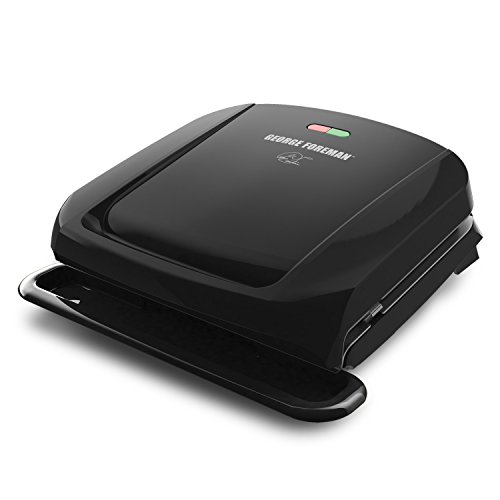
George Foreman 4-Serving Indoor Grill with Removable Plates — Best No-Fuel Option
The easiest grill to use is arguably the one with no fuel, no ignition and no fire at all. The Foreman 4-Serving heats removable nonstick plates from both sides, so food cooks roughly twice as fast with no flipping, while the sloped design drains fat into a tray as it cooks. There is one control decision — plug it in — and the learning curve is a single meal. The plates remove for the sink or dishwasher.
Strengths
- Zero fuel, zero ignition, zero flame: the simplest operation of any grill here
- Dual-sided cooking halves cook times and removes flipping
- Removable plates wash in the sink; fat self-drains during cooking
Trade-offs
- Four servings is the ceiling — a household grill, not a party grill
- Contact cooking presses food; thick, bone-in cuts do not suit it
- No char, no smoke, no outdoor ritual — convenience is the entire point
| Capacity | 4 servings |
| Plates | Removable nonstick |
| Design | Sloped contact grill with fat drainage |
| Use | Indoor electric |
Do not underestimate what removing variables does for a cook. No tank to check, no charcoal to light, no wind, no flare-ups, no weather cancellations: dinner becomes a decision, not a project. For dorms, first apartments, office kitchens and anyone cooking for one or two on a weeknight, that reliability is a feature no burner count can match.
It grills the weeknight canon — burgers, chicken breasts, salmon, vegetables, sandwiches — quickly and leanly, and then its plates go in the dishwasher. As the entry point to grilled food, or the backup when the patio is rained out, it earns its badge without apology.
A small habit doubles the Foreman’s usefulness: put the kettle on while it preheats. The plates cook fast enough that side dishes become the long pole of dinner, and syncing them to the grill’s few-minute cycles turns the whole meal into one motion. It is the only pick in this guide that can plausibly take a weeknight dinner from fridge to plate inside fifteen minutes, cleanup included.
For households of one or two, the Foreman’s four-serving size is honestly two servings with leftovers — which is to say, exactly right. Right-sizing is an ease feature: less to clean, less to store, nothing wasted.
Best for: solo cooks, couples, dorms and first apartments / Not suited for: outdoor cooking, crowds, or thick-cut grilling
Check on Amazon to see the current configuration and delivery options for the George Foreman 4-Serving.
Comparison Table
Line these up by their first action — click a knob, push a button, turn one dial, plug in a cord. That first action is the usability story of each grill in miniature.
| Pick | Badge | Key Spec | Best For |
|---|---|---|---|
| Weber Spirit E-210 Gas Grill | Best Overall | 2 burners, Snap-Jet ignition, cast iron grates | beginners and small households who want zero-friction weeknight grilling |
| Weber Q 1200N Portable Propane Gas Grill | Best Portable | 1 dial, push-button ignition, 10,000 BTUs | couples, balconies, camping and anyone whose second grill must earn its shelf |
| Charbroil Classic 3-Burner Propane Gas Grill | Best Budget | 3 burners, 30,000 BTU, 360 sq. in. | first full-size grill buyers and budget family grilling |
| Blackstone 1813 Original 22-Inch Tabletop Griddle with Hood | Best Griddle for Beginners | 22-inch flat top with hood, one dial | nervous beginners, breakfast cooks and flat-top menu fans |
| Cuisinart Chef’s Style Portable Propane Tabletop Gas Grill (CGG-306P) | Best Tabletop for Two-Zone Cooking | Twin 10,000-BTU burners, 275 sq. in. stainless | small households that want real technique in a portable format |
| George Foreman 4-Serving Indoor Grill with Removable Plates | Best No-Fuel Option | Removable plates, dual-sided, plug-in | solo cooks, couples, dorms and first apartments |
How to Choose the Best Easy To Use Grills for Your Skill Level
Be honest about which part of grilling you find hard. If it is lighting and fire management, choose per-burner ignition gas or go electric and delete the problem. If it is temperature judgment, choose a grill with a real lid thermometer and even burners — or a griddle, where the food is visible and the dial is the temperature. If it is timing and flipping, a contact grill or a two-zone setup (sear, then park the food on the cool side) removes the pressure. The right easy grill is the one that deletes your specific hard part.
Zones are the one capability worth insisting on. Two burners minimum on a gas grill, because the cool zone is where beginners rescue food and where experienced cooks hold finished dishes. A single-zone grill can be delightful — the Q proves it — but it asks the cook to manage doneness with placement and timing alone, which is a skill, and skills are what this guide is trying to make optional.
Thermometers: trust, but verify once
Lid thermometers measure the air near the lid, not the food. They are useful trend gauges — rising, falling, roughly where you set it — and on the picks here they are honest ones. Verify yours once against an oven thermometer on the grate, learn its offset, and it becomes a reliable instrument for the life of the grill. That ten-minute calibration is the highest-value skill in all of easy grilling.
Budget tiers, honestly framed
Easy costs less than people fear, because the expensive parts of usability — ignition, even burners, a good thermometer — are engineering, not luxury. The budget tier (the Charbroil Classic here) covers the fundamentals adequately. Mid-range buys the best ignitions and grates. Premium money should buy build life, not complexity: beware any grill whose price is mostly electronics, because apps crash and modules die, while a knob is forever.
Five Habits That Make Any Grill Easy
Preheat fully — ten to fifteen minutes for gas, until the grate is as hot as the air; most sticking and steaming-instead-of-searing is an under-preheated grate. Oil the food, not the grate: it smokes less and works better. Leave food alone until it releases; grilled food unsticks itself when the crust forms, and forcing it early is where tearing comes from. Cook with the lid down and a timer running, because lid-up grilling is just slower, drier grilling. And clean while the grill is hot, per our clean-up guides — an easy grill is a clean grill, because residue is friction in every sense.
None of these habits requires talent. They are the entire difference between the neighbor whose grill fights them and the one whose grill seems charmed, and every pick in this guide was chosen to reward exactly these habits.
Matching the Grill to the Cook: A Two-Minute Self-Test
Answer three questions. What will you cook most — burgers and dogs, mixed family dinners, or breakfast and flat-top food? How many mouths, honestly, on a normal weeknight? And what made you hate grilling before — lighting it, cleaning it, or burning things? The first answer picks the format, the second picks the size, and the third picks the feature that matters: ignition, clean-up design, or zones and thermometers.
Then buy one tier above your instinct on exactly one axis — build quality — and one tier below your instinct on size. That combination, a smaller and better grill, is the configuration owners rate easiest to live with year after year: fewer burners to clean, better ignition to trust, and a grill that is a pleasure rather than a project at exactly the scale of your real life.
Your First Month: A Simple Practice Plan
Week one: burgers and sausages, lid down, timer on — learn your grill’s preheat and its hot spots by cooking forgiving food. Week two: chicken pieces using the two-zone method, with the thermometer making the doneness calls. Week three: vegetables and a delicate item — fish or shrimp — to learn gentle heat and release timing. Week four: one ambitious cook, a thick steak or a small roast, using everything the first three weeks taught.
That gentle ladder is how easy grills turn beginners into confident cooks without a single ruined dinner, and it works on every pick in this guide. Notice what the plan never requires: talent, special tools or a video course. It requires a grill that lights, zones and tells the truth — which is the whole selection philosophy of this page, and why these six made it.
Safety Habits That Keep Easy Grills Easy
Easy grills still burn fuel and make fire, and the habits that keep them pleasant are mostly safety habits. Keep the grill on a level, non-combustible surface with the maker’s clearances from walls and railings. Check the gas hose and connections with soapy water at the start of each season and whenever the tank changes hands. Never leave a lit grill unattended with children orbiting it, and let charcoal ash cool fully — a full day — before it moves anywhere.
Two habits deserve special emphasis for beginners. First, if the burners ever light weakly or unevenly, suspect the regulator’s safety bypass before suspecting the grill: close everything, disconnect, reconnect, and open the tank valve slowly. Second, keep a spray bottle of water for nothing — water is for drinking at a grill, not for grease flare-ups; the cool zone and the lid are your fire tools. Learn those, and the easy grill stays easy in the only sense that finally matters: uneventful, delicious and repeatable.
How to Run Your First Two-Zone Cook, Step by Step
Two-zone cooking is the one technique that makes grilling easy, and it works on every multi-burner pick in this guide. Here is the full first session:
- Set up the zones: light one side of the grill to medium-high and leave the other side off (or low). Close the lid and preheat ten to fifteen minutes.
- Season the food while the grill heats, and oil the food lightly — not the grate.
- Start thick or slow items first on the cool side, lid down: chicken pieces, thick chops, sausages. They cook gently there without burning.
- Sear quick items over the hot zone: steaks, burgers, vegetables — a few minutes per side until the crust looks right.
- Move anything that is browning too fast to the cool zone and close the lid; the cool zone is your brake pedal, and using it is not cheating, it is technique.
- Finish thick items by internal temperature, not by color or time alone — a simple instant-read thermometer ends all doneness arguments.
- Rest meat on a warm plate for five to ten minutes while you turn the grill to high.
- Use that high-heat window to brush the grates clean, then shut down: burners off, tank valve closed, lid closed. The next cook starts easy because this one ended properly.
Run that session twice and the motions become automatic — which is the actual definition of an easy-to-use grill: one that lets a simple, repeatable routine produce good food every time.
Common Buying Mistakes
Beginners rarely ruin food through lack of talent. They run into these five predictable traps:
Skipping the preheat
Food on a half-hot grate steams, sticks and tears. Ten patient minutes before the first item is the cheapest quality upgrade in grilling, and every pick here preheats fast enough that impatience is the only obstacle.
Cooking everything on high
High is for searing, not for cooking through. Burned outside and raw inside is a heat-management error, not a recipe error — the two-zone method in this guide exists to fix exactly that plate of chicken.
Pressing and moving food constantly
Pressing squeezes out juice; constant moving prevents crust. Place the food, leave it until it releases, turn it once. A forgiving grill helps, but this habit helps more.
Judging doneness by color or by cutting into it
Color lies and cutting drains the juices you cooked to keep. An inexpensive instant-read thermometer is the difference between guessing and knowing, and it makes every grill in this guide easier.
Closing the tank but not the burners (or the reverse)
Shut down in the maker’s order — typically burners off, then the tank valve — so lines do not stay pressurized and the next lighting is clean. A written shutdown order taped inside the cabinet door is a beginner’s best friend for the first month.
Final Recommendation
If you want the full-size easy answer, take the Weber Spirit E-210: per-burner Snap-Jet ignition and two honest zones make it the grill beginners succeed on and veterans respect. The Q 1200N is its portable twin for balconies and campsites. On a budget, the Charbroil Classic 3-Burner keeps the formula simple and full-sized.
Choose the Blackstone 1813 if flare-ups and falling food are your anxieties — a hooded flat top removes both. The Cuisinart CGG-306P is the tabletop that teaches real two-zone technique, and the George Foreman removes fuel from the question entirely. Whichever you pick, run the two-zone session in this guide twice; after that, the grill is not easy to use — it is just yours.
Remember the standard this guide used: an easy grill lights when asked, heats where promised, tells the truth about its temperature, and cleans up without negotiation. Hold every future grill purchase to those four sentences and you will never again own a grill you have to make excuses for — only grills you make dinner with.
And a word to the experienced cook reading this for a gift: resist upgrading the beginner in your life to your grill. Buy them the easy one — the one that lights first click, zones without thought, and forgives the learning month. Skill grows on success, and success is what every pick on this page is engineered to deliver from the very first burger. Their tenth cook will taste like your hundredth, and that is the finest gift a grill can give. Start them on the two-zone session in this guide, lend them your thermometer for the first month, and then simply enjoy being the person whose gift gets used every single week of the season.
Ready to check today’s configurations? Start with the top three: Weber Spirit E-210 Gas Grill, Weber Q 1200N Portable Propane Gas Grill, Charbroil Classic 3-Burner Propane Gas Grill — each listing shows the current setup and delivery options.
Keep exploring the cluster before you decide: Best Easy Clean Bbq Grills Best Easy Clean Up Grills Best Durable Gas Grills Best Grills For Beginners Best Small Grills Best Portable Grills.
Frequently Asked Questions
What is the easiest type of grill for a complete beginner?
A two-burner gas grill with reliable ignition, like the Spirit E-210 here: it lights instantly, offers a hot and a cool zone, and forgives timing mistakes. A griddle is equally forgiving and removes flare-ups entirely. Charcoal is wonderful but asks for fire skills on day one, so most beginners are happier starting with gas, electric or a griddle.
Do I need a thermometer, or is the lid gauge enough?
Use the lid gauge for trends and add an instant-read thermometer for doneness. The lid gauge tells you the grill’s climate; the probe tells you the food’s truth. Together they remove nearly all guesswork, and the probe costs less than one ruined family pack of steaks.
Why does my food stick to the grate?
Almost always one of three causes: the grate was not fully preheated, the food went on wet or un-oiled, or you tried to move it before the crust formed and released it. Preheat fully, pat food dry, oil the food, and wait for the release — the combination fixes sticking on any grill in this guide.
How do I stop flare-ups?
Trim excess fat, keep the grease tray emptied, and move food to the cool zone when flames jump — do not spray water on a grease fire in a gas grill. Grills with good grease routing, like the picks here, flare rarely; a griddle or electric removes the possibility altogether.
Is an electric grill really grilling?
It is really cooking with direct radiant heat on a hot surface, indoors, with zero fuel fuss — and for burgers, chicken, fish and vegetables on a weeknight, the results satisfy most people most of the time. What it cannot give you is smoke and flame-kissed char. Many households happily own both: electric for Tuesday, fire for Saturday.
How long should a gas grill take to preheat?
About ten to fifteen minutes with the lid closed to reach searing temperature at the grate — the picks here sit in that range. If a grill needs much longer, check for a weak burner, a regulator in bypass mode (open the tank slowly to reset it), or simply a very cold and windy day working against you.
How many burners do I actually need?
Two burners cover one to four people and teach zone cooking; three adds a genuine middle zone for families; four or more is for regular crowds and mixed menus. More burners than your household needs means more preheat time, more propane and more cleaning — the easiest grill is usually the smallest one that fits your real headcount.
Should a beginner start with charcoal for the flavor?
Start with the grill you will use twice a week, because reps teach more than fuel does. Most beginners build skills fastest on gas, electric or a griddle, then add charcoal later with real technique already in hand — and many discover they never needed to. Flavor follows the cook, and the cook follows practice.
What accessory helps a beginner most?
An instant-read thermometer, ahead of every gadget: it converts doneness from a guess into a reading, which removes the single largest source of beginner anxiety and ruined meat. After that, long tongs and a good brush. Everything else is optional until your cooking says otherwise.


