Disclosure: airfryerkitchensupply.com is reader-supported. When you buy through links on our site, we may earn an affiliate commission at no extra cost to you.
Where to Buy
Judge these grills by their last ten minutes, not their first: look for listings that show how the ash, grease or residue leaves the grill. All six picks are sold on Amazon in the configurations reviewed; for the kamado and kettle picks, confirm whether a cover is bundled, since a covered grill is a cleaner grill.
- Weber Original Kettle Charcoal Grill, 22-Inch (Black) (Best Overall): Check the current price on Amazon.
- Kamado Joe Classic Joe Series II 18-Inch Ceramic Charcoal Grill (Best Self-Cleaning): Check the current price on Amazon.
- Blackstone 1666 22-Inch Tabletop Griddle (Best Griddle Clean-Up): Check the current price on Amazon.
- George Foreman Indoor/Outdoor Electric Grill with Stand, 15-Serving (Best for Apartments): Check the current price on Amazon.
- Weber Go-Anywhere Portable Charcoal Grill (Best Small Charcoal): Check the current price on Amazon.
- Char-Griller AKORN Jr. Portable Kamado Charcoal Grill and Smoker (Best Compact Kamado): Check the current price on Amazon.
The best easy clean up grills are the ones where the end of the cook feels finished — where ten unhurried minutes after the food comes off, the grill is brushed, emptied, wiped and closed, with no soaking pans, no ash dust on your shoes, and no greasy tray you are pretending not to see. That experience is not about any single feature. It is about the whole clean-up workflow: how residue burns off, how ash is contained on its way out, how grease is caught in something you can throw away or rinse, and how little of the mess ever touches the patio.
Where our companion guide to easy-clean designs concentrates on grease trays and dishwasher ratings, this roundup is about the session itself — the sequence you will perform hundreds of times. We favored grills that clean themselves as far as physics allows: kamados that incinerate their own residue at high heat, kettles that sweep their ash into a sealed can, griddles that scrape clean into a cup while still hot, and electrics whose whole cooking surface lifts off and rinses.
The honest framing: clean-up time is a spectrum, and fuel sets the floor. Charcoal will always involve ash; the question is whether it leaves in a sealed catcher or in a cloud. Gas involves grease; the question is whether it lands in a tray or in the firebox. Choose the grill whose worst ten minutes you can live with weekly, and you will keep it clean — and a clean grill cooks better, flares less and lasts longer.
This guide and its companion on easy-clean design split the topic deliberately: that one asks what the grill is made of, this one asks what you will do at 9 p.m. with a brush in your hand. If you are choosing between the two lists’ picks, choose by the routine you prefer — the sweeping life, the burn-off life, the scraping life or the rinsing life — because the routine, repeated, is the product.
In this guide
Quick Picks
Six grills ranked by how the clean-up session actually feels — fastest, tidiest end-of-cook routines across charcoal, kamado, griddle, gas and electric. Badges match the detailed reviews below.
- Best Overall: Weber Original Kettle Charcoal Grill, 22-Inch (Black) — the classic One-Touch kettle — burn, brush, sweep, done. The clean-up routine every charcoal grill is judged against. — Check price on Amazon
- Best Self-Cleaning: Kamado Joe Classic Joe Series II 18-Inch Ceramic Charcoal Grill — the kamado cleans itself the way a self-cleaning oven does — a high-heat burn incinerates residue, and what remains is a little sterile ash. — Check price on Amazon
- Best Griddle Clean-Up: Blackstone 1666 22-Inch Tabletop Griddle — while the plate is still hot: squirt water, watch it steam, scrape everything into the grease cup, wipe with oil. Ninety seconds, no grate, no ash. — Check price on Amazon
- Best for Apartments: George Foreman Indoor/Outdoor Electric Grill with Stand, 15-Serving — a domed electric grill on a removable stand — nonstick plate lifts out, drip tray empties, and there is no fuel mess of any kind. — Check price on Amazon
- Best Small Charcoal: Weber Go-Anywhere Portable Charcoal Grill — so small the ash load is a handful — legs fold over the lid to lock everything inside for a mess-free trip home. — Check price on Amazon
- Best Compact Kamado: Char-Griller AKORN Jr. Portable Kamado Charcoal Grill and Smoker — kamado efficiency in miniature — very little charcoal in, very little ash out, and a removable ash pan under an insulated steel body. — Check price on Amazon
How These Picks Were Chosen
Every pick was verified against its current Amazon listing. For this list we scored the complete clean-up sequence step by step: burn-off behavior, brush access, ash containment, grease capture, part removal, and how the grill looks when you are done — including whether the surrounding patio stays clean.
We deliberately spread the picks across formats because ‘easy clean up’ means different things to different cooks. The kamado burns itself clean. The kettle sweeps. The griddle scrapes. The electrics rinse. A big charcoal grill with a sealed ash path and a small portable with a tiny ash load both earn places, for opposite reasons.
Cooking quality remained a gate: nothing here is a novelty. Each pick is a grill we would recommend on cooking merit alone, chosen from that set for the tidiest possible ending to every session.
One more scoring factor, because it decides whether clean-up happens at a campsite or a rental patio: how the grill handles being cleaned somewhere without a hose, a sink or a bin of your own. Sealed ash systems, grease cups and scrape-clean surfaces all travel; designs that need a wash-down do not. Several picks earned their place on that portability of tidiness alone.
The 6 Best Easy Clean Up Grills
Read each review as a walkthrough of the last ten minutes of a cook — that is the experience this guide is actually ranking. Cooking notes follow in each case, because a grill still has to earn dinner before it earns cleanup points.

Weber Original Kettle Charcoal Grill, 22-Inch (Black) — Best Overall
The session goes like this: food off, vents open for a five-minute burn, brush the grate, close the vents. Next day, three strokes of the One-Touch lever sweep every trace of ash into the enclosed catcher, which lifts out and tips into a bin without a dust plume. That is the entire clean-up, and it is why this kettle — the simplest grill in this guide — anchors it. The porcelain enamel bowl wipes smooth, and there is nowhere in the design for mess to hide.
Strengths
- One-Touch sweeping contains ash from bowl to bin with no scooping and no dust
- Enamel surfaces release residue with a brush — no chemicals, no soaking
- Almost no parts: nothing to disassemble, soak or lose in the sink
Trade-offs
- Ash must be fully cold before sweeping — the tidy finish waits until tomorrow
- Plated grate wants a brush and light oil rather than a soak
- No grease tray: fatty cooks drip to the bowl, which the burn-off handles but does not eliminate
| Size | 22-inch kettle |
| Ash system | One-Touch cleaning system |
| Body | Porcelain-enameled steel bowl and lid |
There is a rhythm argument for the kettle that fancier grills cannot make: because the routine is four actions, it never gets skipped, and an unskipped routine compounds. The bowl of a five-year-old kettle on this routine is visibly cleaner than the firebox of a feature-laden grill whose twelve-step teardown happens twice a year. Ease of clean-up is, in the end, a behavioral specification.
As a cooker, nothing needs adding: this is the grill that taught two generations two-zone cooking, and it sears, roasts and smokes with equal indifference. If your clean-up philosophy is ‘as little as possible, every time,’ the original kettle is still the correct answer.
Here is the kettle routine at its most refined, from owners who have done it a thousand times: cook, burn, brush, vents closed. Tomorrow — sweep, tip the catcher, done, thirty seconds. Monthly, a foil ball scours the lid’s interior shine back. That is the complete liturgy, and its brevity is why kettles found in garages after twenty years so often turn out to be perfectly serviceable under the dust.
A closing kettle tip: keep the brush on the grill’s own hook, not in the garage. The four-action routine survives on zero fetching; the moment clean-up requires a trip indoors for a tool, it starts getting postponed, and postponed is how bowls die.
Best for: anyone who wants the shortest repeatable clean-up in charcoal grilling / Not suited for: cooks who want same-night, fully-finished cleanup with zero ash handling
Check on Amazon to see the current configuration and delivery options for the Original Kettle 22.

Kamado Joe Classic Joe Series II 18-Inch Ceramic Charcoal Grill — Best Self-Cleaning
A kamado’s clean-up party trick is thermodynamic: open the vents, let the grill run at its highest temperatures for a stretch, and every trace of grease and residue inside carbonizes to ash — the same principle as a self-cleaning oven cycle. Day-to-day, the routine is brush the stainless grates, and occasionally slide out the ash drawer. Because the ceramic body holds heat so efficiently, a kamado also produces remarkably little ash per cook: it burns charcoal almost completely.
Strengths
- High-heat burn-off incinerates interior residue — a true self-cleaning cycle
- Efficient combustion leaves very little ash to remove
- Stainless grates tolerate aggressive brushing without coating damage
Trade-offs
- A full burn-off uses extra charcoal and time — a periodic deep clean, not a nightly one
- Ash drawer and gasket need periodic attention to keep the seal and airflow right
- Ceramic must cool naturally; never quench a hot kamado with water to speed cleanup
| Size | 18-inch ceramic kamado |
| Body | High-fire ceramic with cart and side shelves |
| Grates | Stainless steel, two-tier |
| Hinge | Air-lift hinge |
The clean-up profile is the inverse of a kettle’s: instead of a tiny job every time, the kamado asks almost nothing most cooks — a brush and a glance at the ash drawer — and one deliberate burn-off when residue builds. Cooks who grill in long sessions and smoke often will find the interior stays seasoned-clean rather than greasy, because the kamado’s working temperatures discourage buildup in the first place.
It is also, not coincidentally, one of the finest cooking instruments in this guide: the Divide and Conquer tiers, the air-lift hinge, and insulation that laughs at winter. Buy it for the cooking; keep it for the fact that cleaning it is mostly a matter of letting it do what it already does — get very, very hot.
A note on the burn-off itself: schedule it when you are already cooking something forgiving, or simply let the grill run hot after a pizza session — kamados reach self-cleaning temperatures doing ordinary work, so the deep clean often costs no extra fuel at all. Afterwards, the interior is dry, sterile ash-grey ceramic, and the next low-and-slow cook starts from a neutral, clean-smelling chamber.
Owners new to kamados should resist scrubbing the interior ceramic — ever. The burn-off is the cleaning; brushes and water belong on the grates and the exterior only. Trust the fire: it has been cleaning kilns since before grills existed.
Best for: frequent cooks who want near-zero routine cleaning and periodic self-cleaning / Not suited for: the impatient — burn-offs and cool-downs run on ceramic time
Check on Amazon to see the current configuration and delivery options for the Classic Joe Series II.

Blackstone 1666 22-Inch Tabletop Griddle — Best Griddle Clean-Up
Griddle clean-up is a different sport entirely, and it might be the fastest in all of outdoor cooking. On the Blackstone 1666’s flat steel top, the routine is: scrape the hot surface toward the grease cup, hit stubborn spots with a squeeze of water that flashes to steam and lifts the residue, scrape again, then wipe a whisper of oil across the steel to protect the seasoning. There is no grate to brush, no ash at all, and no firebox — the mess leaves in one cup.
Strengths
- Scrape-and-steam cleaning on the hot plate takes under two minutes
- Rear grease management keeps the mess in one removable cup
- Seasoned steel surface improves with use instead of degrading
Trade-offs
- Seasoning is a discipline: skip the oil wipe and the steel can rust
- A griddle is not a grate — no flame-kissed char or smoke flavor
- Tabletop format needs a stand or table and suits groups up to about four
| Size | 22-inch tabletop griddle |
| Surface | Rolled steel flat top |
| Body | Powder-coated steel with stainless faceplate |
| Fuel | Propane |
What griddle owners know and grill owners envy is that the cooking surface and the cleaning surface are the same plane, worked with the same tool, in the same motion. Breakfast comes off, the scraper comes out, and the top is ready for lunch. For campsite and tailgate cooking — where the Fold N Go style cleanup competes — the griddle’s water-and-scrape routine needs no sink at all, which is a genuine field advantage.
Cooking range is the flat-top canon: smash burgers, cheesesteaks, fried rice, pancakes, bacon by the pound. If your menu lives there, the 1666 offers the tidiest total ownership experience in this guide — provided you respect the seasoning, which is the one non-negotiable habit it demands.
The water-squirt step deserves its warning: use a modest squeeze bottle, not a jug — you want steam bursts that lift residue, not a flood that cools the plate and splashes hot grease. Work in sections, scrape each toward the cup, and finish with the thinnest oil film you can spread. Done right, the top gleams like a diner flattop and the whole performance takes less time than reading this paragraph twice.
If the 1666 will live outdoors between camps, a light oil film and its cover are the whole storage ritual. The steel top that makes clean-up a ninety-second joy will rust if stored wet and bare — the one way to lose the griddle’s easiest-clean crown.
Best for: breakfast and flat-top fans, campers, and anyone who hates brushing grates / Not suited for: open-flame grilling and smoke flavor
Check on Amazon to see the current configuration and delivery options for the Blackstone 1666.
George Foreman Indoor/Outdoor Electric Grill with Stand, 15-Serving — Best for Apartments
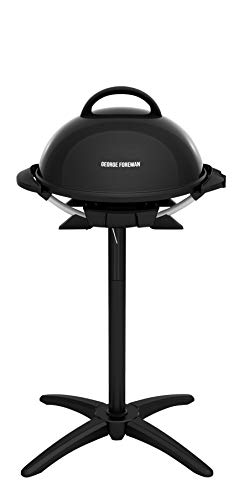
For balcony and apartment cooks, clean-up includes a constraint nobody else faces: no ash disposal, no grease dumping, sometimes no outdoor water. This Foreman answers with the simplest possible system — a nonstick cooking plate that lifts out to wash, a drip tray that catches everything the sloped surface sheds, and electric heat that makes no ash, no soot and no flare-up residue. The stand removes for tabletop or indoor use, and the 15-serving surface handles family batches.
Strengths
- Removable nonstick plate and drip tray — the whole mess washes at the sink
- Electric heat means zero ash, zero charcoal dust, zero tank grease
- Stand removes for indoor tabletop use when weather or rules say no
Trade-offs
- Electric searing is gentler than gas or charcoal — manage expectations on crust
- Nonstick surface requires non-metal tools to stay easy-clean
- Needs an outdoor outlet within cord reach on the patio
| Capacity | 15 servings |
| Design | Domed electric grill, removable stand |
| Surface | Nonstick cooking plate |
| Use | Indoor/outdoor electric |
The clean-up session here is measured in the kitchen, not at the grill: plate and tray to the sink, a wipe of the dome, done. Because the fat drains continuously into the tray during cooking, there is no pooled grease to burn off and no smoke plume to apologize for — a real consideration where the neighbors are six feet away and the lease has opinions about open flame.
It cooks the electric way — steady, even, forgiving — and produces genuinely good burgers, chicken, vegetables and seafood for a crowd-sized batch. For the apartment brief, where clean-up and compliance matter as much as char, it is the most livable grill in this guide.
Apartment owners should note the storage half of this grill’s tidiness: the stand removes, the dome closes over a clean plate, and the whole unit stores in a closet without smelling like a grill — because the fat left in the tray, not baked onto a firebox. For small homes, a grill that stores odor-free is as important as one that cooks well, and very few outdoor grills can make that claim.
The drip tray is the whole inspection schedule on this grill: if it is emptying cleanly and the plate releases food well, the grill is healthy. When the nonstick eventually tires after years of service, replacement plates restore it — another quiet advantage of a design built around removable parts.
Best for: apartments, condos and covered patios with open-flame restrictions / Not suited for: charcoal flavor or high-heat steakhouse searing
Check on Amazon to see the current configuration and delivery options for the Foreman Indoor/Outdoor.

Weber Go-Anywhere Portable Charcoal Grill — Best Small Charcoal
The Go-Anywhere’s clean-up advantage is arithmetic: a grill this size burns a small load of charcoal, so the ash it makes fits in a coffee can, and the whole cooker is small enough to carry to a bin and tip rather than scoop. Its folding legs lock the lid down for transport, which means the ash and the grate travel sealed inside the grill — the portable clean-up problem, solved by containment.
Strengths
- Tiny ash volume — the whole clean-out is a tip into a bin once cold
- Legs fold over the lid, sealing ash and grate inside for transport
- Rectangular format packs flat and wipes down in moments
Trade-offs
- Cooking area suits two people, or four eating in waves
- No ash catcher system — you are the ash system, at very small scale
- Low profile means ground-level cooking without a table
| Design | Rectangular portable charcoal grill |
| Body | Porcelain-enameled steel |
| Extras | Folding locking legs, plated steel grate |
There is an underappreciated clean-up category: the mess a grill makes of your car. The Go-Anywhere’s sealed-lid carry is the feature owners mention years later — no ash dusting the trunk, no greasy grate in a plastic bag. At the site, the routine is burn, brush, cool, tip, lock, go. Nothing else in charcoal is this tidy at this size.
Cooking is honest small-batch charcoal: the rectangular grate takes a line of skewers, a couple of steaks or a round of burgers, and the enamel body shrugs off seasons of travel. For couples who picnic, camp and tailgate, it is the charcoal grill whose clean-up never becomes the reason to stay home.
The Go-Anywhere’s other clean-up virtue is at the sink: the rectangular grate and the small enamel body are both hand-sized, so the seasonal deep clean is a single basin of soapy water rather than a driveway operation. Dry it, oil the grate lightly, lock the lid, and it stores on a shelf like a lunchbox — which, in shape and spirit, is exactly what it is.
For car campers, the Go-Anywhere’s sealed carry also protects the next meal: no ash dust migrates to the cooler, the chairs or the tent. Tidiness in transit is a campsite virtue that only fully makes sense after one trip with a grill that lacks it.
Best for: couples, picnics and campsites where the grill travels in the car / Not suited for: family-size batches or stand-up cooking comfort
Check on Amazon to see the current configuration and delivery options for the Go-Anywhere Charcoal.

Char-Griller AKORN Jr. Portable Kamado Charcoal Grill and Smoker — Best Compact Kamado
The AKORN Jr. miniaturizes the kamado clean-up story: triple-wall insulated steel burns charcoal so efficiently that the ash left after a cook is a fraction of what a kettle of similar cooking size produces, and it collects in a removable ash pan rather than the body of the grill. The cast iron grate brushes clean, the body wipes down, and the whole unit is sized for a tabletop at the campsite or a small patio at home.
Strengths
- Kamado efficiency means minimal charcoal use and minimal ash per cook
- Removable ash pan keeps the body clean and the routine short
- Insulated steel body is light, tough and travel-friendly
Trade-offs
- Compact cooking surface — plan on batches for two to four
- Steel body wants a cover outdoors; it is not ceramic
- Temperature overshoots if you light aggressively — start vents modestly
| Design | Portable kamado, triple-wall insulated steel |
| Grates | Cast iron |
| Ash | Removable ash pan |
Small grills usually clean easily because they are small; the Jr. adds the kamado multiplier, because insulation means the fire you light is the fire you need — no half-chimney of charcoal burned just to hold temperature, and correspondingly little ash to show for a full cook. For apartment patios where ash disposal is a walk to a distant bin, that arithmetic is the whole ballgame.
As a cooker it punches far above its footprint: genuine low-and-slow capability, high-heat searing, and smoking that full-size owners respect. It is the pick for the cook who wants kamado results and kamado tidiness in a grill one person can carry.
Because the Jr. sips charcoal, it also changes the ash-storage math at home: a small household can run it for weeks on the ash output a big barrel makes in one party. The ash pan empties into the same metal container you keep for any charcoal grill, just far less often — and the insulated body stays cleaner outside too, since there is no thin, heat-blistered paint to trap grime.
The Jr.’s ash pan has one more virtue: it makes the grill rental- and guest-friendly. A borrowed kamado that comes back with its ash in a pan, not caked in its base, is a kamado that gets lent again — small design, long friendships.
Best for: small patios, campers and couples who want kamado cooking / Not suited for: groups above four or uncovered long-term storage
Check on Amazon to see the current configuration and delivery options for the AKORN Jr..
Comparison Table
The Key Spec column is really a clean-up method column: sweep, burn off, scrape, rinse, tip, or pan. Choose the verb you can live with weekly.
| Pick | Badge | Key Spec | Best For |
|---|---|---|---|
| Weber Original Kettle Charcoal Grill, 22-Inch (Black) | Best Overall | One-Touch ash sweep, enamel bowl, 22-inch | anyone who wants the shortest repeatable clean-up in charcoal grilling |
| Kamado Joe Classic Joe Series II 18-Inch Ceramic Charcoal Grill | Best Self-Cleaning | Ceramic kamado, burn-off self-cleaning, ash drawer | frequent cooks who want near-zero routine cleaning and periodic self-cleaning |
| Blackstone 1666 22-Inch Tabletop Griddle | Best Griddle Clean-Up | 22-inch flat top, scrape-clean, grease cup | breakfast and flat-top fans, campers, and anyone who hates brushing grates |
| George Foreman Indoor/Outdoor Electric Grill with Stand, 15-Serving | Best for Apartments | Removable plate and drip tray, 15 servings, electric | apartments, condos and covered patios with open-flame restrictions |
| Weber Go-Anywhere Portable Charcoal Grill | Best Small Charcoal | Compact charcoal, locking lid, minimal ash | couples, picnics and campsites where the grill travels in the car |
| Char-Griller AKORN Jr. Portable Kamado Charcoal Grill and Smoker | Best Compact Kamado | Portable insulated kamado, ash pan, cast iron grate | small patios, campers and couples who want kamado cooking |
How to Choose the Best Easy Clean Up Grills by Clean-Up Style
Forget features for a moment and choose your verb. Sweep: kettles with ash systems, four actions, done tomorrow when the ash is cold. Burn off: kamados, near-zero routine effort plus a periodic self-cleaning fire. Scrape: griddles, ninety seconds while hot, but a seasoning habit forever. Rinse: electrics with removable plates, the only style that ends at a sink with soap. Tip: tiny portables, where the whole grill goes to the bin. Every style is legitimately easy; the wrong choice is the one whose verb you personally dislike, because disliked routines get skipped.
Then check the containment path end to end. Where does the mess start, where does it travel, and where does it end? A sweeper that drops ash into an open pan you carry through the house is a different product from one with a sealed catcher. A grease tray you pull from the front beats one you reach under a hot grill for. Follow the mess on paper before you buy, and the clean-up will match the promise.
The cold-ash rule and other non-negotiables
Charcoal clean-up has one safety rule that outranks tidiness: ash comes out cold, into a metal container, never into a plastic bin or a cardboard box the same night. Seemingly dead ash insulates live embers for a day or more. The grills in this guide make the cold routine fast, but none of them makes it skippable — build the next-day sweep into your rhythm and it costs nothing.
Budget tiers, honestly framed
Clean-up quality tracks build quality more than price tier: a simple kettle with a sweeper out-cleans a costly feature grill with a plain bowl. Budget picks can be excellent here if the ash or grease path is designed — that is why this list includes a decades-old portable design. Spend first on the containment system, then on cooking features; the reverse order is how grills become garage clutter.
The Five-Minute Finish: A Universal Clean-Up Sequence
Whatever you cook on, this sequence works: while the grill is hot, burn off and brush (or scrape, for a griddle). While it cools, empty what is meant to be emptied hot-safe — drip trays on electrics, grease cups once they will not splash. When cold, move the ash — sweep, pan or tip — into a metal container. Wipe the surfaces hands touch: handles, knobs, lid edges. Close everything, cover if you cover, and walk away.
Timed honestly, that is three to five minutes for the grills in this guide, and it is the difference between a grill that is always ready and one that needs a Saturday. The sequence also doubles as an inspection: you will notice a thinning heat tent, a stiff damper or a full gasket long before any of them becomes a failure mid-cook.
Setting Up a Clean-Up Station So the Routine Sticks
Friction kills routines, so remove it once: keep the brush hanging on the grill, the metal ash container within two steps, a squeeze bottle and scraper at the griddle, and a small caddy with a towel, tongs and oil where you cook. When every tool lives at the grill, the five-minute finish needs no fetching, and fetching is where good intentions go to die.
Do the same for consumables: spare grease pans, a bag of charcoal, and a backup igniter battery stored with the grill mean the routine never stalls on a missing item. This sounds like housekeeping because it is — and it is the unglamorous difference between the grill that is always ready and the one that needs a Saturday before it can cook a Tuesday burger.
Clean-Up Times, Honestly Compared
Put rough numbers on the verbs. Sweep (kettle): about a minute of active work, split across two days by the cold-ash rule. Burn off (kamado): near-zero active minutes most cooks, plus a periodic hot run you can combine with pizza night. Scrape (griddle): ninety seconds, same session, every time. Rinse (electrics): two minutes at the sink, or zero with a dishwasher doing the work. Tip (small portables): a minute, once cold. Drawer and pan systems on big charcoal grills: two minutes, and the reason big charcoal stays civilized.
Notice that no honest style reaches zero — and that the differences between styles are smaller than the difference between doing a routine and skipping it. A skipped five-minute routine becomes a two-hour seasonal excavation on any grill ever made. So the real buying question is never ‘which cleans fastest’ but ‘which will I still be doing in month six’ — and that is a question about your temperament, which is why this guide presents the verbs and lets you choose.
When Clean-Up Is the Reason to Replace a Grill
Sometimes the honest advice is that a grill’s clean-up problem is not a habit problem — it is a design problem with no fix. The signs: a bowl with no ash path that must be tipped or scooped, a firebox whose grease pools where you cannot reach, grates that need two hands and a screwdriver to remove, or parts that cannot be washed because nothing on the grill was designed to come apart. If your current grill shows two or more of those, no routine in this guide will rescue it, and upgrading to a designed system is a rational purchase, not an indulgence.
Judge replacements by the verbs in this guide and by the glove test from our companion article: can you perform the whole clean-up, gloved, in the order you would want, without tools? The six picks here pass that test in six different styles. That is the standard — not a feature list, not a coating claim — and once you have owned a grill that meets it, the scoop-and-dread era is not something you will volunteer to repeat.
How to Handle Ash and Grease Safely After Every Cook
Easy clean-up is only easy if it is safe. These are the handling rules behind the routines in this guide, in the order you will use them:
- Let charcoal ash cool at least 24 hours in the closed grill before moving it — 48 is better after a long, hot cook. Treat all ash as live until proven cold.
- Transfer ash only into a metal container with a metal lid, set on a non-combustible surface away from the house, deck boards and the fuel supply.
- Keep ash containers outdoors for several days before the contents join household trash, and never vacuum warm ash with a household vacuum.
- Grease trays and cups: let them cool enough to handle safely, then empty into a sealed container for the trash — never pour hot grease into a drain or onto the ground.
- Wipe grease spills on the patio promptly; they are slip hazards, pest invitations and deck stains in that order.
- For griddles, scrape while hot but wipe the final oil film with a folded towel held in tongs — the plate stays hot longer than it looks.
- Wash removable plates and trays fully dry before refitting; a damp tray stored in a closed grill is a rust appointment.
- End every session with the same glance: vents and valves set safe, fuel off or ash contained, lid closed, cover on if used.
Build these into the routine and clean-up stops being a chore with hazards attached and becomes what it is on the grills above: a short, calm closing ritual for the cook.
Common Buying Mistakes
The clean-up mistakes that undo good grill design:
Dumping ash the same night
The most dangerous item on this list. Ash insulates embers for a day or longer, and plastic bins and garage corners are where that lesson gets learned. Cold ash, metal container, outdoors — every time, however tidy you feel.
Cleaning a cold grill with chemicals instead of a hot grill with a brush
Residue that a hot brush removes in seconds becomes a chemical soaking project when cold. If you find yourself buying degreaser monthly, the routine — not the product — is the problem.
Washing a griddle like a pan
Soap and soaking strip a griddle’s seasoning and invite rust. Scrape, steam with water, wipe, oil — the flat top cleans by heat and friction, and washing it like cookware ruins the surface that makes it nonstick.
Forgetting the underside and the tray rail
Grease migrates: under the firebox, along tray rails, into caster wheels. A monthly wipe of the hidden path prevents the drips-on-the-patio mystery and the smell that makes neighbors philosophical.
Storing removable parts damp
Plates, trays and catchers put away wet will rust or mildew inside a closed grill. Thirty seconds with a towel at the sink is the cheapest maintenance in this entire guide.
Final Recommendation
Pick your verb and the choice resolves. Sweep: the Original Kettle 22, the shortest repeatable routine in charcoal. Burn off: the Kamado Joe Classic Joe II, which incinerates its own mess and asks for a brush in between. Scrape: the Blackstone 1666, ninety seconds to a clean, seasoned top. Rinse: the George Foreman Indoor/Outdoor, whose plate and tray simply go to the sink.
Travel light with the Go-Anywhere’s tip-and-lock routine, or take kamado efficiency small with the AKORN Jr. and its ash pan. Every pick here ends a cook the same way — quickly, tidily, and with a grill that is ready for tomorrow. That readiness, repeated all season, is what easy clean up actually means.
Ready to check today’s configurations? Start with the top three: Weber Original Kettle Charcoal Grill, 22-Inch (Black), Kamado Joe Classic Joe Series II 18-Inch Ceramic Charcoal Grill, Blackstone 1666 22-Inch Tabletop Griddle — each listing shows the current setup and delivery options.
Keep exploring the cluster before you decide: Best Easy Clean Bbq Grills Best Durable Charcoal Grills Best Easy To Use Grills Best Easy Storage Camping Grills Best Kamado Grills Best Portable Grills.
Frequently Asked Questions
What is the fastest grill type to clean up after cooking?
A griddle, cleaned hot with a scraper and a splash of water, is fastest at about ninety seconds — but it asks for a seasoning wipe every time. Removable-plate electrics are a close second and need no technique at all: the parts go to the sink or dishwasher and the job is done.
How long must charcoal ash cool before I can empty it?
At least 24 hours in the closed grill, and 48 after a long hot cook, before it goes into a metal container — and the container should stay outdoors on a non-combustible surface for a few days before its contents join household trash. Ash insulates embers far longer than intuition suggests.
Do kamados really clean themselves?
Mostly, yes: a periodic high-heat run carbonizes grease and residue inside the ceramic body, the same principle as a self-cleaning oven. You still brush the grates, empty the ash drawer and maintain the gasket — but there is no scrubbing of the interior, ever, and no chemicals should touch the porous ceramic.
Can I speed up clean-up by lining the grill with foil?
Foil in a drip area you then discard can help on some gas grills, but never block vents, wrap grates, or line a charcoal bowl in ways that trap ash and moisture against metal. Designed systems — trays, pans, sweepers — beat improvised ones, and foil ash left sitting is still ash sitting.
Why does my grill still look dirty after I clean it?
Seasoning and carbon patina are not dirt: a blackened grate and a smoke-stained lid interior are the normal, healthy state of a used grill. Clean means no loose residue, no grease pools, no ash load and no rancid film — not showroom shine. Chasing shine with chemicals usually damages the surfaces that keep a grill easy to clean.
Is it worth paying more purely for easier clean-up?
If you grill weekly, emphatically yes — clean-up friction is the top reason grills fall out of use, and an unused grill has a cost per cook of infinity. A sweeper, a sealed catcher, a removable tray or a dishwasher-safe plate is not a luxury feature; it is the feature that keeps every other feature in your life.
Should I oil the grates after cleaning?
A whisper of high-heat oil on a warm, clean grate protects cast iron and steel from rust and builds the seasoning that makes food release — yes, as a habit. Keep it thin: puddled oil turns gummy and smokes at the next preheat. Porcelain-enameled and stainless grates need it less, but a light wipe does them no harm.


