Disclosure: airfryerkitchensupply.com is reader-supported. When you buy through links on our site, we may earn an affiliate commission at no extra cost to you.
Where to buy
This guide to the best dual coffee and espresso machines links only to models we verified against the manufacturer’s own listing, so the shortlist below is the right place to start comparing.
Dual coffee and espresso machines — one appliance that brews a pot of drip coffee on one side and pulls espresso on the other — are sold through Amazon and most appliance retailers. Amazon is where we verified every pick in this guide against the manufacturer’s own listing, and it is the easiest channel for comparing the closely related De’Longhi and Ninja models without a showroom trip. These are bulky countertop appliances, so confirm the dimensions in the listing against your counter before ordering.
A practical tip for this category: buy from a listing that bundles or clearly offers the machine’s matching permanent filter and a starter supply of descaler. Combi machines have two water circuits to look after, and having the maintenance basics in the first box saves a second order within the month. Check the current price on Amazon for each model, as combi machines are promoted heavily around holiday periods.
- De’Longhi All-in-One Coffee and Espresso Maker (COM530M) — Check the current price on Amazon
- De’Longhi Combi (BCO430) — Check the current price on Amazon
- De’Longhi All-in-One (COM630BK) — Check the current price on Amazon
- Ninja DualBrew Prestige (CFN801) — Check the current price on Amazon
- Cuisinart Coffee Center Barista Bar (SS-4N1NAS) — Check the current price on Amazon
- Ninja Espresso and Coffee Barista System (CFN601) — Check the current price on Amazon
The best dual coffee and espresso machines exist for a very specific household argument: one person drinks filter coffee by the pot, the other wants a cappuccino, and neither is willing to give up counter space to two machines. A combi machine settles the argument with a shared footprint — a drip brewer with a carafe on one side, a pump espresso maker with a steam wand on the other, and in the newer pod-hybrid designs, a single-serve brewer standing in for the pot. Done well, it is the most space-efficient way to cover a whole household’s coffee habits.
Done badly, a combi is two mediocre machines welded together, which is why this category needs careful buying. The honest picture in 2026 is that two brands do combis properly. De’Longhi has refined the two-sided format for years, with dual heating systems that let both sides work at once. Ninja has attacked the same problem from the single-serve direction, combining espresso-style drinks and filter-style coffee in one compact unit. Every pick below was verified model-by-model against the manufacturer’s Amazon listing before we linked it.
Set your expectations correctly before you buy. A combi’s espresso side is a genuine pump machine, but it will not match a dedicated dual boiler for temperature finesse, and its drip side will not out-brew a top standalone coffee maker. What it offers instead is coverage: every drink your household actually makes, from one machine, on one stretch of counter. For the households that is aimed at, coverage wins.
There is also a quieter benefit to the format that owners mention after the first month: a combi simplifies the kitchen’s coffee economy. One machine to descale (twice over, admittedly), one water routine, one spot where every coffee item in the house — beans, filters, cups — naturally gathers. Guests find it without instruction, teenagers operate it without training, and the household’s coffee stops depending on any one person’s expertise. For busy homes, that social simplicity is worth as much as the drinks themselves, and it is why combi owners tend to replace a dead combi with another combi rather than splitting back into separates.
In this guide
Quick Picks
Six verified combi and hybrid machines. De’Longhi owns the classic two-sided format; Ninja owns the modern pod-and-grounds hybrid. Badges repeat in the full reviews so you can navigate quickly.
- De’Longhi All-in-One Coffee and Espresso Maker (COM530M) — Best Overall. The most complete classic combi: a 10-cup drip side and a pump espresso side with a dual heating system, so a pot can brew while a cappuccino is being steamed. Check price on Amazon.
- De’Longhi Combi (BCO430) — Best Budget Classic Combi. The long-running entry point to the De’Longhi combi line: full drip brewer on one side, pump espresso and steam on the other, at the friendliest price of the classic format. Check price on Amazon.
- De’Longhi All-in-One (COM630BK) — Best for Cappuccino Lovers. The newest All-in-One generation with De’Longhi’s Advanced Cappuccino System, aimed squarely at households whose espresso side exists mainly for milk drinks. Check price on Amazon.
- Ninja DualBrew Prestige (CFN801) — Best Pod-and-Grounds Hybrid. Ninja’s 2-in-1 answer: espresso-style drinks from Nespresso-compatible capsules or grounds, plus single-serve filter-style coffee — no carafe, no wasted pot. Check price on Amazon.
- Cuisinart Coffee Center Barista Bar (SS-4N1NAS) — Best 4-in-1 Versatility. Four machines in one chassis: single-serve coffee, espresso, steam wand and hot water — the widest drink coverage of any pick here. Check price on Amazon.
- Ninja Espresso and Coffee Barista System (CFN601) — Best for Espresso-Style Variety. The original Ninja Barista System: capsule-based espresso in three styles plus grounds coffee, in a slim footprint at a friendlier price than the Prestige. Check price on Amazon.
How These Picks Were Chosen
Verification came first, as always on this site. Each machine below was searched by brand and model attached to this site, and the returned listing title had to match the exact model — including the difference between De’Longhi’s several similarly named All-in-One generations — before a link was attached. Combi machines are a category where a single letter in a model code changes the heating system, so we treated near-matches as failures, not as close enough.
Our judging criteria were specific to the format. Both sides had to be genuinely usable, not a headline side and a token side: the drip brewer had to hold temperature and brew a full, honest pot, and the espresso side had to be a real pump machine with a steam wand that can texture milk. We then weighed simultaneous operation — the best combis brew and steam at the same time thanks to dual heating — footprint, carafe type, and how punishing the cleaning routine is when two systems share one chassis.
We also considered who each machine leaves out. Pod-hybrid machines delight single-serve households but cannot brew a pot for guests; classic combis brew the pot but ask more counter depth and more cleaning. The reviews name those limits openly, because the right combi is the one whose compromises your household will never notice.
Two category realities shaped this list. First, the classic combi market has consolidated: beyond De’Longhi, most historical combi makers have exited or let their models age out, which is why one brand holds three of the six places — those places were earned against the hybrids, not gifted. Second, several no-name combis with impressive listings could not be verified to a manufacturer’s own product through the API, and were excluded on that ground alone. A combi is a ten-year appliance; the badge’s support network is part of the product.
The 6 Best Dual Coffee and Espresso Machines, Reviewed
The first three picks are classic two-sided combis; the last three are the newer hybrid designs. If your household’s centre of gravity is a morning pot of coffee, start at the top. If it is single cups through the day, start at the Ninja and Cuisinart picks.

De’Longhi All-in-One Coffee and Espresso Maker (COM530M) — Best Overall
The COM530M is the combi format done by the company that understands it best. Its dual heating system is the headline: unlike cheap combis that make you pick a side, this machine can brew a pot of drip coffee while the espresso side steams milk, because each side has its own heating circuit. For a two-coffee-drinker household with different religions, that simultaneity is the entire point of the category — and this is the machine that delivers it most completely.
- Combination coffee and espresso machine (confirmed in the manufacturer’s listing title)
- Model: COM530M
- 47-ounce class reservoir design
- Dual heating system for simultaneous use
Strengths
- Dual heating lets both sides work at the same time
- Espresso side is a proper pump machine with a usable steam wand
- Drip side brews a full pot with a programmable timer for mornings
Trade-offs
- One of the largest footprints in this guide
- Two systems means two cleaning and descaling routines
- Espresso finesse trails a dedicated machine, as with all combis
In a real kitchen the COM530M behaves like a peace treaty. The drip side handles weekday mornings on a timer, the espresso side handles weekend cappuccinos, and neither user queues behind the other. The espresso extraction is honest — fresh grounds, a warmed portafilter and reasonable beans produce a sweet, balanced shot — and the wand textures milk well enough for latte art with a little practice.
The costs are size and upkeep. This machine claims a serious slab of counter, and you are maintaining a drip brewer and an espresso machine that happen to share a body: two descaling schedules, two sets of parts to wash. Households that genuinely use both sides weekly will not mind. Households that use one side monthly should buy the dedicated machine instead — a warning that applies to the whole category, and which this otherwise excellent machine cannot escape.
Ownership tip from long-term combi users: keep the two sides on different cleaning clocks and write both on the same note — drip side descaled quarterly, espresso side backflushed and descaled on its own cycle — because the side you forget is the side that clogs during a dinner party. The carafe side’s brew basket and the espresso portafilter both reward a weekly soak. In return the machine asks little else, and its size, so imposing on day one, simply becomes the kitchen’s coffee wall that everything else arranges around.
Best for: households split between pot coffee and espresso drinks / Not suited for: single-drink households or anyone short on counter depth
Check the current price on Amazon

De’Longhi Combi (BCO430) — Best Budget Classic Combi
The BCO430 is the combi that has introduced more households to the format than any other, and it stays in this guide because its fundamentals are right. You get a complete drip coffee maker, a pump-driven espresso side with a steam wand for cappuccinos, and a layout that puts water filling at the front — a small mercy anyone who has dragged a machine out from under cabinets will appreciate. It is the classic combi at its most accessible price.
- Coffee and espresso combination machine (confirmed in the manufacturer’s listing title)
- Model: BCO430
- Drip side with carafe; espresso side with steam wand
- Front-loading water access design
Strengths
- Lowest-cost way into a genuine two-sided combi
- Front water access suits under-cabinet counters
- Simple, proven controls with nothing to learn
Trade-offs
- Does not match the COM530M’s simultaneous dual-heating performance
- Materials and finish are a step below the newer All-in-One models
- Espresso side rewards patience while it heats
What you give up against the newer COM530M is refinement: the BCO430 asks a little more patience between functions and feels more appliance-grade in the hand. What you keep is everything that makes a combi useful — a real pot of coffee, real espresso, real steamed milk — in a machine whose controls a guest can operate without instructions.
For a first combi, or a second-home kitchen, that balance is exactly right. It is also a sensible buy for households unsure whether the espresso side will earn its keep: the investment is modest, and if the wand ends up neglected, the drip side still justifies the counter space on its own. Check the current price on Amazon, where it is discounted frequently.
The BCO430’s ownership charm is its lack of mystery: no app, no firmware, no modes to mis-set — a guest or a teenager can run it after one demonstration. Its parts are widely available because the model has sold for years, and its resale and hand-me-down value hold up for the same reason. Expect the espresso side to reward fresh beans far more than technique; with pre-ground coffee it is pleasant, with a small grinder beside it, it is genuinely good. It is the combi most likely to still be working, somewhere, in fifteen years.
Best for: first-time combi buyers and second homes / Not suited for: households that need both sides running simultaneously every day
Check the current price on Amazon

De’Longhi All-in-One (COM630BK) — Best for Cappuccino Lovers
The COM630BK is the current-generation answer to a specific brief: a combi whose espresso side is optimised for cappuccinos and lattes rather than straight shots. Its Advanced Cappuccino System is designed to produce dense, consistent foam with less technique than a fully manual wand, while the drip side remains a full-size brewer. If your household’s espresso order is always milky, this is the combi tuned to your taste.
- All-in-one combination coffee and espresso machine (confirmed in the manufacturer’s listing title)
- Model: COM630BK
- Advanced Cappuccino System milk frothing
- Dual heating system
Strengths
- Frothing system makes cappuccino foam easy and repeatable
- Current-generation design with dual heating for both sides
- Black finish suits modern kitchens better than older silver combis
Trade-offs
- Milk-first design is wasted on straight-espresso drinkers
- Premium positioning within the combi range
- Same two-system cleaning burden as every classic combi
Milk is where combi machines usually disappoint — a weak wand turns the espresso side into a novelty. The COM630BK attacks that weakness directly, and the result is the combi we would hand to a household that measures success in cappuccinos per week. Foam quality is consistent enough that different family members get similar drinks, which is rarer than it should be in this category.
As with the COM530M, the cautions are footprint and upkeep rather than performance. Buy it if milk drinks are the point of the espresso side in your home; if they are not, the COM530M above is the more balanced spend. Either way, verify the current listing matches the COM630BK model code before ordering — De’Longhi’s combi naming is close enough between generations to catch out a hurried buyer.
The cappuccino system that defines this model needs its milk circuit rinsed after use — a thirty-second habit that keeps foam quality where it should be. Owners who build the rinse into the drink-making routine report the machine stays ‘new’ for years; owners who do not, meet the consequences in the steam wand first. Otherwise its ownership profile matches the COM530M: two descaling schedules, a generous footprint, and a household that gradually stops visiting cafés on weekends because the home cappuccino closed the gap.
Best for: cappuccino and latte households that also brew pot coffee / Not suited for: straight-espresso drinkers or minimalists
Check the current price on Amazon

Ninja DualBrew Prestige (CFN801) — Best Pod-and-Grounds Hybrid
The DualBrew Prestige rethinks the dual machine for households that never brew a pot. One side of its personality makes espresso-style drinks — from capsules or from your own grounds — in three brew styles; the other makes single servings of filter-style coffee in several sizes. Nothing is wasted, nothing sits stewing on a hot plate, and the whole machine is dramatically smaller than a classic combi.
- 2-in-1 espresso and coffee system (confirmed in the manufacturer’s listing title)
- Model: CFN801 (DualBrew Prestige)
- Nespresso capsule compatible and grounds brewing
- Three espresso brew styles
Strengths
- Capsule convenience and grounds flexibility in one compact machine
- Single-serve format eliminates stale leftover coffee
- Three espresso styles cover ristretto-to-lungo tastes
Trade-offs
- Cannot brew a full carafe for a table of guests
- Espresso-style output is not identical to a portafilter machine’s
- Capsule habit adds ongoing cost and waste if you lean on it
Ninja understands its buyer precisely: someone whose household drinks coffee one cup at a time, at different strengths, at different hours. For that household the Prestige is arguably better than a classic combi — fresher cups, less cleaning, half the counter. The espresso side, especially with fresh grounds, produces a convincing, crema-topped drink that satisfies all but committed espresso hobbyists.
The limits are structural. A dinner party of eight means eight sequential brews, and purists will note the extraction is espresso-style rather than true portafilter espresso. If your household fits the single-serve pattern, neither limit will ever bite. If it does not, the De’Longhi combis above exist for you. Check price on Amazon before deciding, as the Prestige is promoted aggressively.
Prestige ownership is about keeping both input paths honest: capsules for speed, grounds for quality, and a water tank that gets rinsed rather than endlessly topped up. The machine’s brew basket and capsule holder both collect oils, so a weekly hot wash keeps flavours clean — the difference is obvious in the cup within a fortnight of neglect. Its compact body also makes it the only pick here that realistically relocates: to a home office desk, a holiday let, a dorm-adjacent first flat. Portability, in this category, is a feature owners use more than they predict.
Best for: single-serve households mixing capsules and grounds / Not suited for: households that regularly brew coffee for a group
Check the current price on Amazon

Cuisinart Coffee Center Barista Bar (SS-4N1NAS) — Best 4-in-1 Versatility
Cuisinart’s Barista Bar takes the coverage brief furthest: a single-serve brewer for weekday cups, an espresso function for weekends, a steam wand for milk, and hot water on demand for tea drinkers who usually get forgotten in coffee machine design. If your counter hosts several different drink habits and exactly zero spare space, this is the machine engineered around your problem.
- 4-in-1 coffee maker (confirmed in the manufacturer’s listing title)
- Model: SS-4N1NAS
- Single-serve pods compatible; three brewing sizes
- Espresso function with steam wand
Strengths
- Broadest drink coverage in this guide, including hot water for tea
- Single-serve side accepts pods for maximum weekday convenience
- Cuisinart’s support network is a plus for a complex appliance
Trade-offs
- Jack of all trades: each function is good rather than class-leading
- No full carafe — groups are served one cup at a time
- Many functions mean many parts in the cleaning routine
The Barista Bar’s appeal is arithmetic: it replaces up to four appliances, and for small kitchens that arithmetic beats any single function’s refinement. The espresso it makes is honest café-style coffee, the single-serve side is as convenient as any pod brewer, and the steam wand handles a cappuccino without embarrassment. Tea drinkers finally get instant hot water without a kettle queue.
Buy it with clear eyes about the trade: a dedicated machine will beat it at any one job. But households are not single jobs, and for a mixed-drink home the Barista Bar’s coverage is the most practical in this guide. As always with multi-function appliances, keep up the descaling — several water paths mean several places for scale to hide.
Four functions means four small routines, and the owners who love this machine are the ones who consolidate them: one weekly session that washes the brew basket, portafilter, wand tip and water reservoir together. The hot-water function, easily overlooked, tends to become a quiet favourite — tea, instant soups, and blanching all route through it. Cuisinart’s support reach matters more on a machine this multifunctional; register it, keep the manual, and the Barista Bar’s complexity stays an asset rather than becoming a liability.
Best for: mixed-drink households with minimal counter space / Not suited for: purists about any single drink, or carafe households
Check the current price on Amazon
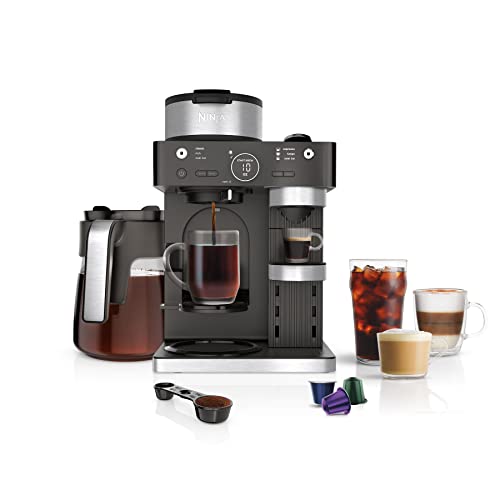
Ninja Espresso and Coffee Barista System (CFN601) — Best for Espresso-Style Variety
The CFN601 is where Ninja’s barista system began, and it remains the value way into the concept. It brews espresso-style drinks from Nespresso-compatible capsules in three styles, handles grounds for filter-style coffee, and does it all from a slim countertop body that suits apartments the classic combis would overwhelm. Households that live on capsules will feel immediately at home.
- Espresso and coffee maker (confirmed in the manufacturer’s listing title)
- Model: CFN601
- Nespresso capsule compatible
- Barista system with three espresso brew styles
Strengths
- Slim footprint fits apartments and small kitchens
- Three espresso styles from widely available capsules
- Friendly price for the hybrid category
Trade-offs
- Capsule-led design; grounds play a supporting role
- No carafe and no portafilter — convenience over craft
- Superseded in features by the DualBrew Prestige above
Choose the CFN601 over the Prestige when your household’s espresso genuinely comes from capsules and the Prestige’s extra flexibility would go unused. The drinks are consistent, the machine is quick, and the daily routine is close to effortless — which, for capsule households, is not a compromise but the goal.
Its place in this guide is as the honest budget hybrid: it covers the two drinks most single-serve households make, in the smallest box, for the least money of the modern designs. If you later fall for espresso as a hobby, no combi will follow you there — but as a household appliance, the CFN601 earns its counter space every single day.
The CFN601 asks the least of its owner of any machine here: capsules in, drink out, an occasional rinse and descale. That simplicity is precisely its value in a second home, a rental or a first flat, where a portafilter machine’s learning curve would simply mean the machine goes unused. Keep a capsule recycling route in the kitchen — a countertop caddy or the maker’s bag scheme — and its one environmental awkwardness is managed. For households that later catch the espresso bug, it also makes an unusually graceful hand-me-down.
Best for: capsule households in smaller kitchens / Not suited for: grounds-first drinkers or anyone wanting a carafe option
Check the current price on Amazon
Comparison Table
The category divides cleanly in this table: classic combis (rows one to three) brew pots and pull portafilter shots; hybrids (rows four to six) trade the carafe for single-serve speed and smaller footprints. Decide which family fits your household first — the model choice follows easily.
| Pick | Badge | Key spec | Best for |
|---|---|---|---|
| De’Longhi All-in-One Coffee and Espresso Maker (COM530M) | Best Overall | Dual heating, 10-cup drip + espresso | households split between pot coffee and espresso drinks |
| De’Longhi Combi (BCO430) | Best Budget Classic Combi | Classic combi layout, front-access water | first-time combi buyers and second homes |
| De’Longhi All-in-One (COM630BK) | Best for Cappuccino Lovers | Advanced Cappuccino System, dual heating | cappuccino and latte households that also brew pot coffee |
| Ninja DualBrew Prestige (CFN801) | Best Pod-and-Grounds Hybrid | Capsule + grounds, 3 espresso styles | single-serve households mixing capsules and grounds |
| Cuisinart Coffee Center Barista Bar (SS-4N1NAS) | Best 4-in-1 Versatility | 4-in-1: single-serve, espresso, steam, hot water | mixed-drink households with minimal counter space |
| Ninja Espresso and Coffee Barista System (CFN601) | Best for Espresso-Style Variety | Capsule espresso, 3 styles, slim body | capsule households in smaller kitchens |
What Counts as a Dual Coffee and Espresso Machine?
The classic definition is one chassis containing a drip coffee brewer and a pump espresso machine, ideally with independent heating so both can run together. De’Longhi’s All-in-One line is the modern benchmark for that format. The newer, looser definition — used by Ninja and Cuisinart — is one machine that covers both drink families by any mechanism: capsules, grounds, single-serve brewing and espresso-style extraction in a single compact unit.
Both definitions are legitimate, but they serve different households, and confusing them is the most common buying error in this category. A household that brews a Sunday pot for six should not buy a hybrid and queue eight single cups; a household of two that drinks at different times should not buy a classic combi and wash a carafe daily for two mugs. This guide includes both families and labels them clearly so you can shop inside the right one.
How to Choose Between a Classic Combi and a Hybrid?
Ask three questions. First: does your household brew coffee by the pot at least twice a week? If yes, a classic combi is your shortlist. Second: do you want real portafilter espresso with a steam wand you control, or capsule convenience? Portafilter points classic; capsules point hybrid. Third: how much counter can you honestly surrender? Classic combis are the largest appliances in this guide; hybrids are closer to a standard coffee maker.
- Choose a classic combi if: you host, you brew pots, you want to learn milk steaming, and you have the counter depth.
- Choose a hybrid if: every drink in your house is a single serving, mornings are rushed, and counter space is the scarcest resource you own.
- Either way, count the cleaning: two water systems always mean more descaling and rinsing than a single-purpose machine.
Budget follows the same split. Classic combis cost more upfront but use cheap inputs — beans and grounds. Hybrids cost less upfront but capsule habits add a per-cup cost forever. Over three years, a capsule-heavy hybrid can cost more than the classic machine it undercut on day one.
What Should You Expect From a Combi’s Espresso Side?
Calibrated expectations make combi owners happy. The espresso side of a good combi is a real pump machine: with fresh beans, a decent grinder and a warmed portafilter it produces balanced, sweet shots and steams milk to a genuine microfoam. What it will not do is match a dedicated machine’s temperature precision, shot profiling or steam stamina across a long queue of drinks — the compromises that keep it affordable and compact.
The drip side deserves the same realism. A combi’s brewer is a competent full-size coffee maker, and for most households it is indistinguishable from the standalone machine it replaced. Coffee obsessives chasing the last few percent of extraction quality will outgrow both sides eventually; everyone else gets years of service from one footprint, which is the entire reason the category exists.
Combi Machines and Counter Space: Planning the Footprint Honestly
Every combi buying mistake list could start and end with the tape measure. A classic combi needs more than its own footprint: it needs working room on the espresso side for the portafilter to swing and lock, vertical room to fill the tank or lift the lid, and a landing zone for the carafe. Measure the space as a workspace — machine plus a forearm’s width on the working side — or the machine will fit and the routine will not, which is worse.
Hybrids relax most of this, which is a large part of their appeal: they occupy a normal coffee maker’s patch and ask only for mug room in front. If your kitchen is small, that difference is not a compromise to weigh but the decision itself. And wherever the machine lands, give it the water discipline from the how-to section: shared chassis or not, two systems scale independently, and the counter you save should not be spent on a repair visit instead.
What Drinks Can a Combi Machine Actually Make Well?
A good combi covers the full café basics without embarrassment: drip coffee by the pot, espresso, cappuccino and latte from the wand, and — on the hybrids — single-serve coffee in several strengths and espresso-style drinks from capsules. Where it stops is the enthusiast frontier: no shot profiling, no precision temperature play, no latte-art-competition steam. Knowing that boundary is what makes combi owners satisfied — they bought coverage, and coverage is what arrives, every day, for every drinker in the house.
The milk question deserves its own sentence, because it decides between the classic picks. A manual wand, as on the COM530M, rewards a week’s practice with real microfoam and full control. A assisted system, as on the COM630BK, trades a little ceiling for a much higher floor — good foam from the first day, for every user. Households with several drink-makers should weight the floor; a single enthusiast should weight the ceiling.
How to Run a Combi Machine So Both Sides Stay at Their Best
Owning two machines in one body means the ownership routine matters twice as much. The habits below keep both the drip and espresso sides tasting clean and working for years.
- Assign each side its own water discipline. Use filtered water for the whole machine, and note the descale dates for both circuits in your phone. The side you descale ‘whenever’ is the side that fails first.
- Warm the espresso side properly. Run a blank shot through the empty portafilter before your first real shot of the day. Combi espresso groups hold less thermal mass than dedicated machines, and this thirty-second habit visibly improves the first cup.
- Grind for the side you are using. Drip and espresso need completely different grinds. Keep two clearly labelled containers if you buy pre-ground, or a grinder with marked settings if you grind fresh — cross-contaminated grind sizes ruin both drinks.
- Purge the steam wand every single time. A two-second purge before and after steaming, plus an immediate wipe, prevents the milk crust that makes combi wands the most neglected part in home coffee.
- Rest the drip side intelligently. If your machine keeps a carafe warm for hours, decant leftovers into a thermal carafe instead. Stewed coffee is the top complaint about combis, and it is a habit problem, not a machine problem.
- Clean in one weekly session. Wash carafe, portafilter, baskets and drip trays together once a week. A single combined routine is far more likely to survive than two separate ones.
Treat the combi as two appliances sharing rent and it will reward you like two appliances. Neglect one side because the other is your favourite, and you will eventually pay for a repair on a machine you only half use.
Common Buying Mistakes
Buying a combi for a household that only drinks one style. If nobody in the house drinks drip coffee, the combi’s second side is expensive sculpture. Audit your household’s actual drinks for a week before shopping — the honest list often points to a single dedicated machine.
Assuming the espresso side replaces a café habit on day one. Combi espresso is good, but it asks for fresh beans and basic technique. Owners who expect pod-level effort with café-level results are disappointed by every machine in this category.
Letting the carafe sit on the warmer all afternoon. Heat murders brewed coffee. The pot you brew at 8 a.m. is not the pot you should drink at 2 p.m., whatever the warmer plate promises. Brew smaller amounts more often, or decant into a thermal carafe.
Descaling one circuit and forgetting the other. The two sides scale independently and fail independently. Track both schedules from the first month, or expect the neglected side to announce itself expensively.
Squeezing the machine into a space with no working room. Portafilters, carafes and milk jugs all need elbow room. A combi wedged into a corner makes its own best features annoying to use, and annoying features go unused.
Final Recommendation
For most households in this category, the De’Longhi COM530M is the answer: true dual heating, a full drip side and a real espresso side in the most refined classic package. The BCO430 delivers the same concept for less money, and the COM630BK is the pick when cappuccinos are the espresso side’s main job. Single-serve households should skip the classics entirely — the Ninja DualBrew Prestige, Cuisinart Barista Bar and Ninja CFN601 cover modern habits in half the space.
Whichever family you choose, buy the format your household’s real week demands, keep both circuits descaled, and the machine will quietly end the two-machine argument for good. Related guides below dig into each side of the format in more depth.
One last piece of advice for whichever machine you choose: give the format a fair first month. Combi ownership has a learning rhythm — the first week is for finding where the portafilter, carafe and cups live; the first month is for the two cleaning clocks to become habit. Households that judge a combi in its first three days often mistake unfamiliarity for inadequacy. By the end of the month, the machine will either have dissolved into the kitchen’s routine — the true sign of a right purchase — or made its mismatch obvious enough to act on while returns are still simple.
- De’Longhi All-in-One Coffee and Espresso Maker (COM530M) — Check price on Amazon
- De’Longhi Combi (BCO430) — Check price on Amazon
- De’Longhi All-in-One (COM630BK) — Check price on Amazon
Best Espresso Machines Best Coffee Makers Best Delonghi Espresso Machines Best Single Serve Coffee Makers Best Coffee Makers With Grinders
Frequently Asked Questions
Can a dual coffee and espresso machine brew both at the same time?
The best classic combis can. Models with dual heating systems — De’Longhi’s All-in-One line in this guide — run the drip and espresso sides simultaneously because each has its own heating circuit. Simpler combis and the single-serve hybrids work one drink at a time, which matters only if two people routinely need drinks in the same minute.
Is the espresso from a combi machine real espresso?
On the classic De’Longhi combis, yes: a pump drives water through a portafilter of ground coffee, which is espresso by any definition, and the steam wand textures genuine milk foam. The Ninja and Cuisinart hybrids make espresso-style drinks — concentrated, crema-topped coffee, often from capsules — which most drinkers enjoy but purists classify separately.
How much counter space does a combi machine need?
Classic combis are among the largest home coffee appliances: allow the footprint of a wide coffee maker plus working room on the espresso side for the portafilter and a milk jug. Hybrids are close to a normal single-serve brewer. Measure depth and under-cabinet height before ordering any model in this guide.
Are combi machines hard to maintain?
They carry roughly double the routine of a single machine: two water paths to descale, a carafe and drip parts to wash, plus portafilter and wand care. None of it is difficult, and a single weekly cleaning session covers most of it — but buyers who know they will not keep up should choose a simpler single-purpose machine.
Which is better value: a combi or two separate machines?
A combi usually costs less than two good separate machines and always costs less counter space. Two separates win on peak quality and on replacement — when one dies you replace one. For most households the combi’s value case is strong; for enthusiasts, separates are the upgrade path.
Can combi machines use coffee pods?
The classic De’Longhi combis are grounds machines. The hybrids in this guide — both Ninja models and the Cuisinart Barista Bar — are built around pod compatibility on their single-serve or espresso side, which is one of the clearest dividing lines between the two families.
Can a combi machine make tea or hot chocolate?
The drip and espresso sides are coffee equipment, but the Cuisinart Barista Bar in this guide includes a dedicated hot-water function that suits tea well. On other combis, running the espresso side without coffee produces hot water in small quantities. Households with serious tea drinkers should treat the hot-water function as a real selection criterion rather than an afterthought.
Do combi machines use more electricity than separate machines?
Roughly the same total energy for the same drinks — heating water is heating water. A combi can actually save a little by sharing standby and housing, while dual-heating models draw more at peak when both sides run together. In practice the difference on a household bill is small next to the counter space and purchase price differences that should drive the decision.
How long do combi machines last?
A well-kept combi from the brands in this guide is a realistic seven-to-ten-year appliance. The drip side is simple and long-lived; the espresso side’s pumps and seals are the wear items, and both De’Longhi and Cuisinart maintain parts channels for their machines. The lifespan lever entirely in your hands is descaling: two circuits kept scale-free will outlast one neglected circuit by years.


