Disclosure: airfryerkitchensupply.com is reader-supported. When you buy through links on our site, we may earn an affiliate commission at no extra cost to you.
Where to buy
This guide to the best dual boilers espresso machines links only to models we verified against the manufacturer’s own listing, so the shortlist below is the right place to start comparing.
Dual boiler espresso machines sit at the serious end of home espresso, so most buyers purchase them through Amazon or an authorised espresso retailer rather than a general appliance store. Amazon is the practical default for the machines in this guide: the listings below are the exact models we verified, delivery is straightforward for machines that can weigh as much as a small child, and returns are far easier to arrange than with a specialist importer if the machine arrives with a transit fault.
Buy the machine from a seller who can also supply the boring essentials in the same order — a bottomless portafilter if you want one, a decent tamper if the included one is plastic, backflush detergent and a water filter. Dual boilers reward good water and punish neglect, so starting with the maintenance kit on day one is cheaper than a service visit in year two. Check the current price on Amazon before you commit, because these models move between promotions frequently.
- Breville Dual Boiler (BES920XL) — Check the current price on Amazon
- Breville Oracle Touch (BES990) — Check the current price on Amazon
- Breville Oracle (BES980XL) — Check the current price on Amazon
- Diletta Alto — Check the current price on Amazon
- Ascaso Steel DUO V3 — Check the current price on Amazon
- AMZCHEF Dual Boiler Espresso Machine — Check the current price on Amazon
The best dual boilers espresso machines solve the one problem every single-boiler and heat-exchanger owner eventually complains about: you should never have to choose between pulling a shot and steaming milk. A dual boiler machine carries two independent boilers — a small, tightly controlled brew boiler that holds water at your exact extraction temperature, and a larger steam boiler that sits ready at full pressure all the time. The result is back-to-back lattes with no temperature surfing, no waiting for a boiler to recover, and no shot that starts five degrees cooler than the last one.
That independence is why dual boilers dominate the premium end of the home market, and it is also why the category needs honest sorting. A dual boiler badge alone does not guarantee a good machine: pump quality, group head design, PID control, pre-infusion, boiler insulation and the quality of the steam wand all separate the machines that feel like café equipment from the ones that merely cost like it. This guide only includes machines whose dual boiler (or dual thermoblock) architecture we could verify against the manufacturer’s own listing, and it explains plainly where each design compromises.
One market reality is worth stating up front. True dual boilers start in the premium tier and climb from there; there is no honest budget dual boiler in the way there are budget single-boiler machines, because two boilers, two heating circuits and the plumbing between them cost real money. The one lower-priced exception in our picks uses a newer mass-produced dual heating design, and we flag exactly what you give up for the saving. Everything else here is a machine a serious home barista can keep for a decade.
In this guide
Quick Picks
Six verified dual boiler (or dual thermoblock) machines, ordered from the safest all-round recommendation to the value outlier. Badges are used again in the full reviews below so you can jump straight to the machine that matches your kitchen and your patience level.
- Breville Dual Boiler (BES920XL) — Best Overall. The reference point for the category: a dedicated brew boiler, a dedicated steam boiler, an actively heated group head and the most forgiving temperature control in its class. Check price on Amazon.
- Breville Oracle Touch (BES990) — Best for Automatic Milk and Touchscreen Control. A dual boiler machine that grinds, doses, tamps and textures milk automatically, driven from a swipe-and-tap touchscreen — café output for people who do not want a hobby. Check price on Amazon.
- Breville Oracle (BES980XL) — Best for Hands-Off Shots Without a Touchscreen. The original Oracle: dual boilers, automatic dosing and tamping, and a dual-wall-to-single-wall flexibility that suits households split between beginners and enthusiasts. Check price on Amazon.
- Diletta Alto — Best for Enthusiast Control. A handmade-in-Italy dual boiler with PID, shot timer and adjustable OPV from Seattle Coffee Gear’s own brand — prosumer hardware with modern controls and dealer support behind it. Check price on Amazon.
- Ascaso Steel DUO V3 — Best for Fast Heat-Up and Small Counters. A dual thermoblock design from Spain with PID and volumetric controls: ready in minutes rather than half an hour, with a footprint that fits real kitchens. Check price on Amazon.
- AMZCHEF Dual Boiler Espresso Machine — Best Budget. A mass-market dual boiler design with a 58mm portafilter, PID control and an automatic milk frother at a fraction of prosumer money — the honest entry point to the category. Check price on Amazon.
How These Picks Were Chosen
Every machine in this guide was verified the same way: we searched the manufacturer’s brand and model connected to this site, matched the returned listing title to the machine we intended to recommend, and only then attached a purchase link to that exact ASIN. If a famous dual boiler could not be matched to a live, correct listing — a few Italian prosumer brands sell almost entirely through specialist dealers — it does not appear here with a link, however good it is. That discipline matters in this category, because espresso listings are full of similarly named models from different model years.
Beyond verification, we judged each machine on the things that actually separate dual boilers in daily use. First, thermal stability: how the brew boiler and group head work together, whether there is PID control, and whether the group is actively heated. Second, steam performance: boiler size, wand articulation and how quickly the machine recovers between drinks. Third, workflow: pre-infusion, shot timers, volumetric or manual control, and how much of the routine the machine automates. Fourth, ownership: water access, drip tray size, descaling path and how serviceable the design is.
We also weighed footprint honestly. Dual boilers are big, heavy machines, and a recommendation that ignores a shallow counter is a bad recommendation. Where a machine demands a deep bench or a tall clearance under cabinets, the review says so. Finally, we ignored decorative features entirely — a dual boiler earns its place here by what happens in the cup across a morning of drinks, not by the finish on its side panels.
A word on what did not make the cut, because it shapes the list you are reading. Several famous Italian prosumer dual boilers could not be matched to a correct, current listing through the API at verification time — they sell through specialist dealers rather than Amazon — so they are absent rather than linked speculatively. Likewise, a number of machines marketed with ‘dual’ language turned out, on inspection of their listings, to be single boilers with marketing adjectives. The six machines above are the ones whose dual architecture and identity we could stand behind with a verified listing in hand.
The 6 Best Dual Boilers Espresso Machines, Reviewed
Read the badges first if you are short on time: they summarise who each machine suits. The analysis under each pick then covers the ownership details — heat-up behaviour, noise, water handling and the small frustrations that only appear after a month of mornings.

Breville Dual Boiler (BES920XL) — Best Overall
The Breville Dual Boiler has been the default recommendation in this category for years, and the reason is simple: Breville engineered the temperature problem properly. The brew boiler feeds an actively heated group head, so the water does not shed degrees travelling the last few centimetres into the portafilter — the detail cheaper dual boilers quietly skip. For the home barista who wants café repeatability without café rituals, this is the machine the others are measured against.
- Dual boiler design with separate brew and steam boilers
- Model: BES920XL
- Actively heated group head for temperature stability
- Manual and programmable shot control
Strengths
- Shot-to-shot temperature consistency is the best in this guide thanks to the heated group head
- Low-pressure pre-infusion is adjustable, which genuinely helps with lighter roasts
- Steam is instant and powerful, with a lever control that is easy to modulate
Trade-offs
- It is a wide, deep machine that dominates a standard counter
- The proprietary design means most repairs go through Breville rather than a local technician
- Descaling is a guided but lengthy process you must actually keep up with
In daily use the BES920XL feels like a machine designed by people who make milk drinks at home. Heat-up is reasonable for a boiler machine, the steam wand produces silky milk quickly, and the shot clock and programmable pre-infusion take the guesswork out of dialling in a new bag of beans. Owners who weigh their shots will find the manual override and the clear pressure gauge easy to work with, and the machine forgives small distribution mistakes better than most prosumer rivals.
The ownership caveats are about ecosystem rather than performance. Internal parts are Breville-specific, the machine wants filtered water and regular descaling, and its footprint demands a permanent home rather than a cupboard rotation. None of that dents the recommendation: if you want one dual boiler that simply works at a very high level for years, this is the safest money in the category. Check the current price on Amazon, as it is discounted often enough that paying full list is rarely necessary.
Ownership settles into an easy rhythm: a backflush with detergent on the machine’s prompted cycle, a descale when it asks, and group-head shower screen checks a few times a year. The drip tray is large but fills faster than new owners expect when you flush before shots, so most long-term owners park a small routine around it — empty it with the morning knock-out and it never becomes a chore. Noise is civilised for the class: the pump is audible, the steam is brisk, and nothing rattles. It is the machine in this guide most likely to be handed down rather than replaced.
Best for: home baristas who want maximum consistency with minimum ritual / Not suited for: tiny kitchens or anyone who wants a machine a local shop can service with generic parts
Check the current price on Amazon
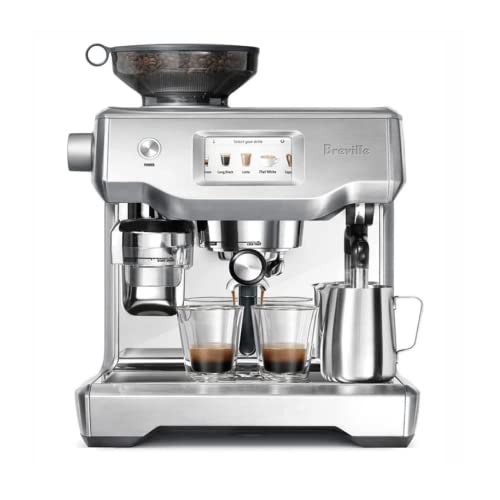
Breville Oracle Touch (BES990) — Best for Automatic Milk and Touchscreen Control
The Oracle Touch takes the same dual boiler foundation as the machine above and wraps it in the most complete automation on this list. It grinds, doses and tamps the puck for you, runs the extraction, and steams the milk to a temperature and texture you pick on the touchscreen. If your household wants flat whites that taste like a café’s but nobody wants to learn tamping pressure before 7 a.m., this is the dual boiler built for you.
- Dual boiler design
- Model: BES990 (Oracle Touch)
- Automatic grinding, dosing and tamping
- Automatic milk texturing with touchscreen drink menu
Strengths
- Automatic dosing and tamping remove the two most common beginner errors
- Milk texturing is genuinely hands-free and repeatable across users
- The touchscreen drink library makes the machine approachable for guests and family
Trade-offs
- Automation means more systems that can need service over a long life
- Purists get less manual control than on the standard Dual Boiler
- It is among the largest and heaviest machines in this guide
What surprises people about the Oracle Touch is that the automation does not dumb the coffee down. The dual boiler layout means extraction temperature and steam pressure are never compromised, the auto-tamped pucks are consistent, and the milk comes out glossy enough for latte art if you pour carefully. For multi-drinker households, the ability for three different people to get the same drink without a training session is worth more than any single specification.
The honest trade-off is control and complexity. You can override and fine-tune, but the machine’s personality is ‘let me handle it’, and enthusiasts who enjoy the ritual will chafe. It also asks for counter space and a real commitment to the cleaning cycles it prompts for. Buy it as an appliance that happens to make excellent espresso, not as a hobbyist instrument, and it will delight you every morning.
Living with the Touch means trusting its prompts: it tells you when to clean the steam wand circuit, when to change the water filter and when to descale, and owners who obey the screen get the reliability the price promises. The automatic milk system needs its post-use purge — a habit of seconds that prevents the one maintenance headache this machine can develop. Counter depth deserves one more mention: measure with the machine pulled forward for tank access, not just parked, because the Touch is serviced from the top and back in daily life.
Best for: households that want café drinks with almost no learning curve / Not suited for: hands-on enthusiasts who enjoy dialling in every variable themselves
Check the current price on Amazon

Breville Oracle (BES980XL) — Best for Hands-Off Shots Without a Touchscreen
The Oracle is the machine that proved a dual boiler could also be an automatic. It keeps the separate brew and steam boilers, adds a built-in grinder that doses and tamps for you, and layers an over-pressure valve over the extraction so a slightly imperfect puck does not turn into a bitter shot. It lacks the Touch’s screen and auto milk, which for many buyers is a fair trade: fewer interfaces, the same core engineering, and milk steaming that stays in your hands.
- Dual boiler design
- Model: BES980XL (Oracle)
- Automatic grinding, dosing and tamping
- Over-pressure valve limits extraction pressure
Strengths
- Auto dose-and-tamp delivers consistent pucks with zero technique
- Dual boilers keep steam ready while shots pull — true back-to-back drinks
- The over-pressure valve makes results forgiving for newer users
Trade-offs
- Milk steaming is manual, unlike the Touch’s automatic texturing
- The built-in grinder is good rather than great next to a dedicated grinder
- Large footprint and weight, like every machine in this tier
Think of the Oracle as the middle path of the Breville dual boiler family. It removes the fiddliest parts of espresso — dosing and tamping — while leaving you the pleasurable parts: watching the extraction and steaming your own milk. In a household where one person is a coffee obsessive and the other just wants a reliable latte, it satisfies both without arguments, and its shot quality sits very close to the fully manual Dual Boiler when the beans are fresh.
Where it loses ground to its siblings is grinder ambition and milk automation. Serious users eventually pair it with a standalone grinder, and anyone who specifically wants push-button milk should step up to the Touch instead. As a dual boiler that makes excellent espresso accessible, though, it remains one of the most sensible purchases in the category — check price on Amazon, since it is frequently the best value of the three Breville machines here.
The Oracle’s long production run means an unusually deep pool of owner knowledge: every quirk, from grind adjustment to the steam lever’s feel, is documented by years of users. In daily life its character is set-and-mostly-forget — the auto tamp keeps shots consistent even when the person making them changes, which households notice more than any specification. Keep the grinder’s burrs brushed out monthly and the drip tray on a routine, and it behaves like the appliance it was designed to be rather than the hobby it replaced.
Best for: mixed-skill households that want consistent shots with manual milk control / Not suited for: buyers who specifically want automatic milk texturing or a touchscreen
Check the current price on Amazon

Diletta Alto — Best for Enthusiast Control
The Diletta Alto is the enthusiast’s pick in this guide: a true dual boiler built in Italy, with PID control over brew temperature, a shot timer in the group area, and an adjustable over-pressure valve for people who like to tune extraction pressure to the bean. Diletta is the house brand of a well-known American espresso retailer, which matters — support, parts and advice come from people who sell and service espresso machines all day.
- Dual boiler design (confirmed in the manufacturer’s listing title)
- PID temperature control and shot timer
- Adjustable OPV
- Handmade in Italy
Strengths
- Adjustable OPV and PID give real tuning range for different roasts
- Traditional E61-style prosumer build with widely understood internals
- Retailer-backed support is a genuine advantage in this category
Trade-offs
- No built-in grinder and no automation — this is a fully manual ritual
- Boiler machines heat slowly compared with thermoblock designs
- A smaller brand means a smaller owner community than Breville’s
The Alto rewards the barista who treats espresso as a craft. Temperature is stable, the steam boiler has the capacity for entertaining, and the adjustable OPV lets you soften extraction for delicate light roasts in a way fixed-valve machines cannot. Fit and finish are a step above the mass-market machines here, and the machine feels like equipment rather than an appliance — because it is.
That character cuts both ways. There is no hand-holding: no auto tamping, no drink menu, no app. You will pair it with a serious grinder, weigh your doses and learn the machine over a few weeks. For the right owner that learning curve is the entire point, and the Alto’s combination of dual boilers, PID and an adjustable valve at its tier makes it the most interesting machine in this guide for tinkerers.
Prosumer ownership is a different contract: you are the first line of maintenance, and the Alto rewards it with a machine built from standard, serviceable parts. Backflushing weekly, a group gasket every year or so, and boiler care through good water will keep it running indefinitely — and unlike sealed appliances, everything inside is reachable by a competent technician. It also holds value unusually well, because the enthusiast market knows exactly what it is. Budget for a capable grinder and a precision basket if you want to hear what the machine can really say.
Best for: experienced home baristas who want tuning control and prosumer build / Not suited for: beginners or anyone who wants the machine to do the work
Check the current price on Amazon

Ascaso Steel DUO V3 — Best for Fast Heat-Up and Small Counters
The Ascaso Steel DUO V3 answers the dual boiler question differently: instead of two boilers it runs two thermoblocks, one for brewing and one for steam, so it can pull a shot and steam at the same time while heating up in a fraction of the time a boiler machine needs. For households that make two drinks on a weekday morning and refuse to plan their coffee half an hour ahead, that trade — a little theoretical thermal mass for a lot of speed — is extremely attractive.
- Dual thermoblock design (confirmed in the manufacturer’s listing title)
- PID control with programmable volumetric dosing
- 120V version
- Compact steel body
Strengths
- Ready to brew in minutes, not the long warm-up of boiler machines
- Volumetric programming makes repeat shots push-button simple
- Compact, handsome steel body suits smaller counters
Trade-offs
- Thermoblock steam is strong but less relentless than a big steam boiler for many drinks in a row
- Costs like a boiler machine despite the simpler heating system
- Ascaso’s service network is thinner than Breville’s in some regions
The Steel DUO’s party trick is not a trick at all: it is simply ready when you are. PID control keeps the brew thermoblock honest, the volumetric dosing means your second shot matches your first, and the steam side handles a couple of lattes back to back without drama. It is also one of the few machines in this class that looks at home in a design-conscious kitchen rather than a café back bar.
Where a big-boiler machine pulls ahead is volume and ultimate steam stamina — a brunch for eight will expose the difference. Most homes never host that brunch, and for them the DUO’s speed and size advantages are worth more than boiler bragging rights. It is the dual-heating machine we would recommend to apartment dwellers and impatient people, categories that overlap heavily.
The DUO’s ownership charm is its schedule freedom: because thermoblocks heat on demand, you never leave a boiler idling all day ‘just in case’, and the machine suits households whose coffee times are irregular. Volumetric programming, once set for your regular dose, makes weekday shots nearly thoughtless. Its steam wand is a professional-style manual wand, so milk skill is on you — but the thermoblock’s steam, while finite, arrives instantly and recovers between drinks faster than sceptics expect. Descaling matters as much as on any machine; thermoblock channels are narrow and unforgiving of neglect.
Best for: small kitchens and anyone who hates long warm-up times / Not suited for: hosts who regularly steam milk for large groups back to back
Check the current price on Amazon

AMZCHEF Dual Boiler Espresso Machine — Best Budget
Every category guide should say plainly when the budget option is a compromise, so here it is: the AMZCHEF is a dual boiler machine in architecture — separate heating for brewing and steaming, PID control, a proper 58mm portafilter — built to a mass-market price. It will not match the Breville or Diletta machines for build, steam stamina or longevity, but it lets a curious buyer experience simultaneous brewing and steaming without a prosumer budget.
- Dual boiler design with dual heating (confirmed in the manufacturer’s listing title)
- 58mm portafilter
- PID and NTC temperature control with LED display
- Automatic milk frother; custom settings
Strengths
- True simultaneous brew-and-steam at an entry price
- Standard 58mm portafilter accepts a wide range of accessories
- Automatic milk frother lowers the learning curve for milk drinks
Trade-offs
- Fit, finish and long-term parts support trail the prosumer brands
- Steam performance is adequate rather than powerful
- Newer brand with a shorter track record in espresso
Judged against single-boiler machines at similar money, the AMZCHEF’s dual heating is a real functional advantage: milk drinks stop being a two-stage wait, and the PID-controlled brew side keeps shot temperatures steadier than the thermoblock budget machines most people cross-shop it with. The LED display and saved settings make it friendly for households, and the automatic frother produces acceptable foam without technique.
Judged against the rest of this guide, the gaps are equally real — materials, refinement and the confidence that parts exist in five years. Our honest framing: this is the machine to buy if you want to learn whether dual boiler life suits you, or if the budget simply will not stretch further. If it will stretch, the Breville Dual Boiler above is where the category properly starts. Check the current price on Amazon either way.
Set ownership expectations correctly and the AMZCHEF is easy to live with: keep up the basic cleaning, use filtered water, and treat the automatic frother’s parts to a rinse after every use, because milk residue is where budget machines age fastest. Its standard 58mm portafilter is a genuine ownership plus — baskets, tampers and spare parts from the wider espresso world fit it, which is more than many budget brands allow. Resale and decade-long parts support are unknowns, so judge its value across a realistic three-to-five-year horizon rather than against the prosumer machines’ lifetimes.
Best for: budget-limited buyers who want genuine dual boiler workflow / Not suited for: buyers shopping for a ten-year machine or café-level steam power
Check the current price on Amazon
Comparison Table
The table compresses the reviews into the four facts most buyers actually decide on. Note how the category splits: three automation levels (full, partial, none) matter more to daily happiness than small differences in boiler hardware.
| Pick | Badge | Key spec | Best for |
|---|---|---|---|
| Breville Dual Boiler (BES920XL) | Best Overall | Dual boilers, heated group head | home baristas who want maximum consistency with minimum ritual |
| Breville Oracle Touch (BES990) | Best for Automatic Milk and Touchscreen Control | Dual boilers, full automation, touchscreen | households that want café drinks with almost no learning curve |
| Breville Oracle (BES980XL) | Best for Hands-Off Shots Without a Touchscreen | Dual boilers, auto dose and tamp | mixed-skill households that want consistent shots with manual milk control |
| Diletta Alto | Best for Enthusiast Control | Dual boilers, PID, adjustable OPV | experienced home baristas who want tuning control and prosumer build |
| Ascaso Steel DUO V3 | Best for Fast Heat-Up and Small Counters | Dual thermoblocks, PID, volumetric | small kitchens and anyone who hates long warm-up times |
| AMZCHEF Dual Boiler Espresso Machine | Best Budget | Dual heating, 58mm portafilter, PID | budget-limited buyers who want genuine dual boiler workflow |
What Does a Dual Boiler Actually Do for Your Coffee?
A dual boiler machine heats brew water and steam water in two separate vessels, each with its own element and control. The brew boiler is small and held within a degree of your target, so every shot extracts at the temperature you set. The steam boiler is larger and held at steaming pressure continuously, so the wand is ready the second you finish a shot. Because neither job borrows heat from the other, you can steam milk while a shot pulls — and the tenth drink of the morning tastes like the first.
Compare that with the alternatives. A single-boiler machine must swing one boiler between brew and steam temperatures, which means waiting and temperature surfing. A heat exchanger runs one boiler at steam temperature and flashes brew water through a coil — capable, but brew temperature is managed indirectly. Dual boilers cost more because they duplicate hardware, but they are the only design where temperature stability and steam readiness are both absolute rather than managed. If your household drinks milk drinks daily, that absoluteness is what you are paying for.
How to Choose the Right Dual Boiler for Your Kitchen?
Start with workflow, not specifications. If several people will use the machine and none of them want training, automation — the Oracle models — is worth more than any boiler detail. If you enjoy the ritual and want to tune, a manual prosumer machine like the Diletta Alto will keep you interested for years. If mornings are rushed and counters are shallow, the Ascaso’s thermoblock speed and compact body solve problems the others create.
- Measure your counter depth and the clearance under your cabinets before falling in love with any model — dual boilers are among the largest home espresso machines made.
- Decide whether a built-in grinder matters: integrated grinders save space and money, but a dedicated grinder is the first upgrade every enthusiast makes.
- Check water tank access: some machines need the tank lifted out from the top or back, which is miserable under low cabinets.
- Plan for water quality from day one — filtered water and scheduled descaling are what separate a ten-year machine from a three-year one.
Finally, think about service. Breville’s network is broad, dealer brands lean on their retailers, and smaller European brands can mean shipping the machine for repairs. None of these is a deal-breaker, but the right choice depends on whether you live near help or are comfortable with a courier box.
Dual Boiler vs Heat Exchanger vs Dual Thermoblock: Which Is Right for You?
Heat exchanger machines are the dual boiler’s historic rival: one big boiler, steam always ready, brew water heated through a coil. Good ones make excellent espresso and often cost less, but brew temperature responds to how long the machine has sat idle, and flushing routines become part of your morning. Dual boilers remove that variable entirely, which is why this guide exists — but if your budget lands between the two, a quality heat exchanger is a better buy than a cut-price dual boiler of doubtful build.
Dual thermoblocks, represented here by the Ascaso, trade thermal mass for speed. They brew and steam simultaneously like a dual boiler, heat in minutes, and sip electricity between drinks because nothing is kept hot. What they surrender is the endless, dry steam of a big boiler when you are serving a crowd. For one to four drinks at a time — nearly every home — the trade is invisible in the cup.
What Will a Dual Boiler Cost You Beyond the Purchase Price?
The machine is the entry ticket, not the whole cost of the hobby, and honest budgeting prevents the common pattern of a flagship machine paired with a neglected everything else. A capable espresso grinder is the big one — for the manual machines here it is effectively mandatory, and even Oracle owners often add one eventually. Then come the consumables that keep boilers alive: water filters or filtered water, backflush detergent, descaler and the occasional group gasket and shower screen. None is expensive alone; together they are a modest annual running cost that should surprise nobody who read this paragraph.
Electricity deserves a calmer look than it usually gets. Boiler machines draw real power while heating and idling, which is why the smart-plug timer is standard practice: heat for the morning, off by mid-morning. Thermoblock designs like the Ascaso sip by comparison because nothing is kept hot. Finally, factor in beans honestly — a dual boiler makes it easy to drink a lot of very good coffee, and at café-bean prices your annual bean spend will quietly exceed the machine’s running costs. That is not a warning; it is the hobby working as intended.
Do You Need a PID, Pre-Infusion and Flow Control?
Dual boiler marketing loves control features, and it is worth knowing which ones change the coffee. PID temperature control is the foundational one: it holds the brew boiler steady instead of cycling around the target, and every machine in this guide has it or its equivalent. Adjustable pre-infusion — wetting the puck gently before full pressure — genuinely helps with fresh, gassy beans and light roasts, reducing channeling and harshness; if you drink light roasts, weight it heavily.
Flow and pressure profiling, found on the enthusiast end of the category, is where returns diminish for most drinkers. It offers real control to those who will learn it and real confusion to those who will not, and the honest test is your own curiosity: if the idea of shaping a shot’s pressure curve excites you, buy the machine that allows it; if it sounds like homework, the Breville machines’ set-and-forget excellence will make you happier coffee. Features serve the drinker, never the reverse.
How to Set Up a Dual Boiler Espresso Machine for Its First Week
A dual boiler rewards a careful first setup more than any other home coffee machine. The routine below gets temperature, water and workflow right from the start, so your first impressions reflect the machine rather than your setup mistakes.
- Start with water. Fill the tank with filtered water that tastes neutral. Dual boilers scale from the inside out, and the water you choose in week one decides how often you descale for the life of the machine.
- Run the full first heat cycle. Let the machine heat completely — boiler machines need their full warm-up so the group head and portafilter reach temperature, not just the boiler readout. Lock in an empty portafilter during warm-up so it heats too.
- Flush and season. Run several shots of water through the group and steam wand before your first coffee. This clears manufacturing residues and confirms both boilers are working.
- Dial in with a forgiving bean. Use a fresh medium roast for the first bag. Set your dose, aim for a shot that runs in the traditional window your machine’s guide suggests, and change one variable at a time.
- Set the brew temperature deliberately. Start at the machine’s default, taste, then adjust a degree at a time over several days. PID control is a fine-tuning tool, not a first-day toy.
- Learn the steam wand on water and a drop of soap. A jug of water with a drop of washing-up liquid mimics milk’s behaviour, so you can practise creating a vortex without wasting milk.
- Backflush and wipe down on day one. Build the habit immediately: purge and wipe the wand after every use, backflush on the schedule your manual sets, and empty the drip tray before it becomes a science project.
After the first week, keep a small notebook or phone note of bean, dose and temperature for each coffee you try. Dual boilers are consistent enough that your notes actually mean something — which is precisely the point of owning one.
Common Buying Mistakes
Buying the machine before the grinder. A dual boiler fed by a cheap grinder produces expensive disappointment. Espresso is ground fresh or it is not espresso; budget for a capable grinder in the same purchase, or choose an Oracle model with the grinder built in.
Ignoring water because the machine was expensive. Scale is the number one killer of boiler machines. Hard tap water will coat two boilers instead of one, and descaling a dual boiler is a longer job than descaling a kettle. Filter first, descale on schedule.
Judging the machine in the first three days. New owners, new beans and a new machine is too many variables. Give any dual boiler two weeks of daily use before deciding it is not for you — most early frustration is dialling-in, not hardware.
Forgetting the counter is a workspace, not a shelf. You need room beside the machine for a knock box, scale, cups and milk jug. A dual boiler squeezed into a corner with no working space turns a pleasure into a daily obstacle course.
Chasing temperature settings before fixing distribution. If shots channel and spray, the problem is puck preparation, not a degree of boiler temperature. Master a level, even tamp first; the PID will still be there when you are ready for it.
Final Recommendation
If you buy one machine from this guide, make it the Breville Dual Boiler (BES920XL): it is the most complete expression of what the category promises, at the sanest balance of performance and support. Households that value ease over ritual should choose the Oracle Touch, or the original Oracle if automatic milk is not a priority. Enthusiasts who want to tune should look at the Diletta Alto, small kitchens and impatient mornings point to the Ascaso Steel DUO V3, and the AMZCHEF is the honest budget door into dual boiler life.
Whichever you choose, pair it with fresh beans, filtered water and a grinder that respects it — the machine is only the middle third of great espresso. Keep exploring the category with the related guides below.
- Breville Dual Boiler (BES920XL) — Check price on Amazon
- Breville Oracle Touch (BES990) — Check price on Amazon
- Breville Oracle (BES980XL) — Check price on Amazon
Best Espresso Machines Best Breville Espresso Machines Best Espresso Machines For Beginners Best Espresso Machines For Home Best Coffee Grinders For Espresso
Frequently Asked Questions
Is a dual boiler espresso machine worth it for home use?
It is worth it if your household drinks milk-based coffee daily or makes several drinks back to back. The ability to brew and steam simultaneously, with no temperature compromise on either side, is a daily quality-of-life difference rather than a subtle one. If you drink a single straight espresso each morning, a good single-boiler machine will serve you just as well for much less money.
How long does a dual boiler machine take to heat up?
Traditional boiler machines need a full warm-up — typically the longest of any home design — because the group head and portafilter must reach temperature along with the boilers. Dual thermoblock designs like the Ascaso Steel DUO are ready in a few minutes. Many owners solve the boiler wait with a smart plug on a timer so the machine is hot when they wake.
Can you steam milk and brew at the same time on all six machines here?
Yes — that is the defining feature of the category and a condition of inclusion in this guide. Each pick has independent heating for brewing and steaming, whether by two boilers or, in the Ascaso’s case, two thermoblocks, so steaming never steals heat from a shot in progress.
Do dual boiler machines need more maintenance than other espresso machines?
Somewhat. There are two boilers to keep scale-free, so water quality and descaling discipline matter more, and backflushing remains part of the routine. In exchange, the machines are built to a serviceable standard — particularly the prosumer models — and a maintained dual boiler is realistically a ten-year appliance.
What grinder should I pair with a dual boiler?
Any grinder marketed honestly for espresso, with fine, stepless or near-stepless adjustment and low retention, will do the machine justice. The Oracle models include a capable built-in grinder. For the manual machines, budget for the grinder as seriously as the machine itself; it influences the cup at least as much.
Are dual thermoblock machines the same as dual boilers?
Not identical, but they solve the same problem: independent heating circuits let them brew and steam at once. Boilers store a volume of temperature-stable water and steam, which gives them an edge in thermal mass and steam stamina. Thermoblocks heat water on demand, which makes them faster to start and thriftier to run. For typical home volumes the results in the cup are very close.
Can I plumb in a dual boiler machine or run it from its tank?
Most home dual boilers in this guide are tank machines designed for a counter, and that is how nearly all owners run them. Some prosumer models offer plumbing options through their dealers. Tank operation is genuinely convenient — the real discipline is not the filling but the water quality, so a tank machine fed filtered water will outlive a plumbed machine fed hard water every time.
How long do dual boiler espresso machines last?
With filtered water, scheduled descaling and basic gasket and screen care, the prosumer and Breville machines here are realistically decade-class appliances, and their serviceability means failures are usually repairs rather than replacements. The budget dual boiler should be judged on a shorter horizon. Longevity in this category is bought less by the badge than by the owner’s water habits.


