Disclosure: airfryerkitchensupply.com is reader-supported. When you buy through links on our site, we may earn an affiliate commission at no extra cost to you.
Where to buy
If you are comparing the best dry flush toilets tiny houses worth your money, start with this verified shortlist. Every toilet below was confirmed against Amazon’s catalogue data before it earned a link — and in this category that matters twice over, because dry flush toilets live or die by their refill cartridges, so you want the exact model whose refills you can keep buying. Check the live listing for what cartridges or bags are included with the unit, since bundles change.
- Laveo Dry Flush Toilet — Check the current price on Amazon
- MODIWELL R1808 Fixed Dry Flush Toilet — Check the current price on Amazon
- LOO SEAL R1808 Waterless Dry Flush Toilet with Swivel Top — Check the current price on Amazon
- MODIWELL LE-310 Dry Flush Toilet — Check the current price on Amazon
- Laveo by Dry Flush Portable Bedside Commode — Check the current price on Amazon
- Separett Villa Urine-Separating Compost Toilet — Check the current price on Amazon
A definition before the picks: a dry flush toilet seals each use into an airtight bag or cartridge liner with a twist of film — no water, no plumbing, no compost to manage, and nothing to smell. It is the closest thing to a normal toilet experience that a tiny house without plumbing can have, paid for in refills. The final pick is a urine-diverting alternative, clearly labelled, for owners who would rather not buy cartridges at all.
The best dry flush toilets for tiny houses solve the tiny-house problem in its purest form: a home too small — or too mobile — for a septic tank, a sewer connection or a black-water system still deserves a toilet that behaves like a toilet. Dry flush technology answers by wrapping each use in a sealed, airtight package at the press of a button or pedal: you sit, you ‘flush’, the waste disappears into a hidden cartridge, and the bowl is clean for the next person. No water in, no odour out, no compost to stir, no cassette to carry sloshing to a disposal point. For tiny houses on wheels, off-grid cabins and minimalist homes where plumbing is the one system the design refuses, it is often the only option that feels like a normal bathroom.
The trade is explicit and this guide will not hide it: dry flush toilets eat refills. Each cartridge or bag set covers a fixed number of flushes, so the running cost per week is real money where a composting toilet’s is pennies — the buying guide does that maths openly. What you buy with it is zero installation beyond a floor and (on the electric models) a battery or outlet, zero learning curve for guests, and a sealed waste stream that leaves the house in a bag. Six verified options follow: the original Laveo Dry Flush as the benchmark, fixed and portable MODIWELL and LOO SEAL units, Laveo’s care-oriented commode version, and a cartridge-free Separett alternative for owners who want out of the refill economy entirely.
It is also worth naming who should not buy dry flush, even in a tiny house, because the category’s marketing will not: a full-time household of four or five, flushing around the clock, will spend more on cartridges than the toilet cost, several times over, and will feel every penny. That household belongs in the composting or separating sections of the dry-toilet guides linked below. Dry flush is the right technology at the right occupancy — this guide’s job is to show you exactly where that line falls for your house.
In this guide
Quick Picks
Five true dry flush toilets plus one clearly-labelled cartridge-free alternative. Read the badges by living situation — fixed tiny house, tiny house on wheels, guests and care needs are different problems.
- Laveo Dry Flush Toilet — Best Overall: the original dry flush — waterless and self-contained, sealing each flush into its cartridge, and explicitly made for tiny homes, vans, boats and off-grid living. Check price on Amazon.
- MODIWELL R1808 Fixed Dry Flush Toilet — Best Fixed Install: a fixed-format dry flush with a swivel top and rechargeable waterless sealing — the plumbed-look install for a tiny house that stays put. Check price on Amazon.
- LOO SEAL R1808 Waterless Dry Flush Toilet with Swivel Top — Best Swivel-Top Alternative: a self-contained dry flush with swivel top whose listing names tiny homes explicitly — a second fixed-format option with the same no-plumbing sealing system. Check price on Amazon.
- MODIWELL LE-310 Dry Flush Toilet — Best Portable Dry Flush: a portable dry flush that stores on a shelf when not in use — sealed waste bags, no water hookup, for tiny houses that need the toilet to disappear. Check price on Amazon.
- Laveo by Dry Flush Portable Bedside Commode — Best for Care and Mobility: Laveo’s dry flush in commode form — a full-size seat with safety and support arms, bringing sealed dry flush to tiny-house residents who need support. Check price on Amazon.
- Separett Villa Urine-Separating Compost Toilet — Best Cartridge-Free Alternative (Not Dry Flush): not a dry flush — a high-capacity urine-separating toilet included deliberately for tiny-house owners who want to leave refill costs behind entirely. Check price on Amazon.
How These Picks Were Chosen
Selection began with the mechanism: a pick only counts as dry flush if it seals waste into an airtight liner per flush — that is the technology the search asks for. Every candidate then had to be confirmed against Amazon’s catalogue data, brand and model matched, before receiving a link; the category is full of look-alike listings, so anything ambiguous was excluded rather than guessed at. One deliberate exception closes the list: a urine-diverting Separett, labelled in its badge and review as the cartridge-free alternative, because a responsible roundup for tiny houses should show the exit from refill costs as well as the best versions of the refill model.
We weighted the lived experience heavily: how completely the seal contains odour between flushes, how many flushes a cartridge realistically delivers in a household (manufacturers count best-case; guests and children use more), whether the unit is fixed or portable, battery life and charging on the rechargeable models, and how the waste leaves the house. Seat height and footprint were checked against tiny-house reality — most tiny bathrooms offer a footprint not much larger than the toilet itself.
Refill availability was treated as a selection criterion, not an afterthought: a dry flush toilet is a small appliance married to a consumable, and the picks below are the models whose refill ecosystems are established and listed alongside the units.
Refill ecosystems were audited as part of selection, not after it. For each unit we confirmed that its matching refill cartridges or bag sets are listed alongside it, that the refill is model-specific rather than vaguely ‘universal’, and that the maker’s system has enough installed base to make discontinuation unlikely. A dry flush toilet orphaned from its refills is a paperweight with a seat, so this check carried veto power: one otherwise attractive sealing toilet was excluded because its refill supply could not be confirmed with the same confidence as its listing.
The 6 Best Dry Flush Toilets Tiny Houses Can Rely On
Each review names the sealing system it uses, who it suits, three strengths, three trade-offs, the verified specification points and a verdict. Refill costs are discussed qualitatively and comparatively — the honest way, since bundles and prices move.

Laveo Dry Flush Toilet — Best Overall
The Laveo is the toilet that defined this category, and its listing says exactly who it is for: tiny homes, vans, boats, camping, RVs and off-grid. It is waterless and self-contained; each flush twists the liner closed around the waste and seals it in the cartridge below, so the bowl is always clean, nothing smells, and there is no compost, chemical or cassette anywhere in the process. For a tiny house that wants a normal-feeling bathroom with no plumbing at all, this remains the benchmark.
Strengths
- True dry flush sealing — waste is wrapped airtight at every flush
- No water, plumbing, venting or compost management required
- Portable and self-contained, so it suits fixed and wheeled tiny houses alike
Trade-offs
- Refill cartridges are a permanent running cost — the category’s core trade
- Cartridge capacity is counted in flushes, so busy households cycle refills quickly
- Battery-powered sealing means keeping the unit charged or powered
| System | Dry flush — seals each use in a cartridge liner |
| Water/plumbing | None — waterless, self-contained |
| Made for | Tiny homes, vans, boats, RVs, off-grid (per Amazon listing title) |
| Verified via | Amazon listing title, 2026-11-21 |
What owners consistently praise is the normality: guests use it without a briefing, children manage it, and the bathroom never smells like a compromise. The sealed packages collect in the cartridge and leave the house in one bag when the cartridge is spent — a five-minute, no-contact job. In a tiny house, where the toilet may share air with the kitchen, that odour performance is not a luxury; it is the whole product.
The maths deserves the same clarity. A cartridge covers a set count of flushes, and a full-time tiny-house household will work through refills at a pace that makes this the most expensive toilet on this page to run — while a part-time cabin or a low-occupancy tiny home will find the cost trivial against the convenience. The buying guide below shows how to estimate your own flush count before committing.
A practical ownership rhythm worth adopting from day one: order the next cartridge when you install the current one, not when the toilet tells you it is finished. Tiny houses often sit at the end of delivery routes, and the gap between ‘cartridge full’ and ‘replacement arrived’ is the only genuinely unpleasant interval in dry flush ownership. The two-cartridge rotation — one in use, one in the cupboard — eliminates it entirely.
Best for: tiny houses wanting the most normal, guest-proof, zero-plumbing toilet experience / Not suited for: high-occupancy full-time homes where refill costs will dominate
Check on Amazon to see the current listing, options and delivery details.

MODIWELL R1808 Fixed Dry Flush Toilet — Best Fixed Install
The R1808 is the dry flush shaped like a fixture rather than a portable: a fixed unit with a swivel top, rechargeable power and waterless sealing, aimed at RVs, boats, off-grid and care use per its listing. In a tiny house on a foundation — or a park-model that moves rarely — that fixed format reads as a real bathroom fitting, mounts securely, and keeps the sealing convenience of the dry flush system.
Strengths
- Fixed format with swivel top suits a permanent tiny-house bathroom
- Rechargeable — no wiring into the house system required
- Waterless sealing keeps the no-plumbing advantage of dry flush
Trade-offs
- Fixed means committed: relocating it is a job, not a lift
- Consumable sealing bags are an ongoing cost, as with all dry flush
- Newer brand ecosystem than Laveo’s — check refill listings before buying
| System | Dry flush — waterless sealing |
| Format | Fixed install, swivel top |
| Power | Rechargeable |
| Verified via | Amazon listing title, 2026-11-21 |
The swivel top is a small design decision with outsized value in tiny bathrooms, where the toilet often sits in a corner or beside a shower: being able to angle the seat to the space — and to the user — makes a tight wet-room layout work. Sealing performance follows the dry flush pattern: each use wrapped and isolated, the waste drawer emptied on the refill cycle.
Choose the R1808 over the Laveo when the house is settled and the bathroom is designed around a permanent fixture; choose the Laveo when the house moves or the layout is still evolving. Either way, confirm the refill bags for this exact model are listed and available before the unit goes in — that check, described in the buying guide, is the category’s golden rule.
For houses that host, the fixed R1808 format carries a subtle advantage: a mounted, swivel-top fixture reads to guests as ‘the bathroom’, where a portable unit can read as ‘the arrangement’. In a tiny-house rental or a home that entertains, that perception is part of the product — the toilet that needs no explanation is worth more than the one that needs a reassuring speech.
Best for: settled tiny houses and park models wanting a permanent dry flush fixture / Not suited for: tiny houses on wheels that reconfigure often
Check on Amazon to see the current listing, options and delivery details.

LOO SEAL R1808 Waterless Dry Flush Toilet with Swivel Top — Best Swivel-Top Alternative
The LOO SEAL R1808 is a self-contained, rechargeable dry flush toilet with a swivel top, and its listing is unusually explicit about tiny homes among its intended uses, alongside RVs, boats, vans and off-grid. It offers the same core proposition as the MODIWELL fixed unit — sealed, waterless, no plumbing — giving tiny-house buyers a genuine second option in the fixed swivel-top format to compare on availability and refill supply.
Strengths
- Swivel top adapts the seat to tight corner layouts
- Self-contained and rechargeable — installs with no plumbing or wiring
- Listing explicitly covers tiny homes among its use cases
Trade-offs
- Shares its format class with the MODIWELL R1808 — compare refill ecosystems carefully before choosing between them
- Sealing consumables are a continuing cost
- Fixed format is less flexible if the layout changes
| System | Dry flush — waterless, self-contained |
| Format | Swivel top |
| Power | Rechargeable, no plumbing |
| Verified via | Amazon listing title, 2026-11-21 |
Having two credible units in the same format is good news for buyers, because the deciding factor in dry flush is rarely the porcelain — it is the refill pipeline. Compare the two R1808-class listings on what ships in the box, what a refill set costs per flush at the time you buy, and how reliably refills are stocked; the toilet that wins that comparison is the right one for your house, whichever badge it wears.
In use, expect the category standard: a clean bowl every time, sealed waste, a drawer or cartridge change on a predictable cycle, and a bathroom that never announces the absence of plumbing. For a tiny house that hosts guests, that normality is the entire point.
Buyers comparing the two R1808-class units should also weigh the unglamorous logistics: which seller ships refills to your address reliably, what the per-flush cost works out to at the bundle sizes actually in stock, and whether the unit ships with a starter set of bags or bare. Those three answers, more than any specification, will decide which of the two you are happier with in month six.
Best for: tiny-house owners comparing fixed dry flush options on refill value and availability / Not suited for: buyers who want the longest-established refill ecosystem by default
Check on Amazon to see the current listing, options and delivery details.
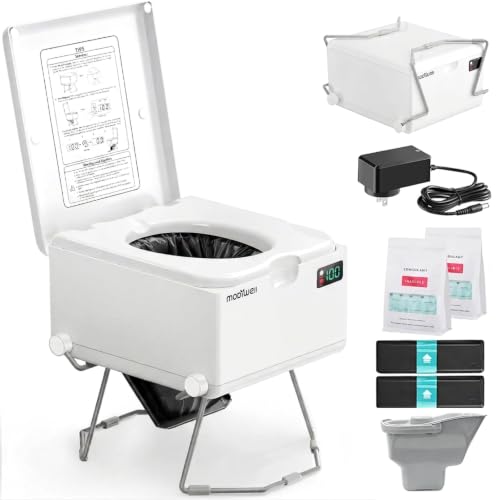
MODIWELL LE-310 Dry Flush Toilet — Best Portable Dry Flush
The LE-310 brings dry flush sealing to a portable, storable format: no water hookup, sealed waste bags, and — per its listing — easy shelf storage. That last phrase is the tiny-house headline: in the smallest homes, a toilet that can live in a cupboard and come out when needed frees the bathroom footprint entirely, which is why portable dry flush suits studio-style tiny houses, guest corners and emergency backup as much as RVs and boats.
Strengths
- Portable dry flush sealing with no water hookup
- Stores compactly — frees the floor when the toilet is not in use
- Sealed bags keep use and emptying odour-free
Trade-offs
- Portable format means setting up and putting away — a rhythm not everyone wants daily
- Bag refills are the running cost, as across the category
- Seat experience is portable-class rather than fixture-class
| System | Dry flush — sealed waste bags |
| Format | Portable, shelf storage |
| Water | No hookup required |
| Verified via | Amazon listing title, 2026-11-21 |
Think of the LE-310 as the dry flush for flexible space: a tiny house that is one room by day, a guest annex, a home office that occasionally hosts overnighters, or a cabin used on weekends. The sealing system means it can be stored after use without any smell penalty — the failure mode of lesser portables — and brought out without a cleaning ritual first.
For a full-time, every-day tiny-house bathroom, a fixed unit is the better daily experience; the LE-310 wins where the toilet’s part-time status is the whole point. Its refill bags follow the category pattern, so the running-cost section of the buying guide applies unchanged.
The LE-310 has a second life worth planning for: emergency preparedness. A storable dry flush toilet is the difference between a plumbing failure or a frozen-pipe week being an inconvenience and being a crisis, in a tiny house or any house. Owners who buy it for a guest corner often report that its most valued service, in the end, was the week the water was off.
Best for: part-time tiny spaces, guest corners and storable backup toilets / Not suited for: full-time primary bathrooms wanting a fixed fixture feel
Check on Amazon to see the current listing, options and delivery details.

Laveo by Dry Flush Portable Bedside Commode — Best for Care and Mobility
Tiny houses are often designed young and lived in long, and this Laveo variant answers the accessibility side of the category: a full-size dry flush toilet in bedside commode form, with safety and support arms and the same patented sealing flush as the standard Laveo. For a tiny-house resident recovering from surgery, an older owner ageing in place, or a carer supporting someone at home, it brings the toilet to the person — sealed, sanitary and odour-free — without any plumbing whatsoever.
Strengths
- Full-size seat with safety and support arms for assisted use
- Same sealed dry flush system — no carrying sloshing waste
- Works bedside, in a bedroom corner or as the main toilet during recovery
Trade-offs
- Commode format is a care appliance first and a design piece never
- Shares the Laveo cartridge running cost
- Arms and frame need more floor width than the standard unit
| System | Dry flush — patented sealing flush |
| Format | Bedside commode, full-size seat |
| Support | Safety and support arms (per Amazon listing title) |
| Verified via | Amazon listing title, 2026-11-21 |
The sanitary advantage over a conventional commode is the story: a standard bedside commode is a bucket that someone must empty and wash, while the dry flush seals every use away, so care stays dignified and the room stays fresh. In a tiny house, where the bedroom is steps from the kitchen, that difference is not cosmetic.
It earns its place in this roundup as the care configuration of the category’s benchmark system. Households without care needs should take the standard Laveo; households with them will find this the most humane no-plumbing option available.
Carers should note the routine advantage in concrete terms: there is no bucket to carry, no liquid to slosh, no washing-out ritual — the used cartridge is sealed and leaves in a bag. In a tiny house where the carer may also be the only other resident, that reduction in daily labour is not a convenience feature; it is what makes home care sustainable for longer.
Best for: tiny-house residents needing supported, bedside or recovery-period toileting / Not suited for: households without mobility or care requirements
Check on Amazon to see the current listing, options and delivery details.

Separett Villa Urine-Separating Compost Toilet — Best Cartridge-Free Alternative (Not Dry Flush)
This pick breaks the category rule on purpose, and says so in its badge: the Separett Villa is a urine-separating toilet, not a dry flush. It is here because every tiny-house buyer weighing dry flush should see the alternative economics in the same list — the Villa separates urine to a container or drain, collects solids in a bag with no additives or mixing, and asks for no cartridges, ever. Separett rates the design for homestead, schoolie and cottage use, which maps closely onto tiny-house life.
Strengths
- No cartridges or proprietary refills — the running cost is bags alone
- High-capacity design suits full-time tiny-house living
- Simple, proven separating system with nothing to charge
Trade-offs
- It does not seal each flush — solids are bagged, not wrapped per use
- Urine needs a container to empty or a drain route, unlike fully self-contained dry flush
- Guest learning curve is higher than press-button dry flush
| System | Urine-separating (NOT dry flush) |
| Additives | None needed (per Amazon listing title) |
| Capacity | High-capacity design |
| Verified via | Amazon listing title, 2026-11-21 |
The Villa is the right answer for a specific owner: full-time, settled, cost-conscious, and happy to manage a urine container and a solids bag in exchange for never buying a cartridge again. Its high-capacity design is made for continuous living rather than weekends, and Separett’s separating toilets have decades of cabin and homestead use behind them.
What you give up against true dry flush is the sealed-per-flush normality — the bowl experience is a separating toilet’s, and guests need a sentence of explanation. Many tiny-house owners will pay dry flush prices precisely to avoid that sentence; others will pocket the savings happily. Both are rational — the guide’s job is to make the trade visible, which is why this pick is labelled rather than disguised.
One honest bridge between the systems: some tiny-house owners run both — the Separett as the daily toilet and a portable dry flush kept for guests, illness or travel weeks. That sounds extravagant until you price it against a single plumbing installation that the house cannot have anyway. The categories are tools, and this guide’s comparisons are meant to help you combine them, not to force a single allegiance.
Best for: full-time tiny-house owners who prioritise zero refill costs over per-flush sealing / Not suited for: owners wanting the sealed, guest-proof dry flush experience
Check on Amazon to see the current listing, options and delivery details.
Comparison Table
Five of the six seal each flush; the Separett is the labelled exception that trades sealing for zero refill cost. Within dry flush, choose fixed versus portable by how settled the house is.
| Pick | Badge | Key spec | Best for |
|---|---|---|---|
| Laveo Dry Flush Toilet | Best Overall | Dry flush cartridge sealing, waterless | Most tiny houses |
| MODIWELL R1808 Fixed Dry Flush Toilet | Best Fixed Install | Fixed dry flush, swivel top, rechargeable | Permanent installs |
| LOO SEAL R1808 Waterless Dry Flush Toilet with Swivel Top | Best Swivel-Top Alternative | Dry flush, swivel top, self-contained | Comparing fixed options |
| MODIWELL LE-310 Dry Flush Toilet | Best Portable Dry Flush | Portable dry flush, sealed bags, storable | Flexible spaces |
| Laveo by Dry Flush Portable Bedside Commode | Best for Care and Mobility | Dry flush commode, support arms | Care and mobility |
| Separett Villa Urine-Separating Compost Toilet | Best Cartridge-Free Alternative (Not Dry Flush) | Urine-separating, high capacity, no refills | Zero-refill living |
How to Choose a Dry Flush Toilet for a Tiny House: The Refill Maths First
Do the arithmetic before the aesthetics. Estimate your household’s flushes per day — count every use by every person, including the quick ones — and multiply by the days between refill orders you are comfortable with. Then compare that with each model’s cartridge or bag capacity as stated on its listing, and price a month of refills at your usage. Full-time couples are often surprised by the monthly figure; part-time cabin owners are often pleasantly surprised how small it is. Both reactions are useful, and both are cheaper to have before buying than after.
Fixed versus portable in a tiny footprint
A fixed dry flush (the R1808-class units, or a Laveo in a permanent spot) gives a real-bathroom feel and a secure mount — the right call for a settled tiny house with a designed bathroom. A portable (standard Laveo carried between spots, or the shelf-storing LE-310) suits houses on wheels, evolving layouts and part-time spaces. The sealing performance is comparable; the difference is ritual. If the toilet will be used daily for years, minimise the ritual and fix it in place.
Power: batteries, charging and off-grid reality
Dry flush sealing is motorised, so every model here needs power — internal batteries, rechargeable packs or a supply. In an off-grid tiny house, fold the toilet into your power budget like any other appliance: check the listing for battery type and expected flushes per charge, keep the charging habit with your phone-and-laptop routine, and hold a spare set of batteries or a charged pack if the toilet is the home’s only one. A dry flush with a flat battery is a bucket with good intentions, so treat its charge as you treat your water tank — checked, not assumed.
Dry Flush vs Composting vs Separating: Which No-Plumbing System Suits Tiny-House Life?
Dry flush wins on experience: it is the only no-plumbing system a guest can use with zero explanation, the only one that seals waste at the moment of flushing, and the easiest to keep odour-free in a one-room home. It loses on running cost, permanently and by design. Composting toilets (agitated chambers, vent fans) win on running cost and interval length, and lose on installation — they want venting, power for the fan, and an owner who will manage medium and moisture. Separating toilets like the Separett Villa sit between: cheap to run, simple, no per-flush seal, and a urine container in the routine.
Tiny-house specifics tilt the answer. Houses on wheels dislike composting’s vent-and-bolt installation and love dry flush’s pick-up-and-go nature. Settled off-grid houses with a designed bathroom can install a composter once and enjoy its economics for years. Houses that host paying guests — tiny-house rentals are a real slice of this market — should weight the guest experience heavily, which points back to dry flush: no instructions on the bathroom wall, no 2 a.m. questions.
There is no universal winner, which is why this roundup includes the Separett as a labelled alternative rather than pretending dry flush is the only answer. Choose by your occupancy pattern and your honest tolerance for toilet admin, and the category will serve you well.
How to Install and Live With a Dry Flush Toilet in a Tiny House
Installation is the category’s party trick: level floor, toilet placed, cartridge or bags loaded, battery charged — most owners are operational in under half an hour with no tools beyond what the maker supplies. Fixed models add screws or a mounting plate; do use them, because a tiny house that moves will find any unsecured toilet in a new location after the first journey. Position for knee room and door swing first, aesthetics second — in a tiny bathroom, the toilet you can sit on comfortably beats the toilet that photographs well.
- Load a fresh cartridge or bag set before the first use and learn the change procedure in daylight, not when the indicator says full at midnight.
- Keep one full refill set in the house at all times — running out converts the toilet to storage until a delivery arrives.
- Wipe the bowl with a mild, non-abrasive cleaner; the liner mechanism does the heavy work, so no harsh chemicals are needed or wanted.
- When the cartridge completes, seal and remove the waste bag as the manual directs and dispose of it with household waste where local rules allow — never into compost or recycling.
- Check battery charge weekly, and if the house will stand empty, remove or charge the battery per the maker’s storage guidance.
Ventilation deserves one honest paragraph: dry flush needs no vent for odour, because the seal does that work, but a tiny bathroom still benefits from the same airflow any bathroom wants for moisture. A small window routine or the house’s normal ventilation is plenty — do not let anyone sell you a vent kit as an odour necessity for this category.
Tiny-House Bathroom Design Around a Dry Flush Toilet
Designing the smallest room in the house around a dry flush toilet starts with the freedoms the technology grants: no soil pipe dictates the toilet’s position, no water feed constrains the wall it sits on, and no vent run shapes the ceiling. Use that freedom in the right order. First, ergonomics — knee room in front, elbow room at the sides, a door or curtain swing that does not collide with a seated user. Second, the refill routine — a cupboard or shelf within reach that holds the spare cartridge, because a refill stored across the house in a loft will, in practice, not be fetched until the toilet is already full. Third, power — a charging point or battery routine designed in, not improvised with a cable across the floor.
Moisture is the tiny bathroom’s other permanent resident, and dry flush interacts with it kindly: with no cistern there is no condensation source and no leak risk, two of the commonest causes of damp damage in small wet rooms. A simple extractor or an opening window still earns its place for shower steam, but the toilet itself adds nothing to the moisture load — a quiet structural advantage over plumbed fixtures that rarely appears in listings.
Finally, design for the household’s future, not just its present. A fixed unit suits a settled layout; a portable preserves the option to re-plan the room, add a shower, or convert the space as life changes. Tiny houses evolve more than conventional homes, and the toilet that can evolve with the room — or be swapped for a separating system when occupancy changes — is often worth more than the one that merely fits today’s floor plan.
When the Tiny House Moves: Dry Flush on the Road
A tiny house on wheels subjects its toilet to a life no fixture in a static home faces: vibration, cornering loads, and the occasional pothole that tests every mounting. Dry flush suits this life structurally — there is no water to slosh, no cistern to crack, and the waste already in the cartridge is sealed in individual packages that cannot leak as a mass. The preparation for travel is correspondingly short: confirm the unit is secured (fixed models by their mounts, portables by a strap or a travelled-in cupboard), check the cartridge is not at its final flush, and confirm the battery charge will cover the trip’s days plus a margin.
Two road habits separate contented owners from cautionary tales. First, never travel with a cartridge you know is finished — change it at home, where disposal is easy, not at a roadside stop. Second, after a long drive, let the unit sit for a few minutes and run one test flush before the house’s first evening: mechanisms that have vibrated for six hours appreciate a gentle first cycle, and discovering any issue in daylight beats discovering it at midnight. Observe those two, and dry flush is the most travel-proof toilet system a wheeled house can carry — one more reason it anchors this category.
Common Buying Mistakes
Buying the toilet without pricing a month of refills at your real flush count. The unit price is the deposit; the cartridges are the rent, and the time to discover the rent is before you sign.
Assuming all dry flush refills are interchangeable. Cartridges and bag systems are model-specific — confirm the exact refill for the exact model is listed and stocked before the toilet goes in.
- Letting the battery die: a motorised seal with no charge is the category’s one true failure mode, and it is entirely preventable with a charging routine and spares.
- Overfilling past the cartridge’s count because it ‘still flushes’ — the seal quality degrades and the eventual change becomes the messy job the system exists to prevent.
- Fixing a portable unit’s location before living with the layout: tiny houses evolve, and a week of portable use teaches you where the toilet truly belongs.
- Disposing of sealed waste bags anywhere but household waste streams — they are not compostable, whatever the bathroom’s eco credentials.
And the strategic mistake: choosing dry flush for a high-occupancy, full-time house without doing the maths, then resenting a good toilet for its design economics. The Separett alternative is on this page precisely for that household.
Finally, a word against a temptation specific to this category: stockpiling refills far beyond need because a bundle looked cheap. Cartridges and bag sets are compact but not immortal, storage in a tiny house is the scarcest resource you own, and a two-cartridge rotation plus a reorder habit beats a year’s supply in a cupboard you needed for food. Buy the toilet for your house as it is, feed it on a rhythm, and let the system stay as light as the living it enables.
Final Recommendation
For most tiny houses, the Laveo Dry Flush is the benchmark for a reason: the most normal, sealed, guest-proof experience with no plumbing at all. Settled houses wanting a fixture should compare the MODIWELL and LOO SEAL R1808 fixed units on refill value; flexible spaces get the portable LE-310; care and recovery needs get Laveo’s commode; and full-time owners who refuse refill economics get the honestly-labelled Separett Villa alternative.
If your tiny living is on wheels or under canvas rather than in a house, the dry camping toilets guide covers the portable end of this world, and the general dry toilets roundup compares every no-water system side by side.
That lightness is the point to end on. A tiny house is an argument that a home needs less infrastructure than we assumed — and the dry flush toilet, needing no pipe, no tank and no water, is that argument expressed in porcelain and film. Choose it with the maths done and the refills confirmed, and it will be the most ordinary extraordinary appliance in the house.
Shortlist recap: Laveo Dry Flush Toilet (best overall), MODIWELL R1808 Fixed Dry Flush Toilet (best fixed install), LOO SEAL R1808 Waterless Dry Flush Toilet with Swivel Top (best swivel-top alternative) — the three to price-check first; the full reviews above explain exactly who each one suits.
Best Dry Toilets Best Dry Indoor Toilets Best Dry Camping Toilets Best Composting Toilets For Tiny Houses Best Toilets For Tiny Houses
Related guides
Frequently Asked Questions
How does a dry flush toilet work without water?
Each flush activates a mechanism that twists and seals a liner around the waste, dropping the airtight package into a cartridge or holding area below and presenting a fresh liner surface as the bowl. Nothing is rinsed, nothing drains away — the waste leaves the house later, sealed inside the spent cartridge’s bag.
How much do dry flush toilets cost to run in a tiny house?
The running cost is refills: each cartridge or bag set covers a fixed number of flushes stated on its listing. A part-time cabin may use a set a month or slower; a full-time couple will cycle them far faster. Multiply your household’s daily flush count by the per-flush refill cost on the listing to get your honest monthly figure before buying.
Does a dry flush toilet smell in a small space?
In normal use, no — sealing each use airtight is precisely an odour-control technology, and it is why dry flush suits one-room tiny homes. Odour appears only if cartridges are run far past their count or seals are damaged, both of which the change-on-schedule routine prevents.
Can a dry flush toilet work off-grid?
Yes — it needs no water or plumbing, and its power draw is a battery or rechargeable pack running the sealing mechanism. Fold it into the house’s power routine, keep the battery charged and a spare available, and it works anywhere the house does.
How do you dispose of dry flush waste?
When the cartridge or bag set is full, you remove the sealed waste bag as the manual directs and dispose of it with household waste, subject to local rules. The packages are airtight and designed for exactly this handling — no contact, no emptying of loose waste, and never into compost or recycling.
Dry flush or composting for a full-time tiny house?
Dry flush for experience and zero admin, at a real monthly refill cost; composting for minimal running cost, at the price of installation, venting and medium management. Occasional-use houses almost always suit dry flush; high-occupancy full-time houses should run both sets of numbers — the Separett separating alternative in this guide is the middle path.


