Disclosure: airfryerkitchensupply.com is reader-supported. When you buy through links on our site, we may earn an affiliate commission at no extra cost to you.
Where to buy
The shortlist below covers the best dough mixers for bread baking that we could verify for this guide. Every mixer below is listed on Amazon and was verified against the catalogue before earning its link — use them to check price on Amazon for the exact configuration you want, because bowl size, included attachments and colour change the listing. Bread dough is the hardest job in a home kitchen, so each review states plainly how much dough the machine handles happily, not just what the box claims.
- Bosch Universal Plus (Best Overall for Bread) — check price on Amazon
- Ankarsrum Original AKM6230 (Best Premium) — check price on Amazon
- KitchenAid 7 Quart Bowl-Lift KSM70 (Best Bowl-Lift for Big Batches) — check price on Amazon
- KitchenAid 5.5 Quart Bowl-Lift KSM55 (Best Mainstream All-Rounder) — check price on Amazon
- Cuisinart Precision Master SM-50 (Best Mid-Budget) — check price on Amazon
- Kitchen in the Box 8.5 QT Stand Mixer (Best Budget Capacity) — check price on Amazon
The best dough mixers for bread baking are not simply the best stand mixers with a dough hook in the box. Bread dough — especially the stiff, low-hydration kind behind good bagels, pizza and rustic loaves — fights back: it climbs hooks, walks machines across counters, and cooks weak motors with sustained torque. Choosing among the best dough mixers for bread baking means choosing a machine whose drive system, bowl and hook were designed for that fight, not merely rated for it.
Three engineering philosophies dominate this roundup. The Bosch Universal Plus drives from below with a belt-driven hook that kneads the way hands do, stretching and folding large batches without drama. The Ankarsrum, from Sweden, rotates the bowl itself around a roller and scraper — a completely different mechanism that bakers of big, wet doughs swear by. KitchenAid and Cuisinart represent the planetary mainstream: a hook orbiting inside a fixed bowl, brilliant for cakes and enriched doughs, with honest limits on stiff, heavy batches that we state per model.
Every pick was verified before linking, and the flour-capacity guidance in each review follows the conservative, baker-tested end of each maker’s guidance — because the fastest way to kill a dough mixer is to believe the biggest number on the box. No prices are printed anywhere; check price on Amazon, and spend the savings from this honesty on good flour.
In this guide
Quick Picks
Six mixers that genuinely knead bread dough, from a budget big-bowl option to the Swedish icon. Badges match the detailed reviews.
- Bosch Universal Plus — Best Overall for Bread. The bread baker’s default: a bottom-drive design that kneads large, stiff doughs without walking, climbing or overheating. — Check on Amazon
- Ankarsrum Original AKM6230 — Best Premium. The Swedish icon: a rotating bowl, roller and scraper that knead huge and wet doughs with an ease no planetary mixer matches. — Check on Amazon
- KitchenAid 7 Quart Bowl-Lift KSM70 — Best Bowl-Lift for Big Batches. KitchenAid’s strongest home dough machine: a stable bowl-lift frame, 7-quart bowl and the accessory set for serious weekly baking. — Check on Amazon
- KitchenAid 5.5 Quart Bowl-Lift KSM55 — Best Mainstream All-Rounder. The sweet spot of the KitchenAid bowl-lift line: real dough stability in a size and price class most kitchens can justify. — Check on Amazon
- Cuisinart Precision Master SM-50 — Best Mid-Budget. Twelve speeds, a 5.5-quart bowl and a proper dough hook at a friendlier tier — the value route into planetary dough mixing. — Check on Amazon
- Kitchen in the Box 8.5 QT Stand Mixer — Best Budget Capacity. The biggest bowl in this guide at the budget end: an 8.5-quart heavy-dough mixer for bakers whose batch size outruns their budget. — Check on Amazon
How These Picks Were Chosen
We selected for dough first and everything else second. The criteria: sustained low-speed torque (bread is kneaded slowly, so headline wattage mattered less than gearing and drive design), hook geometry that folds rather than climbs, bowl capacity expressed in flour weight rather than marketing quarts, and a track record among bread bakers specifically — several famous stand mixers are cake specialists wearing a dough hook as a costume, and they were cut.
Batch realism was the second filter. A home bread baker typically mixes 500 g to 1.5 kg of flour at a time; commercial-style 20-quart machines are a different guide. Each pick below states the batch range where it is genuinely happy, including where it is not — a mixer that strains at bagel dough says so in its review, because a burnt motor helps nobody.
Finally, the standing verification rules: ASINs confirmed, no static prices, no ratings, and spec boxes built only from facts in the verified listings. All six picks verified, so all six are linked.
The 6 Best Dough Mixers for Bread Baking
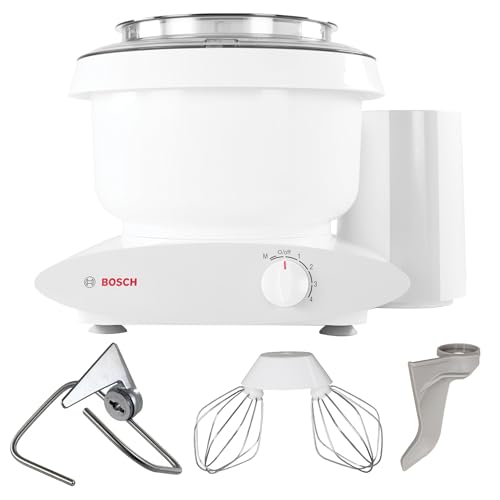
Bosch Universal Plus — Best Overall for Bread
The Universal Plus suits the committed bread baker who mixes multiple loaves weekly — sandwich loaves, whole wheat, pizza dough in family quantities — and wants one machine that treats dough as its main job rather than a side quest.
Strengths
- Bottom-drive dough hook kneads by stretching and folding, developing gluten fast and evenly
- Handles large batches — multiple loaves at once — without the bowl-lift drama of planetary mixers
- Lightweight body with suction feet stays planted even with stiff dough
Trade-offs
- The open-bowl, centre-column design is unusual and takes a session to learn
- Cake and cream work is good rather than class-leading compared with planetary rivals
- Plastic bowl aesthetic divides opinion next to all-metal competitors
| Capacity | 6.5 quart bowl |
| Power | 500 watt motor, belt-driven bottom drive |
| Included | Wire whips, dough hook, NutriMill dough hook extender (this bundle) |
The Bosch kneads differently, and for bread that difference is the whole story. The hook is driven from beneath the bowl and works the dough against the bowl wall in a stretch-and-fold rhythm that mimics hand kneading, so gluten develops quickly without the dough simply riding around on a hook — the failure mode of lesser machines with wet dough, and of climbing with stiff dough.
Capacity is the second headline. This is the mixer bread forums recommend when someone says ‘I bake four loaves every Saturday’, because the 6.5-quart bowl and the drive system genuinely handle batch sizes that make planetary mixers complain. The dough hook extender in this bundle improves small-batch performance too, keeping a single loaf’s worth of dough engaged with the hook instead of smearing around the bowl.
A small accessory note: the dough hook extender bundled in this listing exists because very small batches can orbit a big bowl without engaging the hook — with it fitted, a single 500 g loaf kneads as positively as a double batch. Bosch’s bowl also accepts a full accessory ecosystem (blender, food processor and more drive from the same base), so the Universal Plus quietly becomes the kitchen’s power station rather than a single-task mixer.
Best for: weekly bread bakers mixing medium-to-large batches, including whole grain / Not suited for: bakers who mainly make cakes and want the prettiest countertop machine
Check on Amazon — check the current price on Amazon before you buy, as bundles and included accessories change over time.
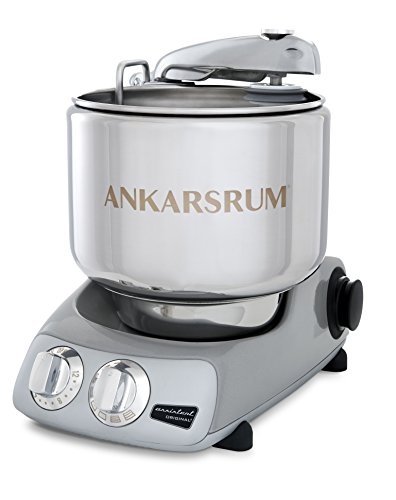
Ankarsrum Original AKM6230 — Best Premium
The Ankarsrum is for the baker who has outgrown ordinary stand mixers — the sourdough devotee mixing high-hydration doughs, the holiday baker doubling everything — and who buys kitchen equipment the way others buy heirloom tools.
Strengths
- Rotating-bowl design with roller and scraper handles very large and very wet doughs beautifully
- Open bowl makes adding ingredients mid-knead effortless — no feed chute gymnastics
- Legendary longevity; a buy-for-decades machine with a devoted baker following
Trade-offs
- Premium price class — the most expensive philosophy in this guide
- The roller-and-scraper technique is genuinely different and takes real learning
- Slower, gentler action is a virtue for dough, less so if you want one machine for everything fast
| Model | Ankarsrum Original AKM6230, Jubilee Silver |
| Design | Rotating bowl with roller and scraper |
| Origin | Swedish design, long-production icon |
Watch an Ankarsrum knead and every other mixer looks like it is guessing. The bowl rotates; a roller presses the dough against the bowl wall while a scraper keeps the wall clean, folding and stretching continuously. High-hydration sourdough that would smear and climb in a planetary mixer develops calmly here, and the open top means flour, water and preferments go in while it runs — a workflow advantage bakers mention more than any spec.
It is also, unambiguously, the connoisseur’s purchase: premium-priced, technique-driven, and specialised in spirit even though it whips and mixes competently with its second bowl. If bread is your central kitchen practice rather than a weekend hobby, the Ankarsrum is the machine the practice deserves, and its multi-decade service reputation makes the premium defensible in a way few appliances earn.
New owners should budget three bakes for the learning curve: the roller position, the scraper adjustment and the speed rhythm are simple but genuinely different, and the first loaf is a lesson rather than a result. The reward is control no other design offers — you can add flour by the spoonful to a running, open bowl and watch hydration correct itself in real time, which is why recipe developers quietly love this machine for testing doughs.
Best for: sourdough and high-hydration specialists, and buy-for-life bakers / Not suited for: occasional bakers or anyone who wants push-button familiarity on day one
Check on Amazon — check the current price on Amazon before you buy, as bundles and included accessories change over time.

KitchenAid 7 Quart Bowl-Lift KSM70 — Best Bowl-Lift for Big Batches
The KSM70 suits the KitchenAid loyalist who bakes big — double batches of sandwich bread, holiday enriched doughs, pizza for a crowd — and wants the brand’s ecosystem and attachments with the sturdiest frame KitchenAid sells for the home.
Strengths
- Bowl-lift design is the stable, no-wobble way to run heavy dough in a planetary mixer
- 7-quart bowl swallows double batches that defeat tilt-head models
- 11 speeds including a gentle 1/2 folding speed, plus a rich accessory bundle
Trade-offs
- Planetary hook still has batch limits with very stiff, low-hydration dough — work in two batches for bagels
- Big and heavy: it claims permanent counter space
- Premium tier within the KitchenAid line
| Capacity | 7 quart bowl, bowl-lift |
| Speeds | 11, including 1/2 speed for folding |
| Included | Double Flex Edge Beater and 4 other accessories (per listing) |
Within the planetary world, bowl-lift is the dough configuration: the bowl locks to a rigid frame, the head never flexes, and the machine stays composed when a heavy dough starts thumping. The KSM70 is KitchenAid’s fullest expression of that idea for home bakers — 7 quarts of bowl, a speed range that starts at a true fold, and accessories that cover the enriched-dough and batter work around the bread.
Keep the honest limit in view: a planetary hook works dough around a central axis, so very stiff doughs in very large batches remain Bosch and Ankarsrum territory. Bake bagels in two half-batches and the KSM70 will serve you for years; ignore batch discipline and you will meet the thermal cut-out that protects its motor. Used as directed, it is the strongest dough performer KitchenAid makes for the home.
The half-speed deserves its sentence: that gentle fold setting is for adding mix-ins — nuts, olives, chocolate, soaked fruit — without smashing them or flinging flour, and enriched-dough bakers will use it weekly. Pair the KSM70 with the brand’s pasta and milling attachments and the big bowl-lift becomes a grain-to-loaf workstation; just keep the stiff-dough batch discipline the review describes and the machine will repay the respect.
Best for: KitchenAid households baking double batches weekly / Not suited for: stiff-dough maximalists who want the largest possible single batch
Check on Amazon — check the current price on Amazon before you buy, as bundles and included accessories change over time.

KitchenAid 5.5 Quart Bowl-Lift KSM55 — Best Mainstream All-Rounder
The KSM55 is for the baker who makes one or two loaves at a time, several times a month, and also wants the mixer to run the household’s cakes, cookies and whipped cream without owning two machines.
Strengths
- Bowl-lift stability for dough, in a more manageable size than the 7-quart
- 11 speeds with the same gentle low end for folding and slow kneading
- Full KitchenAid attachment ecosystem for pasta, grinding and more
Trade-offs
- Single-loaf discipline: big double batches belong to the KSM70 or Bosch
- Stiff bagel dough should be finished in smaller batches or briefly by hand
- Bowl-lift takes slightly more vertical clearance than tilt-head designs
| Capacity | 5.5 quart stainless steel bowl, bowl-lift |
| Speeds | 11 mixing speeds |
| Included | Flat beater, dough hook, wire whip (per listing) |
Most home bread baking is not industrial: it is a pair of sandwich loaves, a focaccia, a batch of rolls. The KSM55 is sized exactly for that reality, with the bowl-lift frame that keeps dough work stable and the 11-speed range that lets you knead at a genuinely slow, gluten-friendly pace instead of the frantic low gears of cheaper mixers.
It is also the most defensible ‘only mixer’ in this guide. The Bosch and Ankarsrum are dough specialists; the KSM55 is a complete kitchen mixer that happens to knead very well within its batch class. If your baking is 60% bread and 40% everything else, this is the balance point — and Porcelain White or any other colour, it will still be on your counter, earning its space, in ten years.
Counter-space reality: bowl-lift models need clearance for the bowl to drop and lift on its arm, so measure your under-cabinet height with the bowl raised before ordering — the KSM55 is the most forgiving of the bowl-lifts here, but it is still a machine that claims its territory permanently. Owners consistently report that permanence as a virtue: a mixer that lives out gets used, and a mixer that gets used gets its money’s worth.
Best for: mixed bakers whose bread batches are one to two loaves / Not suited for: high-volume bakers who regularly double and triple recipes
Check on Amazon — check the current price on Amazon before you buy, as bundles and included accessories change over time.

Cuisinart Precision Master SM-50 — Best Mid-Budget
The SM-50 suits the baker building a first serious setup: regular loaves and enriched doughs, sensible batches, and a budget that should also cover a good scale, a Dutch oven and a proofing basket or two.
Strengths
- 12 speeds give fine low-speed control for gentle kneading
- 5.5-quart bowl covers standard home loaf batches
- Complete attachment set in the box, including splash guard with pour spout
Trade-offs
- Tilt-head frame is less rigid under heavy dough than bowl-lift designs
- Keep stiff doughs to moderate batches; it prefers hydration over brute force
- Less aftermarket attachment ecosystem than KitchenAid
| Capacity | 5.5 quart stainless steel bowl |
| Speeds | 12 |
| Included | Chef’s whisk, mixing paddle, dough hook, splash guard with pour spout (per listing) |
The SM-50’s dough credentials rest on control rather than muscle. Twelve speeds mean the bottom of the range is genuinely slow, and slow is where dough wants to live: the hook folds and stretches instead of tearing, and the dough stays in the bowl instead of auditioning for escape. For standard sandwich loaves, dinner rolls, brioche and pizza dough at sensible hydration, it performs well above its tier.
The tilt-head caveat is real but manageable: with very stiff dough, feed flour gradually and keep batches moderate, and the machine stays composed. Judged as a package — bowl size, speed control, attachments included — the SM-50 is the mid-budget pick that leaves money for the rest of a bread baker’s kit, which is exactly where a smart budget should go.
The splash guard with pour spout is worth more than it sounds in dough work: adding flour in stages — the technique this guide recommends for every planetary mixer — is dramatically less messy through the spout than by lifting the head mid-knead. Use that workflow (half the flour, mix to shaggy, rest, then the remainder gradually) and the SM-50’s dough results punch noticeably above its tier.
Best for: first-serious-setup bakers mixing standard loaves and enriched doughs / Not suited for: bakers whose default recipe is a stiff, double-batch bagel dough
Check on Amazon — check the current price on Amazon before you buy, as bundles and included accessories change over time.

Kitchen in the Box 8.5 QT Stand Mixer — Best Budget Capacity
This one is for the volume baker on a strict budget — big family loaves, church-and-school baking days, freezer-filling sessions — who needs bowl capacity first and brand heritage last.
Strengths
- 8.5-quart bowl: the largest capacity in this roundup
- Marketed and geared as a heavy dough mixer, with 10 speeds to work through
- Budget positioning leaves room in the budget for ingredients and bakeware
Trade-offs
- Long-term durability is less proven than Bosch, KitchenAid or Ankarsrum
- Very stiff doughs still deserve batch discipline despite the big bowl
- Finish and refinement are a step below the heritage brands
| Capacity | 8.5 quart bowl |
| Power | 900 watt (maker’s rating) |
| Speeds | 10, adjustable |
Capacity per dollar is this mixer’s entire argument, and it makes the argument well. An 8.5-quart bowl swallows the double and triple batches that are the natural unit of freezer baking, and the machine is sold explicitly as a heavy dough mixer rather than a cake mixer with a hook thrown in. For bakers whose constraint is genuinely money, that honesty of purpose matters.
The trade is provenance. Bosch, KitchenAid, Cuisinart and Ankarsrum carry decades of service networks and user knowledge; this is a younger brand asking you to trade that safety net for size and price. If your baking volume is high and your budget is fixed, it is a rational trade — made with eyes open, and with the same batch discipline every planetary-style machine deserves.
A sensible ownership plan for this pick: register the warranty on day one, keep the first months’ batches at moderate hydration while you learn the machine’s sounds, and treat an unhappy grinding noise as a stop signal rather than a challenge. Budget-brand machines reward attentive owners; bakers who run them within their comfort zone report years of service, which at this capacity-per-dollar is the entire proposition.
Best for: high-volume bakers whose budget is the binding constraint / Not suited for: buy-for-life shoppers who value service networks and proven decades
Check on Amazon — check the current price on Amazon before you buy, as bundles and included accessories change over time.
Comparison Table
| Pick | Badge | Key spec | Best for |
|---|---|---|---|
| Bosch Universal Plus | Best Overall for Bread | 6.5 qt, bottom-drive dough system | Serious home bread production |
| Ankarsrum Original AKM6230 | Best Premium | Rotating bowl, roller + scraper system | Wet doughs and big batches |
| KitchenAid 7 Quart Bowl-Lift KSM70 | Best Bowl-Lift for Big Batches | 7 qt bowl-lift, 11 speeds | Big-batch planetary mixing |
| KitchenAid 5.5 Quart Bowl-Lift KSM55 | Best Mainstream All-Rounder | 5.5 qt bowl-lift, 11 speeds | Everyday bread plus all-round mixing |
| Cuisinart Precision Master SM-50 | Best Mid-Budget | 5.5 qt, 12 speeds, tilt-head | Value planetary dough mixing |
| Kitchen in the Box 8.5 QT Stand Mixer | Best Budget Capacity | 8.5 qt bowl, budget heavy-dough design | Maximum capacity per dollar |
How to Choose the Best Dough Mixers for Bread Baking
Think in flour weight, not quarts. A quart figure tells you the bowl’s volume; your recipe is built on flour mass, and dough behaviour changes completely between 500 g and 1.5 kg of flour. As a working rule, most home planetary mixers are happiest kneading dough from up to about 1 kg of flour, the Bosch and Ankarsrum designs handle substantially more, and every machine in this guide lists its honest comfort zone in its review.
Match the drive to your dough. Stiff, low-hydration doughs (bagels, some pizza and pretzel doughs) punish planetary hooks and reward the Bosch’s bottom drive or smaller batches. Wet, high-hydration doughs (ciabatta, loose sourdough) climb hooks and smear — the Ankarsrum’s roller was invented for them. Enriched doughs (brioche, panettone-style) need patience and cool running more than torque, and every pick here handles them at sensible batch sizes.
Then consider the rest of the machine’s life. A dough mixer also whips, creams and — with attachments — rolls pasta and grinds meat. If bread is 90% of its work, buy a specialist (Bosch, Ankarsrum). If bread is half its work, the KitchenAid and Cuisinart all-rounders balance the ledger better.
- Flour capacity: your real batch size, in grams of flour
- Drive type: bottom-drive, rotating bowl, or planetary
- Hydration range: the doughs you actually bake, stiff to wet
- Frame: bowl-lift beats tilt-head for heavy dough stability
- Speed floor: a genuinely slow kneading speed matters more than top speed
Why Dough Climbs, Walks and Burns Out Mixers — and How Design Answers
Dough climbs because a rotating hook in a developing dough acts like a screw: as gluten strengthens, the dough grips the hook and winds itself upward, out of the bowl and toward the head. Good hook geometry — the Bosch’s bottom-driven design, well-shaped C and spiral hooks — keeps the mass folding at the bowl’s base instead. If your current mixer climbs, the fix order is: smaller batch, slower speed, then a better hook design.
Walking is a stability story. A kneading dough is an unbalanced, thumping load; light machines on smooth counters travel. Suction feet (Bosch), mass and a rigid bowl-lift frame (KitchenAid) are the engineering answers. A machine that walks is also a machine whose gears are absorbing shocks they were not meant to take.
Burnout is thermal. Kneading is minutes of sustained torque, and motors protect themselves by cutting out — or fail to protect themselves and cook. The discipline that prevents both is unglamorous: respect flour limits, add flour gradually, knead at low speed, and let the machine rest between back-to-back batches. Every ‘my mixer died on bagel day’ story contains a skipped step from that list.
Flour Capacity, Translated: What Each Design Really Kneads
Manufacturers quote capacity in their favourite units, so here is the translation bakers actually use. A standard home loaf runs 500–600 g of flour. A double batch of sandwich bread is about 1–1.2 kg. A serious Saturday session — four loaves — approaches 2 kg and belongs to the Bosch or Ankarsrum, or to two sequential batches in anything else.
Hydration moves the goalposts. A kilogram of flour at 75% hydration is a supple, cooperative dough; the same flour at 55% (bagel territory) is a bar fight. When a review in this guide gives a comfort zone, it assumes middling hydration — shift one class down for stiff doughs, one class up for wet ones, and you will never surprise your motor.
The scale is the cheapest mixer accessory you will ever buy. Weigh flour, respect the zone, and the machine you choose from this page will knead for a decade. Guess by volume and overload by 30%, and no badge on this page can save the gearbox.
Beyond Bread: What Else Your Dough Mixer Should Do
A mixer that only kneads is a hard sell for most kitchens, so it is worth auditing the second jobs. Whipping and creaming favour planetary mixers with fast top speeds and good bowl contact — KitchenAid and Cuisinart territory. The Bosch whips competently in its own bowl system; the Ankarsrum uses a separate plastic bowl and beaters for batters and cream, and owners report it does the job differently but well.
Attachments widen the gap. KitchenAid’s front hub powers pasta rollers, grinders and grain mills, turning the dough mixer into a small food factory — a real argument if your bread habit extends to fresh pasta night. Bosch offers its own attachment family around the Universal system. Ankarsrum’s assistant ecosystem is broad but premium-priced, like the machine.
None of this should outrank dough performance in a guide about dough — but if two picks knead your batches equally, the one whose second jobs match your kitchen is the right tiebreak.
Spiral, C-Hook and Roller: A Field Guide to Kneading Hardware
The tool that touches the dough decides the dough. The classic C-shaped hook, standard on most planetary mixers, pushes dough around the bowl and works well for medium doughs at medium batches. The spiral hook — an upgrade many bakers fit to compatible KitchenAid models — stays at the bowl’s base and reduces climbing, because its geometry drives dough downward. The Bosch’s bottom-driven hook works the mass against the bowl wall in a folding rhythm, and the Ankarsrum abandons the hook entirely for a roller that presses and stretches like a baker’s palm.
If your current mixer almost copes, a hook change is the cheapest experiment in bread baking. If it climbs, walks and overheats at once, the problem is the architecture, not the attachment — and that is the moment this guide’s specialists earn their price. Match the hardware to the dough you bake most: spiral and C-hooks for the sandwich-loaf mainstream, bottom-drive for volume and stiffness, roller for water-rich doughs that laugh at hooks.
A Realistic Baking Week: Matching the Mixer to the Household
Consider three households. The first bakes a sourdough loaf every Sunday and nothing else: the KSM55 or Cuisinart SM-50 covers it completely, with money left for a good Dutch oven. The second bakes four loaves on Saturday for the freezer, plus pizza on Friday: that is Bosch or KSM70 territory, where batch capacity decides whether baking day is a pleasure or a shift. The third is learning high-hydration sourdough as a serious craft: the Ankarsrum’s roller will teach their hands things no other machine can, and its price divides across a decade of weekly bakes into very reasonable tuition.
The pattern to notice: nobody in these sketches needs the wrong machine, and each right machine is obvious once the week is described honestly. Write your own baking week down — loaves, dough types, batch sizes, the other jobs the mixer must do — before you check price on Amazon, and the shortlist will select itself from the reviews above.
Looking After the Machine: Gears, Belts, Bowls and Honest Lifespans
A dough mixer is one of the few kitchen machines that can genuinely serve for decades, and the difference between the ten-year and the thirty-year example is mostly owner behaviour. The rules are few and consistent across every pick in this guide. Never change speeds under heavy load. Never leave dough to dry on hooks and shafts — dried dough is concrete with better PR, and chiselling it off damages finishes. Wash bowls and attachments promptly, dry them fully, and store hooks where they cannot rattle against the bowl.
Drive systems age differently and deserve different expectations. Belt-driven designs like the Bosch treat the belt as a sacrificial, replaceable component — a feature disguised as a weakness, because a belt that slips or fails under abuse is protecting the motor behind it. Gear-driven planetary mixers ask instead for batch discipline, since their protection is a thermal cut-out rather than a cheap wear part. The Ankarsrum’s simplicity — a motor turning a bowl — is a large part of its longevity legend: there is simply less to wear out.
Finally, listen to your machine. Every mixer develops a normal voice — a hum, a rhythm under load — and changes in that voice (new grinding, new clicking, a hot smell) are early warnings that cost little to heed and much to ignore. Bakers who treat the mixer as a long-term colleague rather than an appliance find that it behaves like one.
The Second Bowl, the Scale and Other Small Purchases That Matter
Experienced bakers spend their accessory money in a predictable order, and it is worth copying. First, the digital scale — already preached in this guide, repeated here because it outranks every other item combined. Second, a second bowl for whichever mixer you chose: dough proofing in bowl one while bowl two mixes the next batch is the rhythm of an efficient baking day, and for the Ankarsrum and Bosch systems the extra bowl also unlocks their whipping configurations without washing between jobs.
Third, the dough-friendly small tools: a bowl scraper that matches your bowl’s curve, a Danish dough whisk for hand-finishing and for the shaggy stage on days you skip the machine, and an instant-read thermometer, because dough temperature is the variable home bakers ignore longest and regret most. A dough that leaves the mixer a few degrees warm will ferment on a different schedule than the recipe assumes, and no mixer — however good its kneading — can correct a calendar.
Notice what is not on the list: decorative stands, colour-matched everything, and the attachment catalogue bought in advance. Attachments earn their purchase one recipe at a time, after the core machine has proven its place in your week. The mixers in this guide are the investment; everything else is a rounding error that should stay one until proven otherwise.
How to Knead Bread Dough in a Stand Mixer, Step by Step
Whatever machine you choose from this guide, this sequence protects its motor and develops gluten properly. It assumes a typical 65–75% hydration loaf dough; stiff doughs get the notes at the end.
- Combine flour and water first and rest 20–40 minutes (autolyse) before adding salt and yeast — the rest hydrates the flour so the mixer does less work for better gluten.
- Mix on the lowest speed for 2–3 minutes until a shaggy mass forms and no dry flour remains. Scrape the bowl once; dry pockets become lumps later.
- Add salt and any preferment or yeast, then knead at low speed (speed 2 on most planetary mixers; the gentle settings on Bosch and Ankarsrum) for 6–10 minutes.
- Watch the dough, not the clock: it is ready when it pulls cleanly from the bowl sides, looks smooth and elastic, and passes the windowpane test — a small piece stretches thin enough to see light through without tearing.
- If the dough climbs the hook, stop, push it down, and drop the speed; if it happens repeatedly, your batch is too big or too stiff for the machine — split it.
- Rest the motor between batches: 10–15 minutes of cool-down doubles the working life of any mixer on a big baking day.
- For stiff doughs (bagels, pretzels), knead in the mixer only to the shaggy-smooth stage, then finish 2–3 minutes by hand — the classic compromise that saves gearboxes.
Keep a simple log for your first month: flour weight, hydration, speed, minutes, result. Within a few bakes you will know your machine’s true comfort zone more precisely than any manual states it — and your bread will improve at the same time, because consistency is a recipe ingredient.
Common Buying Mistakes
Believing the biggest capacity number. Bowl volume is not flour capacity. Work from flour weight and the comfort zones in the reviews, and your mixer lives; work from marketing quarts and you will meet the thermal cut-out.
Kneading at high speed to save time. Dough develops with slow folding, not violence. High speed overheats dough, oxidises flavour away and strains the drive. Bread is patient; be like bread.
Adding all the flour at once. A full load of dry flour at startup is the highest-torque moment of the whole process. Add the last quarter gradually and the motor’s hardest second becomes an easy one.
Ignoring the climb. Dough winding up the hook is the machine asking for help: stop, push it down, reduce speed or batch. Letting it climb into the head is how dough ends up in the gearbox vents.
Buying a cake specialist for a bread habit. Lightweight tilt-head mixers are lovely machines that will die young on weekly dough duty. If bread is the habit, buy from this page’s philosophy: drive and frame first, colour chart second.
Final Recommendation
For most bread bakers, the Bosch Universal Plus is the recommendation: it kneads the widest range of doughs and batch sizes without drama, and it is the machine experienced bakers most often name as the end of their search. If your doughs run wet and your standards run high, the Ankarsrum AKM6230 is the premium answer and a legitimate buy-for-life purchase.
KitchenAid households should choose by batch: the 7-quart KSM70 for double-batch bakers, the 5.5-quart KSM55 for the one-to-two-loaf rhythm most homes actually keep. The Cuisinart SM-50 is the mid-budget all-rounder with real dough manners, and the Kitchen in the Box 8.5 QT is the capacity-per-dollar play for volume bakers on strict budgets.
Whichever you choose, check price on Amazon for the exact configuration, buy a kitchen scale in the same order if you do not own one, and respect the flour zones in these reviews. Do that, and the mixer will still be kneading when your sourdough starter is old enough to have opinions.
Shop the linked picks again here: Bosch Universal Plus, Ankarsrum Original AKM6230, KitchenAid 7 Quart Bowl-Lift KSM70, KitchenAid 5.5 Quart Bowl-Lift KSM55, Cuisinart Precision Master SM-50, Kitchen in the Box 8.5 QT Stand Mixer — each opens its Amazon listing so you can check the current price and the exact bundle on offer.
Keep researching the cluster: Best 20qt Dough Mixers Best Dough Mixers For Bread Baking Best Mixers For Bread Dough Best Stand Mixers Best 10 Quart Mixers Best Electric Coffee Mixers
Frequently Asked Questions
What size mixer do I need for bread dough?
Work from flour weight. One standard loaf is 500–600 g of flour; a 5.5-quart bowl-lift or the Cuisinart SM-50 covers one-to-two-loaf batches comfortably. Double batches (around 1–1.2 kg flour) want the 7-quart KitchenAid or the Bosch; four-loaf sessions (near 2 kg) belong to the Bosch or Ankarsrum, or to sequential batches.
Why does dough climb the hook, and which mixers avoid it?
Developing gluten grips the hook and winds upward like a screw. Bottom-drive designs (Bosch) and the Ankarsrum’s roller system largely avoid the geometry that causes climbing. On planetary mixers, smaller batches, slower speeds and pushing the dough down when it starts to climb keep it under control.
Can a stand mixer knead bagel dough?
Carefully, and in modest batches. Bagel dough at low hydration is the stiffest common dough and the classic mixer-killer. The Bosch handles it best in this guide; on planetary machines, mix to a shaggy-smooth stage and finish briefly by hand — your gearbox will thank you for years.
Bosch or Ankarsrum — which is better for sourdough?
For high-hydration sourdough, the Ankarsrum’s rotating bowl and roller develop loose doughs with unmatched gentleness, and its open bowl suits the additions sourdough schedules involve. The Bosch is the better all-batch workhorse and handles stiff doughs the Ankarsrum finds less natural. Wet-dough specialists: Ankarsrum. Mixed repertoires: Bosch.
How long should I knead dough in a mixer?
Typically 6–10 minutes at low speed after the shaggy stage, but judge by the dough: smooth, elastic, clearing the bowl sides and passing the windowpane test. Time varies with flour, hydration and machine — the dough’s appearance is the specification, the clock is only a guide.
Is bowl-lift really better than tilt-head for bread?
For dough, yes. A bowl-lift frame locks the bowl to a rigid arm, so heavy, thumping dough loads do not flex the head or walk the machine. Tilt-heads are friendlier for adding ingredients and smaller kitchens, and the Cuisinart SM-50 still earns its place here — but for repeated heavy dough work, bowl-lift is the sturdier architecture.
Can I knead dough with a hand mixer instead?
For small, soft doughs — a single pizza base, a brioche in a pinch — a sturdy hand mixer with dough hooks can manage, and our egg mixer guide’s corded models occasionally moonlight this way. But hand mixers lack the gearing, stability and bowl for repeated bread duty, and their motors are not built for ten-minute kneading sessions. If bread is weekly, a machine from this guide is the honest tool; the hand mixer is the emergency understudy.
How do I know if my dough is over-kneaded?
Over-kneaded dough turns from smooth and elastic to shiny, slack and eventually soupy as the gluten network breaks down — it will tear rather than stretch and feels oddly wet even at correct hydration. Machine kneading reaches this point faster than hand kneading, especially at higher speeds. The windowpane test every few minutes is the safeguard: stop when the dough stretches thin and translucent without tearing, and remember that enriched doughs forgive more than lean ones.


