Disclosure: airfryerkitchensupply.com is reader-supported. When you buy through links on our site, we may earn an affiliate commission at no extra cost to you.
Where to Buy
Every linked model below was confirmed, and the links point to the exact grill reviewed. Use them to check price on Amazon when you buy. For this category, pay attention to what plates are included in the box — flat griddle plates matter as much as grill plates for sandwiches — and confirm the listing includes the plate set described in the review before ordering.
- Cuisinart Griddler FIVE GR-5B (Best Overall for Grilled Cheese and Cheeseburgers) — Check on Amazon
- Cuisinart Griddler Elite GR-300 (Best for Melts and Loaded Burgers) — Check on Amazon
- George Foreman 4-Serving Indoor Grill with Removable Plates (Best Budget Press) — Check on Amazon
- Ninja Foodi Smart 6-in-1 Indoor Grill & Air Fryer FG551 (Best for Thick Cheeseburgers) — Check on Amazon
- Hamilton Beach Electric Indoor Searing Grill 25360 (Best Lay-Flat Grill for Smash-Style Burgers) — Check on Amazon
- Electric Indoor Grill 1500W 2-in-1 Smokeless with Cheese Pans (Best for Cheese Lovers and Tabletop Melting) — Check on Amazon
The best countertop grills for making grill cheese or cheese burgers — grilled cheese sandwiches and cheeseburgers, the two foods this search is really about — share a short list of talents that ordinary grills only partly have. A grilled cheese needs even, gentle, two-sided heat that crisps bread without scorching it and melts the center completely, ideally with a hinge that floats instead of crushing the sandwich flat. A cheeseburger needs the opposite personality from the same machine: hard heat for a crust on the patty, room for the cheese to melt under cover, and a drip path for burger fat. The grills that do both jobs well are almost all contact grills with reversible plates, which is why Cuisinart’s two Griddlers lead this list, joined by a budget George Foreman press, a thermometer-guided Ninja for thick pub burgers, an open Hamilton Beach that lays flat for smash-style patties, and a 2-in-1 grill that even brings individual cheese pans to the table for raclette-style melting. If your countertop grill will earn its place on sandwich night and burger night rather than steak night, this is the shortlist written for you — every pick judged on bread, cheese, and patties first, and everything else second.
In this guide
Quick Picks
- Cuisinart Griddler FIVE GR-5B — Best Overall for Grilled Cheese and Cheeseburgers: Reversible grill and griddle plates, a floating hinge for thick sandwiches, and LCD temperature control — the most complete two-job tool here. — Check on Amazon
- Cuisinart Griddler Elite GR-300 — Best for Melts and Loaded Burgers: Adds a top-melt position and a 500°F sear function per the Amazon listing — the melt specialist for open-faced sandwiches and cheese-finished burgers. — Check on Amazon
- George Foreman 4-Serving Indoor Grill with Removable Plates — Best Budget Press: A simple sloped contact grill with removable plates sized for four servings — the fast, cheap route to pressed sandwiches and weeknight burgers. — Check on Amazon
- Ninja Foodi Smart 6-in-1 Indoor Grill & Air Fryer FG551 — Best for Thick Cheeseburgers: A smart enclosed grill with a built-in thermometer system — thick pub burgers cooked to exact doneness, with cheese melted under the closed lid. — Check on Amazon
- Hamilton Beach Electric Indoor Searing Grill 25360 — Best Lay-Flat Grill for Smash-Style Burgers: An open searing grill adjustable to 450°F with a 118 sq. in. PFAS-free removable grate per the Amazon listing — room to smash, sear, and cheese burgers in the open. — Check on Amazon
- Electric Indoor Grill 1500W 2-in-1 Smokeless with Cheese Pans — Best for Cheese Lovers and Tabletop Melting: A 2-in-1 smokeless tabletop grill with removable grill and griddle plates plus individual cheese pans for raclette-style melting at the table. — Check on Amazon
A note on bread, because it decides more grilled-cheese outcomes than the grill does: sturdy sliced bread, a thin layer of fat on the outside, and medium heat for a few unhurried minutes beat any appliance upgrade. The grills below were chosen to give that technique even heat and an even press — the two things a stove-top pan struggles to provide on both sides at once.
How These Picks Were Chosen
Verification followed the house rule: brand-plus-model searches in Amazon listing data, exact title matching, and links only for listing-confirmed products. Selection then filtered for this search’s two jobs. For grilled cheese, a pick needed contact plates or a flat griddle surface, a hinge or lid arrangement that does not crush a sandwich, and temperature control low and steady enough to crisp bread without burning it. For cheeseburgers, it needed genuine searing heat, enough surface for at least two to four patties, and sane fat drainage. Models that only grill on an open grate with no press or flat option were cut, however good they are at steaks, because they cannot make a proper grilled cheese. The final six spread across roles: two full-featured Griddlers, a simple budget press, a smart grill for thick burgers, a lay-flat open grill for smash-style cooking, and a cheese-pan tabletop grill for people whose cheese ambitions go beyond a slice on a patty.
The 6 Best Countertop Grills for Making Grilled Cheese or Cheeseburgers

Cuisinart Griddler FIVE GR-5B — Best Overall for Grilled Cheese and Cheeseburgers
The Griddler FIVE is the natural first pick for this search because it was designed around exactly these two meals. Grill plates in, hinge floating, it presses a grilled cheese evenly from both sides; plates flipped to the flat griddle side or the unit opened flat, it becomes the burger station. It suits households that alternate sandwich night and burger night and want one machine fluent in both.
Strengths
- Floating hinge presses thick, generously filled sandwiches evenly
- Reversible plates switch between grill marks and flat griddle contact
- Precise LCD temperature control keeps bread golden instead of scorched
Trade-offs
- Plate area cooks two large sandwiches or about four standard patties at once
- No dedicated melt-only position like the Elite model’s top-melt
- Plates are nonstick — use wood or silicone tools to protect them
| Type | Countertop contact grill, griddle, and panini press |
| Controls | Digital LCD screen (per Amazon title) |
What makes the FIVE the overall pick is the absence of a weak job. Grilled cheese comes out with the two things that define success: a shattering, evenly browned crust and a center melted all the way to the edges, because both plates heat and the hinge self-levels on uneven fillings. Burgers get real contact sear on both sides simultaneously, which shortens cooking and keeps patties juicier than a single-sided cook. The LCD control matters more than it sounds — bread wants a steady medium, patties want it hotter, and dial-free guesswork is how sandwiches burn while cheese stays cold in the middle. If you buy one grill from this page, buy this one.
One detail decides many FIVE owners’ satisfaction: plate discipline. Fit the ribbed plates when drainage and marks matter — burgers, marinated chicken — and the flat plates when contact is king, which for grilled cheese is most of the time, because full-surface contact is what turns bread uniformly crisp instead of striped. Let the unit signal readiness before the sandwich goes on; a press that starts cold steams the bread’s first minute. And use the half-and-half configuration without embarrassment on mixed nights: griddle side for buns and onions, grill side for patties is not a compromise, it is the design working as drawn.
Verdict in one line: if this search is your kitchen’s whole personality, the FIVE is the purchase — press, griddle, and burger station in one.
Best for: households splitting time between grilled cheese, panini, and burgers / Not suited for: cooks feeding more than four at once or wanting a hovering top-melt feature
Check on Amazon — check price on Amazon before you decide, because countertop grill pricing and bundle contents shift often.

Cuisinart Griddler Elite GR-300 — Best for Melts and Loaded Burgers
The Elite is for the cook whose sandwiches are architectural — tall melts, open-faced creations, burgers buried under cheese and toppings that a descending press would destroy. Its top plate can hover just above the food in top-melt mode, radiating heat downward without touching, which is precisely the tool those meals need.
Strengths
- Top-melt position melts cheese without compressing tall sandwiches or burgers
- 500°F sear function builds a serious crust on patties first
- Dual plate controls let the griddle side and grill side run different jobs
Trade-offs
- Premium tier over the FIVE for features some households will rarely use
- Bigger and heavier on the counter
- Hover melting is slower than contact pressing for a plain grilled cheese
| Type | Countertop contact grill and griddle, 6-in-1 |
| Sear function | 500°F temperature sear (per Amazon title) |
| Special feature | Top melt (per Amazon title) |
Sequence is the Elite’s party trick for a cheeseburger: sear the patty hard with the sear function, add cheese, then switch the top plate to melt mode so the cheese drapes instead of being smashed into the bun. The same trick rescues open-faced tuna melts, croque-style sandwiches, and nachos. For a plain two-slice grilled cheese, the cheaper FIVE is honestly just as good and a touch faster, because contact beats radiant heat for crisping bread. Buy the Elite when your sandwiches regularly have height, toppings, or an open face — that is the buyer it was engineered for.
The Elite’s melt position changes how a household uses a grill over months, in a way spec sheets understate. Foods that previously needed the oven’s broiler — a casserole’s top, a tray of nachos, an open sandwich — migrate to the counter, because the hover plate delivers top heat without preheating a full oven. That migration is the Elite’s real return on its premium. The discipline it asks in return is sequencing: sear first with full contact, then lift to melt, rather than trying to make one setting do both jobs. Cooks who internalize that two-step get restaurant-looking finishes from a countertop box, which is a genuinely satisfying trick.
Verdict in one line: the melt specialist — buy it when your sandwiches have architecture and your burgers wear their cheese proudly.
Best for: tall melts, open-faced sandwiches, and cheese-finished burgers / Not suited for: plain-sandwich households that will never use the melt position
Check on Amazon — check price on Amazon before you decide, because countertop grill pricing and bundle contents shift often.
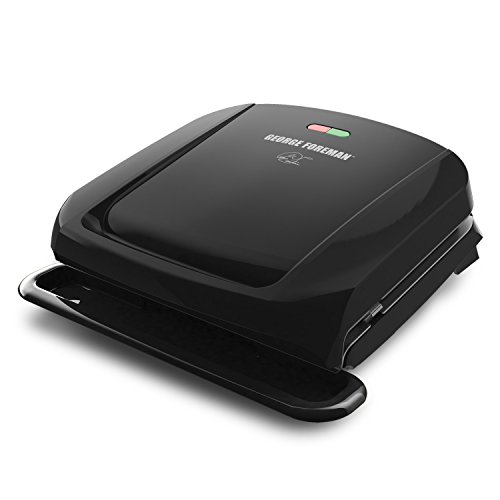
George Foreman 4-Serving Indoor Grill with Removable Plates — Best Budget Press
The George Foreman is the dorm, first-apartment, and weeknight answer: a sloped contact grill that heats fast, presses a grilled cheese or a pair of burgers without ceremony, and sends its removable plates to the dishwasher afterward. Its grease-reducing slope drains burger fat away from the cooking surface as a bonus.
Strengths
- Fast heat-up and dead-simple operation — no programs to learn
- Removable plates make cleanup genuinely easy at this tier
- Sloped surface drains burger fat into the drip tray as it cooks
Trade-offs
- Fixed-angle press can squeeze delicate sandwiches if you lean on the lid
- Four-serving size assumes modest patties and standard bread slices
- Fewer temperature refinements than the Cuisinart models
| Type | Countertop contact grill |
| Capacity | 4-serving (per Amazon title) |
| Plates | Removable nonstick plates (per Amazon title) |
There is a reason this format has sold for decades: for the two meals in this search, it simply works. Bread crisps, cheese melts, burgers cook through quickly with fat draining away, and nothing about the process requires attention. The compromises are finesse — you moderate the press with your hand rather than a floating hinge, and delicate fillings can slide if you close it carelessly. As a first grill, a second grill for a small household, or a budget buy that will still be used in a year, it earns its badge without pretending to be a Griddler.
The Foreman’s slope deserves its own paragraph because it quietly shapes results. Fat leaves the cooking surface continuously, so burgers fry less in their own grease and grilled cheese — cooked on the same slope — benefits from a drier plate contact that crisps bread cleanly. The same slope means very wet or loose fillings migrate if you close the lid carelessly; a gentle close and a second of patience while the sandwich sets prevents the slide. Its removable plates are the budget tier’s best cleanup story, and owners who actually remove and wash them after every use report the nonstick lasting far beyond the model’s throwaway reputation.
Verdict in one line: the people’s press — imperfect, inexpensive, and used constantly, which beats perfect and ignored.
Best for: budget buyers, small households, dorms, and first apartments / Not suited for: cooks making tall, delicate sandwiches or wanting precise temperature control
Check on Amazon — check price on Amazon before you decide, because countertop grill pricing and bundle contents shift often.
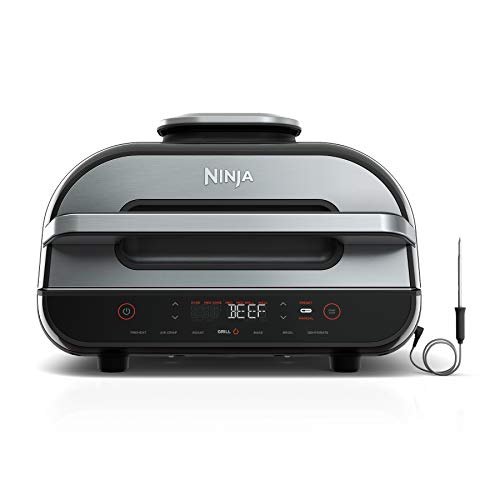
Ninja Foodi Smart 6-in-1 Indoor Grill & Air Fryer FG551 — Best for Thick Cheeseburgers
The FG551 answers the burger half of this search better than any press can: thick patties are where contact grills guess and enclosed smart grills measure. The thermometer system cooks a three-quarter-inch pub burger to your chosen doneness, and the closed lid turns the chamber into a cheese-melting oven for the final minute.
Strengths
- Thermometer guidance nails thick-burger doneness without cutting patties open
- Closed lid melts cheese evenly over the whole patty
- Air-fry side handles the fries that belong next to the burger
Trade-offs
- Not a press — a classic grilled cheese needs the open-grate workaround, not a squeeze
- Smaller surface than the XL Ninja for group burger nights
- Premium tier for what is, on sandwich night, the least specialized tool here
| Type | Enclosed countertop grill and air fryer |
| Thermometer | Built-in thermometer, Smart Cook System (per Amazon title) |
| Air-fry capacity | 4 Qt (per Amazon title) |
Be honest about the division of labor: for grilled cheese, the FG551 is competent but not native — you are grilling bread on a grate under a lid rather than pressing it between plates, and results are good rather than definitive. For cheeseburgers, it flips to first place, because doneness is the whole game with thick patties and this machine measures instead of guessing. Households whose keyword really means burger night with occasional sandwiches should rank it first; sandwich-first households should take a Griddler and never look back.
Burger night logistics are where the FG551 quietly shines. The thermometer probe turns a mixed order — one medium-rare, one well-done, one chicken breast that must be fully cooked — from a juggling act into a queue, because each piece announces its own readiness. Fries air-frying in the same footprint means the meal lands together without oven management. For the sandwich side of its life, treat it as a lidded grill rather than a press: bread on the grate, a light weight or the lid’s gentle close, and cheese that melts from chamber heat. It will not match a Griddler’s pressed crispness, and pretending otherwise helps no one — but as a two-meal compromise it is unusually capable.
Verdict in one line: the burger brain of the list — bring it home for thick patties, keep it for everything else it quietly handles.
Best for: thick-burger lovers who want exact doneness and fries from the same machine / Not suited for: grilled-cheese purists who want a true two-plate press
Check on Amazon — check price on Amazon before you decide, because countertop grill pricing and bundle contents shift often.

Hamilton Beach Electric Indoor Searing Grill 25360 — Best Lay-Flat Grill for Smash-Style Burgers
The Hamilton Beach 25360 suits the smash-burger cook: an open, flat-access grate where you can press patties thin with a spatula, watch the crust form, and drape cheese over the top in the open air. Its 118 square inches serve a small crowd, and the removable grate keeps cleanup proportionate.
Strengths
- Open access is ideal for smash-style patties and spatula work
- 450°F ceiling gives burgers a genuine sear
- Removable PFAS-free grate simplifies washing after fatty cooks
Trade-offs
- Open format cannot press a grilled cheese — sandwiches here are pan-style, one side at a time
- More splatter and aroma than the enclosed or contact picks
- Cheese melting needs a dome or lid trick for best results
| Type | Countertop open searing grill |
| Temperature | Adjustable to 450°F (per Amazon title) |
| Surface | 118 sq. in., serves 6 (per Amazon title) |
| Grate | PFAS-free removable nonstick grate (per Amazon title) |
This pick is a format argument. Contact presses cook burgers well but forbid the smash technique entirely; this open grill exists for cooks who want lacy, crispy-edged patties and full spatula control. For grilled cheese it reverts to skillet logic — buttered bread on the grate, flip once — which works fine but concedes the press advantage. The removable grate and honest temperature range make it a durable weeknight tool, and for mixed households where burgers dominate and sandwiches are occasional, that trade is rational.
The 25360’s removable grate is the detail that keeps it in service. Open grills collect carbonized residue in their texture, and a grate that lifts out for a real wash — rather than being wiped in place around a heating element — resets the cooking surface completely. Smash technique on it benefits from a stiff, wide spatula and confidence: one firm press at the start, seasoning on the exposed side, and no further touching until the edges crisp and release. For cheese, a metal mixing bowl inverted over the patty for the final minute traps enough heat to melt a slice perfectly, the oldest diner trick in the book, and it works on this grill exactly as it works on a flat-top.
Verdict in one line: the spatula cook’s grill — open, hot, and honest, for people who smash first and ask questions later.
Best for: smash-burger fans and open-grill cooks feeding up to a small group / Not suited for: buyers whose priority is pressed grilled cheese sandwiches
Check on Amazon — check price on Amazon before you decide, because countertop grill pricing and bundle contents shift often.

Electric Indoor Grill 1500W 2-in-1 Smokeless with Cheese Pans — Best for Cheese Lovers and Tabletop Melting
This 2-in-1 is the pick for people who read the keyword and thought mostly about the cheese. The little pans melt individual portions of cheese under the grill’s heat — raclette-style — ready to pour over burgers, potatoes, or bread, while the top plate grills patties and vegetables at the same time.
Strengths
- Individual cheese pans turn burger night into a pour-over cheese event
- Grill and griddle plates swap for patties, bread, and vegetables
- Tabletop format makes melting and serving a social, at-the-table process
Trade-offs
- Small pans and surface suit two to four people, not a crowd
- More small parts to wash than a simple press
- Cheese-pan novelty matters only if your household actually eats that way
| Type | Countertop 2-in-1 smokeless grill and griddle |
| Power | 1500W (per Amazon title) |
| Plates | Removable grill and griddle plates (per Amazon title) |
| Extras | Cheese pans for melting (per Amazon title) |
Judge this grill as an experience purchase that also cooks well. The top plate handles standard burger and sandwich-griddle duty credibly, and the pans underneath deliver the one thing no press can: molten cheese, portioned per person, ready to pour at the table. For raclette-curious households and cheese-first cooks, that is a real capability, not a gimmick. For everyone else, the Griddler FIVE covers the search’s core jobs with less washing-up. Know which household you are before choosing.
The cheese pans reframe what a ‘grilled cheese’ night can be. Instead of cheese inside bread, the cheese becomes a course of its own — melted to order, poured over the grilled items each person chose, at the pace the table sets. That format suits grazers, mixed-diet tables, and anyone whose burger is really a vehicle for cheese. The practical notes are simple: the pans are small and get very hot, so keep a trivet and a plan for handling them; cheese varieties with good melt and moderate fat behave best; and the top plate’s timing should be paced so grilled items land as pans finish, not long before. Run that choreography once and the format stops feeling novel and starts feeling inevitable.
Verdict in one line: the cheese course as a main event — a niche tool that, for the right table, becomes the whole point of the evening.
Best for: cheese-first households and raclette-style tabletop meals for two to four / Not suited for: large families or buyers wanting the fewest possible parts to wash
Check on Amazon — check price on Amazon before you decide, because countertop grill pricing and bundle contents shift often.
Comparison Table
| Pick | Badge | Key Spec | Best For |
|---|---|---|---|
| Cuisinart Griddler FIVE GR-5B | Best Overall for Grilled Cheese and Cheeseburgers | Reversible plates; digital LCD control (per Amazon title) | households splitting time between grilled cheese, panini, and burgers |
| Cuisinart Griddler Elite GR-300 | Best for Melts and Loaded Burgers | Top melt; 500°F sear function (per Amazon title) | tall melts, open-faced sandwiches, and cheese-finished burgers |
| George Foreman 4-Serving Indoor Grill with Removable Plates | Best Budget Press | 4-serving contact grill; removable plates (per Amazon title) | budget buyers, small households, dorms, and first apartments |
| Ninja Foodi Smart 6-in-1 Indoor Grill & Air Fryer FG551 | Best for Thick Cheeseburgers | Smart Cook System with built-in thermometer; 4 Qt (per Amazon title) | thick-burger lovers who want exact doneness and fries from the same machine |
| Hamilton Beach Electric Indoor Searing Grill 25360 | Best Lay-Flat Grill for Smash-Style Burgers | 450°F max; 118 sq. in.; PFAS-free removable grate (per Amazon title) | smash-burger fans and open-grill cooks feeding up to a small group |
| Electric Indoor Grill 1500W 2-in-1 Smokeless with Cheese Pans | Best for Cheese Lovers and Tabletop Melting | 1500W; removable grill/griddle plates; cheese pans included (per Amazon title) | cheese-first households and raclette-style tabletop meals for two to four |
Read the table by badge first and key spec second: the badge states the job each pick does best, and the key spec is drawn only from details confirmed in the verified listing. Where two picks look close, the full reviews above separate them on the trade-offs that matter in daily use.
How to Choose a Grill for Grilled Cheese and Cheeseburgers
Match the machine to your ratio. If grilled cheese and panini dominate, prioritize a contact grill with reversible plates and a floating hinge — the hinge is what presses a thick sandwich evenly instead of driving the filling out the back. If burgers dominate, prioritize searing heat, surface area, and either a thermometer system for thick patties or open access for smash patties. Temperature control is the shared requirement: bread burns fast at burger heat, and patties pale at sandwich heat, so a grill with a real range — ideally marked temperatures rather than vague low-to-high — serves both meals best. Check plate removability for dishwasher cleaning, because cheese and burger fat are the two messes you will wash most. Finally, count your servings honestly: two sandwiches or four standard patties is the working capacity of most full-size contact grills, and households that regularly exceed that should look at XL or enclosed models.
Grilled Cheese Technique: Crisp Bread, Fully Melted Center
The classic failure is bread that browns before the cheese melts. Fix it with sequence and temperature, not force. Use medium heat and give the sandwich time — gentle, steady contact melts the center while the crust builds gradually. Spread the outside of the bread with a thin, even layer of softened butter or mayonnaise for the most reliable browning, and choose bread sturdy enough to hold fillings without tearing. Grated or thinly sliced cheese melts faster and more evenly than thick slabs, and bringing the sandwich ingredients closer to room temperature shortens the gap between crisp and molten. On a floating-hinge press, close the lid and let the hinge settle under its own weight rather than bearing down; pressing hard is for panini-style density, not for a classic grilled cheese. Rest the sandwich a minute before cutting so the cheese sets slightly and stays in the sandwich instead of on the board.
Cheeseburger Technique on a Countertop Grill
Patties first, cheese last, buns toasted in between — that order runs every format in this guide. For contact grills, season patties, cook with the lid closed for even two-sided heat, and add cheese in the final minute with the lid down so it melts from both the patty’s heat and the top plate’s. For thick patties on the Ninja, trust the thermometer and pull at your target doneness rather than a timer. For smash patties on the open Hamilton Beach, press once, firmly, in the first seconds, then leave them alone until the crust releases. Toast cut buns on the griddle plate or the warm grill for thirty seconds while patties rest — a toasted bun is the difference between a good countertop cheeseburger and a soggy one. Rest patties briefly, assemble with the cheese side up, and serve immediately; countertop burgers wait for no one.
Bread, Cheese, and Patty: The Ingredient Decisions That Matter More Than the Grill
A countertop grill executes decisions; it does not make them. For grilled cheese, bread with structure — a sturdy white, sourdough, or brioche sliced evenly — crisps without collapsing, while very soft or very crusty loaves fight the press. Cheese selection is melt engineering: young, moist cheeses melt smoothly, aged cheeses bring flavor but split if overheated, and the classic solution is a blend — a reliable melter carrying a flavorful partner. Slice or grate evenly so the center and edges finish together. For cheeseburgers, patty composition drives the result more than any grill feature: a fattier grind stays juicy under contact heat, a leaner grind needs gentler handling and precise timing, and patties formed with a shallow dimple in the center cook flat instead of doming. Season the outside, keep the interior uncomplicated, and chill formed patties briefly so they hold together on the plate. None of this requires a better grill — it requires the cook the grill deserves, and every model in this guide will show the difference immediately.
Troubleshooting: Soggy Sandwiches, Pale Patties, and Other Fixable Failures
Most countertop failures in this category trace to four causes, all correctable. Soggy grilled cheese means the plates were not fully hot, the bread carried too much surface moisture, or the heat was so high the outside raced ahead and trapped steam — preheat completely, use a thin fat layer, and give medium heat its minutes. Cheese that will not melt while bread browns means the filling started fridge-cold and thick; grate it, spread it evenly, and let the assembled sandwich stand a few minutes before pressing. Pale patties mean crowding or a cold start: the plate’s heat went into steam instead of crust, so cook fewer pieces with space between them and resist moving them until the crust releases. Cheese that slides off the burger means it was added to a dry, just-flipped surface and rushed; add it in the final minute, close the lid, and let chamber heat do the work. Keep a small notebook of what you changed — grill cooking is fast enough that two or three iterations will dial in your exact machine, bread, and cheese combination permanently.
Setting Up a Sandwich-and-Burger Station Around Your Grill
The grill is the center, but the station makes the night. Arrange it as a small production line: bread and buns in a basket on one side, cheese sliced and portioned before the grill heats — because cheese added late is cheese added in a panic — and a warm holding plate or low oven ready for finished items, since both sandwiches and burgers punish waiting. Keep two tools at hand and no more: a wide spatula for the open grill work and turning, and tongs for everything else; a crowded tool crock slows a fast process. Seasoning lives at the station, not across the kitchen, because patties are seasoned in the seconds before they cook. A small tray for raw items and a separate clean plate for cooked ones keeps the food-safety line bright without thought. Finally, assign the press operator one job during service: nothing leaves the grill early. Sandwiches and burgers on countertop equipment cook in minutes, and the station’s discipline — mise en place, hot plates, patience — is what converts a good grill into a great sandwich night, reliably, for whoever is cooking.
Before You Buy: The Two-Meal Test
Every finalist in this guide should be subjected to the two-meal test in imagination before purchase — and in reality during its first week home. Meal one is your household’s definitive grilled cheese: your bread, your cheese, your additions. Picture the sandwich on the plates — does the hinge float over its thickness, does the surface fit two at once, can the heat sit at a patient medium without guesswork? Meal two is your definitive cheeseburger: your patty thickness, your headcount, your cheese. Picture the cook — enough room without crowding, a way to know doneness that you trust, a melt step that does not squash the stack. A grill that passes both pictures is your grill; a grill that passes one brilliantly and the other poorly is a specialist, and specialists are wonderful purchases when bought knowingly. Round the decision out with the unglamorous confirmations: plates included in the box, replacement plate availability for the model, and a storage home the machine will actually occupy. Then order with confidence, and schedule the real two-meal test for the first weekend — bread, cheese, and patties are a cheap tuition, and the grill that passes them at your table has nothing left to prove.
Kids, Guests, and Dietary Mixes: Running a Flexible Sandwich and Burger Night
The two-meal format shines brightest when the table is complicated, and a little planning turns the grill into the solution rather than another constraint. For children, the contact grill’s enclosed heat is a safety and simplicity win: sandwiches cook without an open pan of butter, at a steady medium that forgives a distracted minute, and small hands can be given the assembly job — bread, cheese, one favorite addition — while an adult runs the press. For guests, set the station as a build-your-own line and cook to order in the order people finish assembling; countertop equipment’s speed makes two-minute turns feel like a diner, not a delay. For dietary mixes, the format divides cleanly: vegetarian sandwiches and veggie patties on the flat plates or one side of an opened grill, meat on the other, with utensils kept separate — a separation that is easy to honor on reversible-plate machines by dedicating a plate side per group for the night. Gluten-free bread, notably, crisps better under a gentle press than in a toaster, because contact heat compensates for its fragility. Run this way, one appliance feeds the whole table’s variations without a second menu, which is precisely the social job this search’s two foods were born to do.
How to Use a Contact Grill for a Perfect Grilled Cheese and Burger Night
Run burger night as one continuous session and the grill never cools between jobs. Preheat the contact grill with grill plates fitted and the temperature set high for patties. While it heats, form patties slightly wider than the buns — they shrink as they cook — season them, and slice the cheese so it is ready. Cook the patties with the lid closed, turning your attention to bun prep: butter the cut sides lightly. When the patties are nearly done, lay the cheese on top, close the lid for the final stretch, then move the finished cheeseburgers to a warm plate to rest. Drop the temperature to medium, toast the buns cut-side down on the plates until golden, and assemble. For grilled cheese as a second course or a vegetarian parallel track, swap to the flat griddle plates if your grill has them, keep the heat at medium, assemble sandwiches with fat spread thinly on the outside of the bread, and press gently until both sides are deep golden and the center pulls in strings when lifted. Wipe the plates between jobs with a folded, heat-safe cloth while they are still warm — cheese residue removes easily now and stubbornly later.
Common Buying Mistakes
- Using maximum heat for grilled cheese and burning the bread before the cheese melts
- Pressing down hard on sandwiches and squeezing the filling out
- Skipping the floating-hinge check and buying a fixed press for thick sandwiches
- Cooking patties and sandwiches at the same temperature setting
- Forgetting to toast the buns, then blaming the grill for a soggy cheeseburger
- Scraping cheese off cold plates with metal tools and destroying the nonstick surface
The most common shopping mistake in this niche is buying a pure open grill for a sandwich-led brief. Open grills make fine burgers but reduce grilled cheese to skillet work with none of the press benefits. If sandwiches are half the keyword for you — and they are half of this search — a contact grill with reversible plates is the correct default.
Final Recommendation
Start with the Cuisinart Griddler FIVE for most households: it presses the best grilled cheese in this guide and cooks burgers with genuine two-sided sear. Step up to the Griddler Elite if your sandwiches run tall or open-faced, take the George Foreman if the budget leads, the Ninja FG551 if thick burgers are the main event, the Hamilton Beach if smash burgers are your style, and the cheese-pan 2-in-1 if melted cheese is practically a food group at your table. Check price on Amazon for the exact model before ordering. More from this cluster: Best Countertop Grills, Best Countertop Grills Don T Spatter, Best Cuisinart Electric Grills Skillets, and Best Countertop Mounted Natural Gas Grills.
- Cuisinart Griddler FIVE GR-5B (Best Overall for Grilled Cheese and Cheeseburgers) — Check on Amazon
- Cuisinart Griddler Elite GR-300 (Best for Melts and Loaded Burgers) — Check on Amazon
- George Foreman 4-Serving Indoor Grill with Removable Plates (Best Budget Press) — Check on Amazon
- Ninja Foodi Smart 6-in-1 Indoor Grill & Air Fryer FG551 (Best for Thick Cheeseburgers) — Check on Amazon
- Hamilton Beach Electric Indoor Searing Grill 25360 (Best Lay-Flat Grill for Smash-Style Burgers) — Check on Amazon
- Electric Indoor Grill 1500W 2-in-1 Smokeless with Cheese Pans (Best for Cheese Lovers and Tabletop Melting) — Check on Amazon
Frequently Asked Questions
What makes a grill good for grilled cheese specifically?
Even two-sided heat, a hinge that floats over thick fillings instead of crushing them, and steady medium temperature control. Reversible flat plates help too, giving full bread contact for maximum crispness.
Should cheese go on the burger before or after cooking?
In the final minute of cooking, with the lid closed or the top plate lowered. The patty’s residual heat plus gentle top heat melts the cheese evenly without overcooking the meat.
Can a contact grill cook thick pub-style burgers?
Yes, but timing gets less predictable as thickness rises, which is why the thermometer-guided Ninja is the thick-burger pick here. On a press, use the hinge’s highest comfortable setting and verify doneness with a separate thermometer.
Butter or mayonnaise on the outside of a grilled cheese?
Both work. Butter gives classic flavor; mayonnaise spreads thinner, browns very evenly, and tolerates heat slightly better. The grill matters less than using a thin, complete layer and medium heat.
How many burgers fit on a typical countertop contact grill?
About four standard patties on a full-size model, fewer if they are large pub patties. Crowding drops plate temperature and steams the meat, so cook in two batches rather than squeezing in a fifth patty.
How do I clean cheese and burger fat off the plates?
Wipe plates while warm with a heat-safe cloth, then remove them once cool enough to handle and wash or dishwasher them per the manual. Warm cheese releases easily; cold cheese has to be soaked and scraped, which is how nonstick coatings get damaged.


