Disclosure: airfryerkitchensupply.com is reader-supported. When you buy through links on our site, we may earn an affiliate commission at no extra cost to you.
Where to buy
If you are shopping for the best contact grills, start with the verified shortlist below. Every linked model on it was confirmed against a live Amazon listing through the retailer data available to this site before it earned its place here, and every unlinked pick is labelled honestly so you know exactly what you are getting.
- Cuisinart Griddler FIVE GR-5B (Best Overall) — Check the current price on Amazon
- Cuisinart Griddler Elite GR-300 (Best Premium) — Check the current price on Amazon
- T-Fal OptiGrill XL Electric Grill (Best Automatic) — Check the current price on Amazon
- George Foreman 4-Serving Indoor Grill with Removable Plates (Best Easy-Clean Classic) — Check the current price on Amazon
- George Foreman GR10B 2-Serving Mini Grill & Panini Press (Best for Singles and Dorms) — Check the current price on Amazon
- George Foreman Beyond Grill 7-in-1 Electric Indoor Grill with Air Fry Technology (Best Versatile) — Check the current price on Amazon
This page never prints a fixed figure for any product, because grill and grill-book prices and stock move constantly. Use the links above to check price on Amazon at the moment you are ready to buy, and treat any budget language in this article as a tier guide — where the best contact grills market sits — rather than a promise about a specific listing on a specific day. Always confirm the exact model name, size, and fuel type on the listing matches the model reviewed here before you order, because lineups change mid-season and near-identical model names often hide different grates, burners, or included accessories.
The best contact grills solve a specific weeknight problem: protein that cooks slowly on one side, dries while you wait to flip it, and leaves a greasy pan as a parting gift. A contact grill presses food between two heated plates, cooking both sides at once, draining grease as it goes, and finishing in roughly half the time of a skillet — with grill marks and a tidier sink. The six picks in this guide cover the category’s real range, from a dorm-sized mini press to a sensor-driven family machine and a premium searing model.
Choosing among them is mostly about three honest questions. How many servings do you cook at once — because plate size is a hard ceiling, not a preference? How much control do you want — a simple hot press, a dialled multi-function unit, or a sensor that decides doneness for you? And how will you clean it — because in this category, removable dishwasher-safe plates are the difference between a machine used nightly and a machine used twice. Every review below answers those questions for its pick, including the trade-offs, so you can match a machine to your kitchen instead of to its marketing.
As everywhere on this site, every linked pick was verified against a live Amazon listing before it was recommended, no fixed prices or ratings are printed anywhere in this guide, and budget language refers to tiers — the value classics, the mid-range all-rounders, and the premium step-ups — not to figures that will be stale by next week. Confirm the exact model and plate configuration on the listing before you order; contact grills are sold in near-identical sizes and generations that differ exactly in the details that matter.
A final framing before the picks: a contact grill is not a lesser outdoor grill and should not be judged as one. It is a different instrument — closer to a professional sandwich press crossed with a griddle — with its own strengths in speed, consistency, and indoor manners. Judge each pick below on how well it does that job, and this category stops looking like a compromise and starts looking like what it is: the hardest-working small appliance most kitchens can buy.
In this guide
Quick Picks
Short on time? These are the six best contact grills picks explained in full below. Each one owns a distinct job, so match the badge to the way you actually cook instead of chasing the longest feature list.
- Cuisinart Griddler FIVE GR-5B — Best Overall. A five-function countertop contact grill and panini press with an LCD display — grill, griddle, and press in one footprint. — check price on Amazon
- Cuisinart Griddler Elite GR-300 — Best Premium. The step-up 6-in-1 Elite with top-melt and a 500°F sear function — for cooks who press, melt, and sear in the same meal. — check price on Amazon
- T-Fal OptiGrill XL Electric Grill — Best Automatic. The sensor-driven XL with 9 automatic cooking modes that measures thickness and cooks to your chosen doneness — the true set-and-forget contact grill. — check price on Amazon
- George Foreman 4-Serving Indoor Grill with Removable Plates — Best Easy-Clean Classic. The classic sloped Foreman in a 4-serving size with removable nonstick plates — fast heat-up and grease that drains away from the food. — check price on Amazon
- George Foreman GR10B 2-Serving Mini Grill & Panini Press — Best for Singles and Dorms. A compact 2-serving mini grill and panini press with a small cooking surface — sized for one or two people and the smallest kitchens. — check price on Amazon
- George Foreman Beyond Grill 7-in-1 Electric Indoor Grill with Air Fry Technology — Best Versatile. A large 7-in-1 indoor grill with air fry technology — the Foreman line’s move into multi-function, family-size countertop cooking. — check price on Amazon
How These Picks Were Chosen
Picks had to be true contact grills or presses — machines that cook with a heated top plate in contact with the food — not open grills wearing the category’s name. Within that rule we verified each model against a live listing, then judged plate system (removable beats fixed, always), hinge behaviour on thick food, capacity honesty, and the cleaning routine an owner will actually perform at 7 p.m. on a Tuesday.
We deliberately kept the spread wide: two Cuisinart all-rounders at two levels, the automatic T-Fal, two George Foreman classics at two sizes, and the brand’s modern multi-function flagship. If your cooking matches one badge strongly, that is your grill — the comparison table and final recommendation are written to make that call in about a minute.
A note on what did not make the list: open-top indoor grills, stovetop grill pans, and microwave grills were all excluded, however good some of them are, because they do not cook by contact from both sides — and a guide that blurs its own category teaches readers nothing. Everything below presses, drains, and cooks two-sided, which is the job the keyword actually describes.
The 6 Best Contact Grills for Every Kitchen Size

Cuisinart Griddler FIVE GR-5B — Best Overall
A contact grill cooks from both sides at once, and the Cuisinart Griddler FIVE is the machine that defined the modern category: a countertop unit that works as a contact grill, a panini press, and — opened flat — a full grill and griddle, with a digital LCD keeping settings honest. That range is why it takes Best Overall among the best contact grills: most households do not need a press or a grill, they need the small set of jobs both machines do, done by one appliance that earns its counter space.
It suits households of two to five who cook sandwiches, burgers, chicken breasts, and weekend breakfasts in rotation. The floating hinge is the detail that matters daily: it settles evenly on a thick chicken breast or a stacked panini instead of tipping and squeezing the filling out the back, which is the failure mode of cheap presses. Removable, dishwasher-safe plates close the deal — contact grills live or die on cleanup, and plates that go in the dishwasher get cleaned properly every time.
Skip it if your contact-grill need is exactly one sandwich a week — the mini picks below are smaller and cheaper to own — or if you want fully automatic doneness sensing, which is the OptiGrill’s party trick further down this list. For a household that will use three or more of its functions weekly, this is the contact grill to buy.
Ownership tip: cook bacon and fatty burgers with the unit’s drip system angled as the manual directs, and empty the drip tray while it is still warm. Contact grills punish owners who let grease set overnight and reward the thirty-second wipe with years of easy cleaning.
Strengths
- Floating hinge and reversible plates cover everything from thick steaks to pressed sandwiches to griddled eggs
- Removable plates go in the dishwasher, which is why owners actually use it on weeknights
- LCD controls make repeat cooks consistent — same setting, same result
Trade-offs
- Counter footprint is real — measure before you fall for the feature list
- Five functions means a learning curve the single-purpose presses do not have
- Plate edges and hinge need a wipe after fatty cooks to keep the unit fresh
| Specification | Detail |
|---|---|
| Functions | 5-in-1 grill / griddle / panini press (per Amazon listing title) |
| Display | Digital LCD screen (per Amazon listing title) |
| Model | GR-5BNAS (per Amazon listing title) |
Best for: households that want one countertop machine for pressing, grilling, and griddling / Not suited for: single-sandwich minimalists and set-and-forget cooks who want automatic sensing
Check the current price on Amazon

Cuisinart Griddler Elite GR-300 — Best Premium
The Griddler Elite GR-300 is what the contact grill becomes when it stops apologising: a 6-in-1 electric grill and griddle with a top-melt function and a 500°F sear setting, built for cooks who found the standard press almost — but not quite — enough. The sear function is the headline, because crust is the contact grill’s historic weakness; plates that genuinely sear change what the machine can be trusted with, from steaks to scallops.
It suits enthusiastic home cooks who entertain, melt, and finish dishes under heat as often as they press them. Top melt sounds like a garnish until you have finished an open-faced tuna melt, a croque, or a tray of nachos for two without heating a full oven — then it becomes the feature you describe to friends. Dual-zone control extends the same logic: sear on one plate, hold or griddle gently on the other.
Skip it if your pressing life is sandwiches and chicken breasts; the FIVE does those beautifully for less commitment of money and counter. The Elite is for cooks who already know they max out a standard contact grill — if that sentence describes you, this is your machine, and it is not close.
Use the sear function with restraint: it is for finishing and crusting, not for cooking thick cuts through. Cook thick proteins at grill temperature to near-doneness, then sear briefly — the Elite rewards cooks who treat its modes as a sequence rather than a single setting.
Strengths
- 500°F sear function gives contact grilling a crust most countertop units cannot reach
- Top-melt mode finishes open-faced sandwiches and gratins without firing the oven
- Independent plate controls let the two sides run different jobs in one session
Trade-offs
- Premium tier price buys features light users will never touch
- Larger and heavier than the FIVE — a commit-to-the-counter appliance
- More modes means more settings to learn before it feels automatic
| Specification | Detail |
|---|---|
| Functions | 6-in-1 electric grill and griddle (per Amazon listing title) |
| Sear | 500°F temperature sear function (per Amazon listing title) |
| Special mode | Top melt (per Amazon listing title) |
| Model | GR-300NAS (per Amazon listing title) |
Best for: enthusiastic cooks who sear, melt, and finish dishes on the press every week / Not suited for: light users whose pressing begins and ends with sandwiches
Check the current price on Amazon

T-Fal OptiGrill XL Electric Grill — Best Automatic
Every contact grill owner knows the anxiety: press the lid, wait, lift too early, press again, and serve chicken that is somehow both dry and doubted. The T-Fal OptiGrill XL exists to delete that ritual. Its system measures the thickness of the food and cooks through automatic programs — nine intelligent modes in the XL — signalling doneness levels as it goes, so a steak lands where you asked and chicken arrives cooked through without being cremated as insurance.
It suits busy families and nervous grillers — the XL serves six, which turns weeknight protein for a household into a single pressing. It is also the kindest pick here for cooks feeding people with firm doneness preferences: set the level per batch and the machine, not your optimism, decides when it is done. Frozen-food and manual modes round out the practical edges.
Skip it if you love conducting every cook yourself, or if your priority is a flat-open griddle for big breakfasts — the Cuisinarts do that job better. The OptiGrill’s bargain is specific and honest: surrender control, receive consistency. For a lot of households, that is the best trade in this entire guide.
Trust the sensor, but feed it well: bring proteins to an even thickness where you can, pat surfaces dry, and let the program finish before lifting the lid to check. The cooks who complain about automatic grills are usually the ones who kept interrupting the automation.
Strengths
- Automatic thickness sensing and doneness levels remove the guesswork that ruins chicken and steaks
- Nine program modes cover the proteins households actually grill, from burgers to fish
- XL capacity feeds a family in one pressing instead of two
Trade-offs
- You cook the program’s way — improvisers who override everything gain less from the sensing
- Larger footprint than standard presses, and the sensor hardware wants careful plate handling
- Less of a griddle and press all-rounder than the Cuisinart picks
| Specification | Detail |
|---|---|
| Modes | 9 intelligent automatic cooking modes (per Amazon listing title) |
| Capacity | 6 servings, XL (per Amazon listing title) |
| Sensing | Thickness measurement with doneness indicator (OptiGrill system) |
Best for: busy families who want doneness handled automatically, in family-sized batches / Not suited for: hands-on cooks who override every setting and griddle-first households
Check the current price on Amazon
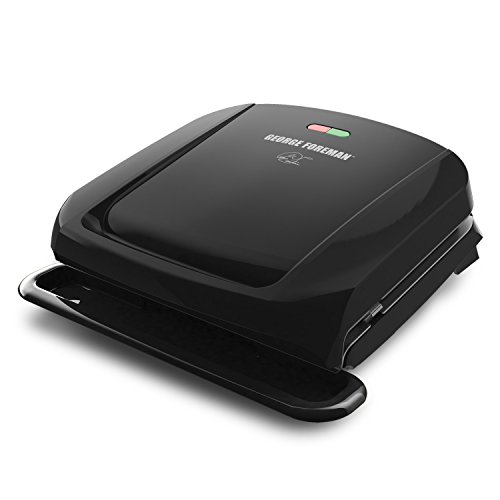
George Foreman 4-Serving Indoor Grill with Removable Plates — Best Easy-Clean Classic
The George Foreman name is practically synonymous with the contact grill, and this 4-serving removable-plate model is the version to buy: it keeps the sloped, grease-draining cooking surface and fast heat-up that made the design famous, and fixes the one thing that made owners quietly stop using the old fixed-plate models — the cleaning. Plates that come off and wash properly turn the Foreman back into what it always promised to be: the fastest route from raw protein to dinner in a small kitchen.
It suits couples and small households, students in their first real kitchen, and anyone whose grilling is mostly burgers, chicken breasts, chops, and sandwiches cooked quickly and often. There is no program to learn and no app to pair; close the lid, wait a few minutes, eat. That simplicity is a feature, and for many kitchens it beats a smarter machine that asks for decisions at 6 p.m.
Skip it if you cook for a crowd, want sear-level heat control, or press thick, uneven cuts that need a floating hinge’s full range. Within its lane — fast, small, easy — the classic Foreman with removable plates remains the value benchmark of this category.
Protect the plates and this grill lasts: wooden or silicone tools only, no cooking spray build-up (wipe plates with a light oil film instead), and store the drip tray with the unit so it is never missing at the greasy moment.
Strengths
- Removable plates fix the classic Foreman complaint — cleaning is finally as easy as the cooking
- Sloped design drains grease to the tray while food cooks, the idea that made the brand
- Heats fast and cooks faster; weeknight proteins go from fridge to plate in minutes
Trade-offs
- No temperature dial finesse — it is a hot, fast, simple machine
- Four servings is a couple-plus, not a family of six
- Nonstick plates want non-metal tools and gentle handling to stay nonstick
| Specification | Detail |
|---|---|
| Capacity | 4-serving (per Amazon listing title) |
| Plates | Removable nonstick plates (per Amazon listing title) |
| Design | Fast heat-up, grease-reducing sloped design (per Amazon listing title) |
Best for: couples and small kitchens that want the fastest, simplest contact grilling / Not suited for: large families and cooks who want temperature control or searing range
Check the current price on Amazon
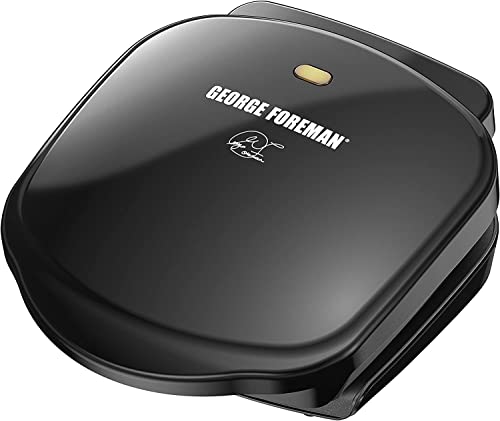
George Foreman GR10B 2-Serving Mini Grill & Panini Press — Best for Singles and Dorms
Most contact grills are family machines that singles tolerate. The George Foreman GR10B is the reverse: a 2-serving mini grill and panini press with a compact cooking surface, designed from the start for dorms, studios, first apartments, and one-person cooking. It takes the counter space of a hardcover book, heats in moments, and turns a chicken breast, a burger, or a proper pressed sandwich into a meal without involving the oven, a frying pan, or a sink full of washing up.
It suits solo cooks, students, office lunch improvers, and couples whose grilling is genuinely two portions at a time. It is also a legitimate second grill: households with a big press sometimes keep a mini for the single sandwich or the teenager’s after-school cooking, because firing the small machine is faster and cleaning it is trivial.
Skip it the moment your regular cooking exceeds two servings, or if thick steaks are your main event — small plates and big cuts are a sad combination. Judged on its own brief, though, it is the most honest appliance in this guide: exactly enough grill for one or two people, and not an inch more.
Dorm and small-kitchen cooks should pair it with a mini fridge routine: keep two or three press-ready fillings on hand — sliced cheese, deli meats, a vegetable that grills well — and the machine becomes a meal system rather than a gadget, which is how small appliances earn permanent counter space.
Strengths
- Genuinely small — fits dorms, studio kitchens, office corners, and camper storage
- Cooks for one without heating a family appliance or a full oven
- Panini-press duty is squarely in its design brief, so sandwiches are its home turf
Trade-offs
- Two servings is a hard ceiling — couples who entertain need a second machine or batches
- Small surface crowds thick cuts; this is a thin-and-quick cooker
- Fixed simplicity: no programs, no sear modes, no griddle conversion
| Specification | Detail |
|---|---|
| Capacity | 1–2 servings (per Amazon listing title) |
| Surface | Compact 7.3 x 5.6 inch cooking surface class (per Amazon listing title) |
| Style | Mini grill and panini press (per Amazon listing title) |
Best for: singles, students, and dorm or studio kitchens cooking one or two servings / Not suited for: families and anyone who regularly cooks more than two portions
Check the current price on Amazon

George Foreman Beyond Grill 7-in-1 Electric Indoor Grill with Air Fry Technology — Best Versatile
The Beyond Grill is George Foreman’s answer to a fair question: why should the contact grill stay a one-trick machine while every other countertop appliance multiplies functions? This large 7-in-1 electric indoor grill adds air fry technology to the family’s sloped-grill heritage, aiming squarely at households that want grilled mains and crispy sides from a single unit — and that would rather own one big appliance than three small ones.
It suits families who cook indoors most of the year, small kitchens trading several gadgets for one hub, and Foreman loyalists ready to graduate from the classic press. The grill function remains the anchor — proteins pressed and drained the Foreman way — while the air fry side handles the fries, wings, and vegetables that otherwise demand a second appliance or the oven’s long preheat.
Skip it if counter space is your scarcest resource and a compact press covers your life, or if you want a specialist’s depth in either grilling or air frying alone. As a consolidation play, though, it is the most modern machine in this guide, and for the one-appliance kitchen it may be the smartest purchase here.
Consolidation only works if you actually retire the replaced appliances. Give the Beyond Grill a month as your sole countertop cooker, box the old units, and judge it on the month’s meals — most households find the freed counter changes how the kitchen feels as much as the cooking does.
Strengths
- Seven functions let one appliance grill, air fry, and cover the week’s other countertop jobs
- Large format suits families the classic small Foremans cannot feed
- Air fry technology adds the crispy side dishes that complete a grilled meal in the same unit
Trade-offs
- Multi-function breadth means it is a very good grill among other talents, not a single-purpose specialist
- Large countertop footprint — this replaces appliances, so plan the space it frees
- More modes and parts to clean and learn than the classic picks
| Specification | Detail |
|---|---|
| Functions | 7-in-1 electric indoor grill (per Amazon listing title) |
| Technology | Air fry technology (per Amazon listing title) |
| Model | MCAFD800D (per Amazon listing title) |
| Size | Large (per Amazon listing title) |
Best for: families consolidating countertop appliances into one grill-centred hub / Not suited for: minimalist counters and single-purpose specialists
Check the current price on Amazon
Comparison Table
| Pick | Badge | Key spec | Best for |
|---|---|---|---|
| Cuisinart Griddler FIVE GR-5B — check price on Amazon | Best Overall | 5-in-1 contact grill, griddle and panini press with LCD | households that want one countertop machine for pressing, grilling, and griddling |
| Cuisinart Griddler Elite GR-300 — check price on Amazon | Best Premium | 6-in-1 with top melt and 500°F sear function | enthusiastic cooks who sear, melt, and finish dishes on the press every week |
| T-Fal OptiGrill XL Electric Grill — check price on Amazon | Best Automatic | 9 intelligent automatic cooking modes, XL 6-serving size | busy families who want doneness handled automatically, in family-sized batches |
| George Foreman 4-Serving Indoor Grill with Removable Plates — check price on Amazon | Best Easy-Clean Classic | 4-serving, removable plates, sloped grease-reducing design | couples and small kitchens that want the fastest, simplest contact grilling |
| George Foreman GR10B 2-Serving Mini Grill & Panini Press — check price on Amazon | Best for Singles and Dorms | 2-serving mini, compact cooking surface | singles, students, and dorm or studio kitchens cooking one or two servings |
| George Foreman Beyond Grill 7-in-1 Electric Indoor Grill with Air Fry Technology — check price on Amazon | Best Versatile | 7-in-1 with air fry technology, large size | families consolidating countertop appliances into one grill-centred hub |
Read the table as a map, not a ranking. The right best contact grills choice depends on your space, your fuel, and how often you cook — the sections below walk through each of those decisions in the order that actually matters.
How to Choose the Right Contact Grill
Size the plates to your real servings
Contact grill capacity is measured in servings, and the number is a ceiling: food must sit in a single layer between the plates, so a 2-serving press feeding four people means two pressings and one cooling dinner. Count your regular cook, not your biggest: couples who batch-cook should still size up, because a half-empty large press works fine while an over-full small press simply fails. Measure your counter and your storage too — the XL and premium picks are countertop commitments, while the mini picks disappear into a cupboard.
Thickness matters as much as area. A floating hinge that stays parallel on a thick chicken breast or a loaded panini is the difference between even cooking and a raw middle with burnt edges. If thick cuts and stacked sandwiches are your life, hinge quality should outrank almost every other feature on your list.
Control: simple, dialled, or automatic
The category splits into three philosophies. Simple presses heat to a working temperature and trust you — fastest to use, nothing to learn, ideal for sandwiches and thin proteins. Dialled multi-function units add temperature control, timers, and convertible griddle modes for cooks who vary their menu. Automatic sensor grills measure thickness and cook to a doneness level, trading your control for their consistency. None is superior in the abstract; the right one is the philosophy that matches how you cook when you are tired, because that is when the machine will be used.
Whichever philosophy you choose, check the plate story before the feature story: removable plates, a drip tray that is actually reachable, and nonstick that tolerates normal utensils. Contact grills fail socially, not mechanically — they get abandoned in cupboards when cleaning annoys people — so buy the cleaning routine, not just the cooking demo.
What the plates are made of, and why it matters
Most contact grill plates are nonstick-coated aluminium: light, fast-heating, and easy to clean, with a coating that rewards silicone and wooden tools and punishes metal and abrasive pads. Ceramic-style coatings, where offered, trade a little slickness for durability and easier high-heat tolerance. Sear-capable models run their plates hotter, which buys crust and costs a little coating life — another reason the premium pick suits enthusiasts who will use the sear weekly rather than as a party trick.
Whatever the coating, never use aerosol cooking sprays on hot nonstick plates; the propellant residue builds into a sticky film that owners mistake for coating failure. A light wipe of oil on a paper towel does the same job and washes off, keeping plates slick for years.
Reading the listing like an owner, not a shopper
Contact grill listings reward careful reading. Check whether ‘servings’ counts two small burgers or four real portions by looking at the plate dimensions, not the headline. Check whether the drip tray is integrated or a separate cup that will live in a drawer and be forgotten. Check the cord length if your counter outlets are sparse, and check the open-flat angle if griddle mode matters to you — some units open fully flat, others stop at an angle that makes flat cooking awkward.
Finally, check what a replacement plate costs and whether it is sold at all. Plates are the wear part of this category; a machine with available replacement plates has a second life built in, while a machine without them is disposable on a five-year horizon, whatever its build quality elsewhere.
How Contact Grilling Actually Cooks: Pressure, Drainage, and Time
Two-sided contact does three things at once. It roughly halves cooking time, because heat arrives from both faces. It presses moisture and fat out of the food — which is why contact-grilled burgers and bacon finish leaner, and why the sloped-plate designs drain that fat to a tray instead of letting food sit in it. And it sets expectations: contact grilling gives you marks, speed, and juicy-enough results on proteins up to moderate thickness, but it will not give you the thick-crust, rare-centred drama of a screaming open grill, because the top plate steams as it sears. Knowing that trade is the whole secret to loving these machines: they are weeknight instruments, not steakhouse theatre.
Thickness is the governing variable. Thin and even is the contact grill’s paradise — chicken breasts pounded or butterflied even, burgers of uniform thickness, fish fillets, sandwiches. Thick and uneven is where cooks get disappointed, blaming the machine for geometry. Butterfly thick chicken, press burgers evenly before they go on, and let the hinge float rather than forcing the lid down hard, and a mid-range contact grill will outperform an expensive one used carelessly. Technique, in this category, is mostly carpentry: make the food fit the machine.
One more piece of physics explains the category’s portion advice. Because both plates are in contact, the machine’s heat goes into the food instead of the room — which is why contact grills are so fast and so energy-frugal, and also why overloading them fails so completely: a crowded plate drops in temperature, the food steams in its own juice, and the marks you bought the machine for never form. Cook in two honest batches rather than one crowded one; the second batch, on fully reheated plates, takes minutes and eats better than a single steamed pile ever will.
Contact Grill vs Open Indoor Grill vs Outdoor Grill: An Honest Split
Open indoor grills — a single heated grate under a lid or open air — behave like a small outdoor grill: one-sided heat, more smoke and splatter, better thick-cut behaviour, slower cooking. Contact grills trade that drama for speed, tidiness, and two-sided certainty. If your indoor cooking is mostly steaks and chops and you have the ventilation for it, an open indoor grill may suit you better; if it is chicken, burgers, fish, and sandwiches on weeknights, contact wins on time and cleanup every single week.
Against outdoor grills the split is simpler still: weather, space, and permission. A contact grill works in a studio in February; an outdoor grill works for twelve people in July. The households happiest with their equipment usually stopped asking which is better and asked which jobs they actually do most — then bought the machine for those jobs first, exactly as this guide’s badges are arranged.
There is also a budget truth hidden in that split: households that buy the wrong style first usually buy the right style second, and own both at twice the cost of choosing once. Read the badges above against your last twenty cooks — not your next dinner party — and you will pick correctly the first time.
How to Use a Contact Grill Well: Setup, Cooking, and Cleaning
Five habits separate contact grill owners who love their machines from owners who store them. Build them from the first cook.
- Preheat with the lid closed and plates empty — contact plates heat fast, and a fully hot plate is what sets marks instead of steaming the surface.
- Even out the food before it goes on: butterfly thick chicken, press burgers to uniform thickness, and pat surfaces dry for better contact and browning.
- Oil the food lightly, not the plates, and skip aerosol sprays on nonstick — a wiped oil film protects both the crust and the coating.
- Close the lid gently and let the hinge float on thick items; forcing it squeezes juices out and cooks unevenly.
- Rest pressed proteins for a few minutes before cutting, exactly as you would from an outdoor grill — the speed of the machine does not repeal the physics of resting.
- Clean while warm, not hot: plates off when the model allows it, or a damp cloth wipe on fixed plates, and empty the drip tray before grease sets.
Do those six things and a contact grill becomes the most-used appliance in a small kitchen: faster than the oven, tidier than the skillet, and honest about what it is. Most disappointment with this category traces back to skipping the preheat or the even-thickness step — both free, both decisive.
Store the machine the way you will actually use it on an ordinary tired evening: plates in, tray in, cord wrapped, on the counter or in the cupboard you actually open daily. Contact grills die of storage inconvenience more than of cooking, and a machine that takes ten seconds to set up gets used ten times as often as one that takes two minutes to excavate.
Common Buying Mistakes
Buying servings by hope, not by headcount
A mini press bought for a family of five is not a bargain; it is a queue. Match plate capacity to your regular cook, and size up if you batch-cook, because contact grills cannot be overloaded gracefully.
Forcing the lid down on thick food
Pressing hard feels like helping and does the opposite: it squeezes out juice, tilts the hinge, and cooks the edges while the centre lags. Let the hinge float and even out thickness before cooking instead.
Using metal tools and sprays on nonstick plates
Metal utensils and aerosol spray residue are the two coating killers in this category. Silicone or wood tools and a wiped oil film keep plates slick for years; ignore this and you will blame the brand for a self-inflicted failure.
Judging doneness by time alone
Contact grills cook fast and vary by food thickness, starting temperature, and how full the plates are. Use the machine’s indicators where fitted, and an instant-read thermometer where it matters — especially chicken — rather than a chart written for a different kitchen.
Final Recommendation
For most households, the Cuisinart Griddler FIVE is the best contact grill: versatile, sensibly controlled, and easy to clean. Cooks who sear and melt weekly should step up to the Griddler Elite; families who want doneness decided for them should choose the T-Fal OptiGrill XL; couples wanting the classic fast-and-simple route should take the removable-plate George Foreman; singles and dorms should take the GR10B mini without a second thought; and consolidators should look hard at the Beyond Grill’s one-hub kitchen.
Whichever badge fits, prioritise removable plates and an honest serving count over any other feature. In this category, the grill you clean happily is the grill you use — and the grill you use three times a week is always the best one you own.
Buy once, clean happily, use it daily, and cook on it this very week without fail — in this category, the first seven days of use predict the next seven years of ownership better than any specification sheet, any feature list, or any showroom demonstration ever will.
Ready to decide? Start with the three most-chosen picks in this guide — Cuisinart Griddler FIVE GR-5B (check price on Amazon), Cuisinart Griddler Elite GR-300 (check price on Amazon), T-Fal OptiGrill XL Electric Grill (check price on Amazon) — and confirm the exact configuration on the listing before you order.
Keep exploring the cluster: Best Countertop Grills Best Compact Electric Grills Best Consumer Grills Best Cuisinart Electric Grills Skillets Best Counter Top Grills Best Dorm Room Grills
Frequently Asked Questions
Is a contact grill the same as a panini press?
A panini press is a contact grill specialised for sandwiches — hinged heated plates that press and toast. Most contact grills in this guide press panini as one of their jobs, and dedicated presses usually grill thin proteins happily too. Buy by servings and plate system, not by which name is on the box.
Does contact grilling squeeze all the juice out of meat?
Gentle contact does not; forcing the lid down does. Let the hinge float, cook to temperature rather than to the clock, and rest the meat afterwards. Cooked that way, contact-grilled chicken and burgers stay properly juicy — the drainage removes surface fat, not the juices inside, unless you press hard enough to expel them.
Can a contact grill replace an outdoor grill?
For weeknight proteins, sandwiches, and indoor cooking in bad weather or small spaces, largely yes. For smoke flavour, large cookouts, and thick steaks with a heavy crust, no. Many households run both: the contact grill for Tuesdays, the outdoor grill for Saturdays.
Are removable plates worth it?
In this category, they are the single most ownership-changing feature. Fixed plates get wiped; removable plates get washed. Over a year of use that difference decides whether the machine stays on the counter or migrates to a cupboard, so weight it ahead of extra cooking modes.
What foods should not go on a contact grill?
Very thick bone-in cuts, delicate fish that flakes under any pressure, and anything with a hard sugar glaze that will carbonise against the top plate. Bone-in and thick work belongs on an open grill; the contact grill’s kingdom is even, boneless, and quick.
What should I check on the Amazon listing before buying?
Confirm the exact model number and generation, the serving size, whether the plates are removable, and what is included in the box. Contact grill lines reuse names across generations with different plates and controls, so match the listing to the reviewed model precisely.
How long do contact grill plates last?
With non-metal tools, no aerosol sprays, and normal washing, nonstick plates should stay slick for years of regular use. Heat abuse — long empty preheats at maximum on sear-capable models — and metal utensils shorten that life fastest. When a coating does tire, models with replaceable plates can be renewed instead of replaced, which is worth checking before you buy.


