Disclosure: airfryerkitchensupply.com is reader-supported. When you buy through links on our site, we may earn an affiliate commission at no extra cost to you.
Where to buy
Every verified pick below is listed on Amazon. Start with the top pick, compare the runner-up, compare the third pick, and keep the final pick in mind. Stock and prices move, so check price on Amazon on the day you order.
Coffee over a real fire is the oldest brewing method in the outdoors, and the best coffee makers for campfire cooking are the pots built to survive it: metal that does not flinch at flame, handles that stay usable, lids that stay on when the pot is lifted with a stick or a gloved hand, and no plastic anywhere near the heat. This guide is deliberately narrow — every pick is an open-fire percolator, judged on fire behaviour first and everything else second.
That focus matters because a stovetop percolator and a campfire percolator live different lives. Fire is uneven, sooty and hotter at the edges than any burner; pots get knocked, set down in ash, and hung or gridded over coals of varying temper. The pots below are the ones campers actually trust in that environment, from heritage enamel to heavy stainless, across sizes from a couple’s breakfast to a whole camp’s morning.
One honest note on method: over a fire you manage heat by distance, not dials. The reviews and the how-to section treat fire management as part of the brewer — where the pot sits, how the coals are arranged, and how you read the perk. Buy any pot here and learn that one skill, and campfire coffee becomes a ritual you will plan trips around rather than a chore you endure.
In this guide
Quick Picks
Six campfire coffee pots made the cut. Each one earned its badge for a different reason, and the same badge follows the product into its full review below so you can track it through the article.
- Coleman Stainless Steel Coffee Percolator, 12-Cup — Best Overall for Campfire Cooking. Stainless steel percolator, 12-cup, rated by its maker for campfire use. Check price on Amazon
- GSI Outdoors Glacier Stainless Percolator, 14 Cup — Best for Big Campfire Groups. Glacier stainless percolator, 14-cup, ultra-rugged for stove and fire. Check price on Amazon
- GSI Outdoors Percolator Coffee Pot, Enamelware — Best Traditional Enamel Fire Pot. Enamelware percolator made for campfire cooking. Check price on Amazon
- COLETTI Bozeman Percolator Coffee Pot, 12 Cup — Best Stainless Purist, 12 Cup. 12-cup percolator with no aluminium or plastic in the coffee path. Check price on Amazon
- Primula Today Aluminum Stove Top Percolator, 9 Cup — Best Budget for Fire and Stove. Aluminium stovetop percolator, 9-cup. Check price on Amazon
- KingCamp Percolator Coffee Pot, 304 Stainless Steel, 9 Cup — Best Wood Handle at the Fire. 304 stainless steel percolator, 9-cup, wood handle, no aluminium or plastic. Check price on Amazon
How These Picks Were Chosen
Models were verified against Amazon listing for this site, and only confirmed models received purchase links. The campfire filter was stricter than the general camper filter: all-metal construction in the heat zone, a bail or sturdy handle arrangement suited to grates and gloved lifting, a lid that seats securely, and a base stable enough for uneven fire grates.
Badges divide by fire role: the overall pot for most fire-cooking camps, the budget entry, the big-group vessel, the enamel classic, the stainless purist’s pot, and the wood-handled option whose grip stays cooler at the fire’s edge. No prices are printed — check price on Amazon — and remember these are lifetime-class purchases: the relevant cost is per decade, not per box.
Fire behaviour was observed as a system, not a spec sheet: how the pot sits on common grates, how the lid behaves when the pot is moved mid-brew, how the handle serves a gloved hand, and how the base handles being set down in ash and grit. Two fashionable camp pots were cut for failing exactly those unglamorous tests despite excellent kitchen reviews. Around a fire, handling is safety, and safety outranked every other criterion in building this shortlist.
The 6 Best Options: Best coffee makers for campfire cooking in Detail

Coleman Stainless Steel Coffee Percolator, 12-Cup — Best Overall for Campfire Cooking
The Coleman earns the overall badge for campfire work on completeness: stainless steel that takes flame and soot without complaint, a 12-cup body that feeds a real camp, a secure lid, and a perk knob that lets you read the brew without opening the pot over the fire. It sits as happily on a fire grate as on a stove, and the handle arrangement suits a gloved lift. For camps that cook over wood most mornings, this is the pot that asks the fewest compromises. It is still a percolator, with the bold cup that implies, and it is more pot than a solo cook needs — those are the honest limits.
Strengths
- Stainless build made for direct campfire duty
- Capacity covers a family or small group in one brew
- Perk knob lets you judge strength without lifting the lid
Trade-offs
- More capacity than solo cooks will use
- Bold percolator flavour, as with the whole class
- Soot blackening is cosmetic but permanent-looking
| Key spec | Stainless steel percolator, 12-cup, rated by its maker for campfire use |
|---|---|
| Format | Open-fire rated percolator — built for grates, coals and direct flame |
Over fire, park this pot at the grate’s edge where the heat is steady rather than in the flame’s centre, and turn it a quarter turn every few minutes. Even heat makes an even perk, and the pot rewards that small attention noticeably.
Over open fire, Coleman Stainless Steel Coffee Percolator, 12-Cup faces conditions no kitchen imposes: heat that swings with every log, soot, ash, uneven grates and handling with gloves and sticks. Its case rests on how completely it ignores those conditions — metal where fire touches, a lid and handle arrangement that behaves when lifted awkwardly, and a brew you can read from the knob without opening anything over the flames. Campfire coffee gear is replaced when it warps, melts, chips through or simply becomes unpleasant to handle at a fire; the pots that become fixtures are the ones that treat the fire as normal working conditions, and Coleman Stainless Steel Coffee Percolator, 12-Cup was selected on exactly that standard.
In daily fire use, the Coleman Stainless Steel Coffee Percolator, 12-Cup develops the patina of a working tool: soot-darkened, seasoned, and kept with the fire irons rather than the kitchenware. That is the correct life for it. Its behaviour across a week of fires — different wood, different weather, different cooks — is what the research behind this guide weighted most, because a fire pot is only ever as good as its worst morning. The Stainless steel percolator, 12-cup, rated by its maker for campfire use construction defines how it takes heat and how it is handled, and its Best Overall for Campfire Cooking badge marks the fire role it fills better than the alternatives that were tested against the same coals.
Best for: most campfire cooks — family and group camps / Not suited for: solo hikers and minimalists
Check on Amazon — check price on Amazon for the current listing before you buy.

GSI Outdoors Glacier Stainless Percolator, 14 Cup — Best for Big Campfire Groups
When the fire is communal, the coffee pot should be too. GSI’s Glacier percolator is the heavy stainless option — fourteen cups, thick-walled, explicitly built ultra-rugged for stove and fire — and it turns one brew into the whole camp’s morning. Its mass is a virtue at a fire: it sits planted on a grate, shrugs off knocks from firewood handling, and holds heat while the last sleepers surface. The same mass makes it absurd for two people, and a full pot over a fire demands a grate you trust. Within its brief — group fire coffee — nothing else here competes.
Strengths
- Largest capacity here, in the toughest build
- Mass and stability suit big fire grates
- Holds heat while a group wakes in shifts
Trade-offs
- Heavy, especially full — a two-hand lift
- Oversized for small camps and small fires
- Needs a genuinely sturdy grate
| Key spec | Glacier stainless percolator, 14-cup, ultra-rugged for stove and fire |
|---|---|
| Format | Open-fire rated percolator — built for grates, coals and direct flame |
Fill it the night before with water only, set it by the fire ring ready, and the morning routine shrinks to adding grounds and lighting the fire — a small staging trick every group camp cook learns eventually.
Over open fire, GSI Outdoors Glacier Stainless Percolator, 14 Cup faces conditions no kitchen imposes: heat that swings with every log, soot, ash, uneven grates and handling with gloves and sticks. Its case rests on how completely it ignores those conditions — metal where fire touches, a lid and handle arrangement that behaves when lifted awkwardly, and a brew you can read from the knob without opening anything over the flames. Campfire coffee gear is replaced when it warps, melts, chips through or simply becomes unpleasant to handle at a fire; the pots that become fixtures are the ones that treat the fire as normal working conditions, and GSI Outdoors Glacier Stainless Percolator, 14 Cup was selected on exactly that standard.
Owners of fire pots like the GSI Outdoors Glacier Stainless Percolator, 14 Cup tend to become mildly evangelical, and the reason is rhythm: the pot goes on as the fire is lit, perks while breakfast cooks, and pours as the camp sits down — a sequence that organises the whole morning around it. Equipment that fights that rhythm, with fiddly parts or fragile finishes, gets retired to the garage shelf. The Glacier stainless percolator, 14-cup, ultra-rugged for stove and fire design keeps the sequence simple enough to survive a sleepy cook and a smoky fire, which is the real content of the Best for Big Campfire Groups badge in this guide.
Best for: large groups cooking over a shared fire / Not suited for: couples and small fires
Check on Amazon — check price on Amazon for the current listing before you buy.

GSI Outdoors Percolator Coffee Pot, Enamelware — Best Traditional Enamel Fire Pot
The speckled enamel pot is the visual icon of campfire coffee, and GSI’s version is built by people who outfit real camps: enamel over steel, sized for a family fire, easy to scrub clean of both coffee and soot. Enamel over a fire has a genuine advantage — it releases soot and coffee oils with a wipe that bare, roughened metal does not — and the ritual value of the classic pot at a fire is not nothing; it is, for many camps, the point. The known weakness rides along: enamel chips when the pot meets stone or concrete hard, so pack and handle it like the heirloom it is trying to become.
Strengths
- Enamel surface cleans free of soot and coffee oils easily
- Authentic traditional campfire form, properly built
- Steel core gives it real fire durability
Trade-offs
- Enamel chips on hard impacts
- Heavier than aluminium fire pots
- Bold percolator cup, as with all picks here
| Key spec | Enamelware percolator made for campfire cooking |
|---|---|
| Format | Open-fire rated percolator — built for grates, coals and direct flame |
Chip prevention is mostly one habit: never set the enamel pot down hard on rock or concrete — use the grate, a log round, or the ground. Camps that keep that habit keep these pots glossy for decades.
Over open fire, GSI Outdoors Percolator Coffee Pot, Enamelware faces conditions no kitchen imposes: heat that swings with every log, soot, ash, uneven grates and handling with gloves and sticks. Its case rests on how completely it ignores those conditions — metal where fire touches, a lid and handle arrangement that behaves when lifted awkwardly, and a brew you can read from the knob without opening anything over the flames. Campfire coffee gear is replaced when it warps, melts, chips through or simply becomes unpleasant to handle at a fire; the pots that become fixtures are the ones that treat the fire as normal working conditions, and GSI Outdoors Percolator Coffee Pot, Enamelware was selected on exactly that standard.
In daily fire use, the GSI Outdoors Percolator Coffee Pot, Enamelware develops the patina of a working tool: soot-darkened, seasoned, and kept with the fire irons rather than the kitchenware. That is the correct life for it. Its behaviour across a week of fires — different wood, different weather, different cooks — is what the research behind this guide weighted most, because a fire pot is only ever as good as its worst morning. The Enamelware percolator made for campfire cooking construction defines how it takes heat and how it is handled, and its Best Traditional Enamel Fire Pot badge marks the fire role it fills better than the alternatives that were tested against the same coals.
Best for: traditionalists and cabin camps / Not suited for: rough handlers — enamel chips on hard knocks
Check on Amazon — check price on Amazon for the current listing before you buy.
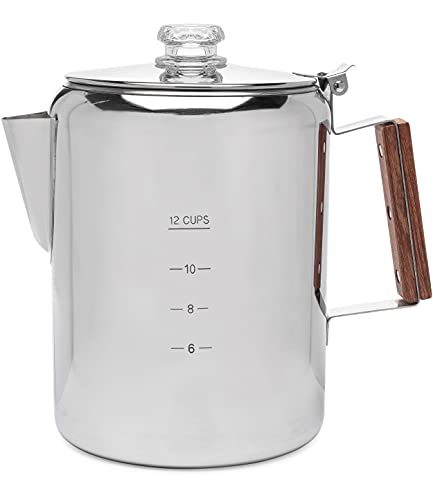
COLETTI Bozeman Percolator Coffee Pot, 12 Cup — Best Stainless Purist, 12 Cup
The 12-cup Bozeman scales up the materials-first formula: a coffee path with no aluminium and no plastic, in a heavy stainless pot sized for family and group fires. Around a campfire that construction reads as simple confidence — nothing to melt, nothing to question, a pot you can set at the coals and forget until the perk calls you back. It costs more than basic percolators and weighs more than aluminium, and it brews the same bold cup as the class. Buyers choosing it are choosing build and materials for the long term, and on those terms it delivers completely.
Strengths
- No aluminium or plastic in contact with the coffee
- Heavy stainless build suited to fire duty
- 12-cup size serves families and groups
Trade-offs
- Premium tier within percolators
- Heavier than aluminium equivalents
- Percolator flavour profile is bold by nature
| Key spec | 12-cup percolator with no aluminium or plastic in the coffee path |
|---|---|
| Format | Open-fire rated percolator — built for grates, coals and direct flame |
Owners of this class of pot tend to keep them for life and lend them reluctantly. If your campfire cooking is a permanent feature of your summers rather than an experiment, that ownership pattern is the review.
Over open fire, COLETTI Bozeman Percolator Coffee Pot, 12 Cup faces conditions no kitchen imposes: heat that swings with every log, soot, ash, uneven grates and handling with gloves and sticks. Its case rests on how completely it ignores those conditions — metal where fire touches, a lid and handle arrangement that behaves when lifted awkwardly, and a brew you can read from the knob without opening anything over the flames. Campfire coffee gear is replaced when it warps, melts, chips through or simply becomes unpleasant to handle at a fire; the pots that become fixtures are the ones that treat the fire as normal working conditions, and COLETTI Bozeman Percolator Coffee Pot, 12 Cup was selected on exactly that standard.
Owners of fire pots like the COLETTI Bozeman Percolator Coffee Pot, 12 Cup tend to become mildly evangelical, and the reason is rhythm: the pot goes on as the fire is lit, perks while breakfast cooks, and pours as the camp sits down — a sequence that organises the whole morning around it. Equipment that fights that rhythm, with fiddly parts or fragile finishes, gets retired to the garage shelf. The 12-cup percolator with no aluminium or plastic in the coffee path design keeps the sequence simple enough to survive a sleepy cook and a smoky fire, which is the real content of the Best Stainless Purist, 12 Cup badge in this guide.
Best for: materials-conscious camps and larger families / Not suited for: budget-first buyers
Check on Amazon — check price on Amazon for the current listing before you buy.

Primula Today Aluminum Stove Top Percolator, 9 Cup — Best Budget for Fire and Stove
The Primula is the lightweight, low-cost way into fire coffee: a 9-cup aluminium percolator that heats fast, weighs little in the camp box, and has introduced generations of campers to the method. Aluminium over a campfire is traditional in its own right — generations of scout pots were exactly this — and its quick heating shortens the morning. The material is also the discussion point: campers who prefer to avoid aluminium in contact with coffee should choose the stainless picks above, a preference this guide respects by labelling rather than hiding it. For everyone else, the Primula’s value is hard to argue with.
Strengths
- Light, fast-heating and very affordable tier
- 9-cup size suits couples and small families
- Simple, proven percolator design
Trade-offs
- Aluminium construction — a deal-breaker for some buyers
- Thinner metal dents more easily than stainless
- Same bold percolator profile as the class
| Key spec | Aluminium stovetop percolator, 9-cup |
|---|---|
| Format | Open-fire rated percolator — built for grates, coals and direct flame |
Treat it as the starter fire pot: learn the gentle perk on the Primula, and you will know within one season whether campfire coffee is your ritual — and exactly which forever pot to upgrade to if it is.
Over open fire, Primula Today Aluminum Stove Top Percolator, 9 Cup faces conditions no kitchen imposes: heat that swings with every log, soot, ash, uneven grates and handling with gloves and sticks. Its case rests on how completely it ignores those conditions — metal where fire touches, a lid and handle arrangement that behaves when lifted awkwardly, and a brew you can read from the knob without opening anything over the flames. Campfire coffee gear is replaced when it warps, melts, chips through or simply becomes unpleasant to handle at a fire; the pots that become fixtures are the ones that treat the fire as normal working conditions, and Primula Today Aluminum Stove Top Percolator, 9 Cup was selected on exactly that standard.
In daily fire use, the Primula Today Aluminum Stove Top Percolator, 9 Cup develops the patina of a working tool: soot-darkened, seasoned, and kept with the fire irons rather than the kitchenware. That is the correct life for it. Its behaviour across a week of fires — different wood, different weather, different cooks — is what the research behind this guide weighted most, because a fire pot is only ever as good as its worst morning. The Aluminium stovetop percolator, 9-cup construction defines how it takes heat and how it is handled, and its Best Budget for Fire and Stove badge marks the fire role it fills better than the alternatives that were tested against the same coals.
Best for: budget camps splitting time between fire and stove / Not suited for: campers avoiding aluminium
Check on Amazon — check price on Amazon for the current listing before you buy.

KingCamp Percolator Coffee Pot, 304 Stainless Steel, 9 Cup — Best Wood Handle at the Fire
The KingCamp’s distinction is in the hand: a wood handle on a 304 stainless percolator, which at a real fire is not decoration — wood stays grippable when metal handles have soaked up the fire’s heat, and the pour at the end of a brew is steadier for it. The pot itself is a sound 9-cup stainless percolator with no aluminium or plastic in the coffee path, sized for couples and small groups. It is the newest name in this company and lacks the decades of field reports the heritage brands carry, which is the honest caveat; on construction and design intent, it earns its place.
Strengths
- Wood handle stays cooler and grippier at the fire’s edge
- 304 stainless body, no aluminium or plastic in the coffee path
- 9-cup size fits couples and small groups
Trade-offs
- Shorter track record than the heritage brands
- Wood needs drying care after washing
- Mid-size only — no group-scale option
| Key spec | 304 stainless steel percolator, 9-cup, wood handle, no aluminium or plastic |
|---|---|
| Format | Open-fire rated percolator — built for grates, coals and direct flame |
Wood handles ask one care habit in return: dry the pot promptly after washing and do not leave it soaking. Kept dry, the handle outlasts seasons of fires and remains the feature owners mention first.
Over open fire, KingCamp Percolator Coffee Pot, 304 Stainless Steel, 9 Cup faces conditions no kitchen imposes: heat that swings with every log, soot, ash, uneven grates and handling with gloves and sticks. Its case rests on how completely it ignores those conditions — metal where fire touches, a lid and handle arrangement that behaves when lifted awkwardly, and a brew you can read from the knob without opening anything over the flames. Campfire coffee gear is replaced when it warps, melts, chips through or simply becomes unpleasant to handle at a fire; the pots that become fixtures are the ones that treat the fire as normal working conditions, and KingCamp Percolator Coffee Pot, 304 Stainless Steel, 9 Cup was selected on exactly that standard.
Owners of fire pots like the KingCamp Percolator Coffee Pot, 304 Stainless Steel, 9 Cup tend to become mildly evangelical, and the reason is rhythm: the pot goes on as the fire is lit, perks while breakfast cooks, and pours as the camp sits down — a sequence that organises the whole morning around it. Equipment that fights that rhythm, with fiddly parts or fragile finishes, gets retired to the garage shelf. The 304 stainless steel percolator, 9-cup, wood handle, no aluminium or plastic design keeps the sequence simple enough to survive a sleepy cook and a smoky fire, which is the real content of the Best Wood Handle at the Fire badge in this guide.
Best for: campfire cooks who value a cooler grip / Not suited for: campers wanting the largest capacities
Check on Amazon — check price on Amazon for the current listing before you buy.
Comparison Table
| Pick | Badge | Key spec | Best for |
|---|---|---|---|
| Coleman Stainless Steel Coffee Percolator, 12-Cup | Best Overall for Campfire Cooking | Stainless steel percolator, 12-cup, rated by its maker for campfire use | most campfire cooks — family and group camps |
| GSI Outdoors Glacier Stainless Percolator, 14 Cup | Best for Big Campfire Groups | Glacier stainless percolator, 14-cup, ultra-rugged for stove and fire | large groups cooking over a shared fire |
| GSI Outdoors Percolator Coffee Pot, Enamelware | Best Traditional Enamel Fire Pot | Enamelware percolator made for campfire cooking | traditionalists and cabin camps |
| COLETTI Bozeman Percolator Coffee Pot, 12 Cup | Best Stainless Purist, 12 Cup | 12-cup percolator with no aluminium or plastic in the coffee path | materials-conscious camps and larger families |
| Primula Today Aluminum Stove Top Percolator, 9 Cup | Best Budget for Fire and Stove | Aluminium stovetop percolator, 9-cup | budget camps splitting time between fire and stove |
| KingCamp Percolator Coffee Pot, 304 Stainless Steel, 9 Cup | Best Wood Handle at the Fire | 304 stainless steel percolator, 9-cup, wood handle, no aluminium or plastic | campfire cooks who value a cooler grip |
Read the table as a map, not a ranking. The badges matter more than the order: a pick that wins on fire tolerance and capacity can still be the wrong buy if your daily routine points the other way.
How do you manage heat for coffee over a campfire?
You brew with coals and distance, not flames. Let the fire burn down to a bed of coals, set the pot on a grate at the edge where heat is steady, and read the perk knob: a gentle bubble every second or two is the target. Too fierce — slide the pot outward or onto a cooler corner. Too lazy — rake fresh coals beneath it. Turning the pot a quarter turn every few minutes evens out the fire’s hot spots. That management, not the pot, is most of campfire coffee craft.
Stainless, enamel or aluminium over fire?
Stainless is the toughest and the heaviest, indifferent to soot and knocks. Enamel cleans easiest and looks the part, but chips on hard impacts. Aluminium is lightest and fastest to heat, thinnest against dents, and avoided by some buyers on material preference. All three brew the same percolator coffee; choose on handling style and values, and every option is represented in the picks with its material stated plainly.
What grind and timing work over fire?
Coarse, even grounds and a gentle perk of seven to ten minutes after the first bubbles, then a minute’s rest off the heat. Fire’s unevenness makes fine grounds punish doubly — they over-extract in the hot spots — so err coarser than you would at home. If a pot tastes harsh, the fix order is: gentler heat, coarser grind, shorter perk. Change one at a time across mornings and your fire coffee will converge on the cup your camp talks about.
Safety and etiquette around fire coffee
Treat the pot as what it is — a litre or more of near-boiling liquid over an open fire. Lift with gloves or the bail, pour away from legs and tent lines, and keep the coffee station out of the fire ring’s traffic path. Follow the site’s fire rules absolutely: in fire-ban conditions the percolator waits, and a stove or a thermos from town carries the morning. No coffee ritual outranks the rules of the place you are camping.
What else belongs in a fire-coffee kit, and what does it cost?
Beyond the pot: a grate that fits your usual fire rings, heat gloves that live in the pot’s bag, a small brush for the basket tube, and a stuff sack that quarantines the soot. The whole supporting kit is inexpensive — check price on Amazon for the pot and the kit together and it remains one of the cheapest complete cooking systems in camp. Spend the savings on better coffee; over a fire, with the gentle-perk method, good beans ground coarse are the difference between a ritual and a routine.
How to Brew Coffee Over a Campfire, From Fire Lay to First Pour
This routine assumes a legal campfire, a grate, and any percolator from the picks above.
- Build the fire early and let it burn down to an even bed of coals while breakfast prep happens — coffee brews over coals, not flames.
- Fill the pot with cold water, add coarse grounds to the basket, and seat the lid firmly.
- Set the pot on the grate at the coal bed’s edge. Watch the knob until the first perks appear.
- Tune the heat by position until the perk settles to a gentle bubble every one to two seconds; turn the pot a quarter turn every few minutes.
- Perk gently for seven to ten minutes, then lift the pot off with a gloved hand or the bail and set it on a safe, level surface.
- Rest one minute for grounds to settle, pour slowly, and knock the grounds into the trash bag once the pot cools enough to handle.
The first pot over a new fire is always partly scouting — note where the steady corner of your grate is, and tomorrow’s pot starts there. Fire coffee is a relationship with a particular fire ring as much as with a pot.
Common Buying Mistakes
Brewing over open flames
Flames are uneven and violent; they soot the pot, scorch the coffee and swing the perk wildly. Coals and patience make the cup.
Grabbing the pot bare-handed
Handles near a fire absorb more heat than they appear to. Gloves or the bail, every time — the one time you skip it is the burn that ends a trip’s cooking.
Setting the pot on bare ground in the fire’s traffic path
A kicked percolator is a litre of boiling coffee loose in camp. The coffee station belongs on the grate or a designated flat spot away from foot traffic.
Ignoring fire restrictions for the ritual
Fire bans are absolute. On ban days the answer is a stove where allowed, or no fire coffee at all.
Final Recommendation
Most campfire cooks should start with the Coleman 12-Cup — the complete, stainless, right-sized fire pot. Big communal fires want the GSI Glacier 14-Cup, traditionalists the enamel GSI, materials-first buyers the COLETTI Bozeman 12-Cup, and anyone who has grabbed a hot handle once will understand the KingCamp’s wood grip instantly.
Buy the pot once and learn your fire. The campers famous for their coffee are not using secret equipment — they are using ordinary pots, gentle coals and ten mornings of attention, and every pick above is capable of carrying that reputation.
Ready to buy? Compare the full shortlist on Amazon: Coleman Stainless Steel Coffee Percolator, 12-Cup, GSI Outdoors Glacier Stainless Percolator, 14 Cup, GSI Outdoors Percolator Coffee Pot, Enamelware, COLETTI Bozeman Percolator Coffee Pot, 12 Cup, Primula Today Aluminum Stove Top Percolator, 9 Cup, KingCamp Percolator Coffee Pot, 304 Stainless Steel, 9 Cup. Check price on Amazon for each before ordering, since listings, bundles and stock change often.
Keep exploring the same cluster on this site: Best Coffee Makers For Campers Best Coffee Makers For Backpacking Best 12 Volt Coffee Maker For Camping Best Coffee Makers For Church Best Coffee Makers For Beginners
Building the Rest of the Fire Coffee Kit
A percolator is the centre of fire coffee, not the whole of it. The supporting kit is short: a grate you trust, heat gloves that live with the pot, a long-handled spoon for the basket, and a dedicated bag that keeps soot off the rest of the kitchen. Add a small enamel mug set and the ritual is complete — none of it expensive, all of it the difference between improvising coffee and running a coffee station.
Beans and grounds travel to fires better than most people expect. Pre-measured doses in small sealed bags — one per morning — remove dawn measuring entirely and keep the coffee fresh across a week. Grind coarse at home for trips up to a few days; for longer trips, whole beans and a compact hand grinder keep the flavour the fire deserves.
Finally, let the fire set the schedule rather than fighting it. Coffee over coals takes the time it takes, and camps that build the fire first and let breakfast gather around the perking pot consistently report the best mornings. The pot is ready when the camp is; that alignment is the entire charm of the method.
Wood choice flavours fire coffee more than campers expect. Clean, dry hardwood gives steady coals and a neutral kitchen; resinous softwood burns fast, sparks, and can perfume the pot with a smoky note some camps love and others do not. Brew over the coal stage and the wood’s influence mostly vanishes — one more reason the coal-bed method in this guide is the standard.
Leave-no-trace applies to the coffee station too: grounds go in the trash bag, rinse water is strained and scattered well away from water sources per local rules, and the fire itself is drowned and cold before the camp leaves. A coffee ritual that damages the place it celebrates would miss its own point, and the pots here are all easy enough to clean that doing it properly costs two minutes.
Fire coffee rewards the cook who treats the fire as an ingredient with its own schedule. The evening before, set the pot, the coffee and the gloves beside the fire ring in firing order, and the morning becomes a single motion: lay the fire, fill the pot, set it at the coals’ edge as they form. Camps that stage this way are drinking coffee while neighbouring sites are still looking for matches, and the pot — whichever pick from this guide hangs or stands at their fire — is only half of that system; the staging is the other half.
It is also worth keeping a small fire-coffee log, even if it is three lines in a notebook: which grate position gave the gentle perk, how many minutes over that trip’s wood, how the coarse grind from home behaved. Fires differ by site and season, and the log turns each new fire ring from an experiment into a variation on a known theme. Two seasons of notes and your camp’s coffee stops depending on luck at all.
And when the trip ends, the pot’s home care decides its next decade: wash the soot to a reasonable level rather than a showroom shine, dry it fully, check the basket tube for trapped grounds, and store it with the gloves inside. Fire pots fail in storage more often than at fires — damp, closed, forgotten — and the two minutes of care after each trip are the cheapest insurance in this entire guide.
Teach the method, not just the menu, when new campers join the fire. The gentle perk is a five-minute lesson — what the knob should look like, where the pot sits, when it comes off — and a camp where three people can run the coffee is a camp whose mornings survive one person’s lie-in. Fire coffee is a tradition precisely because it is teachable; every expert at the fire was shown once by somebody patient.
Kids and dogs change the fire-coffee map, and the adjustment is simple: the pot’s station moves to the fire’s far side, the pouring happens away from the traffic, and the resting pot sits somewhere a small hand or a wagging tail cannot reach. None of that diminishes the ritual; it is the ritual, adapted by people who intend to keep everyone in it safely for years.
And respect the pot’s off-season: a fire percolator stored clean, dry and open will greet the first trip of spring like an old friend, while the same pot stored damp and closed will spend its first brew announcing the fact. The season’s first pot at home — a rehearsal brew on the stove — clears the pipes and the palate in one go.
If your camp cooks for mixed tastes, the fire pot can carry the group while a small press or dripper rides along for the one drinker who wants a different cup — the kettle that feeds the percolator feeds the press too. That two-tier system, pot for the many and press for the particular, is how experienced fire camps keep everyone at the same fire, drinking coffee they each actually chose.
One final fire note: every camp has one person the others look to when the pot comes off the coals, and it is never the person with the most expensive equipment — it is the person who learned the gentle perk and shows up to run it. Any pot in this guide, in those hands, will make the coffee your camp talks about on the drive home.
Frequently Asked Questions
Can any percolator go on a campfire?
Only all-metal pots built for it — every pick here qualifies. Pots with plastic handles, knobs or feet near the heat do not belong on a fire, whatever their stovetop credentials.
How do you keep soot off the pot?
You do not, entirely — soot is the campfire tax. Enamel wipes cleanest; stainless scrubs back with effort. Many campers keep fire pots in their own bag so the soot stays off the rest of the kitchen box.
What size fire pot suits a family of four?
A 9 to 12 cup percolator — remembering campfire ‘cups’ are small measures, roughly two listed cups per real mug.
Is campfire coffee stronger than home coffee?
Percolation makes a bold, full cup, and fire’s heat swings can push it stronger. The gentle-perk routine in this guide keeps it balanced rather than harsh.
Can you hang a percolator over a fire instead of using a grate?
Pots with a bail handle can hang from a tripod, which gives fine heat control by raising or lowering. It is the traditional method and works beautifully with a steady fire.
What do you do with grounds at a campfire site?
Into the trash bag, once cool. Do not scatter them at the site or toss them in the fire ring’s ashes for the next campers to inherit.


