Disclosure: airfryerkitchensupply.com is reader-supported. When you buy through links on our site, we may earn an affiliate commission at no extra cost to you.
Where to buy
The most reliable place to buy any pick in this guide to the best blenders for gains is Amazon, where each verified model below is sold with full product details and delivery options. Use the Check on Amazon links beside each pick to see the current listing — we do not print static prices in our guides, because listings change, so check price on Amazon before you decide. If a pick is described as unlinked in this guide, that means we could not verify a listing we were confident in, and we say so openly rather than guess.
- nutribullet Pro+ N12-1001MK — Check on Amazon (check price on Amazon)
- Ninja Nutri-Blender Pro BN401 — Check on Amazon (check price on Amazon)
- Vitamix 5200 Professional-Grade Blender — Check on Amazon (check price on Amazon)
- nutribullet Full-Size Blender Combo NBF50500 — Check on Amazon (check price on Amazon)
- Ninja Blast BC151BK — Check on Amazon (check price on Amazon)
- Hamilton Beach Portable Blender 51172G — Check on Amazon (check price on Amazon)
The best blenders for gains serve a specific, practical brief: turning protein shakes and calorie-dense smoothies into a daily habit that supports training. That means a machine that liquefies protein powder without grittiness, handles the thick, heavy ingredients bulking shakes rely on — oats, nut butters, frozen banana, Greek yoghurt, milk — and does it fast, every day, with cleanup so quick the habit survives a busy life. A blender that makes shake-making a chore is a blender that stops being used by February, whatever it cost.
A note on honesty before the picks: a blender does not build muscle. Training and total nutrition do that, and this guide makes no medical or body-composition claims. What the right blender does is remove friction from the eating side of the equation — and for people trying to eat enough to support hard training, friction is often the whole battle. The picks below are chosen for that job: personal blenders that live on the counter and blend in the drinking cup, plus full-size machines for batch prep and nut-butter-thick shakes.
Every pick was verified against the retailer catalogue before it earned a link. Read the reviews for who each format suits, then the buying guide on cup size, thickness and prep strategy — the difference between a shake routine that lasts and one that fades is mostly logistics, and logistics is what this guide is about.
A quick word about where a blender sits in a training life, because it explains this guide’s priorities. The shake is rarely the meal anyone plans their day around; it is the meal that fills the gap the day created — after the session, between meetings, on the way to somewhere else. Appliances that serve gap-meals live or die on seconds and washing-up, not on peak performance, which is why this guide ranks convenient formats so highly and treats the mighty full-size machines as specialists for prep work. If you have ever abandoned a shake routine, it was almost certainly the logistics that failed, not the recipes.
One boundary of this guide should be explicit: it recommends blenders, not diets. How much protein, how many calories and which supplements belong in a training diet are questions for the individual, their coach or their clinician, and no appliance purchase answers them. What this guide can do — and what it has done — is remove the equipment excuses from the eating side of training: the gritty shake, the cup that is too small, the machine that cannot handle oats, the routine that collapses because washing up took longer than drinking. Solve the logistics, and whatever nutrition plan you have chosen becomes dramatically easier to keep.
In this guide
Quick Picks
Short on time? These are the six machines that earned a place in this guide to the best blenders for gains. Each one carries a badge for the job it does best, and the same badge appears again at the top of its detailed review further down, so you can jump straight to the machine that matches your kitchen.
- Best Overall for Protein Shakes: nutribullet Pro+ N12-1001MK — a 1200W personal blender with 32 oz and 24 oz cups and a pulse function — sized and powered exactly for daily protein and calorie shakes. — Check on Amazon
- Best Auto-iQ Personal: Ninja Nutri-Blender Pro BN401 — an 1100 peak-watt personal blender with Auto-iQ programs and two 24 oz cups — press a button, get a consistent shake, walk away. — Check on Amazon
- Best for Batch Prep and Nut Butters: Vitamix 5200 Professional-Grade Blender — the full-size heavyweight — batch shakes for the fridge, homemade nut butters, and the thickest calorie blends a personal cup cannot attempt. — Check on Amazon
- Best Shake-and-Batch Combo: nutribullet Full-Size Blender Combo NBF50500 — a 1200W system with a 64 oz pitcher and a 24 oz tumbler — daily personal shakes plus weekend batch prep from one base. — Check on Amazon
- Best Portable for the Gym Bag: Ninja Blast BC151BK — a cordless 18 oz blender that charges by USB-C and lives in a gym bag — a fresh shake blended at the gym, the office or the car park. — Check on Amazon
- Best Budget Personal: Hamilton Beach Portable Blender 51172G — a budget countertop personal blender with a 14 oz travel jar — basic protein shakes at the lowest cost in this guide. — Check on Amazon
How These Picks Were Chosen
We chose these picks around the daily shake routine: protein powder fully dispersed with no grit or clumps, calorie-dense ingredients like oats and nut butter incorporated smoothly, frozen fruit handled without complaint, and a format — personal cup or full pitcher — matched to how lifters actually consume shakes, which is usually alone, often immediately after training, and frequently away from the kitchen.
Convenience features therefore counted heavily: blend-in-the-cup formats, multiple cups for rotation, dishwasher-friendly parts, and enough power that a thick shake finishes in one cycle. Full-size picks earned their places through batch prep and the thickest shakes, where personal cups reach their limits. Each review gives three strengths and three trade-offs, with a verdict naming the right and wrong buyer.
We print no static prices and no fixed ratings anywhere in this guide; check price on Amazon through the links for the current listing.
The 6 Best Blenders for Gains

nutribullet Pro+ N12-1001MK — Best Overall for Protein Shakes
The Pro+ is the shake specialist of this guide. Its 1200W is serious power in a personal format, the 32 oz cup fits a genuinely large bulking shake — milk, oats, banana, nut butter, protein — that smaller personal cups cannot hold, and the pulse function lets you manage thick mixtures that a simple on-off extractor struggles with. It blends in the cup you drink from, which is the whole convenience argument in one sentence.
Strengths
- 32 oz cup fits a full bulking shake in one blend
- 1200W liquefies oats and disperses protein powder completely
- Pulse control helps thick, heavy mixtures circulate
Trade-offs
- Personal format only — no family batches
- Thickest shakes still need sensible liquid ratios
- Cups and blades are hand-wash-friendly but benefit from prompt rinsing
| Power | 1200W |
| Cups | 32 oz and 24 oz |
| Controls | Pulse function |
Protein powder quality is where personal blenders separate. Weak extractors leave powder clinging to the walls and grit at the bottom of the cup; the Pro+’s power and cup geometry pull powder through the vortex, and the result is a shake that drinks like a milkshake rather than a chore. Oats deserve a mention: blended raw into a shake, they thicken and add body, and this machine reduces them fully instead of leaving chewable flecks — the difference between a shake you enjoy and one you endure.
The format’s honesty: this is a one-person system. Two shakes means two cycles, and a household of lifters will queue. Within its brief — one person’s daily shake, made fast, drunk from the blending cup, rinsed in seconds — it is the most complete answer in this guide, and the 32 oz capacity is the detail that makes it a gains pick rather than a generic personal blender.
Best for: lifters making one large daily protein or bulking shake / Not suited for: households needing multi-serving batches
Check on Amazon — check price on Amazon for the nutribullet Pro+ N12-1001MK.
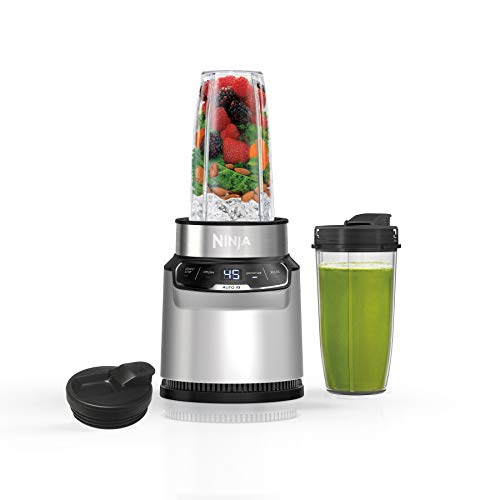
Ninja Nutri-Blender Pro BN401 — Best Auto-iQ Personal
The BN401 is for the lifter who wants zero decisions at 6am. Its Auto-iQ programs run timed pulse-and-blend patterns that disperse protein powder and break down frozen fruit without the user managing anything, and the two 24 oz cups mean one is always clean. At 1100 peak watts it has the power density a thick shake needs in a personal format.
Strengths
- Auto-iQ removes technique from the daily shake
- Two cups keep the routine moving on busy mornings
- Strong frozen-fruit performance for post-workout shakes
Trade-offs
- 24 oz cups cap the biggest bulking shakes
- Programs cannot be fine-tuned mid-cycle
- Peak wattage is a headline figure, as with all personal Ninjas
| Power | 1100 peak W |
| Cups | (2) 24 oz cups |
| Controls | Auto-iQ programs |
Consistency is the underrated virtue in a shake routine. When the shake is identical every day, you know exactly what you ate, and the habit becomes automatic. Auto-iQ delivers that: the same cycle, the same texture, whether you are alert or half asleep. Frozen fruit — the post-workout staple — is handled by the programmed pulsing better than by a naive full-speed blast, which tends to leave the top of the cup untouched.
Choose the BN401 over the nutribullet Pro+ if your shakes fit in 24 oz and you value automation; choose the Pro+ if you regularly build 32 oz calorie shakes or want pulse control for very thick mixtures. Both are legitimate daily drivers; the difference is serving size and philosophy, not quality.
Best for: lifters wanting a fully automatic daily shake routine / Not suited for: builders of very large 32 oz bulking shakes
Check on Amazon — check price on Amazon for the Ninja Nutri-Blender Pro BN401.

Vitamix 5200 Professional-Grade Blender — Best for Batch Prep and Nut Butters
The 5200 enters this guide for the two gains jobs personal blenders cannot do. First, batch prep: a 64 oz container of shake base for two days, blended once. Second, nut butters and ultra-thick mixtures — the calorie-dense ingredients bulking diets lean on — which need sustained power and a tamper-friendly container. If your nutrition strategy involves making your own nut butter or prepping shakes in volume, this is the machine.
Strengths
- Handles nut butters and the thickest shakes personal cups cannot
- 64 oz container for genuine batch prep
- Self-cleaning keeps a daily-use machine realistic
Trade-offs
- Premium tier — check price on Amazon
- Counter footprint and noise are full-size too
- Making one small shake in a 64 oz container is awkward
| Capacity | 64 oz container |
| Controls | Variable speed, high-speed switch |
| Cleaning | Self-cleaning |
Nut butter is the dividing line in blender capability. Turning roasted nuts into a smooth butter requires minutes of sustained high-power blending with the mixture constantly folded back onto the blades; lesser machines overheat or leave a grainy paste. The 5200 does it properly, and for a lifter who eats nut butter daily, making it at home changes both the cost and the quality of a bulking diet’s foundation.
The batch argument is similar: a big, fully smooth shake base portioned into bottles removes the daily decision entirely on busy days. The trade-off is the familiar one — this is a premium, full-size appliance, and a lifter whose whole routine is one post-workout shake is better served by the personal picks. Buy the 5200 when your food prep genuinely extends beyond the shaker bottle.
Best for: meal preppers and makers of nut butter and thick shakes / Not suited for: single-shake users with limited counter space
Check on Amazon — check price on Amazon for the Vitamix 5200 Professional-Grade Blender.

nutribullet Full-Size Blender Combo NBF50500 — Best Shake-and-Batch Combo
The Combo is the middle path for lifters whose week has two rhythms: a personal shake most days, and a bigger prep session — family smoothies, a batch of shake base, soup for meal prep — on the weekend. One 1200W base drives both the 24 oz tumbler for the daily shake and the 64 oz pitcher for the batch, so the counter holds one machine instead of two.
Strengths
- One base covers daily shakes and batch prep
- 1200W handles oats, frozen fruit and nut butter in shakes
- Tumbler format keeps weekday cleanup near zero
Trade-offs
- Neither vessel matches a dedicated machine at its extreme
- More parts to store than a personal-only system
- Very thick nut-butter making belongs to the Vitamix
| Power | 1200W |
| Vessels | 64 oz pitcher + 24 oz tumbler cup |
| Format | Combo system |
Most real kitchens are combo kitchens, which is why this format keeps appearing in these guides. The tumbler handles the high-frequency job — the daily shake, blended and drunk from the same vessel — and frequency is where convenience compounds. The pitcher handles the low-frequency, high-volume jobs without a second appliance purchase, and 1200W is enough power that neither role feels like a compromise for normal use.
Its boundaries are the extremes at both ends: it will not make nut butter like the Vitamix, and it is more machine than a pure single-shake user needs. For the lifter whose nutrition includes both daily shakes and weekly cooking, it is arguably the most rational purchase in this guide.
Best for: lifters who batch-prep as well as shake daily / Not suited for: nut-butter makers or pure single-shake minimalists
Check on Amazon — check price on Amazon for the nutribullet Full-Size Blender Combo NBF50500.

Ninja Blast BC151BK — Best Portable for the Gym Bag
The Blast solves a logistics problem: the shake you want immediately after training, without a shaker bottle’s clumps or a warm shake made hours earlier at home. It is cordless, charges over USB-C, and its 18 oz vessel blends a standard protein shake with liquid and powder — plus soft additions — wherever you are. It is not powerful in the countertop sense, and this review will judge it on its actual job.
Strengths
- Truly portable — cordless with USB-C charging
- Blends a fresh shake at the gym instead of a pre-made one
- 18 oz vessel doubles as the drinking cup
Trade-offs
- Not for frozen fruit, oats-heavy shakes or thick mixtures
- 18 oz caps shake size
- Battery blending is a convenience tool, not a kitchen replacement
| Capacity | 18 oz vessel |
| Power | Cordless, USB-C rechargeable |
| Format | Portable personal blender |
Judge the Blast against the shaker bottle, not against the Vitamix, and it wins clearly: powder fully dispersed instead of clumped, a banana or a handful of soft berries incorporated instead of impossible, and no separate vessel to wash beyond the one you drank from. For lifters whose training happens away from home — lunchtime gym, evening sessions straight from work — that is a genuine upgrade to the routine’s weakest link.
Its limits must be respected or it will disappoint: frozen ingredients, thick nut-butter shakes and oat-heavy bulking blends belong to the countertop picks. Used as designed — a fresh, simple shake at the point of training — it is the only pick in this guide that can be in your bag, and for some routines that is the feature that matters most.
Best for: lifters who train away from home and want a fresh shake on site / Not suited for: frozen or thick-shake blending
Check on Amazon — check price on Amazon for the Ninja Blast BC151BK.

Hamilton Beach Portable Blender 51172G — Best Budget Personal
The 51172G is the entry point: a small countertop personal blender whose 14 oz jar blends and travels, at a budget tier — check price on Amazon. For a standard protein shake — milk or water, powder, a banana — it does the job honestly, and for someone starting a training routine who does not yet know if the habit will stick, spending budget money first is a defensible strategy.
Strengths
- Lowest-cost route into blended shakes in this guide
- Travel jar blends and goes with no transfer
- Simple one-job design with nothing to learn
Trade-offs
- 300W peak cannot handle frozen fruit or thick oat shakes
- 14 oz jar is small even for a standard shake with additions
- Not built for years of daily heavy use
| Power | 300W peak |
| Capacity | 14 oz travel jar |
| Class | Budget personal blender |
The honest framing for this pick is probation. A new lifter’s first ninety days decide whether shakes are a habit or a phase; this machine covers the phase cheaply and adequately, dispersing powder into liquid far better than a shaker bottle and handling soft fruit without complaint. If the habit sticks and the shakes grow — frozen fruit, oats, bigger volumes — the Pro+ or BN401 is the upgrade path, and the Hamilton Beach retires to travel duty.
What it must not be asked to do is impersonate those machines. Frozen ingredients will stall it, thick mixtures will strain it, and a 14 oz ceiling is real. Respect those boundaries and it is a sensible first purchase; ignore them and you will conclude wrongly that personal blenders do not work, when in fact this one was simply out of its depth.
Best for: beginners testing a shake habit on a budget / Not suited for: frozen, thick or large shakes
Check on Amazon — check price on Amazon for the Hamilton Beach Portable Blender 51172G.
Comparison Table
| Pick | Badge | Key spec | Best for |
|---|---|---|---|
| nutribullet Pro+ N12-1001MK | Best Overall for Protein Shakes | 1200W, 32 oz + 24 oz cups, pulse | lifters making one large daily protein or bulking shake |
| Ninja Nutri-Blender Pro BN401 | Best Auto-iQ Personal | 1100 peak W, Auto-iQ, 2 x 24 oz cups | lifters wanting a fully automatic daily shake routine |
| Vitamix 5200 Professional-Grade Blender | Best for Batch Prep and Nut Butters | 64 oz, variable speed, self-cleaning | meal preppers and makers of nut butter and thick shakes |
| nutribullet Full-Size Blender Combo NBF50500 | Best Shake-and-Batch Combo | 1200W, 64 oz pitcher + 24 oz tumbler | lifters who batch-prep as well as shake daily |
| Ninja Blast BC151BK | Best Portable for the Gym Bag | Cordless, 18 oz, USB-C | lifters who train away from home and want a fresh shake on site |
| Hamilton Beach Portable Blender 51172G | Best Budget Personal | 300W peak, 14 oz travel jar | beginners testing a shake habit on a budget |
Read the table as a map, not a ranking. The best blenders for gains are not six versions of the same machine at six prices; they are six different answers to six different kitchens, and the badge column tells you which question each one answers. If two rows look similar, the deciding factor is usually in the detailed review: jar size, control style, or how the machine behaves with the exact ingredients you blend most.
How to Choose a Blender for Gains
Buying a blender for gains is buying for a routine, not a recipe. The sections below cover the decisions that determine whether the routine survives — cup size against your shake size, power against your thickest ingredient, format against where you actually drink the shake, and the prep strategies that turn a blender from an appliance into a system.
How big a cup do you actually need?
Measure your real shake, not the one on the tub’s label. A basic shake — liquid and powder — fits anywhere. A bulking shake with milk, oats, banana and nut butter routinely reaches 24 to 32 oz, and a cup that is too small forces you to omit ingredients or blend in two stages, both of which erode the habit. That is why the 32 oz cup on the nutribullet Pro+ leads this guide, and why the 24 oz systems suit standard rather than maximal shakes.
Also respect headspace: a personal cup filled to the brim cannot circulate. If your shake recipe regularly kisses the max line of a 24 oz cup, you are a 32 oz user, and buying the smaller system to save a little money will cost you a repurchase.
What power do thick shakes need?
Thickness is the enemy. Oats absorb liquid and swell, nut butter resists circulation, frozen banana arrives as rocks — a shake can go from pourable to spoonable in one ingredient. Personal blenders in the 1000W-plus class, like the Pro+ and BN401, have the power density to keep a thick cup moving; the budget and portable picks do not, and their reviews say so plainly.
Liquid strategy helps any machine: add liquid in two stages for very thick shakes — most of it before blending, a splash after if the vortex stalls — and put powders in the middle of the load rather than on the dry top or against the blades, where they clump and stick.
Where will you drink the shake?
The best format follows the location. At home after training, a countertop personal blender is fastest. At the gym straight from work, only the cordless Blast is even present. For a shake drunk at a desk, a travel cup blended that morning beats a countertop pitcher and a separate bottle. Routines fail at their logistical weakest point, so choose the machine that covers your weakest point, not your strongest.
Many lifters end up with two formats — a countertop system for home and the Blast for the bag — and given the portable’s modest tier, that combination still costs less than one premium full-size machine while covering the week better.
Batch prep versus fresh blending
Fresh shakes taste best and keep their texture; batch shakes win on days when time collapses. A workable hybrid, and the reason the Vitamix and the Combo are in this guide, is prepping a base — milk, oats, nut butter, banana blended smooth — refrigerated for a day or two, with protein powder stirred or briefly blended in at serving time, since some powders foam or thicken oddly when stored blended.
Whichever strategy you choose, write the routine down to the level of which cup, which ingredients, which order. The lifters who keep a shake habit for years are not more motivated; their routine simply has fewer daily decisions in it.
What about protein powders that foam or thicken?
Powders behave differently and the blender cannot change their chemistry, only manage it. Some plant proteins foam enthusiastically under high-speed blending; the counter is to blend the base first and fold the powder in with a few short pulses at the end. Casein and blends with gums thicken as they stand, so a shake built on them should be drunk promptly or made slightly thinner than target. Egg-white and collagen powders are the easy citizens — they disperse cleanly in everything here, including the portable.
None of this requires a different machine; it requires knowing your powder. But it does favour machines with a pulse or variable control — the Pro+ and the Vitamix in this guide — for households whose powder of choice is a foamer or a thickener, because the end-of-cycle control those machines offer is exactly the tool the problem calls for.
How Do Successful Shake Routines Actually Run?
Look at the routines that survive a year and a pattern emerges: they are boring in the best way. The ingredients live in one place — powder, oats and seeds in a single cupboard zone, bananas and frozen fruit in one freezer drawer, milk or alternatives at the front of the fridge. The cup from yesterday is clean because it was rinsed in the thirty seconds after drinking, not washed in a batch on Sunday. The recipe is written by repetition, not by document: same base, small variations, no daily invention. The blender’s role in this system is to be the fastest, most predictable step in it.
The routines that die are usually more ambitious: five rotating recipes, ingredients scattered across three shops, a machine that needs assembly and a wash cycle worthy of a roast dinner. Ambition is not the enemy — badly-placed ambition is. Put the ambition in the training, where it pays, and engineer the shake for reliability. That is why this guide’s top picks are a strong personal blender and an automatic one: they are the formats that ask the least of a tired person at the exact moment the shake is due.
One more structural tip from the survivors: anchor the shake to an event that already exists — the return from training, the sitting down at the desk — rather than to a time of day that shifts. A shake anchored to training happens on training days without a decision, and decisions are the currency routines run out of. The machine on the counter, the cup rinsed and waiting, the ingredients in their places: that is the whole technology of consistency, and the blender is simply its most visible part.
How Do You Keep Shake Costs and Effort Under Control?
A daily shake habit has a running cost, and pretending otherwise is how routines quietly die in month two when the premium ingredients run out and are not replaced. The economics favour structure: a base built on affordable staples — milk or a budget alternative, oats, banana, peanut butter — carries the calories and the protein framework, while the expensive additions, the berries and the branded extras, rotate in as accents rather than foundations. Every machine in this guide handles the staple base easily; it is the accents that sometimes ask for the stronger picks, which is another way of saying the routine’s cost and the machine’s tier should be planned together.
Effort has a budget too, and it is spent in the same places every day: finding ingredients, blending, drinking, cleaning. The systems in the buying guide — ingredients zoned together, cups rinsed on the spot, recipes that need no measuring beyond a scoop and a handful — exist to keep the daily spend under five minutes end to end. Measure your own routine honestly for a week; if it runs longer, the fix is almost never a faster blender. It is a better-arranged kitchen.
Finally, plan for the disrupted week — travel, illness, a broken routine — because habits rarely die on good days. A shelf-stable fallback shake for the office, the portable Blast in the bag, a base in the freezer: these unglamorous backups are what a routine looks like from the inside of a real life. The lifters still blending in year three are not the most disciplined people in the gym. They are the ones whose system forgives a bad week.
How Do You Build a High-Calorie Blender Shake That Actually Tastes Good?
Build the shake in layers that help the machine: liquid first, then protein powder and oats in the middle, then soft ingredients like banana and yoghurt, then nut butter in a dollop rather than smeared on the cup wall, and frozen fruit last if you use it. This order keeps powder off the dry surfaces where it clumps, and lets the forming vortex pull everything through the blades in sequence.
Blend once, fully. A thick shake needs a complete cycle — thirty to forty-five seconds in a strong personal blender — not two tentative bursts. If the mixture is too thick to circulate, add liquid a splash at a time and pulse between additions; the goal is the minimum liquid that keeps the vortex alive, because every extra splash is volume you have to drink and dilution you did not plan. Taste and adjust sweetness or thickness before you commit to drinking it — a shake you enjoy is a shake you will make tomorrow.
For a bulking shake that drinks well, balance the heavy ingredients against each other: oats and nut butter both thicken, so a shake with generous amounts of both needs its full liquid allowance and benefits from a banana for body and sweetness. If it comes out too thick to drink comfortably, you have made spoon-food — eat it with a spoon and adjust the recipe next time rather than forcing it down and dreading tomorrow’s.
Rinse the cup and blade immediately. Protein residue is famously unforgiving when dried, and a thirty-second rinse at the sink is the entire maintenance programme of a personal blender. That tiny habit, repeated daily, is most of what separates a shake routine in its second year from one abandoned in its second month.
For lifters who eat the same shake daily, a flavour-rotation trick keeps it welcome without changing its structure: keep the base identical and rotate one accent — cocoa one week, cinnamon the next, a shot of coffee, a handful of frozen cherries, vanilla and almond. The nutrition stays planned, the prep stays automatic, and the palate gets just enough novelty to stay loyal. It sounds trivial until month three of an identical shake, at which point it is the difference between a routine and a memory.
Common Buying Mistakes
Buying a cup smaller than your shake. A maxed-out cup cannot circulate, blends badly and overflows. Size the vessel to your real recipe with headspace to spare — for most bulking shakes that means 32 oz, not 24.
Putting protein powder on top, dry. Powder loaded last sits dry above the vortex, clings to the lid and walls, and ends up as grit in the last mouthful. Powder goes in the middle of the load, surrounded by liquid and soft ingredients.
Expecting a portable to do a countertop’s job. Cordless and budget personal blenders are for simple shakes. Frozen fruit, oat-heavy bulking blends and nut butter belong to the strong picks; forcing the small machines shortens their lives and sours the routine.
Making the shake you should drink instead of one you will. A nutritionally perfect shake you dread is a routine with an expiry date. Adjust flavour and texture until the shake is genuinely enjoyable — consistency over months beats perfection for a week.
Leaving the cup to wash later. Dried protein residue is the single most unpleasant cleaning job in the kitchen, and the most avoidable. Rinse now, every time; the habit takes thirty seconds and saves the routine.
Building the routine on premium ingredients alone. A shake that depends on costly additions collapses the first week they run out. Build the base on staples that are always in the house, and let the premium ingredients be the rotation, not the foundation.
Final Recommendation
For the classic daily shake, the nutribullet Pro+ is our Best Overall: 1200W, a 32 oz cup that fits a real bulking shake, and pulse control for thick mixtures. The Ninja BN401 is the automatic alternative for standard 24 oz shakes, and the nutribullet Combo adds a pitcher for lifters who also batch-prep.
The Vitamix 5200 serves the serious prepper — nut butters and volume batches — while the Ninja Blast covers the gym bag and the Hamilton Beach covers the beginner’s budget. Match the format to where and how you actually drink your shakes, rinse the cup immediately, and the routine will take care of itself.
Shortlist for a fast decision: Check on Amazon (nutribullet Pro+ N12-1001MK — Best Overall for Protein Shakes), Check on Amazon (Ninja Nutri-Blender Pro BN401 — Best Auto-iQ Personal), Check on Amazon (Vitamix 5200 Professional-Grade Blender — Best for Batch Prep and Nut Butters). Each link goes to the current listing — check price on Amazon and confirm the configuration matches the review above before ordering.
Keep exploring the blender cluster on this site: Best Blenders For Frozen Smoothies Best Blenders For Protein Shakes Best Blenders For Protein Shakes With Ice Best Blenders For Frozen Fruit Smoothies Best Blenders
Frequently Asked Questions
What is the best blender size for protein shakes?
For a standard shake, 24 oz is enough. For a bulking shake with milk, oats, banana and nut butter, 32 oz — like the nutribullet Pro+’s large cup — is the comfortable size, because the mixture needs headspace to circulate as well as room for the ingredients themselves.
Can a personal blender handle oats and nut butter in a shake?
A strong one can. Personal blenders in the 1000W-plus class, such as the Pro+ and the Ninja BN401, reduce oats fully and incorporate nut butter smoothly provided the liquid ratio is sensible. Budget and cordless portables cannot do this reliably and should be kept to simple powder-and-liquid shakes with soft fruit.
Should I blend protein powder in advance?
Shakes keep better if the powder goes in last. A base of milk, oats, fruit and nut butter can be batch-blended and refrigerated for a day or two, with protein powder blended or shaken in at serving time, because some powders foam, thicken or taste stale when stored already mixed.
Is a cordless blender worth it for the gym?
If you train away from home and currently rely on a shaker bottle or a shake made hours earlier, yes — the Ninja Blast blends a fresh, smooth shake on site and charges by USB-C. It is a convenience tool for simple shakes, not a replacement for a countertop machine on thick or frozen blends.
How do I stop my shake tasting gritty?
Grittiness usually comes from undispersed powder or under-blended oats. Load powder in the middle of the ingredients rather than on top, give the blend its full cycle, and use a machine with enough power for the format — the jump from a budget personal blender to a 1200W one is most noticeable exactly here.
Can I make my own nut butter for shakes?
Yes, with a full-size high-power blender like the Vitamix 5200, which can turn roasted nuts into smooth butter with sustained blending and tamper work. Personal blenders should not attempt it — the load is too thick and sustained for their motors — so buy nut butter ready-made if a personal system is your machine.
Can I add creatine and other powders to a blended shake?
Yes — small-quantity powders like creatine disperse completely in a blended shake and are a common reason lifters prefer blending to shaker bottles, where they can sit gritty at the bottom. Add them with the protein powder in the middle of the load. This guide makes no claims about any supplement’s effects; it simply notes that a blender mixes them better.
Is a shake from a blender better than from a shaker bottle?
For plain powder and liquid, a shaker bottle is adequate and a blender is smoother. The blender earns its place when the shake becomes food — oats, fruit, nut butter, yoghurt, greens — none of which a shaker can incorporate. Most lifters’ shakes evolve in that direction, which is why the blender, not the bottle, ends up as the routine’s centre.
Can I blend a shake with ice for a thicker, colder result?
Yes — a few cubes thicken and chill a shake in the stronger personal picks, and frozen banana achieves a similar result with more flavour and body. In the portable and budget picks, skip the cubes and use frozen fruit sparingly or none at all; their motors are not built for ice, and a cold shake is not worth a burnt-out machine.
Should I blend my shake with milk or water?
That is a recipe and budget choice rather than a blender question — milk adds body, flavour and calories that suit a bulking shake; water keeps a shake lighter and cheaper. Every pick here handles both identically. What the machine does care about is total volume and thickness, so if you switch liquids, expect to adjust the amount slightly to keep the vortex happy.


