Disclosure: airfryerkitchensupply.com is reader-supported. When you buy through links on our site, we may earn an affiliate commission at no extra cost to you.
Where to buy
For buyers comparing the best 12 volt refrigerator for rv, this shortlist is the place to start. Every RV fridge below is sold on Amazon and was verified against Amazon’s catalogue data before it was given a link. No prices are printed — check the current price on Amazon — and measure your RV’s space before falling for any model: in an RV, the fridge that fits the slide, the bay or the galley corner beats the fridge that wins on paper.
- BougeRV CRD2 V2 52QT Dual Zone Refrigerator with 240Wh Battery — check price on Amazon
- Dometic CFX2 37L Electric Cooler — check price on Amazon
- Alpicool 43 QT Dual Zone Car Refrigerator with APP Control — check price on Amazon
- BougeRV 12V Refrigerator 53 Quart — check price on Amazon
- EUHOMY 48QT 12 Volt Refrigerator Dual Zone — check price on Amazon
- Alpicool C20 Portable Compressor Fridge Freezer (21 Quart) — check price on Amazon
The best 12 volt refrigerator for rv use answers a problem every RV owner recognises: the absorption fridge is slow, level-sensitive and hungry for propane, and the ice chest is a daily errand. A 12V compressor fridge is the third way — it runs directly from the house batteries or the tow vehicle, holds a set temperature on rough roads and steep grades, pre-cools in hours rather than a day, and travels between the RV, the truck and the outdoor kitchen as the trip demands. It is no surprise these boxes have become standard kit in modern RV life.
RV duty has its own priorities. The fridge must sip, because house-bank watt-hours are shared with lights, pump and furnace. It must be quiet, because it may sleep in the same room as you. It must protect the battery it feeds from, lock or latch against travel, and fit a real RV space — a slide tray, a bay, the foot of the bed, the outdoor kitchen. The six picks below were chosen against exactly those tests, from a battery-equipped dual-zone flagship to a 21-quart compact for small rigs.
A note on roles: for many owners the 12V fridge supplements the built-in fridge rather than replacing it — overflow, drinks, the travel-day cold chain, the outside kitchen. Others, especially van and small-trailer owners, run one as their only refrigerator. Both patterns are served here, and the reviews say plainly which each pick suits.
In this guide
Quick Picks
The RV shortlist: the battery-equipped flagship for independence from the house bank, the premium and value dual-zones, the quiet long-trip box, and two compacts for small rigs.
- Best Overall for RVs: BougeRV CRD2 V2 52QT Dual Zone Refrigerator with 240Wh Battery — 52QT dual zone with a built-in 240Wh battery — cold that ignores the house bank. Check the current price on Amazon.
- Best Premium Compact: Dometic CFX2 37L Electric Cooler — 37L freezing to -7°F with 3-stage battery protection and Dometic build. Check the current price on Amazon.
- Best Dual Zone with App Control: Alpicool 43 QT Dual Zone Car Refrigerator with APP Control — 43 QT dual zone with app control — check the fridge from the driver’s seat. Check the current price on Amazon.
- Best for Long Hauls: BougeRV 12V Refrigerator 53 Quart — 53 quarts, ECO mode and 45dB-class quiet — built for weeks on vehicle power. Check the current price on Amazon.
- Best Value Dual Zone: EUHOMY 48QT 12 Volt Refrigerator Dual Zone — 48QT dual zone with ECO/MAX modes and battery protection at a value price. Check the current price on Amazon.
- Best for Small RVs and Vans: Alpicool C20 Portable Compressor Fridge Freezer (21 Quart) — 21 quarts of compressor cold that fits where bigger fridges cannot. Check the current price on Amazon.
How These Picks Were Chosen
All models were verified through the Amazon catalogue data available to this site — brand, model, capacity, temperature range and features confirmed from the listings before a link was attached, with unverifiable products excluded. Prices are not printed because they change constantly; the RV-relevant facts — capacity, zones, battery protection, noise and power options — are quoted from the listings themselves.
RV criteria led with battery manners: adjustable battery protection and an ECO-style mode were near-mandatory, because a fridge that flattens the house bank or the starter battery fails the RV test no matter how cold it gets. Noise claims were weighed for the models that publish them. Dual-zone flexibility scored for full-time and family rigs; compact footprints and vehicle-first design scored for vans and small trailers.
One pick — the BougeRV CRD2 V2 with its built-in 240Wh battery — was selected for a distinctly RV superpower: it keeps food cold when the RV is parked, unplugged and unattended, without touching the house bank at all. Each pick owns a rig type or a role, so the list is a fitment guide as much as a ranking.
The rejects are worth a sentence: several handsome fridges were cut for lacking adjustable battery protection, which in an RV is not a detail but a disqualification; a few compact models duplicated the Alpicool C20’s job with weaker documentation; and the thermoelectric crowd was excluded at the door, as it is from every fridge roundup we publish. Six picks remain, each of which we would bolt into a rig and drive away with — that is the test, and it is a short list by design.
The 6 Best 12 Volt Refrigerator for RV Use

BougeRV CRD2 V2 52QT Dual Zone Refrigerator with 240Wh Battery — Best Overall for RVs
The BougeRV CRD2 V2 earns Best Overall for RVs by removing the category’s central anxiety. Its built-in 240Wh battery means the fridge keeps its 52QT dual zones cold through travel stops, unplugged nights, storage days and house-bank dramas — the food simply stops caring what the RV’s electrical system is doing. For owners whose rig is parked as often as it is plugged in, that independence is worth more than any other feature in this roundup.
Strengths
- The built-in 240Wh battery keeps food cold through stops, hikes and overnight parking without draining the starter battery
- Dual zones at 52QT is a true fridge-plus-freezer combination for long trips
- Battery backup makes it the most forgiving fridge here for forgetful power management
Trade-offs
- The battery adds weight and cost versus the same box without it
- 240Wh is hours of cover, not days — it is a buffer, not an off-grid power system
- When the internal battery ages, replacement is a brand-specific part, not a generic cell
Key specs (from the manufacturer listing):
- Capacity: 52QT dual zone per API listing title
- Battery: built-in 240Wh battery listed in the API title
- Cooling: electric cooler, 12V refrigerator class
The RV patterns multiply quickly: the fridge rides in the tow vehicle on travel days and never touches its battery; it sits in the outdoor kitchen at the site, buffered against the pedestal’s quirks; it keeps the food cold in storage between trips while the house bank rests disconnected. The dual zones run the proper fridge-plus-freezer split for a week’s stores, and when the rig’s power is healthy, the internal battery is pure insurance.
The buffer is hours, not days — across a long unplugged stay the fridge still needs the RV, the vehicle or a power station behind it — and the battery adds weight to an already substantial box. But as the default answer to ‘which 12V fridge for the RV?’, the CRD2 V2’s independence makes it the pick we would install first.
Best for: RV owners whose rig is often parked unplugged, and anyone who wants food security independent of the house bank / Not suited for: owners who never unplug, for whom the battery premium buys insurance they will not claim
Check on Amazon — check the current price on Amazon before you buy, as listings and bundles change.

Dometic CFX2 37L Electric Cooler — Best Premium Compact
The Dometic CFX2 37L is the premium compact for RVs that think in decades: 37 litres holding the equivalent of 48 cans, freezing to -7°F, app control, and a properly configurable 3-stage battery protection system, all in Dometic’s benchmark build quality. In a van conversion or a small trailer where one fridge must do everything and do it for years, this is the buy-once answer.
Strengths
- Dometic’s CFX line is the benchmark for build quality in portable fridges
- -7°F freezing is deep-freezer territory, colder than most rivals claim
- 3-stage battery protection is properly configurable for starter-battery safety
Trade-offs
- Premium tier pricing per litre is the highest in this roundup
- 37L is a couples-plus size; big families will want the larger CFX models
- App features are nice-to-have — the price buys build and compressor quality, not gadgets
Key specs (from the manufacturer listing):
- Capacity: 37L, holds 48 cans per API listing title
- Temperature: freezes to -7°F per API listing title
- Protection: 3-stage battery protection listed in the API title
- Control: app control listed in the API title
- Power: 12/24V portable refrigerator and freezer
The battery protection deserves its headline in an RV context: three stages let you tune the cut-off to the source — protective when sipping from a starter battery in a tow vehicle, relaxed when fed by a proper house bank — and that tuning is the difference between a fridge that is trusted and one that is unplugged in frustration. The -7°F floor is genuine deep freezing for the ice and meat that make a small rig’s kitchen complete.
Thirty-seven litres is a couples’ capacity; families will overflow it by day three, and the price per litre is the highest here. App control is pleasant rather than necessary. What the money buys is the compressor, the insulation and the support network of the category’s benchmark brand — the things still mattering in year eight.
Best for: van conversions and small RVs wanting one premium fridge for the long term / Not suited for: families needing capacity, or budget builds where the value tier suffices
Check on Amazon — check the current price on Amazon before you buy, as listings and bundles change.

Alpicool 43 QT Dual Zone Car Refrigerator with APP Control — Best Dual Zone with App Control
The Alpicool 43 QT Dual Zone brings the modern conveniences to a mid-size RV fridge: two compressor zones in 43 quarts, and app control that lets you check and change temperatures from the driver’s seat, the camp chair or bed. For RV owners who run the fridge in a bay or a slide — places where the control panel is a crouch and a reach away — remote control stops being a gadget and becomes the interface you actually use.
Strengths
- Dual zones let one side freeze while the other keeps produce at fridge temperature
- App control means temperature checks from the driver’s seat or the camp chair
- 43 QT is a family-weekend size without the footprint of the 60-quart class
Trade-offs
- App control depends on your phone and Bluetooth range; the onboard panel still matters
- Dual-zone boxes cost more per quart than single-zone equivalents
- Compressor noise is audible in a quiet RV bedroom if the unit sleeps next to you
Key specs (from the manufacturer listing):
- Capacity: 43 QT dual zone per API listing title
- Control: APP control listed in the API title
- Cooling: compressor cooler, 12V portable fridge freezer
The dual-zone split at 43 QT suits the RV week: frozen stores for the dinners ahead, fresh space for the daily food, and the flexibility to convert zones as the trip’s shopping changes. In travel mode the app earns its keep — a glance confirms both zones held temperature across a hot driving day, without a stop or a door opening that dumps the cold you paid for.
Bluetooth range is the honest limit — the app works near the rig, not from the next county — and the onboard panel remains the fallback that matters. Compressor noise is class-typical rather than class-leading, worth noting if the fridge sleeps in the cabin with you. For app-era RV owners at a mid-tier price, it is the most convenient fridge here.
Best for: RV owners who keep the fridge in a bay or slide and want remote temperature control / Not suited for: buyers who dislike app-dependent features or need whisper-quiet night operation
Check on Amazon — check the current price on Amazon before you buy, as listings and bundles change.

BougeRV 12V Refrigerator 53 Quart — Best for Long Hauls
The BougeRV 53 Quart is the long-haul specialist: a big single-zone box with MAX and ECO modes, a -4°F to 50°F range, 45dB-class quiet running, and 3-level battery protection, from a brand that designs for trucks and RVs first. For the snowbird run, the work-crew trailer, the month-long circuit — trips where the fridge lives on vehicle and house power for weeks — its manners matter more than any headline.
Strengths
- 53 quarts is a full-week size for two or a long weekend for a family
- ECO mode plus 3-level battery protection is exactly the feature set vehicle fridges need
- 45dB-class operation is quiet enough to live with in an RV or van
Trade-offs
- Single zone at this size is the main compromise versus dual-zone rivals
- 53 quarts needs a planned spot and tie-downs; it is not a casual grab-and-go box
- MAX mode cools fast but draws harder on the vehicle battery
Key specs (from the manufacturer listing):
- Capacity: 53 quart per API listing title
- Temperature range: -4°F to 50°F per API listing title
- Modes: MAX/ECO mode listed in the API title
- Noise: 45dB quiet operation listed in the API title
- Protection: 3-level battery protection listed in the API title
ECO mode plus battery protection is the long-haul covenant: the fridge sips overnight, stands guard over the battery, and its low noise keeps it welcome in the sleeping cabin. MAX mode handles the other end of the rhythm — the big shop at the town stop, pulled down fast before the miles resume. Fifty-three quarts holds the week’s fresh food for a couple without Tetris, and the whole unit feels designed by people who have listened to a fridge cycle at 3 a.m.
Single zone is the standing compromise — frozen goods beyond a day or two need the dual-zone picks — and 53 quarts needs its planned, secured spot. For fresh-food long hauls, though, this is the most RV-mannered big box in the roundup, at a mid-tier price that leaves budget for the road.
Best for: long-haul RV and truck travellers who mostly refrigerate fresh food / Not suited for: buyers who need a true freezer zone for week-long frozen stores
Check on Amazon — check the current price on Amazon before you buy, as listings and bundles change.
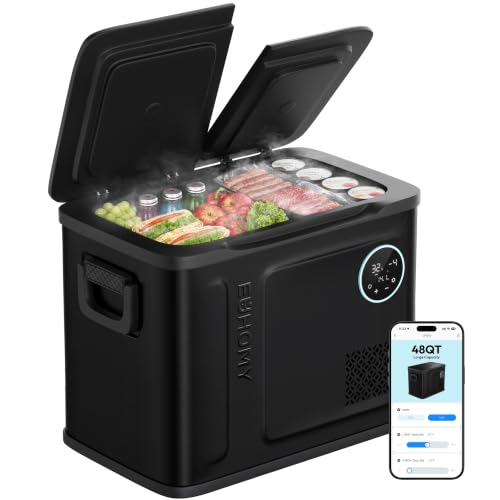
EUHOMY 48QT 12 Volt Refrigerator Dual Zone — Best Value Dual Zone
The EUHOMY 48QT Dual Zone is how an RV gets fridge-plus-freezer without the premium invoice: 48 quarts across two zones, a -4°F to 68°F range, ECO and MAX modes, 3-level battery protection, and both 12V and household AC power. For families equipping a trailer, or owners adding an outdoor-kitchen fridge alongside the built-in unit, it is the specification-per-dollar pick of this roundup.
Strengths
- Dual zone at 48QT in the value tier is the cheapest way into fridge-plus-freezer travel
- Fast cooling mode gets a warm load down to temperature before a departure
- Battery protection levels guard the starter battery when parked
Trade-offs
- Value-tier insulation works the compressor harder than premium boxes in heat
- Two zones in 48QT means each zone is modest — big items need planning
- Support and spare parts are mail-order realities with value brands
Key specs (from the manufacturer listing):
- Capacity: 48QT dual zone per API listing title
- Temperature range: -4°F to 68°F per API listing title
- Power: 12V and 100-240V AC
- Modes: ECO/MAX modes and 3-level battery protection listed in the API title
The dual zones do the family work — ice and frozen dinners on one side, the daily fresh food on the other — and the fast-cooling MAX mode handles the supermarket stop on a hot day the way RV life actually happens. Battery protection keeps it polite on the house bank, and AC power makes it the garage overflow fridge between trips, which is how value gear earns its keep twice.
Value-tier truths apply: insulation that works the compressor harder than the premium boxes in extreme heat, utilitarian hardware, and a thinner support network than the legacy brands. For weekend-and-holiday RV use — the pattern most rigs actually live — those are fair trades, and the savings fund a lot of diesel.
Best for: families and second-fridge buyers who want dual zone at a value price / Not suited for: full-timers who should weight decade-scale build and support first
Check on Amazon — check the current price on Amazon before you buy, as listings and bundles change.

Alpicool C20 Portable Compressor Fridge Freezer (21 Quart) — Best for Small RVs and Vans
Small rigs have small spaces, and the Alpicool C20 is the fridge that respects them: 21 quarts (20 litres) of compressor fridge-freezer, running on 12/24V DC or household AC, in a box that fits the van’s galley end, the teardrop’s kitchen or the truck camper’s corner. It is the compact pick for RVs where the 40-quart class is simply not a physical option.
Strengths
- 21 quarts is the sweet spot for a couple’s weekend without dominating the cargo area
- Compressor design holds temperature in hot vehicles where thermoelectric boxes give up
- AC adapter support makes pre-cooling at home before a trip simple
Trade-offs
- Still a single-zone box: frozen food and fresh food share one setpoint
- No app control at this tier — you set temperature on the unit itself
- Lid and latch hardware is functional rather than premium; treat it kindly on rough roads
Key specs (from the manufacturer listing):
- Capacity: 21 quart (20 liter) per API listing title
- Power: 12V/24V DC and 110V AC
- Cooling: compressor fridge freezer for car and home use
Within its footprint it is a real refrigerator — compressor cooling that holds temperature in a hot van where a thermoelectric box would surrender — and that makes it a genuine only-fridge for solo and couple van life with a fresh-food rhythm: shop little, shop often, eat well. Pre-cooling at home on AC before departure is easy at this size, and its modest appetite is kind to small house banks and single-battery vans.
Twenty-one quarts is a discipline: drinks crowd out dinners quickly, single zone means one temperature for everything, and there is no app or display luxury. Owners who measure their rig’s spare space in centimetres already know whether this is their pick — for them, it is close to the only pick, and a good one.
Best for: vans, teardrops and small campers where space rules everything / Not suited for: families, groups, or any rig with room for the 40-quart class
Check on Amazon — check the current price on Amazon before you buy, as listings and bundles change.
Comparison Table
| Pick | Badge | Key spec | Best for |
|---|---|---|---|
| BougeRV CRD2 V2 52QT Dual Zone Refrigerator with 240Wh Battery | Best Overall for RVs | Capacity: 52QT dual zone per API listing title | RV owners whose rig is often parked unplugged, and anyone who wants food security independent of the house bank |
| Dometic CFX2 37L Electric Cooler | Best Premium Compact | Capacity: 37L, holds 48 cans per API listing title | van conversions and small RVs wanting one premium fridge for the long term |
| Alpicool 43 QT Dual Zone Car Refrigerator with APP Control | Best Dual Zone with App Control | Capacity: 43 QT dual zone per API listing title | RV owners who keep the fridge in a bay or slide and want remote temperature control |
| BougeRV 12V Refrigerator 53 Quart | Best for Long Hauls | Capacity: 53 quart per API listing title | long-haul RV and truck travellers who mostly refrigerate fresh food |
| EUHOMY 48QT 12 Volt Refrigerator Dual Zone | Best Value Dual Zone | Capacity: 48QT dual zone per API listing title | families and second-fridge buyers who want dual zone at a value price |
| Alpicool C20 Portable Compressor Fridge Freezer (21 Quart) | Best for Small RVs and Vans | Capacity: 21 quart | vans, teardrops and small campers where space rules everything |
How to Choose a 12 Volt Refrigerator for Your RV
Measure first, shop second. RV fridge space is architectural: the slide tray’s dimensions, the bay door’s opening, the galley corner’s height with the lid open. Take all three measurements, including the lid-open and cable space, before opening a single listing — the best fridge in this roundup is worthless if it lives in the aisle. Allow ventilation room around the vents in the chosen spot, because a fridge in a sealed bay works harder and hotter.
Match the zone layout to the rig’s kitchen pattern. Full-timers and families almost always justify dual zone — frozen stores are what make a week between shops possible. Weekend rigs with fresh-food habits can save money and gain space with single zone. And decide the fridge’s role: only fridge, travel-day fridge, or outdoor-kitchen second fridge — the second-fridge role is where value dual-zones like the EUHOMY shine brightest per dollar.
Interrogate the battery relationship. The fridge will draw from the house bank or the tow vehicle every day you travel, so adjustable battery protection is not a feature, it is the feature — set it high on a starter battery, lower on a deep-cycle bank, and re-check it when the fridge changes vehicles. If your rig sits unplugged often, the battery-equipped BougeRV removes the question entirely, which is a legitimate reason to pay its premium.
Noise and latching are RV-specific virtues. A fridge that sleeps in the cabin should be judged on its published noise and its ECO behaviour at night; a fridge that travels in a bay or slide needs a lid and contents that stay shut and settled on rough roads — baskets, straps and a planned spot. The fridges here were chosen with those unglamorous tests in mind, because RV life administers them daily.
12V Compressor Fridge vs the Built-In Absorption Fridge: Supplement or Replacement?
The traditional RV absorption fridge runs on propane or AC, cools slowly, prefers to be level, and asks for a day’s notice before a trip. The 12V compressor fridge cools in hours, ignores grades and rough roads, and runs straight from the batteries you already carry. For new rigs — especially vans and small trailers without propane systems — the compressor fridge is increasingly the only fridge, and this roundup’s dual-zone picks are sized for exactly that role.
For rigs with a healthy absorption fridge, the smarter play is often supplement, not replacement: the 12V box takes the travel days (cold chain unbroken while driving, no propane questions in tunnels and ferries), the drinks and overflow at the site, and the outdoor kitchen — while the built-in unit does what it does adequately in place. That division also adds redundancy: a fridge failure on a long trip becomes an inconvenience instead of a food-loss emergency.
Replacement makes sense when the absorption unit is dying, when propane is being deleted from the rig, or when boondocking patterns punish its appetite and slowness. Then the questions become this roundup’s questions — capacity, zones, battery manners — plus one more: whether the house bank and charging can carry a full-time compressor load, which our RV battery guides can help you size.
One more RV pattern deserves naming, because it decides many purchases quietly: the fridge as travel insurance for the rig’s own systems. Absorption fridges fail, house banks age, converters give up at inconvenient distances from parts. A 12V compressor fridge aboard — even a compact one — converts each of those failures from a trip-ending emergency into a reshuffle: the perishables move to the box that still works, and the trip continues while the repair is arranged. Owners who have made that reshuffle once tend to keep a 12V fridge in every rig afterwards, whatever else the rig carries. Redundancy is a feature, and this is the cheapest form of it in the RV kitchen.
How to Install and Run a 12V Fridge in an RV
Give it a home and a harness: mount the fridge on a slide or a secured, ventilated base, with the DC cable run short and adequately thick from the house bank or a fused 12V outlet — thin cable and voltage drop are the silent cause of nuisance cut-outs. Set the battery protection for the source it will actually use, pre-cool the fridge on AC before departure, and load it with cold food so the travel day starts ahead.
Run the travel rhythm: fridge on the house bank or tow vehicle while driving, zones checked at fuel stops (this is where app-control models earn their keep), and at the site, decide its station — inside for the only-fridge rigs, outside in the shaded kitchen for the supplement pattern. Keep it out of direct sun, keep the vents clear of the chairs and storage that migrate toward any flat surface, and let ECO mode carry the nights.
Between trips, empty, dry and store it with the lid ajar, and if your fridge has a built-in battery, leave it charged per its maker’s guidance. A 12V RV fridge rewards this light routine with the one thing RV owners actually want from it: food that is simply, boringly cold, every day of every trip.
The Travel-Day Cold Chain: Why RV Food Survives or Fails on the Road
Ask RV owners when food spoils and the answer is rarely ‘at the site’ — it is on the road. The travel day is the cold chain’s weakest link: the built-in fridge switched between power sources or off entirely for tunnels and ferries, doors opened at every stop, a hot vehicle at the lunch halt. This is the shift the 12V compressor fridge was born to work. It runs from the tow vehicle or the house bank all day, ignores the road’s angles and vibrations, and arrives with its temperature trace unbroken — which is why so many owners who keep their absorption fridge still add a 12V box for the moving hours.
The discipline is simple and worth stating. The 12V fridge is pre-cooled before departure and loaded with the trip’s most perishable food — the cargo whose loss would hurt — while the built-in fridge carries the forgiving load. At fuel stops, a zone check (thirty seconds, or a glance at an app) confirms the chain. At the site, the 12V box either becomes the outdoor kitchen’s fridge or the overflow, and the cold chain simply never has a gap in it to fail through.
Owners who adopt this pattern report a side benefit that is hard to price: shopping freedom. With a powered fridge in the vehicle, the grocery stop can happen whenever it is convenient — midday, mid-journey, at the farm stand two hours from the site — because the food has a cold home waiting in the car. That is the travel-day cold chain working as it should: invisible, unbroken, and quietly expanding what an RV trip can eat.
Dual-Zone Discipline: Running Fridge and Freezer Zones on the Road
A dual-zone fridge is two appliances sharing a compressor, and running it well on the road is a small discipline. Set the freezer zone first — it works hardest and recovers slowest — and let the fridge zone follow; when you change one zone’s target, give the box hours, not minutes, before judging the result, because a loaded fridge’s temperature moves like a ship, not a speedboat. Check both zones at fuel stops rather than opening lids to look: every lid opening on a hot day spends cold you already paid for in battery.
Load the zones by travel logic. The freezer holds the days-ahead food — meat for day four, the ice, the frozen desserts — packed tight, because a full freezer holds its cold through stops better than a half-empty one. The fridge zone holds today and tomorrow, arranged so the thing you need is the thing you reach first. Drinks, the great space-thieves, belong wherever the trip’s pattern says: in the fridge zone on short trips, in a separate simple cooler on long ones where fridge space is cuisine-critical.
Finally, convert zones as the trip evolves — the feature owners forget they bought. Outbound, the freezer is full; by the return leg it is empty, and both zones as fridge space suit the market-stop shopping on the way home. Dual zone is not a fixed layout but a weekly decision, and the RV cooks who treat it that way get a noticeably bigger fridge than the ones who set it once and forget it.
Keeping the RV Fridge Efficient on the Road
A 12V fridge’s appetite is not fixed; it is negotiated daily by how you load and run it, and RV travellers who learn the negotiation stretch their house bank noticeably. The first lever is fullness: a fridge packed with cold food holds its temperature through stops and door openings far better than a half-empty box of cold air, which spills out at every opening. If the fridge is running light, fill the gaps with drinks or water bottles — thermal mass is free efficiency, and the drinks were coming anyway.
The second lever is temperature honesty. A fridge set colder than food safety requires is a battery tax paid for no benefit: fresh food lives safely in the mid-single digits Celsius, and each degree below that is compressor time bought with house-bank watt-hours. The freezer is the exception — frozen food genuinely wants it properly cold — which is another quiet argument for dual-zone models, where the two temperatures can each be exactly what they should be.
The third lever is the door discipline of travel life: the fridge is opened at stops, briefly, with a plan, and the day’s drinks migrate to a small cooler if the pattern is beach-and-back all afternoon. Combine the three levers and owners routinely find their fridge’s real consumption lands well under the figure they sized for — which is battery headroom that shows up as an extra evening of lights, an extra day between charges, or simply a gauge that stops being a source of commentary.
Common Buying Mistakes
The first RV fridge mistake is buying by litres before measuring the space — including the lid-open height and the bay door. Second is leaving battery protection at its factory setting regardless of source, then blaming the fridge for flat batteries or nuisance cut-outs. Third is powering it through a long, thin bargain cable and diagnosing the voltage drop as a faulty unit.
Fourth, owners park the fridge in a sealed, sun-baked bay and wonder why it runs constantly; ventilation is a power feature. Fifth is expecting a single-zone box to be a freezer and a fridge simultaneously across a week — the zone decision is a purchase-time decision. Sixth is forgetting the travel day: the fridge’s most important shift is the drive, and rigs that unplug it between sites arrive with warm food and strong opinions.
Final Recommendation
Start with the BougeRV CRD2 V2 if your RV is ever parked unplugged with food aboard — its built-in battery is the feature this category was missing. Premium small-rig owners should take the Dometic CFX2 37L and buy once; app-minded owners get their interface from the Alpicool 43 QT Dual Zone; long-haul fresh-food travellers get the quiet BougeRV 53; families get dual zone at a value price from the EUHOMY 48QT; and small vans get the only size that fits from the Alpicool C20.
Measure your space, decide your zones, set your battery protection, and any of these six will do the job that defines success in an RV fridge: cold food on day five, a healthy battery on day six, and not one thought spent on either in between.
A closing note from experience: the RV fridge you choose will be judged by your future self on exactly two mornings — the one where the food is perfect on day five of a hot trip, and the one where the engine starts because the battery protection did its job. Every pick in this roundup was chosen to pass both mornings. Measure your space, pick your zones, set the protection before the first mile, and then let the fridge disappear into the background of the trip, where all good RV equipment belongs.
Ready to buy? Check the current price on Amazon for the BougeRV CRD2 V2 52QT Dual Zone Refrigerator with 240Wh Battery. Check the current price on Amazon for the Dometic CFX2 37L Electric Cooler. Check the current price on Amazon for the Alpicool 43 QT Dual Zone Car Refrigerator with APP Control.
Keep researching the rest of this category with our related guides: Best 12 Volt Refrigerator Best 12 Volt Refrigerator For Off Grid Cabin Best 12 Volt Rechargeable Portable Battery For Rv Best 12 Volt Rechargeable Portable Battery Power Pack For Rv Best 12 Volt Rechargeable Battery Pack Best 12 Volt Rechargeable Portable Battery For Camping
Frequently Asked Questions
Can a 12V fridge replace my RV’s built-in fridge?
For many rigs, yes — especially vans and small trailers, where dual-zone compressor models in the 40–55 quart class handle a couple’s full refrigeration. In larger RVs, many owners keep the built-in unit and use a 12V fridge for travel days, overflow and the outdoor kitchen. The deciding factors are capacity for your crew and whether your house bank and charging can carry a full-time compressor load.
How long will a 12V fridge run on my RV house batteries?
It depends on the bank’s usable capacity and the fridge’s average draw — typically a few hundred watt-hours per day. A modest house bank usually carries a fridge for a day or more alongside normal loads; solar or driving recharges close the loop. A fridge with a built-in battery, like the BougeRV CRD2 V2 in this roundup, removes the fridge from the bank’s budget entirely for stretches at a time.
What battery protection setting should I use?
Match it to the source: the highest protection when the fridge draws from a starter battery (tow vehicle), a lower setting on a deep-cycle house bank designed for discharge. The correct setting is the one that stops the fridge before the battery that must start your engine — or run your furnace — is harmed. Re-check it whenever the fridge changes vehicles or power source.
Are 12V compressor fridges noisy in an RV?
They cycle on and off, and in a quiet cabin you will hear a well-behaved one softly rather than not at all. Models that publish low noise figures and offer ECO modes — the BougeRV 53 here is the example — are the picks for fridges that sleep in the cabin. Placement helps too: a fridge on a slide in a bay is a fridge you will never hear.
Can I run a 12V fridge while driving?
Yes — that is one of its best tricks. Powered from the tow vehicle or the house bank (which the alternator is charging as you drive), the fridge holds temperature across the travel day, so food arrives cold and the site setup starts ahead. Just confirm the battery protection setting suits the vehicle it is plugged into, and secure the fridge for the road.
Do I need a fridge slide for an RV 12V fridge?
Not strictly, but in bays and truck beds a slide transforms usability — the fridge comes to you instead of you climbing to it. In galley installations a fixed, ventilated, secured spot is enough. What is not optional is securing the fridge somehow: a loaded compressor fridge is heavy, and on the road it must not be free to move.


