Disclosure: airfryerkitchensupply.com is reader-supported. When you buy through links on our site, we may earn an affiliate commission at no extra cost to you.
Where to buy
Every fan in this guide to the best 12 volt quiet fans was verified against Amazon’s own catalog data before inclusion, and each review describes only what its verified listing states — mounting style, speeds, power source, and intended vehicles. Quiet is a claim anyone can print, so this guide favours designs with a physical reason to be quiet; use the links here to check live availability and check price on Amazon for your finalists.
- SEEKR by Caframo Sirocco II Fan — Check the current price on Amazon
- Caframo Bora 12V Marine Fan — Check the current price on Amazon
- SEEKR Ultimate Fan by Caframo — Check the current price on Amazon
- TN TONNY 12V Marine Fan 6 Inch — Check the current price on Amazon
- ZOIZ 12V RV Fan Oscillating — Check the current price on Amazon
- Muelnmey 8 Inch 12 Volt Oscillating Fan — Check the current price on Amazon
The best 12 volt quiet fans solve a problem that only exists off-grid: moving air in a boat cabin, an RV bedroom, a van conversion, or a truck cab, from a battery, without a drone that keeps you awake or a current draw that flattens the house bank by morning. A fan in a sleeping cabin is judged at 2 a.m., at arm’s length, on its lowest useful speed — and that judgement, not a showroom spin, is what this guide is organised around.
Scope matters here, so let us be plain about it. These are 12-volt vehicle and cabin fans: hardwired marine fans, oscillating RV fans, and plug-in car fans that run from the battery system or the cigarette lighter socket. They are not PC case fans — those are a different product with a different job, covered in a companion guide on this site — and they are not mains fans with a travel adaptor. If your fan must run all night from a leisure battery while you sleep beside it, you are shopping in the right place.
Quiet, in this category, is engineered rather than advertised. It comes from blade design that moves air without chopping it, from motors built for long low-speed service, from mountings that do not turn a bulkhead into a sounding board, and from honest low speeds that stir a cabin without storming it. The six verified picks below each have at least one of those physical reasons to be quiet, and the reviews name it in each case — because a fan whose quietness you can explain is a fan whose quietness you can trust.
In this guide
Quick Picks
Six verified fans for six sleeping-and-driving situations. In this category, choose by mounting and power first — hardwired, clip-on, or plug-in — and by quietness engineering second; the badge order below follows that logic.
- SEEKR by Caframo Sirocco II Fan — Best Overall: the benchmark cabin fan — a gimballed, omnidirectional hardwired fan that points anywhere, sips current on low, and auto-senses 12 or 24 volts for boats and RVs. Check the current price on Amazon
- Caframo Bora 12V Marine Fan — Best Compact Cabin Fan: the small, serious marine fan — a compact direct-wire Caframo with a long-life motor rated in its listing at 5000 hours, built for tight cabins and long seasons. Check the current price on Amazon
- SEEKR Ultimate Fan by Caframo — Best for True Quiet: the quietness extremist — a grill-free fan with soft, shock-absorbing FingerSafe blades that its listing calls whisper-quiet, in a 2-speed direct-wire design. Check the current price on Amazon
- TN TONNY 12V Marine Fan 6 Inch — Best Budget Quiet Fan: the honest budget cabin fan — a 6-inch screw-mounted 12V fan for marine, RV, and truck cabins that leads its own listing with the word quiet and a low-power draw. Check the current price on Amazon
- ZOIZ 12V RV Fan Oscillating — Best Oscillating RV Fan: the flexible one — a quiet oscillating circulator that wall-mounts or stands on a table, runs from 12V or USB-C, and adds a timer for set-and-forget nights. Check the current price on Amazon
- Muelnmey 8 Inch 12 Volt Oscillating Fan — Best Clip-On Car and Truck Fan: the no-install answer — an 8-inch oscillating clip fan that plugs into the cigarette lighter, with two speeds and a long cord, for cars, trucks, and RVs that need air today. Check the current price on Amazon
The six split cleanly by commitment. Hardwire the Sirocco II for the main berth, the Bora for tight corners, and the Ultimate where quiet is sacred. Screw-mount the TN TONNY where value rules. Keep the ZOIZ for flexible shared spaces and the Muelnmey for vehicles that need air without a project. Every pattern is legitimate; the only error is buying one pattern while needing another.
How These Picks Were Chosen
Verification in this category had to solve a vocabulary problem first: quiet is the most abused word in fan marketing, printed on everything from precision marine fans to novelty dash toys. Each pick here was therefore verified by brand-and-model search through the airfry site’s Amazon catalog connection, and admitted only when its listing described a real vehicle or cabin fan — with a mounting method, a power method, and an intended vehicle — rather than a novelty. Specifications quoted in the reviews come from those verified titles alone.
Within the verified pool, picks were chosen to span the category’s three honest patterns — hardwired marine fans, fixed budget cabin fans, and plug-in or flexible fans — because a guide that recommended six hardwired fans would serve boat owners and abandon van renters, and vice versa. Within each pattern, preference went to designs with a physical quietness mechanism: gimballed aim that permits lower speeds, grill-free blades, long-life motors, and oscillation that lets a gentle breeze serve a whole cabin.
Two exclusions are worth stating. PC case fans, though also 12-volt and often genuinely quiet, are a different product for a different enclosure and are covered separately on this site; mixing them here would mislead both audiences. And mains-powered travel fans with car adaptors were excluded for the mirror-image reason: this guide is for fans that belong to a 12-volt system, not guests in one.
The 6 Best 12 Volt Quiet Fans for Boats, RVs, Vans, and Cabs
Each review states the fan’s mounting and power pattern first, because in this category those decide fit before quietness decides satisfaction, then gives three strengths, three trade-offs, and a specification box drawn only from its verified listing.

SEEKR by Caframo Sirocco II Fan — Best Overall
Ask experienced cruisers and full-time RVers which cabin fan they fitted after the cheap ones disappointed them, and the Sirocco II is the name that recurs. Its verified listing describes the formula: 12/24V auto-sensing power, an omnidirectional gimballed design that aims airflow in any direction from a fixed mount, low power draw, and hardwired installation for boats and RVs. It is the fan this category is measured against.
The gimbal is the genius. A cabin fan’s value is not its maximum airflow but its ability to put a gentle stream exactly where a sleeping or reading human is — across a berth, along a settee, over a galley — without moving the fan. The Sirocco’s mount lets you aim once and forget, and its low-speed behaviour is the stuff of its reputation: present, cooling, and easy to sleep inside of, night after night, on a current draw a house bank barely notices.
Strengths
- Omnidirectional gimballed mounting aims airflow anywhere from one fixed install — the feature owners praise most
- Auto-sensing 12/24V operation suits boats and RVs of either system voltage with no variants to order wrong
- Low power draw on cruising speeds makes all-night running a non-event for a healthy house battery
Trade-offs
- Hardwired installation is required — there is no plug-in version, so budget an hour and proper marine wiring
- It is a considered purchase rather than an impulse one; the budget picks below exist for tighter wallets
- Maximum airflow is tuned for cabins, not for cooling a workshop — buy it for berths and settees, not for garages
| Specification | Detail |
|---|---|
| Power | 12V / 24V auto-sensing DC (per verified listing title) |
| Mounting | Hardwire installation, omnidirectional aim (per verified listing title) |
| Use | Boats and RVs (per verified listing title) |
| Origin | Made in Canada (per verified listing title) |
Live with a Sirocco for a season and its virtues compound quietly. It is the fan you aim at the aft berth in the evening and never think about again until you aim it at the galley the next morning. Its low draw changes behaviour: instead of rationing fan hours against battery anxiety, you simply run it, and a cabin that is always gently stirred is a cabin with less condensation, less stuffiness, and better sleep. That behavioural change — from rationed appliance to background infrastructure — is what the price buys.
Install it where its gimbal earns its keep: within aim of both the berth and the daytime seat if geometry allows, wired through a fused circuit with cable sized for the run, and mounted to structure that will not drum. Owners who mount it to thin panels sometimes add a backing pad; the fan itself is composed, and a solid mount lets it stay that way at every speed.
Best for: boat cabins and RV bedrooms wanting one premium, aim-anywhere, sleep-quiet fan / Not suited for: renters, plug-and-play buyers, or anyone unwilling to hardwire
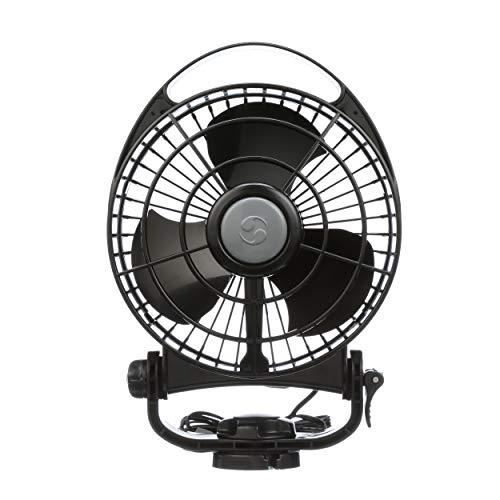
Caframo Bora 12V Marine Fan — Best Compact Cabin Fan
The Bora is the Sirocco’s smaller, simpler sibling in spirit: a compact 12-volt marine fan, direct-wired, with low current draw and a motor whose verified listing states a 5000-hour life. To feel that number properly, run the arithmetic — five hundred ten-hour nights of sleeping airflow, season after season, from a fan small enough to mount where larger fans simply do not fit.
It suits small-boat cabins, compact RVs, and van builds where the mounting spot is a pillar, a bulkhead corner, or the side of a cabinet rather than a broad wall. Compact fans are often toys; the Bora is not. Its design brief — marine duty, long motor life, low draw — reads like the specification a boatbuilder would write, which is roughly the market Caframo has served for decades.
Strengths
- Verified 5000-hour motor life rating signals a fan built for seasons of nightly service, not a single summer
- Compact body mounts in the corners and pillars where cabin airflow is needed and space is not available
- Low draw suits small house banks and solar-topped vans where every overnight amp-hour is budgeted
Trade-offs
- Compact means modest total airflow — it serves a berth or a seat beautifully and a whole large cabin partially
- Direct-wire install only, like the Sirocco; there is no socket-powered shortcut
- Buyers wanting oscillation or remote-style convenience features should look at the ZOIZ below instead
| Specification | Detail |
|---|---|
| Power | 12V DC, direct wire (per verified listing title) |
| Motor life | 5000 hours (verified listing figure) |
| Draw | Low draw (per verified listing title) |
| Use | Marine cabins (per verified listing title) |
The Bora’s natural home is the small cruising boat, where it has quietly become a default. Small cabins overheat in layers — the V-berth traps the day’s warmth, the quarter berth traps the night’s breathing — and a small fan that can live permanently in each problem corner, drawing almost nothing, changes the boat’s habitability out of proportion to its size. Owners commonly fit one, then fit a second the following season, which is the market’s own review written in purchases.
Wiring two small fans rather than one large one is often the smarter cabin strategy, and the Bora is priced and sized for exactly that thinking. Put the airflow where the people are, at the speed sleep requires, and let the cabin’s size stop mattering. It is the distributed-airflow philosophy in its simplest purchasable form.
Best for: small boat cabins, compact RVs, and vans needing long-life fans in tight mounting spots / Not suited for: large open cabins needing one fan to stir everything, or plug-in convenience seekers

SEEKR Ultimate Fan by Caframo — Best for True Quiet
The Ultimate attacks fan noise at its strangest source: the grill. Its verified listing describes a grill-free design with shock-absorbing FingerSafe blades — soft blades that need no protective cage because they are safe to touch — and calls the result whisper-quiet. Removing the grill removes the turbulent hiss and rattle that grills add, and soft blades remove the fear that makes grills necessary. It is a genuinely different piece of engineering, and the quietest brief in this guide.
It suits light sleepers, cabins shared with children, and any berth where a conventional fan’s cage rattle or blade chop has already proven itself the enemy. Two speeds and a direct-wire connection keep it simple: this is not a fan of features, it is a fan of one feature pursued properly. The white finish and open design also disappear visually into pale cabin headliners in a way caged fans never do.
Strengths
- Grill-free, soft-blade design removes cage rattle and turbulence hiss — the two noises that make cabin fans tiring
- FingerSafe blades suit family cabins where small fingers explore everything, with no cage to reach through
- Two speeds and direct wiring keep operation and installation as simple as the design itself
Trade-offs
- Open blades move air gently rather than forcefully — power seekers should take the Sirocco’s stronger stream
- The soft-blade design asks for sensible mounting, out of the path of stored gear that could rest against it
- White-only finish in this listing will not suit every cabin’s trim scheme
| Specification | Detail |
|---|---|
| Design | Grill-free, FingerSafe shock-absorbing blades (per verified listing title) |
| Speeds | 2 speeds (verified listing figure) |
| Power | 12V, direct wire connection (per verified listing title) |
| Origin | Made in Canada (per verified listing title) |
Spend a night with a conventional caged fan and then a night with the Ultimate and the difference is not volume so much as character. Caged fans produce a layered sound — motor hum, blade chop, grill buzz — that the ear keeps re-noticing. The Ultimate’s sound is simpler and lower in information, the kind the brain files as background and then ignores, which is the actual definition of quiet for sleeping. Light sleepers are not imagining their preference in this category; they are hearing accurately.
It also earns a place in day use: over a child’s bunk, beside a reading chair, in a van where the fan is inches from its audience at all times. Proximity is where grill-free softness wins twice — quieter sound, and no anxiety about contact. Mount it thoughtfully, keep its arc clear, and it becomes the fan nobody in the cabin ever mentions, which for a fan is fame.
Best for: light sleepers, family cabins, and berths where the fan sits close to its audience / Not suited for: buyers wanting maximum airflow or a feature-rich oscillating fan

TN TONNY 12V Marine Fan 6 Inch — Best Budget Quiet Fan
Not every cabin needs the benchmark fan, and the TN TONNY is the verified budget answer: a 6-inch DC 12V cabin fan for marine, RV, and truck use, screw-mounted, with low power draw, whose listing puts quiet operation at the front of its description. It suits second cabins, guest berths, work trucks, and any installation where the fan count matters more than the fan pedigree.
The sensible way to buy it is in the role it is built for: permanent screw-mounted airflow at a single seat or berth, bought singly for a spare cabin or in pairs for a small boat, at a total outlay the premium picks cannot approach. Judged as that, rather than as a cut-price Sirocco, it is a thoroughly rational purchase — the category’s value is in the mounting and the motor, and both are present here.
Strengths
- Screw-mounted permanence at a budget position — no suction cups, no clips, no nightly setup
- Low power draw keeps it viable on small batteries and in multi-fan installs
- 6-inch size balances real airflow against the mounting reality of small cabins and truck cabs
Trade-offs
- Budget fans ask for realistic expectations on refinement: fit, finish, and long-life polish sit below the Caframo picks
- Fixed-mount, straightforward operation — oscillation and multi-mode convenience live in other picks
- Verify your mounting surface before ordering; screw-mount fans need structure, not headliner wishes
| Specification | Detail |
|---|---|
| Size | 6 inch (verified listing figure) |
| Power | DC 12V (per verified listing title) |
| Mounting | Screw mounted (per verified listing title) |
| Use | Marine, RV, and truck cabins (per verified listing title) |
There is a fleet logic to fans like this one. A charter boat, a rental RV, a work truck, a spare cabin — installations where the fan must simply work, quietly enough, for whoever is aboard — are budget-fan territory, and a screw-mounted unit that stays where it was fitted beats a fancier fan that walks away or a clip fan that rattles loose. The TN TONNY’s proposition is durability of arrangement: fit it, wire it, and the cabin has airflow from then on.
For private owners it makes an equally good second fan: the premium pick over the main berth, a TN TONNY over the guest berth or in the heads compartment, where its airflow-to-cost ratio is exactly right. Categories are healthiest when buyers match spending to importance berth by berth, and this fan is what the less important berths have been waiting for.
Best for: second berths, work trucks, spare cabins, and multi-fan installs on a budget / Not suited for: buyers seeking benchmark refinement or convenience features

ZOIZ 12V RV Fan Oscillating — Best Oscillating RV Fan
The ZOIZ breaks this guide’s hardwired pattern deliberately, because many RV and van owners cannot — or should not — drill and wire for a fan. Its verified listing describes a quiet oscillating air circulator that works wall-mounted or as a tabletop fan, with dual power via USB-C as well as the vehicle system, and a timer function, aimed at camper vans, RVs, travel trailers, and boats.
Oscillation is its second argument. A fixed fan cools a spot; an oscillating fan cools a space, sweeping a small cabin so two people in two seats both get their share of the breeze, and so the air in a stuffy van turns over rather than merely stirring in one corner. Add the timer — set it at bedtime, let it stop when the cabin has cooled and sleep is deep — and the ZOIZ covers the convenience brief more completely than any hardwired pick here.
Strengths
- Oscillation circulates a whole small cabin rather than a single spot — the right pattern for shared spaces
- Wall-mount or tabletop flexibility plus dual power suits renters, new converters, and evolving van builds
- Timer function delivers the set-and-forget night that fixed fans need a switched circuit to match
Trade-offs
- Portable flexibility trades away the fit-and-forget permanence of hardwired fans — it must be placed, and stowed for travel if tabletop-mounted
- Oscillation mechanisms add a moving assembly that fixed fans simply do not have
- Serious marine cabins in heavy weather belong to the fixed-mount picks; this is a calm-weather circulator
| Specification | Detail |
|---|---|
| Type | Oscillating air circulator (per verified listing title) |
| Mounting | Wall mounted or tabletop (per verified listing title) |
| Power | USB-C dual power with 12V vehicle use (per verified listing title) |
| Features | Timer (per verified listing title) |
| Use | Camper van, RV, travel trailer, boat, home (per verified listing title) |
Van converters in the middle of a build will recognise this fan’s moment: the stage where the van is campable but the electrics are not final, and a fan that runs from USB-C today and integrates tomorrow is worth more than a hardwired fan in a box awaiting its circuit. The ZOIZ serves that stage and stays useful after it, moving between wall and table as the build — and the trip — demands.
Its timer also deserves respect as a battery feature, not merely a comfort one. The classic overnight fan mistake is eight hours of runtime where three would do; a timer converts that waste into saved amp-hours automatically, every night, without the owner performing arithmetic at bedtime. On small van batteries, that discipline is range — another morning of lights, fridge, and phones from the same bank.
Best for: camper vans, renters, and shared small cabins wanting oscillating, flexible, timed airflow / Not suited for: permanent marine installs or buyers who want fit-and-forget hardwiring

Muelnmey 8 Inch 12 Volt Oscillating Fan — Best Clip-On Car and Truck Fan
Sometimes the requirement is airflow this afternoon, with no wiring, no drilling, and no commitment. The Muelnmey answers it: a verified 8-inch 12-volt oscillating fan with a clip mount, cigarette-lighter power, two adjustable speeds, and a cord over six feet long, listed for cars, trucks, and RVs. It is the fan for the dog in the parked car problem, the cab without working air conditioning, the passenger seat in a heatwave, and the RV bunk that needs help tonight.
Judge it as what it is: the largest, most capable version of the plug-in pattern. Eight inches moves noticeably more air than the dashboard toys this category is full of, oscillation spreads it, and the clip mount — onto a headrest, a visor, a grab handle, a bunk rail — puts it where fixed fans cannot go. When the trip ends, it unclips and goes in a cupboard, which for occasional-use vehicles is not a compromise but the entire point.
Strengths
- Zero-installation pattern: clip it, plug it in, and the vehicle has oscillating airflow in one minute
- Verified 8-inch size and oscillation move and spread more air than fixed mini dash fans
- Long cord and two speeds give placement and noise control that single-speed plug fans lack
Trade-offs
- It runs only while the socket is live — vehicles that cut socket power with the ignition cannot use it for parked ventilation
- Clip mounting is temporary by design; rough roads and heavy weather are hardwired-fan territory
- An 8-inch fan in a small cab is a presence — measure your mounting spot before ordering
| Specification | Detail |
|---|---|
| Size | 8 inch (verified listing figure) |
| Power | 12 volt via cigarette lighter plug (per verified listing title) |
| Speeds | 2 speed adjustable (verified listing figure) |
| Cord | 6.5 ft (verified listing figure) |
| Use | Car, truck, RV (per verified listing title) |
The use case that sells this fan hardest is the one nobody plans: the vehicle whose air conditioning fails in July, the rental truck with a hot cab, the car that must carry a dog or a sleeping child in supervised parked shade. In each, a real 8-inch oscillating fan is the difference between coping and cancelling, and its total setup — clip, plug, aim — respects the urgency of the moment.
It also serves as the honest gateway to this whole category. Owners who discover, through one summer with a clip fan, that they use cabin airflow every single night are the owners who hardwire a Sirocco or a Bora the following spring with total confidence in the purchase. Bought in that spirit — trial now, infrastructure later — the Muelnmey is not the cheap option. It is the research budget.
Best for: cars, trucks, and RVs needing immediate plug-in airflow with no installation / Not suited for: permanent installs, unattended parked ventilation on ignition-switched sockets, or heavy-weather marine use
Comparison Table
Compare on pattern, mounting, and power before comparing anything else — a brilliant fan in the wrong pattern is the wrong fan. The table compresses those decisions into one view.
| Pick | Badge | Key spec | Best for |
|---|---|---|---|
| SEEKR by Caframo Sirocco II Fan | Best Overall | 12/24V auto-sensing, omnidirectional gimbal, low draw | boat cabins and RV bedrooms wanting one premium, aim-anywhere, sleep-quiet fan |
| Caframo Bora 12V Marine Fan | Best Compact Cabin Fan | Compact direct-wire body, 5000-hour motor life | small boat cabins, compact RVs, and vans needing long-life fans in tight mounting spots |
| SEEKR Ultimate Fan by Caframo | Best for True Quiet | Grill-free FingerSafe blades, 2 speeds, whisper-quiet brief | light sleepers, family cabins, and berths where the fan sits close to its audience |
| TN TONNY 12V Marine Fan 6 Inch | Best Budget Quiet Fan | 6-inch screw-mount cabin fan, low draw | second berths, work trucks, spare cabins, and multi-fan installs on a budget |
| ZOIZ 12V RV Fan Oscillating | Best Oscillating RV Fan | Oscillating, wall or tabletop, USB-C dual power, timer | camper vans, renters, and shared small cabins wanting oscillating, flexible, timed airflow |
| Muelnmey 8 Inch 12 Volt Oscillating Fan | Best Clip-On Car and Truck Fan | 8-inch clip fan, lighter-plug powered, 2 speeds | cars, trucks, and RVs needing immediate plug-in airflow with no installation |
Notice that no column here ranks loudness, because honest loudness figures are not something these listings state — and inventing them would break this guide’s verification rule. Instead, each review names its fan’s quietness mechanism. Choose the mechanism that matches your cabin, and the volume will follow.
How to Choose the Best 12 Volt Quiet Fans for Your Cabin
Start with the pattern decision, because it cannot be revisited cheaply. Hardwired fans are infrastructure: quiet, permanent, always ready, and the right answer for a main berth you sleep in weekly. Fixed screw-mount budget fans serve secondary spaces with the same permanence at lower refinement. Plug-in and flexible fans are equipment: movable, storable, and right for occasional vehicles, rentals, and evolving builds. Decide which relationship you want with the fan before you compare a single specification.
Then think in airflow placement rather than airflow volume. A cabin fan’s job is to move air across people, and a modest fan aimed along a berth outperforms a powerful fan stirring a corner. Gimballed aim, oscillation, and clip-anywhere mounting are all placement technologies — value them as such. In small cabins, two small fans in the right places routinely beat one large fan in the wrong one, for noise as much as for comfort: each can run slower, and slower is quieter.
Finally, budget the electricity honestly. An all-night fan is an overnight load on the same battery that runs your lights, fridge, and devices. Low-draw designs — the marine picks here are built around them — turn eight hours of fan into a rounding error on a healthy house bank, while thirsty fans on small batteries create the morning-after flatness that gives 12-volt living a bad name. Check the draw, multiply by your nights, and size your bank or your fan accordingly.
- Pattern: hardwired infrastructure, fixed budget, or flexible equipment
- Placement: aim and oscillation beat raw volume in small cabins
- Speed range: a genuinely low low-speed is the quiet fan’s defining feature
- Draw: multiply overnight hours by current before you buy
- Mount: solid structure, clear of bedding and stored gear, at berth height
Why Cabin Fans Sound Loud at Night: The Physics of 2 A.M.
A fan that seems civilised in a daytime shop becomes an intruder at night for three reasons, none of them mysterious. The cabin is quieter, so the fan owns a larger share of everything you hear. You are closer to it, often within arm’s length, where small noises are large. And you are trying to sleep, which lowers your tolerance for patterned sound — the cyclic hums, rattles, and surges that the waking brain edits out. Night judgement is the only judgement that matters for a cabin fan, and it is brutally specific.
The noises themselves have addresses. Motor hum lives in the motor and its mounting, and travels through structure — which is why solid mounts and vibration isolation matter as much as motor quality. Blade noise lives in blade shape and speed, and falls steeply as speed drops, which is why an honest low speed matters more than any other single feature. Grill noise lives in turbulence and loose cages, which is why the grill-free Ultimate exists. Diagnose which noise your current fan makes, and you will know which mechanism your next fan needs.
The practical test, when you fit a new fan, is to run it at sleeping speed for a full night before finalising its position. Ten minutes of daytime listening tells you almost nothing; a night tells you everything, including whether the mount drums, whether the low speed surges, and whether the airflow actually crosses the berth. Fit provisionally, sleep honestly, then finish the install.
Powering Fans from a 12 Volt System Without Flattening It
Fan arithmetic is reassuring when you do it. A low-draw cabin fan running overnight consumes a small fraction of a typical RV or boat house bank — but the word typical hides the small banks: a single modest battery in a small van, already feeding a fridge and lights, feels every load. The discipline is simply to know your numbers: the fan’s draw at the speed you will actually use, multiplied by the hours you will actually run, compared against the usable half of your battery’s capacity. Do that sum once, on paper, before the first trip.
Wiring choices protect both the fan and the bank. Hardwired fans deserve their own fused circuit, cable sized for the run, and — in boats especially — tinned marine cable and sealed connections, because a fan circuit lives in the same damp air as everything else aboard. A switch you can reach from the berth is a safety and sanity feature: the fan you can stop without getting up is the fan whose low battery warning you will actually heed at 3 a.m.
Solar changes the equation kindly. A modest panel that replaces the day’s fan and light consumption by afternoon turns overnight fans from a budget into a background, which is why so many of the cabins these fans serve now carry one. If your fan arithmetic comes out tight, the panel — not a louder, thirstier fan on a bigger bank — is usually the elegant fix.
How to Install a Hardwired 12 Volt Cabin Fan
This pattern covers the hardwired picks — the Sirocco II, Bora, and Ultimate — and any fixed 12-volt fan. Work with the battery disconnected, follow the fan maker’s own instructions where they differ, and use marine-grade materials anywhere damp is possible.
- Choose the mounting point by sitting or lying where the fan must serve: airflow should cross the berth or seat at body height, with the mount on solid structure, clear of bedding, curtains, and stored gear.
- Fit the fan provisionally and live with it for a night on a temporary fused lead before drilling anything permanent — position errors are free at this stage and expensive afterwards.
- Run cable sized for the fan’s draw over the full round-trip length, positive through a fuse near the power source, using tinned cable and sealed crimp connections in any damp space.
- Mount the fan firmly to structure; if the surface is thin panel, add a backing plate or pad so the mount cannot drum at speed.
- Fit a switch reachable from the berth or seat the fan serves, and label the circuit at the panel like every other load aboard.
- Reconnect, then test every speed for a full minute each, listening for mount rattle, cable buzz, and airflow direction; adjust aim and mounting tightness until the fan disappears into the background.
- Sleep on it — literally — for a night before declaring the install finished, and record the fan’s circuit and fuse in the boat or RV’s wiring notes.
A fan installed this way becomes part of the vessel rather than an accessory aboard it, which is the entire ambition. The plug-in picks need none of this, of course — their install is a clip and a socket — but owners who graduate from plug-in to hardwired almost always cite the same reason: the fan they never have to set up is the fan they use every night.
Common Buying Mistakes
The category’s classic mistake is buying a fan for its maximum speed. Maximum speed is a specification for a hot afternoon’s first five minutes; you will live at low speed, in the dark, for thousands of hours. A fan whose low speed is lumpy, surging, or merely a slightly slower loudness is a fan bought wrong, whatever its top end does. Wherever possible, judge — or choose designs known for — the bottom of the speed range, not the top.
Second is mounting to whatever is nearest rather than whatever is solid. Thin panels, headliners, and locker doors turn motor vibration into cabin-wide sound, and owners then blame quiet fans for a loud installation. The fan is only ever as quiet as its mount; give it structure, isolation, and tight fixings, and several decibels of imagined product difference simply evaporate.
- Placing the fan where its airflow crosses a wall instead of the berth
- Running an overnight fan from the starting battery instead of the house bank
- Ignoring current draw until the bank is flat at dawn
- Buying a caged fan for a toddler’s bunk when grill-free designs exist
- Drilling the permanent install before spending one provisional night with the fan
Last, do not solve a placement problem with a bigger fan. A larger fan in the wrong place is a louder fan in the wrong place. Move the airflow — gimbal, oscillation, a second small fan — before you multiply it, and the cabin will reward you in the only currency that matters at 2 a.m.: silence with a breeze in it.
Final Recommendation
For the main berth, fit the Sirocco II and be done: its gimballed aim, low draw, and dual-voltage sensing make it the cabin fan against which the rest are honestly measured. Tight corners and second cabins belong to the Bora, and the lightest sleepers — and the smallest fingers — belong to the grill-free Ultimate. Those three hardwired picks cover permanent installations completely.
For everything temporary, shared, or evolving, choose by flexibility: the oscillating, dual-power ZOIZ for vans and shared cabins, the clip-on Muelnmey for vehicles that need air today, and the screw-mounted TN TONNY wherever a permanent budget fan serves a secondary space. Each pick here was verified as a real vehicle fan with its mounting and power stated in its own listing — hold any alternative to the same standard.
Whichever you fit, spend one provisional night with it before the install is final, wire it to the house bank through its own fuse, and judge it at sleeping speed in the dark. Readers outfitting the rest of a 12-volt cabin will find the companion guides below — including the separate case-fan guide for electronic enclosures — worth the detour.
Shortlist: SEEKR by Caframo Sirocco II Fan · Caframo Bora 12V Marine Fan · SEEKR Ultimate Fan by Caframo
Frequently Asked Questions
How quiet is quiet for a 12 volt cabin fan?
Honest answer: these listings do not state comparable noise figures, and this guide will not invent any. Judge instead by mechanism and by speed: a fan with a genuine low speed, a solid mount, and a design that avoids grill turbulence will sleep quietly in a real cabin, while a fan that is merely small and fast will not, whatever its packaging claims. The night test in the how-to section is the only measurement that finally counts.
Will a 12 volt fan flatten my battery overnight?
A low-draw cabin fan of the kind featured here uses a small fraction of a healthy house battery’s usable capacity across a night — but small banks, old batteries, and thirsty fans change the sum. Multiply the fan’s draw at your chosen speed by your sleeping hours and compare it with half your battery’s rated capacity. If the result is uncomfortable, a timer, a lower speed, or a modest solar top-up closes the gap.
Hardwired or plug-in: which should I choose?
Hardwired if the fan serves the same berth every night and the vehicle is yours for seasons — permanence, readiness, and quiet mounting reward the hour of wiring. Plug-in if the vehicle is rented, shared, evolving, or only occasionally slept in. Many owners own both across a vehicle’s life: plug-in first to learn the habit, hardwired once the habit is proven.
Can these fans run on a 24 volt system?
The Sirocco II auto-senses 12 or 24 volts, per its verified listing, and suits either system. The other picks here are 12-volt units and should be run at 12 volts only. Always match the fan’s stated voltage to your system; a 12-volt fan on 24 volts is a brief, bright mistake, and a 24-volt expectation on 12 volts is a permanent disappointment.
Where should I mount a fan in a small cabin?
Where its air crosses people, at roughly body height for the berth or seat it serves, on solid structure, with its arc and blades clear of bedding and gear. In practice that means bulkheads and pillars near the head of a berth, corners that can sweep a settee, and — for oscillating and clip fans — positions that serve two seats in turn. Fit provisionally and sleep a night before making it permanent.
Are grill-free fans safe around children?
The grill-free pick here uses soft, shock-absorbing blades designed to be safe on contact — that is the stated purpose of its FingerSafe design, and it is why such fans suit family cabins. Sensible mounting still applies: out of the path of stored gear and flailing toys, like any moving equipment. For a toddler’s bunk, a grill-free fan or a well-caged fan mounted out of reach are the two defensible choices.


