Disclosure: airfryerkitchensupply.com is reader-supported. When you buy through links on our site, we may earn an affiliate commission at no extra cost to you.
Where to buy
Every fan in this guide to the best 12 volt quiet case fans was verified against Amazon’s own catalog data before inclusion, and each review quotes only the sizes, speeds, and features stated in its verified listing title. Case fans are a specification-dense category, so verification is the price of admission here; use the links in this box to check live availability and check price on Amazon for your finalists.
- Noctua NF-A12x25 PWM — Check the current price on Amazon
- Noctua NF-A12x25 G2 PWM — Check the current price on Amazon
- ARCTIC P12 PWM PST 5 Pack — Check the current price on Amazon
- Noctua NF-P12 redux-1700 PWM — Check the current price on Amazon
- ARCTIC P12 Silent — Check the current price on Amazon
- ARCTIC P12 Slim PWM PST — Check the current price on Amazon
The best 12 volt quiet case fans are the difference between a PC you can hear thinking and a PC you forget is on. Every standard PC case fan runs from the motherboard’s 12-volt fan headers, and the quiet ones earn that description the hard way: blade geometry that moves air without chopping it, bearings built to stay silent for years, and PWM speed control that lets the fan loiter at a few hundred RPM while you work and spin up only when the hardware genuinely heats. This guide verifies six of them, from the outright benchmark to the slim fan that saves small builds.
Scope, stated once so the right readers stay: these are PC case fans — 120mm units for cases, radiators, and coolers, wired to motherboard headers. They are not the 12-volt cabin fans for boats and RVs that share this site’s wider 12-volt coverage; those are a different product for a different kind of quiet, covered in their own guide. If your enclosure is a PC and your audience is a person at a desk — or trying to sleep in the same room as a rendering workstation — you are in the right place.
A quiet fan is not a slow fan, and the distinction organises everything below. The best designs move serious air at full speed for gaming and rendering loads, then disappear at idle, which is where a PC spends most of its life and where its owner spends most of theirs. Judge the picks by both ends of that range: the airflow that saves your temperatures in July, and the near-silence that saves your sanity in January. The six verified fans here each honour both ends, in different proportions and at different commitments of money and space.
In this guide
Quick Picks
Six verified 120mm fans spanning the benchmark, the value pack, the silence specialist, and the slim rescuer. In this category, choose by your case’s fan positions and your noise tolerance — the badge order follows the typical build’s priorities.
- Noctua NF-A12x25 PWM — Best Overall: the benchmark 120mm fan — high airflow and static pressure at low noise, a 2000 RPM PWM range, and Noctua’s famously complete accessory kit, for cases, coolers, and radiators alike. Check the current price on Amazon
- Noctua NF-A12x25 G2 PWM — Best Premium Upgrade: the second generation of the benchmark — Noctua’s updated A12x25 design with a listed 1800 RPM 4-pin PWM range and the same rich accessory kit, for builders who buy the newest revision on principle. Check the current price on Amazon
- ARCTIC P12 PWM PST 5 Pack — Best Value for Full Cases: the full-case answer — five pressure-optimised 120mm PWM fans with daisy-chain PST sharing, a listed range from 200 to 1800 RPM, and a zero-RPM idle mode, for whole-case outfitting. Check the current price on Amazon
- Noctua NF-P12 redux-1700 PWM — Best Accessible Noctua: the Noctua for sensible money — the redux line’s streamlined take on a classic pressure fan, with a listed 1700 RPM PWM range and the brand’s quiet engineering intact. Check the current price on Amazon
- ARCTIC P12 Silent — Best for Silence-First Builds: the quiet absolutist — a P12 variant tuned by ARCTIC specifically for silence, pressure-optimised for real case positions, for builds where noise is the first specification. Check the current price on Amazon
- ARCTIC P12 Slim PWM PST — Best for Small-Form-Factor Builds: the space rescuer — a slim-profile 120mm fan for the clearances standard fans cannot enter, keeping PWM control, PST sharing, and a pressure-optimised design. Check the current price on Amazon
The six divide by build type with unusual cleanliness: the A12x25 or its G2 for flagship positions, the P12 pack for whole cases on value, the redux for Noctua quality at a moderate commitment, the Silent where noise is the enemy, and the Slim where millimetres are. Most real builds combine two of these picks — and that combination, chosen by position, is the mark of a builder who has done this before.
How These Picks Were Chosen
Every fan here was verified by brand-and-model search through the airfry site’s Amazon catalog connection in this pass, with sizes, speed ranges, and features quoted only from returned listing titles. In a category where listings routinely borrow each other’s claims, that discipline excluded several famous names whose current listings could not be verified to the same standard — including one celebrated silence-focused brand whose searches repeatedly failed to return through the connection. Absence here means unverified in this pass, not unworthy in the world, and the guide says so plainly rather than filling the gap with guesses.
Within the verified pool, picks were assigned to the positions and priorities real builds present: an outright benchmark, its current revision, a whole-case value pack, an accessible engineering pick, a silence specialist, and a slim specialist. That spread was deliberate. A guide recommending six interchangeable flagships would fail the builder with five positions and a budget, the streamer with a microphone, and the SFF builder with a 15mm gap — three audiences who need three different fans, all of whom are served here.
One standard governed the quiet claims in particular: no noise figures are quoted anywhere in this guide, because the verified titles do not state comparable ones and inventing them would break the guide’s own rule. Instead, each review names the mechanism behind its fan’s quietness — bearing and blade design, speed range and idle behaviour, pressure design that permits lower speeds. Mechanisms can be reasoned about and trusted; unverifiable decibel claims can only be repeated.
The 6 Best 12 Volt Quiet Case Fans for Silent PC Builds
Each review leads with the position and priority its fan serves, then gives three strengths, three trade-offs, and a specification box drawn only from its verified listing. Speed figures are listed maximums throughout — your fan curve, not the box, decides working speeds.

Noctua NF-A12x25 PWM — Best Overall
The NF-A12x25 is the fan this category is measured against, and its verified listing states the brief plainly: a high-performance quiet fan in 120mm, delivering high airflow and static pressure at low noise, 25mm thick, for coolers, radiators, and cases, spinning to a listed 2000 RPM under PWM control, with a rich accessory kit in the box. That combination — pressure and airflow and quiet, all three, in one fan — is what the rest of the industry has spent years chasing.
Static pressure is the phrase to understand. A case fan rarely blows into open air; it pushes through radiator fins, dust filters, drive cages, and mesh, all of which resist. Fans designed for pressure keep delivering against that resistance where airflow-optimised fans quietly give up, which is why the A12x25 serves as case intake, radiator fan, and cooler fan with equal authority — one fan model for every position in the build.
Strengths
- High static pressure as well as airflow makes it the one-fan answer for intakes, radiators, and heatsinks alike
- PWM control to a listed 2000 RPM gives it genuine range: silent loitering at idle, serious cooling at load
- The rich accessory kit — adaptors, extension, and mounting options — reflects a maker who expects the fan to serve for years across builds
Trade-offs
- It is the premium commitment in this guide, and a full case set multiplies that commitment honestly
- The signature Noctua colour scheme divides opinion in windowed builds; a black variant exists in the same family for the aesthetically committed
- 25mm thickness is standard, but the very tightest small-form-factor spots should check the slim pick below first
| Specification | Detail |
|---|---|
| Size | 120mm, 25mm thick (verified listing figures) |
| Speed | 2000 RPM, PWM controlled (verified listing figures) |
| Design | High airflow and static pressure, low noise (per verified listing title) |
| Use | Coolers, radiators, cases (per verified listing title) |
Ownership is where this fan’s legend actually lives. Builders move A12x25s from case to case and build to build like quality hand tools, because the bearing and motor are engineered for a service life measured in PC generations rather than warranty periods. A fan that will outlive three graphics cards is not expensive in the way its box suggests; it is amortised into invisibility, which is the correct accounting for components that never ask for attention again.
In use, its defining experience is the fan curve you can finally set and forget: low hundreds of RPM through desktop work, a smooth ramp through gaming, and temperatures that stay where you put them without the acoustic sawtooth of lesser fans hunting around their steps. Set the curve once, in the BIOS or your software of choice, and the fan’s career is a decade of not being thought about.
Best for: builders wanting one benchmark fan model for every position in a quiet, high-performance PC / Not suited for: tight budgets outfitting many positions, or the slimmest small-form-factor clearances

Noctua NF-A12x25 G2 PWM — Best Premium Upgrade
The G2 is what happens when the benchmark iterates: Noctua’s second-generation A12x25, verified here with a listed 1800 RPM ceiling on a 4-pin PWM connection, the same 25mm, case-and-radiator brief, and the same rich accessory kit. A slightly lower top speed than the original, in exchange for the generational refinements a maker builds into a flagship revision, is a trade this category’s enthusiasts understand instinctively.
It suits the builder who is specifying a new flagship PC today and wants the current revision of the definitive fan — for a radiator that will define the build’s thermals, or a case set bought once for a decade. Owners of the original debating an upgrade should hear the honest version: the G2 is the one to buy new, and rarely a reason to retire healthy originals, whose performance remains the standard the G2 was measured against internally.
Strengths
- Newest generation of the category’s defining design, with the refinements a flagship revision implies
- Listed 1800 RPM PWM range is ample for any case or radiator duty while favouring the quiet end of the curve
- Same complete accessory kit and multi-role brief as the original — intake, exhaust, radiator, or cooler
Trade-offs
- A lower listed top speed than the original A12x25, which matters only to builders who genuinely run fans at maximum
- Premium positioning, like its predecessor — value hunters should read the Arctic picks before deciding
- Generational gains are refinements, not revolutions; owners of the original should upgrade for new builds, not from restlessness
| Specification | Detail |
|---|---|
| Size | 120mm, 25mm thick (verified listing figures) |
| Speed | 1800 RPM, 4-pin PWM (verified listing figures) |
| Design | High airflow and static pressure, low-noise (per verified listing title) |
| Use | Coolers, radiators, cases (per verified listing title) |
There is a particular pleasure in buying the current revision of a mature design: the tooling is proven, the failure modes are known and engineered out, and the accessory ecosystem — mounts, adaptors, splitters — is complete from day one. The G2 offers that pleasure in the fan category’s most scrutinised product line. For a flagship build intended to serve unchanged for years, starting with the newest revision of the benchmark is not extravagance; it is scheduling.
Run it as the original taught the world to run it: a considered fan curve, pressure positions filled first, and speeds kept in the quiet hundreds for the ninety percent of computing that is not a benchmark run. The G2’s slightly gentler ceiling will never be missed in that regime, and its refinement at working speeds is the entire argument.
Best for: new flagship builds wanting the current revision of the benchmark fan / Not suited for: owners of healthy original A12x25s seeking a transformative upgrade

ARCTIC P12 PWM PST 5 Pack — Best Value for Full Cases
Most cases need four or five fans, and buying them one flagship at a time is how cooling budgets die. The P12 PWM PST answers in bulk: a verified five-pack of pressure-optimised 120mm fans with quiet motors, a listed speed range of 200 to 1800 RPM, a zero-RPM mode at low PWM signal for true idle silence, and PST — PWM Sharing Technology — which daisy-chains the fans so one header drives the set in unison.
PST deserves its explanation, because it solves the header arithmetic that plagues full builds. Motherboards offer a handful of fan headers; five fans plus a cooler can exceed them, inviting splitters and hubs of varying quality. PST fans pass the PWM signal fan to fan, so a whole intake bank runs from one header on one curve, tidily and synchronously. For builders outfitting a case in one purchase, that integration is worth as much as the fans’ considerable per-unit value.
Strengths
- Five pressure-optimised fans in one pack outfits an entire case at a per-fan commitment the premium picks cannot approach
- PST daisy-chaining runs banks of fans from single headers on unified curves — the tidy builder’s feature
- Listed 200 to 1800 RPM range with zero-RPM idle behaviour covers silence and cooling in one specification
Trade-offs
- Per-fan refinement sits below the Noctua flagship — the pack buys breadth and value, not the last word in polish
- Daisy-chained banks share one curve, so positions needing independent control should sit on their own headers
- Five fans is the full commitment: small cases needing two should buy the singles in this guide instead
| Specification | Detail |
|---|---|
| Size | 120mm case fans, 5 pack (verified listing figures) |
| Speed | 200 to 1800 RPM, PWM (verified listing figures) |
| Idle | 0 RPM at low PWM signal (per verified listing title) |
| Design | Pressure-optimised, quiet motor, PST sharing (per verified listing title) |
The P12’s reputation in the building community is the worst-kept secret in PC hardware: pressure-optimised performance close enough to the flagships that the difference requires instruments to argue about, at a pack price that makes full-case outfitting a shrug. Builders who measure in temperatures rather than in brand loyalty have standardised on it for years, and a five-pack with PST is the format that built that reputation — enough fans, one curve, no drama.
Its zero-RPM idle behaviour deserves emphasis for this guide’s quiet brief. A desktop PC at idle with its case fans stopped is a silent object, and most desktop hours are idle hours. The P12s vanish completely in that state and return smoothly when the workload does — the exact acoustic biography a quiet build is supposed to have.
Best for: full-case outfitting, first quiet builds, and value-focused builders needing four or five fans / Not suited for: single-fan purchases or builders wanting per-position independent curves everywhere
Noctua NF-P12 redux-1700 PWM — Best Accessible Noctua
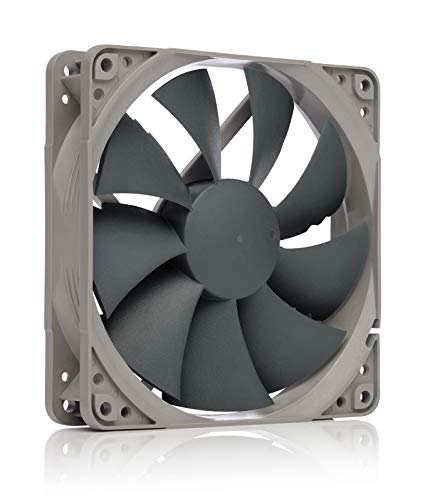
Noctua’s redux line exists for buyers who want the engineering without the ceremony: proven fan designs reissued in a streamlined package, in grey, at a friendlier commitment. The NF-P12 redux-1700 is its 120mm representative here — a verified quiet fan with high airflow at low noise, a listed 1700 RPM ceiling on 4-pin PWM, and a pressure-friendly heritage that suits cases and electronics cooling alike.
The P12 design lineage predates the A12x25 and earned its own following as a pressure fan for radiators and restrictive intakes. In redux form it becomes the rational Noctua: the builder who needs two or three genuinely quiet, genuinely durable fans and declines to pay flagship prices for the privilege will find this pick waiting. Streamlined package means fewer accessories in the box — bring your own splitters — and the fan itself makes no apology for it.
Strengths
- Proven pressure-oriented design with Noctua’s bearing and motor engineering, at the redux line’s accessible position
- Listed 1700 RPM PWM range covers case and radiator duty with quiet headroom to spare
- Grey redux styling suits builds that find the classic Noctua colours a step too far
Trade-offs
- Streamlined packaging means a leaner accessory set than the flagship’s rich kit
- An earlier design generation than the A12x25 — excellent, and priced like it knows the flagship exists
- Buyers wanting zero-RPM idle tricks or daisy-chaining should take the Arctic pack’s feature set instead
| Specification | Detail |
|---|---|
| Size | 120mm, 25mm thick (verified listing figures) |
| Speed | 1700 RPM, 4-pin PWM (verified listing figures) |
| Design | High airflow, low noise, streamlined package (per verified listing title) |
| Use | PC and electronics cooling (per verified listing title) |
Redux is an honest product philosophy: yesterday’s flagship engineering, today’s sensible money, none of the theatre. The P12 redux has cooled radiators and cases for a generation of builders who measure purchases in decades, and its continued verification in current listings is the market agreeing. For a workstation that must be quiet at a desk for eight hours a day, a pair of these on intake and one on exhaust is a complete, defensible, finished answer.
It also makes the ideal first Noctua — the fan that teaches a builder what the fuss is about without the flagship’s commitment. Many A12x25 owners arrived by exactly this road: a redux in the first quiet build, a flagship set in the second, and a drawer of retired no-name fans in between that nobody discusses.
Best for: builders wanting Noctua engineering and durability at a moderate commitment / Not suited for: accessory collectors or builders needing PST daisy-chaining and zero-RPM idle

ARCTIC P12 Silent — Best for Silence-First Builds
Every fan line has a variant that answers the question what if we optimised for quiet and let the rest follow — and in ARCTIC’s line it is named without ambiguity: the P12 Silent. Its verified listing describes a 120mm PC case fan, pressure-optimised, in the Silent tuning. Where the standard P12 balances airflow and acoustics, the Silent biases the balance deliberately toward the acoustic end.
It suits the builds where silence is not a preference but a requirement: the bedroom PC, the recording and streaming corner where a microphone shares the room, the living-room machine under the television, the office workstation in a shared space. In those rooms, a fan’s loudest hour matters more than its strongest hour, and a fan tuned for that priority — while retaining the pressure design that keeps it useful behind filters and mesh — is the correct specialist.
Strengths
- Silence-first tuning serves the rooms where fan noise is a genuine problem rather than a preference
- Pressure-optimised design keeps it effective in filtered intakes and restrictive positions, where silent fans often fade
- ARCTIC’s value positioning makes a full silent case set financially painless
Trade-offs
- The silence bias caps its cooling headroom — heavily overclocked, heat-dense builds should take the standard P12 or the flagships
- Its listing states its brief plainly and briefly; buyers wanting elaborate accessory kits should look up this guide, not down it
- One tuning for one priority: builders who want a single fan model for every conceivable duty should choose the all-rounders
| Specification | Detail |
|---|---|
| Size | 120mm (verified listing figure) |
| Design | Pressure-optimised, Silent tuning (per verified listing title) |
| Use | PC case fan (per verified listing title) |
The Silent’s natural experiment is the microphone test. A streaming or recording setup reveals every acoustic sin in a room, and case fans are the usual unindicted co-conspirators — a constant, broadband presence that gates and compressors faithfully amplify. Swapping to silence-tuned fans is one of the few upgrades a microphone notices immediately, and creators who make it describe the same surprise: the room itself got quieter on playback, not just at the desk.
Bedroom builds tell the same story at lower stakes. A PC that renders, downloads, or folds overnight in the room where its owner sleeps is judged at 3 a.m. by an audience of one, half-awake, with absolute veto power. The P12 Silent is built to survive that judgement — and priced so that surviving it across every fan position in the case costs less than one flagship fan.
Best for: bedroom, studio, and living-room PCs where silence outranks maximum cooling / Not suited for: heat-dense overclocked builds needing maximum airflow headroom

ARCTIC P12 Slim PWM PST — Best for Small-Form-Factor Builds
Small-form-factor building is a game of millimetres, and its most common defeat is a fan position a standard 25mm fan cannot quite enter — above a tall cooler, beneath a long graphics card, against a cramped top panel. The P12 Slim exists for those defeats: a verified slim-profile 120mm fan, pressure-optimised, with PWM control and PST sharing carried over from its full-thickness sibling.
Slim fans are usually apology products — thinner, weaker, louder compromises bought in desperation. The P12 Slim’s significance is that it declines the apology: it keeps the P12 family’s pressure design and its PST daisy-chaining, so a slim position integrates into the case’s fan curves like any other position rather than sulking on its own settings. For SFF builders, that integration is the difference between a cooling system and a collection of fans.
Strengths
- Slim profile enters the clearances — over coolers, under cards, in thin top panels — that defeat standard fans
- Retains PWM control and PST sharing, so slim positions join the case’s unified fan curves
- Pressure-optimised design suits the filtered, obstructed positions SFF cases are made of
Trade-offs
- Physics collects its tax: a slim fan moves less air than its full-thickness sibling at comparable noise, position for position
- It is a specialist for tight spots — cases with full clearances should use standard fans everywhere instead
- Slim positions are often awkward to cable; plan the PST chain before the build closes, not after
| Specification | Detail |
|---|---|
| Size | 120mm, slim profile (verified listing figure) |
| Design | Pressure-optimised (per verified listing title) |
| Control | PWM with PST sharing (per verified listing title) |
Every SFF builder has a photograph of the gap: the fifteen or so millimetres between a component and a panel where the build’s thermals go to be decided. A slim fan in that gap, exhausting a top panel or feeding an intake past a graphics card, routinely changes a small build from thermally anxious to thermally finished — not by brute force, but by giving hot air a planned exit where none existed. The P12 Slim’s career is made in those photographs.
Use it surgically. Standard positions get standard fans; the slim pick fills the one or two positions the case designer made impossible, and its PST link keeps it in the same curve family as the rest. A small build cooled that way — deliberately, position by position — runs quieter than a large build cooled carelessly, which is the SFF hobby’s favourite outcome and this fan’s reason to exist.
Best for: small-form-factor cases and any position where a standard 25mm fan cannot fit / Not suited for: standard cases with full clearances, where full-thickness fans do more per position
Comparison Table
Compare on listed speed range, design brief, and pack format — the three facts these listings state reliably. Noise figures are deliberately absent, for the reasons given in the selection notes.
| Pick | Badge | Key spec | Best for |
|---|---|---|---|
| Noctua NF-A12x25 PWM | Best Overall | 120mm, 2000 RPM PWM, case and radiator design | builders wanting one benchmark fan model for every position in a quiet, high-performance PC |
| Noctua NF-A12x25 G2 PWM | Best Premium Upgrade | 120mm G2 generation, 1800 RPM 4-pin PWM | new flagship builds wanting the current revision of the benchmark fan |
| ARCTIC P12 PWM PST 5 Pack | Best Value for Full Cases | 5-pack, PST daisy-chain, 200 to 1800 RPM | full-case outfitting, first quiet builds, and value-focused builders needing four or five fans |
| Noctua NF-P12 redux-1700 PWM | Best Accessible Noctua | 120mm redux line, 1700 RPM 4-pin PWM | builders wanting Noctua engineering and durability at a moderate commitment |
| ARCTIC P12 Silent | Best for Silence-First Builds | Silent-tuned 120mm, pressure-optimised | bedroom, studio, and living-room PCs where silence outranks maximum cooling |
| ARCTIC P12 Slim PWM PST | Best for Small-Form-Factor Builds | Slim-profile 120mm, PWM PST, pressure-optimised | small-form-factor cases and any position where a standard 25mm fan cannot fit |
The table’s real lesson is that quiet is a system: a pressure fan at low speed behind a filter beats an airflow fan straining at high speed, whatever either box claims. Choose designs that let your curve stay low, and the silence takes care of itself.
How to Choose the Best 12 Volt Quiet Case Fans for Your Build
Count positions and check clearances before admiring any fan. List every fan mount your case offers, note which are obstructed — by radiators, filters, cages, or components — and measure the tight ones in millimetres. Obstructed positions want pressure-optimised designs, which is every pick in this guide to some degree; impossible clearances want the Slim; and the count decides whether you are shopping for singles, a five-pack, or a flagship set. This inventory takes ten minutes and prevents every common fan-buying error at once.
Then decide your control philosophy. PWM fans on considered curves are the quiet builder’s instrument: near-silent at idle, purposeful at load, with zero-RPM behaviour — as on the Arctic pack — as the ultimate idle luxury. Daisy-chained PST banks simplify multi-fan positions onto single headers and single curves. However you wire it, the curve is the product: the same fan is a whisper or a nuisance entirely by its curve, so budget the ten minutes to set curves in the BIOS as part of the purchase, not as an afterthought.
Finally, allocate money by position rather than evenly. Radiator and restrictive intake positions repay flagship pressure fans; open exhaust positions forgive almost anything quiet. Many of the best quiet builds in this guide’s spirit run two premium fans where resistance lives and value fans where it does not — an allocation that buys flagship thermals at a mid-range total, and the true mark of experience in this category.
- Positions first: count mounts, measure clearances, mark obstructions
- Pressure where resisted: radiators, filters, and cages demand pressure designs
- Curves are the product: PWM control, set deliberately, decides real-world noise
- Spend by position: flagship money at restrictive spots, value money at open ones
- Slim is surgical: reserve slim fans for clearances that defeat standard fans
Static Pressure Versus Airflow: The Distinction That Runs This Category
Airflow figures describe a fan blowing into open space; static pressure describes a fan pushing against resistance. Your case offers almost no open space. Intake air arrives through mesh, filters, and sometimes radiator fins; exhaust leaves through grilles and honeycombs; internal air negotiates drive cages and cable runs. In that world, pressure is the working specification and free-air airflow is the brochure specification, and fans designed for pressure — the A12x25 above all, the P12 family in its wake — hold their delivery where airflow fans quietly surrender theirs.
The audible consequence matters as much as the thermal one. A fan that cannot overcome its position’s resistance must spin faster to deliver the same cooling, and fan noise rises brutally with speed. The quiet build’s secret is therefore not quiet fans in the abstract; it is adequate pressure at low speed in the actual positions. This is why experienced builders fill restrictive positions first, with their best fans, and why a single flagship on a radiator often silences a build more than three value fans at full tilt.
Radiators deserve a final word, because they are the most resistive common position and the one where fan choice is most consequential. A radiator fan’s job is to push air through a dense fin stack for the entire life of the loop. Pressure design, a curve that responds to coolant or CPU temperature rather than to noise nerves, and mounting that seals the fan to the radiator without gaps are the whole discipline — and the benchmark picks in this guide are benchmark largely because they perform it without complaint or chorus.
Fan Curves and Bearings: Where Quiet Is Actually Decided
Two identical fans can differ by a perceived mile through curves alone. A curve that idles at a few hundred RPM, rises gently through working temperatures, and reserves maximum speed for genuine thermal emergencies gives a build its quiet character; a curve that steps, hunts, or defaults to full speed gives it a reputation. Modern BIOS and software control makes the good curve a ten-minute task: set the idle plateau honestly, set the ramp by your hottest real workload rather than by a benchmark, and let zero-RPM modes — where your fans offer them — own the idle hours completely.
Bearings decide the other half of quiet: its duration. The bearing is what a fan sounds like in year four — the rattle, tick, and hum that arrive with wear are bearing biographies, not blade problems. This is the engineering the premium picks in this guide are actually selling, and why builders carry them between builds: a fan whose silence is a property of its bearing design keeps that silence, while a fan whose silence was a property of its newness spends it. When you compare a flagship against a value fan, you are largely comparing year four against year one.
Mounting completes the triangle. A fan hard against a vibrating panel broadcasts its motor into the case; the same fan on soft mounts or with its frame decoupled whispers. Use the mounting hardware your fan provides, avoid over-tightening into thin steel, and keep cables from resting against fan frames. Quiet is a system of curve, bearing, and mount — and the system, unlike any single fan, is fully within the builder’s control.
How to Install Case Fans for Maximum Quiet
This pattern assumes a standard ATX-style build and any picks in this guide. Your case and motherboard manuals govern header locations and limits — particularly how many fans a single header may power, which PST chains must respect.
- Plan the airflow path before fitting anything: front and bottom as intake, rear and top as exhaust, with a slight positive-pressure bias through filtered intakes to keep dust out.
- Fit restrictive positions first — radiator and filtered intakes — with your pressure-capable fans, sealing radiator fans flush to the radiator with no gaps at the frame.
- Use the soft or anti-vibration mounting your fans provide, snug rather than crushed, and keep every cable clear of blades and frames.
- Connect PST chains or splitters within your motherboard’s per-header current limit, grouping fans that should share a curve and separating those that should not.
- In the BIOS or control software, build curves per group: a low, flat idle plateau, a gentle ramp through working temperatures, and maximum speed reserved for genuine heat.
- Enable zero-RPM behaviour where offered for idle groups, then verify with a real workload — a game or render, not a synthetic spike — that temperatures and acoustics both behave.
- After a week, revisit the curves once with the build’s real habits in mind; the second tuning, informed by use, is the one the build will keep for years.
A quiet build finished this way has a particular signature: it is inaudible at the desk during work, present but composed under load, and cool in both states. That signature is available from every pick in this guide when the curves and mounts honour the hardware — and unavailable from any of them when they do not. The fans propose; the installation disposes.
Common Buying Mistakes
The category’s defining mistake is buying fans by their free-air airflow figure for positions that are all resistance. The fan arrives, the filter and radiator take their share, delivered air disappoints, speeds rise to compensate, and the quiet build becomes a loud one with excellent paperwork. Pressure design for obstructed positions — the principle behind this guide’s picks — prevents the entire sequence, and costs nothing but the moment it takes to think about where each fan will actually live.
Second is neglecting the curve. Default motherboard curves are written for cooling safety, not for acoustics, and a flagship fan on a default curve can out-shout a value fan on a tuned one. Builders who skip the ten-minute curve setup have not finished buying their fans, whatever the receipts say — they have bought the hardware and declined the product.
- Mixing rotation directions or airflow directions so intakes fight exhausts
- Powering a long PST chain beyond the header’s current limit
- Mounting fans hard against thin panels with no decoupling
- Judging a fan’s noise on an open bench instead of in the case, at the desk
- Filling open exhaust positions with flagship money while the radiator starves on a weak fan
Last, do not chase silence into heat. A curve so timid that components bake is not a quiet build but a slow failure, and modern hardware defends itself by throttling — trading the performance you bought for the quiet you demanded. The goal is both, in that order of honesty: temperatures safely in hand at the lowest speeds that achieve them. Every pick here can deliver that balance; the curve is where you claim it.
Final Recommendation
For a flagship build, fit the NF-A12x25 — or its G2 revision for a new purchase — at the restrictive positions and be done for a decade: no fan in this guide asks less of its owner or gives more to a build. For a whole case on a sane budget, the ARCTIC P12 five-pack is the recommendation this guide expects most readers to take, and takes pride in making: pressure-capable, daisy-chained, silent at idle, and finished in one purchase.
Between those poles, the redux brings Noctua engineering to a moderate commitment, the P12 Silent serves the rooms where noise is a genuine adversary, and the P12 Slim rescues the small builds nothing else fits. Every pick was verified with its figures stated in its own listing — in a category addicted to borrowed claims, that verification is the recommendation beneath all the others.
Complete the build with the installation discipline in the how-to section: planned airflow, sealed radiator mounts, grouped headers, and curves tuned twice. Readers comparing the other kind of 12-volt quiet — the cabin fans for boats, RVs, and vans — will find that guide linked below, written to the same standard for a different silence.
Shortlist: Noctua NF-A12x25 PWM · Noctua NF-A12x25 G2 PWM · ARCTIC P12 PWM PST 5 Pack
Frequently Asked Questions
Why do PC case fans run on 12 volts?
Because the PC’s power architecture standardised on 12-volt fan headers generations ago, and the entire ecosystem — motherboards, controllers, and fans like every pick here — is built around that rail with PWM or voltage speed control. The practical meaning for buyers is compatibility: any standard case fan suits any standard motherboard header, with speed governed by the curve you set. The 12 volts in this keyword is the PC standard, not a vehicle system.
How many case fans does a quiet build need?
Most cases cool quietly and completely with three to five well-chosen fans: two or three filtered intakes and one or two exhausts, favouring slight positive pressure. More fans at lower speeds can be quieter than fewer fans working hard — the principle behind the five-pack pick — but every added fan is also an added sound source at load. Start with the positions your case was designed around, tune the curves, and add fans only where temperatures ask for them.
Are pressure-optimised fans always the right choice?
For obstructed positions — radiators, filtered intakes, dense grilles — yes, decisively: they hold their delivery where airflow designs fade. For a completely open exhaust, the advantage narrows and almost any quiet fan serves. Since most real positions are obstructed to some degree, and since pressure fans lose nothing in open positions that matters, pressure-optimised designs are the safe default for a whole build — which is why this guide’s picks share that design brief.
What is PST daisy-chaining and do I need it?
PST lets compatible fans pass the PWM control signal from one fan to the next, so a bank of fans runs from a single motherboard header on a single curve. You need it when your fan count exceeds your header count, or when you want a whole intake bank synchronised without a separate controller. Respect the header’s current limit when chaining, and keep fans that need independent curves — a radiator bank versus a case bank, for instance — on separate headers.
Can I mix fan models in one build?
Yes, and experienced builders do it deliberately: flagship pressure fans at restrictive positions, value fans at open ones, a slim fan where nothing else fits. Keep each curve group homogeneous where you can, so the curve you set behaves predictably across the group, and let each fan do the job its design suits. A mixed build chosen by position will outperform — and under-sound — a uniform build chosen by brand loyalty.
How long should a quality case fan last?
A quality fan with a well-engineered bearing should outlast the build it cools and move to the next one — builders routinely carry flagship fans across several PC generations, which reframes their price entirely. Value fans serve honourably for years as well. The lifespan killers are dust neglect, mounting stress, and years at maximum speed; a fan run gently on a good curve, behind a filter that gets cleaned, is a fan planning a long career.