Disclosure: airfryerkitchensupply.com is reader-supported. When you buy through links on our site, we may earn an affiliate commission at no extra cost to you.
Where to buy
This guide to the best 12 volt propane gas alarm is built on verified listings only — every product below was checked against Amazon’s catalogue data before it earned a place here.
Buy RV gas alarms from the brand or authorised Amazon listings, where the model number, mounting type and detected gases are stated on the listing. Every pick below was verified against Amazon’s catalogue data before inclusion, and the model numbers in the review headings match the verified listings. Check price on Amazon through the links here — and before ordering, measure your existing alarm’s cut-out or mounting position and confirm the replacement’s format (flush or surface) matches it. In this category, the right model in the wrong housing is the wrong purchase.
- Safe T Alert 30 Series Classic LP Gas Alarm (30-442-P-BL) — Check price on Amazon
- Safe T Alert 20 Series Mini LP Gas Alarm (20-441-P-WT) — Check price on Amazon
- Safe-T-Alert 35 Series Dual LP/CO Alarm (35-742-BR) — Check price on Amazon
- Safe-T-Alert 85 Series CO/Propane Gas Alarm (85-741-WT) — Check price on Amazon
- 4-in-1 RV Gas Detector (Hardwired 12V DC) — Check price on Amazon
- Leakbee RV Gas Detector R501 (Hardwired 12V DC) — Check price on Amazon
Introduction: why every RV needs a working 12 volt propane alarm
The best 12 volt propane gas alarm is the one that is fitted, wired and in date — because propane is unforgiving of good intentions. RVs cook, heat and refrigerate with LP gas, the fittings vibrate as the vehicle travels, and propane itself is odourised but easy to miss when you are asleep. A hardwired 12V alarm watches continuously, powered by the same house system as the lights, and sounds while there is still time to act. If your RV’s alarm is expired, chirping, or older than its manufacturer’s stated service life, replacing it is not an upgrade — it is maintenance that is already due.
This guide compares six verified 12V alarms: the industry-standard Safe T Alert range in dedicated propane, mini surface-mount and two dual LP/CO generations, plus two modern hardwired alternatives that compete on multi-function design and mounting flexibility. Because these are life-safety devices, the reviews are deliberately conservative: features are described as the manufacturers state them, and where a newer brand requires you to verify documented gases on its listing, we say so plainly.
One principle before the picks: an alarm is a system, not a product. Correct placement (low, because propane sinks), correct wiring, a noted replacement date and regular testing matter as much as which badge is on the front. The buying guide below covers all of it, in the order an owner actually needs it: choose the coverage, match the mounting, install it properly, and know what to do on the night it earns its keep.
In this guide
Quick Picks
- Safe T Alert 30 Series Classic LP Gas Alarm (30-442-P-BL) — Best Overall. The long-running OEM-standard 12V propane alarm for RVs: a flush-mount LP detector from MTI Industries’ Safe T Alert line, wired straight into the coach’s 12 volt system. — Check price on Amazon
- Safe T Alert 20 Series Mini LP Gas Alarm (20-441-P-WT) — Best Compact / Surface Mount. A mini surface-mount 12V propane alarm from the same Safe T Alert line — the pick when there is no cut-out, or no room for one. — Check price on Amazon
- Safe-T-Alert 35 Series Dual LP/CO Alarm (35-742-BR) — Best Dual LP + CO Protection. One flush-mount 12V unit that watches for both propane and carbon monoxide — the tidy upgrade for RVs whose single alarm position must cover both gases. — Check price on Amazon
- Safe-T-Alert 85 Series CO/Propane Gas Alarm (85-741-WT) — Best Premium Dual Alarm. The 85 Series is Safe-T-Alert’s higher-tier dual CO/propane alarm in white — the choice for newer RVs and owners replacing a premium factory fit. — Check price on Amazon
- 4-in-1 RV Gas Detector (Hardwired 12V DC) — Best Modern Multi-Function. A hardwired 12V multi-function gas detector aimed at motorhomes, trailers and truck campers — the modern alternative-brand route to combined gas monitoring. — Check price on Amazon
- Leakbee RV Gas Detector R501 (Hardwired 12V DC) — Best Mounting Flexibility. A hardwired 12V RV gas detector supplied with three different mounting brackets — the pick for awkward spaces where standard housings do not fit. — Check price on Amazon
How These Picks Were Chosen
Every alarm in this guide was verified through Amazon’s catalogue data for this site before writing: brand, model number and headline function match a live listing, and only verified products carry purchase links. We have not printed prices or fixed review scores, because both change constantly; check price on Amazon when you buy. Gas-detection claims in the reviews are limited to what the verified listing titles state — propane-only where they say propane, dual LP/CO where they say dual.
Selection prioritised the RV industry’s established standard first: MTI Industries’ Safe T Alert line supplies four of the six picks because it is the original-equipment fitment across much of the RV fleet, with formats for the real installation scenarios — flush replacement, surface retrofit, and dual-gas coverage in two generations. The two alternative-brand picks were included for documented practical advantages (multi-function design; a three-bracket mounting system), with their verification homework stated openly in their reviews.
We excluded battery-powered consumer gas gadgets from this guide entirely. A 12 volt propane alarm for an RV should be hardwired into the vehicle’s system, permanently awake and permanently mounted low — that brief shaped every pick below.
The 6 Best 12 Volt Propane Gas Alarms

Safe T Alert 30 Series Classic LP Gas Alarm (30-442-P-BL) — Best Overall
If your RV, camper or boat cabin has a rectangular cut-out near the floor with a tired old propane alarm in it, this is very likely the modern equivalent of what the factory fitted. The Safe T Alert 30 Series Classic is a dedicated 12V LP (propane) gas alarm in a flush-mount housing, made by MTI Industries — the company whose alarms ship as original equipment in a large share of North American RVs. It suits owners replacing an expired detector or fitting one for the first time who want the proven, standard answer rather than an experiment.
Strengths
- Dedicated propane-only detection from the RV industry’s standard supplier — no multi-gas compromises in the sensor brief.
- Flush-mount design fits the cut-outs already present in most RVs, making replacement a tidy, factory-looking job.
- Hardwired 12V operation means no batteries to forget; it is awake whenever the coach electrical system is alive.
Trade-offs
- Propane only: it does not detect carbon monoxide, so a complete safety setup pairs it with a CO alarm (or a dual unit like the 35 Series below).
- Flush mounting needs a suitable cut-out; surface-mount installations should choose the 20 Series Mini instead.
- Like all RV gas alarms, it has a finite service life and must be replaced at the end of the manufacturer’s stated lifespan — check the date guidance in its documentation.
| Specification | Detail |
|---|---|
| Power | 12V hardwired (RV house system) |
| Gas detected | LP / propane (per API listing title) |
| Mounting | Flush mount, black (per API listing title) |
| Series | Safe T Alert 30 Series Classic, model 30-442-P-BL |
Propane is heavier than air, so it pools low — which is why RV propane alarms live near the floor and why this one’s flush-mount, low-profile format exists. The 30 Series has been the default answer to ‘which LP alarm?’ for so long because it does the single job with the right priorities: continuous hardwired monitoring, an alarm loud enough to wake sleepers, and a form factor that matches the holes RV builders already cut.
Replacement is the most common purchase scenario, and it is where the Classic earns its keep. Alarms age out — sensors degrade — and the industry guidance is to replace them at the end of their stated service life whether or not they still beep on test. Swapping a like-for-like Safe T Alert keeps the wiring and the cut-out, turning a safety-critical job into an hour’s careful work with the power isolated.
Choose it as the reference propane alarm. Add CO coverage separately or step to a dual unit if your current setup lacks it, and note the replacement date the moment you install it — future you is the beneficiary of this entire purchase.
Best for: RV and camper owners replacing or fitting a dedicated 12V propane alarm the factory way / Not suited for: buyers who need carbon monoxide detection in the same unit, or surface-mount installations
Check the current price on Amazon

Safe T Alert 20 Series Mini LP Gas Alarm (20-441-P-WT) — Best Compact / Surface Mount
Not every installation can be flush-mounted: thin walls, existing cabinetry, boats and camper vans often rule out cutting a recess. The 20 Series Mini answers with a compact surface-mount housing in white that screws to the wall near floor level and wires into the 12V system. It suits van conversions, smaller trailers, marine cabins and any retrofit where the alarm must go on the wall rather than in it.
Strengths
- Surface mounting avoids cutting into walls — the easiest legitimate install in conversions and finished interiors.
- Mini footprint fits the tight, awkward spaces where propane appliances and beds compete for wall room.
- Same Safe T Alert propane-detection brief as the 30 Series, in the smaller format.
Trade-offs
- A surface-mount unit sits proud of the wall, so placement must avoid knees, bedding and stored gear that could muffle or knock it.
- Propane only, like its bigger sibling — CO detection needs a separate or dual alarm.
- White housing only in this verified listing; darker interiors may prefer the flush-mount black 30 Series.
| Specification | Detail |
|---|---|
| Power | 12V hardwired |
| Gas detected | LP / propane (per API listing title) |
| Mounting | Surface mount, white, mini format (per API listing title) |
| Series | Safe T Alert 20 Series, model 20-441-P-WT |
The Mini’s virtue is placement freedom. Propane detection only works if the alarm is low, unobstructed and actually installed — and in a camper van or a small boat cabin, a surface-mount mini is often the difference between an alarm that exists and an ideal alarm that never got fitted because the flush-mount job felt too destructive. Screw it low on a suitable wall, wire it to the 12V system with the power isolated, and the safety gap is closed the same day.
Performance expectations should match its brief: it is a dedicated propane alarm doing the same single job as the 30 Series, in a smaller box. What you trade is not detection but discretion — the unit is visible, and in white it will look like what it is. In a working camper, that honesty is fine; in a high-finish interior, the flush-mount Classic is the prettier answer.
For conversions especially, this is our default recommendation: standard-brand detection, minimal installation violence, and a size that fits the spaces vans actually offer.
Best for: camper vans, boats and retrofits where surface mounting is the practical option / Not suited for: buyers wanting an invisible flush finish, or combined CO detection in one unit
Check the current price on Amazon

Safe-T-Alert 35 Series Dual LP/CO Alarm (35-742-BR) — Best Dual LP + CO Protection
Propane leaks and carbon monoxide are the RV’s two invisible hazards, and they behave oppositely: propane pools low, while CO mixes with the air you breathe. The 35 Series Dual LP/CO Alarm addresses both from one flush-mount 12V unit, which suits RVs with a single alarm location, owners replacing an old dual unit like-for-like, and anyone who wants both gases covered without finding wall space and wiring for two separate devices.
Strengths
- Combined propane and carbon monoxide detection in one hardwired 12V unit — one cut-out, one wiring job, both hazards covered.
- Flush-mount format matches the dual-alarm cut-outs fitted in many RVs, making replacement straightforward.
- From MTI Industries’ Safe-T-Alert line, the established RV safety brand behind the other picks in this guide.
Trade-offs
- A combined unit is a compromise by design: dedicated single-gas alarms can be positioned purely for their gas, while a dual unit shares one location.
- Brown housing in this verified listing suits wood-toned interiors; match your interior or choose another colourway on the listing.
- When the unit reaches end of life, both detection functions retire together — you replace the whole unit, not one sensor.
| Specification | Detail |
|---|---|
| Power | 12V hardwired |
| Gases detected | LP/propane and carbon monoxide (per API listing title) |
| Mounting | Flush mount, brown (per API listing title) |
| Series | Safe-T-Alert 35 Series, model 35-742-BR |
The dual-alarm question is really a layout question. Many RVs were built with one alarm position, wired and cut for a combined unit; the 35 Series exists for those vehicles, and for owners who would rather have both gases monitored by one maintained device than a propane alarm fitted and a CO alarm perpetually on the to-do list. A fitted dual alarm beats a perfect plan — that is the honest core of its appeal.
It also simplifies the replacement discipline. RV gas alarms have finite service lives; with one dual unit there is one date to note, one device to test, and one replacement to make when the time comes. Given how often separate CO alarms get forgotten in drawers, consolidation is a genuine safety behaviour, not just tidiness.
If your RV has the space and wiring for separates, the dedicated 30 Series for propane plus a good CO alarm is the purist’s setup. For the large real-world fleet with one alarm position, the 35 Series is the right answer, and the one we would fit.
Best for: RVs with a single alarm position, and owners replacing an existing dual LP/CO unit / Not suited for: purists who want each gas detected by a dedicated unit in its ideal position
Check the current price on Amazon
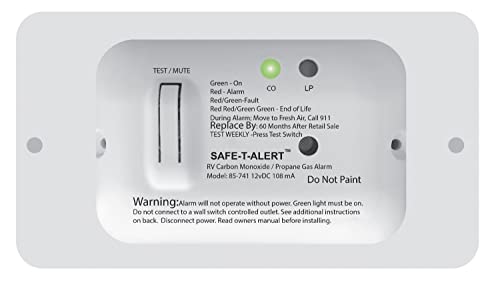
Safe-T-Alert 85 Series CO/Propane Gas Alarm (85-741-WT) — Best Premium Dual Alarm
The 85 Series sits above the 35 Series in MTI’s dual-alarm range, aimed at newer coaches and owners who want the manufacturer’s current-generation combined unit in a white flush finish. It detects both carbon monoxide and propane on the RV’s 12V system. It suits buyers replacing a failed or expired premium alarm, fitting out a newer RV, or standardising on the top dual unit rather than the mid-tier one.
Strengths
- Current-generation dual detection from the category’s standard brand, covering both RV gas hazards in one unit.
- White finish suits the light interiors of most modern RVs better than the brown 35 Series listing.
- Hardwired 12V monitoring with no batteries to manage — always on watch when the coach system is live.
Trade-offs
- Premium tier: it costs more than the 35 Series for buyers whose needs the mid-tier dual already meets.
- Combined-unit compromise applies here too — one location serves two gases with different behaviours.
- Confirm the cut-out dimensions against your existing opening; series changes can alter housings.
| Specification | Detail |
|---|---|
| Power | 12V hardwired (per API listing title) |
| Gases detected | Carbon monoxide and propane (per API listing title) |
| Colour | White (per API listing title) |
| Series | Safe-T-Alert 85 Series, model 85-741-WT |
Choosing between the 85 and 35 Series is mostly about the vehicle in front of you. Newer RVs increasingly ship with higher-series dual alarms, and replacing like with like preserves the factory cut-out, the wiring expectations and the interior finish. The 85 Series in white is the natural citizen of a modern light-toned coach, where the brown 35 would look like a period piece.
Functionally the brief is the same dual coverage — propane low, CO throughout the cabin air — delivered by the current design in the range. For owners who keep an RV for a decade, buying the current series also makes the next replacement cycle simpler, because parts and equivalents stay current longer.
If your existing unit is a 35 Series and it serves you, there is no urgent reason to climb the range early; replace at end of life. If you are choosing fresh for a newer RV, the 85 is the dual alarm we would start with.
Best for: newer RVs and owners replacing a premium factory dual alarm / Not suited for: budget-focused replacements where the 35 Series covers the same brief
Check the current price on Amazon

4-in-1 RV Gas Detector (Hardwired 12V DC) — Best Modern Multi-Function
Alongside the long-established Safe T Alert range, a newer generation of hardwired 12V detectors has arrived for RVs, and this 4-in-1 unit is representative: wired into the vehicle’s 12V DC system and marketed across motorhomes, travel trailers, motor coaches and truck campers. It suits owners who want a modern multi-function detector, are comfortable choosing beyond the legacy brand, and will verify the exact gases and functions on the listing before fitting.
Strengths
- Multi-function design aims to cover more than one hazard in a single hardwired unit.
- Hardwired 12V DC fitment matches how RVs are actually wired — no battery routine to maintain.
- Broad stated vehicle fitment across motorhomes, trailers, coaches and truck campers.
Trade-offs
- ‘4-in-1’ is a headline, not a specification: confirm precisely which gases and functions the listing documents before relying on it for a given hazard.
- Newer brands lack MTI’s decades-long RV track record and OEM presence; documentation quality varies.
- Bracket and cut-out compatibility is model-specific — measure your space rather than assuming a standard fit.
| Specification | Detail |
|---|---|
| Power | Hardwired 12V DC (per API listing title) |
| Format | 4-in-1 RV gas detector (per API listing title) |
| Stated fitment | Motorhome, travel trailer, motor coach, truck camper (per API listing title) |
We include this pick with an explicit instruction: read its listing like an engineer. Multi-function detectors can be genuinely convenient — one wired unit watching several hazards — but the value lives entirely in the documented detail: which gases, what alarm behaviour, what lifespan, what mounting. The listing title establishes the format and the hardwired 12V brief; the full page must establish the rest before this unit earns a wall in your RV.
For the right buyer, that homework is worth it. Modern multi-function units often add displays and clearer status indication than the legacy alarms, and in a truck camper or smaller trailer where wall space is precious, consolidation has real value. The hardwired 12V design is correct for the application — this is not a battery gadget pretending to be an RV alarm.
Our placement of it as the modern alternative, below the established dual units, reflects evidence rather than snobbery: gas alarms are life-safety devices, and a track record is a feature. If the documentation satisfies you, it is a legitimate contemporary choice.
Best for: owners who want a modern multi-function hardwired detector and will verify its documented gases carefully / Not suited for: buyers who prefer the proven OEM-standard brand without homework
Check the current price on Amazon

Leakbee RV Gas Detector R501 (Hardwired 12V DC) — Best Mounting Flexibility
Fitment is the quiet killer of RV upgrades: the alarm you bought does not match the hole the old one left. Leakbee’s R501 attacks that problem directly by shipping with three different brackets, so the hardwired 12V detector can be adapted to the mounting situation your RV actually presents. It suits owners replacing an alarm whose cut-out matches nothing current, and converters fitting a detector into a non-standard interior.
Strengths
- Three included brackets give genuine mounting flexibility — the standout practical feature in this roundup.
- Hardwired 12V DC design suits permanent RV installation rather than battery-powered temporary monitoring.
- Aimed squarely at the replacement market, where fit problems are the norm rather than the exception.
Trade-offs
- As with all newer-brand detectors, verify the documented gases, alarm behaviour and service life on the full listing before fitting.
- Bracket variety solves mounting, not cut-out cosmetics — a much larger old opening may still need a trim solution.
- Brand track record is shorter than MTI’s; factor that into a life-safety purchase decision.
| Specification | Detail |
|---|---|
| Power | Hardwired 12V DC (per API listing title) |
| Mounting | Supplied with 3 different brackets (per API listing title) |
| Model | Leakbee R501 (per API listing title) |
Anyone who has replaced an RV alarm knows the scene: old unit out, new unit in hand, and a hole that is almost — but not quite — the right size. Brackets that adapt the detector to the space turn that afternoon around, and they are why the R501 earns a badge in a field dominated by one brand. Practical fitment innovation is still innovation.
The rest of the brief follows the modern pattern: hardwired 12V power for permanent monitoring in the RV environment. As with the 4-in-1 pick above, our advice is to verify the documented detection scope and lifespan on the listing and to test the installed unit as its manual directs. A life-safety device earns trust through documentation and testing, whatever name is on the front.
Choose the R501 when your constraint is physical — an odd cut-out, a conversion interior, a mounting position nothing standard fits. Choose the Safe T Alert models when your constraint is provenance. Both are rational decisions made with eyes open.
Best for: replacements and conversions where standard alarm housings do not fit the space / Not suited for: buyers who want the longest-established RV safety brand
Check the current price on Amazon
Comparison Table
| Pick | Badge | Key spec | Best for |
|---|---|---|---|
| Safe T Alert 30 Series Classic LP Gas Alarm (30-442-P-BL) | Best Overall | 12V flush-mount dedicated LP alarm, OEM-standard series | RV and camper owners replacing or fitting a dedicated 12V propane alarm the factory way |
| Safe T Alert 20 Series Mini LP Gas Alarm (20-441-P-WT) | Best Compact / Surface Mount | 12V surface-mount mini LP alarm, white | camper vans, boats and retrofits where surface mounting is the practical option |
| Safe-T-Alert 35 Series Dual LP/CO Alarm (35-742-BR) | Best Dual LP + CO Protection | 12V flush-mount dual propane + CO alarm | RVs with a single alarm position, and owners replacing an existing dual LP/CO unit |
| Safe-T-Alert 85 Series CO/Propane Gas Alarm (85-741-WT) | Best Premium Dual Alarm | 12V dual CO + propane alarm, 85 Series, white | newer RVs and owners replacing a premium factory dual alarm |
| 4-in-1 RV Gas Detector (Hardwired 12V DC) | Best Modern Multi-Function | Hardwired 12V DC multi-function RV gas detector | owners who want a modern multi-function hardwired detector and will verify its documented gases carefully |
| Leakbee RV Gas Detector R501 (Hardwired 12V DC) | Best Mounting Flexibility | Hardwired 12V detector with 3 mounting brackets included | replacements and conversions where standard alarm housings do not fit the space |
The table reduces to two decisions: propane-only or dual-gas coverage, and flush or surface mounting. Answer those two questions for your RV and the correct row usually selects itself; the remaining choice is between the established brand and the modern alternatives.
Note the shape of the range: four of the six picks come from one manufacturer, which is unusual in our guides and reflects this category’s reality — a single specialist brand supplies most of the RV industry, and its series numbers (20, 30, 35, 85) describe a genuine ladder of format and function rather than marketing trim levels. The two alternatives earn their rows on documented practical merits, and their reviews carry the verification homework that a life-safety purchase from a newer brand deserves.
How to Choose the Best 12 Volt Propane Gas Alarm for Your RV
Decide the gas coverage first. A dedicated propane alarm (30 Series, 20 Series Mini) does one job in the ideal low position. A dual LP/CO alarm (35 Series, 85 Series, and the multi-function alternatives) covers carbon monoxide from the same unit — valuable when your RV has one alarm position or no CO alarm at all. If you already have a maintained, in-date CO alarm, a dedicated propane unit is a clean choice; if you do not, dual coverage closes two gaps with one installation.
Match the mounting to your wall. Flush-mount alarms need a cut-out, which most factory-built RVs already have where the old alarm sits — measure it before ordering. Surface-mount alarms (the 20 Series Mini) fit anywhere a low wall space exists and are the default for vans and conversions. Bracketed alternatives like the Leakbee exist for the awkward middle cases. Photograph and measure your existing installation before you shop; five minutes with a tape measure prevents the classic wrong-housing return.
Respect service life. RV gas alarms do not last forever: sensors age, and manufacturers state a service life after which the unit must be replaced regardless of whether it still responds to its test button. When you install the new alarm, write the replacement date on your maintenance list the same day. When you buy a used RV, check the existing alarm’s date as part of your first-weekend inspection — an expired alarm is one of the most common inherited defects in the used market.
Buy the provenance you are comfortable sleeping behind. These devices guard sleeping people. The established OEM brand costs what it costs for a reason; the modern alternatives compete on features and fitment and ask you to verify their documentation. Either can be the right purchase — what is never right is an undocumented no-name detector bought on price alone for a life-safety role.
How to Install and Test a 12V Propane Alarm
- Isolate the power first. Disconnect the RV’s 12V supply (and shore power) before touching alarm wiring. You will be working on a permanently live circuit by design, so make it temporarily dead by intention.
- Remove the old unit and note the wiring. Photograph the connections before disconnecting. Most RV alarms wire with simple polarity-sensitive leads — the photograph is your wiring diagram.
- Mount low and unobstructed. Propane sinks, so the alarm belongs near floor level, away from bedding, curtains and stored items that could muffle it, and not directly beside a door where draughts dilute leaks before they are sensed. Follow the new unit’s own placement guidance where it differs.
- Connect, restore power and observe the start-up. Hardwired alarms typically run a warm-up or self-check sequence; let it complete and confirm the normal-status indication described in the manual.
- Test as the manufacturer directs. Use the test function and any sensor-test method the manual specifies. Never improvise a test with an unlit gas appliance — follow the documented method only.
- Record the replacement date. Note the install date and the manufacturer’s stated service life in your RV records. Set the reminder now, not when the end-of-life signal eventually sounds on a holiday.
Propane, carbon monoxide and smoke: three alarms, three different jobs
RV owners often blur the three detectors a well-kept vehicle carries, so it is worth separating them cleanly. A propane (LP) alarm senses unburned fuel gas leaking from the supply system — tanks, regulators, lines, appliance valves — and belongs low, because propane sinks and pools. A carbon monoxide alarm senses the exhaust product of incomplete combustion from furnaces, water heaters, ovens and generators; CO mixes evenly with air, so its placement follows breathing-zone logic rather than floor logic. A smoke alarm senses combustion particles from actual fires and belongs high, where smoke rises. No one of the three substitutes for another, and the dual LP/CO units in this guide exist because the first two share a 12V hardwired world and often a single factory alarm position.
The practical audit is simple: walk your RV and find one of each, in date, correctly placed. Most used RVs fail this audit on at least one count — an expired LP alarm is the most common failure, a missing CO alarm the second. The purchase that fixes your failed line is the right purchase, ahead of any other upgrade on the vehicle.
Looking after the wider gas system your alarm watches over
An alarm is the last line of defence, not the first. The habits in front of it are mundane and effective: have the propane system inspected periodically as your RV’s service schedule suggests, check flexible hoses and regulator age when you check the alarm date, keep the tank compartment and appliance vents unobstructed, and pay attention to the odourant added to propane — a persistent gas smell with the alarm silent is still a problem to solve, not a reassurance. When appliances are serviced or replaced, that is the moment to confirm the alarm is in date too, because the two maintenance cycles naturally belong together.
Storage matters as well. If the RV sits for months, decide deliberately whether the propane is isolated at the tank and whether the house battery — and therefore the hardwired alarm — stays maintained. An alarm disconnected by a flat, neglected house battery protects nobody; a battery maintainer on a stored RV keeps both the battery and its safety systems alive. These are the unglamorous routines that make the alarm on the wall a formality rather than a hope.
What to do if the alarm sounds
Treat every alarm as real until proven otherwise. The standard guidance for a propane alarm event: no flames, no switching electrical items on or off unnecessarily, ventilate if you can do so quickly and safely, turn off the propane supply at the tank if it is safe to reach, get everyone (including pets) out of the vehicle, and do not re-enter until the cause is found and cleared. If you smell gas strongly or anyone feels unwell, move well away and contact local emergency services or the site operator. Carbon monoxide symptoms — headache, dizziness, nausea — deserve the same seriousness even without any smell, because CO has none.
False alarms do happen — sensor age, cleaning sprays and other vapours near the sensor can trigger events — but ‘probably nothing’ is a conclusion you reach outside the vehicle after ventilating, not a reason to silence the alarm and go back to sleep. If an alarm repeatedly triggers without an identifiable cause, that is itself diagnostic information: the unit may be at end of life, and replacement is the correct response.
Buying for a boat, cabin or workshop instead of an RV
Although this guide is written around RVs — the natural home of the hardwired 12V propane alarm — the same units serve anywhere a 12V system and propane appliances coexist: boat cabins with gas galleys, off-grid cabins on a solar 12V system, and workshops or garages with propane heating fed from a battery-backed supply. The selection logic travels with them: dedicated propane detection mounted low, dual coverage where combustion appliances share the air, and formats matched to the wall you actually have. The surface-mount Mini and the bracketed Leakbee are often the practical picks in these settings, where factory cut-outs do not exist.
What does not travel is any assumption about standards or inspection regimes, which differ between road vehicles, marine craft and buildings. If your installation falls under a specific code or survey — a boat survey, an insurance requirement, a rental inspection — confirm the detector requirement with that authority and treat this guide as product guidance, not compliance advice.
Common Buying Mistakes
- Leaving an expired alarm in place. An out-of-date alarm that still beeps on test is not protection; it is decoration. Replace at the manufacturer’s stated service life.
- Buying a battery-powered home gadget for an RV. RV propane alarms should be hardwired 12V, mounted low and always on. A countertop gadget is the wrong tool for this job.
- Ordering before measuring the cut-out. Flush and surface formats are not interchangeable wishes; measure the existing opening and order the format that fits it.
- Covering propane and forgetting CO (or the reverse). Audit both hazards. A dual unit or a maintained pair of dedicated units — either is complete; one gas alone is not.
- Mounting high or behind obstructions. Propane pools at floor level. An alarm at eye level, or muffled behind bedding and gear, is an alarm in name only.
- Silencing repeat alarms instead of investigating. Repeat events mean a leak, a contaminant near the sensor, or an expiring sensor. All three answers require action, not the mute button.
Final Recommendation
For most RV owners, the Safe T Alert 30 Series Classic is the propane alarm to buy: the dedicated, flush-mount, industry-standard answer. If you need CO coverage in the same unit, choose between the 35 Series Dual and the current-generation 85 Series by your RV’s age and finish. Van converters and surface-mount retrofits should take the 20 Series Mini, and awkward fitments justify the bracketed Leakbee or the multi-function alternative — with the listing-verification homework done. Whichever you fit, mount it low, test it as directed, and write the replacement date down. That discipline, more than any model choice, is what a good alarm purchase actually buys.
Related guides in this series: Best 12 Volt Power Tools · Best 12 Volt Pump For Inflating Inflatables · Best 12 Volt Projector · Best 12 Volt Power Wheels
Frequently Asked Questions
Why does a propane alarm need to be 12 volt and hardwired?
Because an RV’s gas risk is continuous, including when you are asleep and when the vehicle is in storage with appliances connected. A hardwired 12V alarm is powered by the house system whenever it is live, needs no battery changes, and is permanently mounted in the low position propane detection requires. It is simply the correct architecture for the vehicle, which is why RV builders fit them as original equipment.
How long does an RV propane alarm last?
Manufacturers state a finite service life for these alarms — sensors degrade with age regardless of use — after which the unit must be replaced even if it still passes its test button. The exact period is in your model’s documentation; check it when you buy, note the date when you install, and treat an inherited alarm in a used RV as guilty until its date proves it innocent.
Where should a propane alarm be mounted?
Low — propane is heavier than air and collects at floor level — in the living space it protects, unobstructed by bedding, curtains or stored gear, and following the specific placement guidance in the unit’s manual. This is also why flush and surface formats both mount near the floor in RVs rather than on ceilings like smoke alarms.
Do I need a separate carbon monoxide alarm as well?
You need CO coverage from somewhere: either a dual LP/CO alarm like the 35 or 85 Series in this guide, or a dedicated CO alarm maintained in date alongside your propane alarm. Furnaces, water heaters and generators all produce CO, and unlike propane it carries no warning smell. Audit both hazards whenever you replace either alarm.
My alarm keeps going off with no leak I can find. What should I do?
First, treat each event as real: ventilate, check for gas smells and appliance issues, and follow the response steps in this guide. If events repeat with no cause found, common explanations are an ageing sensor at end of life, or vapours from cleaning products and aerosols stored or used near the sensor. Persistent unexplained alarms are a reason to replace the unit, not to disconnect it.
Does a propane alarm detect natural gas or other gases?
A propane (LP) alarm is calibrated for LP gas, and that is the only detection you should rely on it for. Natural gas (methane) behaves oppositely — it rises rather than pools — and belongs to different detectors in different positions. The dual units in this guide add carbon monoxide, which their listings state explicitly. If a listing does not name a gas, assume the alarm does not detect it, and buy the detector that names your hazard.
Can I replace my old RV alarm with a different brand?
Yes, provided the replacement matches the job: 12V hardwired, the gases you need covered, and a mounting format that fits your cut-out or wall. Cross-brand replacements are routine in the RV world — the bracketed Leakbee in this guide exists precisely for fitment mismatches — but measure first, and keep the old unit until the new one is installed and tested.


