Disclosure: airfryerkitchensupply.com is reader-supported. When you buy through links on our site, we may earn an affiliate commission at no extra cost to you.
Where to buy
Every pick for the best 12 volt power supply in this guide is sold through Amazon, where listings show live availability, delivery options and the current price for the exact configuration you choose. Start with our top pick, the ALITOVE AC to DC Converter 10A — check price on Amazon — and compare it against the AstroAI AC to DC Converter 10A — check price on Amazon — before you decide. Prices and stock change often, so we never print a fixed price here; the listing you open always shows the live figure.
The best 12 volt power supply depends entirely on what you intend to feed, because ’12 volt power supply’ is one of the broadest phrases in electrical shopping. It covers wall adapters that run a car fridge in your garage, sealed bricks that power LED lighting and CCTV, and open-frame switching supplies that carry an RV’s whole 12V system. This guide sorts the category by job first and product second, so you buy the format your load actually needs.
Every pick here was verified through Amazon’s catalog, and every specification quoted — amps, watts, connector types, named loads — comes from the manufacturer’s own listing. That discipline matters in a category where anonymous supplies routinely print optimistic ratings; the brands below at least stake their names on their numbers, and one pick carries an independent ETL listing.
Two ideas will carry you through the whole guide. The first is headroom: a supply’s printed amps are a ceiling for brief loads, while continuous loads should cruise at roughly two-thirds of the rating. The second is connectors: socket, barrel and terminal outputs serve different devices, and no adapter chain fully fixes buying the wrong format. Get those two right and the specific model almost chooses itself.
What this guide does not cover is laboratory bench supplies with adjustable voltage and current limiting — a different instrument class, discussed honestly in our prototype-focused companion guide. Here, the subject is the fixed 12V rail: the hardest-working voltage in vehicles, RVs, lighting and small systems.
A word on what ‘best’ can mean here: there is no single best supply, only the best supply for a stated load, connector and duty. That is why this guide is organized as six role-winners rather than a podium. If you read only one section beyond the picks, make it the headroom rule — it prevents more burned-out supplies and disappointed purchases than any brand comparison ever published.
In this guide
Quick Picks
Short on time? These are the six 12 volt power supply options that survived our checks, each with a clear job to do:
- ALITOVE AC to DC Converter 10A — Best Overall: A 10A / 120W converter with a cigarette-lighter socket — runs car vacuums, inflators, fridges and coolers from a wall outlet. Check price on Amazon
- AstroAI AC to DC Converter 10A — Best Long-Cord Socket Supply: Another honest 10A / 120W socket converter, distinguished by its 7.78 ft cord — reach matters in garages and campsites. Check price on Amazon
- ALITOVE 12V 15A Power Supply Brick — Best Fixed-Rail Brick: A regulated 15A / 180W brick for LED strips, CCTV and security systems — the installed-load specialist. Check price on Amazon
- ALITOVE 12V 15A Barrel Supply — Best for Barrel-Plug Devices: A 15A / 180W supply with the common 5.5×2.5mm barrel plug — the listing names LED lights, printers, fans, pumps and cameras. Check price on Amazon
- Yaheeda 50A Switching Supply — Best High-Current Supply: A 12V 600W / 50A switch-mode transformer for RV, pump, LED and monitor loads — the heavy lifter of this guide. Check price on Amazon
- Wagan EL9903 5A Adapter — Best Light-Duty Listed Adapter: A 5A / 60W socket adapter, ETL listed, sized for a single car fridge or similar light accessory. Check price on Amazon
How These Picks Were Chosen
Candidates were confirmed model by model through the Creators API before inclusion; unverifiable supplies and supplies whose listings contradicted themselves were cut. Each surviving pick had to own a distinct format or capacity role — socket converter, long-cord converter, sealed brick, barrel supply, high-current terminal supply, or certified light-duty adapter.
Scoring weighted honest specification first: a named load list, a coherent amp/watt pairing, and any independent safety listing. Format fit came next — the right connector for the stated job — followed by the practicalities of cords, ventilation and installation that decide whether a supply gets used or shelved.
We deliberately excluded adjustable bench supplies from this guide rather than padding it with instruments most readers do not need, and we excluded battery chargers with incidental supply modes, which get their own treatment in the radio and prototype companion guides. This list is fixed-rail supplies, chosen on merit.
We also checked each pick’s listing for the small print that reveals a maker’s honesty: whether watts and amps agree with each other at 12 volts, whether intended loads are named specifically or waved at generally, and whether the connector in the photograph matches the connector in the text. Supplies failed on arithmetic more often than on ambition. One more screen deserves recording: we favored supplies whose makers state an input range and a load list over supplies whose listings are a single wattage and a photograph. A maker who tells you what a supply is for has usually built it for that; a maker who will not say is asking you to conduct the experiment at your expense.
The 6 Best 12 Volt Power Supplies
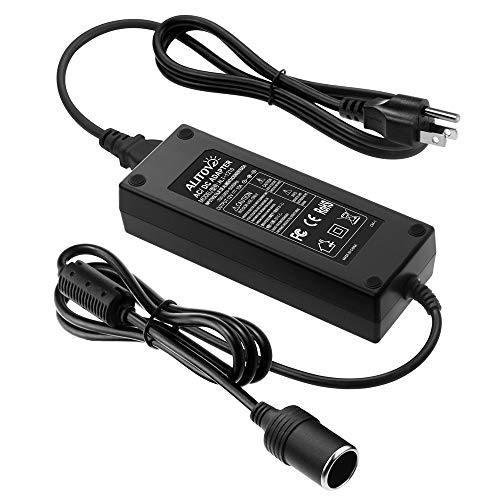
ALITOVE AC to DC Converter 10A — Best Overall
Most people searching for a 12 volt power supply want one practical thing: to run a 12V vehicle accessory — a car fridge, an inflator, a vacuum, a cooler — from a household wall outlet. The ALITOVE 10A converter is built exactly for that job, delivering 10 amps (120W) to a standard cigarette-lighter socket, which is the plug nearly every vehicle accessory already has.
Ten amps is the honest middle of this market. It covers the great majority of single accessories with headroom, without the size, fan noise and cost of industrial supplies. The listing names the intended loads plainly — vacuum cleaner, inflator, refrigerator, cooler — and that plainness is a virtue: this is a tool with a defined job, not a laboratory instrument pretending to be one.
Use it for pre-cooling the car fridge before a trip, inflating tires in the garage without idling the engine, or running a cooler at a campsite with hookups. Respect its ceiling — add up your loads, stay comfortably under 10A continuous, and let it do the quiet, boring work it was designed for.
A practical pattern this converter enables deserves naming: the garage fridge rotation. Pre-cool the car fridge on this supply the night before a trip, load it cold in the morning, and the vehicle’s battery starts the day full instead of half-spent on cooling. Road-trippers who adopt the pattern stop arriving at campsites with warm food and a tired battery — a small workflow win bought entirely with a wall outlet.
Renters and dorm dwellers are this converter’s sleeper audience: no installation, no landlord conversations, just vehicle gear working from a wall outlet in a small space. When the living situation changes, the supply moves in a coat pocket — portability is a specification too, and this class owns it.
See the ALITOVE AC to DC Converter 10A — view it on Amazon — for the current configuration options and delivery details.
Strengths
- 10A / 120W covers most single 12V accessories with headroom
- Cigarette-lighter socket matches the plugs accessories already have
- Purpose-built for fridges, inflators, vacuums and coolers
Trade-offs
- Socket output only — barrel-plug devices need an adapter
- Not a variable bench supply for electronics work
- Continuous loads should stay below the 10A ceiling with margin
| Output | 12V DC, 10A / 120W (listing) |
| Output connector | Cigarette-lighter socket |
| Input | 110V AC (listing) |
Best for: Running one vehicle accessory from a wall outlet / Not suited for: Electronics bench work needing adjustable voltage

AstroAI AC to DC Converter 10A — Best Long-Cord Socket Supply
The AstroAI converter matches the ALITOVE’s core specification — 10A, 120W, cigarette-lighter socket, aimed at inflators and car refrigerators — and differentiates on a detail that sounds trivial until you are kneeling in a garage: cord length. The listing’s 7.78 ft lead means the supply can sit on a shelf or the floor while the accessory works at the vehicle, instead of dangling from the outlet.
That reach also suits the pre-cool routine: fridge on the garage floor by the outlet, cord long enough to keep the converter’s vents clear, load the fridge cold in the morning. Small ergonomic wins are what separate supplies that get used weekly from supplies that live in a drawer.
Choose between this and the ALITOVE on availability and cord needs rather than specification — they are honest equivalents. Either way, you are buying the same sensible capability: one accessory at a time, comfortably inside a 10A envelope, with the vehicle’s own battery left out of the job entirely.
The AstroAI’s long cord also solves the rental-and-visitor case: inflating a guest’s tires, running a cooler on a patio, powering an accessory at a workbench far from the vehicle. Socket converters are the diplomats of the 12V world — they let vehicle gear visit household power anywhere an outlet and seven feet of cord can reach.
See the AstroAI AC to DC Converter 10A — view it on Amazon — for the current configuration options and delivery details.
Strengths
- 10A / 120W socket output for inflators and car fridges
- 7.78 ft cord gives real working reach
- Frees the vehicle battery from accessory duty
Trade-offs
- Same 10A ceiling as any supply in this class
- Socket-only output
- Not intended for permanent installed wiring
| Output | 12V DC, 10A / 120W (listing) |
| Cord length (listing) | 7.78 ft |
| Output connector | Cigarette-lighter socket |
Best for: Garage and campsite use where reach matters / Not suited for: Fixed installations or multi-device loads over 10A

ALITOVE 12V 15A Power Supply Brick — Best Fixed-Rail Brick
Some 12V loads are not accessories you plug in occasionally; they are installations — LED strip lighting, CCTV cameras, security systems — that run for hours or permanently. The ALITOVE 15A brick is the supply for that world: a regulated switching adapter delivering up to 15A (180W) in the sealed-brick format that tucks behind furniture or inside a cabinet.
The listing’s own framing is instructive: it describes the unit as a 15A supply usable at 10A or 8A loads, which is an honest nod to the derating rule this whole guide repeats — continuous loads live happier at two-thirds of a supply’s headline rating. For a long LED run or a multi-camera system, that headroom is the difference between a cool, silent supply and a hot, short-lived one.
Pick the brick when your load has a barrel or terminal input and a permanent home; pick a socket converter when your load is a vehicle accessory. Confusing the two formats is the most common buying error in this category, and it is entirely avoidable by looking at your device’s plug before you shop.
For LED work specifically, remember that strip length is a current budget: every metre of strip draws its share, and a long run fed from one end can dim visibly at the far end as voltage drops along the strip itself. A 15A brick gives you the capacity to feed long runs from the middle or both ends — installation technique the supply’s headroom makes possible, and the difference between a lighting project that looks designed and one that looks tired.
Security-system builders should exploit this brick’s headroom pattern deliberately: cameras draw more at night, when their infrared lights switch on, so size the system for its night load, not its noon load. A 15A brick behind a system whose daytime math says 8A is not waste — it is the difference between footage and a reboot loop at 2 a.m.
See the ALITOVE 12V 15A Power Supply Brick — view it on Amazon — for the current configuration options and delivery details.
Strengths
- Regulated 15A / 180W output for installed loads
- Brick format suits permanent LED and CCTV installs
- Listing honestly supports derated continuous use
Trade-offs
- No cigarette-lighter socket for vehicle accessories
- Fixed 12V rail — no adjustment for other voltages
- Brick still needs ventilation space in enclosed installs
| Output | 12V DC, 15A / 180W (listing) |
| Type | Regulated switching adapter |
| Named loads (listing) | LED strip, CCTV, security system |
Best for: LED lighting runs and CCTV/security installs / Not suited for: Plugging in car accessories with lighter plugs

ALITOVE 12V 15A Barrel Supply — Best for Barrel-Plug Devices
Connector discipline decides this category, and this ALITOVE variant is the one that ends in the barrel plug most 12V devices actually use: 5.5×2.5mm. The listing’s load list — LED light, printer, fan, pump, camera — reads like the inventory of a typical project shelf, which is exactly the point: one supply, many barrel-fed devices, 15A of shared headroom.
Barrel polarity and size are the two traps. The 5.5×2.5mm size is common but not universal (its 5.5×2.1mm cousin looks identical and fits loosely), and center-positive wiring is standard but should be confirmed against your device’s markings. The guide section below walks through both checks; do them before ordering and this supply becomes the simplest purchase in the roundup.
As with its brick sibling, treat 15A as a ceiling, not a cruising altitude. A fan, a pump and a light strip running together for hours should sum to comfortably less than the rating. Bought with that discipline, this is the most versatile fixed-rail supply here for device-style loads.
This barrel variant quietly serves the maker bench better than its lighting-first marketing suggests: fans, small pumps, 3D-printer-adjacent 12V gear and camera rigs all speak barrel. Keep one on the project shelf and the ‘which adapter runs this?’ question that stalls Saturday projects simply stops being asked.
A closing thought on this barrel supply’s place in the ecosystem of this guide: it is the pick most likely to be bought twice. One lives with the lighting, one migrates to the project shelf, and because the format and rating are identical, the household’s knowledge compounds instead of fragmenting. Standardizing on a good general supply is the quiet twin of standardizing on a tool platform.
See the ALITOVE 12V 15A Barrel Supply — view it on Amazon — for the current configuration options and delivery details.
Strengths
- 5.5×2.5mm barrel matches a wide range of 12V devices
- 15A / 180W headroom for multi-device project loads
- Listing explicitly names pumps, fans, printers and cameras
Trade-offs
- Barrel size must be confirmed — 2.1mm devices fit poorly
- No socket output for vehicle accessories
- Fixed rail only; no voltage adjustment
| Output | 12V DC, 15A / 180W (listing) |
| Connector (listing) | 5.5×2.5mm barrel |
| Named loads (listing) | LED, printer, fan, pump, camera |
Best for: Barrel-fed devices: fans, pumps, printers, cameras, LED / Not suited for: Devices with 2.1mm barrels or lighter-socket plugs

Yaheeda 50A Switching Supply — Best High-Current Supply
When the load list stops being ‘an accessory’ and starts being ‘a system’ — an RV’s 12V circuits on shore power, a serious pump, long LED runs, several devices at once — you leave converter territory and enter switching-supply territory. The Yaheeda’s 50A (600W) rating is five times the socket converters’ output, delivered through terminals in an open-frame format built to be installed, ventilated and left alone.
That format carries responsibilities the bricks do not: terminal wiring must be correctly gauged and tightened, the unit needs airflow, and mains terminals must be protected from casual contact. This is a supply for a deliberate install — an RV bay, a workshop wall, a lighting cabinet — not a kitchen counter. The guide’s installation section covers the discipline in full.
Inside that discipline, the value is obvious: one installed 50A rail can replace a drawer of small adapters and run loads no socket converter should attempt. If your honest continuous load is above about 12A, or your peak loads are spiky and motor-driven, this is the class to buy — once, correctly.
RV owners should read the Yaheeda as a battery-preservation device as much as a supply: running the house loads from shore power through a proper 50A rail means the house battery stops cycling for every light and pump, and batteries that stop cycling daily live years longer. The supply pays for itself in battery lifespan before any convenience is counted.
Workshop builders can treat the Yaheeda as the seed of a proper 12V bench: add a fused distribution block, a master switch and labeled branches, and every future 12V project in the building plugs into finished infrastructure instead of a new adapter. Infrastructure thinking, applied once, is the cheapest upgrade path in this entire guide series.
See the Yaheeda 50A Switching Supply — view it on Amazon — for the current configuration options and delivery details.
Strengths
- 50A / 600W — five times the socket converters’ output
- Terminal format suits RV and installed system wiring
- Listing names RV, pump, LED and monitor loads
Trade-offs
- Open-frame install demands wiring care and ventilation
- No plug-and-play socket or barrel convenience
- Massive overkill for a single small accessory
| Output | 12V DC, 50A / 600W (listing) |
| Type | Switching transformer, terminal output |
| Named loads (listing) | RV, pump, LED strip, LCD monitor |
Best for: RV systems, big pumps and multi-device installs / Not suited for: Casual countertop use or single small accessories

Wagan EL9903 5A Adapter — Best Light-Duty Listed Adapter
Not every job needs 10A, and the Wagan EL9903 is the honest light-duty option: 5A (60W) to a cigarette-lighter socket, ETL listed, from a brand that has sold vehicle power gear for decades. For its named job — a 12V car portable fridge — and for small inflators and single light accessories, it is correctly sized and reassuringly certified.
The ETL mark deserves emphasis in a category flooded with anonymous adapters. An independent listing means the design was tested against a safety standard by a recognized lab; it does not guarantee longevity, but it is a floor that no-name supplies do not offer. For a supply that may run unattended cooling a fridge overnight, that floor matters.
Respect the ceiling strictly: 5A is a small envelope, a fridge’s compressor startup can spike above its running draw, and stacking a second accessory is out of the question. If your load list is genuinely one light device, the Wagan is the tidy, certified answer; the moment a second device appears, step up to the 10A class.
The Wagan’s small envelope has one more legitimate kingdom: the always-on single device. A fridge in a garage, a cooler in a workshop, a single camera-class load that runs for months — a certified 5A supply sized exactly to one modest device is not under-buying, it is right-sizing, provided the device’s true draw (including its compressor starts) genuinely fits. Measure once, then let it run for years.
The Wagan also serves the test-before-you-commit role for fridge owners: borrow or buy the small certified supply first, learn your fridge’s true draw across a weekend — startup spikes included — and then size the permanent supply from evidence. A weekend of measurement prevents both the undersized mistake and the oversized shrug.
See the Wagan EL9903 5A Adapter — view it on Amazon — for the current configuration options and delivery details.
Strengths
- ETL listed — independently safety-tested design
- Correctly sized for a single car fridge or light accessory
- Established vehicle-power brand
Trade-offs
- 5A ceiling excludes most multi-device or pump loads
- Compressor startup spikes eat the small headroom
- Socket-only, like the other light converters
| Output | 12V DC, 5A / 60W (listing) |
| Certification (listing) | ETL listed |
| Output connector | Cigarette-lighter socket |
Best for: One car fridge or a single light accessory / Not suited for: Pumps at the 5A line or any multi-device load
Comparison Table
| Pick | Badge | Key spec | Best for |
|---|---|---|---|
| ALITOVE AC to DC Converter 10A | Best Overall | 12V 10A / 120W, socket output | Running one vehicle accessory from a wall outlet |
| AstroAI AC to DC Converter 10A | Best Long-Cord Socket Supply | 12V 10A / 120W, 7.78 ft cord | Garage and campsite use where reach matters |
| ALITOVE 12V 15A Power Supply Brick | Best Fixed-Rail Brick | 12V 15A / 180W regulated brick | LED lighting runs and CCTV/security installs |
| ALITOVE 12V 15A Barrel Supply | Best for Barrel-Plug Devices | 12V 15A / 180W, 5.5×2.5mm barrel | Barrel-fed devices: fans, pumps, printers, cameras, LED |
| Yaheeda 50A Switching Supply | Best High-Current Supply | 12V 50A / 600W terminal supply | RV systems, big pumps and multi-device installs |
| Wagan EL9903 5A Adapter | Best Light-Duty Listed Adapter | 12V 5A / 60W, ETL listed | One car fridge or a single light accessory |
Use the table to shortlist two candidates, then read their full reviews above. When you are ready, check the current price on Amazon for the top pick and compare delivery times across your shortlist.
How to Choose the Best 12 Volt Power Supply: Amps, Watts and Headroom
Convert everything to watts before you compare: watts equal volts times amps, so a 12V device drawing 5A consumes 60W, and a 10A supply offers 120W. List every device the supply must run simultaneously, sum their running watts, then add the startup behavior of anything with a motor or compressor, which can briefly draw two to three times its running figure.
Then apply the cruising rule: choose a supply whose rating is at least one and a half times your summed continuous load. A 6A continuous load belongs on a 10A supply, not an 8A one. Supplies run cooler, quieter and longer with that margin, and the price difference between classes is small compared with replacing a cooked supply — or a cooked device.
Socket, Barrel or Terminals: Matching the Supply to Your Device
Vehicle accessories — fridges, inflators, vacuums, coolers — almost universally use the cigarette-lighter plug, so they need a socket-output converter. Device-style loads — fans, pumps, printers, cameras, LED strips — usually arrive with a barrel plug or bare leads, served by barrel or terminal supplies. Installed systems with several loads belong on terminal-output switching supplies wired once and properly.
Adapters exist between formats, but every adapter adds resistance, a failure point and a place for heat. Use one temporarily if you must; buy the native format for anything that runs daily. And confirm barrel dimensions physically where you can — the 5.5×2.5mm and 5.5×2.1mm pair are the classic look-alike trap.
Switching vs Linear and the Question of Noise
Nearly every affordable 12V supply today is a switching design: efficient, light and cool-running, at the cost of some high-frequency electrical noise on the output. For motors, lights, fridges and pumps that noise is irrelevant. For audio and radio equipment it can matter, which is why the radio-focused companion guide treats supply-mode chargers and filtering in depth.
Linear supplies — heavier, hotter, cleaner — survive mostly in radio and lab niches. If your load is a pump or a light strip, do not pay the linear premium; if your load is a receiver that hums on a switching supply, no amount of switching-supply wattage will fix it. Match the technology to the load’s sensitivity, not to forum folklore.
Understanding Ripple, Regulation and Why Devices Care
Two invisible specifications separate supplies that devices love from supplies that devices tolerate. Regulation is how firmly the output holds 12V as load changes: a well-regulated supply delivers near-identical voltage to a camera drawing milliamps and a pump drawing amps, while a sloppy one sags under load and floats high without one. Ripple is the small AC waviness riding on the DC output of a switching supply — harmless to motors and heaters, audible in some audio gear, visible as banding in a few sensitive cameras.
For the loads in this guide — fridges, pumps, lights, fans, CCTV — regulation matters and ripple rarely does, which is why regulated switching supplies own the category. Save your ripple anxiety for the radio and audio benches, where the companion guides give it the full treatment it deserves there.
Running 12V Gear at Home: The Pre-Cool, the Workshop and the Storm Kit
The socket converters in this guide quietly enable a lifestyle: vehicle gear that works at home. The fridge pre-cools before trips. The inflator lives in the garage, not the trunk. The cooler keeps drinks cold at the garden party from a wall outlet. Each use is small; together they are why a 10A converter is among the highest-utility electrical purchases a vehicle-owning household can make.
Add one to the storm kit as well. When mains power exists but the car should stay fueled and closed, a converter runs 12V lights, fans and radios from the wall; when the car becomes the generator via its own battery, the same accessories transfer back. Power flexibility is a preparedness feature hiding inside a convenience product.
Power Supplies in the Wild: RVs, Boats and Off-Grid Edges
The terminal-supply pattern in this guide — a stiff 12V rail installed once — is the same architecture that runs RV house systems, boat cabins and off-grid sheds, where a supply (or its battery-charger cousin) maintains a battery that actually feeds the loads. If your fixed-rail project grows a battery, you have crossed into that architecture: keep the supply for shore or solar input duty, let the battery absorb surges and outages, and size each for its own job.
Marine and outdoor installs add corrosion and vibration to the discipline list: tinned wire, sealed connections, supplies mounted dry and ventilated. The components in this guide are indoor-bred; give them a dry cabinet and they will serve in wild places for years — expose them to the weather they were never built for and no brand’s rating will save them.
Safety and Installation Discipline for 12 Volt Supplies
A 12V supply is safe to touch but not safe to be careless with: at 15A or 50A, a short circuit delivers enough current to melt insulation and start fires without ever troubling a household breaker. Keep output wiring at or above the gauge the current demands, fuse installed circuits near the supply, and never let terminal-style supplies run with exposed mains connections reachable by hands, tools or pets.
Ventilation is the second discipline. Every supply in this guide converts some power to heat; bricks need air around them, open-frame units need the airflow their cases assume, and no supply belongs buried in insulation or sealed in an unventilated box. A supply that is too hot to hold comfortably is a supply telling you it is overloaded, under-ventilated, or failing — listen to it the first time.
How to Set Up a 12 Volt Power Supply Safely, Step by Step
Step 1: Verify the match on paper. Confirm your device wants 12V DC (not AC, not 24V), note its amp or watt draw, confirm the connector format and — for barrel plugs — the size and polarity. Sum simultaneous loads and check the total against two-thirds of the supply’s rating.
Step 2: Connect the load before the mains. Attach the device or wiring to the supply’s output first, double-check polarity, then plug the supply into the wall. For terminal supplies, tighten connections firmly, confirm no stray wire strands bridge the terminals, and protect the mains side before energizing.
Step 3: Test under observation. Run the full load for fifteen minutes while you stay nearby, then touch-test the supply and connectors for excessive heat and listen for buzzing or fan distress. Only after a calm test run should any supply graduate to unattended duty — and even then, installed supplies deserve a periodic glance on the same rhythm as your other household systems.
One refinement for installed supplies: label the output. A strip of tape naming the load and the date on each brick or terminal supply turns future troubleshooting — yours or the next owner’s — from archaeology into reading. Installed electrical gear outlives memories; write its story on its case. For permanent installs, photograph the finished wiring before the cabinet closes and keep the photo with the supply’s manual. The next person to service the system — often you, in three years, at midnight — inherits either a map or a mystery, and the difference was thirty seconds with a phone camera.
Common Buying Mistakes
Mistake 1: Buying to the exact amp figure. A supply run continuously at its printed maximum runs hot and dies young. Buy one class up and cruise at two-thirds.
Mistake 2: Ignoring the connector. A socket supply cannot natively feed a barrel device and vice versa. Check your device’s plug first; adapters are a workaround, not a plan.
Mistake 3: Forgetting startup surge. Motors and compressors briefly draw multiples of their running current. A supply that looks adequate on running watts can fold at every startup.
Mistake 4: Sealing a supply in an unventilated space. Heat is the tax every supply pays; give it air or you will pay in lifespan instead.
Mistake 5: Daisy-chaining splitters on a socket converter. One socket is one accessory’s worth of current path, however many plugs a splitter offers. Multi-device work belongs on brick or terminal supplies built for distribution.
Mistake 6: Mixing 12V and 24V gear on one supply because the plugs fit. Truck and industrial 24V devices exist in the same connector families. Read the device label every time — the supply cannot forgive a voltage error made at the plug.
Final Recommendation
For the most common job — one vehicle accessory on wall power — the ALITOVE 10A converter is the best 12 volt power supply to buy, with the AstroAI as its long-cord equal. Installed LED and CCTV loads belong on the ALITOVE 15A brick, barrel-fed devices on its barrel sibling, and genuinely big systems on the Yaheeda 50A. The Wagan remains the certified light-duty choice for a single fridge.
Decide by load list and connector, not by brand loyalty: write down what must run, sum the watts with headroom, match the plug, and the right supply from this list will be obvious. That small discipline is the whole secret of this category.
Still undecided between two formats? Buy for the load you have this month, not the system you imagine next year — but buy one class of headroom above it. Formats can be added later; the headroom habit, once learned, protects every supply you will ever own. One more buyer’s shortcut is worth recording for the undecided: if you cannot yet name your load precisely, buy the 10A socket converter first. It is the category’s universal donor — useful with the widest range of borrowed, rented and future accessories — and the knowledge it gives you about your real loads will make the second, specialized purchase obvious. In a category defined by formats, start with the format that teaches. And when the second purchase arrives, keep the converter anyway: households that own one socket converter find a use for it in every season — the borrowed cooler, the guest’s inflator, the fridge’s next pre-cool. Some tools are bought for a job and stay for a lifestyle; this is the category’s clearest example. Buy it once, label it, and let it quietly become the most borrowed object you own. Start there, and every later purchase gets easier, better informed and cheaper to own.
Ready to decide? Start with the top pick — check the current price on Amazon — and work down the shortlist from there.
Related guides on this site: Best 12 Volt Power Pack Best 12 Volt Power Supply For 5 Amp Pump Best 12 Volt Power Supply For Cb Radio Best 12 Volt Power Supply For Prototype Best 12 Volt Power Inverter
Frequently Asked Questions
How many amps should my 12 volt power supply have?
Add up the running draw of everything that will run at once, allow for motor or compressor startup surges, then choose a supply rated at least one and a half times that continuous total. A single car fridge typically sits happily on a 5A to 10A supply; multi-device and pump loads usually belong in the 15A class or above.
Can I run a 12V car fridge from a wall outlet?
Yes — that is exactly what socket-output converters like the ALITOVE and AstroAI 10A units are for, and pre-cooling a fridge on wall power before loading the car is one of the best uses in this guide. The Wagan 5A covers a single small fridge on its own. Just confirm the fridge’s draw against the supply’s rating first.
What is the difference between a power supply and a battery charger?
A power supply delivers a steady 12V rail to run devices directly; a charger manages a battery through staged charging over hours. Some chargers offer a supply mode and some supplies can float a battery in a pinch, but the designs optimize for different jobs. Running devices is supply work.
Why does my supply get warm, and when should I worry?
All supplies convert some power to heat, so warmth is normal; too hot to hold comfortably is not. Excess heat means overload, blocked ventilation or a failing unit. Reduce the load, clear the vents, and if the heat persists at modest loads, retire the supply.
Can one power supply run several devices at once?
Yes, within its rating and with headroom. Sum the simultaneous draws, respect startup surges, and distribute barrel or terminal loads with proper wiring and fusing. Socket converters are effectively single-accessory devices, since they offer one socket; multi-device work belongs on brick or terminal supplies.
Is a switching power supply safe for electronics?
For most devices — lights, motors, pumps, cameras, fridges — yes, completely. Sensitive radio and audio gear can pick up switching noise, which is a performance issue rather than a safety one; that use case is treated in depth in the CB radio companion guide. Standard voltage regulation, not exotic filtering, is what ordinary electronics need.
Can I leave a 12 volt power supply plugged in all the time?
Quality regulated supplies are designed for continuous duty within their ratings, and installed LED and CCTV supplies do exactly that for years. The disciplines are ventilation, keeping continuous loads well under the ceiling, and the occasional touch-test. Anonymous ultra-cheap supplies are the exception — give those supervised duty only, or better, buy from the verified class in this guide.
Will a 12V power supply charge my car battery?
No — running devices and charging batteries are different jobs with different electronics, as the general guide explains. A supply connected to a battery may hold it near float or may fight the battery’s own voltage unpredictably, depending on design. Use a charger to charge; several chargers with genuine supply modes appear in the radio and prototype companion guides for benches that need both.
Can a 12V power supply run from a generator or inverter outlet?
Yes — a regulated supply simply wants clean-ish mains within its input range, and generator or inverter power qualifies in normal cases. The caution is at the extremes: very rough generator output during load swings can stress small supplies, so let the generator stabilize before connecting, exactly as you would with any electronics you value.
What does ‘regulated’ mean on a power supply, and do I need it?
Regulated means the supply actively holds its output at 12V as the load changes, instead of letting voltage wander with demand. For essentially every modern device — electronics, cameras, fridges with control boards, LED systems — yes, you need it, and every pick in this guide is a regulated design. Unregulated adapters belong to a simpler era of purely resistive loads.


