Disclosure: airfryerkitchensupply.com is reader-supported. When you buy through links on our site, we may earn an affiliate commission at no extra cost to you.
Where to buy
Every pick for the best 12 volt power pack in this guide is sold through Amazon, where listings show live availability, delivery options and the current price for the exact configuration you choose. Start with our top pick, the NOCO Boost GB40 — check price on Amazon — and compare it against the GOOLOO GP2000 — check price on Amazon — before you decide. Prices and stock change often, so we never print a fixed price here; the listing you open always shows the live figure.
If you are shopping for the best 12 volt power pack, you are really shopping for insurance: a charged box that turns a flat battery from a ruined day into a five-minute delay. This guide takes the singular seriously — one pack, chosen well, matched to your vehicle — and the six picks below are the ones that survived verification through Amazon’s catalog, each with a distinct job rather than six versions of the same claim.
The first decision is chemistry. Modern lithium packs are light, small and hold charge well in storage, which is why five of our six picks use them; the sixth, a traditional AGM workshop pack, survives because repeated professional jump work is still a job lead-acid does with a stubbornness lithium has not matched. Neither is universally better — the right answer depends on whether your pack lives in a glovebox or a garage.
The second decision is honest sizing. Headline amps are the most abused number in this category, so this guide anchors on the engine coverage the manufacturer itself claims in its listing — litres of gas and diesel — and treats the amp figure as supporting evidence. A pack rated well above your engine is not wasted money if you run a diesel or work in deep cold; a pack rated below it is wasted money at any price.
Finally, remember what a power pack is for. It is not a battery charger, not a replacement for a failing battery, and not a license to ignore a charging-system fault. It is a bridge across one bad start. Choose it for the vehicle and the climate you actually have, keep it charged, and it will quietly do its job for years.
One more scope note before the picks: this guide covers engine-starting power packs. The other species sharing the name — USB power banks for phones and large AC power stations for camping — solve different problems, and a pack chosen for the wrong species disappoints in both directions. If your emergency is a dead phone, buy a phone bank; if it is a dead starter motor’s battery, you are in the right guide.
In this guide
Quick Picks
Short on time? These are the six 12 volt power pack options that survived our checks, each with a clear job to do:
- NOCO Boost GB40 — Best Overall: The 1000A lithium pack most drivers should buy first — rated for engines up to 6.0L gas and 3.0L diesel, with spark-proof, reverse-polarity-protected clamps. Check price on Amazon
- GOOLOO GP2000 — Best Value Power: A 2000A pack rated for 8L gas and 6L diesel at just 1.2 lb — the most starting power per pound and per dollar in this guide. Check price on Amazon
- NOCO Boost GB20 — Best Compact for Small Cars: NOCO’s 500A entry pack — the right size for small cars, motorcycles and powersports, and small enough for a glovebox. Check price on Amazon
- NOCO Boost GBX75 — Best for Trucks and Diesel: A 2500A GBX-series pack rated to 8.5L gas and 6.5L diesel, with fast USB-C charging in both directions. Check price on Amazon
- Clore Jump-N-Carry JNC660 — Best Workshop Pack: The 1700 peak amp AGM professional pack that repair shops have trusted for years — heavy, simple and built for repeated daily jumps. Check price on Amazon
- GOOLOO A3 — Best with Air Compressor: A 3000A jump pack with a built-in 150 PSI auto-off tire inflator — the two roadside failures, answered by one box. Check price on Amazon
How These Picks Were Chosen
Each candidate was confirmed model by model through the Creators API before inclusion, so the amp ratings and engine-coverage figures quoted here are the manufacturer’s own current listing claims, not marketplace folklore. Packs we could not verify, and packs whose claims collapsed under their own contradictions, were cut.
Scoring weighted real starting ability first: coverage headroom over the target engine class, clamp and cable quality, and the protection suite that makes roadside use safe for a non-expert. Power-bank usefulness, light output and recharge speed scored next, because a pack that is useful weekly is a pack that stays charged.
We also scored ownership honestly. A pack that needs an obscure charger, hides its state of charge, or punishes a forgotten top-up with permanent damage lost marks. The best pack is the one that is ready on the day — design either encourages that habit or undermines it.
Finally, we required every lithium pick to carry explicit spark-proof and reverse-polarity protection in its listing. In 2026 that should be table stakes, yet a surprising share of the marketplace still treats protection as a premium feature. On a device whose entire purpose is use by a stressed non-expert, in the dark, we treated its absence as disqualifying. We also weighed cable and clamp quality as a first-class criterion rather than a detail: a pack’s rated current must survive the journey through its own leads, and flimsy clamps with a few teeth of contact waste the rating you paid for. Every pick here delivers its claim through hardware we would trust with our own battery posts.
The 6 Best 12 Volt Power Packs

NOCO Boost GB40 — Best Overall
The GB40 is the answer for the driver who wants one pack, bought once, that simply lives in the car and works on the bad morning. Its 1000A rating covers the engines most households actually run — the listing rates it for up to 6.0L gas and 3.0L diesel — which spans family sedans, crossovers and most half-ton pickups without paying for capacity you will never call on.
What lifts it above cheaper packs with bigger numbers on the box is the protection layer. The clamps are spark-proof and reverse-polarity protected, so the two mistakes a stressed driver makes at 6 a.m. in a dark parking lot — touching the clamps together, or landing them on the wrong terminals — become non-events instead of a damaged pack or a damaged car.
As a power pack rather than a pure jump starter, it also moonlights as a USB power bank for phones and a work light source at the roadside. That dual role is exactly what the singular in this keyword implies: one box, several jobs, no second purchase. Keep it charged on a quarterly rhythm and it asks for nothing else.
Ownership details reward the GB40 further. Its charge level is readable at a glance, its case survives being tossed into a trunk organizer rather than displayed on a shelf, and because it is the volume seller of its line, replacement cables and support are the easiest in this guide to source years from now. Popularity is not a specification, but for a product you may own for a decade, the ecosystem around the popular pick is a real, bankable advantage.
Fleet-of-one thinking also favors the GB40’s resale and hand-me-down path: when you eventually step up to a flagship, the GB40 retires to the second car or the new driver’s trunk still fully useful, because its protection and rating were never marginal. Buying the honest middle first is rarely a wasted step in this category.
See the NOCO Boost GB40 — view it on Amazon — for the current configuration options and delivery details.
Strengths
- 1000A rating honestly matched to engines up to 6.0L gas and 3.0L diesel
- Spark-proof and reverse-polarity protection for error-proof roadside use
- Doubles as a USB power bank, so it earns its trunk space daily
Trade-offs
- Not the pack for large diesels or repeated commercial jump work
- Lithium cell still needs a periodic top-up charge to stay ready
- No built-in air compressor — tire problems need a separate inflator
| Type | Lithium jump starter power pack |
| Peak rating (listing) | 1000A |
| Engine coverage (listing) | Up to 6.0L gas / 3.0L diesel |
| Protection | Spark-proof, reverse polarity |
Best for: Most car and crossover owners buying one dependable pack / Not suited for: Large diesel trucks or anyone needing a built-in inflator

GOOLOO GP2000 — Best Value Power
The GP2000 is the pick for the driver whose engine is bigger than the GB40’s brief — a V8 truck, a larger SUV, a diesel in the middle of the range — but who still wants a pack small enough to forget about. At 1.2 lb it is startlingly light for a 2000A rating, and the listing’s coverage claim of 8L gas and 6L diesel gives genuine headroom over the typical family fleet.
GOOLOO builds its reputation on the BOOST function for deeply discharged batteries: when a battery is too flat for a standard pack to even detect, a manual boost mode can still deliver the start. That single feature rescues the exact scenario — battery left flat for weeks — that defeats lesser packs at the moment of truth.
The operating window in the listing, from deep winter cold to high summer heat, matters more than it sounds. A pack that lives in a trunk in a cold climate spends its life at the temperatures where lithium output sags; a wide rated window is the difference between a pack that starts the car in January and one that becomes a paperweight with a flashlight attached.
A note on the GP2000’s weight claim, because it shapes real use: at 1.2 lb it is light enough to live in a motorcycle tail bag, a boat’s dry box or a tractor cab — places a heavier pack simply never gets carried to. Portability at that level stops being a convenience and becomes coverage: the pack is present at the failure, which is the only metric that has ever started an engine.
Drivers in apartments and condos — no garage, no outlet near the car — should note the GP2000’s storage profile: small enough for a drawer inside, quick to grab on the way down, and indifferent to being carried. Infrastructure-poor owners need portable insurance most of all, and this pack was practically designed for the walk from the third floor.
See the GOOLOO GP2000 — view it on Amazon — for the current configuration options and delivery details.
Strengths
- 2000A with 8L gas / 6L diesel coverage at only 1.2 lb
- Boost mode for batteries too flat to be auto-detected
- Wide rated temperature window for trunk storage in real climates
Trade-offs
- Fewer long-term field reports than the NOCO flagships
- Power-bank role is secondary to its jump role
- Clamps and case feel less premium than pro-grade AGM packs
| Type | Lithium jump starter power pack |
| Peak rating (listing) | 2000A |
| Engine coverage (listing) | 8L gas / 6L diesel |
| Weight (listing) | 1.2 lb |
Best for: V8 and mid-diesel owners who want maximum power in a minimal pack / Not suited for: Buyers who want an inflator or AC outlets in the same box
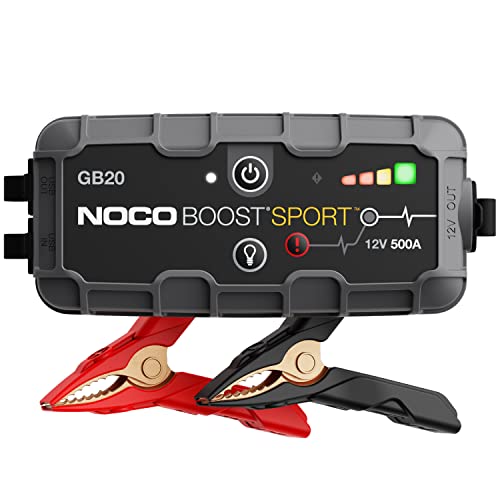
NOCO Boost GB20 — Best Compact for Small Cars
Not every vehicle needs a big pack, and oversizing has real costs: money, space and the temptation to leave the pack at home. The GB20’s 500A rating is aimed squarely at smaller engines — compact cars, motorcycles, ATVs, lawn equipment — where it delivers the same NOCO protection story as its bigger brothers in a genuinely glovebox-sized body.
For a second car that only ever fails in the driveway, a student car, or a motorcycle that sits all winter, this is the honest specification. You are not under-buying; you are matching the tool to the engine. The UltraSafe design language — spark-proof connection, reverse-polarity protection — carries down intact, which is more than can be said for no-name mini packs.
It also makes an excellent first pack for a new driver. The failure it protects against is the most common one in motoring — a flat battery in a small car — and it removes the two traditional barriers: needing another car for a jump, and needing to handle cables correctly under stress.
The GB20 also earns a mention as the household’s second pack — the one that lives with the motorcycle, the mower or the spare car — bought after the main pack proves the concept. Households that start with a flagship often discover the failures that actually happen are small-vehicle failures in the driveway, and a GB20 parked with each small vehicle quietly ends them.
See the NOCO Boost GB20 — view it on Amazon — for the current configuration options and delivery details.
Strengths
- Same UltraSafe protection as the larger NOCO packs
- Glovebox size suits small cars and powersports perfectly
- Lowest-cost way into a quality lithium pack in this guide
Trade-offs
- 500A ceiling excludes larger engines entirely
- Power-bank capacity is modest
- No compressor or AC output — a pure jump-and-charge pack
| Type | Lithium jump starter power pack |
| Peak rating (listing) | 500A |
| Protection | Spark-proof, reverse polarity |
Best for: Small cars, motorcycles, ATVs and new drivers / Not suited for: Trucks, large SUVs or diesel engines of any size
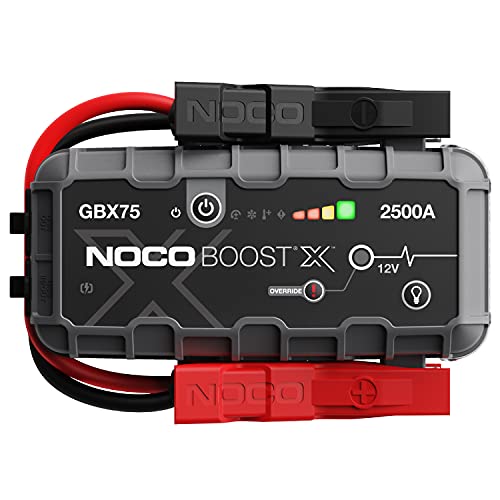
NOCO Boost GBX75 — Best for Trucks and Diesel
The GBX75 is where this guide stops compromising. Its 2500A rating and listing coverage of up to 8.5L gas and 6.5L diesel put full-size trucks, heavy SUVs and working diesels inside the brief, and the GBX platform adds the modern charging standard the older Boost line lacks: USB-C in and out, so the pack recharges quickly and can fast-charge a phone or tablet like a proper power bank.
That charging speed changes ownership. A pack that refills in a short drive or a brief wall-charge session is a pack that actually gets recharged after use; a pack that needs overnight tethering gets forgotten in a discharged state. For a truck that tows, camps or works remotely, the GBX75’s combination of starting muscle and fast turnaround is the practical flagship choice.
It remains a lithium pack with lithium rules: store it out of extreme heat where you can, top it up on a schedule, and do not expect it to crank a completely dead commercial diesel all day. Within its rated envelope, though, it is the most capable single pack here that still fits in a door pocket or under a seat.
Cold-climate drivers should read the GBX75’s diesel figure as its headline. Diesel starting in deep cold is the hardest common job in this category — thick oil, glow plugs drawing before the crank, a battery at its weakest — and it is precisely the job where a mid-tier pack that ‘should’ work becomes a tow truck call. The GBX75’s margin is not vanity; in January it is the product.
Towing and trailer work adds one more GBX75 scenario: the tow vehicle’s battery, loaded by winches, lights and a long day, is the battery most likely to need the pack it carries. Keeping the flagship with the tow rig — rather than in the daily driver — is the assignment discipline this guide keeps preaching, applied to the most expensive seat in the fleet.
See the NOCO Boost GBX75 — view it on Amazon — for the current configuration options and delivery details.
Strengths
- 2500A covering up to 8.5L gas and 6.5L diesel
- USB-C fast charging in and out — doubles as a serious power bank
- GBX build and protection suite aimed at truck duty
Trade-offs
- Premium tier pricing within this guide
- Still a lithium pack — not a substitute for a shop AGM unit on fleet duty
- Overkill for compact cars, where the GB20 or GB40 suffice
| Type | Lithium jump starter power pack |
| Peak rating (listing) | 2500A |
| Engine coverage (listing) | Up to 8.5L gas / 6.5L diesel |
| Charging | USB-C (per GBX platform listing family) |
Best for: Full-size trucks, heavy SUVs and diesel owners / Not suited for: Small-car owners paying for capacity they cannot use
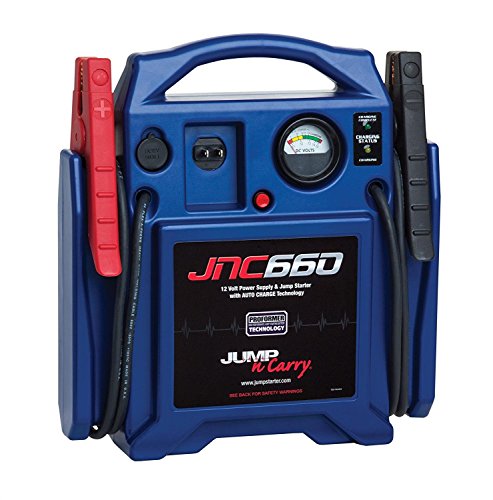
Clore Jump-N-Carry JNC660 — Best Workshop Pack
Every other pick in this guide is lithium; the JNC660 is the deliberate exception, and workshops keep buying it for reasons lithium cannot match. Its AGM battery delivers 1700 peak amps with the sustained cranking character that repeated, back-to-back jump work demands, and the whole unit — cables, clamps, case — is built like shop equipment rather than consumer electronics.
The trade is weight and routine. This is not a glovebox pack; it lives in a garage, a service truck or a farm shed, and its lead-acid heart wants regular charging to live a long life. In return you get a pack that a technician can use all week, that tolerates being knocked around, and whose replacement parts and service ecosystem have existed for years.
For a household with several vehicles, project cars that sit, or equipment that always seems to be flat on Saturday morning, the JNC660 is the pack that ends the problem rather than managing it. Buy it as infrastructure, keep it on its charger, and the question of whether the pack is ready simply stops coming up.
One workshop habit makes the JNC660 effectively immortal: park it where its charger lives and plug it in as reflexively as you hang up a coat. Shops that do this measure these packs’ lives in many years and hundreds of jumps. Shops that store it in a corner and charge it when remembered measure in disappointment. The pack is not maintenance-free; it is maintenance-simple, which for a professional tool is the better virtue.
The JNC660 also moonlights as the yard’s 12V source for testing — powering a suspect starter on the bench, running a 12V accessory to verify it, checking a trailer’s lights. A stiff AGM pack with real clamps is a test instrument in disguise, and workshops that recognize that get a second tool for the price of the first.
See the Clore Jump-N-Carry JNC660 — view it on Amazon — for the current configuration options and delivery details.
Strengths
- 1700 peak amps with genuine sustained-cranking AGM character
- Professional build — cables, clamps and case made for daily use
- The proven choice for multi-vehicle households and workshops
Trade-offs
- Heavy — a garage pack, not a carry-everywhere pack
- AGM chemistry needs disciplined recharging to avoid sulfation
- No USB power-bank frills or inflator
| Type | AGM jump starter pack |
| Peak rating (listing) | 1700 peak amps |
| Role | Workshop / professional |
Best for: Workshops, farms and multi-vehicle households / Not suited for: Anyone wanting a light glovebox lithium pack

GOOLOO A3 — Best with Air Compressor
Flat batteries and soft tires account for the overwhelming majority of roadside misery, and the A3 is the only pack here that answers both. The jump side is a 3000A rating with listing coverage of 9L gas and 6.5L diesel; the air side is a 150 PSI inflator with auto-off, so you set the target pressure and the pump stops itself instead of cooking the tire or the compressor.
Auto-off is the detail that matters. A basic inflator demands you crouch by the wheel watching a gauge; the A3’s set-and-stop behavior turns a ten-minute chore into a background task while you load the car or make the phone call. For family road trips — the exact setting where both failures love to happen — that combination earns its space.
Inevitably, a combined unit is a compromise against specialists: a dedicated inflator is faster, a dedicated pack is smaller. But roadside gear follows the rule of the gear you actually carry, and a single charged A3 in the trunk beats a perfect pack and a perfect inflator sitting in the garage. Charge it after every use and on a calendar rhythm, and it covers the realistic failure list almost completely.
The A3’s inflator deserves one practical warning that applies to every combo unit: air work drains the shared battery far faster than jump work does. Top up a full set of tires and then jump a car and you have spent the reserve twice. The discipline is simple — recharge between jobs, or at least check the gauge before the second job — and with it, the combination stays the convenience it promises to be.
A final A3 scenario worth picturing: the slow leak discovered at a rest stop, two hundred miles from home, with the light going. The inflator’s auto-off earns its keep precisely there — set the pressure, attend to the family and the map, and let the machine watch the gauge. Combinations are bought for bad days, and bad days reward equipment that asks little of you.
See the GOOLOO A3 — view it on Amazon — for the current configuration options and delivery details.
Strengths
- 3000A jump rating plus 150 PSI auto-off inflator in one unit
- Coverage to 9L gas and 6.5L diesel per the listing
- Auto-off inflation removes the gauge-watching chore
Trade-offs
- Larger than a pure jump pack of similar rating
- Inflator is slower than a dedicated compressor
- Two functions share one battery — heavy air use eats jump reserve
| Type | Lithium jump starter + inflator |
| Peak rating (listing) | 3000A |
| Engine coverage (listing) | 9L gas / 6.5L diesel |
| Inflator (listing) | 150 PSI, auto-off |
Best for: Road-trippers who want battery and tire cover in one box / Not suited for: Purists who prefer separate best-in-class tools
Comparison Table
| Pick | Badge | Key spec | Best for |
|---|---|---|---|
| NOCO Boost GB40 | Best Overall | 1000A, up to 6.0L gas / 3.0L diesel | Most car and crossover owners buying one dependable pack |
| GOOLOO GP2000 | Best Value Power | 2000A, 8L gas / 6L diesel, 1.2 lb | V8 and mid-diesel owners who want maximum power in a minimal pack |
| NOCO Boost GB20 | Best Compact for Small Cars | 500A compact lithium pack | Small cars, motorcycles, ATVs and new drivers |
| NOCO Boost GBX75 | Best for Trucks and Diesel | 2500A, up to 8.5L gas / 6.5L diesel | Full-size trucks, heavy SUVs and diesel owners |
| Clore Jump-N-Carry JNC660 | Best Workshop Pack | 1700 peak amp AGM pro pack | Workshops, farms and multi-vehicle households |
| GOOLOO A3 | Best with Air Compressor | 3000A + 150 PSI auto-off inflator | Road-trippers who want battery and tire cover in one box |
Use the table to shortlist two candidates, then read their full reviews above. When you are ready, check the current price on Amazon for the top pick and compare delivery times across your shortlist.
How to Choose the Best 12 Volt Power Pack for Your Vehicle
Start with your largest engine, not your favorite car. The pack must cover the biggest gas or diesel engine it might ever be asked to start, with headroom if you live where winters are serious — cold thickens oil and saps battery output at the same time, which is why northern drivers should buy one class above the summer minimum.
Then choose where the pack will live. Glovebox and under-seat storage demand lithium and small size; garage and service-truck storage open the door to AGM workshop packs with better sustained cranking. Be honest about the routine you will keep: a quarterly calendar reminder suits lithium, while an AGM pack is happiest living on its maintainer.
Peak Amps, Cranking Amps and Engine Litres: Reading the Numbers Honestly
Peak amps is a laboratory figure — the maximum the pack can deliver for an instant — and it is the number marketing prints largest. It is not useless, but it is not comparable across brands the way buyers assume. The manufacturer’s own engine-coverage claim, in litres of gas and diesel, is the more honest shorthand, because the maker has at least tied its reputation to a result.
Diesel engines need substantially more starting effort than gas engines of the same size, thanks to far higher compression, which is why every listing in this guide quotes a lower diesel figure. If your vehicle is diesel, shop by the diesel number only, and treat any pack that quotes a single combined figure with suspicion.
Lithium vs AGM Power Packs: Which Chemistry Fits Your Life?
Lithium packs win on size, weight and storage behavior: they hold a charge for months, recharge quickly and disappear into small storage spaces. Their limits are sustained cranking — repeated long attempts heat them quickly — and a distaste for being stored fully discharged or in extreme heat.
AGM packs like the JNC660 win on sustained delivery and workshop toughness, and they shrug off the daily-use rhythm that wears consumer lithium packs. Their costs are weight, size and a stricter charging discipline. Households usually belong on lithium; workshops, farms and multi-vehicle driveways are where AGM still earns its keep.
What a Power Pack Cannot Do: Knowing the Limits
A power pack cannot charge a battery, repair an alternator, or resurrect a battery with a dead cell — it can only lend cranking current for a few seconds at a time. Owners who understand that boundary use the pack brilliantly; owners who do not end up stranded further from help, with a flat pack added to a flat battery. Treat every jump as diagnostic information: one jump is weather, two in a week is a battery asking to be replaced.
Nor is a pack a jump-start subscription for a vehicle with a parasitic drain. If something in the car eats the battery overnight, the pack will mask it faithfully until the morning it cannot. The fix is a multimeter, a fuse-pulling session and an hour of patience — after which the pack returns to its proper job of covering genuine surprises.
Power Packs and Modern Vehicles: Start-Stop, Hybrids and Sensitive Electronics
Modern vehicles complicate the flat-battery story. Start-stop systems use enhanced batteries and battery-management sensors that want to know when the battery has been serviced; hybrids carry a small 12V auxiliary battery whose failure produces a dashboard of unrelated warnings; and many cars hide their battery in a trunk or under a seat, offering remote jump posts under the hood instead. Your owner’s manual — not habit — should locate the connection points before the bad morning arrives.
The protected packs in this guide are designed for this fleet: controlled connection, spark suppression and polarity protection are exactly the features modern electronics want between them and a lithium brick. This is one more reason the bargain end of the category, where those protections are the first cost cut, is a false economy on any car built in the last decade.
Jump Starting Etiquette and Safety Around Other People’s Cars
Sooner or later the pack makes you the most popular person in the parking lot, and a little etiquette keeps generosity safe. Ask before connecting to a stranger’s vehicle, connect to their car exactly as you would your own, and decline — politely — the vehicle with visible wiring damage, a cracked battery case or a smell of fuel: those are tow-truck situations, and your pack is not insured for them. Helping well means knowing where helping stops.
For your own family’s cars, teach the routine before it is needed: where the pack lives, which clamp is red, what the protection lights mean. A five-minute daylight lesson converts a future 6 a.m. panic into a procedure, and it is the cheapest accessory this guide can recommend — it costs one calm afternoon and pays out for the life of the pack.
Keeping a Power Pack Ready: The Ownership Routine That Actually Matters
More power packs fail their owners through neglect than through defects. The routine is simple: charge the pack fully when it arrives, top it up after every use, and put a recurring reminder — quarterly for lithium, monthly for AGM — in the same calendar that holds your other vehicle checks. A pack stored at partial charge in a hot trunk ages faster than the same pack stored cool and full.
Twice a year, give the pack a real inspection. Check the clamps for corrosion and cracked insulation, confirm the charge indicator responds, and — if your pack offers it — run its light and USB output briefly so every circuit gets exercised. If the pack has swollen, smells sweet or chemical, or refuses to hold a charge overnight, retire it: a damaged lithium pack is a hazard, not a bargain, and no jump start is worth it.
How to Jump-Start a Car Safely with a 12 Volt Power Pack
Step 1: Prepare. Park on a level surface, transmission in Park (or neutral with the brake set for a manual), ignition and lights off. Open the hood and find the battery terminals — or the remote jump posts many modern cars provide; your owner’s manual shows them. Confirm your pack shows a healthy charge before you begin.
Step 2: Connect in order. Attach the red clamp to the positive terminal (marked + , usually red) and the black clamp to an unpainted metal ground point on the engine or chassis, away from the battery itself. Modern protected packs will warn you if the connection is reversed — if yours alerts, stop and correct it rather than forcing a start.
Step 3: Start and disconnect promptly. Start the engine; if it does not catch within a few seconds of cranking, stop, wait a minute for the pack and cables to cool, and try again. Once running, remove the clamps in reverse order, let the engine run or drive for at least twenty minutes, and recharge the pack the same day. A battery that needed a jump twice in a week is telling you it is finished — replace it rather than leaning on the pack.
A last step that separates owners from borrowers of luck: after the successful start, write the date on a piece of tape on the pack. Jump events are data. A pack with one date a year is insurance working as designed; a pack collecting dates monthly is a vehicle asking — politely, while it still can — for a battery, an alternator test or a drain hunt. If the engine starts and dies repeatedly, stop jumping and start diagnosing: a pack can mask a failed alternator for exactly as long as its own charge lasts, and the second stranding will be further from help than the first. One successful jump is a tool working; a pattern of jumps is a message — deliver the car to a test bench while the message is still cheap to receive.
Common Buying Mistakes
Mistake 1: Buying by headline amps alone. A huge peak-amp claim with no engine-coverage figure is marketing, not engineering. Shop by the manufacturer’s litres-of-gas and litres-of-diesel coverage for your actual engine.
Mistake 2: Storing the pack discharged. The number one killer of jump packs is being used once, tossed back in the trunk flat, and found dead a year later. Recharge after every use and on a calendar rhythm.
Mistake 3: Using a pack as a battery substitute. Repeatedly jumping a dying battery overheats packs, strands you further from home each time, and can mask a failed alternator. The pack buys you one trip to the parts store — take it.
Mistake 4: Ignoring the diesel derating. A pack that covers your neighbor’s gas V8 may not cover your smaller diesel. Always check the diesel figure separately, with cold-weather headroom.
Mistake 5: Leaving the pack in a freezing or baking car year-round without checking it. Trunk temperatures age lithium cells. A quarterly charge check catches the decline while it is still a warranty conversation, not a roadside one.
Mistake 6: Lending the pack without its cables’ other half — or borrowing trouble by jumping strangers’ vehicles with unknown electrical faults. Help gladly, but connect carefully, and let a vehicle that smells of burnt wiring be a tow truck’s problem, not your pack’s.
Final Recommendation
For most drivers the decision ends quickly: the NOCO Boost GB40 is the best 12 volt power pack to own — honestly rated, properly protected and small enough to live where it is needed. Drivers with V8s or mid-size diesels should step up to the GOOLOO GP2000 or the NOCO Boost GBX75, and small-car and motorcycle owners can save money and space with the GB20 without giving up protection.
Choose the Clore JNC660 if your reality is a garage full of vehicles rather than one daily driver, and the GOOLOO A3 if you want tire insurance folded into the same box. Whichever you choose, the pack only works if it is charged — make the top-up routine part of the purchase.
If you are still torn between two picks, decide by the vehicle you would least like to be stranded in, in the weather you would least like to be stranded in. That vehicle, that morning, is the design brief. Buy the pack that answers it, and the rest of the year the choice will never cross your mind — which is the highest praise roadside equipment can earn.
Ready to decide? Start with the top pick — check the current price on Amazon — and work down the shortlist from there.
Related guides on this site: Best 12 Volt Power Packs Best 12 Volt Power Supply Best 12 Volt Power Charger Best 12 Volt Power Inverter Best 12 Volt Jump Starter
Frequently Asked Questions
What size 12 volt power pack do I need for my car?
Match the pack to your engine using the manufacturer’s coverage claim: most gas cars up to about 6.0L are well served by a 1000A-class pack like the GB40, larger gas engines and diesels need the 2000A class and above, and small cars and motorcycles are fine with a 500A-class pack. Add one class of headroom for serious winter cold.
How long does a jump starter power pack hold its charge?
A healthy lithium pack holds a usable charge for months in storage, but you should still top it up quarterly and after every use. AGM packs self-discharge faster and are happiest kept on a maintainer. Any pack left fully discharged for a long period may never recover its full capacity.
Can a power pack damage my car’s electronics?
A quality pack with spark-proof and reverse-polarity protection — as every lithium pick in this guide has — is designed specifically to prevent the connection errors that cause damage. The risk lives with unprotected bargain packs and with forcing a start after a protection warning. Follow the connection order and respect the alerts.
Is a power pack the same as a battery charger?
No. A power pack delivers a short, high-current burst to start an engine; a charger restores a battery slowly over hours. Some chargers offer a power-supply mode and some packs can trickle energy back via USB, but the tools solve different problems. A battery that needs frequent jumps needs charging and testing, not just jumping.
Why does my diesel need a bigger pack than a gas engine?
Diesel engines use far higher compression ratios, so the starter motor works much harder to turn them, and glow-plug systems add their own draw in cold weather. That is why listings quote a lower diesel litre rating for the same pack — always shop diesels by the diesel figure.
Can I take a lithium power pack on a plane?
Rules vary by airline and by the pack’s watt-hour rating, and jump packs are large batteries by air-travel standards. Check your airline’s current battery policy before flying with one; for most travelers the practical answer is to leave the jump pack in the car and carry a small phone power bank in the cabin instead.
How many jumps should I get from one charge?
It depends on engine size, battery condition and temperature — a healthy pack starting a healthy-but-flat small car may manage many starts, while a big diesel in winter may take most of a charge in two attempts. Treat the manufacturer’s jump-count claims as best-case laboratory figures and plan around a simpler rule: recharge after every real use, and never count on yesterday’s jumps still being in the pack.
Can a power pack start a car with no battery connected?
Some powerful packs can force-start a vehicle with a missing or completely dead battery using a boost or override mode, but it is hard on the pack, unwelcome by many vehicle electrical systems, and no substitute for a battery. Use override modes to reach a parts store, not as a lifestyle — and never on a vehicle whose manual forbids it.
Can I leave a power pack in the car all winter?
Yes, with the quarterly check this guide prescribes — cold itself is not the enemy; a pack stored charged tolerates winter well and loses capacity only temporarily while cold-soaked. The pack to worry about is the one stored discharged into the cold. Charge before the season, check mid-season, and let the pack’s own protections handle the rest.
Should I keep the pack in the cabin or the trunk?
Either works if the pack is secured and checked quarterly; cabin storage is kinder in temperature extremes and puts the pack within reach when the car is loaded, while a trunk organizer keeps it with the rest of the roadside kit. The wrong answer is loose in a footwell or buried under cargo — a pack you cannot reach in the dark is a pack you do not own.


