Disclosure: airfryerkitchensupply.com is reader-supported. When you buy through links on our site, we may earn an affiliate commission at no extra cost to you.
Where to buy
Every verified pick in this guide to the best 12 volt portable air conditioner is sold on Amazon, and availability for niche 12-volt gear changes faster than anywhere else. Start with the Cybertake S2 Pro Portable Camping Air Conditioner if you want the safest first click, then compare the rest of the shortlist below before you buy. Prices move constantly on this kind of equipment, so check price on Amazon on the day you order rather than trusting any number quoted elsewhere.
- Cybertake S2 Pro Portable Camping Air Conditioner (Best Overall — True Vehicle Power) — Check on Amazon
- Zero Breeze Mark 3 Portable Air Conditioner (Best Cooling Power) — Check on Amazon
- Cybertake Portable Camping Air Conditioner 5100 BTU (Best Value Compressor) — Check on Amazon
- Outohome 5200 BTU Portable Camping Air Conditioner (Best Budget Compressor) — Check on Amazon
- Zero Breeze Mark 2 Portable Air Conditioner 2300 BTU (Best for Solo Sleepers) — Check on Amazon
- Arctic Air Outdoor Evaporative Air Cooler (Best Evaporative Alternative — Not an Air Conditioner) — Check on Amazon
Searching for the best 12 volt portable air conditioner means walking into the most misleading corner of the 12-volt world, so this guide starts with the truth. Real air conditioning — a compressor moving refrigerant — takes serious power, and a vehicle’s 12-volt system delivers limited watts. That physics is why the overwhelming majority of products sold as portable 12V air conditioners are not air conditioners at all: they are evaporative coolers, a fan blowing over wet media, wearing an AC costume. They have their uses, and one is reviewed honestly below, but they do not refrigerate air, and in humid weather they barely cool it.
True compressor portables that can run from vehicle DC power do exist — a handful of specialist units built for tents, truck cabs, small RVs and boats — and every pick in this guide was verified through Amazon’s catalogue data with its power story stated from the listing itself. One pick, the Cybertake S2 Pro, is explicitly rated for 12–24V vehicle power alongside wall power: the genuine native-vehicle compressor AC. The Zero Breeze units are battery-system compressor machines. The Outohome is a low-power compressor unit for small spaces. And the Arctic Air is included, clearly labelled, as the evaporative alternative — because some buyers actually need what it does, provided nobody lies to them about what it is.
Set the expectation these machines deserve: 2,300 to 5,280 BTU cools a tent, a truck sleeper, a small cabin or one room’s sleeping corner. It does not cool a house, a large RV in desert sun, or a workshop. Within their envelope, though, these units are transformative — a sleepable tent in July, a legal rest break in a cool cab, a boat cabin a child can nap in. Buy for the small space you actually need to cool, power it honestly, and this category delivers. Buy the fantasy version and it will not.
In this guide
Quick Picks
Cybertake S2 Pro Portable Camping Air Conditioner — Best Overall — True Vehicle Power. The genuine article: a compressor AC with verified 5,100 BTU cooling, 6,100 BTU heating, three-way power including 12–24V vehicle input, and a stated 8 hours per kilowatt-hour. Check the current price on Amazon.
Zero Breeze Mark 3 Portable Air Conditioner — Best Cooling Power. The output leader: a verified 5,280 BTU compressor portable, lightweight and battery-ready, built for camping, RVs and trucks — powered through its battery system rather than a raw 12V plug. Check the current price on Amazon.
Cybertake Portable Camping Air Conditioner 5100 BTU — Best Value Compressor. The S2 Pro’s brief at a friendlier tier: 5,100 BTU cooling, 6,100 BTU heating, AC and DC compatible, with the same stated 8-hours-per-kWh efficiency, for tents, RVs, boats and fishing. Check the current price on Amazon.
Outohome 5200 BTU Portable Camping Air Conditioner — Best Budget Compressor. The budget compressor entry: a stated 5,200 BTU, low-power 4-in-1 unit for tents, RVs, trucks, vans, cars and pet houses — real refrigeration at the category’s entry tier. Check the current price on Amazon.
Zero Breeze Mark 2 Portable Air Conditioner 2300 BTU — Best for Solo Sleepers. The personal-space original: 2,300 BTU of battery compressor cooling sized for one sleeper — a truck bunk, a solo tent, a single berth. Check the current price on Amazon.
Arctic Air Outdoor Evaporative Air Cooler — Best Evaporative Alternative — Not an Air Conditioner. Included with its true name on the label: an evaporative swamp cooler — USB rechargeable, up to 6 hours per charge, 4 speeds — for patios and decks in dry heat. It is not an air conditioner and this guide will not call it one. Check the current price on Amazon.
How These Picks Were Chosen
We chose these picks by verifying portable air conditioners through the catalogue and then doing what most roundups refuse to do: classifying each unit by what it actually is. Compressor or evaporative. Native vehicle-DC, battery-system, or wall-power-first. BTU as stated in the verified listing. Any product whose listing blurred those lines beyond repair was excluded; products that stated their nature honestly — including the evaporative cooler that calls itself a swamp cooler in its own title — were eligible.
Within the true compressor class we weighted verified BTU, power flexibility and efficiency. The Cybertake S2 Pro leads on the strength of its verified specification: 5,100 BTU of cooling, 6,100 BTU of heating, three-way power including 12–24V vehicle input, and a stated eight hours of runtime on one kilowatt-hour — the efficiency figure that decides whether battery-powered cooling is a plan or a fantasy. The Zero Breeze Mark 3 counters with the highest verified cooling here, 5,280 BTU, in a battery-ready system.
We also weighted honesty as a feature. In a category built on exaggeration, a brand that publishes its BTU, its power inputs and its energy consumption is telling you it expects to be checked. Every specification in this guide traces to a verified listing; where a unit’s vehicle-power path involves its battery system or an adapter rather than a raw 12-volt plug, the review says so in plain words.
The 6 Best 12 Volt Portable Air Conditioners
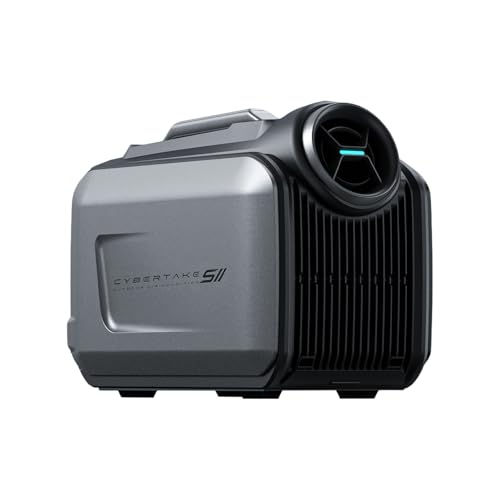
Cybertake S2 Pro Portable Camping Air Conditioner — Best Overall — True Vehicle Power
If your keyword means what it says — an air conditioner that runs from a vehicle — this is the pick. The Cybertake S2 Pro’s verified listing states the specification the whole category dances around: three-way power spanning 48V DC, 12–24V vehicle input, and 100–240V wall power. It is a real compressor machine with 5,100 BTU of cooling and, unusually, 6,100 BTU of heating, aimed at tents, camping and RVs.
Strengths
- Verified 12–24V vehicle power input — true native vehicle-DC compressor cooling
- Heats as well as cools: 6,100 BTU heating extends it to shoulder seasons
- Stated 8 hours on 1 kWh — battery cooling that can actually be planned
Trade-offs
- 5,100 BTU is a tent/cab/small-cabin envelope, not a whole-RV solution in heat
- Premium tier — real compressor AC costs real money
- Vehicle running still draws serious watts; battery maths is mandatory
| Cooling | 5,100 BTU |
| Heating | 6,100 BTU |
| Power | 48V DC / 12–24V vehicle / 100–240V wall |
| Efficiency | 8 hours per 1 kWh (stated) |
The efficiency figure is the one to plan around. Eight hours from a kilowatt-hour means a modest lithium power station or a healthy house battery bank carries a full night of cooling — the first time in this category’s history that sentence has been easy to write. In a vehicle, the practical pattern is to cool while driving or on shore power, then let the battery carry the sleeping hours. In a tent, a kilowatt-hour-class power station beside the unit makes July camping a different sport entirely.
The heating mode deserves its paragraph. A unit that heats at 6,100 BTU covers spring and autumn nights in the same small spaces, turning a summer gadget into a three-season tool and doubling the trips it earns its storage space on. For the vehicle camper who asked this exact keyword’s question, the S2 Pro is the answer the market took years to produce: a real air conditioner, honest power inputs, small spaces only, no costume.
Best for: vehicle campers, truck sleepers and tent campers needing true DC compressor cooling / Not suited for: large RVs in extreme heat, or anyone expecting house-scale cooling

Zero Breeze Mark 3 Portable Air Conditioner — Best Cooling Power
Zero Breeze built the portable compressor AC category for campers, and the Mark 3 is its flagship: a verified 5,280 BTU — the highest cooling figure in this guide — in a lightweight, battery-ready package aimed at camping, RV and truck use. Be precise about its power story: it runs from its battery system and wall power, which makes it a battery air conditioner that travels in vehicles, rather than a unit that plugs into a cigarette socket. For most buyers that distinction changes nothing about the outcome — cold air, off-grid — and this guide states it so your power planning is right.
Strengths
- Highest verified cooling here at 5,280 BTU
- Battery-ready system designed for off-grid camping from the ground up
- Lightweight for its class — genuinely portable between tent, truck and cabin
Trade-offs
- Battery-system power: budget for the battery ecosystem, not just the unit
- Flagship tier pricing
- Still a small-space machine — 5,280 BTU has honest limits in sun-baked spaces
| Cooling | 5,280 BTU |
| Power | Battery-ready system / wall power |
| Use | Camping, RV, truck, outdoor |
The Mark 3’s extra BTU over its rivals buys real-world margin: the tent in partial sun, the truck cab that starts the evening heat-soaked, the small RV bedroom that needs pulling down before sleep. Cooling capacity is what you spend when the space fights back, and among portables this is the strongest verified hand. Paired with its battery system, it delivers the category’s founding promise — air conditioning where no hookup exists — at its most capable.
Plan the system, not the unit. Runtime lives in the battery, so size the battery to your night: the unit’s consumption against your battery’s usable watt-hours, with margin for a hot night’s harder work. Buyers who do that maths once, on paper, before the trip, become this category’s happiest owners. Buyers who assume get a cool first hour and a warm education.
Best for: campers and truck users wanting maximum portable cooling with battery freedom / Not suited for: buyers wanting to plug directly into a 12V socket and nothing else
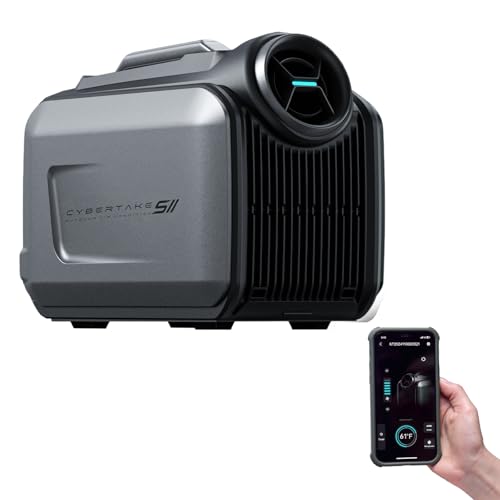
Cybertake Portable Camping Air Conditioner 5100 BTU — Best Value Compressor
Not every buyer needs the flagship’s full power-input menu. This Cybertake carries the same verified core numbers — 5,100 BTU cooling, 6,100 BTU heating, AC and DC compatibility, eight stated hours per kilowatt-hour — in the range’s value position, and adds boats and fishing to its stated territory. For tent, RV and cabin-boat cooling, it is the efficiency-per-dollar pick.
Strengths
- Same 5,100/6,100 BTU cool/heat pairing as the flagship class
- AC and DC compatible — shore power at the dock, DC on the water
- Stated 8 hours per kWh keeps battery planning realistic
Trade-offs
- Confirm the exact DC input arrangement for your vehicle before relying on it
- Small-space envelope, as with every true portable here
- Value tier versus the Pro’s finish and feature polish
| Cooling | 5,100 BTU |
| Heating | 6,100 BTU |
| Power | AC and DC compatible |
| Efficiency | 8 hours per 1 kWh (stated) |
Boat cabins are this unit’s quiet specialty. A small cabin is the perfect compressor-portable space: tiny volume, desperate heat at anchor, and a house battery bank already aboard. AC/DC compatibility means the same unit pre-cools the cabin on shore power at the dock and holds it at anchor on DC — the two halves of a sailing weekend served by one machine. Fishing and camping uses follow the same small-space logic.
As with its Pro sibling, the doctrine is envelope honesty: a tent, a cab, a cabin, a small RV room. Inside that envelope this is the most cooling and heating per dollar in the verified field, with an efficiency claim that makes battery nights plannable rather than hopeful.
Best for: tent campers, small-RV owners and boaters wanting compressor value / Not suited for: buyers needing the Pro’s explicit 12–24V vehicle input guarantee

Outohome 5200 BTU Portable Camping Air Conditioner — Best Budget Compressor
The Outohome is where real compressor cooling reaches its lowest tier: a stated 5,200 BTU in a low-power, 4-in-1 portable aimed at tents, RVs, trucks, vans, cars and — a usefully honest inclusion — pet houses. It is the pick for buyers whose budget cannot stretch to Cybertake or Zero Breeze but who refuse, correctly, to spend anything on an evaporative box mislabelled as an air conditioner.
Strengths
- Real compressor cooling at the entry tier — no evaporative costume
- Stated 5,200 BTU matches premium rivals on paper
- Low-power 4-in-1 format suits vehicles, tents and pet houses
Trade-offs
- Value-tier build and refinement versus the premium brands
- Verify its power-input arrangement for your exact vehicle setup
- Paper BTU and delivered BTU diverge fastest at the budget end — size your space conservatively
| Cooling | 5,200 BTU (stated) |
| Type | Compressor, low power, 4-in-1 |
| Use | Tent, RV, truck, van, car, pet house |
The pet-house mention is more significant than it looks: it signals the manufacturer understands the real market for small compressor cooling — defined small spaces with occupants who cannot open a window. A dog kennel area in a van, a cat’s travel space, a driver’s rest cab: these are the jobs. In those spaces, a budget compressor that genuinely refrigerates beats a premium evaporative that genuinely does not.
Buy it with the budget doctrine: keep the space small and shaded, pre-cool when you can, and let it hold rather than rescue. Owners who respect the envelope get a working air conditioner at the category’s friendliest price; owners who ask it to cool a sun-baked large van at noon will conclude wrongly that portable AC itself is a myth.
Best for: budget buyers needing genuine compressor cooling for a small space / Not suited for: premium finish seekers or large-space cooling

Zero Breeze Mark 2 Portable Air Conditioner 2300 BTU — Best for Solo Sleepers
The Mark 2 is the machine that proved battery air conditioning could exist, and its 2,300 BTU is honestly sized for the smallest envelope of all: one person sleeping. A truck bunk, a one-person tent, a single berth on a boat — in those volumes, 2,300 BTU of real refrigeration is not a compromise; it is the correct specification, delivered at lower power draw than its bigger siblings.
Strengths
- True compressor cooling sized for personal sleeping spaces
- Lower draw suits modest battery systems and longer nights
- The category’s pioneering design, with a mature ecosystem
Trade-offs
- 2,300 BTU will not cool a family tent or a cabin — envelope discipline is absolute
- Battery-system power, like its bigger sibling
- Newer models outgun it for shared spaces
| Cooling | 2,300 BTU |
| Power | Battery system / wall power |
| Use | Solo tent, truck bunk, single berth |
Solo travellers are this unit’s people. The long-haul driver whose sleeper cab needs to be sleepable at a rest stop; the solo camper whose tent becomes a refuge rather than an oven; the single-hander whose berth needs one cool corner. In each case the cooled volume is a few dozen cubic feet, and 2,300 BTU, delivered steadily through the night at modest draw, changes sleep from endurance into rest.
It is also the honest second-hand and spare-unit pick of the category — a proven design whose limits are known quantities. Just never ask it to be a family machine. Its BTU figure is a promise about a small space, and kept to that promise, it keeps its own.
Best for: solo sleepers in truck bunks, one-person tents and single berths / Not suited for: shared tents, cabins or any space beyond one sleeper

Arctic Air Outdoor Evaporative Air Cooler — Best Evaporative Alternative — Not an Air Conditioner
This pick exists to serve the reader honestly in both directions. If you came here for refrigerated air, skip it — it cannot do that, and its own verified listing says what it is: an evaporative air cooler, a swamp cooler. But if your actual need is a rechargeable personal cooler for a dry-climate patio, beach or deck, evaporative cooling is a legitimate, cheap, sip-power technology, and this unit — USB rechargeable with up to six hours per charge and four fan speeds — does it in a tidy package.
Strengths
- Honest evaporative cooling that works in dry heat at a fraction of compressor cost
- USB rechargeable with up to 6 hours of cordless runtime
- Ultra-quiet, four speeds — patio and bedside friendly
Trade-offs
- Not an air conditioner: no refrigerant, no compressor, no true temperature drop in humidity
- Evaporative effect fades as humidity rises — poor in muggy climates
- Personal-zone cooling only; it will not cool a tent’s air, only its occupant’s skin
| Type | Evaporative cooler (NOT compressor AC) |
| Power | USB rechargeable |
| Runtime | Up to 6 hours |
| Speeds | 4 |
Evaporative physics, plainly: water evaporating into dry air absorbs heat, so the air leaving a swamp cooler is cooler than the air entering — in a desert climate, meaningfully cooler. In a humid climate the air is already saturated, evaporation stalls, and the device becomes a fan with a water tank. That single fact explains every furious one-star review in this product class: a good technology sold into the wrong climate under the wrong name.
Bought knowingly, it is a pleasure: silent, cheap to run, cordless for an evening on the deck. Bought as an air conditioner for a humid tent, it is a disappointment with a return label. This guide’s promise is that you will always know which of those purchases you are making — here, and in every listing-shaped claim repeated anywhere in this programme.
Best for: dry-climate patio, deck and personal cooling on a small budget / Not suited for: anyone, anywhere, expecting refrigerated air conditioning
Comparison Table
| Pick | Badge | Key spec | Best for |
|---|---|---|---|
| Cybertake S2 Pro Portable Camping Air Conditioner | Best Overall — True Vehicle Power | 5100 BTU, 12-24V vehicle power | vehicle campers, truck sleepers and tent campers needing true DC compressor cooling |
| Zero Breeze Mark 3 Portable Air Conditioner | Best Cooling Power | 5280 BTU battery-ready compressor | campers and truck users wanting maximum portable cooling with battery freedom |
| Cybertake Portable Camping Air Conditioner 5100 BTU | Best Value Compressor | 5100 BTU, AC/DC compatible | tent campers, small-RV owners and boaters wanting compressor value |
| Outohome 5200 BTU Portable Camping Air Conditioner | Best Budget Compressor | 5200 BTU stated, budget tier | budget buyers needing genuine compressor cooling for a small space |
| Zero Breeze Mark 2 Portable Air Conditioner 2300 BTU | Best for Solo Sleepers | 2300 BTU personal compressor | solo sleepers in truck bunks, one-person tents and single berths |
| Arctic Air Outdoor Evaporative Air Cooler | Best Evaporative Alternative — Not an Air Conditioner | Evaporative — not AC | dry-climate patio, deck and personal cooling on a small budget |
How to Choose the Best 12 Volt Portable Air Conditioner — Honestly
Step one is classification, and you must do it yourself because listings will not. Ask of any candidate: does it contain a compressor and refrigerant? If the listing says evaporative, swamp, water-cooled or air cooler, the answer is no, whatever the headline claims. True compressor portables state a BTU figure and a serious power specification — vehicle DC inputs, battery systems, wall power — and cost accordingly. If the price looks like a fan’s price, you are looking at a fan.
Step two is power honesty. Trace exactly how the unit runs in your vehicle: a native 12–24V input like the Cybertake S2 Pro’s, a battery system like the Zero Breeze machines, or wall power through an inverter. Then do the watt-hour maths for your night: consumption multiplied by hours, against your battery’s usable capacity, with the engine or shore power doing the heavy pre-cooling. Every happy owner in this category has done that arithmetic; every disappointed one skipped it.
Step three is envelope sizing. These machines cool tents, bunks, cabs and small cabins. Measure your space, shade it, insulate what you can, and buy BTU for that volume — 2,300 for a solo sleeper, around 5,000 for a shared small space. No portable at any price cools a large RV in desert sun; that job belongs to roof air and a generator or hookup, and a guide that pretends otherwise is selling you a return shipment.
Compressor vs Evaporative: The Distinction the Listings Blur
A compressor air conditioner moves heat out of a space using a refrigerant cycle — the same physics as your home refrigerator and your car’s dashboard air conditioning. It lowers the air’s temperature and removes humidity, in any climate, at the cost of serious electrical power. An evaporative cooler blows air through wet media; evaporation cools the air in dry conditions and adds humidity in all conditions. The two technologies share a fan and nothing else.
The marketing blur exists because evaporative units are cheap to make and the phrase air conditioner sells them. Tells to watch for: no BTU rating, USB power (refrigeration cannot run on a phone charger’s watts), water tanks as the headline feature, and prices in fan territory. Any one of those marks an evaporative cooler, and the correct response is not outrage — evaporative cooling is genuinely useful in dry heat — but correct classification and correct expectations.
This guide includes one evaporative unit, labelled in its badge as not an air conditioner, because some readers’ real need is exactly that product. The other five picks are verified compressor machines. That ratio — five real, one honestly labelled alternative — is what the whole category’s shelf should look like, and rarely does.
Powering Real AC from a Vehicle: The Watt-Hour Maths
Portable compressor ACs draw hundreds of watts. A vehicle’s starter battery stores roughly a kilowatt-hour on paper and far less in usable, engine-starting-safe practice — which is why running real AC for hours on a starter battery is a plan to meet a jump starter. The working architectures are three: run the AC while driving, letting the alternator carry it; run it from a dedicated house battery or lithium power station sized for the night; or run it on shore power and use DC for travel legs.
The efficiency figures in the verified listings make the planning concrete. The Cybertake units state eight hours per kilowatt-hour — call it roughly 125 watts average — which puts a full night within reach of a 1 kWh power station or a 100Ah-class lithium house battery. Higher-draw machines halve that runtime per battery. Whatever you buy, write the equation down: battery watt-hours times 0.8 usable, divided by the unit’s average watts, equals your hours of cold. If the answer is less than your night, buy battery before you buy BTU.
Finally, pre-cool ruthlessly. Shade the vehicle, run the AC on alternator or shore power before the sleeping hours, and let the battery phase merely hold temperature against the night. Holding is cheap; rescuing a heat-soaked cab is the most expensive cooling there is.
Tents, Cabs and Cabins: Sizing Real AC to Real Spaces
The spaces these machines serve share a profile: small volume, one or two occupants, and a desperate need measured in sleep quality rather than daytime comfort. A two-person tent is perhaps sixty cubic feet of air under a sun-loaded skin; a truck sleeper is a insulated box that heat-soaks all day; a small boat cabin is a fibreglass oven at anchor. Against those volumes, 2,300 to 5,280 BTU of genuine refrigeration is not a toy figure — it is the difference between air that cycles through a compressor and air that merely moves, and occupants feel that difference in the first hour of the night.
Sizing within the class follows occupancy and exposure. One sleeper in a shaded tent: the Mark 2’s 2,300 BTU is honestly sufficient, and its lower draw buys longer nights. Two sleepers, a cab that starts the evening hot, a cabin in partial sun: the 5,000 BTU class is the correct spend, because pull-down power — the ability to drag a heat-soaked space down to sleepable — is what separates a good first night from a bad one. Buyers between the two should size up: an oversized unit idles down; an undersized one runs at its limit all night and still loses.
Insulation and shade multiply whatever you buy. A reflective cover over the tent’s sun side, the truck parked for evening shade, the cabin’s hatches shaded — these free measures can halve the load the AC fights. The veterans of this category treat the machine as the last step of a system that starts with where and how the space sits, and their nights are cooler on smaller batteries for exactly that reason.
The Pet Question: Cooling Animals in Vehicles and Kennels
A significant share of portable AC buyers are buying for animals — the dog in the van’s kennel area, the show cat in its travel space, the pet house in a hot yard — and the Outohome’s verified listing names pet houses outright. The stakes in these uses are higher than comfort: animals cannot open a window, complain articulately, or leave, and heatstroke is fast. That makes this the use case where the honesty of this guide matters most. An evaporative cooler is not a safeguard for an animal in a hot vehicle. A compressor AC, properly powered and monitored, can be part of one.
Part of one — because no machine should be an animal’s only protection. The responsible setup layers defences: the AC sized to the space, a battery budget with genuine margin, ventilation that survives a machine failure, a temperature alarm that reaches the owner’s phone, and a human checking in person on a schedule. Owners who compete, travel and work with animals build exactly these stacks, and the AC’s role in them is to hold a safe temperature through a working day, not to make an unsafe plan acceptable.
Within that doctrine, the picks here serve well: small defined spaces are their native envelope, and the efficient Cybertake class makes the battery side of the stack plannable. Buy the machine for the animal’s space, build the monitoring around it, and never let a product listing — here or anywhere — talk you out of the layers.
Humidity, Condensate and Comfort: The Forgotten Half of Cooling
Comfort is not temperature alone, and compressor air conditioning’s hidden gift is dehumidification. As air passes the cold coil, its moisture condenses out — which is why a compressor-cooled tent feels dry and sleepable while an evaporative-cooled one feels like a swamp with ambitions. In humid climates this is the entire ballgame: a few degrees of cooling with the moisture wrung out transforms sleep, while the same degrees with moisture added can leave occupants damper than the night air they were escaping. It is the physical reason this guide refuses to grade evaporative and compressor machines on one scale.
The condensate has to go somewhere, and managing it is the unglamorous skill of portable AC ownership. Units variously collect water in a tank, evaporate it into their exhaust stream, or drain it through a hose — and the right setup depends on runtime and humidity. In a Gulf-Coast night, a small tank can fill before dawn; the owners who sleep dry are the ones who routed the drain hose on day one and check the arrangement as part of the evening routine, not the ones who met the problem barefoot at 3 a.m.
There is a dividend for gear as well as sleepers. A dehumidified cabin is kinder to everything stored in it — bedding that stays dry, electronics that do not sweat, a truck cab that does not develop the sour smell of a thousand damp nights. Drivers who live in their cabs rate this benefit alongside the cooling itself. When you buy a true compressor portable, you are buying a dehumidifier that also cools, and in much of the country that ordering of virtues is exactly right.
Winter and Shoulder Seasons: The Heating Half of the Story
Two picks in this guide heat as well as cool — the Cybertake units, at a verified 6,100 BTU of heating — and that second talent quietly doubles their season. The nights that end most camping trips early are not summer’s heat but spring and autumn’s cold: the tent that is perfect at dinner and punishing at 4 a.m., the cab that turns a rest stop into a endurance test. A machine that holds a small space at sleeping temperature through those nights extends the travelling year by months, and for vehicle campers whose calendar is the whole point, that extension can matter more than the cooling it was bought for.
Heating small spaces is also the efficient direction: a bunk, a berth, a tent’s sleeping zone asks little of 6,100 BTU, and the unit cycles gently rather than labouring. The power maths still applies — heat is energy, and the battery budget must be written before the trip — but shoulder-season nights are shorter on heating demand than peak-summer nights are on cooling, and the alternator-and-shore pre-warming pattern works exactly as the pre-cooling pattern does.
Judge the dual-mode machines, then, as three-season infrastructure rather than summer gadgets. The buyer who camps from April to October is not purchasing an air conditioner with a bonus; they are purchasing the climate of a small room, in both directions, for most of the year. Priced against the trips it enables, that is the strongest value argument in this entire guide.
How to Set Up a Portable AC in a Tent, Cab or Small RV
Step 1: Shrink and shade the space. Close off the volume you are cooling — a tent’s sleeping area, a cab, one RV room — and shade it from direct sun. Every square foot you exclude is BTU you do not have to buy or power.
Step 2: Vent the hot side properly. A compressor AC exhausts heat; that exhaust must leave the cooled space through the unit’s duct, sealed as well as the setup allows. An exhaust dumping into the tent undoes the cooling as fast as it happens.
Step 3: Position for airflow. Place the unit so its cold output washes over the sleeping area, with intake and exhaust unobstructed by bedding and gear. Cool air pools low — aim it where bodies will be.
Step 4: Connect power in the right order. Shore or alternator power for the pull-down phase; battery for the holding phase. Confirm cables, adapters and the unit’s input setting match your source before the trip, not at midnight in the dark.
Step 5: Manage condensate. Compressor cooling wrings water from the air. Check the unit’s drainage arrangement — tank, drain hose or evaporation — and route it so a full tank never becomes a wet sleeping bag at 3 a.m.
Step 6: Run the night routine. Pre-cool before bed, drop to the efficient setting for sleeping, and let the timer or battery budget you calculated carry the night. Wake, recharge, repeat.
Common Buying Mistakes
Buying an evaporative cooler believing it is an air conditioner. The category’s defining mistake, engineered by misleading listings. Classify by compressor and BTU, never by headline — and in humidity, expect an evaporative unit to do almost nothing.
Asking 5,000 BTU to cool a house-sized problem. These are tent, cab and cabin machines. A large RV in desert sun needs roof air and serious power; no portable in this guide pretends otherwise.
Skipping the watt-hour maths. Real AC on an undersized battery is one cool hour and seven warm ones. Calculate the night before you buy the machine.
Draining the starter battery. Compressor AC on a parked vehicle’s starter battery is a stranding with extra steps. House batteries, power stations, alternator and shore power are the architectures that work.
Sealing the exhaust inside. A compressor’s hot exhaust must leave the cooled space. Duct it out and seal the gap, or you have built a very expensive space heater with a cold spot.
Final Recommendation
The Cybertake S2 Pro is the best 12 volt portable air conditioner for most buyers — the verified native vehicle-power compressor with heating, cooling and plannable efficiency. The Zero Breeze Mark 3 brings the most cooling through its battery system, the base Cybertake the value, the Outohome the budget entry, and the Mark 2 the solo sleeper’s fit. The Arctic Air is a fine evaporative cooler for dry patios and is not, in any sense, an air conditioner.
Keep exploring the honest 12-volt shelf: Best 12 Volt Portable Cool Air Conditioner covers the wider cool-air field, Best 12 Volt Portable Fan and Best 12 Volt Oscillating Fan move air for a fraction of the power, and Best 12 Volt Portable Refrigerator keeps food cold on the same battery. Power planning lives in Best 12 Volt Power Inverter and Best 12 Volt Portable Battery Charger.
Ready to buy? Start with the top three: Cybertake S2 Pro Portable Camping Air Conditioner, Zero Breeze Mark 3 Portable Air Conditioner, Cybertake Portable Camping Air Conditioner 5100 BTU.
Frequently Asked Questions
Is a true 12 volt air conditioner actually possible?
Yes, but narrowly. A handful of compressor portables — the Cybertake S2 Pro in this guide is explicitly rated for 12–24V vehicle power — genuinely refrigerate from vehicle DC. They cool small spaces only, draw serious watts, and cost real money. The far larger crowd of cheap 12V or USB air conditioners are evaporative coolers, which are not air conditioners at all.
Why are most portable 12V air conditioners so cheap if real ones cost this much?
Because most of them are fans blowing over wet pads. A compressor, refrigerant circuit and the power electronics to run them from DC are inherently expensive. The price gap is the technology gap, and a suspiciously cheap air conditioner is telling you the truth about itself if you read it as a classification rather than a bargain.
How long can I run a portable AC on a battery?
Do the maths with your unit’s draw. The efficient verified picks here state eight hours per kilowatt-hour, so a 1 kWh power station or a large lithium house battery carries a night. Higher-draw units and smaller batteries shrink that proportionally. Never plan a night on a vehicle’s starter battery — that battery’s job is starting the engine in the morning.
Can one of these cool my RV?
A small RV’s bedroom or a compact camper in moderate heat — yes, the 5,000 BTU class was built for it, especially with shading and pre-cooling. A large RV in serious summer sun — no portable can; that is roof-air territory with hookup or generator power. Buy for the room, not the rig.
Does an evaporative cooler work in a tent?
Only as personal airflow, and poorly in humidity. In dry desert air it takes the edge off for the person in front of it. In a humid climate it adds moisture to a small enclosed space and can make a tent feel worse. Tent sleepers in real heat need the compressor class — that is the honest answer this category avoids giving.
What is the difference between the Cybertake models and the Zero Breeze models on power?
Power architecture. The Cybertake S2 Pro accepts vehicle 12–24V input directly (alongside wall and 48V DC), so the vehicle itself is a power source. The Zero Breeze machines run through their battery system — the vehicle can charge that system, but the AC itself is a battery appliance. Both deliver real cooling; your rig’s wiring decides which fits better.


