Disclosure: airfryerkitchensupply.com is reader-supported. When you buy through links on our site, we may earn an affiliate commission at no extra cost to you.
Where to buy
Every verified pick in this guide to the best 12 volt portable air compressor is sold on Amazon, and availability for niche 12-volt gear changes faster than anywhere else. Start with the VIAIR 400P Portable Air Compressor 150 PSI if you want the safest first click, then compare the rest of the shortlist below before you buy. Prices move constantly on this kind of equipment, so check price on Amazon on the day you order rather than trusting any number quoted elsewhere.
- VIAIR 400P Portable Air Compressor 150 PSI (Best Overall) — Check on Amazon
- EPAuto 12V DC Portable Air Compressor Pump Digital (Best Budget) — Check on Amazon
- VIAIR 88P Portable Air Compressor Kit 120 PSI (Best Mid-Range) — Check on Amazon
- AstroAI AIRUN H Tire Inflator Portable Air Compressor (Best Compact) — Check on Amazon
- ARB CKMP12 Portable Air Compressor 12V (Best for Off-Road) — Check on Amazon
- VIAIR 450P-RV EF Portable Air Compressor 150 PSI (Best for RVs) — Check on Amazon
The best 12 volt portable air compressor is the one matched to your tyres, because this category spans two almost different products wearing one name. At one end sit compact cigarette-lighter inflators that top up a car tyre in a few minutes and live in a boot corner. At the other sit battery-clamp workhorses from VIAIR and ARB that flow serious air, run long duty cycles, and air up 35-inch off-road tyres after a trail. Both are 12-volt portable compressors; buying the wrong end for your job means either a toy that overheats on your truck tyre or a heavy kit you resent carrying in a hatchback.
Every pick here was verified through Amazon’s catalogue data, and the specifications quoted — maximum PSI, CFM flow, tyre-size capability, duty cycle — come from those verified listings, not from marketing memory. The shortlist deliberately spans the full range: a premium all-rounder, a budget digital inflator, a mid-range battery-clamp kit, a fast compact, an off-road specialist and an RV-grade continuous-duty machine, so the right answer exists here for every vehicle in the driveway.
Two numbers decide everything in this category, and neither is the one printed biggest. Maximum PSI is a ceiling, not a speed: almost any compressor reaches car-tyre pressures eventually. CFM — cubic feet per minute of airflow — is the speed, and duty cycle is the stamina: the share of time the unit can run before it must rest. A compressor with strong CFM and a generous duty cycle fills big tyres quickly and repeatedly; a weak one fills a bicycle brilliantly and a truck tyre eventually, with breaks. Read this guide through those two lenses and the right pick will identify itself.
In this guide
Quick Picks
VIAIR 400P Portable Air Compressor 150 PSI — Best Overall. The all-rounder benchmark: 150 PSI, a verified 2.30 CFM, battery-clamp power and capability for tyres up to 35 inches — the one compressor that covers cars, trucks and trails. Check the current price on Amazon.
EPAuto 12V DC Portable Air Compressor Pump Digital — Best Budget. The budget benchmark: a digital 12V inflator with auto shut-off convenience that has become the default glovebox recommendation for ordinary car tyres. Check the current price on Amazon.
VIAIR 88P Portable Air Compressor Kit 120 PSI — Best Mid-Range. The step-up kit: battery-clamp power and up to 120 PSI for cars and trucks with tyres up to 33 inches, at a mid-range tier below the 400P. Check the current price on Amazon.
AstroAI AIRUN H Tire Inflator Portable Air Compressor — Best Compact. A compact 12V inflator with auto shut-off, a digital gauge, an LED light and a 9.8-foot cord — the night-time, roadside-friendly pick for cars, motorcycles and bikes. Check the current price on Amazon.
ARB CKMP12 Portable Air Compressor 12V — Best for Off-Road. The expedition-grade pick: ARB’s high-performance, high-output 12V compressor in portable form, from the brand off-roaders trust for air lockers and trail air. Check the current price on Amazon.
VIAIR 450P-RV EF Portable Air Compressor 150 PSI — Best for RVs. The stamina champion: 150 PSI, 2.19 CFM and a verified 100% duty cycle at 100 PSI — built for motorhomes and trailers whose many large tyres punish lesser compressors. Check the current price on Amazon.
How These Picks Were Chosen
We chose these six by verifying portable 12-volt compressors through the catalogue and ranking them on airflow, duty cycle and connection type — the three specifications that predict real performance. Connection matters more than buyers expect: cigarette-lighter plugs are limited by the socket’s fuse, typically capping the compressor at modest power, while battery-clamp models draw directly from the battery and unlock the flow rates that big tyres demand. Both types earn places here, labelled clearly, because both jobs are real.
We weighted verified CFM figures wherever listings stated them — the VIAIR models quote theirs openly, which is one reason the brand anchors this guide — and treated unstated flow rates as a signal in themselves: compact inflators that do not quote CFM are top-up tools, and we review them as such rather than pretending otherwise. Gauge quality, auto shut-off and hose length were secondary filters; a compressor you cannot read or that cannot reach the far tyre fails in the driveway regardless of its motor.
Ratings and review counts played no part, per programme policy. What played a part was honesty of specification: brands that publish CFM, duty cycle and tyre-size limits are telling you what their machine is; brands that publish only a giant PSI number are telling you what it is not.
The 6 Best 12 Volt Portable Air Compressors

VIAIR 400P Portable Air Compressor 150 PSI — Best Overall
The VIAIR 400P is the compressor this category is measured against. Its verified listing states the numbers that matter: 150 PSI ceiling, 2.30 CFM of flow, and suitability for trucks, SUVs, Jeeps, RVs and off-road tyres up to 35 inches. It connects to the battery with clamps, which is precisely why it can sustain that flow — no dashboard socket fuse stands between it and the power it needs.
Strengths
- Verified 2.30 CFM flow — fast on car tyres, genuinely capable on 35-inch rubber
- Battery-clamp connection unlocks full power without socket-fuse limits
- One machine covers the whole household fleet, cars to off-road trucks
Trade-offs
- Battery clamps mean an open bonnet for every use — less casual than a plug-in inflator
- Premium tier pricing over compact inflators
- A working kit with hose and case, not a glovebox trinket
| Max pressure | 150 PSI |
| Flow | 2.30 CFM |
| Tyre capability | Up to 35 inches |
| Connection | Battery clamps |
Flow is the felt difference. At 2.30 CFM, topping up a car tyre is a minute-scale job and airing a set of off-road tyres back up after a trail is a routine, not a project. That is the use case that defines this class: drop pressures for grip off-road, restore them for the highway home, four tyres in a row, without the compressor begging for a rest every tyre. The 400P’s reputation among off-roaders was built on exactly that repetition.
The clamp connection is the honest trade. You will open the bonnet, mind the cable, and keep the engine running while it works — the correct ritual for any high-draw 12-volt tool. In exchange you get a machine with no asterisk on its performance. Households with one vehicle that does everything — commute, tow, trail — should buy at this level once and stop thinking about compressors for a decade.
Best for: mixed fleets, off-roaders and anyone who airs up repeatedly / Not suited for: drivers wanting a plug-in glovebox inflator for rare top-ups
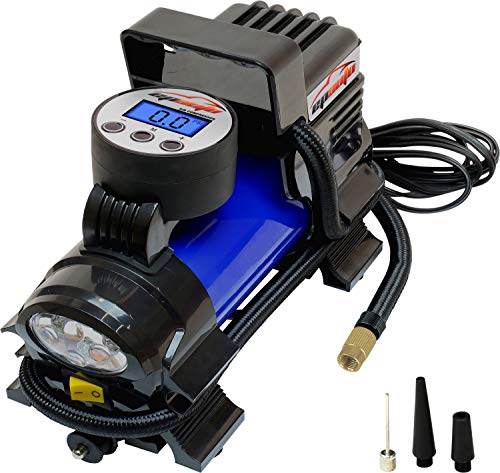
EPAuto 12V DC Portable Air Compressor Pump Digital — Best Budget
The EPAuto is the compact inflator most drivers picture when they picture this category: a digital unit that plugs into the 12-volt socket, reads pressure on a screen, and stops at the pressure you set. Its verified listing keeps the description plain — a 12V DC portable compressor pump and digital tyre inflator — and that plainness is the point. It is a top-up tool for car tyres, executed properly, at the budget end of the market.
Strengths
- Digital gauge with set-and-stop convenience — no squinting at a needle
- Socket-powered simplicity: plug in, inflate, stow
- Budget tier pricing makes it an easy second-vehicle purchase
Trade-offs
- Socket power caps its speed — big or very flat tyres are slow work
- A top-up tool, not an airing-up-after-trails machine
- Compact inflators need cool-down respect on repeated tyres
| Power | 12V DC, vehicle socket |
| Gauge | Digital |
| Type | Compact tyre inflator |
The EPAuto’s job in life is the Tuesday-morning tyre: the one that looks a little soft, reads four pounds low, and would otherwise become a petrol-station errand or, worse, a week of driving on an underinflated tyre. Plugged in at home, it restores pressure in minutes and shuts itself off at the target. That small convenience, repeated monthly, is how tyres last their full life and fuel bills stay honest — most compressor value is boring, and this unit is brilliantly boring.
Respect its class and it will never disappoint you. A completely flat large tyre, four truck tyres in a row, or airing up after off-roading asks for the clamp-powered picks in this guide. The EPAuto is the right tool at the right price for the 90 percent of inflation that is simply keeping car tyres where they belong.
Best for: car owners wanting easy monthly top-ups and emergency insurance / Not suited for: truck tyres, off-road air-ups or fully flat large tyres

VIAIR 88P Portable Air Compressor Kit 120 PSI — Best Mid-Range
The 88P is where casual inflators end and real compressors begin. It trades the socket plug for battery clamps, and its verified listing promises up to 120 PSI across cars, trucks, SUVs, Jeeps and RVs with tyres up to 33 inches. For the household whose largest tyre is a standard truck or SUV fitment, that envelope covers everything — without stepping up to the 400P’s price or flow.
Strengths
- Battery-clamp power at a mid-range tier — real flow without the flagship price
- Verified capability for tyres up to 33 inches covers most trucks and SUVs
- Kit format with the hose and fittings the job actually needs
Trade-offs
- 120 PSI ceiling and flow below the 400P — 35-inch and heavy air-up work is slower
- Clamp ritual: bonnet open, engine running, every time
- Overkill for a small car that only ever needs top-ups
| Max pressure | 120 PSI |
| Tyre capability | Up to 33 inches |
| Connection | Battery clamps |
| Use | Cars, trucks, SUVs, RVs |
Think of the 88P as the family-fleet compressor. The family SUV, the pickup, the trailer tyres before a trip — all sit inside its envelope, and the clamp connection means it fills them at a working pace rather than a waiting pace. It is also a sensible trailer companion: trailer tyres run high pressures and are chronically neglected, and a compressor that reaches their pressures confidently earns its storage space on every trip.
The line between the 88P and the 400P is repetition and tyre size. Occasional fills of standard tyres: the 88P is the rational spend. Regular air-ups of large off-road tyres, or four big tyres in a row every weekend: the 400P’s flow and stamina justify themselves. Buy for the work you actually do monthly, not the expedition you imagine yearly.
Best for: households with trucks and SUVs on standard tyre sizes / Not suited for: 35-inch off-road air-ups or glovebox simplicity seekers

AstroAI AIRUN H Tire Inflator Portable Air Compressor — Best Compact
The AstroAI AIRUN H is the compact inflator designed by someone who has changed a tyre’s pressure at night. Alongside the expected digital gauge and auto shut-off, its verified listing adds an LED light — a small feature that becomes the whole product at 11 p.m. on a shoulder — and a 9.8-foot cord that reaches all four corners of a car from one socket. It is sized for cars, motorcycles and bicycles.
Strengths
- LED light for night and roadside use — genuinely useful, not decoration
- Auto shut-off with digital gauge prevents overinflation guesswork
- 9.8 ft cord reaches every tyre on a car without re-plugging
Trade-offs
- Compact class speed — patience required on large or very low tyres
- Socket-powered ceiling applies, as with all plug-in inflators
- Bright colour options may not suit every glovebox aesthetic
| Power | 12V DC |
| Cord | 9.8 ft |
| Gauge | Digital with auto shut-off |
| Extras | LED light |
Roadside reality drives this design. The flat or soft tyre rarely happens in a lit garage; it happens on a trip, in the dark, with traffic passing. An inflator that lights its own work area, reads its own pressure and stops itself at the target turns a stressful stop into a procedure. The cord length matters in the same moment — a short cord that forces you to move the unit wheel to wheel, re-plugging in the dark, is a design failure this unit avoids.
As with every compact, the discipline is thermal: inflate, and if you are doing several very low tyres, let it breathe between them. Kept in its lane — cars, bikes, motorcycles, the occasional SUV top-up — the AIRUN H is the compact we would hand a new driver, because it is the one most likely to be used correctly at the worst moment.
Best for: drivers wanting the friendliest compact for emergencies and top-ups / Not suited for: truck tyres or repeated full air-ups

ARB CKMP12 Portable Air Compressor 12V — Best for Off-Road
ARB is the name off-roading reaches for when air is not a convenience but a system — the same ecosystem as air lockers and serious recovery gear. The CKMP12 packages that high-performance, high-output compressor engineering in a portable 12-volt form. Its verified listing keeps the claim focused — high performance and output — and the brand’s trail reputation does the rest of the talking.
Strengths
- Expedition-grade engineering from the off-road air specialists
- High-output design intent for repeated, serious air-up work
- Portable format keeps it vehicle-to-vehicle flexible unlike fixed installs
Trade-offs
- Premium tier — the most considered purchase in this guide
- Capability exceeds casual users’ needs by a wide margin
- Trail-grade kit expects the clamp-and-engine-running ritual
| Power | 12V |
| Type | High performance portable compressor |
| Brand focus | Off-road / expedition |
The off-road use case is a stress test no other driving applies: four large tyres, aired down for sand or rock, aired back up at the trailhead, in heat, in dust, far from help, weekend after weekend. Compressors that survive that life earn followings, and ARB’s portable is bought by people who watched lesser units fade mid-tyre. If your compressor is recovery equipment — as essential as the jack — this is your class of product.
For everyone else, honesty applies: the CKMP12’s virtues are wasted on monthly car top-ups, where the EPAuto does the same job for a fraction of the spend. This guide ranks it for the trail because that is where its price converts into reliability you can plan a remote trip around. Buy the compressor your worst day requires.
Best for: off-roaders and overlanders who air down and up every trip / Not suited for: casual car top-ups or budget-first buyers

VIAIR 450P-RV EF Portable Air Compressor 150 PSI — Best for RVs
RV tyres are a compressor’s marathon: large, high-pressure, and numerous — six or more between the coach and a towed trailer. The 450P-RV EF is built for that marathon, with a verified 100 percent duty cycle at 100 PSI, meaning it can run continuously at working pressure without the rest breaks that define lesser units. Its verified listing states 150 PSI and 2.19 CFM, aimed at motorhomes, trailers and trucks.
Strengths
- 100% duty cycle at 100 PSI — continuous running for many-tyre jobs
- 150 PSI ceiling covers high-pressure RV and trailer tyres
- Kit built for RV life, with the reach the job demands
Trade-offs
- The largest, most premium kit in this guide
- Battery-clamp ritual on a big rig takes setup time
- Pure excess for a single car
| Max pressure | 150 PSI |
| Flow | 2.19 CFM |
| Duty cycle | 100% at 100 PSI |
| Use | Motorhomes, trailers, trucks |
Duty cycle is the specification RV owners learn the expensive way. A compressor rated for short bursts will happily inflate the first two coach tyres, then thermal protection parks it — and you — at a rest stop with four tyres to go. A 100 percent duty cycle removes that failure mode entirely: the machine’s stamina matches the job’s length. For a motorhome, where tyre pressure is both a safety system and a fuel-economy system, that reliability is the product.
It is also, frankly, the compressor for people who maintain other people’s tyres — the family member with the good kit who does the rounds before a group trip. If your world includes a trailer, a truck and a relative’s SUV, the 450P-RV’s continuous running turns you into infrastructure. Single-car households should admire it and buy smaller.
Best for: motorhome and trailer owners, and multi-vehicle maintainers / Not suited for: single-car households or glovebox storage
Comparison Table
| Pick | Badge | Key spec | Best for |
|---|---|---|---|
| VIAIR 400P Portable Air Compressor 150 PSI | Best Overall | 150 PSI, 2.30 CFM, up to 35in tyres | mixed fleets, off-roaders and anyone who airs up repeatedly |
| EPAuto 12V DC Portable Air Compressor Pump Digital | Best Budget | Digital gauge, socket powered | car owners wanting easy monthly top-ups and emergency insurance |
| VIAIR 88P Portable Air Compressor Kit 120 PSI | Best Mid-Range | 120 PSI, up to 33in tyres | households with trucks and SUVs on standard tyre sizes |
| AstroAI AIRUN H Tire Inflator Portable Air Compressor | Best Compact | Digital auto-off, LED light, 9.8ft cord | drivers wanting the friendliest compact for emergencies and top-ups |
| ARB CKMP12 Portable Air Compressor 12V | Best for Off-Road | High-output off-road portable | off-roaders and overlanders who air down and up every trip |
| VIAIR 450P-RV EF Portable Air Compressor 150 PSI | Best for RVs | 100% duty cycle at 100 PSI | motorhome and trailer owners, and multi-vehicle maintainers |
How to Choose the Best 12 Volt Portable Air Compressor
Start with your largest tyre and your most repetitive job. Monthly top-ups on a car: a socket-powered digital inflator is enough and its convenience means you will actually do them. A truck or SUV on standard tyres: a battery-clamp mid-ranger like the 88P. Off-road air-ups or RV marathons: flow and duty cycle rule, and the 400P, CKMP12 and 450P-RV class is where you shop. The most common buying error is purchasing by maximum PSI — a ceiling almost every unit shares — instead of by CFM and duty cycle, the numbers that describe speed and stamina.
Connection type is the second decision. Socket plugs are limited by the vehicle’s fuse for that circuit, which caps real power; they win on convenience. Battery clamps demand an open bonnet and a running engine, and win on performance. There is no wrong answer, only mismatched ones: clamp power for a glovebox emergency kit is friction you will avoid using, and socket power for 35-inch tyres is a wait you will regret.
Finally, value the interface. A readable gauge — digital with auto shut-off at the compact end — prevents the over- and under-inflation that sloppy analogue needles invite. Hose and cord length must reach your farthest tyre from the power source. These mundane specs decide whether the compressor gets used monthly or gathers dust, and a used compressor is the only kind that protects tyres.
CFM and Duty Cycle: The Two Numbers That Actually Matter
CFM, cubic feet per minute, is how fast a compressor moves air, and it is measured at a stated pressure — flow falls as pressure rises, which is why honest listings quote CFM with context. A compact inflator moving well under 1 CFM at tyre pressure tops up a car tyre in minutes and a big truck tyre in much longer. A 2.3 CFM machine like the 400P does the same work several times faster. When a listing hides its CFM entirely, assume compact-class flow and buy it as a top-up tool.
Duty cycle is the percentage of an hour the compressor can run before it must rest to cool. A 33 percent duty cycle means roughly twenty minutes of running in an hour; a 100 percent duty cycle — the 450P-RV’s party trick at 100 PSI — means it never has to stop. Duty cycle is invisible on a single car tyre and decisive on four aired-down off-road tyres or six RV tyres. Match the duty cycle to your longest realistic job, with margin.
Together they explain the category’s price ladder better than any feature list. You are not paying for PSI — everyone has PSI. You are paying for air moved per minute and minutes run per hour, wrapped in build quality that survives delivering both for years.
Battery Clamps vs Cigarette Plug: Picking Your Power
The cigarette-lighter socket is the most convenient power source in the vehicle and the weakest. Its fuse — commonly 10 to 15 amps — caps a compressor at modest wattage, and exceeding it pops the fuse mid-job. Socket inflators are engineered under that ceiling, which is why they are compact-class by physics, not by cheapness. For car tyres and top-ups, that ceiling is fine, and the plug-and-go convenience is worth real money in actual use.
Battery clamps bypass the ceiling by drawing directly from the battery, which is how the VIAIR and ARB machines reach their flow rates. The costs are ritual and care: bonnet open, clamps on the correct terminals, engine running to support the draw and protect the battery, cables routed away from belts and fans. It is a five-minute discipline that buys three times the performance.
The hybrid answer some households land on is both: a cheap digital inflator living in each car for top-ups, and one clamp-powered compressor in the garage or the truck for real work. If the budget allows one purchase, buy for the biggest job you do regularly — and let the smaller jobs be slightly over-served rather than the big job be impossible.
Analogue vs Digital Gauges, and Why Accuracy Is a Tyre-Life Issue
A compressor’s gauge is not a display; it is the instrument the whole job is judged by, and its accuracy writes itself into your tyres’ lifespan. Two PSI low across a set of tyres is invisible to the eye and expensive over thirty thousand miles — shoulder wear, heat, fuel. Two high is a smaller, harsher contact patch and a longer stopping distance in the wet. This is why this guide treats gauge quality as a primary filter rather than a feature-list footnote, and why the how-to section insists on verifying with a standalone gauge: compressor gauges, analogue needles especially, drift with age, knocks and heat cycles.
Digital gauges with auto shut-off, the pattern of the compact picks here, remove two human errors at once: misreading a needle in poor light, and overshooting while watching the tyre instead of the dial. Their weakness is dependence on their own sensor, which is exactly what the standalone check catches. Analogue gauges on the clamp-powered kits are typically larger, readable at a glance in daylight, and mechanically honest for years — but they ask the operator to be the shut-off, stopping and checking in bursts.
The professional habit costs almost nothing: one decent standalone gauge, kept in the glovebox, used monthly alongside whichever compressor you own. Two instruments that agree are a measurement; one instrument alone is an opinion. Tyres are too expensive, and their job too important, for opinions.
Compressor Care: Making a Portable Last a Decade
Portable compressors die of three causes: heat abuse, dirty air and neglect in storage. Heat abuse is the duty-cycle story told elsewhere in this guide — long continuous runs on a machine built for bursts. Its prevention is behavioural: work in rotation, let the unit breathe between tyres, and never bag a hot compressor into an airtight case to cook in its own warmth. Ten minutes of cooling after a hard job is the cheapest longevity in this entire category.
Dirty air is the slow killer. Compressors inhale whatever the environment offers — trail dust, garage grit, beach sand — and their intake filters, where fitted, clog silently until the motor strains. Check and clean the intake whenever the unit has worked somewhere dusty, keep it stored in its case rather than loose in a cargo bed, and never run it sitting in the dirt it is trying to protect your tyres from. The machine that fills your tyres breathes the ground it sits on; give it a mat, a tailgate, a clean patch.
Storage neglect finishes the list: hoses kinked hard in a freezing boot crack at the bend; chucks left open collect the grit that later scores a valve stem. Coil loosely, cap the chuck, and run the unit for thirty seconds every few months if it lives unused — seals and motors both prefer occasional gentle work to years of stillness. A compressor maintained this way is a decade-long tool, which is what the good ones in this guide were built to be.
The Compressor as Part of a Road Kit: What Else Belongs With It
A compressor alone is half a system. The other half is small, cheap and decisive, and assembling it is the difference between a driver who handles tyre events and one who telephones them. First, a standalone pressure gauge — the verification instrument this guide keeps recommending — because every compressor gauge is a claim until a second gauge confirms it. Second, a tyre plug kit and the knowledge to use it: many punctures are repairable at the roadside in fifteen minutes, and the compressor is what makes the repair drivable. Third, valve hardware — spare caps, cores and a core tool — because valves fail quietly and strand loudly.
Fourth, light. Tyre events keep night hours, which is why the AstroAI’s LED earned its badge in this guide; a small headtorch in the kit generalises the same idea. Fifth, the unglamorous consumables: gloves for filthy wheels, a mat to kneel on, and the vehicle’s jack and wrench confirmed present and functional — a compressor cannot lift a car, and the spare it inflates still needs mounting. None of this is expensive; all of it is the difference between equipment and a pile of equipment.
Stow the kit as a kit — one bag or case, in the vehicle, inventoried twice a year when you check the spare’s pressure. The twice-yearly ritual takes ten minutes and audits everything at once: compressor runs, gauge agrees, plugs are pliable, torch is charged, spare is full. Drivers who keep that ritual discover their kit’s failures in the driveway, in daylight, at leisure. Everyone else discovers them at midnight, in the rain, at mile marker ninety. The compressor is the heart of the kit, but the kit is what actually saves you.
Reading a Compressor Listing Like an Engineer
Listings in this category reward a sceptical reading, and the skill transfers to every future purchase. Start with the power source and work outward: a socket-powered unit is capped by the vehicle’s fuse, so any airflow claim beside a cigarette plug should be read as compact-class whatever number is printed. A clamp-powered unit’s claims deserve the next question — at what pressure was that CFM measured? Flow at zero pressure is a laboratory vanity figure; flow at 30 or 50 PSI is a filling speed. Brands that state the context, as VIAIR does in the listings verified for this guide, are telling you they expect engineers among their customers.
Duty cycle is the second interrogation. If a listing avoids the subject, the machine’s duty is short and the omission is the answer. If it states a percentage, ask at what pressure — the 450P-RV’s 100 percent at 100 PSI is a complete sentence, while a bare percentage is half of one. Tyre-size capability is the third tell: a stated ceiling — up to 33 inches, up to 35 — is a manufacturer standing behind a use case. Its absence beside truck imagery is marketing wearing engineering’s clothes.
None of this requires cynicism about the products themselves; several picks here are from value brands whose claims need exactly this translation, and they earned their places with their architectures honestly assessed. The skill is simply to buy the machine the specifications describe rather than the machine the photographs suggest. Read listings that way and this category — any category — stops being able to surprise you.
Inflating Beyond Tyres: Trailers, Tools and Toys
A portable compressor’s second life begins where the tyres end. The same machine that maintains the fleet inflates the air mattress that makes the tent civilised, the towable tube at the lake, the paddleboard’s demanding high-pressure chamber with patience, and the sports equipment of every child in the family. Owners consistently report that the compressor they bought for emergencies becomes, within a year, the household’s general air utility — which argues for buying the class you need for tyres and enjoying everything else as dividend.
Two cautions travel with the versatility. Inflatables want volume at low pressure, and a tyre compressor’s gauge and habits are calibrated for the opposite; use the low-pressure nozzle, keep a hand on the item, and stop early — a mattress overfilled by a 150 PSI machine is a short story. And air tools are a different universe: impact wrenches and nailers drink air at rates no portable sustains, and expecting them to is how compressors get cooked. The portable’s honest empire is tyres and inflatables; within it, it rules.
There is a community dividend too. The neighbour with the compressor becomes infrastructure — the borrowed unit at the cul-de-sac’s flat tyre, the air at the kids’ bike rodeo, the top-up before the group trip. Tools that help neighbours have a way of being maintained better and regretted never. Buy the machine your tyres need; lend it like you mean it.
How to Inflate Tyres Correctly with a 12 Volt Compressor
Step 1: Find the target pressure. Use the vehicle manufacturer’s placard — on the driver’s door jamb — not the maximum printed on the tyre sidewall. Check pressures cold, before driving, for a true reading.
Step 2: Set up power properly. For socket inflators, plug in and start the engine if you will be doing more than one tyre. For clamp models, connect red to positive, black to negative or a ground point, keep cables clear of moving parts, and run the engine throughout.
Step 3: Connect the chuck securely. Remove the valve cap, press or thread the chuck on straight, and lock it. A hissing connection is air you are paying time for; reseat it before starting.
Step 4: Inflate to target. On digital units, set the target and let auto shut-off work. On manual units, inflate in bursts and check with the gauge, approaching the target rather than overshooting it.
Step 5: Respect the duty cycle. If you are filling several large tyres with a compact unit, pause between tyres and let the compressor cool. Heat is the enemy of small motors, and patience is cheaper than a replacement.
Step 6: Verify with a second gauge. A cheap standalone gauge check catches a compressor gauge that has drifted. Verify all four tyres, refit valve caps, and note the date — monthly checks are the habit that makes tyres last.
Step 7: Stow it like you will need it tonight. Coil the hose without kinks, let a hot unit cool before bagging it, and store it where you can reach it without unpacking the boot.
Common Buying Mistakes
Buying by PSI alone. A giant maximum-pressure number on a slow, short-duty inflator is marketing. CFM and duty cycle describe the machine; shop by them.
Using the sidewall maximum as the target. The sidewall states a maximum, not a recommendation. The door-jamb placard is the target the vehicle was engineered for.
Running a big job on a compact inflator. Four aired-down truck tyres through a glovebox inflator means overheating, thermal shutdowns and a shortened life. Match the tool class to the job.
Flattening the battery. High-draw compressors on a parked, engine-off vehicle will strand you. Engine running for clamp models and multi-tyre jobs, always.
Never checking pressures between emergencies. A compressor used monthly for two-minute top-ups prevents the flats it would otherwise be used for yearly. The emergency tool is also the maintenance tool.
Final Recommendation
The VIAIR 400P is the best 12 volt portable air compressor for most people with mixed vehicles — verified flow, clamp power, 35-inch capability. Budget and compact honours go to the EPAuto and the AstroAI, the mid-range to the 88P, the trail to the ARB, and the RV marathon to the 450P-RV. Buy by CFM and duty cycle, and the pick makes itself.
Go deeper with the sibling guides: Best 12 Volt Portable Air Compressor For Car for car-specific picks, Best 12 Volt Portable Air Compressor For Truck Tires for heavy rubber, Best 12 Volt Portable Tire Inflator and Best 12 Volt Mini Air Compressor for the compact end, and Best 12 Volt On Board Air Compressor for installed systems. Keep the battery behind it all healthy with Best 12 Volt Portable Battery Charger.
Ready to buy? Start with the top three: VIAIR 400P Portable Air Compressor 150 PSI, EPAuto 12V DC Portable Air Compressor Pump Digital, VIAIR 88P Portable Air Compressor Kit 120 PSI.
Frequently Asked Questions
How long should a 12V compressor take to fill a car tyre?
A compact digital inflator typically adds a few PSI to a car tyre in a couple of minutes and handles a low tyre in under ten. A clamp-powered unit like the 400P is several times faster. A completely flat tyre takes longest because the bead and volume work against you — if a compact inflator is labouring past fifteen minutes, let it rest and cool mid-job.
Can a 12 volt compressor damage my car’s electrics?
Used as directed, no. Socket inflators are designed under the socket’s fuse rating; if a fuse blows, replace it with the same rating, never a larger one. Clamp models connect to the battery like any workshop tool — correct terminals, engine running, cables clear of belts. The realistic risk is a drained battery from engine-off use, not damage.
Do I need the engine running while I inflate?
For one quick car-tyre top-up with a socket inflator, many owners do not bother. For clamp-powered compressors, multiple tyres, or any long job, yes — the engine supports the draw, holds voltage up so the compressor runs at full speed, and guarantees you can drive away afterwards.
What duty cycle do I need?
Match it to your longest job. Single car tyres: any duty cycle works. Four standard truck tyres occasionally: a mid-range unit with breaks is fine. Aired-down off-road tyres every weekend or six RV tyres: buy high duty cycle — up to the 450P-RV’s continuous 100 percent at 100 PSI — and never think about it again.
Why does my compressor get hot and shut off?
That is thermal protection doing its job. Small motors heat under continuous load, and the cut-out saves the motor’s life. Let it cool fully before restarting, shorten your sessions, and if it happens on ordinary jobs, your compressor class is below your tyre class — the fix is a higher-flow, higher-duty machine.
Can I use a 12V compressor for air mattresses and sports balls?
Yes — most include or accept nozzle adapters for inflatables and balls, and the gentle flow of compact inflators suits them well. Use low pressure and a watchful hand: inflatables need volume, not pressure, and a compressor will overfill a ball or mattress faster than you expect.


