Disclosure: airfryerkitchensupply.com is reader-supported. When you buy through links on our site, we may earn an affiliate commission at no extra cost to you.
Where to buy
If you are shopping for best glass teapots with infuser, start with the verified listings below so you compare the exact model, capacity and included parts rather than a look-alike listing. HIWARE 1000ml Glass Teapot with Removable Infuser; Primula Half Moon Teapot with Removable Infuser 40-Ounce; Teabloom Stovetop & Microwave Safe Glass Teapot 40 oz with Removable Glass Infuser; PARACITY Glass Teapot Stovetop 22 oz / 650ml with Removable 18/8 Stainless Steel Infuser; DOPUDO Small Glass Teapot with Infuser 18 oz / 530ml; CNGLASS Glass Teapot Stovetop Safe 20.3 oz with Removable Infuser. The right infuser for your finest regular leaf is the whole decision. Always check price on Amazon on the listing itself, because configurations and included accessories change without notice.
The best glass teapots with infuser succeed or fail on a part many buyers glance at last: the basket. Leaf size, expansion room and clean removal decide whether loose-leaf brewing becomes a pleasure you repeat daily or a fiddle you abandon by February. This guide therefore compares verified infuser pots filter-first, from fine steel mesh that tames rooibos to a glass basket built purely for the blooming display.
Size runs from true single-person pots to a full litre for the table, because infuser brewing is at its best near the volume a pot was designed for. Each pick below was confirmed through the site’s API check, with the infuser type taken from the listed title rather than assumed from photographs.
Match the filter to the finest leaf in your cupboard, size the pot to the session you repeat, and check price on Amazon on the listing itself. The reviews that follow make those two decisions pick by pick.
In this guide
Quick Picks
- Best Overall — HIWARE 1000ml Glass Teapot with Removable Infuser: Best for most loose-leaf households wanting one infuser pot. Check on Amazon
- Best Fine-Mesh Filter — Primula Half Moon Teapot with Removable Infuser 40-Ounce: Best for drinkers of fine-leaf and herbal blends. Check on Amazon
- Best Glass Infuser — Teabloom Stovetop & Microwave Safe Glass Teapot 40 oz with Removable Glass Infuser: Best for blooming-tea hosts wanting a glass infuser. Check on Amazon
- Best Compact Stovetop — PARACITY Glass Teapot Stovetop 22 oz / 650ml with Removable 18/8 Stainless Steel Infuser: Best for small kitchens, desks and travel brewing. Check on Amazon
- Best for One Person — DOPUDO Small Glass Teapot with Infuser 18 oz / 530ml: Best for solo drinkers who brew fresh each time. Check on Amazon
- Best Small Batch — CNGLASS Glass Teapot Stovetop Safe 20.3 oz with Removable Infuser: Best for households wanting an affordable second pot. Check on Amazon
How These Picks Were Chosen
Every pick in this guide was required to show a removable infuser in its listed title — no assumed baskets, no listing-photo guesses. Filtration style, stated capacity and borosilicate or stovetop framing were then recorded from those titles to build the spec lines you see.
Every product named with a link in this guide was cross-checked against Amazon listing data: the brand and model were searched, the listed title was matched to the product described here, and only then was the Amazon link added. Capacities, wattages and features quoted in the spec lines come from those listed titles, not from memory or from third-party roundups. Where a tier or style has no confident API match, this guide says so in plain language instead of inventing a product to fill the slot. Prices are never printed as fixed numbers here because they move; each pick instead points you to check price on Amazon at the moment you shop.
Selection also weighed everyday ownership: how the product behaves on the second month, not just the first day. That means cleaning effort, replacement parts, storage footprint, noise or heat in normal use, and whether the design still makes sense when the novelty fades. Two otherwise similar models were separated by those ownership details, and the comparison table further down makes the trade-offs visible at a glance so you can shortlist in minutes.
The 6 Best Glass Teapots with Infuser
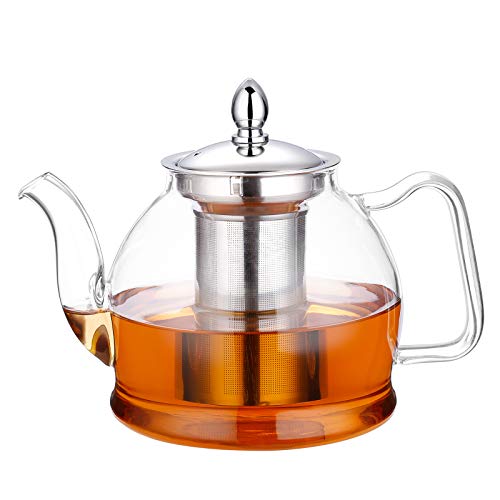
HIWARE 1000ml Glass Teapot with Removable Infuser — Best Overall
Start with the HIWARE if you want the infuser pot that covers the most situations: a full litre of clear glass, a removable infuser with room for leaf to open, and stovetop-safe positioning that keeps heating and steeping in one calm routine.
Key spec (verified): Capacity 1000 ml (from Amazon title); removable infuser; stovetop safe per Amazon title.
Strengths
- Infuser gives leaf room to expand properly
- Clear body shows strength for precise removal
- Litre size covers most household rounds
Trade-offs
- Glass care rules apply every day
- Too large for a true solo brew
- Infuser timing still decides bitterness
Infuser quality decides whether loose leaf is a pleasure or a chore, and the HIWARE gets the fundamentals right: room to expand, clean removal, and a clear view of strength. Whole-leaf teas in particular need that expansion space; cramp them and even expensive leaf tastes flat.
Keep the routine tight — warm the pot, add measured leaf, pour hot water, watch the colour, lift on time — and this pot will outperform fancier vessels used carelessly. Technique beats hardware once the hardware is competent, and this hardware is competent.
Check the current price on Amazon to confirm the exact configuration and what is included before you order.
Best for: Most loose-leaf households wanting one infuser pot / Not suited for: Anyone who finds a litre too large daily
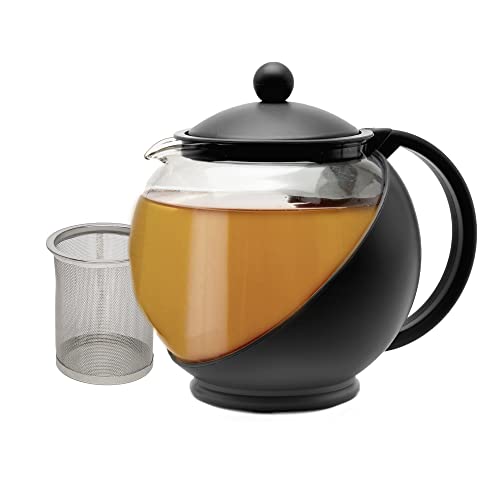
Primula Half Moon Teapot with Removable Infuser 40-Ounce — Best Fine-Mesh Filter
Choose the Primula when leaf size varies in your cupboard. Its reusable fine mesh stainless filter catches the smaller particles that slip through coarse strainers, and dishwasher-safe convenience makes it the easiest infuser pot here to live with daily.
Key spec (verified): Capacity 40 oz (from Amazon title); reusable fine mesh stainless steel filter; dishwasher safe per Amazon title.
Strengths
- Fine mesh suits rooibos and broken-leaf blends
- Reusable filter avoids paper waste
- Dishwasher-safe positioning simplifies care
Trade-offs
- Plainer styling than display-focused pots
- Mesh needs prompt rinsing after fine teas
- Mid size still needs refills for crowds
Fine particles are the quiet test of an infuser pot. Rooibos, broken breakfast blends and herbal mixes all shed sediment that coarse strainers wave through, leaving the last cup gritty. Primula’s fine mesh is built for exactly that cupboard reality.
The ownership story is equally plain: rinse the mesh before residue sets, wash without drama, and the filter keeps performing. If your tea shelf holds many small-leaf blends, this is the most forgiving daily driver in the guide.
Check the current price on Amazon to confirm the exact configuration and what is included before you order.
Best for: Drinkers of fine-leaf and herbal blends / Not suited for: Buyers wanting a display centrepiece first

Teabloom Stovetop & Microwave Safe Glass Teapot 40 oz with Removable Glass Infuser — Best Glass Infuser
Pick the Teabloom when you specifically want a glass infuser rather than steel. The see-through basket keeps blooming teas fully visible, and the combined kettle-and-maker design means nothing is transferred or disturbed between heating and serving.
Key spec (verified): Capacity 40 oz (from Amazon title); removable glass infuser; stovetop & microwave safe per Amazon title.
Strengths
- Glass infuser keeps blooming display unobstructed
- No transfer step between heating and serving
- Full size serves guests as well as daily use
Trade-offs
- Glass infuser is the most delicate here
- Slower ritual than steel-mesh pots
- Fine leaf may pass a glass filter more easily
A glass infuser is a deliberate choice, not a default. It exists for visibility: the flower opens inside a clear basket inside a clear pot, and nothing metal frames the view. For blooming-tea hosts that purity is worth the gentler handling it demands.
For fine-leaf drinkers the calculus flips, because steel mesh filters smaller particles more reliably. Read your own cupboard honestly — blooming and whole-leaf drinkers will love this pot, while rooibos-heavy drinkers should take the Primula above.
Check the current price on Amazon to confirm the exact configuration and what is included before you order.
Best for: Blooming-tea hosts wanting a glass infuser / Not suited for: Fine-leaf drinkers needing the tightest filtration

PARACITY Glass Teapot Stovetop 22 oz / 650ml with Removable 18/8 Stainless Steel Infuser — Best Compact Stovetop
Take the PARACITY 22 oz when counter space and portion size both run small. The borosilicate body and removable 18/8 stainless infuser deliver proper loose-leaf brewing at a travel-and-desk-friendly scale, including camping use as the Amazon title notes.
Key spec (verified): Capacity 22 oz / 650 ml (from Amazon title); 18/8 stainless steel infuser; borosilicate glass per Amazon title.
Strengths
- Quality 18/8 steel infuser at a compact size
- Borosilicate clarity for judging the steep
- Portable scale suits travel and small kitchens
Trade-offs
- Small volume means frequent re-brewing
- Compact handle feel differs from full pots
- Not a family sharing choice
Compact infuser pots live or die on whether the small scale still brews properly, and the PARACITY keeps the essentials: borosilicate glass, a real removable steel infuser, and stovetop-safe use. That combination is rarer at this size than it should be.
Use it where it shines — a desk, a small kitchen, a camper — and brew fresh each time. Small pots punish the nurse-a-half-pot habit less because there is simply less tea to stew, which is a hidden quality advantage.
Check the current price on Amazon to confirm the exact configuration and what is included before you order.
Best for: Small kitchens, desks and travel brewing / Not suited for: Families brewing for a table at once

DOPUDO Small Glass Teapot with Infuser 18 oz / 530ml — Best for One Person
Consider the DOPUDO 18 oz for true single-person brewing. Its compact borosilicate body and 18/8 steel infuser are framed by the maker for individual loose-leaf sessions, which means fresher tea and less wasted leaf across the week.
Key spec (verified): Capacity 18 oz / 530 ml (from Amazon title); 18/8 steel infuser; borosilicate per Amazon title.
Strengths
- Honest single-serving sizing prevents stewed tea
- Steel infuser handles fine leaf reliably
- Compact footprint lives happily on a desk
Trade-offs
- Strictly a one-person pot
- No headroom for unexpected guests
- Small parts need careful drying and storage
Single-person brewing is underserved by family-sized pots, and the DOPUDO answers it directly. An 18 oz pot brewed fresh for one tastes better across a month than a litre pot brewed once and reheated in spirit if not in fact.
The steel infuser keeps the small format versatile across leaf sizes, and the compact body stores where a full pot cannot. If you mostly drink alone, sizing the pot to the drinker is the single biggest upgrade in this entire guide.
Check the current price on Amazon to confirm the exact configuration and what is included before you order.
Best for: Solo drinkers who brew fresh each time / Not suited for: Anyone regularly serving unexpected guests

CNGLASS Glass Teapot Stovetop Safe 20.3 oz with Removable Infuser — Best Small Batch
Select the CNGLASS 20.3 oz when you want a simple, stovetop-safe small pot for loose leaf and blooming teas without extra ceremony. It suits dorms, desks and second pots kept purely for herbal blends that would flavour a main pot.
Key spec (verified): Capacity 20.3 oz (from Amazon title); removable infuser; stovetop safe per Amazon title.
Strengths
- Straightforward stovetop-safe small format
- Removable infuser covers leaf and blooming teas
- Easy second pot for strongly flavoured blends
Trade-offs
- Basic presentation without display extras
- Small capacity limits sharing
- Verify included parts on the listing
Every tea household eventually wants a second small pot: for the mint that flavours everything after it, the smoky blend a partner dislikes, or the bedtime herbal that should not share a vessel with morning black tea. The CNGLASS fills that role without ceremony or cost in attention.
Its stovetop-safe, removable-infuser design keeps it a real brewer rather than a novelty. Keep expectations matched to its simple brief and it will be used constantly — often the truest measure of a good small pot.
Check the current price on Amazon to confirm the exact configuration and what is included before you order.
Best for: Households wanting an affordable second pot / Not suited for: Shoppers wanting included extras without checking
Comparison Table
| Pick | Badge | Key spec | Best for |
|---|---|---|---|
| HIWARE 1000ml Glass Teapot with Removable Infuser | Best Overall | Capacity 1000 ml (from Amazon title); removable infuser; stovetop safe per Amazon title | Most loose-leaf households wanting one infuser pot |
| Primula Half Moon Teapot with Removable Infuser 40-Ounce | Best Fine-Mesh Filter | Capacity 40 oz (from Amazon title); reusable fine mesh stainless steel filter; dishwasher safe per Amazon title | Drinkers of fine-leaf and herbal blends |
| Teabloom Stovetop & Microwave Safe Glass Teapot 40 oz with Removable Glass Infuser | Best Glass Infuser | Capacity 40 oz (from Amazon title); removable glass infuser; stovetop & microwave safe per Amazon title | Blooming-tea hosts wanting a glass infuser |
| PARACITY Glass Teapot Stovetop 22 oz / 650ml with Removable 18/8 Stainless Steel Infuser | Best Compact Stovetop | Capacity 22 oz / 650 ml (from Amazon title); 18/8 stainless steel infuser; borosilicate glass per Amazon title | Small kitchens, desks and travel brewing |
| DOPUDO Small Glass Teapot with Infuser 18 oz / 530ml | Best for One Person | Capacity 18 oz / 530 ml (from Amazon title); 18/8 steel infuser; borosilicate per Amazon title | Solo drinkers who brew fresh each time |
| CNGLASS Glass Teapot Stovetop Safe 20.3 oz with Removable Infuser | Best Small Batch | Capacity 20.3 oz (from Amazon title); removable infuser; stovetop safe per Amazon title | Households wanting an affordable second pot |
Read the table as a shortlist, not a ranking carved in stone. The best choice for best glass teapots with infuser depends on how much you make at once, how you store the product, and which small annoyance you would rather live with. If two rows look tied, prefer the one whose trade-offs match the way you already work in your kitchen, because that is the one you will keep using.
How to Choose a Glass Teapot with an Infuser?
The infuser is the decision; the pot is its housing. Start by naming the finest leaf you brew weekly — whole-leaf oolong, broken breakfast blend, rooibos, herbal mixes — because that leaf sets the filtration you need. Fine steel mesh handles the full range, while glass infusers trade filtration fineness for an unobstructed blooming display.
Expansion room is the second test. Leaf that cannot open cannot flavour properly, so an infuser should look generous relative to the pot rather than like a small cage in a large vessel. Compact pots can still pass this test when the basket fills the body sensibly, as the small picks in this guide are designed to do.
Removal is the third test, and the one you will feel daily. The infuser should lift out cleanly, without dripping across the table or burning fingers, at the exact moment the brew is right. Every pick here uses a removable infuser per its verified title; confirm the handle and lid arrangement on the listing matches your grip and habits.
Glass Infuser vs Steel Mesh: Which Filters Better?
For filtration alone, fine steel mesh wins. It holds back the small particles of rooibos, broken leaf and herbal blends that can pass a glass basket’s slots, keeping the last cup as clean as the first. Daily drinkers with varied cupboards should default to mesh without hesitation.
For display, glass wins just as clearly. A blooming tea opening inside a clear basket inside a clear pot is a single uninterrupted view, and hosts who serve flowering teas regularly are right to choose it and accept gentler handling as the price.
Whole-leaf drinkers sit comfortably with either. Large leaves stay in both basket styles and expand well in both, so the choice returns to ritual preference: the clean mechanics of steel or the ceremony of glass. Let your most-brewed tea, not your most beautiful tea, break the tie.
How Should You Size an Infuser Teapot?
Size to the session you repeat, not the session you imagine. A desk drinker brewing twice daily needs the compact class, where every brew is finished fresh; a household pot covering the breakfast table needs the litre class; and a second small pot for herbs and smoky blends is a legitimate strategy rather than an indulgence.
Remember that infuser pots brew best near their intended volume. Too little water in a large pot leaves the basket barely submerged and the steep uneven; too much in a small pot overflows the leaf’s room to expand. The honest middle — brewing the volume the pot was designed for — tastes noticeably better.
Storage counts too. Infusers have parts that want drying and keeping together, so a pot that fits your shelf with its basket stored inside will stay complete, while an oversized pot exiled to a distant cupboard will slowly stop being used at all.
How to Brew Loose Leaf in a Glass Infuser Teapot, Step by Step?
Set up for a clean steep. Warm the glass pot with a hot rinse, add measured leaf to the infuser rather than the pot, and lower the basket in as you pour so the leaf wets evenly from the first second instead of floating dry on the surface.
Time by colour and taste together. Watch the shade build through the wall, and for a new tea, pour a small taste near the expected finish rather than trusting a timer blindly. When it is right, lift the infuser in one smooth motion and rest it on a small dish, not the counter.
Pour promptly and completely. Infuser pots are designed so the brewed tea leaves the leaf behind; serve the full round rather than leaving a portion sitting warm in the pot, where it continues to pick up bitterness from residue even after the basket is out.
Rinse the basket immediately. Spent leaf releases easily when wet and warm, and stains reluctantly when attended to at once. Dry the infuser fully before storing it in the pot, and the next brew starts neutral instead of carrying yesterday’s flavour.
Common Buying Mistakes
Buying a glass infuser for a rooibos habit is the most predictable disappointment in this category. The fine red particles pass the basket, every cup carries sediment, and the buyer blames the pot. Read your cupboard first: fine leaf means fine mesh, without exception.
Cramming the infuser to ‘make it stronger’ produces the opposite. Packed leaf cannot expand, water cannot circulate, and the brew tastes thin and harsh at once. Use the correct amount of leaf for the volume and let time, not compression, build strength.
Leaving the basket in ‘just while we eat’ steeps the whole pot past its best. The lift takes five seconds at the moment of readiness; skipping it trades an entire pot’s balance for a tiny convenience. Make the lift part of the pour, not an afterthought.
Storing a damp infuser sealed inside the pot invites stale flavours that greet the next brew. Rinse, dry fully in the open, and only then put the set away. That single storage habit keeps a glass infuser pot tasting clean for years.
Final Recommendation
For most shoppers, start with the Best Overall pick and only move away from it for a stated reason: a smaller household, a larger batch, a tighter cupboard, or a strong preference for one material or workflow over another. That discipline keeps you from paying for capacity or features you will never use while still leaving room to step up when your routine genuinely demands it.
Keep exploring the cluster once you have shortlisted: Best Glass Teapots and Best Full Size Teapots Modern cover the closest alternatives, while Best Ceramic Teapots and Best Electric Teapots help if your needs sit just outside this brief. Readers who want the neighbouring angle should also see Best British Teapots.
Going Deeper: What Experienced Owners Learn About Best Glass Teapots With Infuser?
The shortlist above will get best glass teapots with infuser right for most buyers. The sections that follow are for readers who want the second layer — the habits, pairings and small systems that separate a purchase you are satisfied with from one you would repeat without thinking. None of it changes the picks; all of it changes how much value you extract from them.
How Do Different Teas Behave in These Pots?
Black teas are the most forgiving residents of any pot in this guide. They want fully hot water, a confident steep, and they announce their readiness clearly in colour and aroma. A full pot of breakfast blend brewed at the right strength and decanted from the leaf will hold its character across a leisurely table session, which is why black tea remains the benchmark brew for judging any sharing pot.
Green and white teas ask for restraint instead. Cooler water and a shorter steep protect their delicacy, and this is where a visible brew — in the glass picks — or a promptly lifted infuser earns its keep. Over-steeped green tea turns bitter in a way no pot can undo, so treat the first brew of a new green tea as a calibration: taste early, note the time, and repeat the success next round.
Oolong and whole-leaf teas are the expansion test. Their leaves unfurl dramatically and need the roomiest infusers in this guide; cramp them and the celebrated second and third steeps never materialise. If oolong is your daily drink, weight the picks with generous baskets heavily, and consider brewing slightly smaller volumes so each infusion gets the space and attention it deserves.
Herbal blends and rooibos bring the filtration question back. Fine particles demand fine mesh, strongly flavoured blends argue for a dedicated pot or at least a devoted infuser, and caffeine-free evening brewing rewards a smaller second pot kept purely for the purpose. Matching pot and infuser to the full range of your cupboard — not just your favourite tea — is what separates a good purchase from a perfect one.
How Should You Care for Your Teapot So It Lasts for Years?
Rinse promptly, wash gently, dry fully: that nine-word routine covers most teapot longevity. Tea film and tannin build slowly and surrender easily when fresh, while neglected residue demands soaking and scrubbing that no material enjoys. The infuser deserves the same promptness, because a basket rinsed while warm releases its leaf in seconds and resists staining for years.
Descaling matters wherever water is hard. Mineral film dulls glass, roughens pouring and can taint flavour long before it is visible. A periodic soak with a suitable descaling approach for the material, followed by thorough rinsing, restores clarity and keeps spouts pouring cleanly. Follow the maker’s guidance for your specific pot, and never use abrasives on glass or polished finishes.
Storage is the quiet half of care. Keep the pot where it will not be knocked reaching for something else, store the infuser dry inside the pot only once fully dry, and leave enough shelf room that lifting the pot out is a calm motion rather than an extraction. Most chips and cracks happen in cupboards, not in use.
Finally, inspect occasionally with fresh eyes. A hairline crack in glass, a loosening handle, a lid that no longer seats — each is cheap to respect early and expensive to ignore. Retire a cracked pot from hot service without sentimentality; a teapot’s job involves boiling water, and safety outranks attachment every time.
How Do You Serve Tea Well for Guests?
Good hosting with a full pot is mostly choreography decided in advance. Warm the pot, brew slightly before guests sit, lift the infuser at readiness, and bring the pot to the table with cups already warm if the occasion deserves it. That sequence means the host pours and converses instead of disappearing to manage a second brew.
Offer control without fuss. Some guests drink tea weaker, some stronger, and a small jug of hot water on the table lets each person adjust their cup without touching the pot’s balance. Milk, lemon and sweeteners belong within reach rather than on request, so the table’s conversation never has to pause for logistics.
Plan the second pot before the first is empty. If the gathering is going well, a fresh brew announced early beats a stewed top-up every time, and a full-size pot makes that generosity practical. Guests remember the feeling of abundance — tea that kept arriving at its best — far longer than they remember the pot itself.
Afterwards, let the routine close the occasion: leaf to compost, rinse while warm, dry and store. A pot cared for in the ten minutes after guests leave is a pot that will host the next gathering without a preparatory scrub, which is its own quiet form of hospitality.
Shortlist by need: For the all-round infuser, see HIWARE 1000ml Glass Teapot with Removable Infuser. For fine-leaf filtration, see Primula Half Moon Teapot with Removable Infuser 40-Ounce. For the solo fresh brew, see DOPUDO Small Glass Teapot with Infuser 18 oz / 530ml. Each of those links goes to the verified listing for the exact model discussed above, so you can confirm the configuration and check price on Amazon before deciding.
Which Pick Should Each Kind of Household Actually Buy?
The two-person household that drinks tea together morning and evening should resist the glamour of the largest pot. Your best tea comes from a volume you finish while it is fresh, so the moderate full-size picks — or the compact end where this guide offers it — will quietly outperform a showpiece that spends its life half empty and cooling. Buy for the Tuesday you repeat fifty times, not the celebration you host twice.
The family household lives at the other pole: throughput is kindness. A pot that covers the whole table in one brew removes the queue, the re-boil and the negotiation about who waits, and that calm compounds across hundreds of breakfasts. Weight capacity and clean infuser removal above all else, and let individual styling preferences settle whatever remains tied.
The entertainer’s household should buy for the table’s eye as well as its thirst. A pot that arrives as a centrepiece — clear glass with a bloom opening, or a considered modern finish — changes how the same tea feels to drink, and guests genuinely register the care. Pair it with the practical habit of brewing just before sitting, and hosting becomes the easiest argument in this entire guide.
The mixed household, where one person drinks tea seriously and everyone else drinks occasionally, is best served by a capable main pot plus a small second vessel for the specialist’s stronger or stranger brews. That two-pot answer sounds indulgent until you price the alternative: years of compromise brews that fully satisfy nobody at the table.
What Should You Check on the Listing Before You Order?
Confirm the exact capacity and what it measures. Stated volumes are rim capacities in much of this category, so look for the maker’s own framing — cups, ounces or millilitres as given in the verified titles quoted in this guide — and translate it into your mugs before money moves. A two-minute conversion prevents the most common return in the category.
Confirm what is in the box. Infuser included, lid arrangement, any warmer or base component, and for system-style designs exactly which parts the price covers. The verified spec lines in this guide record what the Amazon titles state; the listing is where you confirm the current bundle, because sellers adjust included accessories without renaming the product.
Confirm heat guidance in the maker’s own words. Stovetop-safe, microwave framing and induction readiness are model-specific claims, not category defaults, and the listing for your exact pick is the authority. Following the wrong assumption here is how good pots die young, so treat this check as part of the purchase, not fine print.
Finally, confirm care guidance and replacement-part availability. Infusers are the part most likely to need replacing over a long life, and a maker who sells the basket separately is a maker whose pot you can keep for a decade. That small check, made before ordering, is the difference between a durable good and a disposable one.
A Week With an Infuser Teapot: What Changes?
Day one teaches the lift. The brew reaches colour, the basket comes out in one motion, and the second cup tastes like the first — a small revelation for anyone whose loose-leaf history involves a strainer balanced over a mug and leaf left steeping in the pot out of sheer habit. The infuser’s whole purpose lives in that single repeated gesture.
By midweek the cupboard sorts itself. Fine blends gravitate to the mesh pot, display teas to the glass basket, and the household stops forcing one filter to serve every leaf badly. That sorting, more than any single brew, is what owning the right infuser pot actually buys: each tea finally steeped the way it asks to be.
The desk and the evening develop their own rituals around the compact picks. A small pot brewed fresh at three o’clock replaces the stale mug; a dedicated herbal pot at night keeps mint out of the morning’s black tea. Small infuser pots multiply quietly in households that discover this, because each one solves a specific daily moment.
Cleaning, the feared cost, turns out to be a ten-second tax paid while the leaf is warm. Rinse, shake, dry, done — and the basket that is rinsed two hundred times without drama outlasts the basket scrubbed heroically once a month. The week proves what the guide claimed: the routine, not the hardware, is the product.
One Last Check: Matching the Pot to Your Water, Leaf and Table
Water is the ingredient nobody shops for and everybody tastes. Hard water films glass and dulls delicate teas; if your kettle furs quickly, expect your pot to need the descaling rhythm described earlier, and favour the finishes that forgive it. Soft-water households can choose purely on ritual and looks, a freedom worth enjoying consciously.
Leaf quality deserves a pot that can reveal it. Expensive whole leaf in a cramped infuser is money steeped badly, while modest leaf in a well-sized basket, lifted on time, regularly out-tastes it. Upgrade the match before upgrading the leaf: pot, infuser and habit are the multiplier on everything you brew.
Table habits close the decision. A pot that will be carried full across a room wants balance and a secure lid; a pot that lives where it brews can favour looks. Children, pets and crowded counters are not footnotes — they are design inputs, and the honest household factors them in before ordering, not after the first accident.
Key Takeaways Before You Decide
First, size and filter decide daily happiness more than styling does. A pot whose comfortable volume matches your table, with an infuser matched to your finest regular leaf, will brew better tea on an ordinary Tuesday than a beautiful pot that misses on either count. Settle those two specifications first, using the verified spec lines in this guide, and let the remaining choice be about pleasure.
Second, every material in this guide is a bargain with care. Glass trades handling for visibility, ceramic and porcelain trade a little fragility for table warmth, and steel trades fingerprint discipline for durability. There is no care-free option, only the care your household will actually perform — so choose the bargain you will keep, and the pot will repay you for years.
Third, technique multiplies hardware. Warming the pot, measuring for the volume brewed, watching the steep and lifting the infuser on time will improve any pick here more than stepping up a tier will. Buy the best-matched pot you can justify, then invest the small daily attention that lets it perform, and your tea will taste like the sum of both decisions.
Finally, buy once and buy completely: confirm the bundle on the listing, secure any replacement infuser path, and give the pot a proper home on the shelf. A teapot is a decade-scale object in most kitchens, and the buyers who treat it that way — in selection, in setup and in care — are the ones still praising the same pot long after the novelty of everything else has faded.
How Does the Right Infuser Change Loose-Leaf Economics?
Loose leaf is often cheaper per cup than quality bagged tea, yet households abandon it when the brewing feels wasteful — leaf stewed in the pot, half a batch poured away, sediment ruining the final cup. A correctly sized infuser pot attacks all three losses at once: the lift preserves the un-drunk portion, the right volume prevents over-brewing, and proper filtration makes the last cup as good as the first. The savings are modest per cup and relentless per year.
There is a quality dividend alongside the financial one. Leaf that is removed on time can, for suitable teas, be steeped again, and an infuser makes that second steep a deliberate act rather than an accident of leftovers. Households that discover resteeping with a good basket often find their cost per genuinely enjoyable cup falling even as the teas they buy get better — the rare upgrade that pays for itself in both directions.
One final habit ties the whole system together: rinse the basket, dry it in the open, and set the pot back on its shelf ready rather than merely clean. Readiness is a real feature. The next brew — tomorrow’s breakfast, tonight’s herbal, the unexpected guest’s cup — should begin from a pot that needs nothing, and that state is created in the thirty seconds after the previous brew, not in the minutes before the next one. Households that adopt the reset habit find their infuser pot used more, not less, as the months pass, because every use starts at zero friction. That compounding ease, far more than any single specification, is what the right glass infuser teapot actually delivers across its life.
It is also worth saying plainly what this guide did not do: it did not rank these pots by popularity, by appearance in other roundups, or by any score invented for the occasion. Each pick earned its place through a verified infuser, a stated capacity suited to a real session size, and a filtration style matched to a named kind of drinker. If your household’s habits sit between two picks, choose the one whose trade-offs you mind least — the pot you forgive daily is the pot you keep, and a kept pot brews more good tea in a year than a theoretically superior pot that quietly falls out of use.
Frequently Asked Questions
What is the difference between a glass infuser and a steel infuser?
Visibility versus filtration. A glass infuser keeps blooming and whole-leaf teas fully on display, while fine steel mesh filters smaller particles more completely. Choose by the finest leaf you brew regularly.
Can I brew tea bags in an infuser teapot?
Yes. Remove or ignore the basket, or rest bags in the pot directly, and brew as usual. The infuser simply gives you the loose-leaf option when you want it, which is the point of choosing this style.
How do I stop loose leaf escaping into my cup?
Match filter to leaf first, then pour smoothly and do not overfill the basket. If fine particles persist with a glass infuser, that tea belongs behind fine steel mesh — the Primula-style filter in this guide exists for exactly that case.
Are glass infuser teapots fragile?
The glass basket is the most delicate part and wants gentle rinsing rather than scrubbing. Handled that way it lasts well; households wanting maximum robustness should choose a steel-mesh model from this guide instead.
What size infuser teapot suits one person?
The compact class around 18 to 22 ounces brews a generous single session that finishes fresh. Solo drinkers get better flavour brewing that size twice than brewing a litre once and drinking it stale.
How should I clean the infuser basket?
Rinse it while the leaf is still warm and wet, wash gently, and dry it fully before storing. Prompt attention prevents both staining and the stale flavours that a neglected basket passes to the next brew.


