Disclosure: airfryerkitchensupply.com is reader-supported. When you buy through links on our site, we may earn an affiliate commission at no extra cost to you.
Where to buy
If you are shopping for best glass teapots, start with the verified listings below so you compare the exact model, capacity and included parts rather than a look-alike listing. HIWARE 1000ml Glass Teapot with Removable Infuser; Teabloom Stovetop & Microwave Safe Glass Teapot 40 oz with Removable Glass Infuser; Primula Half Moon Teapot with Removable Infuser 40-Ounce; Ehugos 1500ml (50 oz) Glass Teapot with Removable Infuser; Teabloom Celebration Glass Teapot & Kettle 27 oz with Infuser; Hario ChaCha Kyusu Maru Tea Pot 700ml. Glass rewards careful hands with better tea, because you can see the brew. Always check price on Amazon on the listing itself, because configurations and included accessories change without notice.
Searching for the best glass teapots usually starts with looks, but it should start with behaviour: glass is the only teapot material that shows you the brew itself. Colour, clarity and the moment a steep is ready are all visible, which makes glass the fastest teacher a tea drinker can own. This guide gathers verified glass pots from compact Japanese style to a gathering-sized showpiece, each checked through the site’s API process.
The trade glass asks in return is care — no thermal shock, prompt rinsing, sensible storage. This guide is honest about that bargain in every review, because a buyer who accepts it will love glass for years, while a buyer who denies it should choose ceramic or steel from the neighbouring guides and be happier.
Every linked pick below carries a verified capacity and, where the Amazon title states it, its heat and infuser framing. Use those spec lines, check price on Amazon at the listing, and match the size to the sessions you repeat most often.
In this guide
Quick Picks
- Best Overall — HIWARE 1000ml Glass Teapot with Removable Infuser: Best for most households wanting one clear everyday pot. Check on Amazon
- Best for Blooming Tea — Teabloom Stovetop & Microwave Safe Glass Teapot 40 oz with Removable Glass Infuser: Best for hosts who serve blooming tea as a centrepiece. Check on Amazon
- Best Everyday Value Feel — Primula Half Moon Teapot with Removable Infuser 40-Ounce: Best for daily loose-leaf drinkers wanting easy cleanup. Check on Amazon
- Best Large Capacity — Ehugos 1500ml (50 oz) Glass Teapot with Removable Infuser: Best for large gatherings brewed in a single pot. Check on Amazon
- Best Compact Celebration — Teabloom Celebration Glass Teapot & Kettle 27 oz with Infuser: Best for couples who still want the blooming ritual. Check on Amazon
- Best Japanese Style — Hario ChaCha Kyusu Maru Tea Pot 700ml: Best for japanese-tea drinkers who brew small and fresh. Check on Amazon
How These Picks Were Chosen
Selection for this guide required clear-glass construction confirmed in the listed title, a stated capacity, and a brewing role a household would genuinely repeat. Blooming display, fine filtration and compact freshness were treated as distinct virtues rather than ranked on a single scale.
Every product named with a link in this guide was cross-checked against Amazon listing data: the brand and model were searched, the listed title was matched to the product described here, and only then was the Amazon link added. Capacities, wattages and features quoted in the spec lines come from those listed titles, not from memory or from third-party roundups. Where a tier or style has no confident API match, this guide says so in plain language instead of inventing a product to fill the slot. Prices are never printed as fixed numbers here because they move; each pick instead points you to check price on Amazon at the moment you shop.
Selection also weighed everyday ownership: how the product behaves on the second month, not just the first day. That means cleaning effort, replacement parts, storage footprint, noise or heat in normal use, and whether the design still makes sense when the novelty fades. Two otherwise similar models were separated by those ownership details, and the comparison table further down makes the trade-offs visible at a glance so you can shortlist in minutes.
The 6 Best Glass Teapots
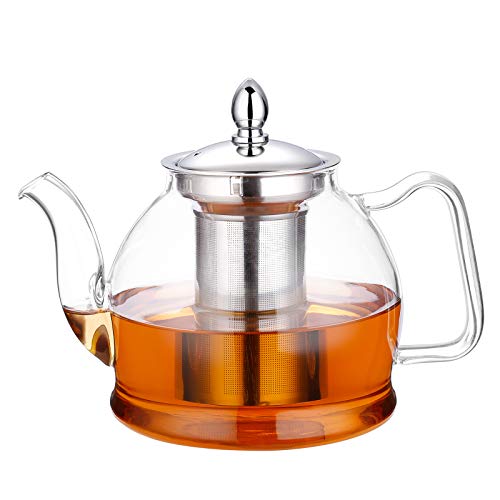
HIWARE 1000ml Glass Teapot with Removable Infuser — Best Overall
Start here if you want the glass pot most households will be happiest with: a clear 1000 ml body, a removable infuser, and stovetop-safe positioning that keeps the routine simple. You see the colour, you lift the infuser, you serve — nothing about it needs explaining to guests.
Key spec (verified): Capacity 1000 ml (from Amazon title); removable infuser; stovetop safe per Amazon title.
Strengths
- Clear wall makes steep strength visible at a glance
- Removable infuser handles loose leaf and blooming teas
- Mid-large size suits couples and small families
Trade-offs
- Glass needs careful handling around hard surfaces
- Mid size still means a second brew for large groups
- Infuser must be lifted promptly to avoid bitterness
What keeps the HIWARE in daily rotation is predictability. The infuser gives leaf room to open, the wall shows you exactly when a green tea is still pale or a black tea has gone far enough, and removal is a single lift. Over weeks that visual feedback teaches better brewing faster than any timer chart.
Care is ordinary glass care: avoid thermal shock by not setting a hot pot on a cold wet surface, rinse the infuser before residue dries, and store it where it will not be knocked. Follow those habits and the pot stays clear instead of slowly clouding.
Check the current price on Amazon to confirm the exact configuration and what is included before you order.
Best for: Most households wanting one clear everyday pot / Not suited for: Anyone careless with glass around stone counters

Teabloom Stovetop & Microwave Safe Glass Teapot 40 oz with Removable Glass Infuser — Best for Blooming Tea
Choose the Teabloom 40 oz when the visual ceremony is the point. The glass infuser keeps blooming teas unobstructed, and the kettle-plus-maker design means the flower you heated is the flower you pour, with no transfer to spoil the display.
Key spec (verified): Capacity 40 oz (from Amazon title); removable glass infuser; stovetop & microwave safe per Amazon title.
Strengths
- Glass infuser preserves the full blooming display
- Dual kettle-and-maker role cuts washing up
- Generous size serves guests without a second brew
Trade-offs
- Glass infuser needs gentler care than steel
- Ceremony suits unhurried brewing best
- Not ideal for very fine leaf that slips glass filters
Blooming teas expose weak glass-pot design quickly: a cramped infuser crushes the flower and a transfer step tears it. Teabloom avoids both by steeping in the serving vessel with room to unfurl. Hosts notice the difference immediately, because the centrepiece arrives intact.
For everyday loose leaf the same pot still works, but judge it honestly — if you never brew blooming teas, you are paying in care and attention for a display you will not use. Buy it for the ritual and it delights; buy it as a generic pot and the options above or below may serve you better.
Check the current price on Amazon to confirm the exact configuration and what is included before you order.
Best for: Hosts who serve blooming tea as a centrepiece / Not suited for: Drinkers who never brew blooming teas
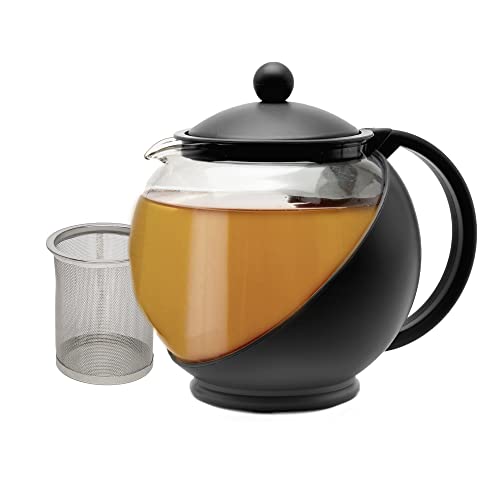
Primula Half Moon Teapot with Removable Infuser 40-Ounce — Best Everyday Value Feel
Pick the Primula Half Moon when you want a straightforward 40-ounce glass maker with a reusable fine mesh stainless filter and dishwasher-safe convenience. It is the pragmatic option for daily loose-leaf drinkers who value easy cleanup over ceremony.
Key spec (verified): Capacity 40 oz (from Amazon title); reusable fine mesh stainless steel filter; dishwasher safe per Amazon title.
Strengths
- Fine mesh filter suits smaller leaf particles
- Dishwasher-safe positioning eases daily cleanup
- Half-moon shape pours and stores neatly
Trade-offs
- Utilitarian look will not thrill design hunters
- Black accents may not match every scheme
- Filter care still matters for staining teas
Primula’s strength is the absence of friction. The fine mesh handles the broken leaf and blends that escape coarser strainers, the pot goes through normal cleanup without special rituals, and the shape sits stably on the counter. Daily drinkers feel that ease every single morning.
It will not win a beauty contest against the more sculptural pots here, and it does not try to. Judge it as the workhorse: the pot you reach for when tea is a habit rather than an event, and the one guests can use without instructions.
Check the current price on Amazon to confirm the exact configuration and what is included before you order.
Best for: Daily loose-leaf drinkers wanting easy cleanup / Not suited for: Buyers prioritising sculptural design

Ehugos 1500ml (50 oz) Glass Teapot with Removable Infuser — Best Large Capacity
Take the Ehugos when one pot must cover a crowd. At 1500 ml it is the volume leader in this guide, with a stainless infuser and a clear wall that turns steep timing into something you judge by eye instead of by timer alone.
Key spec (verified): Capacity 1500 ml / 50 oz (from Amazon title); stainless infuser; stovetop safe per Amazon title.
Strengths
- Largest capacity here for gatherings
- Stainless infuser is sturdy for daily use
- See-through body prevents over-steeping by eye
Trade-offs
- Big body is awkward in crowded cupboards
- Large brews cool if you drink slowly alone
- Too much pot for a single-cup routine
Volume changes brewing maths, and the Ehugos makes that visible. Leaf for a full 1500 ml pot needs proper measuring, water should be fully hot before it meets the leaf, and serving should start soon after the infuser comes out. Get those three things right and large-pot tea tastes as deliberate as a single cup.
The reward is hospitality without juggling. One brew covers brunch, the table watches the colour build together, and nobody waits for a second kettle. If your gatherings are frequent, that calm alone justifies the shelf space it asks for.
Check the current price on Amazon to confirm the exact configuration and what is included before you order.
Best for: Large gatherings brewed in a single pot / Not suited for: Solo drinkers with limited storage
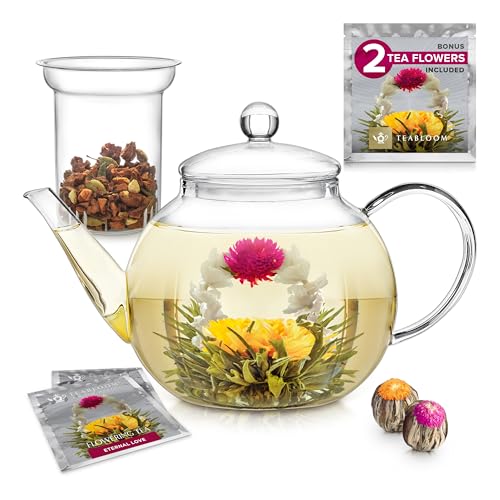
Teabloom Celebration Glass Teapot & Kettle 27 oz with Infuser — Best Compact Celebration
Consider the Teabloom Celebration 27 oz for smaller households that still want the blooming-tea moment. The heat-resistant glass and removable glass infuser keep the ritual intact at a size that suits two generous mugs better than a full table.
Key spec (verified): Capacity 27 oz (from Amazon title); removable glass infuser; heat-resistant glass per Amazon title.
Strengths
- Right-sized for two without wasteful volume
- Heat-resistant glass per Amazon title
- Keeps the blooming ritual at a compact scale
Trade-offs
- Too small for family sharing in one brew
- Glass infuser rewards careful rinsing
- Blooming focus may exceed everyday needs
Smaller glass pots solve a real problem: the solo or couple brew that a family pot ruins by cooling too fast and tasting stewed by the second hour. The Celebration size keeps the Teabloom experience — heat-resistant glass, glass infuser, blooming teas included in the concept — at a volume you will actually finish fresh.
Treat it as the two-mug pot. Brew, pour both mugs, and start fresh next time rather than nursing a cooling half-pot. That discipline is why smaller pots often produce better-tasting tea across a week than larger ones used carelessly.
Check the current price on Amazon to confirm the exact configuration and what is included before you order.
Best for: Couples who still want the blooming ritual / Not suited for: Families needing one pot for everyone

Hario ChaCha Kyusu Maru Tea Pot 700ml — Best Japanese Style
Select the Hario ChaCha Kyusu Maru when your taste runs to Japanese-style brewing and a more compact 700 ml pot. Hario’s glass heritage shows in the clean form, and the size rewards drinkers who brew fresh, smaller pots more often.
Key spec (verified): Capacity 700 ml (from Amazon title).
Strengths
- Compact size encourages fresh, frequent brews
- Clean Japanese form suits minimal kitchens
- Trusted glass specialist brand heritage
Trade-offs
- No infuser detail in Amazon title — check listing
- Smaller volume needs refills for guests
- Specialist style suits tea-focused buyers best
The Hario rewards a different rhythm: smaller, fresher, more frequent. Japanese tea culture built kyusu brewing around exactly that idea, and the 700 ml Maru format fits drinkers who would rather brew twice fresh than once large. Sencha and other delicate teas particularly suit the cadence.
Because the Amazon title confirms capacity without detailing an infuser, check the listing carefully for the strainer arrangement before ordering, and match it to your leaf. Buyers who do that small check get a refined pot with a clear purpose instead of a compromise.
Check the current price on Amazon to confirm the exact configuration and what is included before you order.
Best for: Japanese-tea drinkers who brew small and fresh / Not suited for: Anyone who will not verify the strainer on the listing
Comparison Table
| Pick | Badge | Key spec | Best for |
|---|---|---|---|
| HIWARE 1000ml Glass Teapot with Removable Infuser | Best Overall | Capacity 1000 ml (from Amazon title); removable infuser; stovetop safe per Amazon title | Most households wanting one clear everyday pot |
| Teabloom Stovetop & Microwave Safe Glass Teapot 40 oz with Removable Glass Infuser | Best for Blooming Tea | Capacity 40 oz (from Amazon title); removable glass infuser; stovetop & microwave safe per Amazon title | Hosts who serve blooming tea as a centrepiece |
| Primula Half Moon Teapot with Removable Infuser 40-Ounce | Best Everyday Value Feel | Capacity 40 oz (from Amazon title); reusable fine mesh stainless steel filter; dishwasher safe per Amazon title | Daily loose-leaf drinkers wanting easy cleanup |
| Ehugos 1500ml (50 oz) Glass Teapot with Removable Infuser | Best Large Capacity | Capacity 1500 ml / 50 oz (from Amazon title); stainless infuser; stovetop safe per Amazon title | Large gatherings brewed in a single pot |
| Teabloom Celebration Glass Teapot & Kettle 27 oz with Infuser | Best Compact Celebration | Capacity 27 oz (from Amazon title); removable glass infuser; heat-resistant glass per Amazon title | Couples who still want the blooming ritual |
| Hario ChaCha Kyusu Maru Tea Pot 700ml | Best Japanese Style | Capacity 700 ml (from Amazon title) | Japanese-tea drinkers who brew small and fresh |
Read the table as a shortlist, not a ranking carved in stone. The best choice for best glass teapots depends on how much you make at once, how you store the product, and which small annoyance you would rather live with. If two rows look tied, prefer the one whose trade-offs match the way you already work in your kitchen, because that is the one you will keep using.
How to Choose a Glass Teapot?
Begin with the glass itself. Every pick in this guide was verified through the site’s API check, and the titles that state borosilicate or heat-resistant glass tell you the pot is framed for hot brewing rather than cold service. Treat any glass pot without a clear heat framing as a question to resolve on the listing, not an assumption to make at home.
Size follows ritual. Compact glass pots around the 18 to 27 ounce band brew fresh for one or two and reward frequent small batches; the 40 ounce class serves a table; and the largest option here covers gatherings in a single brew. Glass cools faster than ceramic, so a pot matched to what you will finish promptly will taste better than a larger pot nursed for hours.
Then weigh the infuser style. Glass infusers preserve the blooming display, fine steel mesh filters smaller leaf more completely, and a simple strainer lid suits bagged and large-leaf teas. Your cupboard decides: match the filter to the finest leaf you brew regularly, not the most photogenic tea you brew twice a year.
Are Glass Teapots Practical for Everyday Use?
Yes, with honest habits. Glass asks for three things: no thermal shock, prompt rinsing after dark teas, and storage where it will not be knocked. Households that give it those three things use glass daily for years; households that treat it like steel will break it and blame the material.
The payoff for that care is feedback no opaque pot can give. You watch colour build, you see when a delicate green is still pale, and you catch over-steeping before it happens. Beginners improve faster with glass for exactly this reason — the pot teaches while it brews.
Stovetop-safe framing, where the Amazon title states it, adds a further practical option: heating and steeping in one vessel. Even then, follow the listing’s heat guidance, use moderate heat, and never set a hot pot down on a cold wet surface. Practicality is a partnership between the pot and the routine.
Glass Teapot Sizes: Which One Fits Your Table?
Solo and couple drinkers should look first at the compact end, where a fresh small brew beats a large cooling one every day of the week. The tea tastes brighter, the leaf goes further in perceived quality, and the pot stores in spaces a family pot cannot enter.
Families and hosts belong in the 40 ounce class and above. One full brew that covers the table removes the kettle queue, and glass turns the wait into part of the pleasure as everyone watches the colour arrive together.
Between those poles, choose by your second-most-common occasion rather than your most common one. A pot that covers daily drinking and stretches to weekend guests will be loved; a pot bought only for daily use that fails every Sunday will quietly frustrate you for years.
How to Brew in a Glass Teapot Without Ruining the Tea — or the Pot?
Handle temperature transitions gently. Rinse a cold glass pot with warm water before adding fully hot brewing water, and rest a hot pot on a dry mat or trivet rather than a cold stone counter. These two habits prevent the thermal shock that ends most glass pots’ lives.
Dose by volume and watch the wall. Measure leaf for the amount you are brewing, pour at the temperature the tea prefers, and use the colour as your primary gauge — pale gold for delicate teas, deep amber for robust ones — lifting the infuser the moment the shade is right.
Pour with the infuser’s behaviour in mind. A smooth, unhurried pour keeps leaf in the basket and tea in the cup; a rushed tilt floods the spout with leaf. If your pot uses a glass infuser, support the lid as you pour until the motion is familiar.
Clean little and often. Rinse the pot and infuser straight after use, wash gently without abrasives, and dry the infuser fully before storing. Tea film builds slowly and removes easily when fresh; left for days it clouds the glass that is the entire reason you bought the pot.
Common Buying Mistakes
Treating glass like steel is the fastest route to a broken pot and a wrong conclusion. Knocks in the sink, thermal shock on cold counters and overfilled boiling are user errors that no brand survives. Decide before buying whether your household’s habits suit glass, and buy ceramic or steel without regret if they do not.
Buying the largest glass pot for solo drinking wastes both tea and pleasure. The brew cools, steeps past its best while you work through it, and the second half tastes like a different, worse drink. Size the pot to the drinker and brew fresh more often.
Choosing a glass infuser for a fine-leaf cupboard frustrates daily. Glass baskets are for display and whole leaf; rooibos and broken blends belong behind fine steel mesh. Match the filter to your finest regular tea or accept sediment as a permanent guest.
Neglecting prompt rinsing clouds the pot you bought for clarity. Tea film is patient and cumulative, and restoring neglected glass takes far more effort than the ten-second rinse that prevents it. Build the rinse into the serving routine itself.
Final Recommendation
For most shoppers, start with the Best Overall pick and only move away from it for a stated reason: a smaller household, a larger batch, a tighter cupboard, or a strong preference for one material or workflow over another. That discipline keeps you from paying for capacity or features you will never use while still leaving room to step up when your routine genuinely demands it.
Keep exploring the cluster once you have shortlisted: Best Glass Teapots With Infuser and Best Full Size Teapots Modern cover the closest alternatives, while Best Ceramic Teapots and Best Electric Teapots help if your needs sit just outside this brief. Readers who want the neighbouring angle should also see Best British Teapots.
Going Deeper: What Experienced Owners Learn About Best Glass Teapots?
The shortlist above will get best glass teapots right for most buyers. The sections that follow are for readers who want the second layer — the habits, pairings and small systems that separate a purchase you are satisfied with from one you would repeat without thinking. None of it changes the picks; all of it changes how much value you extract from them.
How Do Different Teas Behave in These Pots?
Black teas are the most forgiving residents of any pot in this guide. They want fully hot water, a confident steep, and they announce their readiness clearly in colour and aroma. A full pot of breakfast blend brewed at the right strength and decanted from the leaf will hold its character across a leisurely table session, which is why black tea remains the benchmark brew for judging any sharing pot.
Green and white teas ask for restraint instead. Cooler water and a shorter steep protect their delicacy, and this is where a visible brew — in the glass picks — or a promptly lifted infuser earns its keep. Over-steeped green tea turns bitter in a way no pot can undo, so treat the first brew of a new green tea as a calibration: taste early, note the time, and repeat the success next round.
Oolong and whole-leaf teas are the expansion test. Their leaves unfurl dramatically and need the roomiest infusers in this guide; cramp them and the celebrated second and third steeps never materialise. If oolong is your daily drink, weight the picks with generous baskets heavily, and consider brewing slightly smaller volumes so each infusion gets the space and attention it deserves.
Herbal blends and rooibos bring the filtration question back. Fine particles demand fine mesh, strongly flavoured blends argue for a dedicated pot or at least a devoted infuser, and caffeine-free evening brewing rewards a smaller second pot kept purely for the purpose. Matching pot and infuser to the full range of your cupboard — not just your favourite tea — is what separates a good purchase from a perfect one.
How Should You Care for Your Teapot So It Lasts for Years?
Rinse promptly, wash gently, dry fully: that nine-word routine covers most teapot longevity. Tea film and tannin build slowly and surrender easily when fresh, while neglected residue demands soaking and scrubbing that no material enjoys. The infuser deserves the same promptness, because a basket rinsed while warm releases its leaf in seconds and resists staining for years.
Descaling matters wherever water is hard. Mineral film dulls glass, roughens pouring and can taint flavour long before it is visible. A periodic soak with a suitable descaling approach for the material, followed by thorough rinsing, restores clarity and keeps spouts pouring cleanly. Follow the maker’s guidance for your specific pot, and never use abrasives on glass or polished finishes.
Storage is the quiet half of care. Keep the pot where it will not be knocked reaching for something else, store the infuser dry inside the pot only once fully dry, and leave enough shelf room that lifting the pot out is a calm motion rather than an extraction. Most chips and cracks happen in cupboards, not in use.
Finally, inspect occasionally with fresh eyes. A hairline crack in glass, a loosening handle, a lid that no longer seats — each is cheap to respect early and expensive to ignore. Retire a cracked pot from hot service without sentimentality; a teapot’s job involves boiling water, and safety outranks attachment every time.
How Do You Serve Tea Well for Guests?
Good hosting with a full pot is mostly choreography decided in advance. Warm the pot, brew slightly before guests sit, lift the infuser at readiness, and bring the pot to the table with cups already warm if the occasion deserves it. That sequence means the host pours and converses instead of disappearing to manage a second brew.
Offer control without fuss. Some guests drink tea weaker, some stronger, and a small jug of hot water on the table lets each person adjust their cup without touching the pot’s balance. Milk, lemon and sweeteners belong within reach rather than on request, so the table’s conversation never has to pause for logistics.
Plan the second pot before the first is empty. If the gathering is going well, a fresh brew announced early beats a stewed top-up every time, and a full-size pot makes that generosity practical. Guests remember the feeling of abundance — tea that kept arriving at its best — far longer than they remember the pot itself.
Afterwards, let the routine close the occasion: leaf to compost, rinse while warm, dry and store. A pot cared for in the ten minutes after guests leave is a pot that will host the next gathering without a preparatory scrub, which is its own quiet form of hospitality.
Shortlist by need: For the everyday default, see HIWARE 1000ml Glass Teapot with Removable Infuser. For the blooming display, see Teabloom Stovetop & Microwave Safe Glass Teapot 40 oz with Removable Glass Infuser. For the largest table, see Ehugos 1500ml (50 oz) Glass Teapot with Removable Infuser. Each of those links goes to the verified listing for the exact model discussed above, so you can confirm the configuration and check price on Amazon before deciding.
Which Pick Should Each Kind of Household Actually Buy?
The two-person household that drinks tea together morning and evening should resist the glamour of the largest pot. Your best tea comes from a volume you finish while it is fresh, so the moderate full-size picks — or the compact end where this guide offers it — will quietly outperform a showpiece that spends its life half empty and cooling. Buy for the Tuesday you repeat fifty times, not the celebration you host twice.
The family household lives at the other pole: throughput is kindness. A pot that covers the whole table in one brew removes the queue, the re-boil and the negotiation about who waits, and that calm compounds across hundreds of breakfasts. Weight capacity and clean infuser removal above all else, and let individual styling preferences settle whatever remains tied.
The entertainer’s household should buy for the table’s eye as well as its thirst. A pot that arrives as a centrepiece — clear glass with a bloom opening, or a considered modern finish — changes how the same tea feels to drink, and guests genuinely register the care. Pair it with the practical habit of brewing just before sitting, and hosting becomes the easiest argument in this entire guide.
The mixed household, where one person drinks tea seriously and everyone else drinks occasionally, is best served by a capable main pot plus a small second vessel for the specialist’s stronger or stranger brews. That two-pot answer sounds indulgent until you price the alternative: years of compromise brews that fully satisfy nobody at the table.
What Should You Check on the Listing Before You Order?
Confirm the exact capacity and what it measures. Stated volumes are rim capacities in much of this category, so look for the maker’s own framing — cups, ounces or millilitres as given in the verified titles quoted in this guide — and translate it into your mugs before money moves. A two-minute conversion prevents the most common return in the category.
Confirm what is in the box. Infuser included, lid arrangement, any warmer or base component, and for system-style designs exactly which parts the price covers. The verified spec lines in this guide record what the Amazon titles state; the listing is where you confirm the current bundle, because sellers adjust included accessories without renaming the product.
Confirm heat guidance in the maker’s own words. Stovetop-safe, microwave framing and induction readiness are model-specific claims, not category defaults, and the listing for your exact pick is the authority. Following the wrong assumption here is how good pots die young, so treat this check as part of the purchase, not fine print.
Finally, confirm care guidance and replacement-part availability. Infusers are the part most likely to need replacing over a long life, and a maker who sells the basket separately is a maker whose pot you can keep for a decade. That small check, made before ordering, is the difference between a durable good and a disposable one.
A Week With a Glass Teapot: What Changes?
The first change is attention. A glass pot on a weekday morning turns steeping from a timed guess into a watched moment: the colour blooms, you lift the infuser at the shade you have learned, and the cup tastes like evidence that the small pause was worth it. Beginners feel their brewing improve within days for exactly this reason.
The second change is care, quickly becoming habit. The pot gets its warm rinse, rests on its mat, and is rinsed while the last cup is still being drunk. None of it takes a minute, and by the end of the first week it no longer registers as care at all — it is simply how tea is made in this kitchen now.
Guests produce the third change: the pot starts conversations. A blooming tea opening in clear glass, or even an ordinary amber steep visible from across the table, gives people something shared to watch while the kettle’s work finishes. Hosts who entertain even occasionally find this social value quietly decisive.
The honest fourth change is selectivity. Glass households become choosier about where the pot travels and who washes it, and they accept that bargain openly. If your week, honestly imagined, includes rough handling and rushed sinks, let this section talk you into ceramic or steel — the right pot is the one your real week can keep.
One Last Check: Matching the Pot to Your Water, Leaf and Table
Water is the ingredient nobody shops for and everybody tastes. Hard water films glass and dulls delicate teas; if your kettle furs quickly, expect your pot to need the descaling rhythm described earlier, and favour the finishes that forgive it. Soft-water households can choose purely on ritual and looks, a freedom worth enjoying consciously.
Leaf quality deserves a pot that can reveal it. Expensive whole leaf in a cramped infuser is money steeped badly, while modest leaf in a well-sized basket, lifted on time, regularly out-tastes it. Upgrade the match before upgrading the leaf: pot, infuser and habit are the multiplier on everything you brew.
Table habits close the decision. A pot that will be carried full across a room wants balance and a secure lid; a pot that lives where it brews can favour looks. Children, pets and crowded counters are not footnotes — they are design inputs, and the honest household factors them in before ordering, not after the first accident.
Key Takeaways Before You Decide
First, size and filter decide daily happiness more than styling does. A pot whose comfortable volume matches your table, with an infuser matched to your finest regular leaf, will brew better tea on an ordinary Tuesday than a beautiful pot that misses on either count. Settle those two specifications first, using the verified spec lines in this guide, and let the remaining choice be about pleasure.
Second, every material in this guide is a bargain with care. Glass trades handling for visibility, ceramic and porcelain trade a little fragility for table warmth, and steel trades fingerprint discipline for durability. There is no care-free option, only the care your household will actually perform — so choose the bargain you will keep, and the pot will repay you for years.
Third, technique multiplies hardware. Warming the pot, measuring for the volume brewed, watching the steep and lifting the infuser on time will improve any pick here more than stepping up a tier will. Buy the best-matched pot you can justify, then invest the small daily attention that lets it perform, and your tea will taste like the sum of both decisions.
Finally, buy once and buy completely: confirm the bundle on the listing, secure any replacement infuser path, and give the pot a proper home on the shelf. A teapot is a decade-scale object in most kitchens, and the buyers who treat it that way — in selection, in setup and in care — are the ones still praising the same pot long after the novelty of everything else has faded.
How Does a Glass Teapot Change the Way You Learn Tea?
Most tea instruction is written for people who cannot see their brew, so it leans on timers, temperatures and faith. A glass pot quietly replaces faith with evidence. Within a fortnight of daily use, most drinkers develop an eye for their teas — the exact amber of a breakfast blend at readiness, the pale gold where a green tea is about to turn — and that eye transfers to every other vessel they will ever use. In that sense a glass teapot is not just a brewer; it is the cheapest tea education available.
It also changes how households talk about tea. ‘Too strong’ stops being an accusation and becomes a shade anyone can point to through the wall of the pot, and preferences get calibrated in a shared visual language. Families discover, sometimes with surprise, that they never disagreed about tea at all — they disagreed about a steep nobody could see. The pot that settles that argument earns a permanent place well beyond its brewing duties.
One final habit separates glass-pot owners who stay delighted from those who drift back to opaque pots: keep the glass pot in the light, literally. A clear pot stored at the front of a shelf gets reached for; a clear pot buried behind ceramics gets forgotten, and forgotten pots gather the film and dust that make the next use feel like a project. Visibility is the material’s nature — honour it in storage as in brewing, and the pot will keep teaching, pouring and pleasing long after its first month. That is the whole quiet argument for glass, and it only asks for the small, steady care this guide has described.
Frequently Asked Questions
Are glass teapots safe to use with boiling water?
Pots framed as heat-resistant or borosilicate and stovetop-safe in their verified titles are made for hot brewing. Still avoid thermal shock: warm a cold pot first and rest a hot pot on a dry mat, never a cold wet surface.
What is the advantage of a glass teapot over ceramic?
Visibility. You judge strength by colour, watch blooming teas open, and learn steeping faster because the pot shows you what is happening. Ceramic holds a more traditional table feel and forgives rougher handling.
Can I put a glass teapot on the stove?
Only when the verified title says stovetop safe, and then with moderate heat and the listing’s guidance followed. Many glass pots are brewers only and belong with a separate kettle. Check the exact model before assuming.
Why does my glass teapot drip when pouring?
Usually pace and fill level. Pour smoothly rather than tipping sharply, do not fill to the rim, and keep the lid seated or supported. If dripping persists with good technique, the spout design simply suits a slower pour.
How do I stop a glass teapot staining?
Rinse promptly after dark teas, wash the infuser before residue dries, and clean gently without abrasives. Fresh film lifts easily; neglected film clouds the glass and takes real effort to restore.
Which size glass teapot is best for two people?
The compact-to-mid band around 27 to 40 ounces covers two generous mugs with a small top-up. Couples who drink one mug each can go smaller and brew fresher; the right size is the one you finish while it is still at its best.


