Disclosure: airfryerkitchensupply.com is reader-supported. When you buy through links on our site, we may earn an affiliate commission at no extra cost to you.
Where to buy
Every pick in this guide to the best game meat grinders was confirmed through the Amazon Creators catalogue for this site before it earned a link, so the model names and configurations below match what you will actually find on the product page. Start with the shortlist here, then read the full reviews before you decide: LEM BigBite Dual #22 · MEAT! 1HP #22 · Weston #12 · VEVOR #12 · LEM BigBite #8 · LEM MightyBite #8. On each product page, use the “check price on Amazon” habit rather than trusting any number quoted elsewhere, because sink, grinder and footwear pricing moves with size, finish and season.
The best game meat grinders are judged in November, not in a showroom: a deer in the cooler, an elk quartered on the table, a season’s worth of burger and sausage to process before the meat warms. Game grinding is heavier work than beef from a butcher — more sinew, more silverskin, colder and denser trim, and batches measured in tens of pounds. A grinder that charms with five pounds of chuck can become a long, hot, smearing afternoon with twenty pounds of venison, which is why this guide starts at the #8 size and spends most of its time at #12 and #22.
The picks below were chosen for the realities of wild game: metal drive systems that tolerate sinew, throats wide enough to keep a processing line moving, plates in the coarse sizes game sausage wants, and duty cycles that respect a full harvest rather than a recipe. Every model was confirmed through this site’the Amazon catalogue. We also note, honestly, where each machine’s ceiling sits — the grinder that is perfect for one deer a year is not the grinder for an elk camp, and pretending otherwise helps no one.
A word on expectations: no grinder redeems poor field care. Meat that was cooled slowly, trimmed carelessly or ground warm will taste like it in any machine. The guide sections after the reviews cover the game-specific workflow — trimming, chilling, plate choice, batch rhythm — that lets a good grinder produce the clean, mild grind wild meat deserves.
In this guide
Quick Picks
If you only have two minutes, this is the whole guide to the best game meat grinders in one screen. Each pick carries the same badge it keeps in its full review further down, so you can jump straight to the detailed section for the one that fits your kitchen, your budget tier and the way you actually cook, clean or unwind at home.
- LEM BigBite Dual Grind #22 Meat Grinder, 1.0 HP — Best Overall for Game. Dual-grind #22 power: two grinds in one pass, 1.0 HP, stainless — the fastest route from quartered game to finished grind. Check price on Amazon
- MEAT! 1 HP Pro-Grade Meat Grinder #22 — Best Pro-Grade Alternative. A pro-grade #22 in stainless with coarse and fine plates included — commercial intent from a game-processing specialist brand. Check price on Amazon
- Weston #12 Electric Meat Grinder and Sausage Stuffer, 750 Watt — Best #12 for Most Hunters. The #12 sweet spot: a 1 HP-class motor, stainless plates and a maker’s stated four-pounds-a-minute pace for deer-sized batches. Check price on Amazon
- VEVOR Meat Grinder #12, 750W / 1 HP Motor — Best Value #12. A #12 with two plates, three stuffing tubes and an ETL listing at a value tier — throughput-per-dollar for game households. Check price on Amazon
- LEM BigBite #8 Meat Grinder, 0.5 HP — Best #8 for Smaller Harvests. BigBite auger design in a 0.5 HP #8 stainless body — flagship grinding manners for one-deer and small-game households. Check price on Amazon
- LEM MightyBite #8 Meat Grinder, 500 Watt — Best Compact for Occasional Game. LEM’s compact 500-watt #8 in aluminum — the occasional-game grinder that also lives happily as a kitchen machine. Check price on Amazon
How These Picks Were Chosen
Verification followed the site standard: brand-and-model search, title matched to the exact grinder — size, motor class and generation, because families like LEM’s BigBite span several sizes under one name — and only then a product link. Game grinders are sold on throughput claims, so we credited the conservative, size-based expectations in the reviews rather than any headline rate.
Judging weighted what a harvest actually demands: grinder size (#12 as the serious starting point, #22 for volume), drive construction, tolerance for sinew and partially frozen trim, reverse or easy-clear design, and the availability of plates and tubes in game-useful sizes. We also valued makers with a genuine game-processing catalogue — stuffers, mixers, seasoning ecosystems — because a grinder is the centre of a processing system, not a solo appliance.
The final six form a ladder: a dual-grind flagship that cuts processing time dramatically, two pro-grade #22 alternatives, a #12 workhorse for the one-or-two-deer household, a value #12 with serious throughput claims, a proven 0.5 HP #8 for smaller harvests, and a compact #8 for the hunter whose game work is real but occasional. Climb only as high as your harvest justifies.
The 6 Best game meat grinders
The six reviews below are ordered by how we would recommend the best game meat grinders to most households, not by price. The first pick is the one to buy if you do not want to think about the category again for years; the later picks win on a specific strength — a tighter budget tier, a particular layout, a material or a use case — that matters more to some homes than all-round polish.

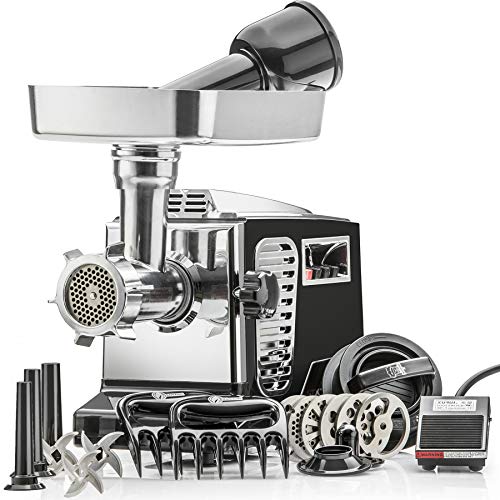
1. LEM BigBite Dual Grind #22 Meat Grinder, 1.0 HP — Best Overall for Game
The BigBite Dual Grind #22 exists to delete the worst hour of processing day: the second pass. Traditional fine grinding means feeding the entire batch twice — once coarse, once fine — with the meat warming and the crew tiring between passes. LEM’s dual-grind head performs both grinds in a single pass through two plates, so a deer becomes finished burger grind in roughly half the machine time, while the meat is still properly cold. For elk and multi-animal households, that is not a luxury feature; it is the difference between a controlled process and a race against temperature.
The #22 size underwrites the speed with substance: a wide throat that takes game trim in serious strips, large plates that resist clogging on sinewy venison, and a 1.0 HP motor driving metal gearing built for commercial-quality duty in a home setting. Silverskin still deserves trimming — no grinder loves it — but the BigBite tolerates the imperfect reality of wild trim better than any smaller machine in this guide.
Buy it as the centre of a processing system. LEM’s catalogue of plates, stuffing equipment and mixers all assumes this class of machine, and a household processing multiple animals a year will amortise the premium tier in saved weekends alone. If your harvest is one whitetail, the picks below are the honest size; if it is an elk camp’s worth, this is the flagship to build around.
Strengths
- Dual grind finishes burger texture in a single pass — hours saved per harvest
- #22 throat and plates keep a processing line moving
- LEM’s game-processing ecosystem: plates, tubes, stuffers, mixers
Trade-offs
- Premium tier and a heavy, dedicated-storage machine
- Oversized for small annual harvests
- Dual-grind head adds parts to the cleaning routine
| Size | #22 grinder |
|---|---|
| Motor | 1.0 HP |
| Grind | Dual grind — two passes in one |
| Body | Stainless steel |
Ownership across a season is where the dual-grind case compounds: the crew finishes earlier, the meat spends its life colder, and the evening after the hunt is measurably shorter. Camps that process together report the machine becoming the bench’s centre of gravity — trimming and packaging reorganise around its pace. The head’s extra parts do add minutes to cleanup, a trade every owner we would quote calls trivial against the hours returned.
Best for: Elk, moose and multi-deer households processing big batches / Not suited for: Apartment kitchens or one small deer a year
2. MEAT! 1 HP Pro-Grade Meat Grinder #22 — Best Pro-Grade Alternative
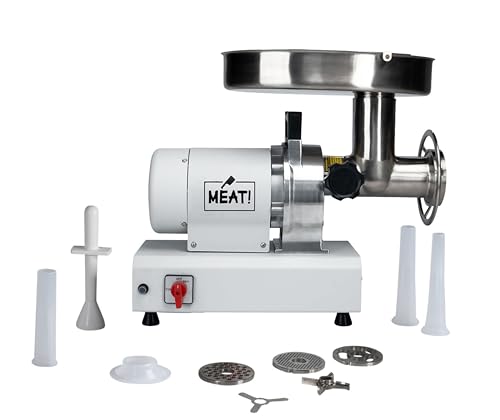
MEAT! builds for the processing community, and its 1 HP #22 reads like it: stainless construction, pro-grade positioning and the two plates game work actually starts with — coarse for the first pass and chilli-style grinds, fine for finished burger and sausage blends. For the household that processes multiple deer or shares an elk, it offers flagship capacity without the dual-grind head’s additional cost and complexity.
The #22 format is the story. Game trim arrives in volume and in imperfect shapes; a wide throat and large plates keep the line moving at the pace the crew can feed, rather than the pace a small machine dictates. Through a long session, that headroom is what keeps meat cold — the crew is never standing around a bottleneck watching the batch warm up, which is where game flavour is won or lost.
Choose it over the LEM flagship if your workflow already runs two passes happily — many sausage makers prefer a coarse pass, a seasoning mix, then the fine pass, a sequence the dual-grind cannot accommodate. Choose it over the #12 picks if your harvest volume is real. It is a specialist tool bought by people who process like it matters, because for them it does.
Strengths
- True #22 capacity with 1 HP drive
- Coarse and fine plates in the box for game workflows
- Stainless build suits heavy seasonal use and easy sanitation
Trade-offs
- Single-pass design — fine grinds still need a second pass
- Heavy machine, dedicated storage territory
- Premium tier
| Size | #22 grinder |
|---|---|
| Motor | 1 HP |
| Body | Stainless steel |
| Plates | Coarse and fine included |
MEAT!’s ownership story is told by processors who run the two-pass ritual deliberately — coarse, season, rest, fine — and who therefore never wanted the dual-grind shortcut. For them this machine is the honest industrial tool: nothing to learn, nothing to configure, just capacity and stainless composure through the longest weekends of the year. Its plates’ availability through game-processing channels keeps mid-season replacements a non-event.
Best for: Serious processors who want pro build without the dual-grind premium / Not suited for: Occasional small-batch grinding

3. Weston #12 Electric Meat Grinder and Sausage Stuffer, 750 Watt — Best #12 for Most Hunters
For the classic American harvest — one to three whitetails, ground into burger, sausage and jerky trim across a weekend — the Weston #12 is the size that fits the life. Its 1 HP-class motor and #12 head move deer meat at a working pace the maker states in pounds per minute, and the stainless plates shrug off the wash-and-store cycle that a seasonal machine endures eleven months of the year.
Weston earns its place through the ecosystem as much as the machine: this is a harvest brand, with stuffers, slicers, vacuum sealers and jerky equipment designed to continue where the grinder stops. A beginner processor can build the whole bench around one catalogue and one set of instructions, which lowers the learning curve of a first solo processing season considerably.
The boundaries are clear-eyed: the body is die-cast aluminum rather than stainless, and an elk — especially with a crew feeding it fast — will have this machine working at its ceiling with sensible rests. Households at that volume should climb to the #22 picks. For deer country, though, this is the grinder that matches the harvest, the garage shelf and the budget in one decision.
Strengths
- #12 size is the proven deer-processing sweet spot
- Stainless plates resist rust through seasons of storage
- Weston’s game and harvest catalogue supports the whole workflow
Trade-offs
- Die-cast aluminum body rather than stainless
- Maker’s throughput assumes ideal, well-chilled trim
- Will work hard — with rests — on a full elk
| Size | #12 grinder |
|---|---|
| Motor | 750 watt, 1 HP class |
| Plates | Stainless steel grinding plates included |
| Body | Die-cast aluminum |
Weston owners describe a machine that fits the garage-shelf life of seasonal gear: out for the harvest weekends, washed, dried and stored without ceremony, and ready the following autumn without a warm-up act. The #12’s pace matches a two-person crew — one trimming, one grinding — with a synchrony that makes processing social rather than frantic. For deer country, that rhythm is the ownership experience, repeated annually like the season itself.
Best for: One-to-three-deer households that process their own harvest / Not suited for: Elk camps or commercial-volume processing

4. VEVOR Meat Grinder #12, 750W / 1 HP Motor — Best Value #12
The VEVOR #12 makes the value case for stepping up in size: a genuine #12 head and 1 HP-class motor, two plates, three stuffing tubes and a kibbe kit, with an ETL listing on the electrics, at a tier that undercuts the heritage brands noticeably. For a deer household whose alternative was a struggling #8, that arithmetic is hard to argue with.
Read the throughput headline the way this guide reads all of them — as a laboratory number with perfect meat, not a promise about sinewy venison at hour two. Judged realistically, as a #12 with proper plates and tubes, it processes deer batches at the pace the size family delivers, which is to say entirely adequately for one-to-three-animal seasons. Keep the meat cold, trim the worst silverskin, and let the size do the work.
What the tier does not buy is depth behind the machine: LEM and Weston offer broader parts catalogues and longer model histories. If your processing is a weekend or two a year and the budget is real, the VEVOR is a rational allocation — the savings buy the vacuum sealer that completes the system.
Strengths
- #12 capacity at a distinctly value tier
- Complete starter kit: plates, tubes and kibbe in the box
- ETL listing gives the electrics a verified baseline
Trade-offs
- Headline hourly rates assume perfect conditions — expect less on sinewy game
- Brand ecosystem and parts depth trail LEM and Weston
- Newer model with a shorter field history
| Size | #12 grinder |
|---|---|
| Motor | 750W / 1 HP |
| Includes | Two plates, three stuffing tubes, kibbe kit |
| Listing | ETL listed |
The VEVOR’s owners are typically value calculators who spent the savings visibly — on the vacuum sealer, the stuffer, the knives — and who judge the grinder as one line in a system budget. Through a deer or two a season it does its line’s work without drama. Its long-term question is parts depth in year five, which its owners accept as the known price of the known saving.
Best for: Value-focused deer processors who want #12 capacity / Not suited for: Buyers who prioritise brand ecosystem and long support history

5. LEM BigBite #8 Meat Grinder, 0.5 HP — Best #8 for Smaller Harvests
Not every hunter’s season is an elk. For the household processing one deer, a hog, or a mixed bag of small game and waterfowl sausage, the BigBite #8 brings LEM’s flagship grinding design down to a storable size: the BigBite auger, which grips and pulls meat through the plate with noticeably less pusher work, in a stainless 0.5 HP body. Less pushing means less smearing, and on lean venison that texture difference is directly a flavour difference.
The #8 ecosystem argument applies with full force: plates in every useful grind, tubes and LEM’s stuffers and mixers all speak this machine’s language, so the processing bench can grow around it. Its manners with the imperfect trim of wild meat — a little more sinew than a butcher would pass — are the calmest in the #8 class we could verify.
Volume is the boundary, stated plainly: a whole elk through a #8 is an afternoon of patience, and a multi-deer weekend will have you wishing for the #22. Buy this for the harvest you actually have, and it will feel less like a compromise than like the correct, high-quality tool sized to your season.
Strengths
- BigBite auger pulls meat in steadily — less pushing, cleaner grind
- Stainless build in a compact #8 footprint
- Full LEM plate and accessory ecosystem
Trade-offs
- #8 throughput means patience on a whole large animal
- Premium tier for its size class
- Not the tool for a processing party’s volume
| Size | #8 grinder |
|---|---|
| Motor | 0.5 HP |
| Design | BigBite auger |
| Body | Stainless steel |
BigBite #8 ownership feels like owning the flagship’s younger sibling: same manners, smaller appetite. Owners processing a deer across a relaxed weekend describe the auger’s pull as the difference between feeding a grinder and fighting one. It also moonlights as the household’s burger grinder with a quality the kitchen-only machines envy — one purchase quietly serving both calendars.
Best for: Single-deer, hog and small-game processors who value quality over volume / Not suited for: Multi-animal or elk-volume seasons

6. LEM MightyBite #8 Meat Grinder, 500 Watt — Best Compact for Occasional Game
The MightyBite #8 is the dual-life pick: compact enough to earn year-round kitchen space for burgers and sausage, capable enough — worked in sensible waves — to process a deer across a couple of sessions. For the hunter whose game grinding is one weekend a year, a dedicated #22 is storage nonsense; this machine’s calendar actually justifies its shelf.
LEM’s #8 compatibility means the plates and tubes ecosystem is fully available, and the 500-watt class motor handles chilled, trimmed venison steadily when the operator respects the rhythm: feed, grind a bowl, re-chill, repeat. That rhythm is good practice on any grinder, and on game meat — which rewards cold handling more than any other — it doubles as quality control.
Be honest about the ceiling and it will never disappoint: aluminum body, lighter duty cycle, and no business being fed an elk quarter in a hurry. Bought as the occasional-game and everyday-kitchen machine it is, the MightyBite is the most liveable grinder in this guide — and the one most likely to still be in weekly use when next season opens.
Strengths
- Compact and light enough for year-round kitchen duty
- LEM #8 parts and accessory compatibility
- Honest capacity for a deer broken into sessions
Trade-offs
- Aluminum body, lighter duty than the BigBite line
- Work in waves on a full deer — re-chill between them
- Occasional-game tool, not a processing-party machine
| Size | #8 grinder |
|---|---|
| Power | 500 watt class |
| Body | Aluminum |
| Format | Compact countertop |
The MightyBite’s year is mostly ordinary kitchen life punctuated by one proud weekend, and owners value exactly that ratio. It stores like an appliance because it is one, and when the deer comes home it rises to the occasion in waves without complaint. Households that later escalate to a #22 often keep it as the small-batch machine — a retirement plan most entry grinders never earn.
Best for: Hunters who grind one small harvest plus year-round kitchen batches / Not suited for: Dedicated high-volume game processing
Comparison Table
Use this table to compare the six best game meat grinders side by side on the one specification that decides most purchases in this category, then read the full review of your top two before ordering.
| Pick | Badge | Key spec | Best for |
|---|---|---|---|
| LEM BigBite Dual Grind #22 Meat Grinder, 1.0 HP | Best Overall for Game | #22 size, 1.0 HP, dual-grind in one pass, stainless steel | Elk, moose and multi-deer households processing big batches |
| MEAT! 1 HP Pro-Grade Meat Grinder #22 | Best Pro-Grade Alternative | #22 size, 1 HP, stainless, coarse + fine plates included | Serious processors who want pro build without the dual-grind premium |
| Weston #12 Electric Meat Grinder and Sausage Stuffer, 750 Watt | Best #12 for Most Hunters | #12 size, 750 watt / 1 HP motor class, stainless plates | One-to-three-deer households that process their own harvest |
| VEVOR Meat Grinder #12, 750W / 1 HP Motor | Best Value #12 | #12 size, 750W/1 HP motor, 2 plates + 3 tubes, ETL listed | Value-focused deer processors who want #12 capacity |
| LEM BigBite #8 Meat Grinder, 0.5 HP | Best #8 for Smaller Harvests | #8 size, 0.5 HP, BigBite design, stainless steel | Single-deer, hog and small-game processors who value quality over volume |
| LEM MightyBite #8 Meat Grinder, 500 Watt | Best Compact for Occasional Game | #8 size, 500 watt, aluminum body, compact format | Hunters who grind one small harvest plus year-round kitchen batches |
How Should You Trim and Chill Game Meat for Grinding?
Game grinding quality is decided before the grinder is switched on. Trim aggressively: silverskin, heavy sinew, blood-shot meat and any fat that smells of the field rather than the kitchen should leave before the batch is cubed, because a grinder distributes whatever it is given through the entire batch. Venison fat in particular is tallowy and coats the mouth; most experienced processors trim wild fat hard and add pork fat or beef fat at a controlled ratio for sausage and burger blends instead.
Temperature is the second discipline. Cube the trimmed meat, spread it on trays and chill it to the edge of firm — the same near-freezing firmness as for domestic grinding, held more carefully because game batches are larger. Work in waves sized to your grinder: grind what is cold, return the next tray to the cold, and never let a mountain of cubed meat sit warming on the counter while a small machine catches up.
Keep the ground meat cold and moving toward its destination — patties, sausage mix or vacuum bags — rather than letting it accumulate warm in a tub. The flavour of well-handled wild game is clean and mild; every step of the cold, trimmed workflow exists to protect exactly that.
Which Plates and Grind Sequence Do Game Processors Use?
The standard game sequence is a coarse first pass followed, after chilling and any seasoning or fat blending, by a medium or fine second pass — the sequence the dual-grind LEM performs in one pass for burger production. Coarse plates in the 10 mm class break down trim and give chilli and rustic sausage their texture; medium plates around 4.5 to 6 mm are the burger standard; finer plates serve emulsified sausages and smooth blends.
Grind fat and lean together in alternating handfuls so the blend self-distributes, and mix by hand only enough to even it out — overmixing ground meat before cooking makes burgers dense, while sausage benefits from a deliberate mix to develop its bind. The distinction matters: burger grind is handled gently and seasoned late; sausage grind is mixed with purpose and seasoned before stuffing.
Jerky and snack-stick production changes the plate logic again, favouring fine, even grinds that extrude smoothly. Whatever the product, write your plate sequence and ratios down per batch. The processor who keeps notes repeats their best batch; the one who wings it chases it for seasons.
How Do You Choose Between #12 and #22 for Game?
Count animals and pounds, not enthusiasm. A #12 in honest working order processes a whitetail’s grind in a comfortable session and handles two-to-three-deer weekends with rhythm and rests. A #22 earns its storage and tier when the season regularly includes elk, moose, or a group’s pooled harvest — the point where a #12’s pace starts warming meat and tiring crews.
Consider the crew as well as the calendar. Processing is social: a #22 fed by two people trimming and cubing keeps everyone moving, while a solo processor may find a #12’s pace matches their knife’s pace exactly, making the larger machine an expensive spectator. Buy for the line you actually run.
Finally, remember the system around the size: plates, tubes, stuffers and mixers all scale with the grinder family. Choosing #22 is choosing the commercial shelf of every accessory catalogue; choosing #12 keeps you in the well-stocked middle. Both are respectable — the mistake is only the mismatch.
How Do You Add Fat to Venison and Other Lean Game?
Wild game is lean by nature — venison burger ground pure will cook dry and crumble unless the cook compensates. The processor’s standard answers are beef fat, pork fat or fatty pork shoulder blended at ratios the household learns by taste: many start near twenty percent added fat for burgers, less for sausage styles that carry their own richness, and adjust across seasons with notes. Beef fat gives a familiar burger character; pork fat is milder and is the classic sausage choice; fatty shoulder adds meat as well as fat, stretching the harvest usefully.
Technique matters as much as ratio. Cube the fat and the game to similar sizes, chill both to the same firmness, and alternate them through the grinder so the blend self-distributes in the bowl rather than arriving in layers. If a second pass is planned, blend before it, so the final grind knits fat and lean into one texture instead of marbling two separate grinds together at the mixing bowl.
Label every package with its ratio. The difference between this year’s beloved twelve-percent batch and next year’s dry twenty-percent guess is a line of handwriting on a freezer bag — the cheapest quality control in the entire processing system.
What Other Equipment Completes a Game Processing Bench?
The grinder is the centre, not the whole. A vacuum sealer is the second purchase almost every processor makes, because ground game stored air-free keeps its flavour across the year instead of surrendering it to freezer burn by spring. A dedicated vertical stuffer transforms sausage day from a grinder attachment’s patience test into a controlled, fast fill — the first upgrade serious sausage makers nominate. A mixer, sized to your batches, blends seasoning and fat evenly without warming the meat the way hands do.
The supporting cast is unglamorous and decisive: a scale for ratios, trays that fit your refrigerator, a gambrel and knife set you maintain, freezer space organised before the season rather than during it, and labels and markers treated as equipment rather than stationery. None of it is expensive beside the grinder; all of it together is the difference between processing as a chore survived and processing as a craft enjoyed.
Buy in the order your pain nominates. For most households that is sealer first, stuffer second, and everything else as the seasons teach. The grinder you choose from this guide will wait patiently at the centre of the bench while the system grows around it.
How Do You Budget a Harvest Across Grinder, Sealer and Supplies?
A processing household’s money works hardest when it is allocated as a system. The grinder takes the largest share because it is the hardest to substitute and the longest-lived; the vacuum sealer takes the second share because it protects the value the grinder creates; casings, seasonings, bags and labels are small recurring costs that should be stocked before the season, when choice is wide, rather than during it, when the cooler is full and the clock is loud. Hunters who budget this way in September describe calmer Novembers than those who buy reactively at the sporting-goods counter.
Within the grinder share, the size decision is the budget decision: a #12 system and a #22 system differ not only in the machine but in plates, stuffers and mixers scaled to match. Buying the #22 machine on a #12 accessory budget produces a flagship fed by compromises; buying the matched #12 system produces a bench with no weak link. This guide’s ladder exists so the whole system can be chosen at one rung, honestly.
Finally, count the offset honestly: home processing returns its cost in avoided processor fees, in grind quality no commercial run matches, and in the use of trim that would otherwise be wasted. Most households that process two animals a year find the bench pays for itself faster than the gear’s finish suggests — which is an argument for buying the right size once, not the cheap size twice.
How Do You Clean and Store a Game Grinder for the Off-Season?
A game grinder’s year is mostly storage, so off-season care decides its lifespan. Clean at the end of processing while everything is still cold: disassemble fully, wash hot with a brush in every auger flight and plate hole, and sanitise as the maker directs. Then dry with unusual thoroughness — plates and knives especially, which should be dried, lightly oiled with food-safe oil, and stored wrapped or in a dry container. The head’s interior deserves the same respect; a single forgotten fragment of game fat will announce itself, unforgettably, next season.
Store the machine where its weight is safe and its parts stay together — ideally in one lidded bin with the plates, tubes, manual and your processing notes from the season just ended. Those notes are equipment too: ratios, plate sequences and what you would change, written while the memory is fresh, are what turn next season’s first batch into a continuation rather than a reinvention.
Before the next season, run an inspection rather than a hope: plates flat and sharp, knife edges true, cord and housing sound, and a test grind of a pound of domestic meat to confirm the machine’s manners. Ten minutes of this in September is the difference between a processing day that starts at dawn and one that starts with a repair.
How to Run a Deer Processing Session Without Warming the Meat
Set the cold chain before the first cut: trays in the refrigerator or a cooler with ice, grinder head parts chilled, bowls cold, and a plan for where finished grind goes — straight into bags, a sausage mix or a patty session. Break the animal’s grind into waves of a few pounds each. Only one wave lives outside refrigeration at a time; the rest wait their turn cold. This single organisational habit does more for flavour than any grinder upgrade.
Grind wave by wave with the plate sequence your product needs, watching the output’s texture as your thermometer: clean, distinct crumbles mean the meat is cold enough; a pale, pasty smear means stop, return everything — meat and head parts — to the cold, and take the break the meat is asking for. Season and blend between passes while the batch re-chills, so no time is wasted and no warmth accumulates.
Finish like a professional: package promptly, label with species, cut, ratio and date, and freeze flat for fast, even storage. Then clean the grinder completely while the session’s lessons are fresh — game fat and protein left in a head overnight is a smell that survives several washings. A cold chain, kept from cooler to freezer, is the whole craft; the grinder is simply its most enjoyable tool.
Common Buying Mistakes
Game processing punishes the same shortcuts every season. These are the errors that turn a good harvest into mediocre grind.
- Grinding silverskin and field fat into the batch. A grinder distributes whatever it is fed. Trim hard and add controlled domestic fat instead — the flavour difference is the whole game.
- Letting cubed meat warm on the counter. Work in cold waves. A mountain of warming trim beside a busy grinder is where off-flavours are born.
- Undersizing the grinder for the harvest. An elk through a compact #8 warms meat and tempers alike. Match the machine to the season’s real volume.
- Skipping the second chill between passes. Two-pass grinding without re-chilling smears fat. The pause is part of the recipe, not a delay.
- Packaging without labels. Species, ratio and date on every bag. Future-you, staring into the freezer in March, is begging for this habit.
Every one of these is a workflow choice, not an equipment purchase — which is good news, because it means the grinder you already chose from this guide, run with cold discipline, will do your harvest justice.
Final Recommendation
If your season justifies it, the LEM BigBite Dual Grind #22 is the game grinder to build a processing bench around — one-pass finishing on cold meat is a genuine transformation of processing day. The MEAT! #22 serves pro-grade traditionalists, the Weston #12 fits most deer households exactly, and the VEVOR #12 delivers the size at a value tier. Smaller harvests are honestly served by the BigBite #8, and the MightyBite #8 covers the dual-life kitchen. Match the size to your animals, not your ambitions.
Then run the cold chain like it is the recipe — because with game, it is — and check price on Amazon for the exact model and plate bundle before the season opens, not after the first deer is already in the cooler.
Ready to order? Start with the top three: LEM BigBite Dual #22 · MEAT! 1HP #22 · Weston #12 — and check price on Amazon for the exact configuration you measured or sized for.
Best Meat Grinders Best Entry Level Meat Grinders Best Meat Grinders For Deer Processing
Frequently Asked Questions
What size grinder do I need for deer?
A #12 is the comfortable size for one-to-three deer a season, processing each animal in a steady session. A #8 handles a deer in waves with re-chilling. Regular elk, moose or group harvests justify a #22.
Can I grind venison with the fat on?
You can, but most processors trim venison fat hard because its tallowy texture and field flavour coat the mouth unpleasantly. Burger and sausage blends usually replace it with beef or pork fat at a controlled ratio for better eating quality.
What does dual grind actually save?
It performs the coarse and fine passes in a single pass through the machine, roughly halving machine time on fine grinds and — more importantly — finishing while the meat is still properly cold. On multi-animal days that temperature margin is the real prize.
How do I stop sinew from clogging the plate?
Trim the heavy silverskin and sinew before cubing, keep the meat near-frozen firm, and feed steadily. A knife and plate in good condition matter too — a dull knife smears and wraps rather than cutting. Occasional wrapping clears with a stop and a clean, never by forcing.
Is a #22 grinder worth it for one deer a year?
For most households, no — a #12 or even a good #8 matches that harvest, stores better and costs less. The #22 earns its tier on volume: elk, moose or several animals a season, or a group that processes together.
Can game grinders also grind domestic meat?
Absolutely — every pick here handles beef, pork and poultry blends as its day job. Game capability is about size, drive strength and sinew tolerance; a machine with those qualities finds domestic grinding easy.
Can I grind partially frozen game meat?
Firm, near-frozen meat grinds best — that is the target texture. Rock-solid frozen blocks are another matter: they strain any grinder and should be tempered until a knife can cube them. Aim for stiff and cold, not frozen through.
How long can I run a game grinder continuously?
Follow the maker’s duty guidance and your own hand on the motor housing: warmth is the signal to pause. In practice, the cold-chain rhythm — grind a wave, re-chill the next — gives any of these machines natural rests that keep sessions sustainable.
Should I grind game with the hide-side fat or trim it all?
Trim the field fat and silverskin hard, then add back controlled domestic fat at your chosen ratio. Wild fat carries the flavours of the animal’s diet and the day it was taken, and it oxidises faster in the freezer. The controlled blend tastes cleaner now and keeps better across the year — the two things home processing exists to achieve.
Can I process a whole season’s grind in one weekend?
You can, and many households do, but the cold chain becomes the whole project: cooler space for waves of cubed meat, freezer space ready for the output, and enough hands that no batch waits warm. If any of those three is missing, splitting the season across two weekends will produce better meat than one heroic, warming marathon.
Best Sausage Stuffers Best Vacuum Sealers