Disclosure: airfryerkitchensupply.com is reader-supported. When you buy through links on our site, we may earn an affiliate commission at no extra cost to you.
Where to buy
Our shortlist of the best food processors blender juicer systems starts with the Ninja Foodi Power Blender & Processor System (SS401), the strongest all-round performer we verified for this buying guide after checking every contender, and the nutribullet Triple Prep System, the most complete three-way system in one honest, well-organized box. Families should look at the Ninja Professional Plus Kitchen System (BN801), buyers who want an actual juicer function in the box at the Sunvivi 4-in-1 Food Processor, budget shoppers at the Sangcon 5-in-1 Combo, and small kitchens at the nutribullet Ultra Plus+ 3-in-1. Every system was verified against Amazon’s catalog before receiving a link; check price on Amazon for the bundle currently offered, since multi-function sets are re-bundled with the seasons.
The honest truth about three-in-one machines
Anyone searching for the best food processors blender juicer combination deserves the market’s awkward truth first: a true three-in-one — a full food processor, a full blender, and a real juicer on one base — barely exists. Juicing is mechanically different work. A centrifugal or masticating juicer separates juice from pulp with a spinning basket or an auger; a blender liquefies everything together; a processor chops with blades in a bowl. Cramming all three mechanisms into one affordable base produces compromises somewhere, so manufacturers choose: most “3-in-1” systems are blender-plus-processor systems that handle juicing the blender way — whole produce blended smooth, optionally strained — while a minority include a genuine juicer attachment, usually a citrus or small centrifugal unit.
This guide grades both approaches honestly. The Ninja and nutribullet systems below are the finest blender-processor platforms we could verify, and they “juice” superbly in the whole-food sense: green juices, citrus blends, and strained refreshers with all the fiber decisions left to you. The Sunvivi is included because its verified listing names an actual juicer among its functions, for buyers who want the attachment in the box. What we did not do is pretend a blender pitcher is a juicer, or print a “3-in-1” claim a listing itself did not support. Read the picks with that map and your own kitchen’s habits in mind and you will buy the right machine the first time. One more framing note before the shortlist: throughout this guide, “juicing” without qualification means the whole-food method, and every review states plainly which systems include a juicer attachment and which do not — because the fastest way to disappoint a buyer is to let a label promise what the box does not contain.
In this guide
Quick Picks
- Best Overall: Ninja Foodi Power Blender & Processor System (SS401) — 7 functions, a 72 oz blend-and-process pitcher, and an XL smoothie bowl maker. Check price on Amazon
- Best True 3-in-1 System: nutribullet Triple Prep System (NBKS50100) — 1500W base with a full-size blender, a personal blender, and a 7-cup food processor. Check price on Amazon
- Best for Families: Ninja Professional Plus Kitchen System (BN801) — 1400W, Auto-iQ, and 5 functions for smoothies, chopping, and dough. Check price on Amazon
- Best with a Juicer in the Box: Sunvivi 4-in-1 Food Processor — 350W with a 1.8L stainless bowl, juicer, meat grinding, and coffee grinding functions. Check price on Amazon
- Best Budget: Sangcon 5-in-1 Food Processor Combo — 47 oz pitcher, 2.5-cup bowl, and two to-go cups in one value set. Check price on Amazon
- Best Compact 3-in-1: nutribullet Ultra Plus+ — 1200W compact system with blender, food processor, and coffee and spice grinder. Check price on Amazon
How These Picks Were Chosen
We required a real processor bowl and a real blender pitcher in every system — no smoothie-cup toys — and then graded the third function honestly: what does this box actually do about juicing? Systems were scored on blending power and pitcher design, processor bowl usefulness, and the truthfulness of their juicing story, whether that is whole-food blending, a strainer workflow, or an included juicer attachment. Ownership factors — dishwasher-safe parts, storage, brand support — broke ties. Prices, as always, are left to the live listings, because bundles in this category change with promotions and seasons faster than any printed figure could track.
The Best Food Processors Blender Juicer Systems
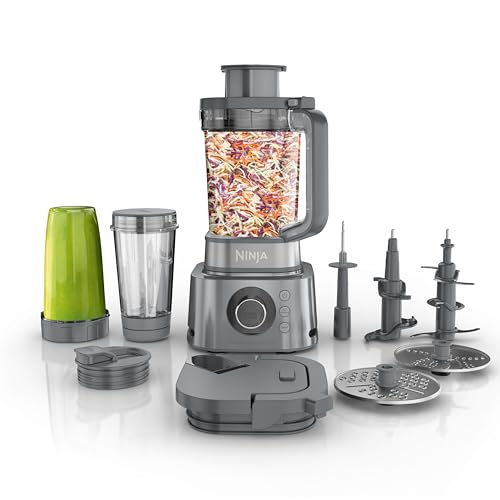
Ninja Foodi Power Blender & Processor System (SS401) — Best Overall
The SS401 is the strongest blender-processor platform we verified for this guide: a 72 oz pitcher that blends and processes, seven functions, load-sensing torque that feeds power into thick mixtures instead of stalling, and an XL smoothie bowl maker for spoon-thick blends. For juicing households, its pitch is the whole-food method at its best — greens, citrus, ginger, and frozen fruit liquefied completely, served thick as a smoothie-juice or strained for a lighter glass. It suits health-led kitchens that want one base for nearly everything.
Strengths
- Torque-sensing power finishes thick blends and doughs without bogging down.
- One pitcher covers most blending and processing, simplifying storage.
- Smoothie bowl maker produces café-style thick bowls at home.
Trade-offs
- No dedicated juicer attachment — juicing is the blend-and-strain method.
- No disc-based slicing or shredding workflow.
- Premium tier among the systems here.
| Spec | Detail (verified) |
|---|---|
| Model | SS401 Foodi Power Blender & Processor System |
| Functions | 7 |
| Pitcher | 72 oz blend & processing pitcher |
| Extras | XL smoothie bowl maker |
The case for the SS401 as a “juicer” is nutritional as much as mechanical: whole-food blending keeps the fiber that centrifugal juicers discard, and many juice drinkers have moved to exactly this style for that reason. With a nut-milk bag or a fine strainer, the same machine produces a clear, light juice when you want one — two drinks from one process, your choice each morning. Add its processing competence for hummus, doughs, and sauces, and the SS401 is the single base we would choose for a health-focused kitchen. The Ninja Foodi SS401 is the overall pick.
Set expectations correctly on volume: the pitcher is generous, but produce for juicing should be added in stages with liquid, and fibrous greens blend smoothest when they go in early under the liquid rather than last on top.
There is a workflow elegance to the SS401 that deserves emphasis: because one pitcher handles both blending and most processing, the counter stays clear and the washing stays singular. Health routines survive on low friction — the juice habit that requires assembling three appliances dies by February, while the one that needs a pitcher, produce, and sixty seconds becomes permanent. The SS401 is engineered, consciously or not, for the routine that actually sticks.
Best for: health-led households wanting one powerful base for smoothies, juices, and processing. / Not suited for: buyers who want a dedicated pulp-separating juicer.
Check the current price on Amazon

nutribullet Triple Prep System (NBKS50100) — Best True 3-in-1 System
The Triple Prep is the most literal answer to this search that we could verify: a 1500W base with three distinct appliances on it — a full-size blender for family batches, a personal blender for single servings, and a 7-cup food processor for chopping and prep. It suits households that genuinely use all three formats weekly and want one motor’s footprint and one brand’s ecosystem. Juicing, as with the Ninja, is the whole-food blending method, executed here by the strongest personal-blender lineage in the business.
Strengths
- Three complete formats — full blender, personal blender, 7-cup processor — on one 1500W base.
- Personal blending is nutribullet’s home turf: fast, smooth, genuinely portable cups.
- Strong power for frozen fruit and ice across the formats.
Trade-offs
- Three formats mean three sets of parts to store and wash.
- Juicing remains the blend-and-strain method, not a juicer attachment.
- Processor is a capable 7-cup, not a disc-library workstation.
| Spec | Detail (verified) |
|---|---|
| Model | NBKS50100 Triple Prep System |
| Power | 1500W |
| Formats | Full-size blender, personal blender, 7-cup food processor |
| Maker | nutribullet |
What the Triple Prep understands is that households do not have one blending size. The morning smoothie is personal, the weekend soup is full-size, and the onion is neither — it belongs in the processor. Covering all three with one base, at real power, is the system’s whole argument, and it is convincing. For juice drinkers, the personal blender is the daily driver: a grapefruit, an orange, greens, and ginger become a whole-food juice in under a minute, cup sealed and out the door. The nutribullet Triple Prep System is the three-in-one for households that will actually use all three.
Storage discipline is the ownership tax: dedicate one cabinet shelf to the fleet of cups, jars, and the processor bowl, or the system’s versatility becomes counter clutter. Organized owners love it; improvisers should pick a two-format system instead.
The Triple Prep also deserves credit for cup quality: nutribullet’s personal vessels seal properly, travel without leaking, and clean in seconds, which is why the brand owns the weekday-smoothie ritual. In a three-format system, the format you use most should be the best one, and here it is. Families where two people leave at different times with different drinks will feel the design’s intelligence every single morning.
Best for: households using personal blending, batch blending, and processing every week. / Not suited for: minimalists or dedicated-juicer seekers.
Check the current price on Amazon

Ninja Professional Plus Kitchen System (BN801) — Best for Families
The BN801 is the family-scale system: 1400W, Auto-iQ preset programs, and five functions spanning smoothies, chopping, and dough, built on the 72 oz-class pitcher format Ninja’s systems are known for. It suits households feeding several people — batch smoothies, family salsa, pizza dough — where the processor bowl and pitcher both work at full size. Auto-iQ’s timed programs make results repeatable for whichever family member is cooking, a feature whose value grows with every additional user.
Strengths
- 1400W and Auto-iQ presets deliver consistent family-size results.
- Five functions cover the smoothie-to-dough spectrum.
- Full-size vessels suit batch cooking and entertaining.
Trade-offs
- Juicing is the whole-food method; no juicer attachment included.
- Large footprint and a generous parts count to store.
- Power and presets overlap the BL770-class systems — compare bundles.
| Spec | Detail (verified) |
|---|---|
| Model | BN801 Professional Plus Kitchen System |
| Power | 1400W |
| Functions | 5, with Auto-iQ |
| Maker | Ninja |
Families feel the BN801’s virtues at breakfast and at parties: a full pitcher of green juice-smoothie for four, strained or not, then the same base processing the evening’s guacamole without a second appliance appearing. Auto-iQ deserves its mention — the pulse-and-pause programs genuinely improve ice crushing and dough consistency for less experienced users, which in a family means everyone’s results converge on good. The Ninja BN801 is the family pick. It also anchors our sibling roundup: Best Food Processors And Blender.
As with all big Ninja systems, plan the storage shelf before the box arrives, and teach the household the blade-safety basics in week one — many hands use a family system.
Parties reveal the BN801’s other talent: sequencing. A pitcher of margaritas, a bowl of pico de gallo, a batch of hummus, and a dough for flatbreads can come off one base in one prep session, in the order the cook chooses, with one motor cooling between jobs it barely notices. That is the family system’s real promise — not any single function, but the absence of the appliance shuffle that makes ambitious home cooking feel like logistics.
Best for: families needing batch capacity across blending, juicing-style drinks, and processing. / Not suited for: small households or juicer-attachment seekers.
Check the current price on Amazon

Sunvivi 4-in-1 Food Processor — Best with a Juicer in the Box
The Sunvivi earns its place on a distinction none of the bigger brands here can claim: its verified listing names a juicer among its functions, alongside an electric meat grinder with two bi-layer blades, a 1.8L stainless steel bowl, and coffee grinding. It suits buyers who want the multi-function box to literally include juicing — understanding that at 350W and this tier, each function is a home-scale version rather than a specialist. For small households wanting maximum function count per dollar and per inch, it is a genuinely different proposition.
Strengths
- Juicer function included in the box, per the verified listing.
- Stainless 1.8L bowl and dual bi-layer blades for processing and grinding.
- Four functions — process, grind meat, juice, grind coffee — in one compact unit.
Trade-offs
- 350W is modest: batch sizes and hard produce need patience.
- Smaller brand, thinner long-term support ecosystem than Ninja or nutribullet.
- Each function is home-scale; none replaces a dedicated specialist.
| Spec | Detail (verified) |
|---|---|
| Model | Sunvivi 4-in-1 Food Processor |
| Power | 350W |
| Bowl | 1.8L stainless steel |
| Functions | Meat grinder, juicer, coffee grinder, processor (per listing) |
Judge the Sunvivi by the standard of its tier and it makes sense: a single compact unit that processes dinner, grinds coffee in the morning, and juices without a second machine is exactly what a small kitchen with varied habits asks for. The stainless bowl is a genuine plus at this price class, and the dual-blade design handles the chopping-grinding spectrum credibly. What it will not do is match the Ninjas’ blending power or a dedicated juicer’s yield on hard vegetables — and buyers should hear that from us, not discover it. The Sunvivi 4-in-1 is the pick for function-count-first shoppers with clear eyes.
Practical advice: work in smaller batches, alternate hard and soft produce through the juicer function, and clean the juicing parts immediately — at this scale, hygiene and patience are the performance features.
A note on who should not buy the Sunvivi, in the spirit of this guide’s honesty: daily juicers working through pounds of carrots and beets will outgrow its scale within weeks, and power users will find its ceiling quickly. Its buyer is the varied, small-scale household — juice on Sunday, ground coffee daily, dinner processed nightly — and for that household the little unit’s breadth is worth more than any specialist’s depth. Match the machine to the life and it will not disappoint.
Best for: small households wanting an actual juicer function included in a multi-function box. / Not suited for: high-volume juicing or power users.
Check the current price on Amazon
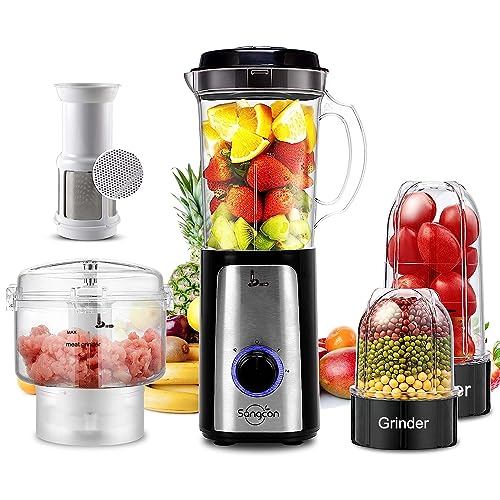
Sangcon 5-in-1 Food Processor Combo — Best Budget
The Sangcon 5-in-1 is the budget multi: a BPA-free 47 oz pitcher, a 2.5-cup processor bowl, and 18 oz and 11 oz cups in one set, covering smoothies, chopping, and everyday blending for one or two people. It suits students, first kitchens, and smoothie-led households whose processing is light and whose juicing is the whole-food blending style. At its tier, the completeness of the set — pitcher, bowl, and two cup sizes — is the story.
Strengths
- Complete small set: pitcher, processor bowl, and two cup sizes.
- Friendliest tier in this guide.
- BPA-free vessels and a compact total footprint.
Trade-offs
- Modest power and capacities — strictly one-to-two-person scale.
- No juicer attachment; juicing is blend-and-strain.
- Brand support ecosystem is thinner than the majors’.
| Spec | Detail (verified) |
|---|---|
| Model | Sangcon 5-in-1 Food Processor Combo |
| Pitcher | 47 oz, BPA-free |
| Bowl | 2.5-cup |
| Cups | 18 oz and 11 oz |
The Sangcon’s honest role is the starter system: it teaches a household which functions they actually use, at a cost that forgives the lesson. Most owners discover their real pattern within a month — usually smoothies daily, chopping weekly, juicing occasionally — and either settle happily at this scale or upgrade with knowledge instead of guesses. For a dorm, a first flat, or a single cook, the Sangcon 5-in-1 Combo is a rational, complete start.
Keep batches small, liquids adequate, and blades rinsed promptly, and the little system performs above its station. Overfill it like a Ninja and it will remind you, fairly, that it is not one.
The Sangcon’s cups deserve a kind word: having both an 18 oz and an 11 oz cup in the box sounds like a small thing until a household’s two smoothie sizes — the full breakfast and the small afternoon — both get their exact vessel. Budget systems often force one compromise size; this one does not. It is the kind of detail that suggests the set was designed by someone who actually makes smoothies, and at this tier that is not guaranteed.
Best for: budget-first singles and couples starting a system habit. / Not suited for: families or heavy processing.
Check the current price on Amazon

nutribullet Ultra Plus+ 3-in-1 Compact Kitchen System — Best Compact 3-in-1
The Ultra Plus+ compresses the three-in-one idea: a 1200W compact system combining a blender, a food processor, and a coffee and spice grinder. It suits small kitchens that want the multi-function idea without the fleet of full-size vessels — the grinder module, in particular, earns daily keep in spice-and-coffee households that the bigger systems serve less directly. Juicing follows the house style: whole-food blending in the blender format, strained or thick as you prefer.
Strengths
- Three functions — blend, process, grind — in a compact footprint.
- 1200W is serious power at this size class.
- Coffee and spice grinder adds a genuinely daily third function.
Trade-offs
- Compact capacities suit one to three people, not family batches.
- No dedicated juicer attachment.
- Newer platform with a shorter ownership track record.
| Spec | Detail (verified) |
|---|---|
| Model | nutribullet Ultra Plus+ 3-in-1 Compact Kitchen System |
| Power | 1200W |
| Functions | Blender, food processor, coffee and spice grinder |
| Maker | nutribullet |
The Ultra Plus+ makes a design argument the bigger systems cannot: that the third function a small kitchen actually uses daily might be grinding — spices for dinner, coffee for the morning — rather than a juicer attachment used monthly. Paired with nutribullet’s personal-blending competence, the result is the most counter-efficient multi here. Small households that cook with spices and drink their produce blended will find the nutribullet Ultra Plus+ the most honest three-in-one of the compact class.
As with its Triple Prep sibling, give the parts one shelf and a routine, and the system stays a pleasure. Buyers wanting family-scale pitchers should step up to the Triple Prep instead.
The grinder module also changes the Ultra Plus+’s economics in spice-cooking households: whole spices, ground fresh in seconds, are cheaper and dramatically more flavorful than pre-ground jars, so the little system quietly improves every dinner it touches, not just the ones it blends. A three-in-one whose third function elevates meals you were already cooking is earning its counter space the honest way.
Best for: small kitchens wanting blend-process-grind versatility at real power. / Not suited for: family batches or juicer-attachment seekers.
Check the current price on Amazon
Comparison Table
| Pick | Badge | Key spec | Best for |
|---|---|---|---|
| Ninja SS401 | Best Overall | 7 functions, 72 oz pitcher | Whole-food juicing + processing |
| nutribullet Triple Prep | Best True 3-in-1 System | 1500W, 3 formats, 7-cup processor | All-format households |
| Ninja BN801 | Best for Families | 1400W, Auto-iQ, 5 functions | Batch cooking |
| Sunvivi 4-in-1 | Best with a Juicer in the Box | 350W, 1.8L steel bowl, juicer | Function-count shoppers |
| Sangcon 5-in-1 | Best Budget | 47 oz pitcher, 2.5-cup bowl | Starters, singles, couples |
| nutribullet Ultra Plus+ | Best Compact 3-in-1 | 1200W, blend/process/grind | Small kitchens |
What is the difference between a 3-in-1 system and a kitchen system?
Largely vocabulary: “kitchen system” usually means blender plus processor formats on one base, while “3-in-1” promises a third function — which may be a personal blender format, a grinder, or occasionally a juicer. Read the third function’s fine print rather than the headline, exactly as this guide did when building the shortlist.
How to Choose a Food Processor, Blender and Juicer System
Decide your juicing style first, because it divides this guide. If you drink whole-food juices and smoothies — fiber included — any Ninja or nutribullet here serves you superbly, and you should choose on batch size and budget. If you want clear, pulp-separated juice from an attachment in the box, the Sunvivi is the honest pick at home scale, and heavy juicers should buy a dedicated juicer alongside a system instead. Then size the system to your household, and count the parts you are willing to store.
Is blended “juice” actually as healthy as juicer juice?
They are different drinks. Blending keeps the whole produce — fiber included — which many nutrition-minded drinkers prefer for satiety and blood-sugar behavior; juicing removes fiber and concentrates volume, which suits people who want to drink more produce than they could eat. Neither is fraudulent; choose by your goal, and know that the systems here let you strain a blend when you want the lighter style.
Can one base really drive three appliances well?
Yes, when the motor is honestly sized — the 1200–1500W systems here drive their formats without strain. The compromises live in vessel capacity and specialist features (disc libraries, juicer yield), not in the shared motor. That is why this category works, and why the budget end, with gentler motors, asks for smaller batches.
What should a heavy juicer do?
Buy a dedicated centrifugal or masticating juicer for the juice habit and a blender-processor system for everything else. No combo attachment matches a specialist’s yield on carrots and leafy greens at daily volume, and pretending otherwise wastes two purchases. Our picks cover the other ninety percent of households.
How to Juice With a Blender-Processor System, Properly
Build the blend in order: liquid first (water, coconut water, or a juiced citrus base), then soft produce, then fibrous greens, then hard or frozen items last so the vortex pulls them down. Blend a full minute beyond smooth — the difference between a gritty green drink and a silky one is usually thirty extra seconds. Drink it thick for the whole-food version, or pour it through a fine strainer or nut-milk bag, pressing with a spoon, for a clear juice; the pulp that remains is excellent in muffins, soups, or the compost. Chill ingredients beforehand rather than diluting with ice, rinse the pitcher immediately (dried greens are forever), and your system will juice daily without complaint. That routine, on any Ninja or nutribullet here, is the practical heart of this entire category.
Common Buying Mistakes
- Believing every “3-in-1” label means a real juicer. Read what the third function actually is; in most systems it is a format or a grinder, not a juicer.
- Buying a combo for daily clear juicing. Heavy pulp-free juicing deserves a dedicated juicer; combos serve the whole-food style.
- Overlooking part count. Three formats mean three sets of vessels — no storage plan, no deal.
- Under-sizing for a family. Compact systems in a five-person kitchen mean double batches of everything.
- Skipping the strainer. A nut-milk bag transforms a blender into a credible juicer for a few dollars; not owning one is the cheapest mistake in this category.
Final Recommendation
Everything in this guide was verified against live catalog data before publication, and the shortlist is revisited as bundles change — multi-function systems are re-boxed constantly, and a buying guide should track the boxes actually on sale.
For most households, the Ninja SS401 is the strongest single base for processing, blending, and whole-food juicing. Format collectors get the nutribullet Triple Prep, families the BN801, attachment-first buyers the Sunvivi, budget starters the Sangcon, and small kitchens the Ultra Plus+. Buy with your juicing style — not the box’s marketing — as the deciding question, and the system will fit your kitchen like it was designed for it. For the two-function version of this category, see Best Food Processors And Blender; for processor-only depth, see Best 12 Cup Food Processors and Best 7 Cup Food Processors.
Juicing Methods Compared: Centrifugal, Masticating, and Whole-Food Blending
Since this search promises a juicer, the three real methods deserve a fair comparison. Centrifugal juicers spin produce against a mesh basket at high speed: fast, affordable, and good with hard produce, but the juice oxidizes quickly and leafy greens yield poorly. Masticating (slow) juicers crush produce with an auger: better yield, drier pulp, quieter operation, and juice that keeps longer, at higher cost and slower pace. Whole-food blending — the method most systems in this guide use — liquefies everything and keeps the fiber, producing a thicker drink that is nutritionally a smoothie-juice hybrid and can be strained toward clarity. None is the “true” juice; they are three drinks sharing a name. Your pick among this guide’s systems should follow the drink you actually want in the glass, and heavy devotees of the first two methods should buy a dedicated machine for that job alone.
How to Keep a Multi-Function System Clean and Ready
Multi-function systems fail at hygiene more than at engineering, because more parts invite more procrastination. The counter-rule is a rinse-at-the-moment culture: every vessel rinsed when emptied, every blade washed before food dries on it, juicing parts — on the Sunvivi especially — cleaned immediately, because dried pulp in a strainer is the single most miserable clean in the kitchen. Weekly, run the full wash: gaskets out, lids separated, everything dried before reassembly so nothing mildews in a closed bowl. Monthly, inspect blades for dulling and gaskets for nicks, and descale nothing — these are cold machines — but do clean the base’s coupling of the flour and smoothie residue that migrates there. Ten disciplined minutes a week keeps a three-in-one tasting like three clean appliances instead of one tired one.
A Week of Drinking and Prep on One Base
Monday opens with personal-cup green juices — kale, apple, cucumber, lemon, ginger — blended whole and drunk thick. Tuesday’s dinner prep runs through the processor bowl: onions, peppers, and herbs for a sauce, with the pitcher rinsing clean in seconds afterward. Wednesday is soup night, blended silky in the big pitcher. Thursday, the grinder (Ultra Plus+) or processor handles spices and coffee for a curry that tastes like the spices were bought ground that morning — because they were. Friday brings the party test: frozen drinks in the pitcher, salsa in the bowl, and a strained watermelon-lime juice that proves the blend-and-strain method to skeptical guests. The weekend belongs to batch work — dough, hummus, energy bites — and a Sunday juice session that uses up every softening fruit in the fridge. One base, present at every act. That presence, not any single specification, is what a three-in-one purchase is really buying.
What About Noise, Storage, and Other Ownership Realities?
Noise: the big systems are loud at full power for the short life of each job; the compact and budget picks are gentler but slower. Juice and smoothie work happens in one-to-two-minute bursts, which households tolerate easily — it is the acoustic price of ice becoming snow. Storage: count the parts before you buy, not after; the Triple Prep’s fleet needs a real shelf, the Sangcon’s set fits a single drawer-adjacent cabinet, and every system rewards a labeled home for its blades. Counter presence: a base left out gets used daily, and daily use is the entire value proposition, so choose the system whose base you are happy to look at. None of these realities appears on a box, and all of them decide whether a three-in-one becomes infrastructure or clutter within a year.
How to Get the Most From the Processor Half of a 3-in-1
The processor bowl in these systems rewards the same three disciplines as any food processor, doubled because the bowls are shared with a blender’s schedule. Cut uniformly before you chop, because blades equalize nothing. Pulse for texture and blend for silk — the moment you confuse the two, onions become soup and soup stays chunky. And keep the bowl at or below two-thirds for chopping, since an overfilled bowl rides its contents above the blade’s reach. Doughs want liquid added in a stream while running, crumbs want dry bread and patience, and nut butters want scraping breaks so the motor and the mixture both stay cool. None of this is difficult, and all of it is the difference between a system that feels like three appliances and one that feels like three compromises. Technique is the multiplier on every watt in this guide.
Who Should Split the Purchase Instead?
Three households, honestly. The daily clear-juice devotee, who will always be better served by a masticating juicer plus a mid-range blender. The serious baker, whose dough volumes belong in a dedicated large processor or a stand mixer. And the minimalist, whose actual week involves smoothies and nothing else — a personal blender alone is their honest machine. Everyone between those poles — which is most kitchens that cook and drink with any variety — is the three-in-one’s natural owner, and the six systems above divide that audience by scale, budget, and juicing philosophy rather than by quality, because all six clear the bar their tiers set.
Safety Notes for Blades, Bowls, and Juicing Parts
More functions mean more sharp edges in the drawer, and a short safety culture keeps a multi-system friendly. Wash blades with a brush and never by bare hand in cloudy water. Store blade assemblies inside their vessels, lids on, rather than loose among utensils. Keep the base unplugged while changing attachments, and teach children that the colorful cups are for drinking, never for reaching into. On the Sunvivi’s juicer and grinder parts, small components are both sharp and losable — wash them in a sink strainer so nothing disappears down the drain, and dry them fully before the box closes. These are thirty-second habits; built in week one, they become invisible, and the system stays what it should be: the hardest-working, least dramatic appliance in the kitchen.
A closing perspective on the whole category: the three-in-one system is best understood as a kitchen’s utility player — not the finest juicer, blender, or processor ever made, but the one purchase that puts competent versions of all three within arm’s reach of every meal. Kitchens run on that kind of competence far more than on specialist excellence. Buy the system whose scale matches your household and whose juicing story matches your glass, keep its parts clean and shelved, and it will quietly become the appliance your cooking assumes — the highest compliment a kitchen tool can earn.
Accessories Worth Adding, and the Ones to Skip
Worth adding: a nut-milk bag or fine strainer, which converts every blender here into a credible clear-juice maker for almost no money; extra personal cups if your household’s smoothie count grows; and a second processor bowl for parallel prep in busy kitchens. Worth skipping: novelty attachments bought speculatively, duplicate blade sets purchased “just in case,” and any accessory whose job your current vessels already do. The pattern is the same as the original purchase — let your real week of cooking and drinking write the list, in pencil, after a month of evidence. Systems reward owners who expand them deliberately and punish, with clutter, those who expand them hopefully.
The Economics of One Base: What a 3-in-1 Saves Over Five Years
Run the honest ledger. One system replaces two or three separate purchases at the counter, and its parts — cups, bowls, blades — are the consumables, not whole appliances. Electricity is shared across one motor that idles at zero. The subtler saving is behavioral: a household with one capable base actually uses its functions, while the third separate appliance, bought hopefully and stored awkwardly, is where kitchen money goes to sleep. Against that, credit the separates their due: when one function of a system fails late in life, the whole base is implicated, where separates degrade one at a time. On balance, for the varied household this guide serves, the system’s economics win comfortably — provided the system is sized and shelved correctly in the first place, which is why this guide spends so many words on fit rather than features.
Troubleshooting: Three Problems Every System Owner Meets
Problem one: the blend stalls and rides above the blades. The cause is almost always load order or too little liquid; stop, add a splash, tamp the mixture down with the base unplugged, and restart at a lower speed before climbing. Problem two: the processor turns vegetables to mush at the bottom while the top stays chunky. The bowl was overfilled or the pieces were uneven; halve the batch, cut uniformly, and pulse in shorter bursts with a redistribution between them. Problem three: juices taste grassy-bitter. The greens were over-blended or the ratio leaned too far green; shorten the blend, add citrus and a sweet fruit to balance, and remember that a strained juice forgives more than a thick one. Every system in this guide can produce all three problems and, with these fixes, none of them twice.
Frequently Asked Questions
How much produce can these systems juice at once?
Work in pitcher-scale batches: roughly a full 72 oz pitcher of prepared produce and liquid on the big systems, less on the compacts, adding fibrous items in stages. For a household’s daily juices that is ample; for a juice cleanse serving six, it is a dedicated juicer’s job. Two consecutive batches, with a quick rinse between, cover even ambitious home routines without straining any motor in this guide.
Does any system here include a real juicer?
The Sunvivi 4-in-1’s verified listing names a juicer among its functions. The Ninja and nutribullet systems juice by the whole-food blending method — with optional straining — which many drinkers prefer, but they do not include a pulp-separating juicer attachment.
Which system is best for green juices?
The SS401 and Triple Prep, for their power with fibrous greens. Load greens early under the liquid, blend long, and strain only if you want the lighter style. The BN801 matches them at family batch sizes. A practical ratio for beginners: two parts fruit and citrus to one part greens keeps the drink bright while your palate adjusts, and a thumb of ginger covers a multitude of leafy sins.
Can these systems replace a standalone food processor?
For chopping, purees, crumbs, and moderate dough, yes. For wide disc libraries and high-volume slicing, a dedicated processor still leads — see our processor-only roundups for that end of the market. The households that end up buying both usually do so in the right order: the system first, the specialist later, purchased for a named weekly task rather than a vague ambition.
Are the parts dishwasher safe?
The major systems’ vessels, lids, and blades are designed for dishwasher cleaning; smaller brands vary by part, so check the manual for the budget picks. Prompt rinsing remains the habit that keeps every system pleasant to own. Treat the dishwasher as the weekly deep clean rather than the daily method and the plastics will stay clear, the gaskets supple, and the blades keen for far longer — a small discipline with a compounding return across a system’s life.
What size system does a family of four need?
The 72 oz pitcher class — SS401, BN801, or the Triple Prep’s full-size format. Compact systems will technically work and practically frustrate, in double batches of everything. Size for the biggest routine job, not the average one: a system that handles Saturday’s family smoothie run in a single blend will feel effortless on Tuesday, while a system sized for Tuesday will tax every Saturday until it is replaced.
Is a 3-in-1 system a good first appliance purchase?
It is an excellent one, because it reveals your real habits — blending, processing, juicing — at one footprint and one learning curve. Few purchases teach a new cook as much per dollar: within a month you will know your household’s true ratio of smoothies to chopping to juicing, and every later appliance decision becomes evidence-based instead of hopeful. The Sangcon and Ultra Plus+ are the gentlest entries; the Ninja and Triple Prep systems are the ones you may never need to upgrade from. Compare the two-function alternatives in Best Food Processors And Blender if juicing is not part of your week.


