Disclosure: airfryerkitchensupply.com is reader-supported. When you buy through links on our site, we may earn an affiliate commission at no extra cost to you.
Where to buy
Our shortlist of the best food processors and blender systems is led by the Ninja Mega Kitchen System (BL770), the category’s benchmark combo, and the Ninja Foodi Power Blender & Processor System (SS401) for the most demanding blending. Frozen-drink households should look at the Ninja UltraCrush Pro Kitchen System (BP401), value shoppers at the Ninja Kitchen System Pro+ (BR601AMZ), and budget-first buyers at the Oster Blender and Food Processor Combo or the glass-jar Oster Classic 16-Speed. Every system was verified against Amazon’s catalog before it earned a link; check price on Amazon for the current bundle configuration.
Why buy a food processor and blender as one system?
Shoppers looking for the best food processors and blender in a single purchase are really asking one machine base to do two families of work: the blender’s high-speed vortex jobs — smoothies, frozen drinks, soups, nut butters — and the processor’s blade-and-disc jobs — chopping, slicing, shredding, dough, salsa, crumbs. A combo system answers with one motor base and a set of vessels: a full-size pitcher for blending, a processor bowl with an S-blade and discs for prep, and usually single-serve cups for smoothies to go. The advantages are real: one footprint, one motor to pay for, and containers that share lids, storage, and a learning curve.
The honest trade-offs deserve stating up front. A dedicated full-size food processor offers wider feed tubes, more discs, and bigger dough capacity than any combo bowl; a dedicated high-performance blender out-blends combo pitchers at the extremes of nut butter and silky soup. What the combo wins is the middle ninety percent of home cooking — weeknight prep and daily smoothies — at one footprint and one price. This guide grades exactly that proposition: how completely each system covers both jobs for a real household, verified model by model against Amazon’s catalog before any link was added.
One market note: this category is dominated by a few system specialists, and Ninja in particular has spent a decade refining the format. Rather than fake diversity, we picked the best execution at each tier — including two Oster systems that keep the glass-jar, budget end honest — and we say plainly where a dedicated separate appliance still beats the combo.
In this guide
Quick Picks
- Best Overall: Ninja Mega Kitchen System (BL770) — 1500W base, 72 oz pitcher, 8-cup processor bowl, and two 16 oz to-go cups. Check price on Amazon
- Best for Serious Blending: Ninja Foodi Power Blender & Processor System (SS401) — 7 functions with a 72 oz blend-and-process pitcher plus an XL smoothie bowl maker. Check price on Amazon
- Best for Frozen Drinks: Ninja UltraCrush Pro Kitchen System (BP401) — 1500W Total Crushing power, 72 oz pitcher, 8-cup processor, and an 18 oz to-go cup. Check price on Amazon
- Best Mid-Range: Ninja Kitchen System Pro+ (BR601AMZ) — 1200W, 72 oz pitcher, and 8-cup processor in a simplified package. Check price on Amazon
- Best Budget: Oster Blender and Food Processor Combo — 3 settings for smoothies, shakes, and chopping, with two 24 oz cups. Check price on Amazon
- Best Classic Glass Jar: Oster Classic 16-Speed Blender with Food Chopper — 700W, 16 speeds, and a glass jar with a food chopper attachment. Check price on Amazon
How These Picks Were Chosen
We required both jobs in the box: a full-size blending pitcher and a genuine processor bowl with a chopping blade — smoothie-cup-only systems and blender-with-mini-chopper toys were cut. We graded blending on ice and frozen-fruit performance and pitcher capacity; processing on bowl size, blade design, and whether slicing or shredding is supported by discs or a second blade; and ownership on dishwasher-safe parts, storage sanity (these systems breed attachments), and the maker’s replacement-part support. Motor wattage was treated as a supporting spec, not a headline — blade design and jar geometry move real food more than a number does.
The Best Food Processors and Blender Systems

Ninja Mega Kitchen System (BL770) — Best Overall
The BL770 is the system that defined this category and still anchors it: a 1500W base driving a 72 oz blending pitcher, an 8-cup processor bowl, and two 16 oz single-serve cups with travel lids. It suits households that cook — salsa, dough, coleslaw, frozen margaritas, morning smoothies — and want one appliance footprint to cover all of it. A decade of production means accessories, replacement jars, and community knowledge are everywhere, which matters for a machine bought to work daily.
Strengths
- Complete vessel set: family pitcher, 8-cup processor, and two to-go cups.
- 1500W base handles ice, dough, and dense mixtures without drama.
- Dishwasher-safe parts and a mature accessory ecosystem.
Trade-offs
- Loud at full power — it is moving a lot of food, quickly.
- Attachment storage needs a plan; the set is generous, not small.
- Processor discs are more limited than a dedicated processor’s library.
| Spec | Detail (verified) |
|---|---|
| Model | BL770 Mega Kitchen System |
| Power | 1500W |
| Pitcher | 72 oz |
| Processor bowl | 8-cup, plus two 16 oz cups |
What keeps the BL770 on top is balance. The pitcher genuinely crushes a full load of ice and frozen fruit to snow; the processor bowl chops evenly, mixes a respectable dough, and turns out salsa with texture instead of soup; and the single-serve cups handle the weekday smoothie without washing the big jar. Owners measure these systems in years of daily service, and the BL770’s long production run means a replacement pitcher or blade is a click away rather than a discontinued part number. If one box must be your blending and processing department, the Ninja Mega Kitchen System BL770 is the department to buy.
Practical tip: learn the pulse discipline this system rewards. Short pulses with a scrape-down between them beat one long blast for even chopping, and the dough blade wants liquid added gradually. Ten minutes of technique in week one pays off in every meal after.
There is a longevity argument unique to the BL770: because it has been sold in huge numbers for years, its ecosystem is self-sustaining. Third-party and original replacement pitchers, blade assemblies, lids, and cups are stocked everywhere, and every problem the machine can develop has a documented fix. A system bought for daily work should be judged partly on that support tail, the same way you would judge a car by its parts network. On that measure the BL770 is the safest purchase in this entire guide.
Best for: households wanting one complete, proven system for blending and processing. / Not suited for: cooks needing a dedicated processor’s full disc library.
Check the current price on Amazon
Ninja Foodi Power Blender & Processor System (SS401) — Best for Serious Blending
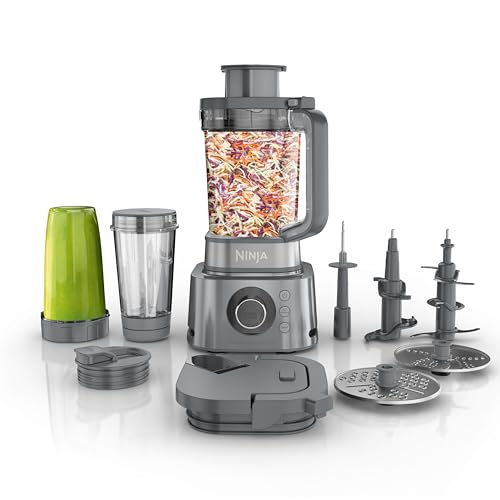
The SS401 pushes the combo idea toward the blender end: a 72 oz pitcher that both blends and processes, an XL smoothie bowl maker attachment for thick spoonable blends, and seven functions tuned by Ninja’s smart torque approach, which adjusts power to the load instead of bogging down. It suits smoothie-bowl devotees, nut-butter makers, and anyone whose processing is mostly high-speed work — sauces, purees, doughs of the wetter kind — rather than slicing and shredding.
Strengths
- Seven functions with load-sensing power for thick mixtures.
- XL smoothie bowl maker handles spoon-thick blends rivals stall on.
- One pitcher covers most blending and processing, simplifying storage.
Trade-offs
- No traditional disc-based slicing/shredding workflow.
- Premium tier among the Ninja systems here.
- The powerful base is, again, not quiet.
| Spec | Detail (verified) |
|---|---|
| Model | SS401 Foodi Power Blender & Processor |
| Functions | 7 |
| Pitcher | 72 oz blend & processing pitcher |
| Extras | XL smoothie bowl maker |
The SS401’s party trick is torque intelligence: when a mixture thickens — frozen fruit, dates, nut butter forming — the base feeds more power instead of cavitating, so the blend finishes smooth without the tamper dance. For households whose food processing is really “things a powerful blender can do,” that is a better tool than a disc library they will never open. The smoothie bowl attachment alone justifies the model for the breakfast crowd. Choose the Ninja Foodi SS401 if your cooking lives at high speed.
Be clear-eyed about the boundary: if weekly coleslaw, sliced potatoes, and shredded cheese are your reality, the BL770’s bowl-and-blade setup or a dedicated processor serves you better. The SS401 is a specialist wearing a system’s clothes, and specialists should be bought on purpose.
The smoothie bowl maker deserves its own sentence, because it changes breakfast economics. Thick, spoonable bowls — the kind cafés sell as premium items — need a small, narrow vessel and a blade that keeps dense mixtures moving, and the SS401’s attachment is purpose-built for exactly that physics. Owners who buy the system for this feature alone rarely feel short-changed, and the full-size pitcher still covers family smoothies on weekends. It is a specialist’s tool that happens to live inside a generalist’s box.
Best for: thick-blend lovers and high-speed processing households. / Not suited for: slice-and-shred-heavy cooks.
Check the current price on Amazon

Ninja UltraCrush Pro Kitchen System (BP401) — Best for Frozen Drinks
The BP401 tunes the kitchen-system formula for the frozen-drink household: 1500W of Total Crushing power, a 72 oz pitcher, an 8-cup processor bowl, and an 18 oz to-go cup, in silver. It suits entertainers and smoothie families whose blender work starts with ice more often than not, while keeping a real processor bowl for the prep that surrounds the drinks — salsas, dips, frozen-dessert bases.
Strengths
- Total Crushing blade design turns ice to snow reliably.
- Full system: family pitcher, 8-cup processor, to-go cup.
- 1500W base shared across every vessel.
Trade-offs
- Overlaps heavily with the BL770 — buy on bundle and finish, not fantasy differences.
- Full-power operation is loud.
- Storage footprint grows with the vessel count.
| Spec | Detail (verified) |
|---|---|
| Model | BP401 UltraCrush Pro Kitchen System |
| Power | 1500W |
| Pitcher | 72 oz |
| Processor bowl | 8-cup, plus 18 oz to-go cup |
Frozen drinks are a blade-geometry test disguised as a power test: the pitcher must pull ice down into the blades continuously instead of letting it ride above them, and the UltraCrush design does this well enough that daiquiri texture — uniform snow, no icebergs — is routine. The processor bowl keeps it a system rather than a party trick. If your household’s blender pitcher lives in the freezer door’s blast radius, the Ninja UltraCrush Pro BP401 is the tuned choice.
Honest positioning: households choosing between the BP401 and BL770 should decide on the cups and finish they prefer and current bundle pricing at the listing — the platforms are siblings, and both will serve a decade of smoothies.
Entertainers should also note the BP401’s rhythm advantage: the big pitcher empties a party batch in one blend, the to-go cup handles the driver’s smoothie the next morning, and the processor bowl turns the same evening’s salsa without a second appliance coming out of the cupboard. Systems earn their keep in exactly these transitions, where a single-purpose blender would leave the prep undone and a single-purpose processor would leave the drinks unmade.
Best for: frozen-drink and smoothie households wanting a full system. / Not suited for: cooks who need extensive slicing discs.
Check the current price on Amazon

Ninja Kitchen System Pro+ (BR601AMZ) — Best Mid-Range
The Pro+ trims the flagship systems to their essentials: a 1200W base, the 72 oz pitcher, and the 8-cup processor, in grey. It suits households that want the genuine Ninja system experience — real crushing power, a real processor bowl — without paying for the largest bundle of cups and extras. For many kitchens, this is the rational point on the curve where capability stops growing and only accessories do.
Strengths
- Full-size pitcher and processor bowl at a mid tier.
- 1200W is ample for ice, dough, and daily prep.
- Simpler bundle means less storage burden.
Trade-offs
- Fewer included cups and extras than the flagship bundles.
- Slightly less headroom on the densest frozen loads.
- Same counter footprint as the bigger systems.
| Spec | Detail (verified) |
|---|---|
| Model | BR601AMZ Kitchen System Pro+ |
| Power | 1200W |
| Pitcher | 72 oz |
| Processor bowl | 8-cup |
In daily work the Pro+ is indistinguishable from its bigger siblings across the middle of the repertoire — smoothies, salsas, soups, doughs, crumbs — and only at the frozen extremes does the flagship wattage show. That makes it the value-optimizer’s Ninja: same jars, same blades philosophy, same dishwasher-friendly cleanup, fewer dollars parked in accessories you may not use. The Ninja Kitchen System Pro+ is where we send mid-budget households first.
One consideration: if single-serve smoothies are a daily habit for several people, price the cost of adding cups against stepping up to the BL770 bundle — the math sometimes favors the flagship, and both are honest purchases.
The Pro+ also teaches an important buying lesson: within one brand’s system line, the tiers mostly repackage the same core competence. The jars and blade philosophy carry down the range; what changes is bundle size and motor headroom. A household that understands this buys the Pro+ with confidence and spends the difference on ingredients — the only upgrade that improves every single meal a system ever makes.
Best for: mid-budget households wanting the full system without the full bundle. / Not suited for: multi-person to-go-cup households.
Check the current price on Amazon

Oster Blender and Food Processor Combo — Best Budget
Oster’s combo is the budget door into this category: a blender with three settings shaped around smoothies, shakes, and food chopping, a processor function for everyday prep, and two 24 oz cups that blend and travel. It suits students, first kitchens, and smoothie-first households whose processing needs are modest — onions, herbs, crumbs, a quick salsa — and whose budget is real.
Strengths
- Friendliest tier in this guide for a blender-plus-processor system.
- Two 24 oz cups cover the daily smoothie routine.
- Simple three-setting controls anyone can run.
Trade-offs
- Processing capacity and power are a class below the Ninja systems.
- No disc-based slicing or shredding.
- Plastic vessels rather than the Oster line’s classic glass.
| Spec | Detail (verified) |
|---|---|
| Model | Oster Blender and Food Processor Combo |
| Settings | 3, for smoothies, shakes, and chopping |
| Cups | Two 24 oz cups included |
| Maker | Oster |
Judged at its tier, the Oster combo does the important things right: the smoothies are smooth, the chopping is even enough for weeknight cooking, and the whole system cleans up without a project. It will not snow a full pitcher of ice like the Ninjas or knead a serious dough, and pretending otherwise would insult the reader. As an honest first system — especially for a smoothie-led kitchen — the Oster Blender and Food Processor Combo earns its place.
Buy it with the upgrade path in mind: if cooking grows, this becomes the second system in a cabin or office, and nothing about the purchase is wasted.
There is also a size honesty to the Oster combo worth praising: it does not pretend to feed a family of six. Its cups and bowl are scaled to one or two people, and for that household — a couple’s first kitchen, a single cook who meal-preps modestly — the scale is a feature, because everything washes in a small sink and stores in a single cabinet shelf. Right-sizing is a legitimate form of quality, and this system is right-sized for its audience.
Best for: budget-first, smoothie-led kitchens with modest processing needs. / Not suited for: heavy dough, big-batch prep, or disc work.
Check the current price on Amazon

Oster Classic 16-Speed Blender with Food Chopper — Best Classic Glass Jar
The Oster Classic is the traditionalist’s combo: a 700W, 16-speed blender with a glass jar — still the material many cooks prefer for hot soups, easy cleaning, and no plastic taste — plus a food chopper attachment for the processor’s everyday jobs. It suits smaller households, classic-kitchen loyalists, and anyone whose blending is soups-and-smoothies rather than ice-crushing theatre.
Strengths
- Glass jar handles hot liquids and cleans beautifully.
- 16 speeds give fine control for sauces and purees.
- Food chopper covers daily prep in a compact attachment.
Trade-offs
- 700W is the gentlest power here — frozen loads need patience and liquid.
- Chopper capacity is small next to the 8-cup Ninja bowls.
- No single-serve cup system.
| Spec | Detail (verified) |
|---|---|
| Model | Oster Classic 16-Speed Blender, Food Chopper and Glass Jar |
| Power | 700W |
| Speeds | 16 |
| Finish | Brushed nickel |
The Classic’s virtues are the old ones: a jar that does not stain with turmeric soup, a dial-and-button interface that never needs a firmware thought, and a brand whose blenders have been repaired in home kitchens for generations. The chopper attachment is honestly sized for a small household’s onions-and-herbs reality. If your cooking is sauce-and-soup led and your processor jobs are daily-small, the Oster Classic 16-Speed is a deeply sensible buy.
Do not ask it to be a Ninja: feed frozen fruit in smaller batches with adequate liquid, and it rewards you; overload it with dry ice cubes and it will complain the way all honest machines do.
The Classic also wins a point no specification captures: repairability culture. Oster blenders have been serviced by local shops and handy owners for generations, with jars, blades, and gaskets standardized across years of production. In a category drifting toward sealed disposables, a machine your neighborhood can fix is a genuinely different ownership proposition — and for many classic-kitchen buyers, it is the deciding one.
Best for: glass-jar loyalists and soup-and-sauce households. / Not suited for: frozen-drink volume or big-batch processing.
Check the current price on Amazon
Comparison Table
| Pick | Badge | Key spec | Best for |
|---|---|---|---|
| Ninja BL770 | Best Overall | 1500W, 72 oz + 8-cup + cups | Complete households |
| Ninja SS401 | Best for Serious Blending | 7 functions, smart torque | Thick blends, nut butters |
| Ninja BP401 | Best for Frozen Drinks | 1500W Total Crushing | Ice and entertaining |
| Ninja BR601AMZ | Best Mid-Range | 1200W, 72 oz + 8-cup | Value optimizers |
| Oster Combo | Best Budget | 3 settings, two 24 oz cups | First systems |
| Oster Classic | Best Classic Glass Jar | 700W, 16 speeds, glass jar | Soups and sauces |
How to Choose a Food Processor and Blender System
Start with your real ratio. If processing means weekly slicing, shredding, and dough at volume, weight the bowl and blades — the BL770 leads, and a dedicated processor still beats every combo. If blending dominates and processing is occasional, the SS401’s high-speed intelligence or the BP401’s crushing focus fit better. Then count drinkers: to-go cups multiply value in smoothie households, while soup households should prize the Oster’s glass or the big Ninja pitchers. Finally, measure the cabinet where the attachments will live; a system whose parts have no home becomes a system half-used.
Can a combo really replace a separate food processor?
For chopping, pureeing, crumbs, salsa, and moderate dough — yes, completely. For high-volume slicing and shredding with a wide disc library and a feed tube that swallows whole potatoes, a dedicated processor remains better. Most households live in the first category and never miss the second; keen cooks know which one they are.
How much power do you actually need?
Enough to keep blades moving through your thickest regular job. Ice and frozen fruit at family scale want the 1200–1500W class here; soups, sauces, and smoothies with liquid are happy at 700W. Wattage is a ceiling, not a result — blade design and jar shape decide how much of it reaches the food.
Glass jar or plastic pitcher?
Glass wins for hot soups, staining foods, and longevity of clarity; modern Tritan-style pitchers win for weight, capacity, and drop survival. Households with kids and frozen drinks usually choose plastic; soup-led cooks choose glass. Both appear in this guide because both answers are right for someone.
Safety and Sanity: Running Powerful Blades at Home
These systems put genuinely sharp, fast blades in a home kitchen, and a short safety culture keeps them friendly. Treat every blade assembly as sharp even when “dull” — wash it with a brush, never bare fingers in soapy water where you cannot see it. Assemble and disassemble vessels on the counter, not over a sink of water. Keep the base unplugged when changing blades, and teach every household member that the interlock is a design, not a suggestion: if a vessel is not locked, the motor should not run, and forcing it is never the answer. With children, store blade assemblies inside their vessels with lids on, out of the everything-drawer. None of this is burdensome — it is the same respect a good knife demands — and households that build the habits in week one never think about them again.
How do you size a system for your household?
Count simultaneous eaters, not theoretical guests. One or two people live happily with the Oster combo’s scale or the Pro+ bundle. Three to five want the 72 oz pitcher and 8-cup bowl class — under-sizing a system is the most common regret in this category, because batch cooking in two rounds doubles both time and washing. Buy for your Tuesday, not your Thanksgiving, but do buy for the whole Tuesday.
How to Use a Combo System Like a Prep Cook
Work in the order professionals do: dry jobs before wet, big vessels before small. Start with crumbs, dough, or chopping in the clean, dry processor bowl; scrape, set aside, then blend sauces or smoothies in the pitcher; finish with the single-serve cups for drinks. Pulse for texture — salsa, onions, and nuts all punish continuous running — and blend continuously only for things meant to be silky. Add liquid to frozen blends gradually rather than flooding, and let the system’s presets run their full cycle before judging thickness. Clean as you go: a rinse now beats a soak later, blades are safest washed immediately and dried, and every vessel here tolerates the dishwasher for the deep clean. Fifteen minutes of prep-cook discipline turns one motor base into a whole station.
Common Buying Mistakes
- Buying wattage instead of vessels. The containers you will actually use matter more than the motor’s headline number.
- Expecting disc-library processing from a combo. If slicing and shredding dominate your cooking, buy the dedicated processor and a blender separately.
- Ignoring storage. Systems come with many parts; no cabinet plan means counter clutter and lost blades.
- Overfilling the pitcher with ice. Even the best systems crush better in two honest batches than one overloaded one.
- Skipping the pulse. Most disappointing “processor” results are technique, not hardware — pulse and scrape.
Final Recommendation
Everything in this guide was verified against live catalog data before publication, and the shortlist is revisited as bundles and models change — kitchen systems are re-bundled often, and a buying guide should track the boxes actually on sale.
For most households, the Ninja BL770 remains the complete answer: proven, capacious, and equally serious about both jobs. Thick-blend specialists get the SS401, frozen-drink households the BP401, value optimizers the Pro+, and budget or classic buyers the two Osters — each honest at its tier. Whichever you choose, learn the pulse, respect the fill lines, and the system will quietly absorb half your kitchen’s prep work. If your needs split further — a dedicated processor on one side or a juicer added on the other — see Best Food Processors Blender Juicer and the processor-only roundups in this cluster, including Best 8 Cup Food Processors and Best 14 Cup Food Processors and Best Food Processors Blender Juicer.
How to Store and Organize a Kitchen System Without Losing Your Mind
Every system in this guide arrives with more parts than the box photo suggests, and the difference between a beloved system and a resented one is usually a drawer. Give the parts a single home: a deep drawer or one cabinet shelf, with blades nested in the bowl they belong to, discs and dough blades in a labeled container, and lids stacked by vessel. Keep the base on the counter if you blend daily — systems that live in cupboards get used monthly, and monthly appliances fail the value test no matter how powerful they are. Store the to-go cups with their lids screwed on, and the whole fleet stays findable. Five minutes of organization in week one is the cheapest performance upgrade in this entire category.
How to Maintain Blades, Bowls, and Bases So a System Lasts
Blades first: rinse them immediately after use — dried smoothie and dough are the enemies — and dry them before storage, because a blade left wet in a closed bowl dulls and smells. Never reach into a vessel to dislodge food while the base is plugged in; unplug, remove the vessel, then use a spatula. Bowls and pitchers should be washed before food dries, with the dishwasher reserved for the weekly deep clean if you want the plastics to stay clear for years. The base itself needs only a wipedown and one discipline: never immerse it, and let it cool between genuinely heavy back-to-back jobs like double dough batches. Gaskets and lids appreciate a monthly soak in warm soapy water. That is the whole liturgy — ten minutes a week — and systems maintained this way are the ones still crushing ice in year eight.
What Can a Combo System Actually Make? A Week of Real Cooking
Monday: green smoothies in the to-go cups before work, thirty seconds each. Tuesday: the processor bowl turns two onions, peppers, and herbs into the base of a weeknight sauce while the pitcher rests. Wednesday: hummus in the bowl — smoother from the processor than the blender, a texture lesson every system owner learns — with pita chips from yesterday’s bread crumbed in the same bowl. Thursday: a wet dough for flatbreads, mixed in the bowl in under a minute. Friday: frozen margaritas and a chunky salsa for friends, pitcher and bowl working the same party. Saturday: pancake batter in the pitcher at breakfast, coleslaw from the bowl at lunch, a silky tomato soup blended hot at dinner (glass-jar owners, this is your moment). Sunday: nut butter or energy bites for the week, the job that separates the strong systems from the pretenders. That week is the combo proposition in full: not two appliances’ spec sheets, but one base quietly present at almost every meal.
Combo System vs. Separate Appliances: The Honest Ledger
Cost: one system undercuts a comparable separate blender and processor pair, sometimes substantially, and needs one outlet and one footprint. Performance: separates win at the extremes — the dedicated processor’s slicing discs and feed tube, the performance blender’s ultimate silkiness — while the combo wins the broad middle where most cooking lives. Storage: the system wins on bases and loses slightly on vessels, which multiply in both worlds anyway. Failure risk: one motor is a single point of failure, where separates degrade gracefully; against that, one motor is also one maintenance routine. The verdict most households reach: if you cook widely and often, the system is the rational center of the kitchen, and separates become later specializations bought for a specific, known need — which is a much better reason to buy them than a guess on day one.
How to Get Processor Results Worth Serving: Technique Notes
Three techniques decide whether a combo’s processor bowl produces deli-quality prep or a disappointing puree. First, size uniformity: cut vegetables into similar pieces before they enter the bowl, because the blade can only equalize what starts roughly equal. Second, the pulse rhythm: short bursts with the lid off between them to redistribute, checking texture early and often — you can always pulse again, and you can never un-puree an onion. Third, batch discipline: a half-full bowl processes evenly, while an overfilled one rides above the blade and chops the bottom to mush while the top stays raw. For slicing and shredding on systems that support discs, feed with steady, moderate pressure and let the disc do the work; forcing the pusher bends results and strains the motor. Master those three habits and the difference between a combo bowl and a dedicated processor narrows to the disc library alone — which is why technique, not wattage, is this category’s real dividing line.
Who Should Buy Separates Instead of a System?
Bakers who knead large doughs weekly, cooks who slice and shred in restaurant quantities at home, and smoothie devotees chasing the last degree of silkiness from a dedicated performance blender — these three know who they are, and separates serve them better. Everyone else, which is most kitchens, gets more cooking done per dollar and per inch with a system. The tell is simple: if your current week includes both blending and chopping but neither at competition volume, you are a system household, and the only remaining question is which of the six above matches your budget and your freezer’s ice habit.
Blending Technique: Getting Café Texture From a Home System
The blender half of these systems rewards two habits above all. Load order matters: liquids first, then soft ingredients, then frozen and hard items last, so the vortex forms early and pulls the heavy pieces down instead of trapping them on top. And time matters more than speed: a full sixty to ninety seconds at high power is what separates a smoothie with detectable fibers from one with café silkiness, and most home users stop thirty seconds too early. For hot soups, vent the lid and start slow — steam expansion is the one genuinely dramatic failure mode in blending, and every system here is designed around respecting it. For nut butters, patience and scraping win: the mixture will look like dry sand, then a ball, then suddenly a glossy butter, and stopping at the sand stage is the classic beginner surrender. These are small skills with outsized results, and they transfer to every vessel in every system in this guide.
A closing word on expectations, because kitchen systems attract a specific disappointment: the buyer who imagined a machine that cooks. A system does not cook; it prepares, at speed, with a consistency tired human hands rarely match at 6 p.m. on a Tuesday. The cooking remains yours — the seasoning, the tasting, the judgment — and that division of labor is exactly right. Buy the system whose vessels match your week’s real meals, learn the pulse and the load order, keep the blades clean and the parts in one drawer, and the machine will repay you in the only currency that matters in a kitchen: time, returned daily, with better texture.
What Accessories Are Worth Adding Later?
Buy nothing beyond the box for the first month — systems ship with more than most owners master quickly, and the honest gaps reveal themselves in use. The additions that commonly prove worthwhile: a second processor bowl for households that prep in parallel, extra to-go cups when smoothies become a family routine, and replacement blades on the maker’s schedule rather than after a failure. Dedicated slicing or shredding discs, where a system supports them, are worth it only when your cooking demonstrably asks weekly — otherwise they become the drawer clutter this guide keeps warning about. The discipline is the same as the purchase itself: let your real week of cooking, not the catalog, write the accessory list.
A Short History of the Kitchen System, and Why It Won
The combo system is a young category with old roots. Blenders spent the twentieth century as single-job appliances, and food processors arrived in the 1970s as a second motor on the counter. The insight that merged them — one powerful base, many vessels — waited for motors to get strong and cheap enough to do both jobs without compromise, and for smoothie culture to make the blender a daily appliance rather than a party one. Ninja’s kitchen systems, which dominate this guide, are that insight industrialized: the same base that crushes ice at noon shreds cabbage at six. The category won because kitchens shrank while cooking ambitions grew, and a system is the only honest answer to “both, in less space, for less money.” The separates will always exist for specialists; the system is what the rest of us cook with.
Frequently Asked Questions
Which system is best for a family of five?
The BL770 or BP401: the 72 oz pitcher and 8-cup bowl are sized for family batches, and the included cups cover individual smoothies without washing the big vessels between rounds. The Pro+ suits a family that blends big but processes small. Whichever a large family chooses, the discipline that makes it sing is batch rhythm: prep once, in the big vessels, at the start of the week, and let the cups handle the daily one-offs in between.
What is the difference between a kitchen system and a regular blender?
A kitchen system adds a processor bowl with chopping blades (and sometimes discs and dough blades) plus single-serve cups to the blender’s pitcher, all driven by one base. A regular blender only blends. If you chop, knead, or shred weekly, the system’s bowl earns its storage space. The reverse is equally true and worth saying: if your kitchen never does more than smoothies, a blender alone is the honest purchase, and no guide should sell you a processor bowl that will live its life in a cupboard.
Can these systems knead bread dough?
The Ninja systems handle moderate dough batches with their dough blades or processing blades; the Osters are better kept to soft doughs and batters. Respect the bowl’s flour capacity — overloading dough is the fastest way to strain any combo motor. Small, frequent batches beat one heroic one: two half-batches rest the motor, mix more evenly, and take barely longer than struggling through a single overloaded bowl.
Are the parts dishwasher safe?
The Ninja vessels, lids, and blades are designed for dishwasher cleaning, as are the Oster combo’s cups and parts; the Oster Classic’s glass jar is famously easy to clean by hand or machine. Blades last longer washed promptly and dried, whatever the manual allows. One practical habit separates tidy system owners from overwhelmed ones: rinse each vessel the moment it empties, even if the full wash waits for the evening — thirty seconds of foresight that keeps every part in this category genuinely easy to own.
Which system is best for baby food and purees?
The SS401’s torque control and the BL770’s single-serve cups both excel at smooth purees in small or large batches. For dedicated baby-food making with steaming, see the specialized makers covered elsewhere in our food processor coverage. Parents should also note the systems’ batch flexibility: a cup-sized puree for today and a freezer tray’s worth from the big bowl on Sunday come from the same base, which is exactly the kind of quiet versatility that makes a system feel indispensable by the second month.
How loud are these systems?
The high-power Ninjas are loud at full speed for the minute a job takes; the Osters are gentler. None is a conversation appliance while crushing ice — that is physics, not a flaw. In practice, households adapt without thinking: the loud jobs cluster at prep time, not at the table, and a minute of honest noise in exchange for snow-fine ice or a silent week’s worth of chopped onions is a trade every owner we know makes gladly.
What if I already own a good blender?
Then a dedicated food processor may serve you better than a system, and our processor-only guides — such as Best 10 Cup Food Processors — are the right next read. Systems shine brightest when both halves of the purchase are needed at once, in the same kitchen, in the same ordinary, unglamorous week of real, honest home cooking, and buying one to duplicate a blender you love helps neither your cooking nor your cabinets.


