Disclosure: airfryerkitchensupply.com is reader-supported. When you buy through links on our site, we may earn an affiliate commission at no extra cost to you.
Where to buy
Shopping for best faucets for standard kitchen sink? Every linked pick in this guide is sold through Amazon, where you can check the current price, finish options and delivery terms before you commit. We link only to listings we verified; picks without a verified listing are covered without a link and say so openly.
- Moen Essie 87014SRS Pull-Down Kitchen Faucet — check price on Amazon
- Moen Adler 87233SRS Pull-Down Kitchen Faucet — check price on Amazon
- Moen Arbor 7594SRS Pull-Down Kitchen Faucet — check price on Amazon
- Delta Essa 9113-AR-DST Pull-Down Kitchen Faucet — check price on Amazon
- Kraus Oletto KPF-2820SFS Pull-Down Kitchen Faucet — check price on Amazon
- FORIOUS Pull-Down Kitchen Faucet — check price on Amazon
Finding the best faucets for standard kitchen sink setups is mostly an exercise in fit: a standard sink means standard hole drilling — one hole, or three holes on 4-inch or 8-inch centres — and a faucet that covers those holes, clears your backsplash and cabinets, and connects to ordinary half-inch supply lines without drama. Every pick in this guide was verified against Amazon listing for this site, and each one mounts on a standard deck without custom drilling.
The honest market picture is that ‘standard’ is where the big brands concentrate their best engineering, because it is the largest replacement market. That is good news for buyers: docking systems, spot-resistant finishes and quick-connect installs that used to be premium-only now appear at several price tiers. The differences that remain are height, docking style, finish behaviour in hard water, and the support network standing behind the valve — and those are the axes this guide compares.
We have written this guide for a replacement buyer standing in front of an existing sink, tape measure in hand. If you are building new, the same picks apply, but the measurement sections matter less than the style and docking choices. Either way, start with hole count and clearance, then pick the spray and finish you will enjoy using three times a day for a decade.
In this guide
Quick Picks
Short on time? These are the six picks that survived our checks for this guide. Each one is reviewed in full further down, with strengths, trade-offs and a plain verdict.
- Moen Essie 87014SRS Pull-Down Kitchen Faucet — Best Overall. A single-handle pull-down that fits 1, 2, 3 or 4-hole standard sinks with its included deck plate, so it drops into the most common sink layouts without extra parts. — Check the current price on Amazon
- Moen Adler 87233SRS Pull-Down Kitchen Faucet — Best Budget. The value pick in Moen’s own line: Power Clean spray and Reflex docking in a slightly shorter 14.56-inch body that suits standard sinks under low cabinets. — Check the current price on Amazon
- Moen Arbor 7594SRS Pull-Down Kitchen Faucet — Best for Traditional Kitchens. A curved, traditional silhouette with Power Boost for faster filling and rinsing, at a 15.5-inch height that suits standard sinks with a classic cabinet style. — Check the current price on Amazon
- Delta Essa 9113-AR-DST Pull-Down Kitchen Faucet — Best Modern Design. Delta’s minimalist single-hole pull-down with MagnaTite magnetic docking — the wand snaps into place and stays there, in a clean Arctic Stainless finish. — Check the current price on Amazon
- Kraus Oletto KPF-2820SFS Pull-Down Kitchen Faucet — Best for Spot-Free Finish. A tall 16.6-inch single-hole pull-down in a spot-free stainless finish, with a brass body and ceramic cartridge verified in the Amazon listing features. — Check the current price on Amazon
- FORIOUS Pull-Down Kitchen Faucet — Best Value Alternative. A budget pull-down in SUS304 stainless with a ceramic cartridge, three spray modes and a 10-inch deck plate for 1 or 3-hole standard sinks. — Check the current price on Amazon
How These Picks Were Chosen
We chose these six by starting from the constraints a standard kitchen sink imposes, not from brand marketing. First, mounting: every pick installs on a 1-hole deck directly, or covers a 3-hole deck with an included or matched deck plate. Second, verification: each faucet’s ASIN, title and headline specifications were confirmed on 2026-11-21, and the specifications printed in the mini spec boxes come from that listing data — nothing is copied from unverified roundups.
Third, spread: the six cover the real decision space — a best overall, a budget sibling from the same brand family, a traditional design, a modern design, a hard-water finish specialist and an honest value alternative — rather than six near-identical pull-downs. Fourth, support: for a fixture expected to last a decade, the manufacturer’s parts network counted in our ranking, which is why the value pick carries an explicit caveat instead of a silent pass.
The 6 Best Faucets for Standard Kitchen Sink Setups, Reviewed
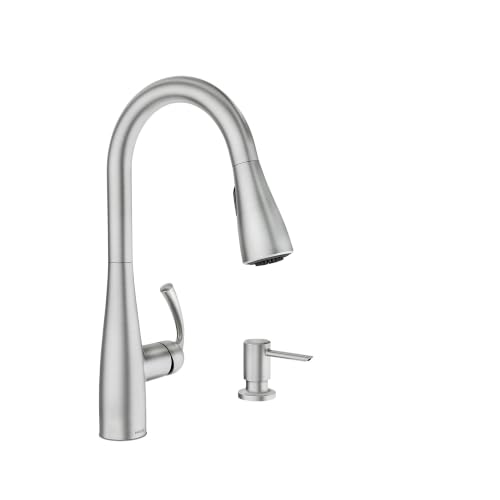
1. Moen Essie 87014SRS Pull-Down Kitchen Faucet — Best Overall
Check the current price on Amazon for the Moen Essie 87014SRS Pull-Down Kitchen Faucet.
If your sink is a standard 1-hole or 3-hole stainless or composite model, the Essie is the safest first look. The included deck plate covers unused holes cleanly, the single lever controls temperature and flow together, and the pull-down wand docks with Moen’s Reflex system, which uses the hose weight and a guided track so the head seats back in place instead of dangling.
Strengths
- Deck plate in the box covers 1 to 4-hole standard sink decks, so no separate cover plate purchase
- Reflex docking pulls the wand back into the spout reliably after rinsing
- Spot Resist Stainless finish hides fingerprints and water spots between cleanings
Trade-offs
- The included soap dispenser takes a fourth hole or counter space some sinks do not have spare
- Power Clean spray is forceful enough to splash in shallow sink bowls
- Single-lever control means fine temperature trimming takes a little practice
| Overall height | 15.75 inches (per Amazon listing data) |
|---|---|
| Installation | 1, 2, 3 or 4-hole with included deck plate |
| Spray technology | Power Clean spray with Reflex docking |
| Extra | Soap/lotion dispenser included per Amazon listing features |
The Essie suits the standard kitchen sink brief because ‘standard’ usually means a top-mount or undermount sink with holes drilled on 4-inch or 8-inch centres and a deck that was never planned around one specific faucet. A faucet that ships with a flexible deck plate removes the most common reason a replacement gets returned: exposed empty holes. Measure your hole spacing before ordering anyway — the plate covers the common layouts, but very wide custom drilling is the exception worth checking.
In daily use the difference between this and cheaper pull-downs is the hose behaviour. Reflex combines a braided hose, a counterweight and a smooth spout track, so the wand extends without fighting you and retracts without a tug. The Duralock quick-connect fittings also matter for a standard retrofit: supply lines click together under the sink, which shortens the awkward part of the install where you are working blind by feel.
Best for: Standard 1-hole and 3-hole sinks where you want one faucet that fits without extra parts / Not suited for: Very shallow bowls where a forceful spray bounces out, or period kitchens that need a two-handle bridge look

2. Moen Adler 87233SRS Pull-Down Kitchen Faucet — Best Budget
Check the current price on Amazon for the Moen Adler 87233SRS Pull-Down Kitchen Faucet.
The Adler is where we send readers who want the Moen docking and spray system without paying for the taller designer silhouettes. At just over 14.5 inches tall it also clears low-hanging cabinets and window trim that rule out the tallest high-arc models, which is a real constraint over many standard sinks.
Strengths
- Same Power Clean spray and Reflex docking family as pricier Moen pull-downs
- Shorter profile fits under low cabinets and over-sink windows
- Deckplate included for the common 3-hole standard sink layout
Trade-offs
- Fewer finish choices than the flagship Moen lines
- Plastic components appear in non-structural areas where premium models use metal
- Spray pattern choice is simpler than multi-function heads
| Overall height | 14.5625 inches (per Amazon listing data) |
|---|---|
| Installation | 1 or 3-hole, deckplate included |
| Spray technology | Power Clean with Reflex docking, dual-function spray head |
Budget here does not mean a different mounting gamble. The Adler uses the same Duralock-style quick connections and the same hole coverage as its siblings, so the install on a standard sink is the same one-evening job. Where the savings show is in the trim: the silhouette is plainer, the finish list is shorter, and some hidden parts trade metal for engineered plastic. For a rental-grade or first replacement faucet, that trade is usually the right one.
Performance at the sink is close to the Essie for the jobs a standard kitchen actually does: filling pots under the arc, rinsing sheet pans with the wand, and blasting stuck food with the boosted spray. If you run a lot of oversized stockpots, measure the arc height against your tallest pot; the slightly lower body is the one specification that can genuinely get in the way.
Best for: First replacements and rental kitchens that still want a proper pull-down docking system / Not suited for: Statement kitchens where the faucet is the visual centrepiece

3. Moen Arbor 7594SRS Pull-Down Kitchen Faucet — Best for Traditional Kitchens
Check the current price on Amazon for the Moen Arbor 7594SRS Pull-Down Kitchen Faucet.
Not every standard kitchen sink sits in a modern kitchen. The Arbor keeps the pull-down convenience but wraps it in a softer, arched profile that looks right with raised-panel cabinets, farmhouse sinks and traditional hardware, where a sharp contemporary faucet would look out of place.
Strengths
- Traditional styling that matches classic kitchens instead of fighting them
- Power Boost button speeds up pot filling and stubborn rinsing
- Reflex docking and Spot Resist finish carry over from the modern lines
Trade-offs
- The curved profile costs more than the plainer Adler for similar internals
- Boost mode is loud and splashy in shallow bowls
- Traditional styling narrows resale appeal if you remodel to a modern scheme
| Overall height | 15.5 inches (per Amazon listing data) |
|---|---|
| Spray technology | Power Boost button for boosted spray and flow |
| Docking | Reflex pull-down docking system |
The Arbor’s party trick, Power Boost, is genuinely useful on a standard sink: press the button and both the stream and spray run harder, which cuts the time to fill a pasta pot and strips rice and oatmeal off pans before the dishwasher. Used carelessly in a shallow bowl it will redecorate your counter with water, so learn the gentler default mode first.
Under the counter it is the familiar Moen story: single-hole mounting with an optional deck plate, quick-connect supply fittings and a hose weight you can reposition if it snags on under-sink plumbing or a garbage disposal. On older standard sinks with a disposal and a dishwasher drain hose crowding the cabinet, leave slack in the hose loop and check the wand still retracts fully before you close up.
Best for: Traditional and farmhouse kitchens that want pull-down convenience without a modern silhouette / Not suited for: Ultra-modern kitchens or very shallow sink bowls

4. Delta Essa 9113-AR-DST Pull-Down Kitchen Faucet — Best Modern Design
Check the current price on Amazon for the Delta Essa 9113-AR-DST Pull-Down Kitchen Faucet.
The Essa is the pick for a standard sink in a kitchen that leans modern: a single clean post, a lever that reads as part of the sculpture, and a pull-down wand that docks with a magnet strong enough that it does not creep out of the spout over time — the small annoyance that ruins cheaper pull-downs.
Strengths
- MagnaTite docking keeps the wand seated firmly year after year
- Diamond Seal Technology valve platform is built to reduce leak points
- Minimalist profile pairs with slab cabinets and quartz counters
Trade-offs
- Single-hole first design — 3-hole standard sinks need the optional escutcheon
- Modern look can clash with traditional cabinetry
- Touch and touchless Essa variants are different models; this is the manual version
| Overall height | 15.25 inches (per Amazon listing data) |
|---|---|
| Installation | Single hole (optional deck plate for 3-hole sinks, check listing) |
| Docking | MagnaTite magnetic docking (Delta DST platform) |
Delta builds the Essa on its DST platform, where the valve’s diamond-embedded disc is the headline durability claim: the disc polishes itself as it moves, which is Delta’s answer to the slow drip that develops in cartridge faucets. We cannot verify lifespan claims in a buying guide, but the platform is shared across Delta’s premium line and the parts support behind it is a genuine reason to shortlist the brand.
On a standard sink the practical checks are hole count and handle clearance. The Essa lever sweeps to the side, so confirm you have room between the faucet hole and the backsplash for the lever’s full travel, especially on sinks set close to the wall. With that measured, the install is a standard single-post job with integrated supply lines.
Best for: Modern kitchens with a standard single-hole sink, or a 3-hole sink plus the optional plate / Not suited for: Traditional kitchens, or tight backsplash clearances you cannot adjust

5. Kraus Oletto KPF-2820SFS Pull-Down Kitchen Faucet — Best for Spot-Free Finish
Check the current price on Amazon for the Kraus Oletto KPF-2820SFS Pull-Down Kitchen Faucet.
If your standard sink lives in a hard-water home, the finish is not a cosmetic detail — it is a weekly cleaning chore. The Oletto’s spot-free stainless is the headline here, backed by a brass body and a ceramic cartridge, in the tallest profile in this guide.
Strengths
- Spot-free finish resists the water spots and fingerprints that show on plain stainless
- Solid brass body and ceramic cartridge at a mid-tier position
- Tall arc and generous reach suit deep standard sinks and big pots
Trade-offs
- At 16.6 inches it is the tallest pick here — check cabinet and window clearance
- Single-hole design needs a deck plate solution for 3-hole sinks
- Kraus parts support is thinner on the ground than Moen or Delta in some regions
| Overall height | 16.625 inches (per Amazon listing data) |
|---|---|
| Flow rate | 1.8 GPM (per Amazon listing data) |
| Construction | Brass body with ceramic cartridge |
| Spout | 8.75 in height, 8.875 in reach (per Amazon listing data) |
Reach Technology is Kraus’s name for the swivel and hose behaviour: the spout rotates and the wand travels so you can direct water around a double-bowl standard sink rather than only at its centre. On a 60/40 or equal double bowl, that manoeuvrability is the difference between rinsing both bowls comfortably and perching pans at an angle.
The 1.8 GPM flow is the fuller-flow end of modern kitchen faucets, which fills pots quickly but is worth knowing if your home is chasing water savings; an aerator swap is the usual middle path and is a standard thread on this class of faucet. As with every tall faucet in this guide, measure from the sink deck to the lowest obstruction before ordering.
Best for: Hard-water homes and deep double-bowl standard sinks that need reach and height / Not suited for: Sinks under low cabinets, or buyers who want the largest local parts network

6. FORIOUS Pull-Down Kitchen Faucet — Best Value Alternative
Check the current price on Amazon for the FORIOUS Pull-Down Kitchen Faucet.
Every guide needs an honest budget alternative, and this FORIOUS model earns the slot on specifications we could verify: SUS304 stainless construction, a ceramic cartridge, three spray modes including a pause that stops water at the wand, and a long deck plate that covers the standard 3-hole layout.
Strengths
- Verified stainless construction and ceramic cartridge at a budget position
- Pause mode on the wand prevents the classic spray-the-floor moment
- 10-inch deck plate covers standard 3-hole drilling cleanly
Trade-offs
- Brand support and long-term parts availability are weaker than Moen, Delta or Kraus
- Docking relies on the hose weight rather than a magnetic or guided system
- Finish matching to existing stainless appliances is less predictable
| Overall height | 14.76 inches (per Amazon listing data) |
|---|---|
| Flow rate | 1.8 GPM (per Amazon listing data) |
| Construction | SUS304 stainless, ceramic cartridge |
| Spray modes | Stream, spray and pause, with an 18-inch hose (per Amazon listing features) |
The pause button deserves more credit than it gets in budget listings. When you pull the wand out to fill a pot sitting on the counter beside a standard sink, pause lets you move the wand without water running — a feature people usually meet first on much pricier faucets. The 18-inch hose is adequate for in-sink work and short counter reaches.
Our honest framing: this is the pick when the budget is the budget, for a laundry-adjacent kitchen, a rental, or a first home where a name-brand faucet is not where the money should go. It is not the pick we would choose for a forever kitchen, because a faucet is a 10-plus-year fixture and the support network behind it matters more than any single specification.
Best for: Tight budgets, rentals and secondary sinks that still need a pull-down with pause / Not suited for: Forever kitchens where decade-long parts support is the priority
Comparison Table
The table below puts the six picks side by side on the one specification that matters most for each of them. Full reasoning for every row is in the individual reviews above.
| Pick | Badge | Key spec | Best for |
|---|---|---|---|
| Moen Essie 87014SRS Pull-Down Kitchen Faucet | Best Overall | 15.75 in tall; 1–4 hole fit with deck plate | Standard 1-hole and 3-hole sinks where you want one faucet that fits without extra parts |
| Moen Adler 87233SRS Pull-Down Kitchen Faucet | Best Budget | 14.56 in tall; 1 or 3-hole with deckplate | First replacements and rental kitchens that still want a proper pull-down docking system |
| Moen Arbor 7594SRS Pull-Down Kitchen Faucet | Best for Traditional Kitchens | 15.5 in tall; Power Boost; Reflex docking | Traditional and farmhouse kitchens that want pull-down convenience without a modern silhouette |
| Delta Essa 9113-AR-DST Pull-Down Kitchen Faucet | Best Modern Design | 15.25 in tall; single-hole; magnetic docking | Modern kitchens with a standard single-hole sink, or a 3-hole sink plus the optional plate |
| Kraus Oletto KPF-2820SFS Pull-Down Kitchen Faucet | Best for Spot-Free Finish | 16.625 in tall; 1.8 GPM; brass body | Hard-water homes and deep double-bowl standard sinks that need reach and height |
| FORIOUS Pull-Down Kitchen Faucet | Best Value Alternative | 14.76 in tall; 1.8 GPM; 3 spray modes | Tight budgets, rentals and secondary sinks that still need a pull-down with pause |
What Do Faucet Valves and Cartridges Actually Do?
Inside every single-lever faucet in this guide is a cartridge or disc valve that mixes hot and cold and meters the flow, and it is the component that decides how the faucet feels in year eight rather than week one. Ceramic disc and quality cartridge designs dominate modern name-brand faucets because the sealing surfaces are hard, flat and wear slowly; the slow drip that plagued older compression faucets — the kind with rubber washers that needed annual surgery — is largely engineered out of this class.
Why should a buyer care about a part they will never see? Because the valve is the part you will eventually service, and serviceability is a brand question. Moen, Delta and Kohler cartridges are stocked by ordinary hardware stores and identifiable by model number decades later; a no-name cartridge can turn a small drip into a full faucet replacement. When our reviews weight the support network, this invisible part is most of what we are weighting.
The practical takeaway for a standard sink is simple: any pick in this guide uses a mainstream, replaceable valve platform, and the budget pick’s ceramic cartridge was a deliberate inclusion criterion, not a happy accident. If you are comparing a faucet outside this list, the question ‘can I buy the cartridge locally in ten years?’ is worth more than any showroom impression.
How Much Water Pressure and Flow Do You Actually Need?
Modern kitchen faucets in this guide flow between roughly 1.5 and 1.8 gallons per minute at standard household pressure, and the difference is worth understanding rather than maximising. The fuller flow fills pots faster and rinses with more authority; the lower flow saves water and splashes less in shallow bowls. Neither is a defect — they are tunings for different kitchens, which is why our spec boxes print the verified flow figure where the Amazon listing provides one.
Boost modes complicate the picture usefully: Moen’s Power Boost and Kohler’s Boost temporarily raise flow or spray force for the jobs that need it — stripping a roasting pan, filling a stockpot — while the default mode stays civilised. That two-speed arrangement is the mature answer to the flow question, and it is one reason the mid-tier picks in this guide satisfy more households than either extreme.
If your home’s pressure is low — top-floor flats and some rural supplies — favour the fuller-flow and boost-equipped picks and keep the aerator clean, because a scaled aerator on low pressure turns any faucet feeble. If your pressure is high and your bowl is shallow, the opposite advice holds, and a flow-restricting aerator is a cheap, standard-thread fix.
How Long Should a Kitchen Faucet Last, and What Kills One Early?
A name-brand kitchen faucet on a standard sink should be a ten-to-fifteen-year fixture, and the picks in this guide are built to that horizon: metal or quality engineered bodies, mainstream cartridges, finishes bonded rather than painted. What shortens that life is rarely the faucet’s design. It is installation shortcuts — a base that rocks because the mounting nut was never fully seated, supply connections stressed at an angle — and water conditions nobody managed, above all grit and scale in homes without any filtration at the tap.
The early-warning signs are consistent across brands: a handle that develops play, a wand that stops docking because the hose has stiffened or the weight has slipped, a drip that appears at the spout an hour after shut-off. Each maps to a serviceable part — cartridge, hose, weight, aerator — on every pick here, which is the practical meaning of ‘buy a brand with a parts network’. A faucet you can service is a faucet you keep; a faucet you cannot service is landfill with good styling.
Cleaning closes the loop. Finishes in this class want a soft cloth and water, with a vinegar solution for mineral deposits in hard-water homes; abrasive pads and harsh chemical cleaners void warranties and dull spot-resistant coatings permanently. Five gentle minutes a month is the difference between a faucet that looks new at year ten and one that looks tired at year three.
Single-Handle vs Two-Handle on a Standard Sink: The Honest Trade
Every pick in this guide is single-handle, and that is a deliberate editorial position worth defending rather than assuming. A single lever controls temperature and flow in one motion, with wet or soapy hands, and it suits the pull-down format that modern standard sinks are happiest with. For the way kitchens actually work — one hand holding a pan, the other running the water — it is simply the more usable control scheme.
Two-handle faucets keep two genuine advantages. They suit traditional and bridge designs that some kitchens demand aesthetically, and they give separate, set-and-forget control of hot and cold that some cooks prefer for tasks like filling a pot at an exact temperature. If your kitchen is period-styled and your heart is set on a bridge faucet, buy a good one from a mainstream brand and accept the side spray’s separate hose as the maintenance trade.
What we would not do is choose two handles by default out of habit. The standard sink’s hole pattern accommodates both, the market’s best docking and spray engineering lives in the single-handle pull-down world, and a decade of daily use will reward the control scheme that fits how hands actually move around a sink full of dishes.
Faucet Finishes Compared: Stainless, Chrome, Matte Black and Bronze
Finish is the specification you will look at longest and research least, so here is the honest comparison for a standard sink. Brushed and spot-resistant stainless is the forgiving default: it hides fingerprints better than chrome, shrugs off hard-water spots in its spot-resistant form, and matches the stainless sink and appliances most standard kitchens already have. It is the finish of four picks in this guide for practical, not aesthetic, reasons.
Chrome is the classic and the paradox: nothing looks cleaner when polished, and nothing shows water spots and fingerprints faster in daily service. It suits kitchens that are wiped down as a matter of routine and traditional schemes where stainless reads too industrial. Matte black is the contemporary statement — superb against light counters and white sinks — with a specific hard-water caveat: mineral deposits dry pale on it, so in a hard-water home it asks for the regular wipe that spot-resistant stainless forgives.
Bronze and champagne tones are the warm-design choice, beautiful with traditional cabinetry and the Arbor-style profiles, and the most scheme-specific: they commit the kitchen’s metal palette in a way stainless never does. Whichever you choose, choose it against your water and your cleaning temperament rather than the showroom photograph — a finish is a maintenance relationship, and the right one is the one whose upkeep you will actually enjoy, or at least never resent.
One last finish note for standard sinks specifically: because the sink itself is usually stainless, a stainless faucet in a neighbouring tone can clash more visibly than a deliberate contrast would. Hold the finish decision against the sink, the cabinet hardware and the appliances together — the faucet sits at the centre of that triangle, and it is the one element all three have to agree with.
How to Choose a Faucet for a Standard Kitchen Sink
Start under the sink, not at the showroom. Count the holes in your sink deck and measure their spacing, check whether a soap dispenser or air gap occupies one of them, and look at how much cabinet room the supply lines, a disposal and a dishwasher drain leave for a pull-down hose loop. Those four observations decide which faucets can physically go in; everything after that is preference.
Next, measure upward: from the sink deck to the underside of any cabinet, shelf or window trim above it. The picks in this guide range from about 14.5 to 16.6 inches tall, and a faucet that is an inch too tall is a return, not an inconvenience. While you have the tape out, check handle clearance too — side levers need room to sweep toward the backsplash through their full temperature range.
Then choose your spray behaviour. A pull-down wand is the default recommendation for a standard sink because it rinses the whole bowl and fills pots that do not fit under the arc. Decide whether you want a boost mode for stuck food, a pause mode for filling pots on the counter, or a simple two-function head you will never have to think about. More modes are not automatically better; the right count is the count you will actually use.
What Actually Differs Between Faucet Price Tiers?
At the budget tier you get the core job done: stainless or stainless-look construction, a ceramic cartridge and a weight-docked wand. What you give up is invisible at first — thinner support networks, fewer finish options, and docking that depends entirely on the hose weight staying unobstructed under the sink.
The mid tier is where the engineering that matters daily lives: guided or magnetic docking that seats the wand every time, spot-resistant finishes that cut cleaning in hard-water homes, quick-connect fittings that make a one-person install realistic, and valves designed around replaceable cartridges. Most standard-sink buyers should shop here first.
The premium tier buys design and extras — touch or voice activation, designer silhouettes, exotic finishes — rather than proportionally better water delivery. There is nothing wrong with paying for a faucet you love looking at; just do it knowingly, and confirm the fancy variant is a different model number before ordering, because manual, touch and touchless versions often share a product page.
Should You Choose a Pull-Down, Pull-Out or Fixed Spout?
Pull-down faucets pair a tall arc with a wand that drops into the bowl, which suits deep standard sinks and big cookware. Pull-out faucets hide a longer hose in a lower spout, which suits shallow bowls and low clearances. Fixed spouts with a separate side spray are the traditional arrangement: fewer moving parts in the faucet itself, but the side spray’s hose and diverter are their own maintenance story.
For most standard sinks we recommend pull-down, and all six picks here follow that pattern because the category has converged on it. The exception is a genuinely low clearance above the sink, where a pull-out or a shorter pull-down like the Adler profile is the honest answer instead of forcing a tall arc into a space it does not fit.
How to Install a Pull-Down Faucet on a Standard Sink
Turn off both supply valves under the sink and open the old faucet to drain pressure. Disconnect the supply lines with a basin wrench, unthread the mounting nuts, and lift the old faucet out. Scrape the deck clean of old putty and mineral crust — the new deck plate seals against this surface, and grit left behind is how slow deck leaks start.
Set the new faucet’s deck plate or gasket on the deck, drop the faucet body through the centre hole, and from below, slide on the mounting bracket and snug the nut by hand before tightening with the supplied tool. Do not fully torque it until you have checked from above that the faucet sits straight and the handle sweeps clear of the backsplash.
Connect the integrated supply lines to the shut-off valves — hot on the left when facing the sink — using the quick-connect or threaded fittings the faucet ships with, hand-tight plus a quarter turn unless the manual says otherwise. Thread the pull-down hose through the spout, attach it to the outlet under the sink, and clip the counterweight onto the hose at the marked position, leaving a clean loop that clears the disposal and drain lines.
Turn the water back on slowly, check every new joint with a dry paper towel, then flush the faucet for a minute with the aerator removed to clear debris from the lines before refitting it. Finally, pull the wand out to its full reach several times: it should extend smoothly and dock itself every time. If it hangs up, move the counterweight or clear whatever the hose loop is catching on — five minutes of adjustment now prevents the most common complaint about pull-down faucets.
Common Buying Mistakes
The most common mistake is ordering by photograph and discovering the hole pattern is wrong. A 3-hole sink with a 1-hole faucet and no deck plate leaves two open holes collecting water and grime. Count first, then shop — every pick in this guide states its hole coverage in the spec box for exactly this reason.
Second is ignoring height. Standard sinks often sit under a window with a low sill or a cabinet valance, and tall high-arc faucets are the most returned category for exactly this. Measure deck to obstruction and compare it with the verified heights in this guide before falling for a silhouette.
Third is strangling the hose. A pull-down installed with its hose loop draped over a disposal or wedged behind stored bottles will dock badly and get blamed on the faucet. Route the loop cleanly, position the weight as marked, and keep the swing zone under the sink as clear as you reasonably can.
Fourth is over-tightening. Modern faucet connections seal with washers and O-rings; cranking them with a wrench deforms the seal and creates the leak you were trying to prevent. Hand-tight plus the fraction of a turn the manual specifies is the whole job.
Final Recommendation
There is no single winner for every kitchen, so match the pick to the job you actually do most:
- Moen Essie 87014SRS Pull-Down Kitchen Faucet (Best Overall): choose it if standard 1-hole and 3-hole sinks where you want one faucet that fits without extra parts. Check the current price on Amazon.
- Moen Adler 87233SRS Pull-Down Kitchen Faucet (Best Budget): choose it if first replacements and rental kitchens that still want a proper pull-down docking system. Check the current price on Amazon.
- Moen Arbor 7594SRS Pull-Down Kitchen Faucet (Best for Traditional Kitchens): choose it if traditional and farmhouse kitchens that want pull-down convenience without a modern silhouette. Check the current price on Amazon.
- Delta Essa 9113-AR-DST Pull-Down Kitchen Faucet (Best Modern Design): choose it if modern kitchens with a standard single-hole sink, or a 3-hole sink plus the optional plate. Check the current price on Amazon.
- Kraus Oletto KPF-2820SFS Pull-Down Kitchen Faucet (Best for Spot-Free Finish): choose it if hard-water homes and deep double-bowl standard sinks that need reach and height. Check the current price on Amazon.
- FORIOUS Pull-Down Kitchen Faucet (Best Value Alternative): choose it if tight budgets, rentals and secondary sinks that still need a pull-down with pause. Check the current price on Amazon.
If you only read one section, make it the measurement part of the buying guide: hole count, deck-to-obstruction height and handle clearance decide whether any of these faucets can live in your kitchen at all. Once fit is settled, the choice is simple — the Essie for the all-round answer, the Adler to save money inside the same system, and the Oletto if hard water is your daily enemy.
Keep reading the rest of our coverage in this category: Best Faucets For Undermount Kitchen Sink Best Kitchen Faucets Best Pull Down Kitchen Faucets Best Single Hole Kitchen Faucets Best Budget Kitchen Faucets
Frequently Asked Questions
Will these faucets fit a 3-hole standard sink?
Yes, with the right configuration. The Moen Essie and Adler include deck plates that cover 3-hole drilling, the FORIOUS pick includes a 10-inch plate, and the single-hole designs from Delta and Kraus pair with their matched optional escutcheons. Check the spec box on each pick for its stated hole coverage before ordering.
What is the difference between a pull-down and a pull-out faucet?
A pull-down wand drops down from a tall arc into the bowl, suiting deep sinks and large pots. A pull-out wand pulls toward you from a lower spout, suiting shallow bowls and tight clearances. All six picks in this guide are pull-down models, which is the pattern most standard sinks are happiest with.
How long does a DIY faucet replacement take?
For a straightforward swap on a standard sink with working shut-off valves, plan on one to two hours, most of it spent removing the old faucet. Corroded mounting nuts and seized valves are what stretch the job; if your shut-offs do not fully stop the water, fix that first or call a plumber.
Do I need plumber’s putty or silicone for the deck plate?
Follow the faucet’s manual: many modern deck plates seal with a rubber gasket and need nothing else. Where a sealant is specified, use the type the manufacturer names — some finishes and sink materials are stained by the oils in plumber’s putty, which is why several brands specify silicone instead.
Why does my pull-down wand not stay docked?
Almost always the hose, not the magnet or dock. Check that the counterweight is clipped at the marked spot, that the hose loop is not snagging on the disposal, drain lines or stored items, and that nothing under the sink is pushing the loop sideways. Clear the path and most docking complaints disappear.
Is a spot-resistant finish worth it?
In hard-water homes, yes — it is the difference between wiping the faucet weekly and polishing off mineral spots constantly. In soft-water homes it is a minor convenience. The Kraus Oletto pick in this guide is the finish specialist if spots are your main frustration.

