Disclosure: airfryerkitchensupply.com is reader-supported. When you buy through links on our site, we may earn an affiliate commission at no extra cost to you.
Where to buy
This guide to the best faucets for kitchen with d shaped sinks starts with where to buy safely. This companion guide approaches D-shaped sinks from the household side — matching faucets to how the sink is actually used — and every linked pick was confirmed against Amazon’s catalog data for this site before earning its link. Use the links to check price on Amazon for the exact model. As with the geometry-first companion guide, measure your deck before ordering: hole count and rear clearance veto more faucets in D-sink kitchens than any other factor.
- Delta Foundations Two-Handle Bar/Prep B2410LF Family — check price on Amazon
- Moen Adler Pull-Down 87233SRS — check price on Amazon
- Delta Essa Kitchen Faucet 9113-AR-DST — check price on Amazon
- KRAUS Oletto Pull-Down KPF-2820SFS — check price on Amazon
- Moen Essie Pull-Down 87014SRS — check price on Amazon
- KOHLER Jolt Pull-Out 30612-VS — check price on Amazon
If you live with a kitchen with d shaped sinks, you already know the daily negotiations: the faucet that splashes the curved front when you rinse at full flow, the lever that kisses the backsplash, the pot that only fills at an angle. The best faucets for kitchen with d shaped sinks are the ones that end those negotiations — sized for the deck the D-shape allows, with water delivery that respects a bowl that is deep at the back and shallow at the curve.
Where our companion D-sink guide leads with tape-measure geometry, this one leads with households: the family kitchen whose D-sink is the main sink, the hard-water home, the cook who fills stockpots, the renovator matching a finish. The picks overlap in spirit — compact, well-mannered faucets — but the selection and the reasoning here start from use, and several models differ so the two guides together cover the category properly.
The through-line is restraint. A D-sink is a modest bowl wearing a space-saving shape; the faucets that flatter it are competent rather than enormous. Every pick below can be the only faucet in a real kitchen and hold the job down — none is a novelty, and each earned its place by solving a named D-sink household problem.
In this guide
Quick Picks
1. Delta Foundations Two-Handle Bar/Prep B2410LF Family — Best Value for D-Sinks. Delta’s Foundations bar/prep two-handle — honest, compact, and priced for real life; the D-sink faucet that simply works. Check price on Amazon
2. Moen Adler Pull-Down 87233SRS — Best Family D-Sink Faucet. At 14.56 inches the Adler is the compact end of Moen’s pull-down range — Reflex docking and Power Clean sized for a family D-sink. Check price on Amazon
3. Delta Essa Kitchen Faucet 9113-AR-DST — Best for Deeper D-Bowls. The full-size Essa at 15.25 inches — for the larger D-sinks whose deep rear bowl can use a real arc and a pull-down head. Check price on Amazon
4. KRAUS Oletto Pull-Down KPF-2820SFS — Best Stainless Main-Sink Pick. The full Oletto pull-down: 16.6-inch height, 1.8 GPM, spot-free stainless — for stainless D-sinks that are the kitchen’s centre. Check price on Amazon
5. Moen Essie Pull-Down 87014SRS — Best Complete Package. Reflex, Power Clean and a soap dispenser in the box, at 15.75 inches — the D-sink package for renovators doing the whole sink wall at once. Check price on Amazon
6. KOHLER Jolt Pull-Out 30612-VS — Best Gentle-Flow Pick. A 1.5 GPM pull-out in Vibrant Stainless — the calm-flow answer for shallow D-bowls that splash under stronger faucets. Check price on Amazon
How These Picks Were Chosen
Verification followed the cluster standard: brand-plus-model searches in Amazon’s catalog data for this site, with returned titles matched to the intended models before dp links were granted, and published dimensions used wherever the verified data provided them. Picks without confirmable dimensions were assessed on platform and form, and their reviews say what to measure instead of pretending to a number.
Selection then ran by household problem. Splash-prone shallow curve: a pull-down with a gentle spray and a pull-out with a low-flow option. Tight deck: single-hole compacts. Deep rear bowl and stockpots: the tallest arc that still respects a D-deck. Finish matching for the commonest D-sink pairings — stainless bowls, white ceramic — was weighted so the guide answers the questions D-sink owners actually ask.
Excluded: oversized commercial-style faucets whose bases crowd a D-deck, models with no parts channel, and any listing whose ‘compact’ claim dissolved when its dimensions were read.
A closing note on method, because it governs every badge above: no pick in this guide was chosen from a photograph or a marketing claim. Each was verified as a real, current listing from its brand, measured where its dimensions could be confirmed, and matched to a named situation in a real kitchen. Where a number could not be confirmed, the guide says so and tells you how to measure instead — because a faucet guide that invents its facts would fail you at exactly the moment a tape measure would not.
What are the 6 best faucets for kitchen with d shaped sinks?

1. Delta Foundations Two-Handle Bar/Prep B2410LF Family — Best Value for D-Sinks
The Foundations bar/prep faucet is the D-sink answer for households that want the problem solved, not showcased. Two handles keep the centre low and the deck balanced, the bar/prep scale respects the narrow ledge, and Delta’s Foundations line is built to a price that makes it the default choice in rentals, first homes and utility kitchens across the country. It is not glamorous. It is correct — and on a D-sink, correct is the whole game.
Strengths
- Bar/prep proportions drawn for small decks
- Two-handle layout keeps height and rear swing minimal
- Delta Foundations value with full parts support
Trade-offs
- Basic feature set — no spray head travel
- Traditional styling only; modern kitchens look elsewhere in this guide
- Confirm the exact variant’s configuration when ordering
| Style | Two-handle bar/prep faucet (verified from Amazon listing) |
| Platform | Delta Foundations |
Value picks earn scrutiny, so here is the case plainly: the Foundations platform shares Delta’s cartridge ecosystem and finish processes with the brand’s pricier lines, at a scale and feature set trimmed for prep sinks. On a D-sink — where the expensive faucets’ height and reach are liabilities anyway — the trim costs you almost nothing and the savings are real.
It is also the easiest recommendation to maintain. Any plumber in America has Foundations parts on the truck, and any hardware store can order what the truck lacks. For a sink shape that already asks compromises of you, a faucet that asks none in return is worth its badge.
Ownership note: Foundations faucets are the ones plumbers keep on the truck for a reason — when this faucet needs anything, the part exists within a day’s reach anywhere in the country. That ubiquity is a longevity feature no specification sheet lists.
Best for: Rentals, first homes and utility D-sinks / Not suited for: Cooks who want a pull-down spray head
Check the current price on Amazon

2. Moen Adler Pull-Down 87233SRS — Best Family D-Sink Faucet
When the D-sink is the family’s main sink, the faucet has to do everything: fill, rinse, wash, survive children. The Adler is Moen’s most compact mainstream pull-down at 14.56 inches tall per the verified data, carrying the same Reflex docking and Power Clean spray as its bigger siblings in a body that respects a D-deck and a window line. Spot Resist Stainless keeps it presentable in a house that has no time to polish plumbing.
Strengths
- Full Moen pull-down platform at a compact 14.56 in height
- Reflex docking and Power Clean spray for family-scale rinsing
- Deck plate covers 1-or-3-hole decks — retrofit friendly
Trade-offs
- Still a pull-down: check rear lever and hose path on tight decks
- Family-size head is bigger than bar models — confirm bowl proportions
- Spot Resist costs more than the chrome variant
| Height | 14.5625 in (verified from Amazon listing) |
| Dimensions | 7.5 x 10.25 x 14.5625 in |
| Features | Power Clean, Reflex, dual-function spray |
| Installation | 1 or 3 hole, deckplate included |
The Adler’s trick is refusing to choose between the D-sink guides’ two virtues: it is compact like a bar faucet and capable like a full kitchen faucet. In a family kitchen that means one faucet decision instead of a compromise you revisit at every meal — the head travels for the curved bowl, the spray has real rinsing pressure, and the height stays out of the window’s way.
Install it with the hose loop clear of the under-sink clutter that family kitchens accumulate, and the Reflex system will dock the head faithfully for years. That under-sink tidiness, unglamorous as it is, is the difference between the Adler owners who love it and those who write grumpy reviews about retraction.
Ownership note: the Adler’s deckplate makes it the renovator’s friend on inherited decks, but photograph your deck’s hole pattern before ordering anyway — ‘three holes’ that turn out to be a widespread pattern have ended more weekend installs than any defective faucet.
Best for: Family kitchens where the D-sink is the main sink / Not suited for: Very narrow decks or tiny bowls
Check the current price on Amazon

3. Delta Essa Kitchen Faucet 9113-AR-DST — Best for Deeper D-Bowls
Not all D-sinks are small. The generous D — deep at the straight back, wide across the curve — is a serious main sink, and it deserves a serious faucet. The full-size Essa stands 15.25 inches per the verified data, with a pull-down head and Delta’s Diamond Seal platform, in Arctic Stainless. If your D-sink’s bowl depth can take the arc — and your rear clearance passes the measurement — this is the most capable modern faucet the shape can host.
Strengths
- Full-size capability for larger, deeper D-bowls
- Pull-down head places water anywhere in the offset bowl
- Diamond Seal platform longevity and Delta support
Trade-offs
- The tallest pick here — rear clearance and height must genuinely pass
- Single-hole modern look only suits contemporary schemes
- Overshoots truly small D-sinks in every sense
| Height | 15.25 in (verified from Amazon listing) |
| Dimensions | 1.25 x 11 x 15.25 in |
| Installation | Single hole, pull-down |
Fit discipline is this pick’s whole review: measure first, and let the tape decide. On the right D-sink — deep bowl, adequate deck, no low window — the Essa is simply the best faucet in either D-sink guide, because nothing about it is a compromise. On the wrong one it is a daily splash machine, and the fault will be the match, not the faucet.
That honesty is why it sits third rather than first: most D-sinks are modest, and this guide’s job is to serve the majority without hiding the flagship. If your measurements pass, buy it with confidence and enjoy the rare D-sink kitchen that never thinks about its faucet again.
Ownership note: the full-size Essa asks one thing in return for its capability: a clear hose loop and an unobstructed dock. In a D-kitchen’s compact cabinet, assign the loop its own territory at install and defend it when the cleaning bottles move back in.
Best for: Large, deep D-bowls with clearance to spare / Not suited for: Modest D-sinks or low windows
Check the current price on Amazon

4. KRAUS Oletto Pull-Down KPF-2820SFS — Best Stainless Main-Sink Pick
Kraus designs sinks and faucets in the same building, and the Oletto pull-down shows it: a tall, confident faucet in spot-free stainless whose proportions were drawn beside the bowls it serves. At 16.625 inches it is the tallest pick in this guide — a deliberate inclusion for the big stainless D-sinks in open-plan kitchens, where the deck sits on an island or a run with no backsplash crowding and the D-curve faces the room.
Strengths
- Spot-free stainless — the finish that survives family life
- 1.8 GPM flow and a proper pull-down head for a main sink
- Brass body, ceramic cartridge, Reach hose technology per the verified features
Trade-offs
- Tallest here — island or open decks only; backsplash decks need not apply
- Spout reach of 8.875 in must be checked against the drain position
- Premium-mainstream pricing
| Height | 16.625 in; spout height 8.75 in; reach 8.875 in (verified) |
| Flow rate | 1.8 GPM |
| Installation | Single hole |
| Body | Brass, ceramic cartridge, spot-free finish |
The island D-sink is the exception that proves this guide’s rules: with no backsplash, rear clearance is infinite, and the constraint flips to reach and presence. The Oletto answers with a faucet tall enough to fill anything the big bowl holds and finished to be looked at from across the room — because on an island, it will be.
Check the one number that still binds: spout reach versus your hole-to-drain distance. The pull-down head forgives a near miss, but the parked stream should still land in the bowl’s deep zone. Measure, and if it lands right, this is the main-sink D-faucet with the fewest apologies in the catalogue.
Ownership note: Kraus’s spot-free finish has one rule — no abrasive pads, ever, because the spot resistance lives in the surface treatment. A soft cloth is not a limitation; it is the entire maintenance programme, which is the point of the finish.
Best for: Island and open-deck stainless D-sinks / Not suited for: Backsplash decks or low ceilings of any kind
Check the current price on Amazon
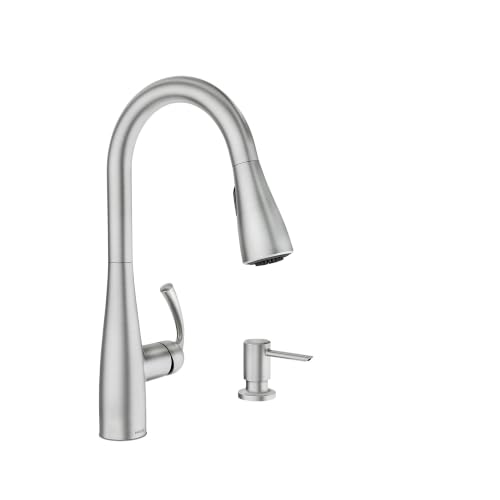
5. Moen Essie Pull-Down 87014SRS — Best Complete Package
Renovating a D-sink usually means doing the whole station: faucet, dispenser, maybe a disposal button. The Essie is the package pick — Moen’s benchmark Reflex pull-down with Power Clean spray, Spot Resist finish, and a soap dispenser included in the verified feature list, filling the deck’s spare hole with something useful instead of a blanking plate. At 15.75 inches it suits mid-size and larger D-decks with honest clearance.
Strengths
- Most complete package here — dispenser included
- Reflex hose behaviour is the class benchmark
- Flexible 1-to-4-hole fit with the included deck plate
Trade-offs
- Needs the clearance its 15.75 in height implies
- Dispenser consumes a hole some decks do not have spare
- Premium-mainstream tier
| Height | 15.75 in (verified from Amazon listing) |
| Installation | 1, 2, 3 or 4-hole, deck plate included |
| Features | Power Clean, Reflex, Duralock, soap dispenser included |
The dispenser’s value is easy to underrate until you have lived with the alternative: a plastic soap bottle colonising the narrow D-deck, falling into the curved bowl weekly. Building the dispenser into the deck reclaims the scarcest real estate in a D-kitchen — the ledge — and the Essie bundles it with the best hose system in the business.
As in our extendable guide, route the Reflex hose with a clear loop and the Essie rewards you daily. In a D-kitchen, where the under-sink cabinet is often as compact as the bowl, spend the extra ten minutes on hose path before the bottles and bins move back in.
Ownership note: the Essie’s included dispenser shares its finish with the faucet, which matters more each year as third-party dispensers drift in colour. When the dispenser pump eventually tires, order Moen’s — the match is guaranteed by the same catalogue.
Best for: Whole-station D-sink renovations / Not suited for: Tight decks without a spare hole
Check the current price on Amazon

6. KOHLER Jolt Pull-Out 30612-VS — Best Gentle-Flow Pick
Some D-bowls splash not because the faucet is wrong but because the flow is: a shallow curve and a 1.8 GPM stream are natural enemies. Kohler’s Jolt answers with a 1.5 GPM pull-out — a two-function head on a hose, touch control, in Vibrant Stainless — delivering a calmer stream you can aim precisely into the deep zone. For water-conscious households it doubles as the efficiency pick, meeting strict flow caps without an aerator swap.
Strengths
- 1.5 GPM flow tames splash in shallow curved bowls
- Pull-out head aims water into the deep zone precisely
- Kohler build and Vibrant Stainless finish quality
Trade-offs
- Lower flow fills big pots more slowly
- Pull-out hose discipline — pull straight, not sideways
- Sleek modern form only suits contemporary schemes
| Flow rate | 1.5 GPM (verified from Amazon listing) |
| Style | Pull-out, two-function sprayhead |
| Finish | Vibrant Stainless |
Flow is a fit dimension, and this guide is the place to say so: matching GPM to bowl depth prevents more D-sink splashing than any spout shape. The Jolt’s two-function head still rinses effectively — Kohler’s spray face is well engineered — while the stream stays composed in a shallow bowl. If your current faucet’s crime scene is the counter in front of the sink, start here.
The pull-out form suits the D-deck too: low body, no tall arc to fight the window, and a head that travels to the work. In a small D-kitchen that cooks gently and values calm, the Jolt is the quiet professional of this roundup.
Ownership note: the Jolt’s 1.5 GPM flow makes it the pick most likely to satisfy a strict local code or a water bill’s conscience, and its aerator should be kept scrupulously clean — at lower flows, a half-scaled aerator is a bigger fraction of the stream.
Best for: Shallow splash-prone D-bowls and strict flow caps / Not suited for: Stockpot fillers in a hurry
Check the current price on Amazon
Comparison Table
| Pick | Badge | Key spec | Best for |
|---|---|---|---|
| Delta Foundations Two-Handle Bar/Prep B2410LF Family | Best Value for D-Sinks | Compact two-handle bar/prep, Delta value line | Rentals, first homes and utility D-sinks |
| Moen Adler Pull-Down 87233SRS | Best Family D-Sink Faucet | 14.56 in Moen pull-down, Reflex, Power Clean | Family kitchens where the D-sink is the main sink |
| Delta Essa Kitchen Faucet 9113-AR-DST | Best for Deeper D-Bowls | 15.25 in full Essa pull-down | Large, deep D-bowls with clearance to spare |
| KRAUS Oletto Pull-Down KPF-2820SFS | Best Stainless Main-Sink Pick | 16.6 in Oletto pull-down, spot-free, 1.8 GPM | Island and open-deck stainless D-sinks |
| Moen Essie Pull-Down 87014SRS | Best Complete Package | Reflex pull-down with dispenser, 15.75 in | Whole-station D-sink renovations |
| KOHLER Jolt Pull-Out 30612-VS | Best Gentle-Flow Pick | 1.5 GPM pull-out, Vibrant Stainless | Shallow splash-prone D-bowls and strict flow caps |
How to Choose a Faucet for a Kitchen With D-Shaped Sinks, Household by Household
If the D-sink is your main family sink, buy capability at compact scale: the Moen Adler pattern — mainstream pull-down platform, moderate height, forgiving deck plate. Family duty punishes novelty; it rewards docking that works and finishes that hide the evidence. If the D-sink is a secondary or prep sink, invert the logic: bar-scale simplicity like the Foundations two-handle will out-serve an over-specified flagship that crowds the little deck.
If splashing is your presenting complaint, diagnose before you buy. Splash at the curved front with a long-reach faucet is a reach problem; splash everywhere at full flow in a shallow bowl is a flow problem, answered by the Jolt’s 1.5 GPM pattern; splash behind the faucet is a lever-and-seal problem that no new spout fixes. Each diagnosis points at a different pick in this guide, which is why the guide is organised by household rather than by price.
If you are renovating, decide the faucet before the countertop is drilled and the window trim is set. D-kitchens are tolerance games: an inch of sill height or a hole two inches forward changes which faucets fit. Bring the faucet’s dimension sheet to the fabricator, not a photograph, and keep the box until the water runs — D-sink returns are common enough that retailers expect them, but only for uninstalled faucets.
- Name your household type first: main family sink or secondary sink
- Diagnose splash by cause — reach, flow, or seals — before shopping
- Match finish to the bowl: stainless with stainless, calm colours with ceramic
- Decide the faucet before drilling or trim work in a renovation
- Keep packaging until the install is proven
Living With a D-Sink: Small Habits That End the Splashing
Angle the head, not the pot. With a pull-down or pull-out, bring the spray to the work and keep the stream short — splash is mostly falling distance. Rinse at the bowl’s deep rear zone, where the D is deepest, and let the curve be a drying rack rather than a washing area. These two habits fix most ‘bad faucet’ complaints that are actually geometry complaints.
Keep the aerator clean. A partially scaled aerator deflects the stream into a fan that finds the rim; a monthly soak in vinegar keeps the stream coherent and centred. In hard-water D-kitchens this five-minute habit is the difference between a faucet that seems badly designed and one that seems perfect — it is the same faucet, with a clean aerator.
How to Swap a Faucet on a D-Sink Without Damaging the Deck
D-sink decks are often part of the sink itself or a narrow stone ledge, so work gently and from below wherever possible. Photograph the existing connections, shut off and drain the lines, and loosen mounting nuts with a basin wrench rather than force from above — torque applied to the faucet body transmits straight into a thin deck. Support the old faucet as the last nut releases; dropped faucets chip ceramic D-sinks beautifully.
Seat the new faucet on its gasket or a bead of plumber’s putty where the manufacturer directs (never on stone with staining risk — use the gasket), tighten evenly in small passes, and connect the hose with its loop clear before the supplies. Run the water and inspect with a dry paper towel under every joint: on a D-deck, a slow drip travels along the straight back edge and appears far from its source, so check the whole run, not just the spot below the faucet.
Common Buying Mistakes
Treating splash as a faucet defect. On D-bowls, splash is usually reach or flow mismatched to the bowl. Diagnose the cause; the fix may be an aerator, not a faucet.
Buying flagship height for a modest bowl. A 17-inch arc over a shallow D looks and splashes like a fountain. Scale is a feature.
Forgetting the D-sink is often the second sink. Prep sinks want simplicity. Over-specifying the island sink while the main sink suffers is the classic misallocation.
Drilling before deciding. In renovations, the faucet’s dimensions must reach the fabricator before the stone does. Photographs do not drill holes accurately.
Discarding the box at unboxing. Fit failures declare themselves at install. Keep packaging until the water has run and the lever has swung a hundred times.
The Two D-Sink Guides: How to Use Them Together
This guide and its geometry-first companion were written as a pair, and they divide the work deliberately. The companion answers ‘what fits’ — dimensions, clearances, reaches — with the tape measure as its authority. This guide answers ‘what suits’ — households, habits, finishes, complaints — with daily life as its authority. A faucet that passes both examinations is a faucet you will keep, and the overlap between the two shortlists is where the safest purchases live.
If the two guides seem to disagree — a pick praised here for capability that the companion flags for size — the disagreement is the information: that faucet is excellent where it fits and wrong where it does not, and your measurements arbitrate. No review can measure your deck from the page; the guides’ job is to make sure you know which three numbers to take.
Read the companion for the measuring routine, this guide for the household reasoning, and the cluster’s other articles for the platforms themselves. That is more reading than a faucet usually gets — and a faucet installed for a decade, used fifty times a day, has earned it.
D-Sinks in Rentals, Flats and Small Homes: A Landlord’s-Eye View
A large share of D-sinks live in homes their cooks did not choose — rentals, flats, inherited kitchens — and the faucet strategy there is different: reversible, affordable, and forgiving of decks you cannot modify. The heroes of that strategy are the deck-plate pull-downs and the value two-handles in this guide, which install on existing holes, improve the sink’s daily life out of proportion to their cost, and can be swapped back or left as a genuine improvement when you move.
Renters should keep two habits: photograph the original faucet and its connections before touching anything, and keep the old faucet in a box rather than a bin. Landlords vary, but a documented, reversible upgrade is rarely argued with — and in many homes the D-sink’s original faucet is tired enough that the conversation is easy.
For landlords themselves, the D-sink calculus is durability per dollar across years of tenants: the Foundations and Adler end of this guide, with parts on every plumber’s truck, is where that arithmetic has always landed. A rental’s faucet is a maintenance contract disguised as a fixture; buy the one whose contract you like.
What a D-Sink Faucet Costs to Own Over Ten Years
Without quoting prices — which date instantly and help no one — the ownership ledger of a D-sink faucet has four lines: the purchase, one cartridge in a decade for a quality platform, possibly one hose or sprayer, and the water it uses. The purchase dominates the headlines but not the ledger: a cheap faucet replaced twice, with a plumber’s visit each time, outspends a quality compact bought once, and the gap widens in fitted kitchens where every swap risks the deck.
The water line is the sleeper. A faucet that drips one drop a second — the classic tired cartridge — wastes a startling volume over a year, and a quality cartridge’s decade of tight shut-off quietly pays rent. Flow rate cuts the other way for filling, but for the rinsing-dominated life of a D-sink, the efficient picks lose nothing and save steadily.
Read this guide’s badges with that ledger in mind: ‘Best Value’ means the lowest ten-year cost of a correct outcome, not the lowest number on a box. It is the only definition of value a decade-long appliance deserves.
From Complaint to Faucet: Matching D-Sink Picks to Real Frustrations
Start from the sentence you actually say about your sink. ‘The counter is always wet’ is a reach or flow sentence — it points at the Jolt’s calm 1.5 GPM or at a pull-down that shortens the fall, and it is cured by water placement, not by a taller arc. ‘I can’t fill the big pot’ is a clearance sentence — it points at the tallest arc your deck honestly passes, the Essa or Oletto end of this guide, or at a pull-out that fills the pot on the counter and ends the argument sideways.
‘It looks tired’ is a finish sentence, and the cheapest true cure in this guide: a spot-free or Spot Resist compact transforms a D-station’s appearance for the price of the faucet alone, because on a small deck the faucet is most of what the eye sees. ‘The lever hits the wall’ is the saddest sentence, because it describes a faucet that should never have been installed — its cure is a side-lever or two-handle replacement, and its prevention is the measurement this guide repeats like a chorus.
Shopping from the sentence rather than the catalogue is the whole method of this companion guide. Catalogues organise faucets by brand and finish; kitchens experience them as solutions and frustrations. Name yours first, and the shortlist writes itself.
The D-Sink Faucet and the Rest of the Kitchen’s Water
A D-sink rarely lives alone in a kitchen’s water plan, and the faucet choice echoes. If the kitchen has a pot filler at the range, the sink faucet’s height matters less — the tallest fills happen at the stove — and a compact D-faucet becomes easier to choose with confidence. If the D-sink is the prep sink and a full-size sink lives elsewhere, invert the logic again: the D-faucet should be the simple one, and the flagship money belongs at the main sink.
Dishwasher habits echo too. Kitchens that hand-wash the awkward half of their cooking — trays, pots, jars — need the D-faucet to be a rinsing tool: travelling head, honest spray, a dock that works with wet hands. Kitchens that dishwasher everything need only a filling tap with good manners, and the Foundations end of this guide serves them for a decade without a thought.
The point is that ‘the best faucet for a D-sink’ is partly a question about the other water in your kitchen. Answer it in context and the pick feels obvious in retrospect — which is what a good decision always feels like.
Maintaining a D-Sink Station: The Whole Fixture, Not Just the Faucet
A D-sink station ages as a system, and the faucet’s happiness depends on its neighbours. The sink’s own surface sets the tone: stainless D-bowls want their grain direction respected when cleaned, or swirl marks will halo the faucet’s base; fireclay wants its glaze protected from the metal tools a faucet swap inevitably waves around. The deck seal is the second neighbour — the bead or gasket where faucet meets deck is the station’s flood defence, and on a D-deck, where splash concentrates along the straight back, that seal works harder than on any other sink shape. Inspect it when you descale the aerator; a failing seal announces itself as a dark line and a musty cabinet, both cheap to prevent and miserable to cure.
The cabinet below is the third neighbour: compact, often shallow, and the first victim of any slow drip. A drip tray or a simple leak alarm under a D-sink’s connections is the highest-value accessory in this entire guide’s orbit, because the D-station’s plumbing is crowded into the least inspectable cabinet in the kitchen. Ten minutes of prevention, once, against a cabinet floor’s replacement — the arithmetic needs no advocate.
Keep the station’s paperwork together — faucet model, sink model, seal type, install date — in the kitchen file this guide keeps recommending. The D-sink household that can name its parts can maintain its station in an afternoon a year. The one that cannot spends its weekends on archaeology. The faucet will be blamed either way; make sure it is innocent.
The D-Sink Household’s Spare-Parts Drawer
Every D-sink household should keep a small, specific drawer — or a labelled box in the cabinet — because the station’s failures are few, known and cheap to pre-empt. Its contents: the faucet’s aerator (a spare, not the memory of one), a cartridge for the installed model once the faucet passes its fifth birthday, a tube of plumber’s grease, the basin wrench that fits your mounting nuts, and the paperwork — model numbers for faucet and sink, the installer’s name, the install date. Total volume: a shoebox. Total value on the Saturday morning something drips: beyond calculation.
The drawer has a second function: it is the household’s memory. D-sinks pass between owners, tenants and generations, and the box that explains the station — what is installed, when, with what parts — converts the next person’s archaeology into maintenance. Farmhouses and cottages have kept such boxes for a century under the name ‘the house book’. The D-sink, a shape from the same era of rationed space and kept things, deserves its page in yours.
Reading D-Sink Reviews Critically: What Other Owners’ Complaints Mean
Owner reviews for D-sink-suitable faucets are a goldmine with a known impurity: most complaints are fit complaints wearing quality clothing. ‘Splashes everywhere’ on a compact faucet usually means it was installed on a big sink, or its reach never met the reader’s drain. ‘Head won’t stay up’ usually means a hose loop strangled by cabinet clutter. ‘Lever hits the wall’ means the measurement in this guide was skipped by someone else, at their expense, for your education. Read complaints as case reports: extract the geometry, not the verdict.
Praise needs the same scepticism in reverse. A faucet praised to the skies by owners of farmhouse sinks may be a poor citizen on a shallow D, and a model damned by owners of cavernous double bowls may be perfect at your scale. The reviews that matter are the ones whose sink sounds like yours — which is why this guide has spent its length teaching you to describe your sink precisely: depth, deck, drain position, window. Describe yours well, and the entire internet’s review corpus becomes sortable. Describe it vaguely, and no quantity of stars — a metric this site refuses to print in any case — will save the purchase.
Why This Guide Refuses to Rank by Stars
A word about method, because D-sink buyers arriving from other sites will notice an absence: this guide prints no star ratings and no review counts, by policy, because those numbers rot. A rating gathered over a decade mixes three hardware revisions; a count gathered over a continent mixes a hundred sink geometries, most of them nothing like yours. What does not rot is the reasoning — dimensions, mechanisms, parts channels, and the fit between a named faucet and a named household problem — which is why this guide spends its words there instead.
Judge the picks the way the guide built them: verify the model, measure the deck, name the frustration, and let the match make the decision. A faucet chosen that way does not need a crowd’s stars to validate it. It validates itself every morning, at your sink, in your bowl — the only review venue that was ever going to matter.
Final Recommendation
Start with the Moen Adler if your D-sink is the family’s main sink — it is the compact-capable balance this shape rewards. Take the Kohler Jolt if splashing is your complaint, the Delta Essa or Kraus Oletto if your D is large and your deck is open, and the Delta Foundations if the sink is a humble prep station that deserves an honest faucet.
Read alongside the geometry-first companion: Best Faucets For Kitchen D Shaped Sinks, plus Best Faucets For Small Kitchen Sink, Best Kitchen Faucets, Best Pull Down Kitchen Faucets and Best Bar Sink Faucets.
Shop the verified picks: Delta Foundations Two-Handle Bar/Prep B2410LF Family; Moen Adler Pull-Down 87233SRS; Delta Essa Kitchen Faucet 9113-AR-DST; KRAUS Oletto Pull-Down KPF-2820SFS; Moen Essie Pull-Down 87014SRS; KOHLER Jolt Pull-Out 30612-VS.
Frequently Asked Questions
Why does my D-shaped sink splash so much?
Usually reach or flow: a spout landing past the bowl’s deep zone, or a strong stream in a shallow curve. A pull-down aimed into the deep zone, or a calmer 1.5 GPM faucet, fixes most cases.
Is a D-shaped sink a good main sink?
A generous D is a fine main sink — deep at the back, efficient with counter depth. A small D suits prep and secondary duty. The faucet should be chosen for the role the sink actually plays.
What finish suits a stainless D-sink?
Stainless-look finishes from the same brand family match best; spot-free and Spot Resist variants hide the water marks that stainless bowls and faucets both collect.
Can I fit a pull-down faucet on a D-sink?
Yes — compact pull-downs like the Adler are designed for it. Check height against windows, rear lever swing against the backsplash, and give the hose a clear loop below.
D-sink vs apron sink — which faucet rules apply?
Apron sinks usually offer a full deck and take farmhouse forms; D-sinks constrain the deck and reward compact scale. The measuring discipline is the same, the answers differ.
Should a D-sink faucet have a side sprayer?
It is a good alternative to a pull-down on low decks: the sprayer travels while the faucet stays low. Two-handle sets with sprayers are the classic D-sink solution for window walls.
How long should a D-sink faucet last?
A platform faucet from the brands in this guide should give a decade or more of daily service, with a cartridge and possibly a hose or sprayer refreshed along the way. Longevity on a D-sink is mostly fit and maintenance: a faucet that was measured in, whose aerator is kept clean and whose seals are watched, has no D-specific reason to die young.
Is it worth replumbing to fit a bigger faucet on a D-sink?
Almost never for the faucet’s sake alone. Replumbing earns its cost when it solves the deck’s geometry — moving a hole line forward, adding a sprayer hole during a countertop replacement — not when it merely admits a taller arc. If the countertop is being replaced anyway, that is the moment to set the holes for the faucet you actually want; until then, the compact catalogue exists precisely so the plumbing can stay where it is.


