Disclosure: airfryerkitchensupply.com is reader-supported. When you buy through links on our site, we may earn an affiliate commission at no extra cost to you.
Where to buy
This guide to the best faucets for kitchen d shaped sinks starts with where to buy safely. D-shaped sinks — one straight side against the backsplash, one curved bowl front — punish faucets that are too tall, too long in reach, or too wide at the base, so the picks below were chosen for compact footprints and moderate arcs first and brand second. Every linked pick was confirmed against Amazon’s catalog data for this site before earning its link. Use the links to check price on Amazon for the exact model, and measure your sink’s deck depth before ordering anything: on a D-sink, the measurement from the hole centre to the backsplash is the one that decides what fits.
- Delta Windemere Two-Handle 21996LF — check price on Amazon
- GROHE Concetto Bar Faucet 31479001 — check price on Amazon
- Delta Essa Bar Faucet 9913-BL-DST (Matte Black) — check price on Amazon
- KRAUS Oletto Bar Faucet KPF-2822SFS — check price on Amazon
- Delta Modern Bar Faucet 14882LF-SP — check price on Amazon
- GIMILI Bar Sink Faucet B0B2R4FN7C — check price on Amazon
Finding the best faucets for kitchen d shaped sinks is a geometry problem before it is a shopping problem. A D-shaped sink puts its straight edge — and usually its faucet deck — hard against the backsplash, which steals the rear clearance that tall levers and deep faucet bases assume. The bowl’s curved front, meanwhile, is often shallower than a rectangular sink’s, so a long-reach spout overshoots the bowl’s sweet spot and splashes the front edge. The right faucet is compact at the base, moderate in height, and honest in reach.
The six picks below are drawn from bar and prep faucets and compact kitchen models whose verified dimensions suit the D-sink’s constraints: shorter arcs, narrower bases, reaches that land water in the bowl rather than on its rim. Several are sold as bar faucets — do not let the label put you off. A bar faucet is simply a kitchen faucet scaled for a smaller sink, which is exactly what a D-shaped sink is asking for.
Two measurements govern everything that follows. First, hole centre to backsplash: your lever’s backward swing and the base’s depth must live inside it. Second, hole centre to the bowl’s drain: your spout reach should land near it, not beyond it. The buying guide turns those into a five-minute measuring routine; the picks assume you will run it.
In this guide
Quick Picks
1. Delta Windemere Two-Handle 21996LF — Best Overall for D-Sinks. A low, traditional two-handle at 11.63 inches tall with a side sprayer — proportions drawn for exactly the deck a D-sink offers. Check price on Amazon
2. GROHE Concetto Bar Faucet 31479001 — Best Premium Compact. Grohe’s Concetto scaled to bar size: SilkMove cartridge, dual spray, 360-degree swivel and a pull-down head in a D-sink footprint. Check price on Amazon
3. Delta Essa Bar Faucet 9913-BL-DST (Matte Black) — Best Modern D-Sink Pick. The Essa design language at bar scale, in matte black, with a pull-down head — the modern compact for contemporary D-sink kitchens. Check price on Amazon
4. KRAUS Oletto Bar Faucet KPF-2822SFS — Best Stainless Compact. The Oletto platform at bar height in spot-free stainless — Kraus build quality scaled for D-sinks and prep sinks. Check price on Amazon
5. Delta Modern Bar Faucet 14882LF-SP — Best Simple Single-Hole. A clean single-handle, single-hole bar faucet in SpotShield stainless — the unfussy compact for narrow D-sink decks. Check price on Amazon
6. GIMILI Bar Sink Faucet B0B2R4FN7C — Best Budget D-Sink Pick. A budget single-hole bar faucet that still includes a pull-down sprayer — extendable function at D-sink scale and price. Check price on Amazon
How These Picks Were Chosen
Picks were verified as elsewhere in this cluster — brand-plus-model searches in Amazon’s catalog data for this site, titles matched to models before any dp link was granted — and then filtered hard on geometry. Models with published heights and footprints in the verified data were preferred, because a D-sink recommendation without dimensions is a guess wearing a badge.
The shortlist favours compact platforms: Delta’s bar and prep versions of proven designs, Grohe’s Concetto bar model, Kraus’s Oletto bar variant, and compact full-kitchen models for larger D-sinks. Each pick’s review states the fit it suits — tight deck, deep bowl, low cabinet — so you can match by measurement rather than by hope.
Excluded: full-height statement faucets whose arcs tower over a D-sink’s proportions, wide-base widespread sets that crowd a narrow deck, and any model whose dimensions could not be established from verified data.
A closing note on method, because it governs every badge above: no pick in this guide was chosen from a photograph or a marketing claim. Each was verified as a real, current listing from its brand, measured where its dimensions could be confirmed, and matched to a named situation in a real kitchen. Where a number could not be confirmed, the guide says so and tells you how to measure instead — because a faucet guide that invents its facts would fail you at exactly the moment a tape measure would not.
What are the 6 best faucets for kitchen d shaped sinks?

1. Delta Windemere Two-Handle 21996LF — Best Overall for D-Sinks
The Windemere wins this category on proportions alone: at 11.63 inches tall per the verified listing data, it is the lowest full kitchen faucet in this roundup, with a traditional two-handle layout that spreads its controls along the deck instead of stacking height at the centre. On a D-sink under a window or low cabinet, that low, wide stance is precisely right — and the side sprayer supplies the rinsing travel the modest spout cannot.
Strengths
- Lowest profile here — 11.63 in verified height suits tight vertical space
- Two-handle layout keeps the centre low and the deck balanced
- Side sprayer covers the bowl’s curved corners
Trade-offs
- Chrome finish wants regular wiping
- Four-hole deck requirement (8-inch centres plus sprayer)
- Two-handle temperature ritual, as with all traditional sets
| Height | 11.63 in (verified from Amazon listing) |
| Dimensions | 8 x 10.25 x 11.63 in |
| Installation | 4-hole, 8 in centres, side sprayer |
D-sinks are frequently fitted in kitchens where the sink sits under a window, and window sills are faucet-killers: they cap height and punish rear lever swing. The Windemere’s lever handles swing sideways rather than tipping back, and its arc stays below most sill lines — two quiet geometric virtues that matter more here than any spray technology.
The cartridge story is reassuring too: the verified listing notes a cartridge tested to 500,000 uses, and Delta’s parts channel is as deep as the industry offers. For a faucet chosen on fit, it is pleasant to also get longevity — fit gets a faucet installed, but parts keep it installed.
Ownership note: the Windemere’s side sprayer diverter is its one moving subtlety — run the sprayer weekly even if you rarely use it, because diverters that sit dry for months are the ones that stick. Thirty seconds of sprayer use is the cheapest maintenance in this guide.
Best for: D-sinks under windows or low cabinets / Not suited for: Single-hole decks or one-hand cooks
Check the current price on Amazon
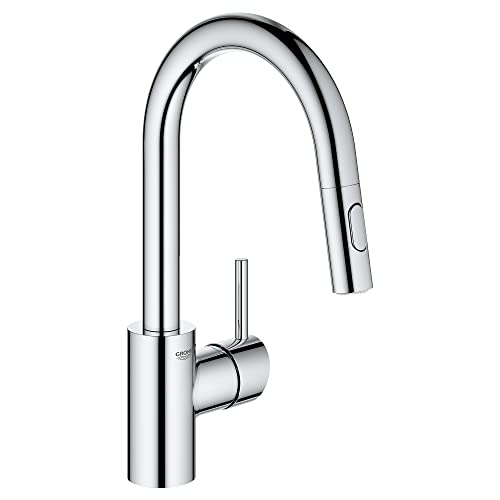
2. GROHE Concetto Bar Faucet 31479001 — Best Premium Compact
If your D-sink is the main sink in a small, well-finished kitchen, the Concetto Bar is the premium answer: the full Grohe experience — SilkMove lever, dual-spray pull-down head, full swivel — compressed into a bar faucet’s footprint. The 360-degree swivel matters doubly on a D-sink, letting you angle the spout along the straight back edge for filling, then swing it to centre for washing, instead of living with one fixed landing spot.
Strengths
- Premium SilkMove cartridge in a compact footprint
- Pull-down head plus 360-degree swivel solves D-sink aiming
- Single-hole mount suits narrow D-sink decks
Trade-offs
- Bar scale means a smaller head and shorter hose than full Concettos
- Chrome finish upkeep, as with all bright Grohe
- Premium pricing for a compact faucet
| Flow rate | 1.75 GPM (verified from Amazon listing) |
| Swivel | 360 degrees |
| Valve | SilkMove ceramic |
| Installation | Single hole, pull-down |
The swivel is the D-sink feature nobody lists first and everybody needs. A fixed spout lands water in one ellipse; a D-bowl’s usable area is a half-disc offset toward the curve. A full-swivel spout with a pull-down head lets you place water anywhere in that half-disc — the geometric mismatch simply dissolves. When you test-fit mentally, this is the pick that never splashes the rim.
Lever swing also behaves: the Concetto’s side lever works in a compact arc that respects a close backsplash better than back-tilting centre levers. Measure anyway — but of the premium compacts, this is the one designed by people who measured.
Ownership note: Grohe’s bar models share cartridges with the full Concetto line, so the compact’s parts future is a flagship’s parts future. That inheritance is the quiet reason the premium compact outranks cheaper small faucets whose cartridges exist only in their own listing.
Best for: Small premium kitchens with a D-sink as main sink / Not suited for: Large family sinks needing a full-size head
Check the current price on Amazon
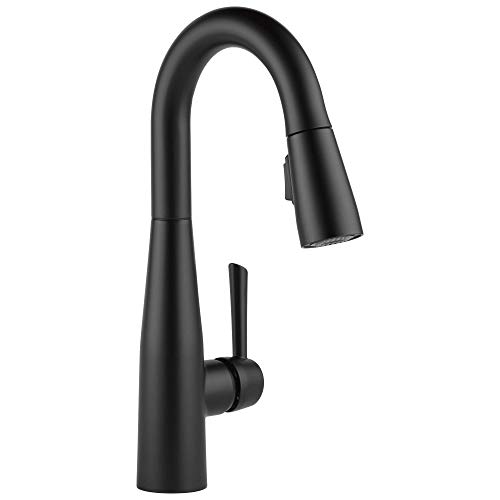
3. Delta Essa Bar Faucet 9913-BL-DST (Matte Black) — Best Modern D-Sink Pick
Delta’s Essa is one of the most-liked modern faucet designs of the last decade, and its bar version keeps the sculptural arc while shrinking the footprint for prep and D-shaped sinks. In matte black it suits the contemporary small kitchen — flat-front cabinets, pale stone, black accents — and its pull-down head gives the aiming freedom a D-bowl rewards. Delta’s Diamond Seal platform underneath is proven across millions of installs.
Strengths
- Essa’s modern design at a D-sink-friendly scale
- Pull-down head for precise placement in a curved bowl
- Matte black hides fingerprints in a busy small kitchen
Trade-offs
- Matte black shows hard-water scale — wipe-downs needed
- Bar-scale hose travel is shorter than full-size Essa
- Modern look will not suit traditional D-sink kitchens
| Style | Bar/prep pull-down (verified from Amazon listing) |
| Platform | Diamond Seal Technology |
| Finish | Matte Black |
Small kitchens feel every object’s visual weight, and the Essa Bar earns its place by being interesting at a size that does not dominate. Its arc gives enough clearance for a D-sink’s typical work — saucepans, colanders, a watering can — without the tower effect of a full-height faucet over a modest bowl.
As a prep-platform faucet it also plays well as a second sink’s faucet in a big kitchen, which is worth remembering if your D-sink is an island or butler’s-pantry sink rather than the main event: matching the main sink’s finish family while shrinking the scale is exactly what bar versions exist for.
Ownership note: the Essa Bar’s matte black will tell you your water’s hardness within a month — read it as a free water-quality gauge, and let a softening or wiping routine follow the evidence rather than a schedule copied from the internet.
Best for: Modern small kitchens and secondary D-sinks / Not suited for: Traditional kitchens or hard-water no-wipe homes
Check the current price on Amazon
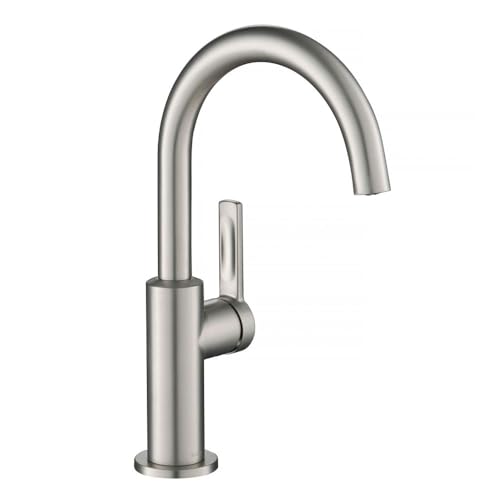
4. KRAUS Oletto Bar Faucet KPF-2822SFS — Best Stainless Compact
Kraus built its name on sinks, which makes its bar faucet a thoughtful D-sink pick: the company designs faucets and bowls as a system. The Oletto Bar brings the full-size Oletto’s brass body and ceramic cartridge down to bar scale, in a spot-free stainless finish that is the lowest-maintenance surface in this roundup. For a stainless D-sink — the most common pairing — it is the set-and-forget choice.
Strengths
- Spot-free finish — the easiest upkeep here
- Brass body and ceramic cartridge from the full Oletto platform
- Designed by a sink maker, with proportions to match
Trade-offs
- No pull-down head on the bar model — fixed spout discipline required
- Check spout reach against your bowl’s drain position carefully
- Kraus’s faucet parts channel is smaller than Delta’s or Moen’s
| Style | Single-handle bar faucet (verified from Amazon listing) |
| Finish | Spot Free Stainless Steel |
A fixed spout on a D-sink is a precision exercise: the reach must land the stream in the bowl’s deep zone, forward of the straight back edge and short of the curved rim. Kraus publishes its dimensions properly, so do the arithmetic with your sink’s hole-to-drain measurement before ordering — when the numbers align, a fixed spout’s simplicity (no hose, no dock, nothing to wear) is its own luxury.
The spot-free finish deserves its reputation in small kitchens, where the faucet is always in view and rarely wiped. If your D-sink lives in a rental or a busy family kitchen, this is the pick whose appearance survives the household’s real habits.
Ownership note: with a fixed spout, the aerator is your only aiming adjustment — keep it clean and consider an aerator with a slight swivel if your bowl’s deep zone sits off-axis. It is the cheapest geometry fix in plumbing, and on a D-sink it can feel like a new faucet.
Best for: Stainless D-sinks and low-maintenance households / Not suited for: Anyone who needs a travelling spray head
Check the current price on Amazon

5. Delta Modern Bar Faucet 14882LF-SP — Best Simple Single-Hole
Some D-sink decks offer exactly one hole and no apologies. Delta’s Modern bar faucet is built for that deck: a single-hole, single-handle compact in SpotShield Stainless, with modern lines that suit small contemporary kitchens and a footprint that leaves the narrow deck uncluttered. No sprayer, no bridge, no drama — just a well-made small faucet from a brand whose parts will outlive the countertop.
Strengths
- True single-hole install for the narrowest decks
- SpotShield finish resists spots and fingerprints
- Delta parts and support depth
Trade-offs
- Fixed spout — reach must be matched to the bowl by measurement
- No spray function at all
- Minimalist look only suits modern schemes
| Installation | Single hole (verified from Amazon listing) |
| Style | Single-handle bar/prep faucet |
| Finish | SpotShield Stainless |
There is a discipline to recommending the simplest faucet in a roundup: it has to be the right answer for a real reader, and here it is — the reader with one hole, a shallow D-bowl, and no desire to maintain a hose. Every feature omitted is a failure mode omitted, and Delta’s execution of the basics (cartridge feel, finish consistency, mounting hardware) is exactly what you are paying for.
Pair it with a sink-side sprayer only if your deck secretly has a second hole; otherwise embrace the simplicity and put the saved budget into the sink itself, where a D-kitchen feels money better.
Ownership note: Delta’s SpotShield finish on the Modern bar faucet is doing double duty on a D-deck, where the faucet sits close to the wall and gets wiped less often simply because it is awkward to reach. Forgiving finishes earn their premium in exactly such corners.
Best for: One-hole narrow decks and minimalists / Not suited for: Anyone who rinses with a spray head daily
Check the current price on Amazon

6. GIMILI Bar Sink Faucet B0B2R4FN7C — Best Budget D-Sink Pick
GIMILI’s bar faucet is the budget route to the feature that matters most on a D-sink: a pull-down sprayer that lets you place water precisely in a curved bowl. It is a modern single-hole design in brushed nickel, sized for bar and prep sinks, at the friendliest tier in this roundup. For a rental D-kitchen, a utility-room D-sink, or a first small kitchen, it delivers the geometry win without the premium.
Strengths
- Pull-down sprayer at a budget tier — rare at bar scale
- Single-hole fit for narrow decks
- Brushed nickel is a forgiving, versatile finish
Trade-offs
- Budget brand — parts support is the shallowest here
- Hose travel is bar-scale short
- Finish and cartridge are serviceable, not premium
| Style | Single-hole bar faucet with pull-down sprayer (verified from Amazon listing) |
| Finish | Brushed Nickel |
The honest frame for this pick is value per function: the pull-down head transforms D-sink usability, and getting it at this tier means accepting a thinner support story. Keep the documentation, treat the hose gently, and the faucet will do its job for years in a light-to-moderate duty kitchen.
In a heavy-duty family kitchen, step up to the Grohe or Delta compacts above — the cartridge and hose differences are real. But do not let anyone tell you a budget pull-down is a mistake in a small D-sink: geometry beats pedigree every time the water lands where you aimed it.
Ownership note: budget bar faucets reward a careful first install disproportionately — flush the lines, seat the gasket evenly, and check the hose crimp before the cabinet is repacked. The GIMILI’s service life is substantially written in its first hour.
Best for: Rentals, utility D-sinks and first small kitchens / Not suited for: Heavy-duty main kitchens wanting deep parts support
Check the current price on Amazon
Comparison Table
| Pick | Badge | Key spec | Best for |
|---|---|---|---|
| Delta Windemere Two-Handle 21996LF | Best Overall for D-Sinks | 11.63 in tall, two-handle, side sprayer | D-sinks under windows or low cabinets |
| GROHE Concetto Bar Faucet 31479001 | Best Premium Compact | Compact Concetto, 360° swivel, pull-down | Small premium kitchens with a D-sink as main sink |
| Delta Essa Bar Faucet 9913-BL-DST (Matte Black) | Best Modern D-Sink Pick | Bar-scale Essa, pull-down, matte black | Modern small kitchens and secondary D-sinks |
| KRAUS Oletto Bar Faucet KPF-2822SFS | Best Stainless Compact | Bar-scale Oletto, spot-free stainless | Stainless D-sinks and low-maintenance households |
| Delta Modern Bar Faucet 14882LF-SP | Best Simple Single-Hole | Single-hole compact, SpotShield finish | One-hole narrow decks and minimalists |
| GIMILI Bar Sink Faucet B0B2R4FN7C | Best Budget D-Sink Pick | Budget bar pull-down, single hole | Rentals, utility D-sinks and first small kitchens |
How to Choose a Faucet for a D-Shaped Sink: Measure These Three Things
First, hole centre to backsplash. This is your rear clearance budget, and it must swallow the faucet base’s depth plus the lever’s backward swing with room to spare. Side-lever and two-handle designs spend this budget most wisely; back-tilting centre levers are the usual casualties. If the number is under three inches, shortlist side-lever compacts and two-handle sets only.
Second, hole centre to drain centre. Your spout’s reach should land the stream at or just behind the drain — that is the bowl’s deep zone, where water behaves. A reach longer than this distance by more than an inch or two will splash the curved front rim on full flow; shorter, and you will be pushing pots backwards to fill them. Fixed-spout picks live or die by this number; pull-downs forgive it.
Third, deck width and hole count. D-sink decks are often a narrow ledge. Single-hole compacts and 8-inch two-handle sets fit most; widespread sets and wide deck plates frequently do not. Count your holes before you fall in love, and remember a leftover hole can be covered — a missing one cannot be wished into stone.
- Measure hole-to-backsplash clearance including lever swing
- Match spout reach to the hole-to-drain distance
- Count holes and measure deck width before shortlisting
- Prefer pull-down or swivel models if reach is uncertain
- Check overall height against windowsills and cabinets
Why Bar Faucets Keep Appearing in This Guide
Because ‘bar faucet’ is a size, not a demotion. Bar and prep models are kitchen faucets engineered for smaller bowls: shorter arcs, compact bases, reaches tuned to land in a modest sink. A D-shaped sink is, dimensionally, a modest sink with one straight side — so the bar catalogue is where its faucets live. The platforms are the same (Grohe’s Concetto, Delta’s Essa, Kraus’s Oletto all appear here in bar form), the cartridges are the same, and the warranty channels are the same.
The one compromise to accept knowingly is hose travel and head size on pull-down bar models: both shrink with the scale. For a D-sink’s bowl, the travel is sufficient by design. Only if your D-sink is unusually large should you shop the full-size catalogue instead — and then, measure a full-size faucet’s base against that rear clearance twice as carefully.
How to Test-Fit a Faucet on a D-Sink Before Drilling Anything
Make a paper template. Mark the hole centre on painter’s tape on the deck, then use a cardboard cut-out of the faucet’s base footprint — dimensions are in every serious listing — to check the base against the backsplash and the deck’s front edge. Swing an imaginary lever: mark its arc on the tape and confirm nothing collides.
Then simulate the water. From the hole centre, measure the spout reach along the deck and drop a plumb line (a phone torch and a ruler work) into the bowl: the stream should land at the drain’s neighbourhood, not on the rim’s curve. If you are between two models, this five-minute simulation is worth more than an hour of reviews — geometry does not have opinions, and neither will your tape measure.
Common Buying Mistakes
Buying a full-height faucet for a D-sink under a window. Height plus rear lever swing is the classic D-sink collision. Measure both before ordering.
Ignoring spout reach versus drain position. Too long splashes the curved rim; too short strands your pots. The hole-to-drain number decides.
Dismissing bar faucets as lesser. They are the same platforms at the right scale. A bar faucet that fits beats a statement faucet that collides.
Forgetting the deck is narrow. Wide deck plates and widespread sets crowd a D-sink ledge. Check base footprint against deck width.
Skipping the paper template. Five minutes with tape and cardboard prevents the most expensive sentence in plumbing: ‘it doesn’t fit’.
D-Shaped Sink Materials and the Faucets That Match Them
Stainless steel D-sinks pair naturally with stainless-look faucets, but the match is subtler than it sounds: sink steel is brushed in one direction and faucet finishes vary in warmth, so order the faucet from the same brand family as the sink where you can — Kraus, notably, designs both — or accept a near-match softened by the fact that the two surfaces meet at an angle and never share a flat plane. In practice, any of the spot-free or brushed finishes in this guide sits comfortably on a stainless D.
Fireclay and ceramic D-sinks, rarer and prettier, want calmer company: chrome reads classic, brushed nickel reads soft, and matte black reads designed. Their decks — often the sink’s own ledge — are also less forgiving of wide bases, which is another vote for the compact single-hole picks here. Composite granite D-sinks split the difference and take any finish, with black-on-black being the combination most likely to look expensive.
Whatever the material, protect it at install: a faucet base torqued unevenly can star-crack a ceramic ledge, and a dropped wrench chips fireclay in a way that cannot be un-chipped. Work with a towel in the bowl — the oldest trick in plumbing, and still the one that saves the most sinks.
The D-Sink at Work: Washing Up in a Half-Disc
A D-bowl’s working geography is a half-disc with its deep zone along the straight back. Arrange your washing to that map: soak in the deep zone, rinse with the head or sprayer aimed along the back, and use the shallow curve as the draining and stacking area rather than the washing area. Cooks who fight the shape park everything in the curve and splash; cooks who read the map find the D washes as efficiently as a rectangular sink of the same volume.
Two accessories multiply a D-sink’s usefulness. A bottom grid sized to the bowl protects the surface and lets water circulate under soaking pans — and in a D, the grid must be the D-shaped one, because a rectangular grid in a curved bowl rocks and rattles. A roll-up drying rack across the straight back turns the dead zone behind the faucet’s swing into draining space, which in a small D-kitchen is found square footage.
None of this requires the perfect faucet — but the faucets in this guide were chosen to cooperate with the map: swivels that serve the back zone, pull-downs that shorten the fall, sprayers that reach the curve without drowning it.
D-Sink Faucet Problems and Their Real Causes
Problem: water on the counter behind the faucet. Cause: rarely the faucet — usually lever swing flicking wet hands, or a base seal letting splash creep. Dry the deck, watch a full wash-up, and you will see which; seals are replaceable, habits are adjustable. Problem: the stream hits the front rim. Cause: reach too long for the hole-to-drain distance — an aerator with a downward angle or a pull-down head used at part-travel are the fixes short of replacement.
Problem: handles foul the backsplash. Cause: a back-tilting lever on a close deck, designed-in and unfixable by adjustment — this is the measurement this guide keeps repeating, because it is the one that cannot be cured later. Problem: the sprayer or head weakens over months. Cause: scale in the screen and aerator, the universal solvent-soluble fault. Soak, rinse, restore.
The pattern across all four: D-sink problems are geometry and maintenance, almost never mystery. Measure before, maintain after, and the shape that looked like a compromise becomes the most efficient sink you have owned.
D-Sink Faucets and the Window Above: A Clearance Masterclass
The window above a D-sink is both the kitchen’s charm and its constraint, and the clearance question has three dimensions that are routinely confused. Height is the obvious one — faucet top against sill bottom — and the only one most buyers measure. Swing is the second: a lever that tilts back toward the window at full temperature travel needs inches that the tape must grant behind the faucet’s base, not above it. Splash is the third and the sneakiest: a stream that lands wrong in a shallow D-bowl throws droplets at the window and sill, and a sill that is splashed daily eventually shows it in the paint.
The picks in this guide map onto the three dimensions deliberately. The Windemere wins height and swing with its low two-handle form. The swivel and pull-down picks win splash by letting you shorten the water’s fall and choose its landing. A D-sink under a window that passes all three dimensions is a solved problem; most ‘difficult’ D-sinks are simply windows whose second and third dimensions nobody measured.
If your window opens inward over the sink — a casement that swings into the room — add a fourth check: the open window’s arc against the faucet’s top and lever. It is the rarest collision and the most absolute, because a window that cannot open is a renovation that failed at the last inch.
Small Variations: Corner D-Sinks, Offset Drains and Other Real Bowls
Not every D is the textbook D. Corner installations rotate the shape, putting the straight side against one wall and the faucet deck in the corner’s wedge — a geometry that punishes wide bases and rewards single-hole compacts with side levers, because the corner steals room on two sides at once. If your D lives in a corner, read this guide’s picks through that filter: the Grohe and Delta compacts are your shortlist, and the two-handle sets need their handle swing checked against both walls.
Offset drains shift the reach arithmetic: the deep zone sits where the drain is, not where the catalogue drawing assumes, so the hole-to-drain measurement in the buying guide must be taken to the actual drain centre, diagonally if necessary. A pull-down forgives the diagonal; a fixed spout must be aimed by it, and some fixed-spout owners solve an offset with a swivel aerator — a small part that buys fifteen degrees of grace.
Double D-sinks — two bowls sharing the shape — are the final variation: they want a faucet centred between bowls with a swivel or a head that travels, and they punish short reaches hardest of all. The Moen Essie and Adler patterns from the companion guide are the natural citizens here. Variations aside, the method never changes: measure the bowl you have, not the bowl the listing imagined.
A Short History of the D-Sink, and Why It Is Coming Back
The D-shaped sink is older than its current fashion suggests: it belongs to the era of compact European kitchens, where counter depth was rationed and a bowl that spent its inches on curve rather than corners made ergonomic sense. The straight back wastes nothing against the wall; the curved front gives the cook a bowl that meets the body kindly, with no corner digging at the hip during a long wash-up. Mid-century American kitchens, drunk on space, let the shape lapse — and the current revival, driven by smaller homes, accessory dwelling units and a general re-rationing of kitchen square footage, has rediscovered what the shape always knew.
That history explains the faucet market’s shape too: the D-sink’s natural faucets live in the bar and compact catalogues because those catalogues were built for the same rationed kitchens. When you buy a Grohe or Delta bar model for a D-sink, you are not improvising — you are reuniting a sink with the fixture class that grew up beside it, in the same small European kitchens, under the same windows.
It also predicts the category’s future correctly: as kitchens keep shrinking on average, compact platforms will keep improving, and the D-sink owner shopping in five years will have more choice, not less. Buy the platform with the parts channel, and that future is yours to draw on — the shape is not a compromise to be endured but a tradition to be equipped.
When a D-Sink Should Get a Wall-Mounted Faucet Instead
One legitimate escape from every constraint in this guide deserves its paragraph: if the deck truly cannot host a faucet — too narrow, too close to the wall, drilled beyond redemption — a wall-mounted faucet above the sink removes the deck from the equation entirely. Wall mounts suit D-sinks handsomely, because the spout can be centred over the bowl’s deep zone by the plumbing’s placement rather than the deck’s, and the deck becomes pure workspace. Traditional and modern wall-mount kitchen faucets exist from the same brands that fill this guide.
The costs are real and should be counted: the plumbing lives in the wall, so installation and any future service open the wall; the spout height is fixed at rough-in, so the pot-clearance decision is permanent; and in cold climates the wall must be an interior one or insulated against freezing. None of these is a reason to avoid the option — they are the price list for the one geometry that frees a D-sink completely. If your deck has vetoed three faucets in a row, price the wall mount before vetoing a fourth.
D-Sink Faucets for Left-Handed and Right-Handed Kitchens
Handedness is the D-sink variable nobody lists. A single-lever faucet’s lever sits on one side — most commonly the right — and on a D-deck backed against a wall, that side may be the cramped one, the one beside the draining board, or the one a left-handed cook approaches across their body. Before ordering, stand at the sink and mime a day: which hand is wet, which hand holds the pan, which side does the lever want to be on for your household’s dominant pattern? Several platforms in this guide offer the lever in configurations worth checking at the model level, and two-handle sets are gloriously ambidextrous by design.
The sprayer and pull-down inherit the question: a head drawn by the non-dominant hand across a curved bowl is a splash rehearsing itself. None of this is decisive for most households — cooks adapt in a week — but in a kitchen shared by a committed left-hander and a committed right-hander, the two-handle Windemere pattern or a centre-lever compact can be the peace treaty. It costs one mime at the sink to find out, which makes it the cheapest research in this entire guide.
One More Measurement: The Cook’s Own Clearance
Every measurement in this guide has been about the sink and the room — but the last one is about the cook. Stand at the D-sink in your working position and note where your body meets the bowl’s curve and where your forearms travel during a wash-up. A faucet whose lever sits inside that forearm path will be bumped, splashed and cursed; a spout whose arc clears your habitual lean keeps the peace. Tall cooks and short cooks inhabit the same D-sink differently, and the faucet that fits the room but fights the cook is only half fitted.
This is why the final check in any D-sink purchase is a mime, not a measurement: run the phantom wash-up, filling, rinsing and stacking, with the candidate’s dimensions in mind. Two minutes of theatre at the empty sink will tell you what a month of ownership would — and it costs nothing but the willingness to look slightly foolish in your own kitchen, alone, before the box is opened rather than after.
Final Recommendation
For most D-shaped sinks, start with the Delta Windemere if your deck takes four holes and your space is tight — its proportions were made for this problem. Go Grohe Concetto Bar for a premium single-hole install, Delta Essa Bar for modern looks, and Kraus Oletto Bar if a fixed spout’s simplicity and a spot-free finish suit your household’s habits.
More geometry help lives in the cluster: Best Faucets For Kitchen With D Shaped Sinks, Best Faucets For Small Kitchen Sink, Best Kitchen Faucets, Best Bar Sink Faucets and Best Single Hole Kitchen Faucets.
Shop the verified picks: Delta Windemere Two-Handle 21996LF; GROHE Concetto Bar Faucet 31479001; Delta Essa Bar Faucet 9913-BL-DST (Matte Black); KRAUS Oletto Bar Faucet KPF-2822SFS; Delta Modern Bar Faucet 14882LF-SP; GIMILI Bar Sink Faucet B0B2R4FN7C.
Frequently Asked Questions
What is a D-shaped sink?
A sink whose bowl is straight on the side against the wall and curved on the front — shaped like the letter D. The layout saves counter depth and puts the faucet deck close to the backsplash, which constrains faucet size.
Can I use a regular kitchen faucet on a D-shaped sink?
Sometimes — if its base fits the rear clearance, its lever clears the backsplash, and its reach lands in the bowl. Bar and compact models fit far more often, which is why this guide favours them.
What spout reach is right for a D-sink?
One that lands the stream near the drain: measure from your faucet hole to the drain centre and choose a reach close to that distance. Pull-down heads forgive a mismatch; fixed spouts do not.
Do D-sinks need a pull-down faucet?
Not need — but a pull-down or a full-swivel spout solves the D-bowl’s aiming problem elegantly, because the usable bowl area is offset toward the curve. Fixed spouts work when the reach arithmetic is right.
How do I stop splashing on the curved front?
Usually the reach is too long or the flow too strong for the bowl’s depth. A pull-down aimed into the deep zone, or an aerator matched to the faucet, calms it. Check reach first — it is the commonest cause.
Are bar faucets durable enough for a main sink?
The bar versions of major platforms use the same cartridges and finishes as their full-size siblings. In a small kitchen where the D-sink is the main sink, they are a legitimate long-term choice.
Does a D-shaped sink limit my choice of finishes?
Barely. The constraint is geometry, not colour: any finish offered on a compact platform is available to you, from chrome to matte black. Match the finish to the bowl material and your wiping habits — spot-free and brushed finishes forgive the close-quarters splashing that D-sinks specialise in, while polished finishes ask for the cloth you may not always have handy.
Can I fit a faucet with a soap dispenser on a D-sink deck?
Only if the deck genuinely has the spare hole and the width — D-decks are the least forgiving in the kitchen, and a dispenser crowded against the backsplash is a dispenser that never gets refilled. Where the deck allows it, a dispenser reclaims the ledge from a soap bottle and is worth having; where it does not, a wall-mounted or sink-rim bottle is the honest alternative, and no drilling should be attempted in a stone or ceramic ledge to force the issue.


