Disclosure: airfryerkitchensupply.com is reader-supported. When you buy through links on our site, we may earn an affiliate commission at no extra cost to you.
Where to buy
This guide to the best farmhouse kitchen faucets starts with where to buy safely. Farmhouse faucets live on Amazon across two worlds: genuine bridge and traditional models from heritage brands, and modern pull-downs wearing farmhouse-friendly finishes. Every linked pick below was confirmed against Amazon’s catalog data for this site before earning its link — important in this category, because vintage-look listings are thick with unbranded copies. Use the links to check price on Amazon for the exact model and finish; with bridge faucets especially, the finish suffix decides both the look and whether a side sprayer is included.
- Kingston Brass Heritage Bridge KS1278ALBS (Brushed Nickel) — check price on Amazon
- WOWOW Brass Bridge Faucet (Oil Rubbed Bronze) — check price on Amazon
- Moen Brantford Pull-Down 7185SRS — check price on Amazon
- Kingston Brass Heritage Bridge KS1175AX (Oil Rubbed Bronze) — check price on Amazon
- WOWOW Brass Bridge Faucet (Polished Nickel) — check price on Amazon
- Kingston Brass French Country Widespread KB1795TXBS — check price on Amazon
Choosing the best farmhouse kitchen faucets starts with a confession: ‘farmhouse’ describes a kitchen, not a faucet mechanism. The kitchens in question — apron-front sinks, Shaker cabinets, wood and stone, hardware with some weight to it — ask the faucet to do two jobs at once: work like a modern appliance and look like it belongs in a house that has cooked for a century. The faucets that pull that off share traits: bridge or traditional silhouettes, honest metal finishes like brushed nickel, brass and oil-rubbed bronze, and handles you operate with the back of a floury hand.
The six picks below split deliberately. Three are true bridge faucets — two handles, an exposed horizontal bar, a side sprayer — the authentic farmhouse form. Three are modern single-handle machines in farmhouse-friendly dress, for cooks who want the look without giving up pull-down convenience. Both camps are legitimate; the guide below helps you decide which compromise your kitchen actually wants to live with.
One caution that shapes this whole list: the farmhouse look is the most copied in plumbing. Unbranded ‘vintage’ faucets with no parts support crowd this search. Every pick here is from a brand with a real catalogue and replaceable cartridges — because a farmhouse kitchen is a keep-it-forever kitchen, and its faucet has to be serviceable on the same timescale.
In this guide
Quick Picks
1. Kingston Brass Heritage Bridge KS1278ALBS (Brushed Nickel) — Best Overall. The authentic farmhouse form — two handles on an exposed bridge, a brass side sprayer, and an 8-3/4-inch reach — in go-with-everything brushed nickel. Check price on Amazon
2. WOWOW Brass Bridge Faucet (Oil Rubbed Bronze) — Best Bronze Bridge. A solid-brass bridge with side sprayer in oil-rubbed bronze — the dark, warm finish that defines the rustic end of farmhouse. Check price on Amazon
3. Moen Brantford Pull-Down 7185SRS — Best Modern Farmhouse Convenience. Traditional styling over a thoroughly modern pull-down: Power Boost, Reflex docking and Spot Resist finish for farmhouse kitchens that cook hard. Check price on Amazon
4. Kingston Brass Heritage Bridge KS1175AX (Oil Rubbed Bronze) — Best Heritage Bronze. Kingston’s Heritage bridge in oil-rubbed bronze — the heritage brand’s take on the rustic classic, from a catalogue built on period plumbing. Check price on Amazon
5. WOWOW Brass Bridge Faucet (Polished Nickel) — Best Bright Bridge. The same solid-brass WOWOW bridge in polished nickel — brighter and warmer than chrome, the connoisseur’s bright finish for period kitchens. Check price on Amazon
6. Kingston Brass French Country Widespread KB1795TXBS — Best Widespread Statement. A widespread French Country design — separate handles, 8-1/4-inch reach, brass sprayer — for farmhouse kitchens with a European country accent. Check price on Amazon
How These Picks Were Chosen
Each pick was verified the same way as the rest of this site’s faucet cluster: a brand-plus-model search in Amazon’s catalog data, with the returned title required to match the intended model and finish before a dp link was granted. Bridge models were checked for the detail listings most often blur — whether the side sprayer is included, which the verified titles here confirm through their model suffixes and descriptions.
Authenticity was judged on silhouette and materials, not marketing words. A pick counted as farmhouse if its form — bridge, traditional two-handle, or high-arc with period detailing — and its finish would sit naturally over an apron-front sink. Purely modern faucets in a bronze coat did not make the cut unless the overall form still read traditional.
Serviceability closed the list: every brand here sells replacement cartridges and sprayers through normal channels. In a style category built on nostalgia, that requirement quietly eliminates most of the catalogue — which is the point.
What are the 6 best farmhouse kitchen faucets?
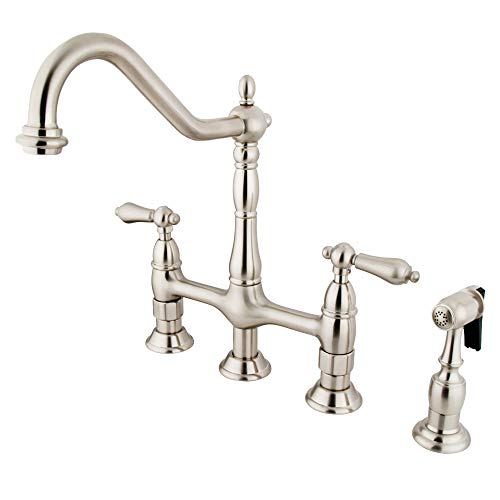
1. Kingston Brass Heritage Bridge KS1278ALBS (Brushed Nickel) — Best Overall
This is the faucet the farmhouse style was built around. A bridge faucet mounts the hot and cold handles on an exposed horizontal bar, with the spout rising from the middle and a separate brass side sprayer for rinsing. Kingston’s Heritage line executes the form in solid, weighty brass with traditional cross-or lever-style detailing, and the brushed nickel finish suits the widest range of farmhouse kitchens — it neither shouts like chrome nor darkens the room like bronze. Over an apron-front sink, nothing else in this roundup looks as inevitable.
Strengths
- True bridge silhouette — the authentic farmhouse form
- Brass side sprayer included for sink rinsing and pot filling
- Brushed nickel hides water spots and matches most hardware
Trade-offs
- Bridge installs need an 8-inch two-hole deck (plus sprayer hole) — not a single-hole drop-in
- Two handles mean two hands for temperature changes mid-task
- No pull-down head; the side sprayer does the travelling instead
| Spout reach | 8-3/4 in (verified from Amazon listing) |
| Style | Bridge, two-handle, brass side sprayer |
| Finish | Brushed Nickel |
Living with a bridge faucet is a rhythm change worth understanding before you buy. Temperature is set with two handles, which cooks with doughy hands do with wrists and forearms — farmhouse cooks have done exactly this for a century, and the handles here are sized for it. The side sprayer, not a pull-down head, is your travelling water: it rinses the apron sink’s corners and fills pots beside the sink with a reach a fixed spout cannot match.
The installation is the real commitment. A bridge needs its holes at 8-inch centres and a fourth hole for the sprayer on most decks, so this is a faucet chosen alongside the sink, not after it. If your renovation is at that stage, choose this first and drill once; retrofitting a bridge into a single-hole countertop is a conversation with a fabricator, not a weekend job.
Ownership note: Kingston’s bridge cartridges are standard, long-catalogued parts — the farmhouse promise kept. When a handle eventually drips, the fix is a cartridge and twenty minutes, and the faucet’s second decade begins. This is precisely the future the unbranded copies cannot offer.
Best for: Apron-front renovations planned around an authentic bridge / Not suited for: Single-hole countertops or pull-down devotees
Check the current price on Amazon

2. WOWOW Brass Bridge Faucet (Oil Rubbed Bronze) — Best Bronze Bridge
Where brushed nickel is the safe farmhouse choice, oil-rubbed bronze is the soulful one: near-black with warm brown edges that deepen against wood counters and white apron sinks. WOWOW’s bridge is built from solid brass per the verified listing, on 8-inch centres with a side sprayer, in an unapologetically vintage form. For the kitchen with reclaimed wood, iron hardware and a range with brass rails, this is the faucet that completes the sentence.
Strengths
- Solid brass construction stated in the verified listing
- Oil-rubbed bronze is the definitive rustic farmhouse finish
- Full bridge form with sprayer at a friendlier tier than heritage brands
Trade-offs
- Bronze finishes show hard-water scale as pale crust — wipe-downs matter
- Newer brand; parts support is shallower than Kingston or Moen
- Dark finish commits the whole hardware scheme — pulls and hinges must follow
| Construction | Solid brass (verified from Amazon listing) |
| Centres | 8 in, 2-handle, 4-hole with sprayer |
| Finish | Oil Rubbed Bronze |
Bronze is a living finish in spirit: it darkens where hands touch and lightens on edges, which is precisely the patina farmhouse kitchens are chasing. That means two WOWOW bridges will not age identically, and that is a feature — but go in knowing the showroom shine is a starting point, not a permanent state. Keep cleaners gentle; abrasive pads strip the rubbed effect unevenly and the damage cannot be blended back.
Value is the second story. A solid-brass bridge with sprayer at this brand’s tier undercuts the heritage names while keeping the material honest. The trade is support depth: document the model, keep the paperwork, and accept that a cartridge in year eight is a search rather than a certainty.
Ownership note: oil-rubbed bronze over solid brass ages by touch — the handles will lighten where thumbs land, the spout will deepen where water runs. Photograph it new if you like; then let it become the kitchen’s, because fighting a living finish is a losing, joyless war.
Best for: Rustic farmhouse kitchens built around dark bronze / Not suited for: Hard-water homes that will not wipe the faucet
Check the current price on Amazon

3. Moen Brantford Pull-Down 7185SRS — Best Modern Farmhouse Convenience
Not every farmhouse kitchen wants a history lesson at the sink. The Brantford wraps Moen’s modern pull-down platform — Reflex docking, Power Boost spray — in traditional curves and a Spot Resist Stainless finish, so it sits comfortably with Shaker cabinets while behaving like the appliance a working kitchen needs. One handle, one hand, spray head on a hose: this is the pick for farmhouse cooks who bake, can, and wash up at volume.
Strengths
- Full modern pull-down convenience in traditional dress
- Power Boost and Reflex — Moen’s best spray and docking systems
- Spot Resist finish suits a kitchen that cannot be wiped hourly
Trade-offs
- Single-hole heart — wide decks need the plate, and purists see a modern faucet
- No bridge authenticity; the look is farmhouse-adjacent, not period
- Premium-mainstream tier pricing
| Style | Traditional one-handle pull-down (verified from Amazon listing) |
| Features | Power Boost, Reflex docking |
| Finish | Spot Resist Stainless |
The Brantford’s design intelligence is in what it does not do: no faux-vintage handles pretending the cartridge is from 1920, no bridge bar hiding a modern mixer. It is honestly a modern faucet with period manners, and over an apron sink with modern appliances — which is most real farmhouse kitchens — that honesty reads as coherence rather than compromise.
Mechanically it inherits the Essie’s virtues from our extendable guide: Reflex hose behaviour, strong spray, forgiving install. If your household includes cooks who would curse two-handled temperature setting daily, this is the farmhouse faucet that keeps both the scheme and the peace.
Ownership note: the Brantford’s modern internals mean its service story is Moen’s: cartridges on the shelf, Reflex parts documented, a spray head you can replace without a plumber. It is the farmhouse pick whose tenth year is easiest to predict, and predictability is a feature in a working kitchen.
Best for: Working farmhouse kitchens wanting modern convenience / Not suited for: Period-authenticity purists
Check the current price on Amazon

4. Kingston Brass Heritage Bridge KS1175AX (Oil Rubbed Bronze) — Best Heritage Bronze
Kingston Brass is the brand US renovators reach for when the house itself is old: its catalogue is period plumbing, and the Heritage bridge in oil-rubbed bronze is its farmhouse centrepiece. Compared with the WOWOW above, you are paying for depth of range — matching bath hardware, a long production history, and cartridges that have been catalogue items for years. In a renovation meant to look inevitable rather than themed, that depth shows.
Strengths
- Heritage specialist brand with deep period catalogue
- Bronze bridge form with traditional handle detailing
- Long-running model — parts history is established
Trade-offs
- This title variant ships without the side sprayer — confirm configuration before ordering
- Bronze needs the gentle-cleaning discipline all dark finishes demand
- 8-inch bridge install constraints apply, as with all true bridges
| Style | Heritage bridge (verified from Amazon listing) |
| Finish | Oil Rubbed Bronze |
| Note | Confirm sprayer configuration for the exact variant |
The Heritage line’s advantage is coherence across the house. Farmhouse renovations rarely stop at the kitchen sink, and Kingston can match the bridge’s bronze and handle language into the bathroom and laundry in a way newer brands cannot. If the project is a whole farmhouse rather than a kitchen refresh, that ecosystem is worth real money.
Read the variant carefully before ordering: Heritage bridges exist with and without side sprayers under closely related model numbers, and the verified title for this one does not claim a sprayer. If the sprayer matters — over a big apron sink it should — choose the sprayer-equipped sibling model and verify its title the same way.
Ownership note: Kingston variants reward the paperwork-keeper. The Heritage range’s model family is wide, and the owner who filed the exact variant number can reorder a matching handle or sprayer in one step; the owner who guesses gets to learn the range’s breadth the expensive way.
Best for: Whole-house farmhouse renovations matching hardware / Not suited for: Buyers who need the sprayer included by default
Check the current price on Amazon

5. WOWOW Brass Bridge Faucet (Polished Nickel) — Best Bright Bridge
Polished nickel is the finish renovators choose when chrome feels too blue and modern: it is bright like chrome but warm, slightly golden, and historically what early twentieth-century plumbing actually wore. WOWOW’s solid-brass bridge in polished nickel, with side sprayer on 8-inch centres, brings that warmth to the farmhouse sink at an attainable tier. Against marble or white quartz and unlacquered-look hardware, it is quietly the most elegant option in this guide.
Strengths
- Polished nickel — the warm, period-correct bright finish
- Solid brass body with side sprayer included
- Bridge form flatters marble and white stone counters
Trade-offs
- Polished nickel shows water spots like chrome and wants regular wiping
- Living-finish warmth means it will not match chrome accessories
- Newer brand’s support depth, as with the bronze sibling
| Construction | Solid brass (verified from Amazon listing) |
| Centres | 8 in, 2-handle, 4-hole with sprayer |
| Finish | Polished Nickel |
Finish-matching is this pick’s discipline. Polished nickel beside chrome reads as a mistake, because the eye catches the temperature difference instantly; polished nickel beside polished nickel — cabinet pulls, hinges, lighting — reads as a designed room. Commit the sink wall to one bright metal and this faucet rewards you every time the light hits it.
Mechanically it mirrors the bronze WOWOW: honest material, vintage form, friendly tier, shallower support. Buy it as the design-led choice with documentation kept, and it will serve a farmhouse kitchen beautifully.
Ownership note: polished nickel’s one true enemy is the wrong cleaning shelf — anything abrasive or acidic dulls its warmth unevenly. Put a soft cloth and mild soap under the sink as the designated kit, and tell everyone in the house the rule on day one.
Best for: Bright period kitchens committing to polished nickel / Not suited for: Kitchens with existing chrome hardware everywhere
Check the current price on Amazon

6. Kingston Brass French Country Widespread KB1795TXBS — Best Widespread Statement
The French Country widespread is the maximalist farmhouse option: instead of a bridge bar, the handles and spout mount as separate pieces across the deck, in curving French provincial forms, with a brass sprayer alongside. The 8-1/4-inch spout reach suits deep apron sinks, and the oil-rubbed bronze keeps it rustic rather than formal. Choose it when the kitchen’s farmhouse leans Provençal — open shelving, copper pans, a range cooker — and a bridge feels too plain.
Strengths
- Widespread separate-piece mounting — the most decorative farmhouse form
- 8-1/4-inch reach suits deep apron-front sinks
- Brass sprayer included for rinsing and filling
Trade-offs
- Widespread decks need the widest hole layout — plan with the sink purchase
- Ornate forms have more crevices to clean
- Bronze care discipline applies, as with all dark finishes here
| Spout reach | 8-1/4 in (verified from Amazon listing) |
| Style | Widespread, brass sprayer |
| Finish | Oil Rubbed Bronze |
Widespread mounting is a design decision with plumbing consequences: each piece has its own deck hole and its own under-deck connection, so installation takes longer and future cartridge service means working on separate valves. In exchange you get the most furniture-like presence at the sink — the faucet reads as three crafted objects rather than one appliance, which is exactly the French Country effect.
Proportion is the check before buying: widespread sets need a generous deck and a big sink to avoid looking crowded. On a 36-inch apron sink with stone counters, this set is magnificent; squeezed onto a compact sink it is merely busy. Measure the deck’s front-to-back depth as carefully as the hole spread.
Ownership note: the French Country set’s separate valves mean each handle’s cartridge services independently — a drip on the cold side never takes the hot side out of service. In a farmhouse that hosts and preserves at volume, that graceful degradation is worth more than it sounds.
Best for: Large Provençal-leaning farmhouse kitchens / Not suited for: Compact sinks or minimalist farmhouse schemes
Check the current price on Amazon
Comparison Table
| Pick | Badge | Key spec | Best for |
|---|---|---|---|
| Kingston Brass Heritage Bridge KS1278ALBS (Brushed Nickel) | Best Overall | Bridge form, 8-3/4 in reach, brass sprayer | Apron-front renovations planned around an authentic bridge |
| WOWOW Brass Bridge Faucet (Oil Rubbed Bronze) | Best Bronze Bridge | Solid brass bridge, oil-rubbed bronze | Rustic farmhouse kitchens built around dark bronze |
| Moen Brantford Pull-Down 7185SRS | Best Modern Farmhouse Convenience | Traditional-styled pull-down, Power Boost, Reflex | Working farmhouse kitchens wanting modern convenience |
| Kingston Brass Heritage Bridge KS1175AX (Oil Rubbed Bronze) | Best Heritage Bronze | Heritage bridge in bronze, period catalogue depth | Whole-house farmhouse renovations matching hardware |
| WOWOW Brass Bridge Faucet (Polished Nickel) | Best Bright Bridge | Solid brass bridge, polished nickel, sprayer included | Bright period kitchens committing to polished nickel |
| Kingston Brass French Country Widespread KB1795TXBS | Best Widespread Statement | Widespread French Country, 8-1/4 in reach | Large Provençal-leaning farmhouse kitchens |
How to Choose a Farmhouse Kitchen Faucet: Form First, Finish Second
Start with the mounting your sink and countertop actually offer, because farmhouse forms are the least forgiving in plumbing. A bridge needs 8-inch centres plus a sprayer hole; a widespread needs its own multi-hole layout; a modern pull-down fits a single hole and forgives everything else with a deck plate. If the countertop is already drilled, the form is already chosen — work backwards from the holes, not forwards from a photograph.
Then choose the working style honestly. Two-handled bridges and widespreads ask for two-handed temperature setting and give you a side sprayer for travel. Single-handle pull-downs give one-handed control and a travelling head. Farmhouse kitchens that bake and preserve at volume usually land on the pull-down’s side of that trade; kitchens built as period rooms land on the bridge. Neither answer is more authentic to your life than the other.
Finish last, and finish as a scheme: brushed nickel for the widest compatibility, oil-rubbed bronze for rustic warmth, polished nickel for bright period elegance. Whatever you choose at the faucet must be repeatable at the cabinet pulls, hinges and lighting, or the room will read as a collection of near-misses.
- Let the existing hole layout veto forms before you fall in love
- Decide bridge ritual versus pull-down convenience as a household
- Pick the finish as a whole-room scheme, not a single object
- Confirm sprayer inclusion in the exact model variant
- Favour brands with catalogue cartridges — farmhouse is a forever style
Which Farmhouse Finish Ages Best?
Brushed nickel is the forgiving champion: it hides water spots, fingerprints and minor scratches, and its neutrality survives cabinet repainting in any direction. Oil-rubbed bronze is the character choice — it deepens with touch and suits wood-heavy rooms — but it advertises hard-water scale and punishes abrasive cleaning. Polished nickel is the elegant middle: brighter than brushed, warmer than chrome, and just as wipe-hungry as chrome.
In hard-water homes the ranking sharpens: brushed nickel first by a mile, bronze and polished nickel tied at ‘only if you will wipe it’. There is no dishonour in choosing the finish your cleaning habits can sustain; a spotted bronze bridge looks older than a clean brushed-nickel one within a year.
How to Plan a Bridge Faucet Installation
Plan the bridge with the sink, not after it. Confirm the deck or sink ledge offers 8-inch centres for the bridge body and a fourth hole for the sprayer, with enough front-to-back depth that the handles clear the backsplash through their full turn. Stone fabricators drill what they are told — give them the faucet’s own specification sheet, not a verbal description.
On install day, set the bridge body first and connect the sprayer hose with its weight or guide positioned so the sprayer draws smoothly from its holder. Flush both supplies before final connection, set your hot and cold handles to their correct sides, and test the sprayer’s diverter under full pressure: a diverter that chatters or leaks at the spout base is far easier to fix with the tools still out.
Common Buying Mistakes
Falling for an unbranded ‘vintage’ faucet. The farmhouse look is plumbing’s most copied style. No cartridge catalogue means the faucet is disposable — the opposite of farmhouse.
Ordering a bridge for a single-hole countertop. Bridges need 8-inch centres and usually a sprayer hole. Check the deck before the faucet, always.
Assuming the sprayer is included. Heritage variants exist with and without sprayers under near-identical names. Verify the exact variant’s title.
Mixing bright metals. Polished nickel beside chrome reads as an error. Commit the sink wall to one bright finish.
Scrubbing bronze with abrasives. You will strip the rubbed finish in patches that cannot be blended. Gentle soap, soft cloth, patience.
Apron-Front Sinks and Their Faucets: A Pairing Guide
The apron-front (farmhouse) sink is the faucet’s stage, and its dimensions write the faucet’s brief. Apron sinks are deep — often ten inches — so the spout must either stand tall enough to clear the rim with a pot beneath it, or carry a sprayer or pull-down that brings the water down into the bowl. This is why the classic pairing is a tall bridge with a side sprayer: height for filling, a traveller for rinsing, and no mechanism hidden where flour and water will find it.
Deck geometry is the second act. Many apron sinks have no deck at all — the faucet mounts on the countertop behind the sink, or on the sink’s own rear ledge on models that provide one. That decision cascades: countertop mounting frees the hole pattern (bridges welcome) but demands the fabricator’s precision; ledge mounting constrains the pattern to the sink maker’s drilling. Decide sink, then mounting, then faucet — in that order — and the farmhouse holy trinity assembles itself.
Material harmony closes the pairing. Fireclay and cast-iron apron sinks wear their age gracefully and ask the faucet to do the same: real metal, honest finishes, nothing chrome-plated-and-hopeful. The picks in this guide were chosen to age at the sink’s pace — a farmhouse sink will outlive two lesser faucets, and the arithmetic of buying the right one once is not close.
Farmhouse Faucet Handles: Cross, Lever or Porcelain?
Handle style is farmhouse’s most visible dialect. Cross handles are the oldest language — grippy with wet hands, precise in small turns, and the natural partner of bridge faucets. Their cost is speed: a cross takes a full grip and a twist, where a lever takes a wrist. Kitchens that cook with dough, marinades and raw meat on their hands often prefer crosses anyway, because a cross can be worked with the back of a hand or two knuckles without smearing the whole handle.
Lever handles are the modern concession that kept its manners: one-handed, elbow-friendly, ADA-considerate, and available in period shapes that read correctly beside a bridge or a traditional arc. Porcelain-accented levers and crosses — white inserts, ‘hot’ and ‘cold’ script — are the farmhouse detail that photographs best and divides opinion most; they suit genuinely period rooms and can tip a merely rustic kitchen into theme-park territory.
Choose by hand, literally: mime your messiest cooking moment at the showroom sink. The handle your flour-covered self can operate without thought is the right handle, and the style will follow — farmhouse has room for every handle that has earned its place in a working kitchen.
The Farmhouse Kitchen’s Water: Sprayers, Pot Fillers and Second Taps
Serious farmhouse kitchens often run more water points than the main faucet, and the main faucet choice should anticipate them. A side sprayer at the sink covers rinsing and bucket-filling; a pot filler at the range — plumbed in the same finish family — saves the heaviest carries in cooking; and a small prep faucet at a second sink keeps two cooks out of each other’s water. The farmhouse style’s deep catalogues, Kingston’s especially, exist precisely so all three can speak the same finish and handle language.
Sequencing matters more than selection. The main faucet is bought first because it sets the finish; the pot filler and prep faucet follow its lead, from the same brand family where possible, because cross-brand bronze matching is a lottery. If a pot filler is even a someday thought, tell the plumber during the main install — a capped stub-out added then costs little, while opening the wall later costs the renovation’s peace.
None of this is required for a great farmhouse sink. It is the upgrade path that the style, uniquely, makes graceful — because a farmhouse kitchen is understood to be a lifetime project, and its plumbing can grow at the same pace as its garden.
Farmhouse Faucets and Resale: What the Next Buyer Sees
Kitchens sell houses, and farmhouse kitchens sell a feeling — permanence. A real bridge or traditional faucet in solid metal is one of the few fixtures that reads as ‘kept’ rather than ‘flipped’, because its weight and patina cannot be faked at a flipper’s budget. Estate agents know this instinctively: the farmhouse sink with a Kingston bridge photographs as a lifestyle, while the same sink with a thin unbranded faucet photographs as a project. If resale is anywhere in your decade, the heritage tier of this guide is not an indulgence but a positioning decision.
The converse also holds and deserves saying: a farmhouse faucet in a kitchen that is otherwise a glossy modern renovation reads as an error at resale, because buyers price inconsistency as future work. Style coherence is the asset; the faucet is merely its most visible deposit. Buy the farmhouse faucet for a farmhouse kitchen, keep the scheme’s repetitions up while you own it, and the room will argue its own value to whoever walks in next.
Documentation helps here too, unglamorously: a kitchen file with the faucet’s model, finish and install date tells the next owner the fixture is serviceable and tells their plumber exactly what to bring. Permanence, it turns out, is partly paperwork.
Bridge Faucet Etiquette: Living With Two Handles Gracefully
The two-handle life has a learning curve of about a fortnight, after which its rituals become invisible. The core skill is the preset: learn your household’s washing-up temperature as handle positions — a quarter turn of hot, a third of cold, or whatever your system delivers — and set it by sight before your hands are wet or floury. Farmhouse cooks of a century ago worked exactly this way, and the handles’ size and spacing on a good bridge are designed for that visual preset.
The sprayer has its etiquette too: it lives in its holder, it is drawn with a straight pull, and it is returned rather than dropped, because a brass sprayer dropped into a fireclay sink is a chip waiting for its moment. Households with children teach the sprayer as the kitchen’s water pistol permit — rinsing only, aimed at the sink — and the fixture survives childhood intact, which is more than most modern spray heads promise.
Guests will fumble your bridge for exactly one visit. Then they will mention, unprompted, that they liked using it — because a bridge faucet is one of the few pieces of plumbing with genuine theatre: weight, ceremony, and water that arrives like it means it. That theatre is part of what the style buys, and it is not the least part.
Farmhouse Faucets and the Long Renovation
Farmhouse renovations are rarely finished; they mature. The faucet chosen in year one is joined by the pot filler in year three, the second sink in year five, the bathroom in the same finish language whenever the budget recovers. That timeline is the deepest argument for the heritage catalogues in this guide: Kingston and Moen will still be selling your finish’s family when the later chapters are written, and the room will accumulate coherence instead of a museum of near-matches. A faucet from a vanished brand or a discontinued fashion finish forecloses those chapters before they are imagined.
Plan the maturation loosely at the start: keep the faucet’s documentation, note the finish’s exact name as the manufacturer spells it, and photograph the install. When chapter two arrives, those three artefacts turn a matching exercise into a catalogue order. The farmhouse style forgives slow timelines — it was born in houses built over generations — but it punishes undocumented ones, because memory is a terrible finish-matching instrument.
And if the long renovation never continues past the faucet, nothing is lost: a great bridge over an apron sink is a complete sentence by itself. The long view is simply the farmhouse way of buying — once, in materials that age, from makers who stay. It is why this guide’s badges sit where they sit, and why the cheapest line in it is labelled a stepping stone with respect rather than a destination with regret.
The Farmhouse Sink as a Workstation: Organising Around the Faucet
A farmhouse sink earns its keep as a workstation, and the faucet is its foreman. Organise the station in the faucet’s terms: the sprayer’s reach defines the wet zone, so soaking, rinsing and the washing-up bowl live inside it; the arc’s height defines the dry stack, so the draining board and the clean pans live under its clearance without ducking. A station arranged against its faucet’s geometry feels cramped no matter how large the sink; arranged with it, even a modest apron front works like a scullery.
Two habits complete the organisation. Keep the deck behind the faucet empty by policy — it is the splash zone and the handle zone, and every object parked there migrates into the bowl eventually. And give the station a single home for its smalls: brush, cloth, aerator key, in one crock within the sprayer’s parish. Farmhouse kitchens look effortless in photographs because their effort has been organised out of sight — the faucet, central and unhurried, presiding over a station that knows where everything is.
The Farmhouse Faucet and the Working Pantry
Farmhouse kitchens increasingly include a working pantry — the scullery revival — and its sink deserves a word in any farmhouse faucet guide, because the pantry is where the main faucet’s understudy performs. The pantry sink takes the messiest work: flower water, preserving jars, the dog’s bowl, paint brushes after the room’s annual refresh. Its faucet should be the main faucet’s language at a working volume — a simpler Kingston or a Belfield sibling — because a pantry that speaks a different finish dialect breaks the house’s accent for everyone who carries a tray through it.
Function in the pantry inverts the main sink’s priorities: the sprayer or travelling head matters more than the arc, durability matters more than theatre, and a finish that hides a working sink’s evidence — brushed nickel above all — matters more than the atmospheric bronzes saved for the show sink. Buy the pantry faucet second, from the main faucet’s catalogue, and the pair will read as what they are: one household, two workstations, a single standard of honesty about materials.
It is the farmhouse idea in miniature, and a fitting place to end the argument of this guide: the style was never about a look. It is about a house that works, built from things that last, in materials that tell the truth — at the main sink, in the pantry, and everywhere the water runs.
A Last Word on Weight: Why Farmhouse Faucets Should Feel Heavy
Lift a candidate faucet before you buy it if you possibly can — in this style, weight is information. A bridge or two-handle set with real heft is telling you its body is brass and its handles are metal; a suspiciously light one is telling you the silhouette is a costume over thin castings and plastic internals. The hand learns in two seconds what a specification sheet obscures in two pages, and traditional plumbing is the category where that lesson is most reliable, because the forms have not changed in a century and neither has the material they were designed for.
Weight also predicts the small experiences: the handle that turns without flex, the spout that does not tremble at full flow, the sprayer that sits in its holder like it belongs there. None of these appear in a listing’s bullet points, and all of them are why the heritage picks in this guide cost what they cost. Buy the weight. In farmhouse plumbing, it is the sound of the truth.
Final Recommendation
For the authentic farmhouse renovation, the Kingston Heritage Bridge in brushed nickel is the faucet to build around — plan its holes with the sink and it will look inevitable for decades. Choose the Moen Brantford if your farmhouse kitchen works too hard for two-handed rituals, the WOWOW bronze bridge for rustic warmth on a friendlier budget, and the French Country widespread if your farmhouse speaks with a Provençal accent.
Related reading in the cluster: Best Farmhouse Style Kitchen Faucets, Best Kitchen Faucets, Best Bridge Kitchen Faucets, Best Faucets For Kitchen D Shaped Sinks and Best Oil Rubbed Bronze Kitchen Faucets.
Shop the verified picks: Kingston Brass Heritage Bridge KS1278ALBS (Brushed Nickel); WOWOW Brass Bridge Faucet (Oil Rubbed Bronze); Moen Brantford Pull-Down 7185SRS; Kingston Brass Heritage Bridge KS1175AX (Oil Rubbed Bronze); WOWOW Brass Bridge Faucet (Polished Nickel); Kingston Brass French Country Widespread KB1795TXBS.
Frequently Asked Questions
What makes a faucet ‘farmhouse style’?
Form and finish: bridge or traditional silhouettes, weighty metal construction, and finishes like brushed nickel, brass and oil-rubbed bronze that suit apron-front sinks and Shaker cabinetry. The mechanism inside can be entirely modern.
Do farmhouse faucets work with apron-front sinks?
They are designed for them. Bridges and widespreads mount on the deck or sink ledge behind the apron bowl; just confirm hole layout and handle clearance before the stone is drilled.
Is a side sprayer as good as a pull-down head?
For rinsing corners and filling pots beside the sink, yes — a sprayer travels well. It cannot match a pull-down for plunging spray into a deep bowl, and it adds a diverter to maintain. Choose by how you rinse.
Which farmhouse finish is lowest maintenance?
Brushed nickel, by a wide margin — it hides spots and fingerprints and tolerates hard water best. Bronze and polished nickel are beautiful but ask for regular gentle wiping.
Can I install a bridge faucet on an existing countertop?
Only if the holes already match 8-inch centres plus a sprayer hole, or a fabricator can drill your material. Most retrofits are easier with a deck-plate pull-down in traditional styling.
Are Kingston Brass faucets good quality?
Kingston is a heritage-plumbing specialist with a deep period catalogue and long-running models, which is what matters in this style: cartridges and trim remain available. Verify the exact variant, as configurations vary under similar names.


