Disclosure: airfryerkitchensupply.com is reader-supported. When you buy through links on our site, we may earn an affiliate commission at no extra cost to you.
Where to buy
The fastest way to buy any of the best color for grills in this guide is through Amazon, where the listings carry the current configuration, fuel options and delivery terms for each model. Start with our top pick, the Weber Original Kettle Premium Charcoal Grill, 22-Inch, Copper (check price on Amazon), and work down the list from there. Prices move with seasons and promotions, so we do not print static prices in this article — use the links to check the current price on Amazon for the exact version you want. The full shortlist: Weber Master-Touch Charcoal Grill, 22-Inch, Deep Ocean Blue (check price on Amazon); Kamado Joe Classic Joe I, 18-Inch, Red (check price on Amazon); Weber Master-Touch Charcoal Grill, 22-Inch, Ivory (check price on Amazon); Kenmore 3-Burner Propane BBQ Grill, Azure Blue (check price on Amazon); Weber Original Kettle Premium Charcoal Grill, 22-Inch, Green (check price on Amazon).
Asking for the best color for grills sounds like a decorating question, and it is — but only partly. A grill’s color changes how hot its surfaces feel in the sun, how clearly grease and ash show between cleanings, how fast the finish visibly fades, and how the grill looks against your house, deck and garden three summers from now. The best color for grills is the one that fits your climate, your cleaning habits and your taste, in that order.
Here is the practical truth the showroom will not tell you: color barely affects cooking. A black kettle and a copper kettle with the same dampers cook identically. What color changes is ownership. Dark finishes hide soot and look sharp longer in rainy climates; light finishes run cooler to the touch in desert sun and show every splatter; saturated colors like red, blue and green make the grill a garden feature and demand an owner who enjoys that.
So this guide does two things. The six picks below are excellent grills that happen to be the finest examples of their color — copper, ocean blue, red, ivory, azure and green — each verified against its current Amazon listing. Then the buying guide gets honest about heat, fading, dirt and resale, so you can choose a color with your eyes open instead of by impulse.
In this guide
Quick Picks
Short on time? These are the six best color for grills worth your money, each chosen for a different kind of cook and a different kind of space. Every pick below was cross-checked against the manufacturer listing data available through Amazon before it earned a place here.
- Weber Original Kettle Premium Charcoal Grill, 22-Inch, Copper — Best Copper Finish. The classic kettle in its warmest finish — copper porcelain enamel that glows against green gardens and weathers beautifully. Check the current price on Amazon.
- Weber Master-Touch Charcoal Grill, 22-Inch, Deep Ocean Blue — Best Blue Finish. A deep, saturated blue on Weber’s most complete kettle — the color for coastal homes and anyone tired of black appliances. Check the current price on Amazon.
- Kamado Joe Classic Joe I, 18-Inch, Red — Best Red Finish. The iconic red kamado — a ceramic cooker whose glossy red glaze is practically a brand signature, with cart and shelves included. Check the current price on Amazon.
- Weber Master-Touch Charcoal Grill, 22-Inch, Ivory — Best Light Finish. Ivory porcelain on the full Master-Touch platform — the light, retro finish that runs coolest in the sun and brightens a shaded patio. Check the current price on Amazon.
- Kenmore 3-Burner Propane BBQ Grill, Azure Blue — Best Blue Gas Grill. Proof that gas grills need not be black or stainless: a three-burner, 30,000-BTU cabinet grill in a clear azure blue with cast-iron grates. Check the current price on Amazon.
- Weber Original Kettle Premium Charcoal Grill, 22-Inch, Green — Best Green Finish. The deep green kettle — the color that disappears into a garden until you lift the lid, on the fully featured Premium platform. Check the current price on Amazon.
How These Picks Were Chosen
We chose these picks to cover the real color decision, not to fill a rainbow. Each color family a buyer actually considers — the safe darks, the classic lights, the statement colors — is represented by the strongest grill we could verify in that finish. A beautiful color on a mediocre grill did not qualify; the grill had to earn its place on cooking merit first.
Verification followed the house rule: every model was searched by brand and model connection, the returned title was matched to the exact color variant described — color is in the listing title for each pick below — and only then was its ASIN used. Specs in the mini boxes come from those verified titles.
We also weighed how each finish ages. Porcelain-enamel kettles hold color for decades with basic care; painted steel on budget gas grills fades and chalks faster; stainless is technically a finish too, and it shows fingerprints and heat tinting that some owners love and others cannot unsee. Those ownership realities are in every review, because a color you hate in year two was the wrong color at any price.
The 6 Best color for grills

1. Weber Original Kettle Premium Charcoal Grill, 22-Inch, Copper — Best Copper Finish
Copper is the color for the owner who wants the grill to be part of the garden’s design rather than an appliance parked in it. On the Premium kettle you also get the built-in lid thermometer, heat-control dampers and the One-Touch ash system, so the prettiest kettle in the yard is also one of the most complete to cook on.
Strengths
- Copper porcelain enamel hides ash dust better than black
- Premium kettle hardware: thermometer, dampers, One-Touch cleaning
- Warm tone pairs with wood decks, brick and planting
Trade-offs
- Copper is a statement — it will not disappear into the background
- Porcelain can chip if the lid is dropped on concrete
- Color-matched touch-up is harder than with black
| Size | 22-inch kettle |
| Finish | Copper porcelain enamel |
| Features | Built-in thermometer, heat-control dampers, One-Touch cleaning (listing) |
Copper occupies a sweet spot in grill colors: warm enough to feel designed, earthy enough to sit naturally among terracotta, timber and foliage. In practice it also forgives the charcoal life — the grey film of ash that makes a black kettle look neglected after every cook blends into copper’s variegated tone, so the grill looks cared-for between wipe-downs.
As a cooker this is the fully featured kettle: dampers that actually modulate temperature, a lid thermometer for orientation, and ash management that takes seconds. If your question about the best color for grills is really ‘which grill will I still enjoy looking at in five years’, copper on a Premium kettle is the answer we give most often.
Best for: garden-focused owners who want warmth and a forgiving finish / Not suited for: anyone wanting the grill to vanish visually, or rough handlers
Check on Amazon to see the current configuration and delivery options for the Weber Original Kettle Premium Charcoal Grill, 22-Inch, Copper.
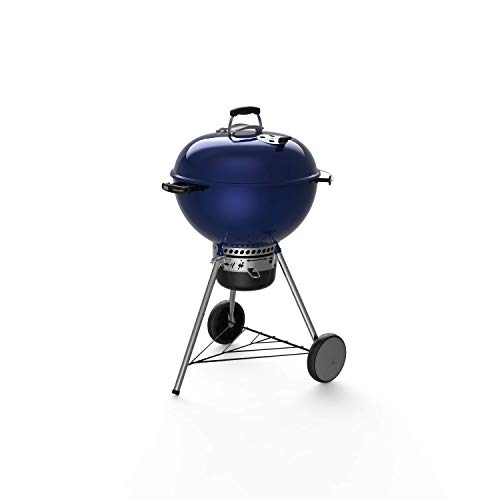
2. Weber Master-Touch Charcoal Grill, 22-Inch, Deep Ocean Blue — Best Blue Finish
Deep Ocean Blue is the confident choice: dark enough to behave like a neutral beside navy, grey and white exteriors, vivid enough to be the one deliberate color in the yard. The Master-Touch platform adds the Tuck-Away lid holder and the hinged cooking grate, making this the best-equipped kettle in this guide wearing the boldest classic color.
Strengths
- Rich blue reads premium and hides soot nearly as well as black
- Master-Touch lid holder and hinged grate are daily conveniences
- Porcelain enamel keeps the color deep for years
Trade-offs
- Blue commits you — it clashes with some brick and warm wood tones
- Master-Touch tier costs more than the basic kettle
- Dark surface still gets hot in direct summer sun
| Size | 22-inch kettle |
| Finish | Deep Ocean Blue porcelain enamel |
| Features | Tuck-Away lid holder, One-Touch cleaning (listing) |
Blue is the most livable of the statement colors. It photographs beautifully, pairs with the greys and whites of modern exteriors, and — unlike red — it does not fight with the warm tones of grilled food and wooden furniture around it. Deep Ocean Blue specifically is dark enough that ash and soot stay discreet, which keeps a charcoal grill looking intentional rather than grubby.
The Master-Touch underneath the paint is the kettle Weber owners graduate to: the lid parks itself, the grate hinges for coal access, and temperature control is as good as charcoal gets without electronics. If you want one colored grill that is also simply one of the best kettles made, this is the strongest candidate in the guide.
Best for: coastal and modern homes wanting a designed, durable color / Not suited for: warm-toned traditional yards, or minimalists
Check on Amazon to see the current configuration and delivery options for the Weber Master-Touch Charcoal Grill, 22-Inch, Deep Ocean Blue.

3. Kamado Joe Classic Joe I, 18-Inch, Red — Best Red Finish
Red is the kamado color, and Kamado Joe’s red is the reference point: a deep, glossy glaze on an 18-inch ceramic cooker that grills, roasts and smokes with insulation no metal grill can match. The Classic Joe I listing includes the cart, side shelves, grill gripper and ash tool, and its two-tier cooking system stretches the 250 square inches further than the number suggests.
Strengths
- Ceramic body holds heat and moisture like nothing else here
- Red glaze is durable, glossy and instantly recognizable
- Complete package: cart, shelves and tools in the listing
Trade-offs
- Ceramic is heavy and can crack if knocked or thermally shocked
- Red is the loudest color in any yard — no blending in
- 18-inch grate is snug for very large groups
| Size | 18-inch ceramic kamado |
| Cooking area | 250 sq. in., 2-tier system (listing) |
| Finish | Red glaze |
| Included | Cart, side shelves, grill gripper, ash tool (listing) |
Some colors are decoration; this red is identity. Kamado Joe built its name on it, resale buyers look for it, and the glaze itself is functional — a hard, glassy surface that shrugs off weather and wipes clean. On a ceramic cooker that may live outdoors for a decade, that finish durability matters as much as the hue.
The cooking case is the kamado case: charcoal efficiency, steady low temperatures for smoking, and fierce heat for steakhouse sears, all from the insulated ceramic shell. Choose the red Classic Joe when you want the grill to be the garden’s centerpiece and your barbecue to be the neighborhood’s reference point — it is built, and colored, for exactly that role.
Best for: barbecue enthusiasts who want a centerpiece that smokes and sears / Not suited for: anyone needing portability, subtlety, or a featherweight grill
Check on Amazon to see the current configuration and delivery options for the Kamado Joe Classic Joe I, 18-Inch, Red.

4. Weber Master-Touch Charcoal Grill, 22-Inch, Ivory — Best Light Finish
Ivory is the contrarian’s color and, in hot climates, the engineer’s. A pale kettle reflects summer sun instead of absorbing it, so handles and lid stay friendlier to the touch, and the retro-cream tone has a mid-century charm that black cannot imitate. You get the complete Master-Touch feature set underneath, so nothing is sacrificed but darkness.
Strengths
- Light finish stays noticeably cooler in direct sun
- Retro ivory brightens shaded or small patios
- Full Master-Touch hardware: lid holder, One-Touch cleaning
Trade-offs
- Shows grease splatter, soot and rust spots honestly
- Demands a wipe-down habit to keep its looks
- Can look stark against very dark decking
| Size | 22-inch kettle |
| Finish | Ivory porcelain enamel |
| Features | Tuck-Away lid holder, One-Touch cleaning (listing) |
Ivory asks more of its owner and gives more back. The ‘more’ is real: on a July afternoon the difference between a black lid and an ivory one is the difference between a glove and a bare hand, and in a small, shaded urban patio the pale kettle reads as furniture rather than equipment. Owners who love the look tend to keep these grills for decades, and the porcelain supports that — it does not fade to grey the way painted light finishes do.
The cost is visibility. Every splatter shows, every soot smudge announces itself, and a neglected ivory kettle looks sadder than a neglected black one. If your cleaning style is ‘hose it in spring’, choose another color. If you wipe a grill the way some people wipe a counter, ivory is the most rewarding finish in this guide.
Best for: hot, sunny climates and design-led owners who clean as they go / Not suited for: low-maintenance owners or sooty, tree-covered yards
Check on Amazon to see the current configuration and delivery options for the Weber Master-Touch Charcoal Grill, 22-Inch, Ivory.

5. Kenmore 3-Burner Propane BBQ Grill, Azure Blue — Best Blue Gas Grill
Colored gas grills are rare, which makes this Kenmore the pick for the buyer who wants push-button propane convenience without the appliance-store look. Azure blue over a three-burner cabinet with cast-iron cooking grates, folding side tables and tool hooks — it is a complete backyard grill that happens to be the color of a summer sky.
Strengths
- A genuine color option in a sea of black and steel gas grills
- Cast-iron grates sear and hold heat properly
- Folding side tables shrink its footprint for storage
Trade-offs
- Painted finishes age faster than porcelain enamel
- Blue cabinet is a commitment guests will have opinions about
- Three burners suit families, not banquet crowds
| Burners | 3 burners |
| Output | 30,000 BTUs (listing figure) |
| Grates | Cast iron (listing) |
| Finish | Azure Blue |
Most gas grill ‘color’ is a lid accent on a black box. Kenmore committed the whole cabinet to azure, and the effect is cheerful rather than garish — the grill becomes the patio’s deliberate pop of color, the way a painted door works on a house. For renters and first-home owners especially, it makes a modest yard feel designed.
Underneath, the spec is honest family kit: three burners for zone cooking, cast iron that marks food properly, tables that fold when the cover goes on. The finish will not outlast porcelain — expect gradual dulling in harsh sun and budget a cover from day one. As the only full-color gas option among the best color for grills, it earns its place by existing — and then by cooking well enough to justify itself.
Best for: gas-grill buyers who refuse the black-box look / Not suited for: perfectionists expecting porcelain-grade finish longevity
Check on Amazon to see the current configuration and delivery options for the Kenmore 3-Burner Propane BBQ Grill, Azure Blue.
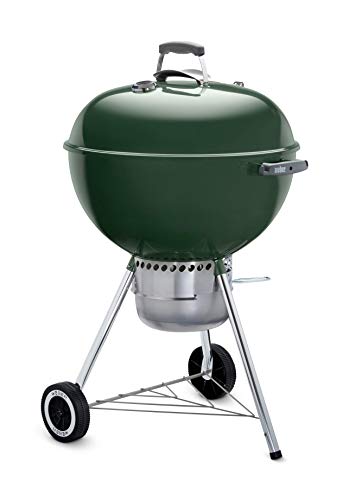
6. Weber Original Kettle Premium Charcoal Grill, 22-Inch, Green — Best Green Finish
Green is the gardener’s color: against lawns, hedges and planting, a deep green kettle recedes in a way no other finish can, which is exactly what many owners want from a tool that lives outside all year. This is the Premium kettle again — thermometer, dampers, One-Touch ash system — in the finish that asks the least visual attention.
Strengths
- Blends into gardens and green surroundings naturally
- Mid-dark tone hides ash and pollen reasonably well
- Full Premium kettle feature set for cooking control
Trade-offs
- Green can look dated if your exterior palette is grey/modern
- Still a dark surface for peak-sun heat absorption
- Less resale demand than black or red classics
| Size | 22-inch kettle |
| Finish | Green porcelain enamel |
| Features | Built-in thermometer, heat-control dampers, One-Touch cleaning (listing) |
There are two philosophies in this guide: the grill as centerpiece and the grill as landscape. Green is the landscape philosophy perfected. In a planted yard it reads as one more deep green shape; guests notice the food, not the equipment. Owners with HOA-sensitive or simply serene gardens consistently land on this finish and stay happy.
And because it is the Premium kettle, nothing about the cooking is a compromise — this is the same damper control and ash handling as the copper pick, in the quietest color Weber makes. If the best color for grills, for you, is the one you stop seeing, green is your answer.
Best for: gardeners and anyone wanting the grill to blend into planting / Not suited for: modern grey exteriors, or centerpiece seekers
Check on Amazon to see the current configuration and delivery options for the Weber Original Kettle Premium Charcoal Grill, 22-Inch, Green.
Comparison Table
| Pick | Badge | Key spec | Best for |
|---|---|---|---|
| Weber Original Kettle Premium Charcoal Grill, 22-Inch, Copper | Best Copper Finish | 22-inch kettle | garden-focused owners who want warmth and a forgiving finish |
| Weber Master-Touch Charcoal Grill, 22-Inch, Deep Ocean Blue | Best Blue Finish | 22-inch kettle | coastal and modern homes wanting a designed, durable color |
| Kamado Joe Classic Joe I, 18-Inch, Red | Best Red Finish | 18-inch ceramic kamado | barbecue enthusiasts who want a centerpiece that smokes and sears |
| Weber Master-Touch Charcoal Grill, 22-Inch, Ivory | Best Light Finish | 22-inch kettle | hot, sunny climates and design-led owners who clean as they go |
| Kenmore 3-Burner Propane BBQ Grill, Azure Blue | Best Blue Gas Grill | 3 burners | gas-grill buyers who refuse the black-box look |
| Weber Original Kettle Premium Charcoal Grill, 22-Inch, Green | Best Green Finish | 22-inch kettle | gardeners and anyone wanting the grill to blend into planting |
Read the table as a map, not a ranking. The right row is the one whose key spec matches the way you actually cook — the most powerful grill in this list of best color for grills is the wrong buy if its fuel, footprint or cleaning routine fights your routine every single week.
Does Grill Color Affect Cooking or Surface Heat?
Cooking first, because it is the short answer: no meaningful difference. Heat at the grate comes from burners or charcoal, and two kettles of different colors with the same fuel and damper settings cook the same food the same way. Anyone who tells you a black grill ‘cooks hotter’ is describing the lid in the sun, not the fire inside.
Surface heat is where color is real. Dark finishes absorb solar radiation and can become genuinely uncomfortable to touch on a summer afternoon — relevant if children circulate around the grill or you cook at midday. Light finishes like ivory reflect that energy and stay friendlier. It will not change your dinner, but it can change whether you grab the lid handle barehanded, and it is a legitimate reason hot-climate buyers choose pale grills.
Which Grill Colors Hide Dirt, Ash and Age Best?
For charcoal grills, the enemies are grey ash film and black soot; for gas grills, grease splatter and pollen. Mid-tone, slightly variegated finishes — copper is the champion here — camouflage all of it. Honest black hides soot but advertises ash and dust. Ivory and other pale finishes hide dust and pollen but confess every grease spot. Stainless hides nothing and adds fingerprints and heat rainbows to the list, which is why so many stainless owners become cover devotees.
Aging is the second act of the same story. Porcelain enamel — the finish on every Weber and the Kamado Joe in this guide — is glass fused to metal; it holds color for decades and resists fading better than any paint. Painted steel, like the Kenmore’s azure cabinet, will gradually dull in strong sun. Neither is a defect, but your climate and your cover habit should decide which aging curve you sign up for.
Matching a Grill Color to Your Space
Work with the palette you already have. Warm exteriors — brick, cedar, terracotta — welcome copper and red and can make blue look cold. Cool exteriors — grey siding, white trim, concrete — take blue, ivory and smoke beautifully and can make copper feel stray. Green belongs to planted yards; on a bare concrete balcony it loses its camouflage and simply looks green, which some owners love and others regret.
Also decide the grill’s role before its color. A centerpiece cooker, like the red kamado, should be placed and colored like furniture — visible, deliberate, lit by the garden’s best angle. A utility grill should recede: green in the planting, black in the shadows, ivory against a pale wall. The best color for grills is the one that makes the grill look like it was always part of the plan.
How to Choose the Best Color for Grills: a Short Decision Path
Ask three questions in order. First, climate: brutal sun pushes you light or covered; mild climates free the whole palette. Second, cleaning temperament: honest self-knowledge here saves years of low-grade annoyance — match the finish to the wipe-down you will actually do. Third, taste: within the survivors of questions one and two, buy the color that makes you walk outside happier.
One last consideration is resale and replacement. Black and red classics hold the deepest second-hand demand; unusual colors sell to a narrower but sometimes keener audience. And if you ever need a replacement lid or part, common colors are easier to match. None of that should override a color you love — a grill is a decade-long object, and loving it is a feature.
How to Care for a Colored Grill Finish So It Lasts
Porcelain enamel and painted finishes are tougher than owners fear and more vulnerable than brochures admit. This care routine keeps a colored grill looking chosen, not faded, for years.
- Wash with mild soap, never abrasives. Clean enamel and paint with warm water, a drop of dish soap and a soft cloth. Steel wool, scouring powders and oven cleaner will cloud porcelain and strip paint — the two fastest ways to ruin a colored finish while ‘cleaning’ it.
- Cover the grill, but let it breathe. A cover is the single best color-preserver, blocking the UV that fades paint and dulls enamel. Put it on a cool, dry grill; trapping moisture under a cover over a wet grill invites rust at every chip and fastener.
- Treat chips immediately. A chip in porcelain exposes steel that will rust and spread. Dry the spot, touch it with high-heat enamel paint in a matching or neutral tone, and the repair disappears at conversational distance while stopping the damage cold.
- Keep the grill out of sprinkler range. Irrigation water spots and mineral-stains light finishes and pits dark ones over a season. A few feet of distance — or a cover — prevents the slow, speckled aging that owners often blame on the finish itself.
- Wax stainless and painted cabinets seasonally. A light coat of automotive or appliance wax on painted and stainless surfaces sheds water, slows fading and makes grease wipe off instead of bonding. Ten minutes twice a year is the whole job.
- Store cushions and tools off the lid. The lid is not a shelf. Dragged tools and stored accessories scratch finishes in exactly the place your eye lands. Give the grill a hook rail or side table and keep its colored crown clear.
None of this is elaborate — soap, a cover, chip repair and a little distance from the sprinklers. Colored finishes fail from neglect and abrasives, not from use. Treat the color as part of the machine and it will still look deliberate a decade in.
Porcelain Enamel vs. Paint vs. Stainless: the Finish Behind the Color
Every color answer in this guide is really a finish answer wearing a color’s name. Porcelain enamel — the finish on the Weber kettles and, as a glaze, on the kamados — begins as powdered glass sprayed on steel and fired until it fuses into a hard, glossy skin. That skin is why enamel colors behave so well for so long: the color cannot peel because it is not a film, it resists ultraviolet fading because glass does not sunburn, and it shrugs off the heat cycles that crack lesser coatings. Its weaknesses are mechanical, not chemical — a hard knock can chip it, and a dropped lid on concrete is the classic injury — which is why chip repair, not repainting, is its maintenance story.
Painted and powder-coated steel live a step down the durability ladder and a step down in price with it. Modern powder coats are respectable: they resist weather and moderate heat for years, and on a portable or a value gas grill they are the rational choice. But their aging curve is real — gradual dulling in strong sun, chalking on the hottest panels, chips at edges and fasteners where tools and covers rub. Owners who know this going in, and who keep a cover on the grill, get good years from painted color; owners who expect enamel behavior from paint are the ones writing disappointed reviews in year three.
Stainless steel deserves its own paragraph because it is the finish buyers choose to avoid choosing a color, and it is not maintenance-free neutrality. It shows fingerprints at a glance, water spots after every rain, and a straw-to-blue heat tint near the firebox that some owners polish away and others accept as a patina. Its virtue is that it never peels and its aging is cosmetic rather than corrosive, especially in higher grades. The honest summary for anyone weighing the best color for grills: enamel for longevity of hue, paint for price, stainless for indifference to hue — and a cover, in all three cases, as the great equalizer.
Color Psychology at the Grill: What Your Guests See Before They Taste
A grill is rarely just cooked on; it is gathered around, and its color sets a tone before the first burger lands. Red is the appetite color in the most literal sense — warm, energetic, associated with fire and food across cultures — which is why the red kamado and the red RoadTrip feel like hosts in their own right. Hosts who love a crowd gravitate to red instinctively, and their gatherings collect around the grill. Blue works the opposite social trick: it cools a hot yard visually, reads calm and competent, and flatters the modern exteriors most new patios wear. A blue grill says the cooking is under control.
Green is the diplomat. In a planted yard it defers to the garden; at a campsite it defers to the landscape; in both it tells guests the setting matters more than the equipment. Copper and the warm metallics are the storytellers — they photograph with a glow at golden hour, echo terracotta and timber, and make even a Tuesday cook feel like an occasion in the pictures that outlast the meal. Ivory and the pale finishes read as freshness and cleanliness, which is why they flatter food photography and bright, coastal spaces — and why their owners, who tend to be tidy by temperament, keep them looking that way.
None of this should bully anyone out of a practical choice, but it explains a pattern every grill retailer knows: owners use the grills they enjoy looking at more often. A color that makes you cross the yard happily, that suits the house behind it and the people around it, quietly increases the number of meals cooked outside in a year. That is a real performance metric, and it belongs in any serious answer about the best color for grills — right after the sun, the dirt and the finish have had their say.
Renting the Color Before You Buy It: Low-Risk Ways to Live With a Shade
A decade is a long time to spend with the wrong color, and the grill industry offers no paint swatches — but there are honest ways to rehearse a shade before committing. The simplest is the photograph test: find owner photos, not studio shots, of the exact model in the exact color, outdoors, in yards like yours. Studio lighting flatters every finish into the same gloss; a copper kettle in a real garden at noon and at dusk is the information you actually need. Owner forums and listing reviews are full of these pictures, including the unflattering ones, which are the most valuable.
The second rehearsal is the surrogate object. A kettle-shaped anything — a planter, a metal stool, a painted board propped where the grill will live — in a similar tone will tell you in a week of glances whether the color delights you or merely seemed like a good idea. This sounds theatrical until you remember the grill will occupy that exact sightline for ten years, through every window you look out of while cooking dinner indoors. People rehearse house paint on a wall for less.
Finally, interrogate your own history. The car color you chose and still love, the coat you reach for, the kitchen you saved photographs of — your durable preferences are already documented in your life. The owners who regret a grill color are rarely the ones who chose boldly from genuine taste; they are the ones who chose timidly against it, or boldly against it, to please a trend or a companion. The best color for grills is a long relationship. Rehearse it like one, then commit without looking back.
Regional Color: What Works Where the Grill Will Live
Climate writes the first draft of every color decision, and it is worth reading your own region’s draft before choosing. In the desert Southwest, the enemies are ultraviolet and heat: pale and mid-tone enamels age slowest, black lids become branding irons by noon, and a cover is not an accessory but a condition of ownership. On the humid Gulf and Florida coasts, the enemies are moisture and salt: finishes that chip are finishes that rust, so enamel’s integrity and stainless’s better grades earn their keep, and the wipe-down after cooking matters as much as the cover. In the northern tier, the grill’s winter is the test — freeze-thaw cycles punish water trapped in chips and seams, which argues for the finish you will inspect and touch up each autumn.
The middle of the country, with four honest seasons and moderate everything, is where color choice is freest — and where taste, rather than survival, should lead. Even there, local light has opinions: a yard under mature oaks lives in green shade that flatters green and copper and dulls blue, while an open suburban yard in full sun is the one place every color shows its true photograph. The regional rule is not that some colors are forbidden somewhere; it is that every color has a climate where it is effortless and a climate where it is a hobby. Choose the effortless one unless the hobby is the point — for some owners, happily, it is.
A Note on Stainless, the Color That Is Not a Color
No guide to grill color is complete without settling the stainless question, because for gas grills it is the most chosen ‘color’ of all. Stainless is best understood as a material making a promise: no paint to peel, no hue to clash, a professional kitchen’s signal transplanted outdoors. It keeps that promise structurally — a stainless lid will not rust through or flake in any normal lifetime — while quietly breaking it cosmetically, since the same surface records fingerprints, water spots and heat tinting with documentary fidelity. Owners divide into those who polish it like an appliance and those who let it weather into a working patina, and both camps are right; the unhappy ones are those who bought stainless expecting it to need neither choice.
If you are torn between a color and stainless, the deciding question is what the rest of your outdoor room is doing. A kitchen-led space — outdoor cabinets, a sink, refrigeration — speaks stainless fluently, and a colored grill there can look like a guest. A garden-led space speaks in materials and hues, and stainless there can look like an appliance awaiting installation. Match the grill to the room’s language and the ‘non-color’ becomes as deliberate a choice as copper or blue — which, in the end, is all this guide has ever asked of any finish.
Common Buying Mistakes
Choosing color before checking sun exposure. A black grill in unshaded desert sun and an ivory grill under a sooty tree are both self-inflicted problems. Walk your yard at cooking time, note where the light and the trees are, then pick the finish.
Assuming stainless means maintenance-free. Stainless is a finish with its own demands — fingerprints, water spots and heat tinting near the firebox. Owners who buy it to avoid upkeep often end up polishing more than the enamel crowd.
Matching the grill to a color you are about to repaint. Houses get repainted and decks get restained; grills keep their color for a decade. Choose for the palette you are keeping, or pick a true neutral — black, smoke, stainless — that survives redecorating.
Using a wire brush or oven cleaner on enamel. One aggressive cleaning can cloud a porcelain lid permanently. The damage never cooks any differently, but the grill looks tired forever. Soft cloth, mild soap, patience.
Forgetting that lids and parts come in colors too. If you love a rare color, know that matching replacement parts are rarer than black ones. That is not a reason to avoid copper or ivory — it is a reason to treat the lid gently and keep the cover on.
Final Recommendation
If you want one recommendation: copper on the Weber Premium kettle is the most forgiving, warm and garden-friendly color we compared in this guide, and Deep Ocean Blue on the Master-Touch is the boldest classic that still behaves like a neutral. The red Kamado Joe is the centerpiece choice and a serious cooker besides; ivory is the hot-climate and design lover’s pick; azure proves gas grills can have a personality; green disappears into the garden like it grew there.
Whatever you choose, choose it for your sun, your cleaning habits and your palette — in that order — and the color will still please you when the grill is old. The best color for grills is not a trend answer. It is the finish that fits the life the grill will actually live in your yard.
Ready to decide? Start at the top of the shortlist — Weber Original Kettle Premium Charcoal Grill, 22-Inch, Copper, Weber Master-Touch Charcoal Grill, 22-Inch, Deep Ocean Blue and Kamado Joe Classic Joe I, 18-Inch, Red cover the majority of buyers in this category — and check the current price on Amazon for the configuration you want.
Keep exploring the grills cluster: Best Color Of Grills Best Coleman Grills Best Collapsible Grills Best Combination Grills Best Combi Grills
Frequently Asked Questions
What is the most popular grill color?
Black, by a wide margin — it is the default finish for most gas grills and the classic kettle color. It hides soot well and matches everything, which is why it dominates. Stainless steel is the other mainstream choice on gas grills. Colored finishes are a minority taste, but a growing one as outdoor kitchens become designed spaces.
Do black grills get hotter than light-colored grills?
Their sun-exposed surfaces do — a black lid in direct summer sun becomes noticeably hotter to the touch than an ivory one. Cooking temperature inside is set by the fire, not the paint, so your food will not know the difference. The effect matters for comfort and for households with children, not for dinner.
Which grill color fades the least?
Porcelain enamel in any color fades least, because the color is glass fused to the metal. Among hues, dark and mid tones show fading less than reds and pale paints, and painted steel fades faster than enamel overall. A cover is worth more than any color choice for fade resistance.
Are colored grills harder to maintain?
Only the pale ones, and only cosmetically: ivory and light finishes show grease and soot that darker colors hide, so they reward a quick wipe after cooking. The care routine itself — mild soap, soft cloth, cover, chip repair — is identical for every finish in this guide.
Can you repaint a grill a different color?
You can repaint exterior panels with high-heat paint made for grills and engines, and it can refresh a faded cabinet. It will never match the durability or gloss of factory porcelain enamel, and painting over a sound enamel finish just to change color usually disappoints. Buy the color you want; paint is a repair, not an upgrade.
What grill color is best for resale?
Black and classic red hold the broadest second-hand demand, with stainless close behind on gas grills. Unusual colors sell to fewer buyers but often to enthusiasts who pay fairly for a well-kept example. Condition and brand outweigh color in every resale conversation.


