Disclosure: airfryerkitchensupply.com is reader-supported. When you buy through links on our site, we may earn an affiliate commission at no extra cost to you.
Where to buy
Shopping for best coffee makers bodum? The fastest way to buy this shortlist is Amazon, where every verified pick below is sold with current availability shown on the product page. Prices move often, so we do not print them here — Bodum’s range spans decades-old classics and newer electric models, and listings vary by finish and size — confirm the exact model and capacity on the listing before ordering. Use the Check on Amazon links throughout this guide to see the live price, delivery options and any current bundle offers for each model.
- Bodum Pebo Vacuum Coffee Maker, 34 oz (Best Overall) — Check on Amazon
- Bodum ePebo Electric Vacuum Coffee Maker, 34 oz (Best Electric) — Check on Amazon
- Bodum Pour Over Coffee Maker, 34 oz (Best Pour Over) — Check on Amazon
- Bodum Chambord French Press, 12 oz (Best Classic Solo Press) — Check on Amazon
- Bodum Brazil French Press, 12 oz (Best Budget Press) — Check on Amazon
- Bodum Bean French Press, 34 oz (Best for Households) — Check on Amazon
Best coffee makers bodum
The best coffee makers Bodum makes share a philosophy you can spot across the whole range: no pods, no pumps, no electronics between you and the coffee unless you choose them — just glass, steel, water and time. The Danish brand built its name on the French press, then extended the same honest, design-led thinking to pour-over brewers and its theatrical vacuum (siphon) pots. A Bodum shelf is also unusually beautiful, which matters for objects that live on your counter every day.
This guide covers the six Bodum brewers worth buying now: the iconic Pebo vacuum pot and its electric ePebo sibling, the glass pour-over with its permanent filter, and three French presses that between them cover solo drinkers, budget buyers and full households. Every pick was verified against retailer data before linking, and the reviews are honest about the brand’s universal trade-off — borosilicate glass is lovely and flavour-neutral, and it is still glass.
If you want push-button coffee, Bodum is the wrong brand and our automatic drip guide is the right page. If you want a slower, better-looking ritual that costs very little to run — no pods, and on the presses, no paper filters at all — read on.
A note on Bodum’s design language, because it affects ownership more than aesthetics usually do. The brand’s brewers expose their workings — you see the water level, the grounds, the plunge — and that transparency is functional: it teaches you the method as you use it, and it makes faults obvious. A press that is brewing badly looks wrong before it tastes wrong. Owners tend to become better brewers with Bodum equipment almost by accident, simply because nothing is hidden from them.
One clarification for newcomers to the brand: Bodum’s sizes are stated in ounces and small ‘cups’, and the range spans both in this guide, so read each review’s capacity line against your own mug before choosing. A 12 oz press is a single generous mug, whatever the box calls it; a 34 oz model is a household brewer. More Bodum purchases disappoint over that arithmetic than over any question of quality, and it takes ten seconds to get right.
In this guide
Quick Picks
Short on time? These are the six best coffee makers bodum we would buy with our own money, each chosen for a different kind of coffee drinker. Every badge here matches the badge in the full review further down, so you can jump straight to the model that fits your kitchen.
- Bodum Pebo Vacuum Coffee Maker, 34 oz — Best Overall: Bodum’s signature brewer: a two-chamber glass vacuum pot that brews by vapour pressure and puts on the best show in coffee. — Check on Amazon
- Bodum ePebo Electric Vacuum Coffee Maker, 34 oz — Best Electric: The vacuum-pot experience with the heat managed for you: electric base, temperature control and a BPA-free Tritan jug in the system. — Check on Amazon
- Bodum Pour Over Coffee Maker, 34 oz — Best Pour Over: Bodum’s glass pour-over carafe with a permanent stainless filter — clean cups, zero paper filters and a cork-and-glass look that suits any table. — Check on Amazon
- Bodum Chambord French Press, 12 oz — Best Classic Solo Press: The original Bodum design in its smallest classic size — a single-serving French press with the chrome frame and glass beaker that defined the style. — Check on Amazon
- Bodum Brazil French Press, 12 oz — Best Budget Press: The entry-level Bodum press: the same brewing essentials in a simpler, lighter build that keeps the price at the bottom of the range. — Check on Amazon
- Bodum Bean French Press, 34 oz — Best for Households: The big Bodum press: 34 oz of full-bodied coffee for households and tables, in the Bean line’s modern, colourful styling. — Check on Amazon
How These Picks Were Chosen
We chose within the Bodum range by brewing method first, because method decides the cup more than any other factor: vacuum brewing for clarity and theatre, pour-over for a clean, bright mug, French press for full-bodied richness. Within each method we picked the model that represents it best for a distinct buyer — the classic, the electric upgrade, the small, the budget and the large — rather than filling slots with colour variants.
Practical checks followed: capacity in real mugs rather than nominal cups, filter type and whether it is permanent or a consumable, spare-part logic (Bodum’s glass beakers are replaceable, which extends a press’s life considerably) and how much counter theatre versus daily convenience each design really delivers. Only models matched to verified listings earned links.
One more check shaped the final six: spare-part dignity. Bodum’s culture of replacement beakers, seals and plungers means a Bodum bought today is not a disposable object, and we favoured the models where that culture clearly applies. In a guide full of glass, the ability to replace the glass is not a footnote — it is the difference between a five-year brewer and a fifteen-year one, and it quietly underwrites every recommendation above.
We should acknowledge the elephant in the Bodum room: the brand also sells electric drip machines and kettles in some markets, and a long tail of novelty items. This guide deliberately covers the manual core — vacuum, pour-over and press — because that is where Bodum’s design and value arguments are strongest and where the verified listings were clearest. A Bodum guide that pretended the brand was a drip-machine specialist would serve nobody.
The 6 Best Bodum Coffee Makers

Bodum Pebo Vacuum Coffee Maker, 34 oz — Best Overall
The Pebo is the Bodum everyone pictures: two glass chambers stacked like laboratory glassware, brewing by one of the most elegant processes in coffee. Heat drives water up into the top chamber to mingle with the grounds; remove the heat and the brewed coffee is drawn back down through the filter by vacuum, leaving the grounds behind. The result is an exceptionally clean, aromatic cup — and a small performance your guests will actually watch.
Strengths
- Vacuum brewing gives a uniquely clean, fragrant cup
- High-heat borosilicate glass — flavour-neutral and beautiful
- A genuine centrepiece; brewing it is half the pleasure
Trade-offs
- The most involved method here — this is a ritual, not a rush
- All-glass construction demands careful handling and washing
- Needs a heat source and your attention through the brew
| Type | Vacuum (siphon) coffee maker |
| Capacity | 34 oz |
| Material | High-heat borosilicate glass |
| Brewing | Stovetop-style vapour pressure system |
As an overall pick the Pebo wins on distinctiveness: nothing else in the Bodum range — or most ranges — brews quite this cleanly or looks quite this good doing it. Vacuum brewing keeps the water and grounds in full contact, then separates them completely, which is why the cup tastes so clear while still full-flavoured. It suits weekend mornings and dinner parties better than weekday scrambles, and owners tend to describe it as an experience first and an appliance second.
Be honest about your temperament before buying: if the ritual sounds delightful, it will be, daily. If it sounds like a faff, the same money buys the pour-over below and coffee in half the time.
A dinner-party note: the Pebo’s brew finishes in the lower chamber, which is also the server — carry it to the table and pour from the glassware your guests just watched perform. Few coffee purchases deliver that much occasion for this little money, and it is why the Pebo survives every range rationalisation Bodum attempts.
Pebo sizing honesty: 34 ounces is three to four mugs, which makes the Pebo a gathering brewer more than a daily solo tool. Daily solo drinkers who buy it for the beauty tend to migrate to a press for weekdays and keep the Pebo for weekends — a division of labour owners describe happily.
Best for: Coffee lovers who enjoy ritual and brew for guests / Not suited for: Rushed weekday mornings or butterfingered households
Check the current price on Amazon

Bodum ePebo Electric Vacuum Coffee Maker, 34 oz — Best Electric
The ePebo answers the classic objection to siphon brewing — managing a separate heat source — by electrifying the process. The base handles heating with temperature control, the funnel is high-heat borosilicate glass and the jug is BPA-free Tritan, giving you the vacuum method’s clean cup with push-button convenience and a less fragile serving vessel.
Strengths
- Electric heating with temperature control — no separate burner
- Vacuum brewing’s clean cup with modern convenience
- Tritan jug is tougher than an all-glass lower chamber
Trade-offs
- Premium pricing within the Bodum range
- More parts and electronics than the classic Pebo
- Still a considered brew, not an instant one
| Type | Electric vacuum coffee maker |
| Capacity | 34 oz |
| Jug | BPA-free Tritan plastic |
| Funnel | High-heat borosilicate glass |
| Control | Electric base with temperature control |
The ePebo is the vacuum brewer for people who love the cup and the spectacle but want repeatability without flame management. Temperature control removes the siphon’s one real skill barrier — heat judgement — and the Tritan jug softens the fragility worry that hangs over the classic. For a design-conscious kitchen that entertains, it is arguably the most interesting electric coffee maker Bodum makes.
Purists will still pick the glass Pebo for the full ritual and the lower price. Everyone else who is siphon-curious should start here, where the learning curve is shortest.
Temperature control also quietly fixes the siphon variable nobody talks about: repeatability. The second ePebo pot tastes like the first, which makes it the vacuum brewer to serve guests whose opinion you care about — the classic Pebo rewards practice, the ePebo forgives its absence.
The ePebo’s jug design also pours more cleanly than the classic glass lower chamber, a small ergonomic point that matters when serving guests at a table rather than a counter. Theatre plus tidiness is the ePebo’s real specification.
Best for: Siphon-curious buyers who want electric convenience / Not suited for: Traditionalists or budget shoppers
Check the current price on Amazon

Bodum Pour Over Coffee Maker, 34 oz — Best Pour Over
This is Bodum’s answer to the Chemex-style brewer: a borosilicate glass carafe with a permanent stainless steel mesh filter, so water passes through the grounds and the coffee serves from the same elegant vessel — with no paper filters to buy, ever. The cup lands between paper-filtered clarity and French press body, which many drinkers find is exactly the sweet spot.
Strengths
- Permanent stainless filter — no paper consumables at all
- Brewer and server in one glass carafe
- Clean, bright cup with more body than paper-filtered pour-over
Trade-offs
- Permanent mesh lets a little fine sediment into the last cup
- Glass carafe needs hand care and has no warming option
- Manual pouring technique still applies — a kettle is required
| Type | Pour-over coffee maker with permanent filter |
| Capacity | 34 oz |
| Filter | Permanent stainless steel mesh |
| Material | Borosilicate glass carafe |
For daily pour-over drinkers, the permanent filter changes the economics and the routine: nothing to stock, nothing to run out of, and a wash takes seconds. The 34 oz size is the household sweet spot — two generous mugs or a small table’s worth — and the carafe is handsome enough to serve from directly. It is the Bodum we would recommend first to someone leaving pod machines behind.
Sediment-sensitive drinkers who prize absolute clarity should look at paper-filter systems instead. Everyone else gets a beautiful, zero-consumable brewer that will run for years.
Care tip specific to this carafe: the permanent filter lifts out for washing, and it should — a mesh that only gets rinsed slowly flavours the brew with old oils. A weekly soak in warm water with a little bicarbonate keeps it neutral, and the carafe glass stays sparkling with the same treatment.
This pour-over is also the Bodum most likely to convert pod drinkers permanently: the routine is barely longer than a pod cycle once learned, the coffee is unrecognisably better, and the running-cost difference pays for the carafe quickly.
Best for: Daily pour-over drinkers who want no consumables / Not suited for: Drinkers who demand a completely sediment-free cup
Check the current price on Amazon

Bodum Chambord French Press, 12 oz — Best Classic Solo Press
The Chambord is the French press as Bodum originally framed it: a glass beaker in a polished metal frame, a plunger with a fine mesh filter, and proportions that have barely changed because they work. This 12 oz size is the solo drinker’s version — one good mug, brewed rich and full-bodied, with no batch wasted.
Strengths
- The classic design — quality frame, glass and plunger
- 12 oz size brews one mug with no waste
- Replacement beakers and parts keep it alive for years
Trade-offs
- Small by design — useless for serving guests
- Glass beaker is breakable (though replaceable)
- French press coffee carries natural sediment
| Type | French press |
| Capacity | 12 oz — one mug |
| Beaker | Glass, in a metal frame |
| Filter | Stainless steel mesh plunger |
There is a particular pleasure in a press sized exactly to your mug: the coffee is always fresh, the ratio is easy to repeat and the wash-up is trivial. The Chambord’s build quality also stands a class above no-name presses — the frame is rigid, the plunger seal is clean, and when the beaker eventually meets a hard sink, a replacement restores the press rather than landfill claiming it.
Couples should size up to the Bean or Brazil below rather than brewing this twice. As a personal press for a desk or a solo kitchen, it is the definitive Bodum buy.
The Chambord’s frame deserves its premium in one specific way: it holds the beaker with a tolerance that makes plunging feel machined rather than rattly. On a product you will operate half-awake every morning for years, that tactile quality is not vanity — it is the ownership experience itself.
Solo press drinkers should know the Chambord beaker’s size makes it the fastest press to wash in the range — a genuine weekday virtue that compounds across hundreds of mornings, and a reason many owners keep the small press even after buying bigger kit.
Best for: Solo drinkers who love French press body / Not suited for: Couples or anyone serving groups
Check the current price on Amazon

Bodum Brazil French Press, 12 oz — Best Budget Press
The Brazil line is Bodum’s value range, and this 12 oz press covers the solo drinker who wants the brand’s brewing geometry without the Chambord’s premium frame. The beaker, plunger and mesh do the same work; the surrounding build is simpler and more plastic-forward, which is exactly where the saving lives.
Strengths
- Lowest-cost route into genuine Bodum pressing
- Same simple, full-bodied French press result
- Light, unfussy build suits desks, dorms and travel bags
Trade-offs
- Simpler materials than the Chambord — it feels like the budget model it is
- 12 oz size limits it to solo service
- Glass beaker still needs care despite the casual build
| Type | French press |
| Capacity | 12 oz — one mug |
| Line | Brazil value range |
| Filter | Stainless steel mesh plunger |
French press brewing is forgiving of hardware: water, grounds, four minutes and a plunge. The Brazil proves it — the coffee it makes is recognisably the same rich cup as its pricier siblings, because the method, not the frame, does the work. That makes it the smart buy for a first press, a second press for the office, or a student kitchen where loss and breakage are facts of life.
Buy the Chambord instead if this will be your one press for years and you will enjoy the better build daily. Buy the Brazil if the press is a tool first and an object second.
Because the Brazil is light and inexpensive, it has become the unofficial travel press of the range — hotel rooms, caravans and relatives’ houses all brew better with one in the bag. If it is lost or left behind, the replacement cost stings far less than its classic siblings would.
The Brazil’s lighter build has one more advantage: it is the press to hand to teenagers, guests and other unsupervised brewers. If it survives — and it usually does — great; if it does not, the lesson cost the least in the catalogue.
Best for: First-time press buyers, students and office desks / Not suited for: Buyers wanting a premium counter piece
Check the current price on Amazon
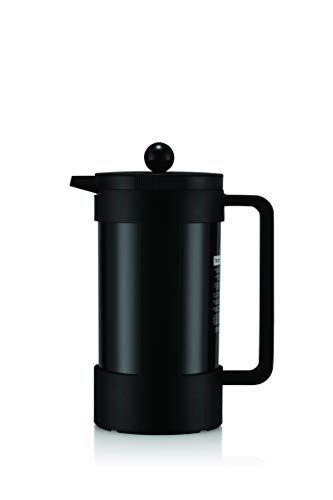
Bodum Bean French Press, 34 oz — Best for Households
The Bean scales the French press up to household duty. At 34 oz it brews for three or four mug drinkers at once, in a modern design that trades the Chambord’s chrome classicism for a friendlier, more contemporary look. For families that drink press coffee together, it is the Bodum that fits the routine.
Strengths
- 34 oz capacity serves a household in one brew
- Modern styling with Bodum’s proven press mechanics
- No consumables — the mesh plunger is permanent
Trade-offs
- A full 34 oz of press coffee should be decanted — it keeps extracting in the beaker
- Large glass beaker is the fragile part of a family kitchen
- Sediment is part of the French press character
| Type | French press |
| Capacity | 34 oz |
| Line | Bean range |
| Filter | Stainless steel mesh plunger |
Press coffee for a group has one golden rule — serve it or decant it, because grounds left in contact with the brew keep extracting and turn the last cups bitter. Follow that rule and the Bean delivers exactly what a household wants: a big, rich, honest batch with no filters to buy and no machine to programme. Its size also makes it the dinner-party Bodum, brewed at the table and poured into cups or a thermal jug.
Small households will waste coffee in a press this size; the 12 oz Chambord or Brazil is the honest fit for one or two modest drinkers. Match the beaker to the table you actually sit at.
Households that entertain should keep a thermal jug beside the Bean as a system: plunge, decant, and the table gets an hour of good coffee while the press is already washed and put away. It is the two-item combination that makes big-press ownership feel effortless.
For the Bean, a coarser grind matters more as size grows: a big beaker of fine grounds is a muddy beaker. If your grinder struggles for coarse consistency, the Baratza in our accessories guide is the natural partner purchase for this press.
Best for: Families and hosts brewing press coffee for several people / Not suited for: Solo drinkers or sediment-averse palates
Check the current price on Amazon
Comparison Table
| Pick | Badge | Key spec | Best for |
|---|---|---|---|
| Bodum Pebo Vacuum Coffee Maker, 34 oz | Best Overall | 34 oz glass vacuum pot | Coffee lovers who enjoy ritual and brew for guests |
| Bodum ePebo Electric Vacuum Coffee Maker, 34 oz | Best Electric | Electric vacuum, 34 oz, temp control | Siphon-curious buyers who want electric convenience |
| Bodum Pour Over Coffee Maker, 34 oz | Best Pour Over | 34 oz glass, permanent steel filter | Daily pour-over drinkers who want no consumables |
| Bodum Chambord French Press, 12 oz | Best Classic Solo Press | 12 oz classic French press | Solo drinkers who love French press body |
| Bodum Brazil French Press, 12 oz | Best Budget Press | 12 oz budget French press | First-time press buyers, students and office desks |
| Bodum Bean French Press, 34 oz | Best for Households | 34 oz household French press | Families and hosts brewing press coffee for several people |
Method is the message in the Bodum range: vacuum for clarity and theatre (Pebo, ePebo), pour-over for a clean everyday mug (Pour Over 34 oz), and French press for body, in sizes from solo (Chambord, Brazil) to household (Bean). All six share Bodum’s no-pod, low-consumable economics — the running cost of the whole range is basically the coffee itself.
Vacuum, Pour-Over or French Press: Which Bodum Method Suits You?
The vacuum brewers make the cleanest, most aromatic cup and the biggest impression, at the cost of the most involved process — choose them for weekends, guests and the pleasure of the ritual. The pour-over sits in the middle: a bright, clean mug, a few attentive minutes with a kettle, and a permanent filter that keeps daily running costs at zero. The French presses make the richest, heaviest cup with the simplest process of all — grounds, water, wait, plunge — and suit drinkers who like body and are untroubled by a little sediment.
There is no wrong choice, only a mismatch. Buy the method whose process you will still enjoy on the hundredth morning, not the one that impresses you on the first.
Why Bodum Owners Rarely Buy Filters or Pods
Running costs are the Bodum range’s quiet superpower. The French presses and the pour-over use permanent mesh filters; the vacuum pots use their built-in filtration. Nothing in this guide requires a paper filter subscription, a pod order or a proprietary anything — the only consumable is coffee. Over a year of daily brewing, that difference against a pod machine is not small change; it is the price of another brewer.
The one recurring cost to plan for is glass. Beakers and carafes are replaceable on most Bodum designs, which is the right way to think about them: a broken beaker is a spare part, not a new appliance, provided you buy the genuine size for your model.
How to Choose the Right Size of Bodum
Think in mugs, and be honest. A 12 oz press makes one good mug — perfect for a solo drinker, maddening for a couple. The 34 oz models make three to four mugs, which covers couples with margin and small gatherings comfortably. Oversizing a French press is a subtler error than undersizing a drip machine, because leftover press coffee over-extracts in the beaker; if you regularly brew for one and occasionally for four, buy the small press for daily use and let guests trigger a second round, or decant a big brew into a thermal jug the moment it is plunged.
- One mug daily: Chambord or Brazil 12 oz
- Two mugs daily: Pour Over 34 oz (brew half) or a mid-size press
- Household and guests: Bean 34 oz or Pebo 34 oz
- Theatre plus capacity: Pebo or ePebo 34 oz
Size the brewer to the ordinary day, and let the extraordinary day improvise.
Bodum and the Zero-Waste Coffee Routine
Run the numbers on a year of daily coffee. A pod household discards hundreds of capsules and pays a steep per-cup premium for the privilege. A paper-filter household discards hundreds of filters and brews a little waste paper into every morning. A Bodum household — press or pour-over with its permanent mesh — discards coffee grounds, which compost beautifully, and nothing else. The ePebo and Pebo add no consumables either; their filtration is part of the glassware.
That is not a marginal difference; it is the difference between a routine with a supply chain and a routine with a coffee bag. Buyers who care about household waste — and about never being held hostage by a proprietary consumable — are Bodum’s natural constituency, and this economy is a core reason the brand’s decades-old designs still sell.
Getting the Best from Bodum Glass: Care That Pays
Borosilicate glass rewards three habits. Warm it before it meets boiling water in a cold kitchen — a rinse of hot tap water is enough — so thermal shock never gets a vote. Keep it off cold stone and wet metal surfaces while hot, for the same reason. And wash it warm with a soft sponge rather than subjecting it to a crowded dishwasher’s percussion section. Follow those habits and Bodum glass serves for years; the breakage stories almost always trace back to one of the three being skipped.
When a beaker does eventually chip or crack, do not bin the brewer: Bodum’s replacement-beaker model means the frame, plunger and lid carry on with a new glass heart. It is an old-fashioned, repairable way to sell a product, and it is a genuine part of the value case for the Chambord and its siblings.
Bodum for Guests: Brewing for a Table Without Stress
Bodum kit shines at gatherings precisely because it scales by ritual rather than by programming. For a dinner party, the Pebo brews its 34 ounces as a small ceremony at the table’s end, and the Bean press, plunged and decanted into a thermal jug, quietly supplies the second round. The pour-over carafe covers the two-guest case with the least equipment of all. The common thread is that none of it needs counter space near a socket — Bodum brewers work on a sideboard, a balcony table or a garden bench as happily as in the kitchen.
Hosts should plan one detail: water. A full kettle per brewer, boiled just before serving, keeps the ritual smooth; juggling half-kettles mid-conversation is the only way this relaxed system generates stress. Set the kettle, the grounds measure and the brewers out before guests arrive, and Bodum entertaining becomes what it should be — coffee as part of the evening, not an absence from it.
Bodum Through the Seasons: Iced Coffee and Cold Mornings
The Bodum range earns its cupboard space across the year, not just in winter. In summer, the French presses double as cold-brew makers — coarse grounds, cold water, an overnight steep in the fridge, plunge in the morning — producing a smooth, sweet concentrate that dilutes beautifully over ice. The pour-over carafe brews directly over ice for a flash-chilled cup that keeps the aromatics hot-brewed coffee has and cold brew lacks. Even the Pebo’s clean cup chills gracefully into the cleanest iced coffee in this guide.
In winter the same kit answers the opposite need: presses and vacuum pots brew at full, satisfying strength for dark mornings, and a decanted thermal jug of press coffee keeps a slow weekend supplied without any machine humming on the counter. One set of glassware, four seasons of coffee — that versatility is a large part of why Bodum owners so rarely drift to other systems.
Bodum vs the Electric World: When Manual Brewing Wins
It is worth stating plainly when Bodum’s manual kit beats the electric alternatives that fill our other guides. It wins on running cost, permanently — there is no contest between a mesh filter and a pod subscription. It wins on longevity per dollar, because a glass-and-steel press has almost nothing in it that can become obsolete. It wins on portability and silence: Bodum brewers work in power cuts, in holiday cottages, at campsites and in quiet houses at 5 a.m. without waking anyone. And it wins on engagement — the drinker is present for the making, which many people discover is the part of coffee they actually loved all along.
The electric world wins on one axis only, but it is a heavy one: unattended convenience. If your mornings genuinely have no four minutes to give, a programmable drip machine is not a moral failure; it is the right tool, and our drip guide will sell you a good one. Choose Bodum when you have the minutes and want them to feel well spent — which, for a growing number of coffee drinkers, is most days of their lives.
How to Brew Bodum French Press Coffee Properly
Three of our picks are French presses, and the method rewards a few specifics. This is the routine that gets the rich, clean-tasting cup the design promises.
- Start with coarse, even grounds — fine grounds slip through the mesh and turn the cup muddy; a coarse grind is the French press’s best friend.
- Use a generous ratio — roughly one part coffee to twelve parts water by weight is a reliable home starting point for press brewing.
- Pour hot water just off the boil over the grounds, filling the beaker, and give it a gentle stir to wet everything.
- Wait four minutes with the lid on and the plunger resting above the surface — patience is the recipe’s main ingredient.
- Plunge slowly, stopping just above the bed of grounds rather than compressing it hard.
- Serve or decant immediately. Coffee left sitting on the grounds keeps extracting and turns bitter; pour it into mugs or a thermal jug straight away.
The same care, translated, serves the whole range: fresh grounds at the right size for the method, water just off the boil, and no brewed coffee left sitting where it was made. Bodum’s designs reward those habits with years of good cups.
Common Buying Mistakes
Using fine grounds in a French press. They pass the mesh, muddy the cup and make plunging hard work. Coarse is correct for every press in this guide.
Leaving coffee in the press while you chat. It over-extracts on the grounds. Decant the full beaker the moment you plunge — the Bean’s 34 oz makes this mistake expensive.
Treating glass like plastic. Bodum glass is quality borosilicate, but it is glass: warm it before boiling water in winter, keep it off cold stone surfaces and wash it without violence.
Buying the vacuum pot for weekday speed. The Pebo is a ritual brewer. Weekday-rush buyers end up resenting a beautiful object; match the method to the morning.
Skipping the rinse on permanent filters. Mesh filters clog slowly with coffee oils and start flavouring the brew. Hot water and an occasional soak keep them neutral.
Final Recommendation
The Pebo is the Bodum to own if you love coffee as an occasion, and the ePebo if you love that same cup with electric ease. For daily drinking, the Pour Over 34 oz is the range’s most practical beauty — no consumables, a clean cup and a carafe worth serving from. Press drinkers should size honestly: Chambord for the classic solo ritual, Brazil for the budget route to the same cup, and the Bean when the household drinks together.
Whichever you choose, you are buying into the cheapest-to-run coffee system in this entire programme: no pods, no paper, just coffee, water and glass. That economy, plus the design, is why Bodum owners tend to stay Bodum owners.
Keep exploring the rest of our coffee coverage here: Best Coffee Makers Best Coffee Makers And Accessories Best Coffee Makers Aeropress
Frequently Asked Questions
What is a Bodum vacuum coffee maker and how does it work?
The Pebo and ePebo brew by vapour pressure. Heat pushes water from the lower chamber up into the upper chamber, where it mixes with the grounds; when the heat is removed, the vacuum draws the finished coffee back down through a filter, leaving the grounds above. The result is an exceptionally clean, aromatic cup — and a brewing process that is genuinely fun to watch.
Do Bodum French presses need paper filters?
No. All Bodum presses use a permanent stainless steel mesh plunger, so there are no paper filters to buy. The trade-off is a small amount of natural sediment in the cup, which is part of the French press style.
What size Bodum French press should I buy?
Buy for your ordinary day. The 12 oz models (Chambord and Brazil) make one good mug for a solo drinker. The 34 oz Bean makes three to four mugs for households and guests. Oversized presses waste coffee, because brewed coffee left on the grounds over-extracts.
Is Bodum glass safe with boiling water?
Bodum uses high-heat borosilicate glass designed for brewing temperatures. Treat it sensibly — avoid thermal shock from cold surfaces, do not set a hot beaker on cold stone, and replace a beaker if it chips. Replacement beakers are available for most models, which keeps a damaged press in service.
What grind does a Bodum French press need?
Coarse and even. Fine grounds pass through the mesh filter, make the cup muddy and resist the plunger. If you buy pre-ground coffee, choose a coarse or French-press grind; if you grind at home, use the coarsest consistent setting your grinder offers.
How do I clean a Bodum coffee maker?
Knock the grounds into the bin or compost, then wash the beaker and plunger parts in warm soapy water and dry them well. The mesh filter benefits from an occasional soak to clear coffee oils. Glass parts are best hand-washed to protect them from dishwasher knocks.
What coffee beans suit Bodum brewers best?
Medium and medium-dark roasts flatter the presses, whose full immersion emphasises body and sweetness, while the vacuum and pour-over models reward brighter, lighter roasts with clarity. Whatever the method, buy beans you will finish within a few weeks and grind them for the method — coarse for press, medium for pour-over and vacuum — as close to brewing as you can.
Can I brew tea in a Bodum French press?
Yes — a French press is an excellent loose-leaf tea infuser, using the same steep-and-plunge method. Dedicate one press to tea if you brew both often, because coffee oils linger in the mesh and can flavour delicate teas. The Brazil’s low cost makes it a popular second press for exactly this job.
Why does my French press coffee taste muddy?
Almost always the grind: too fine, and particles pass the mesh. Coarsen the grind, let the brew settle for thirty seconds after plunging, and pour gently, leaving the last sip — where the sediment collects — in the cup. Those three habits clean up press coffee dramatically.
Is Bodum coffee equipment a good gift?
It is one of the safest coffee gifts: the designs are beautiful, the prices span budget to premium, and none of it locks the recipient into pods or subscriptions. Match the size to the household — a Chambord for a solo drinker, the pour-over or Bean for couples — and add a bag of coarse-ground coffee for press models so the first brew can happen immediately.
Can I put Bodum glass in the dishwasher?
Many Bodum glass parts are described as dishwasher safe, but hand washing is the kinder habit: dishwashers chip glass through contact with other items, and detergent film can dull the clarity that makes Bodum glassware beautiful. A warm sink, a soft sponge and thirty seconds is the recommended routine for every glass pick in this guide.
Does Bodum make an electric coffee maker?
Bodum’s range centres on manual brewing, with the ePebo in this guide as the notable electrified exception — a vacuum brewer whose heating is handled by an electric base with temperature control. For fully automatic drip machines, see our automatic drip guide, where other brands specialise.
Which Bodum should a complete beginner buy?
The pour-over if you like a clean cup, or the Brazil or Chambord press if you like a rich one. Both methods forgive beginners, need no other equipment beyond a kettle, and cost little to run. Save the vacuum brewers for your second Bodum, when the ritual itself has become part of the attraction.
Related guides in this series: Best Coffee Makers Bonavita Best Coffee Makers Automatic Drip Best Coffee Makers Below 50 Dollars


