Disclosure: airfryerkitchensupply.com is reader-supported. When you buy through links on our site, we may earn an affiliate commission at no extra cost to you.
Where to buy
Shopping for best coffee makers automatic drip? The fastest way to buy this shortlist is Amazon, where every verified pick below is sold with current availability shown on the product page. Prices move often, so we do not print them here — drip machines are a high-turnover category with frequent model refreshes, so confirm the exact model code on the listing matches the review you read. Use the Check on Amazon links throughout this guide to see the live price, delivery options and any current bundle offers for each model.
- Technivorm Moccamaster KBGV Select 10-Cup (Best Overall) — Check on Amazon
- Bonavita 8 Cup Coffee Maker BV1901TS (Best Value Performer) — Check on Amazon
- Breville Precision Brewer BDC400 (Best for Customisation) — Check on Amazon
- BUNN BX Speed Brew Classic 10-Cup (Best for Speed) — Check on Amazon
- Cuisinart DCC-3200 PerfecTemp 14-Cup Programmable (Best for Big Households) — Check on Amazon
- OXO Brew 8-Cup Coffee Maker (Best Compact Certified) — Check on Amazon
Best coffee makers automatic drip
The best coffee makers automatic drip buyers can choose share one job — a pot of filter coffee, brewed without supervision — and do it at wildly different levels of quality. The difference is almost entirely about water temperature and how evenly that water wets the grounds. Machines that brew at a properly hot, stable temperature and shower the coffee bed evenly produce a sweet, clear pot; machines that dribble lukewarm water through the middle of the grounds produce the sour, thin coffee that gives drip a bad name.
This guide is built around that difference. The six machines below include two certified high-performance brewers, a hand-built Dutch icon, the fastest home brewer in the business, a big programmable family machine and a customisable flagship for tinkerers. Every one was verified against retailer data before linking, and the spec boxes only claim what those verified listings state.
One framing note: ‘automatic drip’ here means electric filter machines that brew a carafe. If you want pods, espresso or a built-in grinder, our other coffee guides cover those — this page is for people who want a proper pot, made properly, with the least possible morning effort.
There is also a quiet economic argument for buying drip well once. A household brewing a pot a day spends more on coffee in a year than on any machine in this guide — which means the machine that extracts those beans properly is not the expensive option, it is the one that stops you wasting the expensive option. Cheap machines that under-extract effectively tax every bag you buy; the certified brewers below are how you stop paying that tax.
A word about who this category quietly serves best: people who drink coffee as a daily staple rather than a hobby. The hobbyist has rituals and enjoys them; the staple drinker wants a pot that is simply there, correct and hot, while life happens around it. Every machine in this guide was chosen to disappear into that life — to be loaded in seconds, to brew without supervision and to ask for nothing but a rinse and a monthly descale in return. Judge them by that standard and the ranking almost writes itself.
In this guide
Quick Picks
Short on time? These are the six best coffee makers automatic drip we would buy with our own money, each chosen for a different kind of coffee drinker. Every badge here matches the badge in the full review further down, so you can jump straight to the model that fits your kitchen.
- Technivorm Moccamaster KBGV Select 10-Cup — Best Overall: The hand-built Dutch brewer that defines the category: a copper heating element, a nine-hole shower arm and a 10-cup pot brewed in about six minutes. — Check on Amazon
- Bonavita 8 Cup Coffee Maker BV1901TS — Best Value Performer: SCA-certified brewing with a thermal carafe at a mid-tier price — the performance-per-dollar champion of automatic drip. — Check on Amazon
- Breville Precision Brewer BDC400 — Best for Customisation: The tinker’s drip machine: adjustable temperature, bloom time, flow rate and brew modes, with both carafe and pour-over flexibility. — Check on Amazon
- BUNN BX Speed Brew Classic 10-Cup — Best for Speed: A full 10-cup pot in about four minutes, thanks to BUNN’s always-hot internal tank — the fastest route from awake to coffee. — Check on Amazon
- Cuisinart DCC-3200 PerfecTemp 14-Cup Programmable — Best for Big Households: The family workhorse: 14-cup capacity, full programmability, adjustable temperature and brew strength — the most coffee with the least thought. — Check on Amazon
- OXO Brew 8-Cup Coffee Maker — Best Compact Certified: SCA-certified brewing in a compact body that also brews a single mug — the small-kitchen pick that gives up nothing on quality. — Check on Amazon
How These Picks Were Chosen
We chose by brewing fundamentals first: machines known for holding proper brewing temperature and wetting the grounds evenly were ranked ahead of machines competing on clocks and cup counts. Certification by the Specialty Coffee Association, where a model carries it, was treated as supporting evidence because it involves independent temperature and extraction testing. After fundamentals, we weighed capacity, carafe type, programmability and how the machine fits real counters.
We also deliberately mixed philosophies. Some buyers want a machine that disappears into the morning routine; others want bloom cycles and temperature dials. Both are legitimate, so the list includes a set-and-forget speed brewer and a fully customisable flagship, each badged for the buyer it actually suits rather than ranked on one ladder.
We also sanity-checked each pick against its own replacement ecosystem before finalising the list. A drip machine’s carafe is its most fragile component and its basket its most losable; models whose carafes are standard, stocked and reasonably priced scored ahead of equally good brewers with orphan glassware. It is an unglamorous criterion that decides real ownership costs in year three, and it is one more reason the names in this guide are the established ones.
Durability signals were part of the selection too. We favoured machines with simple, proven architectures, obtainable carafes and filters, and makers with a track record of supporting models for years. A drip machine is a daily appliance, not a seasonal gadget, and the total cost of a machine that dies in year two is higher than a better machine that serves for eight — a calculation this guide makes on your behalf in every review.
The 6 Best Automatic Drip Coffee Makers

Technivorm Moccamaster KBGV Select 10-Cup — Best Overall
The Moccamaster is the automatic drip machine other machines are measured against. Built in the Netherlands with a copper heating element that holds brewing temperature properly and a shower arm that distributes water across the whole coffee bed, it brews a 10-cup pot with a clarity and sweetness cheap machines cannot reach. The KBGV Select adds a brew-volume selector for half or full pots.
Strengths
- Brewing temperature and even extraction are the class benchmark
- Hand-built, repairable design with a long service life
- Half/full pot selector brews small batches properly
Trade-offs
- Premium tier — the most expensive simple drip machine most people will consider
- No timer or programmability; it brews when you switch it on
- Glass carafe on a hot plate, so coffee is best drunk promptly
| Type | Automatic drip coffee maker |
| Capacity | 10-cup, 40 oz / 1.25 L (per manufacturer listing) |
| Heating | Copper boiling element |
| Selector | Half or full carafe brew selector |
| Build | Hand-built in the Netherlands |
What you are paying for is the brew itself. The Moccamaster’s element brings water to a proper boil and its pulse action and shower head keep the whole coffee bed extracting evenly, pot after pot, year after year. Owners routinely keep these machines for a decade or more, and parts remain available — a ownership proposition no disposable machine matches.
The compromises are convenience features, not coffee: there is no clock, no timer and no app. If your routine needs coffee waiting when you wake, look at the Cuisinart below. If you are awake when you brew and taste is the priority, this is the machine.
A last word on value: divide the Moccamaster’s price by a decade of daily pots and it becomes one of the cheapest machines in this guide per cup. Premium drip pricing looks very different through that lens, and it is the lens the machine was designed for.
Resale and hand-me-down value tell the same story as longevity: a used Moccamaster is a sought-after object years after purchase, which no one has ever said about a disposable brewer. Buy quality once and even your exit from the product is cheaper.
Best for: Quality-first households who brew while awake and keep machines for years / Not suited for: Anyone who needs a wake-up timer or the lowest price
Check the current price on Amazon

Bonavita 8 Cup Coffee Maker BV1901TS — Best Value Performer
The BV1901TS takes the formula that made Bonavita famous — a powerful heater that reaches proper brewing temperature, an even shower over the grounds and a thermal carafe — and packages it in the current one-touch design. It carries SCA certification, meaning its brewing performance has been independently tested, which almost nothing else at its tier can claim.
Strengths
- SCA-certified brewing performance at a mid-tier price
- Thermal carafe keeps coffee hot without a hot plate
- One-touch operation with an optional pre-infusion (bloom) mode
Trade-offs
- 8-cup capacity is modest for big households
- Design is functional rather than beautiful
- Thermal carafe lid and pour take a little practice
| Type | Automatic drip coffee maker |
| Capacity | 8-cup |
| Carafe | Stainless steel double-wall thermal |
| Certification | SCA Certified (per manufacturer listing) |
| Operation | One-touch, with auto pause brewing |
For most households this is the sweet spot of the entire category: certified brewing fundamentals, a thermal carafe and a price well below the Moccamaster. The bloom mode — a short pre-wetting pause before the main brew — is a feature borrowed from manual pour-over that genuinely helps fresh beans degas and extract evenly.
Choose it over the Moccamaster if budget matters or you want the thermal carafe. Choose the Moccamaster for build, longevity and that last increment of cup quality.
Bonavita’s support story is worth a line: the brand’s machines are simple enough that common issues — a carafe, a basket, a lid — are replaceable parts rather than workshop jobs. That maintainability is part of why the 1901TS holds the overall-value argument even against newer rivals.
The 1901TS also makes an excellent ‘second machine’ for a holiday home or a serious office kitchenette: certified coffee, no instructions needed, and a thermal carafe that tolerates meeting schedules. Not every pick needs to be a flagship to be a flagship decision.
Best for: Most households wanting certified brewing quality at a fair price / Not suited for: Families needing more than 8 cups per brew
Check the current price on Amazon
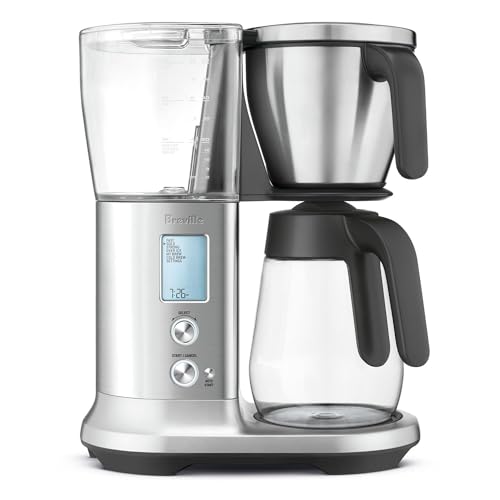
Breville Precision Brewer BDC400 — Best for Customisation
The Precision Brewer is for drinkers who treat drip coffee as a craft. It offers preset modes including a Gold setting tuned to specialty standards, plus a custom mode where temperature, bloom time and flow rate are yours to set. It can brew a full carafe or work with pour-over drippers, making it the most flexible automatic drip platform here.
Strengths
- Deep customisation — temperature, bloom and flow rate
- Gold preset brews to specialty-coffee standards out of the box
- Works as a carafe brewer or an automatic pour-over station
Trade-offs
- Complexity is wasted on set-and-forget drinkers
- Large footprint and a premium tier price
- More settings means more ways to brew a bad pot while learning
| Type | Automatic drip coffee maker, customisable |
| Modes | Preset brew modes including Gold, plus custom My Brew |
| Adjustments | Temperature, bloom time and flow rate |
| Use | Carafe brewing and pour-over dripper compatible |
Automatic drip usually means surrendering control; the Precision Brewer hands it back. Home roasters and bean explorers can tune a brew to a specific coffee rather than accepting the house setting, and the Gold preset means the machine is still excellent on the mornings you cannot be bothered. It is the natural upgrade path for pour-over drinkers who want automation without giving up their craft.
If the previous sentence sounded like work rather than fun, buy the Bonavita and enjoy certified results with one button. This machine rewards curiosity specifically.
If you take one habit from the Precision Brewer, let it be this: change a single variable per brew and notice. The machine makes experimentation cheap; a week of single-variable pots will teach you more about your own taste than a year of presets on any machine.
A note for home roasters: the Precision Brewer is the only machine in this guide that can follow a roast’s development day by day, nudging temperature and bloom as the beans age. That is a niche need, but for the household that has it, no other automatic brewer will do.
Best for: Enthusiasts who want automatic brewing with manual-level control / Not suited for: Set-and-forget households
Check the current price on Amazon

BUNN BX Speed Brew Classic 10-Cup — Best for Speed
BUNN built its name in commercial cafés, and the BX brings the café trick home: an internal stainless tank keeps water hot around the clock, so brewing starts the instant you pour cold water in, and a full pot lands in roughly four minutes. There is no programmability and no fuss — just speed, every single time.
Strengths
- Fastest full-pot brewing in this guide
- Commercial-style build and a simple, repairable design
- No waiting for water to heat — the tank is always ready
Trade-offs
- The always-hot tank uses standby energy to stay ready
- No timer, no settings — speed is the whole proposition
- Drip-free carafe design is functional, not elegant
| Type | Automatic drip coffee maker, reservoir tank design |
| Capacity | 10-cup |
| Brew speed | About 4 minutes for a full pot (commercial-style tank system) |
| Tank | Internal stainless steel hot-water tank |
For households where the morning is a scramble — shifts, school runs, early trades — the BX removes the one delay nobody budgets for. It is also a favourite in offices and workshops for the same reason. The coffee itself is honest, hot and consistent, a step below the certified brewers on finesse but delivered in half the time.
The standby energy of the hot tank is the real cost of that speed; BUNN even provides a vacation switch for longer absences. If your household brews once a day at a leisurely pace, the speed buys you little. If minutes matter, nothing else here is close.
The BX also deserves its reputation in holiday homes and rentals: it asks nothing of guests, needs no instructions beyond ‘pour water in’, and produces a pot before anyone has finished complaining about being awake. Simple, fast machines earn their keep in shared spaces.
The BX’s tank system has one more virtue: because the water is already hot, back-to-back pots for a crowd or an event take minutes each. For community halls, teams and big family weekends, that throughput is worth more than any refinement of flavour.
Best for: Busy households and workplaces where brew time is the bottleneck / Not suited for: Energy-conscious single daily brewers who can wait
Check the current price on Amazon

Cuisinart DCC-3200 PerfecTemp 14-Cup Programmable — Best for Big Households
The DCC-3200 is the mainstream answer done thoroughly. Fourteen cups of capacity, a programmable timer so coffee waits for you instead of the reverse, adjustable carafe temperature and brew-strength control, all in Cuisinart’s familiar stainless format. For a big household that runs on drip coffee, it covers every base without a premium price.
Strengths
- Largest capacity here — 14 cups per brew
- Fully programmable with brew-strength and temperature settings
- Mainstream price despite the full feature set
Trade-offs
- Brewing finesse sits a tier below the certified specialists
- Glass carafe on a hot plate — drink within the hour for best taste
- Big machine; check cabinet clearance
| Type | Automatic drip coffee maker, programmable |
| Capacity | 14-cup glass carafe |
| Controls | Brew strength and carafe temperature adjustment |
| Features | Programmable auto-brew, 1–4 cup setting |
Not every household’s priority is extraction perfection; many need volume, timing and reliability at a sane price, and that is exactly this machine’s brief. The 1–4 cup setting is a thoughtful touch for small batches, and the strength control handles the difference between weekday fuel and weekend coffee. It is the drip machine equivalent of a good family car.
Coffee geeks will find its ceiling quickly, and that is fine — they have the Moccamaster and Precision Brewer above. For everyone else, this is the default big-household recommendation.
Families should note the DCC-3200’s auto shut-off behaviour when choosing routines: set the programme for the household’s first riser, and the strength setting handles the rest. It is the rare big machine that also behaves well on a quiet two-person Sunday via its small-batch setting.
Programmable machines live or die by their clocks being right; the DCC-3200’s straightforward interface means the timer actually gets used, which sounds faint praise until you have owned a machine whose programming required a manual and a free evening.
Best for: Families and heavy drinkers wanting programmable volume / Not suited for: Small households or extraction perfectionists
Check the current price on Amazon

OXO Brew 8-Cup Coffee Maker — Best Compact Certified
The OXO Brew 8-Cup packs certified brewing into the smallest footprint in this guide, and adds a trick the others lack: it can brew a single mug as happily as its thermal carafe. For apartments, small kitchens and one-or-two-person households, it resolves the usual dilemma — certified quality normally means a bigger machine than the counter wants.
Strengths
- SCA-certified brewing in a compact footprint
- Brews a full thermal carafe or a single mug
- Thoughtful OXO design details throughout
Trade-offs
- 8-cup ceiling, like the Bonavita
- Single-mug mode is a bonus, not a replacement for a true single-serve machine
- Thermal carafe only — no glass option
| Type | Automatic drip coffee maker |
| Capacity | 8-cup thermal carafe, plus single-mug brewing |
| Carafe | Stainless steel thermal |
| Certification | SCA Certified Home Brewer (per manufacturer listing) |
OXO’s kitchen-tool design sense shows in the details — a well-sealed thermal carafe, sensible controls and a rainmaker-style shower head for even saturation. The single-mug mode makes it the only machine here a solo drinker can buy without wasting pot after pot, while the carafe still covers weekend guests.
Against the Bonavita it trades a little price advantage for compactness and the single-mug trick. Either is a certified, satisfying buy; choose by your counter and your household size.
Small-kitchen buyers should measure the OXO against the space above the counter as well as the footprint: its lid and basket access are designed for real cabinets, a detail apartment dwellers appreciate daily and spec sheets never mention.
The OXO’s single-mug mode also makes it the natural machine for the decaf-after-dinner problem: one mug, properly brewed, no full pot brewed and abandoned. Small flexibilities like that are why owners keep these machines for years.
Best for: Small kitchens and one-to-two-person households wanting certified quality / Not suited for: Large families brewing at full capacity daily
Check the current price on Amazon
Comparison Table
| Pick | Badge | Key spec | Best for |
|---|---|---|---|
| Technivorm Moccamaster KBGV Select 10-Cup | Best Overall | 10-cup, copper element, half/full selector | Quality-first households who brew while awake and keep machines for years |
| Bonavita 8 Cup Coffee Maker BV1901TS | Best Value Performer | 8-cup thermal, SCA certified | Most households wanting certified brewing quality at a fair price |
| Breville Precision Brewer BDC400 | Best for Customisation | Custom temp/bloom/flow, Gold mode | Enthusiasts who want automatic brewing with manual-level control |
| BUNN BX Speed Brew Classic 10-Cup | Best for Speed | 10-cup in ~4 minutes, hot tank | Busy households and workplaces where brew time is the bottleneck |
| Cuisinart DCC-3200 PerfecTemp 14-Cup Programmable | Best for Big Households | 14-cup, programmable, strength control | Families and heavy drinkers wanting programmable volume |
| OXO Brew 8-Cup Coffee Maker | Best Compact Certified | 8-cup thermal + single mug, SCA certified | Small kitchens and one-to-two-person households wanting certified quality |
Two axes organise this list: brewing pedigree and lifestyle fit. The Moccamaster, Bonavita and OXO compete on certified or benchmark extraction; the Breville adds control; the BUNN adds speed; the Cuisinart adds capacity and programmability. Decide which axis your mornings actually run on, and the table chooses for you.
What Makes One Automatic Drip Machine Taste Better Than Another?
Three things, in order. Water temperature: proper drip brewing needs water in the low-to-mid 90s Celsius at the grounds, held steadily — machines that brew cooler make sour, under-extracted coffee no bean can fix. Even saturation: a shower head that wets the whole coffee bed beats a single stream that drills a channel through the middle. And contact time: a full pot should take roughly four to eight minutes; much faster usually means under-extraction, which is why the BUNN’s tank system — hot water, ready instantly, flowing at a designed rate — is engineered the way it is.
Certification exists to test exactly these things. An SCA-certified brewer has demonstrated temperature and extraction performance to an independent standard, which is why three of our six picks carry it or match its benchmark.
How to Choose the Right Size and Carafe
Count mugs, not ‘cups’. A manufacturer’s cup is a small measure, so a 10-cup machine makes roughly five to six real mugs, a 14-cup about seven to eight, and an 8-cup about four. Buy for your biggest regular occasion — weekday mornings for two, not the annual family visit, which a second brew can cover.
Then the carafe. Thermal carafes protect coffee that waits and are the default recommendation in this guide. Glass carafes cost less and show the level, but their hot plates keep cooking the brew; if your pot is gone within the hour, glass is a fair saving, and if it is not, thermal pays for itself in taste.
Does Programmability Matter?
Only if your mornings need it. A timer is genuinely valuable when the household wakes to a deadline — school, shifts, commutes — and worthless complexity when someone is always awake and unhurried before brewing. Note the interplay with freshness: a programmable machine grinds nothing and simply brews pre-loaded grounds at the set time, which is why pairing a timer machine with fresh beans and correct storage matters.
- Wake-to-deadline household: programmability first (Cuisinart)
- Quality-first, unhurried mornings: brewing pedigree first (Moccamaster, Bonavita, OXO)
- Unpredictable mornings: speed first (BUNN)
- Hobbyist mornings: control first (Breville)
There is no hierarchy here — only fit. The most regretted drip purchases are excellent machines bought for someone else’s routine.
Drip Coffee and Health-Conscious Drinking: A Sober Note
Filter coffee has one built-in advantage worth knowing: the paper filter traps most of the coffee oils that unfiltered methods — French press, moka, boiled coffee — let through. Drinkers who watch their cholesterol are often advised by their clinicians to favour filtered coffee for exactly this reason, and automatic drip is the most convenient filtered method there is. We make no medical claims beyond that widely reported distinction, and your own clinician’s advice outranks any buying guide — but if the question is already on your mind, it is one more reason the humble drip pot holds its place in the kitchen.
The drip format also makes moderation easy to practise: a carafe shows you exactly how much you have brewed and drunk, unlike an endless pod or café habit. Households managing caffeine — half-caf blends, a cut-off time, decaf after noon — find a pot-based routine simpler to steer than any other format in our coffee coverage.
Troubleshooting a Disappointing Pot of Drip Coffee
When a good machine makes a bad pot, work this list in order before blaming the hardware. Sour and thin almost always means under-extraction: grind finer, use a little more coffee, or check that scale has not dragged the brew temperature down. Bitter and harsh means over-extraction or staling: grind coarser, brew a touch less strong, and decant off the hot plate sooner. Flat and papery points at the inputs — old beans, old water from the tank, or an unrinsed filter.
- Sour/thin → finer grind, more coffee, descale check
- Bitter/harsh → coarser grind, less coffee, decant earlier
- Flat/papery → fresh beans, fresh water, rinse the filter
- Weak overall → check the ratio before touching any setting
Change one thing per pot and taste honestly. Nine times in ten, the fix is free and the machine was innocent — which is exactly why the fundamentals-first machines in this guide reward their owners: once the inputs are right, there is nothing left standing between you and the pot the machine was built to brew.
Automatic Drip vs the Alternatives: An Honest Word Before You Buy
Drip is not the only way to make coffee at home, and this guide would be dishonest if it pretended otherwise. Espresso machines make a different drink — concentrated, pressure-brewed, the base of café culture — at several times the cost and effort. Pod machines win on per-cup convenience and lose on per-cup cost, waste and ceiling of quality. Manual methods — pour-over, press, AeroPress — offer control and ritual at the price of your attention. Automatic drip’s claim is narrower and, for most households, decisive: the best ratio of cup quality to human effort for coffee drunk by the mug and the pot.
Choose drip when the household drinks filter coffee daily and wants it ready without a ceremony. That describes the majority of coffee homes, which is why this unglamorous category quietly outsells all the others — and why buying a good one, once, is among the highest-value decisions a coffee household makes.
Setting Up Your New Drip Machine: The First Week Done Right
Day one is for plumbing and patience: wash the carafe and basket, run two full cycles of plain water to flush the machine, and brew your first pot at the standard ratio without judging it — new machines and new owners both need a settling pot. Days two and three are for one adjustment: if the cup is thin, add coffee before you touch anything else; if it is harsh, subtract. By day four, weigh the dose once so your scoop hand learns what the right amount looks like, and write the number on a note inside the cupboard door.
The rest of the first week is about placing the machine in the household’s real geography. The best drip machine position is the one where loading it the night before is effortless — near the coffee, near the sink, with headroom to lift the lid under the cabinets you actually have. Owners who set up thoughtfully in week one describe the machine, a year later, as invisible infrastructure; owners who wedge it into a photogenic but impractical corner describe it as a chore. The machine is the same. The corner is the difference.
Drip Coffee for One: Solving the Small-Batch Problem Honestly
The solo drip drinker is the category’s awkward customer: most machines are built for pots, and a lonely two cups sloshing in an eight-cup basket extract unevenly and taste like it. This guide contains the three honest solutions. The OXO brews a genuine single mug through the same certified system as its carafe. The Moccamaster’s half-pot selector exists precisely to keep small batches honest. And the Bonavita-class 8-cup machines, while pot-first, handle a half batch more gracefully than mainstream rivals because their shower heads cover the basket properly.
What we would not advise is the common workaround of brewing a full pot and reheating cups through the day. Reheated drip coffee is a shadow of itself, and the habit quietly convinces people they do not like filter coffee. Brew small, brew fresh, and choose the machine whose small-batch honesty matches your household’s real size — the cup will tell you the difference every single morning.
How to Brew a Better Pot with Any Automatic Drip Machine
Machine quality sets the ceiling, but these habits decide how close your daily pot gets to it — they apply to every model in this guide.
- Use fresh beans, ground for drip just before brewing where possible; if you buy pre-ground, store it sealed and finish the bag within a couple of weeks.
- Measure with a simple ratio: start near 60 grams of coffee per litre of water — roughly two level tablespoons per mug — and adjust to taste over the week.
- Use the right filter, seated properly: the correct size for your basket, rinsed if your machine’s manual suggests it, with no folds collapsing into the grounds.
- Fill with fresh, cold water each brew rather than topping up yesterday’s tank water.
- Let the full cycle finish before pouring — early cups from a part-brewed pot are over-strong and leave the rest weak (machines with pause-and-serve forgive this, but the pot is better whole).
- Decant thermal-style: if coffee will wait, a thermal carafe beats a hot plate every time; if yours is glass, consider pouring the finished pot into a thermal server.
- Rinse the carafe and basket daily, descale monthly in hard-water areas — scale insulates heating elements and slowly drags brew temperature down.
Change one habit at a time and taste the difference. Most ‘my drip coffee is disappointing’ cases trace back to stale grounds, a guessed ratio or a scaled-up machine — all fixable for free.
Common Buying Mistakes
Judging machines by cup count alone. A 14-cup badge says nothing about temperature or extraction. The certified 8-cup machines in this guide will out-brew most bigger, cheaper boxes.
Leaving coffee on a hot plate for hours. The plate keeps coffee hot and keeps cooking it. Decant into a thermal carafe, or buy thermal in the first place.
Using yesterday’s water and a stained carafe. Old water tastes flat and coffee oils turn bitter. Fresh water and a daily rinse are the cheapest upgrades in drip coffee.
Never descaling. Scale silently lowers brew temperature until a good machine brews like a bad one. Monthly descaling in hard-water areas keeps the specification you paid for.
Buying a timer machine and pre-grinding a week ahead. Convenience stacking can cancel itself out. If you use the timer, at least store grounds airtight and use them within days, not weeks.
Final Recommendation
For the best pot of automatic drip coffee, full stop, the Technivorm Moccamaster remains the benchmark, and the Bonavita BV1901TS delivers most of its quality — certified and thermal — for notably less, which is why it may be the smartest buy on the page. The OXO is its compact, single-mug-friendly rival. Around those three, the Breville serves tinkerers, the BUNN serves the hurried and the Cuisinart serves big programmable households.
Match the machine to your morning, keep it descaled, and feed it decent coffee in the right ratio. Automatic drip rewards those three habits more reliably than any feature list.
Keep exploring the rest of our coffee coverage here: Best Coffee Makers Best Coffee Makers And Grinder Best Coffee Makers Bonavita
Frequently Asked Questions
What temperature should an automatic drip coffee maker brew at?
Specialty standards put proper brewing water in the low-to-mid 90s Celsius at the coffee grounds. Machines that brew much cooler under-extract and taste sour. SCA certification, carried by picks in this guide, independently verifies that a brewer hits and holds the right range.
How long should a full pot take to brew?
Roughly four to eight minutes for a full carafe on most well-designed machines. Much faster usually signals under-extraction — the BUNN in this guide is the engineered exception, using a pre-heated tank and a designed flow rate to brew a full pot in about four minutes.
Is a thermal carafe really better than glass?
For coffee that waits, yes: insulation holds temperature without continuing to cook the coffee, so the last cup tastes close to the first. Glass on a hot plate is fine when the pot is finished within about an hour, and it shows the remaining level more clearly.
What does SCA certified mean on a coffee maker?
It means the Specialty Coffee Association has tested the brewer against its brewing standards — water temperature, extraction and uniformity among them — and it passed. It is the most meaningful independent quality mark in home drip coffee, and it is why certified models anchor this guide.
Can an automatic drip machine brew a small amount well?
Better models can. The Moccamaster KBGV Select has a half-pot selector, the Cuisinart has a 1–4 cup setting, and the OXO brews a single mug outright. On machines without such features, small batches often under-extract because the shower head is designed for a full bed of grounds.
How often should I descale my drip coffee maker?
About monthly in hard-water areas, less often with soft water — and whenever brew times lengthen or coffee starts tasting dull. Scale buildup lowers brewing temperature gradually, so descaling is maintenance of the machine’s core specification, not just cleanliness.
Which of these machines is quietest?
Drip machines are all relatively quiet — the sounds are a heating element’s murmur and the final gurgle of the shower as the last water leaves the tank. The BUNN’s tank system is effectively silent until brewing starts, while tankless machines tick and sigh as they heat. None approaches a grinder’s volume, and any pick here can brew in the next room without waking a household.
Can I use pre-ground coffee in these machines?
Yes — every pick here brews pre-ground coffee happily. Fresh-ground is better, and a grinder is the upgrade we recommend most, but a certified drip machine fed decent pre-ground coffee still beats an uncertified machine fed anything. Store pre-ground coffee airtight and use it within a couple of weeks of opening.
Why does my drip coffee taste different from café filter coffee?
Usually ratio and freshness, not magic. Cafés weigh their coffee, grind fresh and brew on certified equipment at the correct temperature. Match those three — a measured ratio near 60 grams per litre, fresh beans, and a machine from this guide — and the gap closes to almost nothing.
How long do automatic drip coffee makers last?
It tracks build and care. Simple, well-built machines that are descaled regularly commonly serve five to ten years; the Moccamaster’s repairable design is famous for going well beyond that. The usual failure points are heating elements stressed by scale and carafes lost to accidents — both are cheaper to prevent than to replace.
Do I need a grinder for an automatic drip machine?
Not need — but it is the single best upgrade. Fresh-ground coffee in a certified drip machine is where most households discover how good home filter coffee can be. If the budget forces a sequence, buy the machine first and the grinder second, and use fresh pre-ground coffee in between rather than the reverse order.
Can an automatic drip machine make iced coffee?
Yes, two ways. Brew a normal pot, let it cool and refrigerate it for cold coffee through the day; or brew a stronger pot directly over ice in the carafe — the Japanese iced method — which chills instantly and keeps the aromatics bright. Thermal-carafe models suit the first method; any model here handles the second with a strong ratio.
What is the difference between drip and pour-over coffee?
Control. Pour-over is drip brewing done by hand — you pour the water yourself, in stages, and steer the extraction. Automatic drip mechanises the same physics: a shower head instead of your kettle. The cups are cousins, and a certified automatic machine will match or beat most home pour-over attempts, which is precisely its appeal.
Related guides in this series: Best Coffee Makers Alexa Compatible Best Coffee Makers Below 50 Dollars Best Coffee Makers And Accessories


