Disclosure: airfryerkitchensupply.com is reader-supported. When you buy through links on our site, we may earn an affiliate commission at no extra cost to you.
Where to buy
The fastest way to shop for best coffee grinders and coffee makers for restaurants is on Amazon, where every pick below is sold with full specifications, sizing and configuration options on the product page. Start with our top recommendation, the BUNN CWTF15-APS Automatic Airpot Brewer — check price on Amazon — then compare it against the other five picks in the Quick Picks table before you decide.
This guide splits into the three formats restaurant coffee actually uses — plumbed airpot brewers, urns for events, and a grinder scoped honestly for small operations. Match the format to your service first; the badge winners inside each format follow from that decision, and the buying guide below walks through the format decision in the order a working restaurateur would actually make it.
The best coffee grinders and coffee makers for restaurants are not bigger versions of home machines — they are a different category of equipment, bought against different failures. A home brewer that dies is an inconvenience. A restaurant brewer that dies at 8:15 on a Saturday is a dining room full of people being told there is no coffee, and a review profile that says so. Commercial coffee equipment is bought for duty cycle, serviceability and throughput first, and for taste as the entry ticket rather than the prize.
Format is the first decision, and this guide is organised around it. Plumbed automatic brewers feeding airpots are the professional default for continuous service. Pour-over brewers serve the spaces that cannot plumb. Urns serve the event world, where coffee arrives by the gallon. And the grinder question — which the keyword rightly insists on — gets an honest, scoped answer: a superb small-operation grinder, plus clear guidance on where its territory ends and true commercial grinding begins.
Everything named here was verified against the Amazon catalogue data available to this site before being linked, and the commercial picks were chosen from manufacturers’ commercial lines rather than domestic models in bigger boxes — a distinction this category’s marketing works hard to blur, and one your health inspector and your Saturday rush will both notice within the first month of service, though rarely in the way the marketing department intended.
In this guide
Quick Picks
Short on time? These are the six best coffee grinders and coffee makers for restaurants options we would buy ourselves, each chosen for a different need and budget tier. Every badge below matches the badge used in the full review further down, so you can jump straight to the model that fits you.
- BUNN CWTF15-APS Automatic Airpot Brewer — Best Overall Commercial Brewer. A plumbed, automatic commercial brewer that fills airpots back to back all service — the format serious cafés and restaurants standardise on for a reason. Check price on Amazon.
- BUNN VPR APS Pour Over Air Pot Brewer — Best Pour-Over Commercial Brewer. The unplumbed workhorse: pour water in the top, brew into airpots, no water line required — commercial coffee for spaces that cannot or will not plumb. Check price on Amazon.
- BUNN CW15 APS Commercial Brewer — Best Compact Commercial Brewer. A smaller-footprint automatic BUNN for tight back bars and small dining rooms that still want plumbed, airpot-based service. Check price on Amazon.
- Hamilton Beach Commercial 60 Cup Coffee Urn D50065 — Best Urn for Service. Sixty cups of brewed coffee, held and served from one polished stainless urn — the catering and banquet format, from a commercial line built for it. Check price on Amazon.
- West Bend 100-Cup Commercial Coffee Urn NSF — Best for Banquets and Big Events. The largest urn in this guide, NSF approved for commercial food service — one hundred cups for the wedding, conference and festival end of the restaurant world. Check price on Amazon.
- Baratza Encore Conical Burr Grinder — Best Grinder for Small Cafés. The grinder half of this guide, honestly scoped: for small cafés and restaurant bars grinding drip beans in modest volume, the Encore’s burrs and repairability beat commercial pretenders. Check price on Amazon.
How These Picks Were Chosen
We selected for commercial reality: plumbed or pour-over formats from BUNN’s commercial range, urns from commercial lines with the certifications venues need, and duty cycles that assume daily multi-cycle service rather than a home kitchen’s one pot. Domestic machines with ‘commercial-style’ language were excluded on sight.
Airpots anchor the brewer picks because they solve the restaurant problem — coffee that must wait for the customer without deteriorating — better than any burner format, and because the two BUNN formats (plumbed and pour-over) cover venues with and without a water line. Urns were judged on capacity, certification and service practicality rather than on brew delicacy they do not pretend to offer.
The grinder pick was scoped deliberately. Readers running high-volume programmes should treat that section as the honest headline of this page, not as a footnote to it.
The 6 Best Coffee Grinders and Coffee Makers for Restaurants

BUNN CWTF15-APS Automatic Airpot Brewer — Best Overall Commercial Brewer
Restaurant coffee has one unforgiving requirement: it must be ready before it is ordered, in volume, for hours. The BUNN CWTF15-APS is built around that reality. Plumbed into a water line, it brews automatically into airpots — insulated servers that hold coffee at serving quality far longer than a glass carafe on a burner — so the pass, the bar and the dining room can each hold fresh coffee without anyone babysitting a brew cycle during service.
Strengths
- Automatic plumbed brewing — no manual filling during service
- Airpots hold quality far longer than burner carafes
- The proven commercial format for cafés and restaurants
Trade-offs
- Requires a plumbed water line and filtration
- Airpots themselves are a separate purchase to plan for
- Over-specified for very small cafés with low volume
| Specification | Detail |
|---|---|
| Format | Automatic brewer for airpots (pourover/airpot system) |
| Use | Commercial, plumbed water line |
| Service style | Brew into airpots for station or table service |
The airpot system is the professional’s answer to the freshness-versus-volume problem. Brew a full airpot for the morning rush, carry it to where the service is, and brew the next while the first pours. Coffee spends its life sealed and insulated rather than cooking on a hot plate, which is why the last cup of a BUNN airpot tastes like coffee and the last cup of a diner burner pot tastes like a warning. For restaurants whose coffee reputation matters — breakfast spots especially — this format is the standard for a reason.
Ownership is commercial in character: it needs a water line and a filter, counter depth, and a descaling discipline matched to your water. It is not NSF-window-dressing; it is a working appliance that expects a working kitchen’s maintenance. Restaurants stepping up from pour-over brewers will feel the labour saving in the first week — nobody stands over a kettle during a rush ever again.
Best for: restaurants and cafés serving coffee continuously through service / Not suited for: tiny counters brewing a handful of cups a day
Check on Amazon — check the current price on Amazon before you buy, because configurations and bundle options change over time.
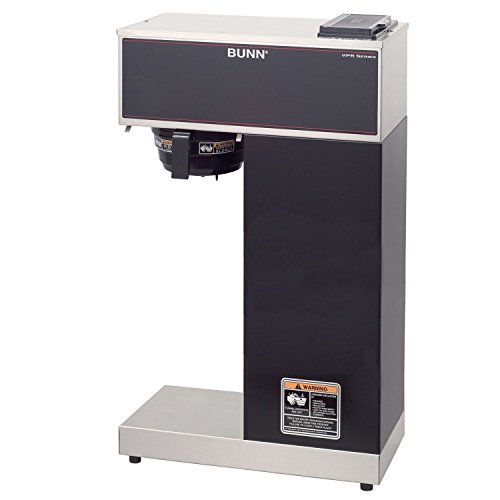
BUNN VPR APS Pour Over Air Pot Brewer — Best Pour-Over Commercial Brewer
Not every restaurant can plumb a brewer — leased spaces, food trucks, historic buildings, catering operations and pop-ups all share the constraint. The VPR APS removes it: staff pour water into the top and the machine brews into the same airpot system as its plumbed sibling, keeping the service quality of airpots with the installation cost of a kettle. For a first commercial brewer, that combination is hard to beat.
Strengths
- No plumbing — installs anywhere with a socket
- Same airpot service quality as plumbed models
- Simple enough for any staff member to run
Trade-offs
- Manual filling costs staff time at peak
- Lower hourly output than plumbed brewers
- Airpots are an additional purchase
| Specification | Detail |
|---|---|
| Format | Pour-over brewer, brews into airpots |
| Use | Commercial, manual water fill |
| Service style | Airpot service |
In operation it is as simple as commercial equipment gets, which is a genuine virtue in kitchens with rotating staff. There is no programme to corrupt, no menu to learn: water in, brew, swap the airpot. BUNN’s sprayhead design — the part of the machine that actually determines extraction evenness — is proper commercial grade, so the coffee in the airpot is brewed evenly rather than channelled through the middle of the basket, the flaw that gives pour-over formats a bad name at the cheap end.
The manual fill is the honest cost: someone must pour, and during a rush that someone is busy. Output per hour trails the plumbed CWTF for the same reason. But for the many restaurants whose coffee volume is measured in airpots per service rather than per hour, the VPR APS delivers professional results with domestic simplicity, and it can later move to catering or backup duty when a plumbed machine takes over the main station.
Best for: restaurants, caterers and trucks without a water line at the station / Not suited for: high-volume operations brewing continuously at peak
Check on Amazon — check the current price on Amazon before you buy, because configurations and bundle options change over time.
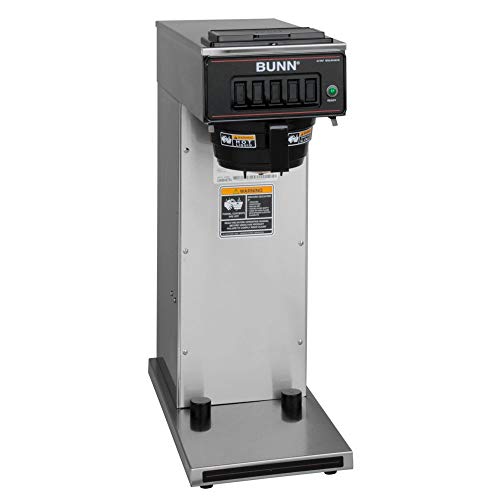
BUNN CW15 APS Commercial Brewer — Best Compact Commercial Brewer
Counter depth is money in a restaurant, and not every dining room can give a full-size brewer its territory. The CW15 APS is BUNN’s answer for the compact station: automatic, plumbed brewing into airpots in a smaller commercial footprint, suited to bistros, small hotels, bakeries and office-adjacent cafés where coffee is a serious line item but the back bar is measured in centimetres.
Strengths
- Automatic plumbed brewing in a compact footprint
- Airpot quality without a full-size station
- Even commercial extraction, staff-free cycles
Trade-offs
- Throughput sized for small-to-mid volume
- Still needs plumbing, filtration and descaling
- Large venues will outgrow it
| Specification | Detail |
|---|---|
| Format | Automatic brewer for airpots |
| Use | Commercial, plumbed |
| Footprint | Compact commercial format |
What it keeps from its bigger siblings matters more than what it sheds: the airpot service model, the even commercial sprayhead extraction, and the automatic cycle that frees staff during service. A small restaurant’s coffee problem is rarely maximum volume — it is one person doing everything at 8 a.m., and an automatic brewer that fills an airpot unattended is worth more to that person than a larger machine’s extra hourly output.
The limits are the expected ones: throughput suits small-to-mid volume, and a breakfast rush at a large venue will outrun it. It also shares the platform’s needs — water line, filtration, descaling discipline. Within its intended scale, though, it is the professional format without the professional footprint, and that is a combination small restaurants are rarely offered.
Best for: small restaurants, bistros and bakeries with tight counters / Not suited for: banquet-scale or high-volume chain operations
Check on Amazon — check the current price on Amazon before you buy, because configurations and bundle options change over time.

Hamilton Beach Commercial 60 Cup Coffee Urn D50065 — Best Urn for Service
Some restaurant coffee is not brewed to order or by the airpot — it is brewed by the event. Banquets, buffets, conferences, weddings and hotel breakfast services all run on urns, and the D50065 is the commercial-grade expression of the format: sixty cups brewed, held and dispensed from a single polished stainless vessel that looks correct on a service table and survives being treated like catering equipment, because it is.
Strengths
- True commercial build for daily catering duty
- 60 cups brewed, held and served from one vessel
- One-hand dispensing keeps buffet lines moving
Trade-offs
- Batch urn coffee is not fresh-brew delicate
- Needs strict descaling in hard-water venues
- Too much machine for à la carte coffee service
| Specification | Detail |
|---|---|
| Capacity | 60 cups |
| Build | Polished stainless steel |
| Line | Hamilton Beach Commercial |
The commercial designation is the point of this pick. Domestic urns borrow the shape; the Commercial line is built for repeated daily cycles, faster brewing and the knocks of service life. The one-hand dispensing style of urn service keeps a buffet line moving, and a single appliance replaces what would otherwise be a rotation of carafes and a staff member permanently assigned to coffee. For venues whose coffee demand arrives in waves of fifty people, nothing else in this guide is even the right shape.
Urn coffee has an honest ceiling: it is batch coffee, held, and it will not match a fresh airpot brew for delicacy — nor does its audience ask it to. The urn also demands descaling discipline, because a scaled urn brews slowly in front of a queue. Judged on the job it exists for — volume, held, served with dignity — the D50065 is the professional default.
Best for: banquets, buffets, hotels and event venues / Not suited for: cafés whose reputation rests on per-cup freshness
Check on Amazon — check the current price on Amazon before you buy, because configurations and bundle options change over time.

West Bend 100-Cup Commercial Coffee Urn NSF — Best for Banquets and Big Events
At the top of the volume scale sits the West Bend 100-cup: an urn sized for the events where coffee is measured in gallons and the queue is measured in dozens. Its NSF approval matters in this tier — commercial food service, health inspections and insurance all take a different view of certified equipment, and a venue serving the public at scale should buy urns that carry it.
Strengths
- NSF approved — correct for inspected commercial service
- 100 cups from a single brew cycle
- Light-for-size aluminium body, decades-proven design
Trade-offs
- Event-scale only — absurd for daily café service
- Storage and cleaning commitment after every use
- Batch quality ceiling, like all urns
| Specification | Detail |
|---|---|
| Capacity | 100 cups |
| Certification | NSF approved for commercial use |
| Build | Highly polished aluminium |
The format’s virtues compound at this size. One appliance, one brew cycle, one hundred cups: the labour maths of event coffee collapses to a single task done before doors open. The polished aluminium body keeps the weight manageable for a vessel of this capacity — a full 100-cup urn is heavy enough without a steel shell — and the design has served the banquet trade for decades, which means parts, gaskets and institutional knowledge are all easy to find.
Nobody should buy this urn for a café, and the review would be dishonest not to say so plainly: coffee brewed a hundred cups at a time is event coffee, judged by event standards. It also takes real storage space and a real cleaning commitment after every use. For the venues it fits — caterers, halls, large hotels, festival operators — it is not an extravagance but the correct tool, and its NSF badge is the difference between equipment and a liability.
Best for: caterers, banquet halls and large event venues / Not suited for: any venue whose coffee is brewed to order or by the pot
Check on Amazon — check the current price on Amazon before you buy, because configurations and bundle options change over time.

Baratza Encore Conical Burr Grinder — Best Grinder for Small Cafés
A restaurant guide titled ‘grinders and coffee makers’ owes you a grinder, and it owes you honesty about scale. True commercial grinders — hopper-fed, kilo-capacity machines — are a specialist purchase usually made through restaurant suppliers, and no honest guide should pretend a countertop grinder replaces one at volume. What the Encore legitimately is: the right grinder for the small café, bakery or restaurant bar whose drip programme runs through a few pounds of beans a day, ground in batches for the brewer rather than dosed per shot.
Strengths
- Even drip grinding for small-café batch brewing
- Repairable with parts — minimal downtime
- Simple enough for consistent staff operation
Trade-offs
- Not a high-volume commercial grinder
- Not suitable as an espresso programme’s grinder
- Batch grinding only — no per-dose commercial workflow
| Specification | Detail |
|---|---|
| Burrs | 40mm conical steel burrs |
| Settings | 40 grind settings |
| Support | Spare parts and repair guides available |
For that duty its virtues align precisely. The conical burrs grind evenly at drip settings, which is the whole quality battle in brewed coffee. The design is repairable with manufacturer parts — a commercial virtue, because a grinder down in a working café is revenue down, and a part in the post beats a replacement on a card. And its simplicity means any staff member can run the morning batch identically, which is what consistency in a small operation actually consists of.
The boundary is volume and role. It is not an espresso grinder for a café programme built on espresso, and it will not keep pace with a high-volume drip bar at peak — those operations need a true commercial grinder, which we flag in the buying guide below rather than fake with a badge. For the small end of the restaurant world, though, the Encore is the grinder we would install, and its presence here is a deliberate, scoped recommendation rather than a category error.
Best for: small cafés, bakeries and restaurant bars with modest drip volume / Not suited for: high-volume coffee bars and espresso-led programmes
Check on Amazon — check the current price on Amazon before you buy, because configurations and bundle options change over time.
Comparison Table
| Pick | Badge | Key spec | Best for |
|---|---|---|---|
| BUNN CWTF15-APS Automatic Airpot Brewer | Best Overall Commercial Brewer | Automatic plumbed brewer, brews into airpots, commercial duty | restaurants and cafés serving coffee continuously through service |
| BUNN VPR APS Pour Over Air Pot Brewer | Best Pour-Over Commercial Brewer | Pour-over brewer for airpots, no plumbing required | restaurants, caterers and trucks without a water line at the station |
| BUNN CW15 APS Commercial Brewer | Best Compact Commercial Brewer | Compact automatic brewer for airpots, commercial duty | small restaurants, bistros and bakeries with tight counters |
| Hamilton Beach Commercial 60 Cup Coffee Urn D50065 | Best Urn for Service | 60-cup capacity, polished stainless steel, commercial urn | banquets, buffets, hotels and event venues |
| West Bend 100-Cup Commercial Coffee Urn NSF | Best for Banquets and Big Events | 100-cup capacity, NSF approved, polished aluminium commercial urn | caterers, banquet halls and large event venues |
| Baratza Encore Conical Burr Grinder | Best Grinder for Small Cafés | 40mm conical steel burrs, 40 settings, manufacturer parts support | small cafés, bakeries and restaurant bars with modest drip volume |
Which format does your restaurant actually need — airpot brewer, urn, or both?
Map your coffee demand by the hour before you look at a single machine. Continuous à la carte service — breakfast through lunch, tables turning — is airpot territory: brew ahead in small batches, hold in sealed insulation, pour instantly. Event-driven demand — the function room, the buffet, the conference — is urn territory: one large batch, served by the guest or a single attendant. Many venues need both, and the common professional pattern is an airpot brewer for the dining room and an urn that comes out for functions, rather than one compromised machine pretending at both jobs.
Volume per batch is the second axis. Airpot systems brew a few litres at a time and reward freshness; urns brew tens of litres and reward labour. If your peak hour sells forty cups, an airpot brewer cycling steadily will serve better coffee with less waste than a 100-cup urn brewed hopefully at dawn and stewing by ten. If your peak is a two-hundred-cover wedding, the reverse is true and it is not close.
Finally, infrastructure: a plumbed brewer needs a water line, filtration and drainage sense; an urn needs a socket and storage. Buy the format your building and your service pattern agree on, in that order.
What should restaurants know about commercial coffee grinders?
This is the section where honesty matters most, because the search promises grinders and the market for true commercial grinders is largely a supplier market, not a retail one. A high-volume café grinder is a kilo-hopper, doser-or-on-demand machine built to grind hundreds of doses a day, every day, with burrs the size of saucers. If your operation grinds for espresso or runs a serious drip bar at volume, buy that machine through a restaurant equipment supplier who can service it — do not let any gift-guide format talk you into a countertop substitute.
Below that scale, the picture reverses. Small cafés, bakeries and restaurants grinding a few pounds a day for batch drip brewing are well served by a quality countertop burr grinder — our Encore pick — used as a batch grinder: grind the brewer’s dose, brew, repeat. The quality is real, the cost is a fraction of commercial grinding, and the repairability suits a small operation’s cash flow. The mistake is the middle path: an expensive prosumer grinder bought for commercial volume, which delivers neither the throughput of the supplier machines nor the value of the Encore.
Whichever scale you are at, grind for drip in batches as close to brewing as service allows, keep burrs on a replacement schedule rather than waiting for the coffee to tell you they are done, and remember that in brewed coffee the grinder’s consistency is worth more than the brewer’s badge — a truth that holds in a Michelin dining room exactly as it does in a home kitchen.
What does water do to commercial coffee equipment?
Water is the ingredient restaurants most often get wrong, because it arrives free and invisible. Commercial brewers heat water all day, and the minerals in it plate out as scale on elements and sprayheads — slowing brew times, dropping temperatures and eventually killing machines mid-service. Every plumbed pick in this guide assumes a filter on the line, changed on schedule, and every urn and brewer assumes a descaling rhythm matched to your local hardness. In hard-water cities that rhythm is monthly, and venues that skip it buy replacement brewers on a cycle they mistake for bad luck.
Water also decides taste before the beans get a vote. Heavily chlorinated municipal water makes expensive beans taste like a swimming pool; a carbon stage in the filtration fixes it for pennies a day. If your restaurant’s coffee disappoints despite good beans and a good machine, test the water before you replace either — it is the cheapest diagnostic in this entire guide and the most commonly skipped.
Budget the filtration as part of the machine’s price, because it is. A plumbed brewer without its filter budget is a purchase half-made, and the second half always comes due during a service.
How do you plan capacity for peak service?
Work backwards from your worst fifteen minutes. Count the coffees your biggest rush actually demands — a full breakfast turn, the conference break, the post-theatre surge — and size the system so that rush is routine rather than heroic. Airpot brewing scales by cycling: know your brewer’s batch size and cycle time, and stage airpots so one is always pouring while one is brewing. Urns scale by choosing the vessel that covers the event with one brew, because a second urn cycle mid-event is a queue with a soundtrack.
- Stage, do not scramble: a written station plan for peak — who brews, who pours, when the next batch starts — beats a bigger machine run chaotically.
- Hold a reserve: one filled airpot or a backup urn element is the difference between a hiccup and a dining-room apology.
- Track waste for a month. Coffee poured away daily is capacity bought wrong — usually a batch size problem, not a machine problem.
Capacity planning sounds like operations management because it is. The machines in this guide are the hardware half; the plan is the other half, and restaurants that write the plan get professional results from mid-tier hardware while restaurants that skip it get amateur results from the best equipment money can buy. Write the plan on one page, tape it at the station, and revise it after the first big service tells you where it was wrong.
How do you keep commercial coffee quality consistent across staff and shifts?
Consistency in a restaurant is a systems problem: the Tuesday-morning coffee should taste like the Saturday-night coffee even though different hands made it. The tools are unglamorous — a measured dose rather than a scoop-and-hope, a grinder setting that is marked and not casually changed, brew cycles timed by the machine rather than by attention, and a one-page station card that says exactly how this house makes coffee. Airpot formats help structurally, because the machine controls the brew and the server only pours; urn formats help at events, where one batch removes variation by definition.
Taste your own coffee weekly, at a random service moment, the way a guest receives it. Owners who only taste the first careful pot of the day are auditing a coffee their customers never drink. The gap between the audited cup and the served cup is where restaurant coffee reputations quietly leak away, and closing it costs nothing but the habit.
When quality does slip, change one variable and re-taste. Restaurants have the same diagnostic discipline as home brewers — beans, grind, dose, water, scale — compressed into a working day. The venues with good coffee are not the ones with the fewest problems; they are the ones whose problems get isolated fastest.
What does certification — NSF and commercial listing — actually buy you?
For a home buyer, certification is a footnote. For a restaurant, it can be the purchase. NSF approval signals that equipment is built and tested for commercial food service — materials, cleanability and construction that health inspectors recognise. A domestic urn pressed into commercial service may brew identical coffee and still be the wrong purchase, because the inspection, the insurer and the landlord may all have views that the coffee cannot answer.
This is why our urn picks come from commercial lines and why the West Bend’s NSF badge is in its headline rather than its small print. It is also why this guide excluded several popular ‘commercial-style’ domestic machines: style is not a certification, and the difference only becomes visible at the worst possible moment — an inspection, a claim, a failure under load.
Check your local requirements before ordering, since they vary, and keep the documentation with the machine. In commercial purchasing, the paperwork is part of the product — file it where the inspector, the insurer and your future self can all find it without a search party.
What does restaurant coffee equipment cost to own over five years?
The purchase price of commercial coffee equipment is the smaller half of its cost, and restaurants that budget only for the invoice learn the rest on a schedule set by their water and their volume. The recurring ledger has four lines. Filtration and descaling consumables, modest but non-negotiable. Energy and water, minor for brewers, noticeable for urns held hot all day. Parts — sprayheads, gaskets, urn elements, grinder burrs — which commercial lines make available and domestic lines often do not, a difference that decides whether a failure is a repair or a replacement. And downtime, the line nobody invoices and everybody pays: a brewer out of service on a Saturday costs more than its filter budget for a year.
This arithmetic is why the guide favours established commercial platforms over cheaper novelties. A BUNN brewer’s parts ecosystem and service familiarity mean a failure is measured in days; an obscure machine’s identical failure can be measured in weeks, during which the restaurant rents, borrows or apologises. When comparing two machines that both meet your format and capacity needs, the one your local service technician already knows is worth a premium you will never regret paying exactly once — on the worst morning of your year.
Keep a simple log from day one: purchase date, filter changes, descales, repairs. Five years of that log turns your next equipment decision from an opinion into arithmetic, and it is the document a buyer of your business will ask for first.
How to Set Up a Restaurant Coffee Station for Service
A station that survives service is arranged before the first ticket arrives:
- Place the brewer where the person brewing can work without crossing the pass or the dish pit’s traffic — coffee stations fail on geography more than on equipment.
- Plumb and filter plumbed models from day one; never run a new commercial brewer on unfiltered water ‘temporarily’, because temporary becomes the machine’s whole scaled-up life.
- Stage airpots or the urn, cups, lids, sugars and stirrers within one pivot of the brewer, so serving a coffee never becomes a walk.
- Write the station card: dose, grind setting, batch size, cycle timing, descale date, and who owns each task per shift.
- Brew the first batch before doors, taste it yourself, and only then call the station ready.
- Log the descale and filter dates on a label on the machine itself — the calendar in the office is not where the person descaling looks.
Revisit the station after the first month with waste numbers in hand: how much coffee was poured away, when the queues formed, which task collided with which. One rearrangement informed by a month of real service is worth more than any amount of pre-opening theory. Photograph the station as arranged, once it works — when a busy weekend scrambles it, as busy weekends do, the photograph is the fastest way to put it back to the arrangement that a month of evidence chose.
Common Buying Mistakes
The defining restaurant mistake is buying domestic equipment for commercial duty — it voids warranties, fails inspections, and dies young under loads it was never built for, usually during the service you could least afford. The second is the mirror image: buying event-scale urn capacity for à la carte service and serving stewed batch coffee to guests who ordered a cup.
- Skipping the water filter on a plumbed brewer to save a small line item, then replacing the brewer early at a large one.
- Letting every shift adjust the grinder, guaranteeing the coffee is a different product each day.
- Brewing the day’s coffee at dawn in one giant batch for a dining room that deserved fresh airpots.
- No named owner for descaling — the task that belongs to everyone happens for no one, until the machine stops mid-service.
And the subtlest: judging the new setup by the owner’s careful first brew rather than by a random cup poured at peak by the newest hire. Your customers drink the second cup. Buy and arrange for that one — train for it, write the station card for it, and taste for it weekly, because the reputation of your coffee is set by the worst cup you serve regularly, not by the best cup you can produce when you are watching.
Final Recommendation
For most restaurants the answer is the BUNN CWTF15-APS: plumbed, automatic, airpot-based — the professional default, chosen because service is unforgiving and this format forgives the most. Take the VPR APS where plumbing cannot go, the CW15 APS where the counter is small, and the urns — Hamilton Beach Commercial for regular service volume, West Bend NSF for true banquet scale — where events rule. The Baratza Encore covers grinding honestly for small operations, with the guide above marking exactly where supplier-grade commercial grinding takes over.
Whatever the format, filter the water, write the station card, and taste the coffee your guests actually get. Those three habits separate restaurants known for coffee from restaurants that merely serve it — and in a trade where the coffee is often the last taste of the meal and the one carried out the door, that separation is worth more than its modest cost in attention.
Scaling down or comparing formats? Home-scale picks live in Best Coffee Makers, combined grind-and-brew machines in Best Coffee Grinder And Coffee Makers For Office, grinder pairing in Best Coffee Grinder For Drip Coffee Makers, and station finishing touches in Best Coffee Makers Accessories.
To recap the shortlist with links in one place: BUNN CWTF15-APS Automatic Airpot Brewer, BUNN VPR APS Pour Over Air Pot Brewer, BUNN CW15 APS Commercial Brewer, Hamilton Beach Commercial 60 Cup Coffee Urn D50065, West Bend 100-Cup Commercial Coffee Urn NSF, Baratza Encore Conical Burr Grinder. Check price on Amazon for the one that matches your needs, and re-read its review above if you are torn between two badges.
One last practical note: availability and configurations change on Amazon without notice, so confirm the exact variant you want on the product page before ordering. The reasoning behind every badge above, though, does not change — each pick earned its place on the criteria in this guide, and those criteria are the ones your own shortlist should be judged by too.
Frequently Asked Questions
What is the best coffee maker format for a restaurant?
For continuous service, a plumbed automatic brewer feeding airpots — it brews unattended, holds coffee at quality in sealed insulation, and scales by cycling batches. Pour-over airpot brewers suit unplumbed spaces, and urns suit events. Most venues eventually run an airpot brewer for the dining room and an urn for functions.
Do restaurants need a commercial grinder?
At volume, yes — a supplier-grade commercial grinder matched to your programme, bought with service support. Small operations grinding a few pounds a day for batch drip can use a quality countertop burr grinder like the Baratza Encore in a batch role. The mistake is the middle: prosumer grinders worked at commercial volume.
How much coffee capacity does a restaurant need?
Size to your worst fifteen minutes, not your average hour. Count peak demand, know your brewer’s batch size and cycle time, and stage airpots so one pours while another brews. For events, choose an urn that covers the function in a single brew.
Why does restaurant coffee need a water filter?
Scale and taste. Unfiltered water plates minerals onto heating elements and sprayheads, slowing brews and killing machines early, while chlorine flavours every cup. A filter on a plumbed line, changed on schedule, is part of the machine’s real price — budget it from day one.
How often should commercial coffee equipment be descaled?
On a schedule set by your water hardness — monthly in hard-water areas, quarterly in soft ones — and logged on the machine. Waiting for symptoms means the scale is already costing you brew temperature, speed and eventually a service-day failure.
Is urn coffee good enough for a restaurant?
For banquets, buffets and events, yes — that is the format’s home, and guests judge it by event standards: hot, fresh enough, and available without a queue. For à la carte dining where coffee is part of the kitchen’s reputation, airpot-brewed coffee is the better standard.
Can a restaurant use a home coffee maker as a backup?
Briefly, in an emergency, any hot coffee beats none — but not as a plan. Domestic machines are not built or certified for commercial duty cycles, warranties typically exclude commercial use, and an inspector will not accept one as your service equipment. The correct backup is a second commercial path: a pour-over brewer behind the plumbed one, or an urn that can cover a service while the main brewer is repaired.
What beans should a restaurant buy for brewed coffee?
A fresh, medium-roast blend from a roaster who can supply your volume consistently, bought in quantities your turnover finishes while the beans are still in their prime. Consistency of supply matters more than exotic sourcing for brewed coffee: your regulars are loyal to a flavour, and the roaster who never misses a delivery and never quietly changes the blend is worth more than a famous name that does both.


