Disclosure: airfryerkitchensupply.com is reader-supported. When you buy through links on our site, we may earn an affiliate commission at no extra cost to you.
The best cheapest toasters are a genuinely useful category, because a toaster is one of the few appliances where the cheap end of the market can still do the core job well. Toasting bread is mature technology: a heating element, a timer, a slot. What the cheapest tier asks you to give up is not toast — it is everything around toast: thick artisan capacity, perfect evenness, durable bodies, quiet mechanisms and longevity measured in decades. This guide is about finding the cheapest machines that keep the core job intact, and being blunt about which corners the price cut, so you can decide whether those corners matter in your kitchen.
The market reality deserves stating plainly. Below a certain tier, toasters become effectively disposable: plastic bodies, minimal insulation, shade dials whose calibration varies from unit to unit, and a service life that owners should measure in a few years rather than a decade. That can still be the right purchase — for a dorm room, a first flat, a holiday home, an office kitchen or a household that toasts twice a month. It is the wrong purchase when a household toasts daily and will buy three cheap machines in the time one mid-range machine would have served, spending more in total for worse toast throughout.
The six picks below are the cheapest toasters we can recommend with a straight face, all verified as real, orderable models: Amazon’s own Basics machine, Proctor Silex’s two honest workhorses, a compact OVENTE for tight counters, a stainless bella, and a BLACK+DECKER with a proper bagel mode. Every one is budget tier — check price on Amazon for the current figure — and every review states clearly what the saving costs you.
Where to buy
Cheap toasters are commodity items sold everywhere, but buy through Amazon where possible: the exact model numbers below matter, because each of these brands sells several near-identical machines at slightly different tiers, and the listing lets you confirm the model, the slot configuration and the functions before paying. Check price on Amazon at the point of order — budget-tier prices move often, and yesterday’s cheapest pick can be today’s merely cheap one.
- Amazon Basics 2-Slice Toaster (Best Overall Cheap Toaster) — Check the current price on Amazon
- Proctor Silex 2-Slice Toaster 22660 (Oat White) (Best Bare-Bones Value) — Check the current price on Amazon
- Proctor Silex 4-Slice Toaster 24215G (White) (Best Cheap 4-Slice) — Check the current price on Amazon
- OVENTE TP2210B 2-Slice Toaster (700W) (Best Compact Cheap Toaster) — Check the current price on Amazon
- bella 2-Slice Toaster (Stainless Steel) (Best Cheap Stainless Look) — Check the current price on Amazon
- BLACK+DECKER 2-Slice Toaster with Bagel Mode (Best Cheap Toaster for Bagels) — Check the current price on Amazon
In this guide
Quick Picks
Six budget machines, ranked by how much of the real toaster job survives the price cut: the Amazon Basics for all-round value, two Proctor Silex workhorses, a compact OVENTE, a stainless bella and a bagel-capable BLACK+DECKER.
- Best Overall Cheap Toaster: Amazon Basics 2-Slice Toaster — The budget benchmark: extra-wide slots, six browning settings, bagel/defrost/cancel buttons, a removable crumb tray and cord wrap at 900W. More real-toaster features survive here than anywhere else at the tier. — Check price on Amazon
- Best Bare-Bones Value: Proctor Silex 2-Slice Toaster 22660 (Oat White) — Proctor Silex’s honest workhorse: seven shades, wide slots, bagel and defrost buttons, Toast Boost and auto-shutoff — the essentials done plainly, in a soft Oat White finish. — Check price on Amazon
- Best Cheap 4-Slice: Proctor Silex 4-Slice Toaster 24215G (White) — The family’s budget answer: four extra-wide slots, seven shades, Toast Boost and auto-shutoff. Four-slice capacity at a price most two-slice brand names charge. — Check price on Amazon
- Best Compact Cheap Toaster: OVENTE TP2210B 2-Slice Toaster (700W) — The small-counter pick: a compact 700W two-slice with six shade settings and a removable crumb tray, sized for dorms, desks, caravans and the tiniest kitchens. — Check price on Amazon
- Best Cheap Stainless Look: bella 2-Slice Toaster (Stainless Steel) — The style-conscious budget pick: a stainless-steel finish and extra-wide slots from the brand that built its name on making cheap appliances look designed. — Check price on Amazon
- Best Cheap Toaster for Bagels: BLACK+DECKER 2-Slice Toaster with Bagel Mode — A household-name budget machine with a real bagel mode, seven shade settings, extra-wide slots and an extra-lift lever for small slices. The bagel household’s cheap answer. — Check price on Amazon
How These Picks Were Chosen
Picks were chosen by a strict cheapest-tier discipline: each model had to be a real, verifiable product — confirmed through the Amazon catalogue data available to this site, with the exact model number matched to its listing — and it had to retain the core functions that make a toaster a toaster rather than a warming box: slots wide enough for real bread, a shade control with usable range, a crumb tray, and at minimum a cancel function. Machines below that functional floor exist and cost slightly less; we will not recommend them, because a toaster that cannot take a bagel or be cleaned is not cheap, it is unfinished.
We also weighed the total cost of ownership honestly. A budget toaster replaced three times costs more than one mid-range machine, so each review states the expected ownership pattern the pick suits — light use, secondary locations, households in transition — rather than pretending a bottom-tier machine is a lifetime purchase. Where a pick’s saving comes from a specific omission (power, size, dual controls), the review names the omission and the buyer it does not suit.
The 6 Best Cheapest Toasters

Amazon Basics 2-Slice Toaster — Best Overall Cheap Toaster
The Amazon Basics toaster is what the cheapest sensible toaster looks like. The feature list reads like a machine a tier up: extra-wide slots that genuinely accept bagels, six browning settings, separate defrost, bagel and cancel buttons, a removable crumb tray and a cord wrap to keep a small counter tidy. At 900 watts it has enough power to brown decisively rather than slowly drying slices out — the most common cheap-toaster failure — and the black and silver finish looks like an appliance rather than a toy.
Strengths
- Full feature set survives the price cut: wide slots, bagel and defrost functions, crumb tray
- 900W gives decisive browning rather than slow drying
- Cord wrap and tidy footprint suit small counters
Trade-offs
- Evenness on thick artisan bread is a step behind premium machines
- Second-round darkening is yours to manage on the dial
- Budget build — buy it expecting years, not decades
| Power | 900W (per Amazon listing) |
| Slots | Extra wide, for bagels (per Amazon listing) |
| Controls | 6 browning settings, defrost/cancel/bagel buttons (per Amazon listing) |
| Care | Removable crumb tray, cord wrap (per Amazon listing) |
Browning is good rather than great, and the distinction is worth understanding. Everyday sliced bread comes out evenly enough that most owners never think about it; the machine’s limits appear with thick artisan slices, where coverage is less uniform than the Breville-class machines, and across consecutive rounds, where there is no compensation technology and the second round runs a touch darker. Both are normal at this tier, and both are manageable with the habits in this guide’s how-to section.
Longevity expectations should be set honestly: this is a budget appliance with a budget build, bought for a few years of service, not a decade. What makes it Best Overall at the tier is that nothing about the daily experience feels cheap — the controls work, the slots fit real bread, and the toast is properly toast. For dorms, first homes, offices and light-use kitchens, it is the default answer.
Best for: dorms, first flats, offices and light-use kitchens wanting a complete cheap toaster / Not suited for: daily heavy use or artisan-bread households chasing perfect evenness
Check on Amazon — check price on Amazon for the current listing, configuration options and delivery terms before you order.

Proctor Silex 2-Slice Toaster 22660 (Oat White) — Best Bare-Bones Value
Proctor Silex has built its name on appliances that do the job without theatre, and the 22660 is the purest expression of that in this roundup. Seven shade settings give finer control than most budget rivals, the wide slots take bagels and thicker slices, Toast Boost lifts small items like English muffins clear of the slots — a feature cheap toasters often omit, leaving you fishing with a fork, which you should never do — and auto-shutoff adds a genuine safety margin that the very cheapest machines skip.
Strengths
- Seven shade settings — finer control than most budget rivals
- Toast Boost and auto-shutoff are features cheap machines usually cut
- A long-established brand’s workhorse, with real bagel and defrost functions
Trade-offs
- Lightweight build with a functional, not premium, feel
- Standard budget evenness and consecutive-round behaviour
- Two-slice only, with no high-end slot geometry
| Controls | 7 shade settings, bagel/defrost/cancel (per Amazon listing) |
| Features | Toast Boost, auto shutoff (per Amazon listing) |
| Slots | Wide slots (per Amazon listing) |
| Care | Slide-out crumb tray (per Amazon listing) |
The browning is workmanlike: even enough on standard bread, shade calibration that owners learn within a week, and the usual budget behaviour across consecutive rounds. The bagel and defrost buttons are real functions rather than decoration. The Oat White finish is also a quiet virtue — pale, soft and easier to keep looking clean in a bright kitchen than fingerprint-prone chrome-effect plastic.
What the price removes is substance you can feel: the body is light, the lever action is functional rather than satisfying, and nothing about the machine suggests a ten-year plan. That is the correct trade for its buyers. If your brief is ‘toast, reliably, for as little as possible, from a brand that has done this for decades’, this is the most honest machine in the list.
Best for: minimum-spend buyers who still want the essential features done properly / Not suited for: anyone who wants an appliance that feels substantial
Check on Amazon — check price on Amazon for the current listing, configuration options and delivery terms before you order.

Proctor Silex 4-Slice Toaster 24215G (White) — Best Cheap 4-Slice
Four-slice toasters usually escape the cheapest tier entirely, which is what makes the 24215G the family pick here. Four extra-wide slots handle the morning batch in one cycle, the seven-shade dial covers the household’s range, and the features that matter survive: bagel capability, Toast Boost for small items, auto-shutoff, and a slide-out crumb tray. For a family currently running a two-slice machine twice every morning, this is the cheapest meaningful upgrade in the entire category.
Strengths
- Four extra-wide slots end the family breakfast queue at a budget tier
- Seven shades, Toast Boost and auto-shutoff all survive the price
- Bagel-capable slots handle thick slices and halves
Trade-offs
- One control set for all four slots — no split shades
- Corner evenness on thick artisan bread is modest
- Lightweight budget build and longevity
| Capacity | 4 slices, extra wide slots (per Amazon listing) |
| Controls | 7 shade settings, cancel (per Amazon listing) |
| Features | Toast Boost, auto shutoff (per Amazon listing) |
| Care | Slide-out crumb tray (per Amazon listing) |
The honest limits are consistency and control granularity. One control set serves all four slots, so two different shades at once is not on the menu — the dual-control Cuisinart in our browning roundup is the fix, at a very different tier. Browning across all four slots is good on standard bread and less uniform at the corners with thick artisan slices, and consecutive batches darken slightly, as every unmanaged chamber does.
As with its two-slice sibling, the build is light and the plan should be years rather than decades. But judged on toast-per-dollar for a family, nothing else in this roundup is close: it converts the most common budget-kitchen frustration — the breakfast queue — into a solved problem for the price of a takeaway meal or two. Check price on Amazon, because this model’s tier position is exactly why it sells.
Best for: families who need four slices at once on a strict budget / Not suited for: households with split shade preferences — that needs dual controls
Check on Amazon — check price on Amazon for the current listing, configuration options and delivery terms before you order.

OVENTE TP2210B 2-Slice Toaster (700W) — Best Compact Cheap Toaster
Some cheap-toaster buyers are not short of money so much as short of counter, and the OVENTE TP2210B is built for them. Its compact design fits the spaces a standard toaster cannot — a dorm shelf, a studio kitchenette, a caravan, a break-room corner — while keeping the fundamentals: six shade settings, a removable crumb tray and enough slot for bread and thin bagels, as the listing itself specifies.
Strengths
- genuinely compact footprint for dorms, caravans and tiny kitchens
- Six shade settings and a removable crumb tray at a bottom-tier price
- Gentle 700W output suits standard sliced bread well
Trade-offs
- 700W is slow with thick or frozen items
- Slots sized for bread and thin bagels, not artisan loaves
- A secondary or small-space toaster, not a family main machine
| Power | 700W (per Amazon listing) |
| Design | Compact design (per Amazon listing) |
| Controls | 6 shade settings (per Amazon listing) |
| Care | Removable crumb tray (per Amazon listing) |
The 700-watt output defines its character honestly. It toasts more gently and a little more slowly than the 900W Amazon Basics, which suits standard sliced bread perfectly well and asks patience — and a lighter setting discipline — with anything thick or frozen. Within its intended job, thin and standard slices, the results are entirely respectable, and the gentle power is arguably a virtue for items that scorch easily.
Do not buy it as a household’s main toaster for a family that loves thick artisan loaves; that is not a criticism, it is the product’s stated shape. Buy it where space is the binding constraint and toast is a simple pleasure — a single person’s first kitchen, a guest room, a workspace — and it returns exactly what it promises at a bottom-tier price.
Best for: dorms, studios, caravans and desk-side kitchens where space rules / Not suited for: thick-bread households or anyone in a morning hurry
Check on Amazon — check price on Amazon for the current listing, configuration options and delivery terms before you order.

bella 2-Slice Toaster (Stainless Steel) — Best Cheap Stainless Look
bella’s whole proposition is that budget appliances do not have to look like budget appliances, and this stainless two-slice is the proof of concept in the cheapest tier. The stainless finish lifts it visually above the black-plastic crowd, the extra-wide slots handle bagels and thicker bread, and the machine covers the daily basics without fuss. For a buyer furnishing a first kitchen that they actually want to look at, that combination is the entire argument — and it is a fair one.
Strengths
- Stainless finish looks a tier above its price
- Extra-wide slots for bagels and thicker slices
- Simple, adequate daily performance on standard bread
Trade-offs
- Stainless shows fingerprints — needs a wipe-down habit
- Feature depth slightly behind the Amazon Basics
- Standard budget evenness and build expectations apply
| Construction | Stainless steel finish (per Amazon listing) |
| Slots | Extra wide slots (per Amazon listing) |
| Capacity | 2 slices (per Amazon listing) |
Functionally it sits in the honest middle of this roundup: browning that serves standard bread well, shade control that owners calibrate by experience, and none of the consistency technology or inspection features of the premium machines. It asks the standard budget disciplines — manage consecutive rounds on the dial, keep the tray emptied — and rewards them with perfectly decent toast.
The stainless finish deserves one practical note: it shows fingerprints and water spots more than matte finishes, so it rewards a wipe-down habit and punishes neglect visually long before any functional issue appears. If you are buying it for the look, buy the habit with it. On value, it trades a little of the Amazon Basics’ feature depth for design — a legitimate exchange that buyers should make consciously.
Best for: style-conscious first kitchens on a strict budget / Not suited for: feature-maximisers — the Amazon Basics packs more in
Check on Amazon — check price on Amazon for the current listing, configuration options and delivery terms before you order.
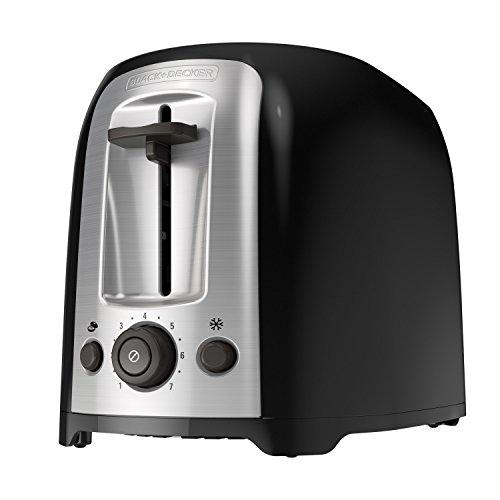
BLACK+DECKER 2-Slice Toaster with Bagel Mode — Best Cheap Toaster for Bagels
BLACK+DECKER sells more budget toasters than almost anyone, and this model shows why: the specification targets the features households actually use. A dedicated bagel mode that browns the cut face properly, seven shade settings, extra-wide slots for the bagels themselves, an extra-lift lever so muffin halves and small slices come out without a dig, and a removable crumb tray. It is a checklist written by people who have listened to years of returns desks.
Strengths
- Dedicated bagel mode browns cut faces properly at a budget tier
- Seven shades, extra-wide slots and extra-lift lever cover daily life
- Household-name availability and easy like-for-like replacement
Trade-offs
- Standard budget evenness on thick artisan bread
- Consecutive-round drift is manual to manage
- Lightweight build, tier-typical lifespan
| Controls | 7 shade settings, bagel mode (per Amazon listing) |
| Slots | Extra-wide slots (per Amazon listing) |
| Features | Extra lift lever (per Amazon listing) |
| Care | Removable crumb tray (per Amazon listing) |
Browning performance is the brand’s familiar budget character: good on standard bread and bagels — the mode genuinely helps the cut face — with the usual tier caveats about thick artisan evenness and consecutive-round drift. The controls are clear, the machine is light and easy to move and clean, and the brand’s ubiquity means the model is easy to find, compare and replace like-for-like years later, which at this tier is a real form of value.
Choose it over the Amazon Basics if bagels are a weekly staple in your house and the dedicated mode matters more than the Basics’ slightly broader polish; choose the Basics if your toasting is mostly sliced bread. Either way, set the longevity expectation at the tier: this is dependable, inexpensive equipment, not an heirloom, and at its price that is a fair and useful thing to be.
Best for: bagel households shopping the bottom tier / Not suited for: artisan-loaf households or decade-long ownership plans
Check on Amazon — check price on Amazon for the current listing, configuration options and delivery terms before you order.
Comparison Table
At this tier the differences are about what survived the price cut. The table compares the survivors: slots, power, signature feature and the job each machine is honestly for.
| Pick | Badge | Key spec | Best for |
|---|---|---|---|
| Amazon Basics 2-Slice Toaster | Best Overall Cheap Toaster | 2-slice, 900W, extra-wide slots | dorms, first flats, offices and light-use kitchens wanting a complete cheap toaster |
| Proctor Silex 2-Slice Toaster 22660 (Oat White) | Best Bare-Bones Value | 2-slice, 7 shades, Toast Boost | minimum-spend buyers who still want the essential features done properly |
| Proctor Silex 4-Slice Toaster 24215G (White) | Best Cheap 4-Slice | 4-slice budget, extra-wide slots | families who need four slices at once on a strict budget |
| OVENTE TP2210B 2-Slice Toaster (700W) | Best Compact Cheap Toaster | Compact 2-slice, 700W | dorms, studios, caravans and desk-side kitchens where space rules |
| bella 2-Slice Toaster (Stainless Steel) | Best Cheap Stainless Look | 2-slice stainless, extra-wide slots | style-conscious first kitchens on a strict budget |
| BLACK+DECKER 2-Slice Toaster with Bagel Mode | Best Cheap Toaster for Bagels | 2-slice with bagel mode, 7 shades | bagel households shopping the bottom tier |
How to Choose the Cheapest Toaster Without Buying a Bad One
Set a functional floor and refuse to go below it, however tempting the price. The floor is: slots wide enough for your actual bread (extra-wide if bagels or thick slices feature in your life), at least five or six usable shade settings, a removable crumb tray, a cancel button, and enough power — around 900 watts in a two-slice — to brown rather than dry. Every pick in this guide meets that floor; the machines below it are where cheap turns into false economy.
Then match the machine to the ownership pattern. A dorm, a first flat, a holiday home or a light-use kitchen will get full value from a budget machine’s realistic lifespan. A household toasting daily for a family should do the arithmetic the other way: the four-slice Proctor Silex stretches the budget tier to family capacity, but a household that will keep a toaster for a decade is financially better served one tier up. Cheap is a strategy, not a virtue — it is right when the use is light or temporary, wrong when it guarantees repeat purchases.
- Check the wattage before the features: underpowered toasters dry bread instead of toasting it.
- Wide slots are the one upgrade that matters at this tier — they decide what bread the machine can serve at all.
- A crumb tray is non-negotiable: machines without one foul their elements and brown worse every month.
- Brand workhorses (Proctor Silex, BLACK+DECKER) beat unknown novelty brands at the same price — support and consistency exist.
What Do You Actually Give Up at the Cheapest Tier?
Evenness, first: budget elements and simple slots produce good toast on standard bread and visibly less uniform results on thick, tall or artisan slices. Consistency, second: no budget machine compensates for a hot chamber, so consecutive rounds drift darker and the dial becomes your compensation system. Build, third: bodies are lighter, levers simpler, insulation thinner — outside surfaces run hotter and the machine feels like its price. Longevity, fourth and most important: plan on years, not decades, and treat anything beyond that as a bonus.
What you do not give up, if you buy from this list, is the core experience: hot, browned, crisp toast from real bread, with bagels and frozen slices handled by real functions. That is why the category is worth a guide at all — the floor of acceptable toasting sits surprisingly low in price, provided you refuse the truly bottom machines that fall through it.
When Is a Cheap Toaster the Wrong Purchase?
When it will be used hard, daily, for years. The arithmetic is unforgiving: three budget machines across a decade cost more than one solid mid-range toaster, and deliver worse toast for most of that decade. When your bread is expensive artisan loaf, a cheap machine’s unevenness wastes costly bread slice by slice. And when the toaster is a gift for someone setting up a long-term home, a tier-up machine says it better and serves longer.
The cheap tier’s home ground is transition and lightness: students, first homes, temporary contracts, second locations, spare machines, and households that toast occasionally. If that is you, buy from this list with confidence and spend the savings on better bread — the highest-value upgrade in all of toasting.
Cheap Toaster Safety: What to Check Before and After Buying
Budget pricing makes safety diligence more important, not less, and the checks are simple. Before buying, confirm the machine carries recognised safety certification for your market and includes the basics: a cancel function that stops a cycle instantly, stable feet, and — on the better budget models like the Proctor Silex pair here — auto-shutoff. After buying, the habits are the safety system: never leave any toaster running unattended, keep it clear of curtains and paper, empty the crumb tray weekly so crumbs cannot smoulder against the elements, and unplug before retrieving anything stuck — with wooden tools only, never metal.
One budget-specific warning: very light machines can be dragged by their own cord or knocked when a lever is pressed firmly. Seat a light toaster where its cord runs straight to the outlet without tension, and press the lever with the machine held if it skates on your counter material. These are thirty-second arrangements that remove the realistic risks of the tier entirely.
How to Make a Cheap Toaster Last as Long as Possible
The lifespan gap between a budget toaster that dies in eighteen months and one that serves five years is mostly maintenance. Crumbs are the mechanism of decline: they insulate elements, create hot spots, attract moisture and eventually jam carriages. A weekly tray emptying and a monthly slot brushing-out — machine unplugged and cool, shaken gently over a bin — is the entire core routine, and it preserves browning quality at the same time.
Handle the mechanism like the light engineering it is: press the lever once, fully, rather than jabbing it; never force a carriage up mid-cycle; let the machine cool between heavy batch sessions rather than running it continuously through a brunch for twelve. And store the cord loosely wrapped rather than kinked — on a budget machine the cord and its entry point are statistically where failures begin. None of this turns a budget toaster into an heirloom, but it reliably doubles the useful life you paid so little for.
Should You Buy a Cheap Toaster Oven Instead?
It is the obvious neighbouring question, and the honest answer is: only if you will use the oven. A cheap toaster oven toasts more slowly and less evenly than a cheap slot toaster — its elements are farther from the bread and its cavity loses heat at the door — so as a pure toasting purchase it is the worse machine at the same money. Its case rests on the second job: reheating pizza, melting cheese, baking small items. If those jobs are weekly realities in your kitchen, the toaster oven’s mediocre toast may be an acceptable tax; if they are fantasies, the slot toaster wins outright.
There is also a counter-space verdict: a toaster oven claims two to three times the footprint of the compact picks in this guide. Small kitchens voting with their counters should buy the slot toaster and use the main oven for the occasional melt. This guide’s picks exist because, for toast itself, the dedicated cheap machine remains unbeaten at its price.
What Is the Total Cost of ‘Cheap’ Over Ten Years?
Run the arithmetic honestly, because this category lives or dies by it. A budget toaster replaced every three years is three purchases in a decade, plus three rounds of shopping, delivery and disposal — and across that decade its owner ate budget-tier toast: adequate on sliced bread, mediocre on everything else. A single mid-range machine bought once costs less in total than the three budget purchases in most realistic comparisons, and serves better toast for nine of the ten years. That is the case against cheap, and it is a strong one — for households whose toaster use is daily and whose home is stable.
The case for cheap is the mirror image: where the decade is not the horizon. A student graduates, a contract ends, a holiday home hosts six weekends a year, a spare machine covers a renovation. In those lives, the mid-range machine’s longevity is value that will never be collected, and the budget machine’s lower price is money kept. The cheapest toaster is the right purchase exactly when its realistic lifespan matches your realistic need — and this guide’s picks exist to make sure that, within that honest brief, the toast itself never has to be the compromise.
Are Cheap Toasters Repairable or Disposable?
Disposable, in practice — and buyers should purchase with that understanding rather than discover it. Budget toasters are assembled as sealed units: elements are not sold as parts, carriages are riveted rather than screwed, and no service network exists behind them. A failure outside warranty is a replacement, full stop. This is not a scandal; it is the engineering that the price buys, and at the tier it is a legitimate design choice.
What you can do is refuse the failures that are not the machine’s fault. Most budget toaster deaths trace to crumb fouling jamming the carriage, cords kinked at the entry point, and levers forced against a jam. The cleaning and handling habits in this guide’s how-to section are, for a budget machine, the entire repair programme — and they routinely double the service life that the ‘disposable’ label predicts.
Reading a Cheap Toaster Listing Like a Skeptic
Budget listings are written to be skimmed, and the skeptic reads them in a different order. First, the model number — the only part of the page that cannot be spun — checked against the manufacturer’s own range so you know which machine this actually is. Second, the slot dimensions and wattage, where stated; their absence, on a listing that finds room for a dozen adjectives, is itself information. Third, the functions list read negatively: no crumb tray mentioned means no crumb tray; no cancel button mentioned means cycles end by waiting or by the lever, and you should price that inconvenience honestly.
Fourth, the photographs, distrusted in a specific way: lifestyle images show scale dishonestly, so find the one specification photograph or dimension line and believe only that. Fifth, the warranty length, which at this tier is the manufacturer’s own lifespan estimate written in legal language — a brand that warrants a toaster for a year expects a life measured in a small multiple of that, and a brand offering longer is telling you something worth paying a little more for. Read this way, a budget listing stops being a promise and becomes a specification — and the picks in this guide are the ones whose specifications survived the reading.
Where Cheap Toasters Make Unexpected Sense
Some settings flatter the budget tier so completely that buying above it is the wasteful choice. The workshop and garage, where a toaster serves tea-break duty amid dust and knocks. The holiday let, where guests’ habits are unknown and replacement should be painless. The growing family’s stopgap year, when every appliance budget is spoken for by larger emergencies. The office kitchen, where equipment walks, breaks and is used by thirty people with thirty techniques. In each, the calculus of this guide inverts: longevity stops being the prize, painless replacement becomes it, and a machine from this list — complete, honest, cheap — is not a compromise but the correctly specified tool. Knowing which life your toaster will live is worth more than any single specification in this roundup.
A Final Word on Breakfast Economics
There is a quiet satisfaction in a cheap appliance that does its job without apology, and it is worth naming as this guide closes: the money a budget toaster saves is real money, available for better bread, better coffee, or the hundred other claims a kitchen makes. Bought with the floor respected and the expectations honest, the cheapest toaster is not the least admirable purchase in this roundup series — it is, for the right household, the most rational one on the page.
How to Get Good Toast From a Cheap Toaster
Budget machines reward technique more than premium ones, because you are the consistency system they do not have. These habits close most of the gap.
- Learn your dial with your everyday bread in the first week: run three slices at the middle setting, note the winner, and write the number down — budget dials vary by unit, so your number is yours alone.
- Manage the rounds manually: drop the setting a fraction for the second batch and again for the third, because the chamber is storing heat the machine does not account for.
- Centre every slice in its slot. Cheap slots rarely self-centre, and a leaning slice browns on one face only — ten seconds of placement fixes the most common budget complaint.
- Use the defrost and bagel functions if your model has them; on frozen bread especially, they are the difference between toasted and scorched-outside, cold-inside.
- Empty the crumb tray weekly. Budget elements foul fast, and a crumb layer makes browning more uneven month by month — most ‘my cheap toaster got worse’ stories are this.
- Never lever a stuck slice out with metal. Unplug, let it cool, and use the high-lift or Toast Boost; budget mechanisms bend, and a bent carriage ends the machine.
Follow those six habits and a budget toaster delivers ninety percent of the daily experience of a machine at three times the price — which is precisely the value this category promises.
Common Buying Mistakes
Buying below the functional floor. The very cheapest machines — narrow slots, no tray, feeble power — are not bargains. The few dollars saved buy a toaster that cannot do the job.
Ignoring wattage. A low-power toaster dries bread slowly instead of toasting it. Around 900W in a two-slice is the budget sweet spot; treat much lower as a warning.
Expecting a decade from a budget build. Plan the purchase as a few years of service. If your household needs a decade, the mid-range tier is actually the cheaper address.
Running a two-slice machine four times for a family. Your time is worth money too. The four-slice budget pick exists precisely for households making this mistake every morning.
Judging by the first slice. Budget machines drift across rounds more than premium ones. Test three consecutive slices before deciding a machine is inconsistent — or consistent.
Skipping the crumb tray clean. At this tier, maintenance is performance. A fouled budget toaster browns unevenly and smells of old crumbs; a clean one stays honest.
Final Recommendation
The Amazon Basics 2-Slice is the default cheapest toaster: the most complete feature set at the tier, adequate power, wide slots — the machine to buy when you simply need a good cheap toaster. The Proctor Silex 22660 is the bare-bones purist’s version, and its four-slice sibling is the family answer. The OVENTE serves the smallest counters, the bella serves the style-conscious, and the BLACK+DECKER serves bagel households. Check price on Amazon for each before ordering, because at this tier the ranking can be rearranged by a single promotion.
Buy cheap proudly if your use is light or temporary — and buy one tier up without guilt if it is not. The only true mistake in this category is buying below the floor.
Related guides on this site: Best Inexpensive Toasters Best Economy Toasters Best Affordable Toasters Best Inexpensive 4 Slice Toasters Best Compact 2 Slice Toasters
Frequently Asked Questions
What is the cheapest toaster worth buying?
The cheapest worth buying is the cheapest that meets a functional floor: wide-enough slots for your bread, usable shade range, a crumb tray, a cancel function and adequate power. In this roundup that is the Amazon Basics 2-Slice and the Proctor Silex 22660 — machines below their level cut functions that make a toaster usable, and are false economy at any price.
How long will a cheap toaster last?
Plan on a few years of regular service from a budget-tier machine from a known brand, longer with light use and weekly crumb-tray cleaning. That lifespan is priced into the category; households wanting a decade of daily service save money in the long run by buying one tier up.
Is a cheap toaster safe?
The picks here include the safety features that matter — auto-shutoff on the Proctor Silex models, cancel functions across the list — and come from established brands. The standard rules apply at every tier: never leave a toaster unattended, never retrieve stuck toast with metal, and keep the crumb tray emptied so crumbs cannot smoulder.
Can a cheap toaster handle bagels and thick bread?
Yes, if you choose one with extra-wide slots — the Amazon Basics, both Proctor Silex models, the bella and the BLACK+DECKER in this roundup all qualify, and the BLACK+DECKER adds a dedicated bagel mode. The compact OVENTE is the exception: its slots suit bread and thin bagels, as its listing states.
Why does my cheap toaster brown unevenly?
Usually placement and fouling, not failure: centre the slice so both faces sit evenly between the elements, and empty the crumb tray — a crumb layer shadows the elements and worsens monthly. If thick artisan slices stripe in a clean, centred machine, that is the tier’s genuine limit, and the fix is a wider-slot, better-element machine.
Should I buy a cheap 4-slice or a better 2-slice?
Match it to your mornings. If you regularly toast three or four slices at once, the cheap four-slice Proctor Silex will improve your life more than a finer two-slice run twice. If you toast two slices and care about evenness, the better two-slice wins. Capacity you use beats quality you queue for.


