Disclosure: airfryerkitchensupply.com is reader-supported. When you buy through links on our site, we may earn an affiliate commission at no extra cost to you.
Where to buy
Every grill in this guide to the best charcoal smoker grills was verified against Amazon listings before it earned a place here, so the links below lead to the exact models reviewed. Prices move with seasons and promotions, so we never print a fixed price in the article — check price on Amazon on the product page for the current figure. The shortlist:
- Best Overall Offset Smoker-Grill: Oklahoma Joe’s Highland Offset Charcoal Smoker Grill — check price on Amazon
- Best for Even Temperatures Across the Chamber: Oklahoma Joe’s Highland Reverse Flow Offset Charcoal Smoker — check price on Amazon
- Best Bullet Smoker for Beginners: Weber Smokey Mountain Cooker Smoker, 14-Inch — check price on Amazon
- Best Vertical Smoker for Small Patios: Dyna-Glo Wide Body Vertical Offset Charcoal Smoker (DGO1890BDC-D) — check price on Amazon
- Best Kamado Smoker-Grill: Kamado Joe Classic Joe Series II Ceramic Charcoal Grill, 18-Inch — check price on Amazon
- Best Budget Smoker-Grill: Royal Gourmet CC1830S Charcoal Grill and Offset Smoker — check price on Amazon
A charcoal smoker grill has to do two jobs that pull in opposite directions: hold a low, gentle, smoky fire for hours, and still grill like it means it when the occasion calls for it. The best charcoal smoker grills manage that tension with design — an offset firebox that keeps flame away from food, a water-pan bullet that buffers heat, a vertical chamber that stacks capacity, or a ceramic kamado whose walls store heat and sip fuel. This guide compares the verified best of each design, honestly.
Charcoal smoking is a craft of clean fire. The smoke you want is thin and pale, produced by a small, hot, well-aerated fire; the smoke you do not want is thick and white, produced by smouldering fuel, and it makes food bitter. Every design here manages that balance differently, and the right choice depends on how much tending you enjoy, how much food you smoke at once, and how much patio you can give the cooker. Offsets demand the most involvement and deliver the most traditional result; bullets and kamados trade some of that theatre for steadiness.
A word on capacity claims, because smoker marketing inflates them: total cooking area often includes warming racks and secondary grates. We quote the figures from each product’s verified listing title and interpret them in the reviews — what matters is how many chickens, rib racks or briskets fit in one layer with air space around them, since crowded food steams instead of smoking.
In this guide
Quick Picks
If you are short on time, these are the best charcoal smoker grills worth your money, at a glance. Each pick carries a badge for the job it does best, and the same badge appears again in its full review further down so you can jump straight to the detail.
Oklahoma Joe’s Highland Offset Charcoal Smoker Grill — Best Overall Offset Smoker-Grill
900 sq. in. traditional offset that smokes in quantity and grills over the firebox — the enthusiast benchmark here. Check price on Amazon.
Oklahoma Joe’s Highland Reverse Flow Offset Charcoal Smoker — Best for Even Temperatures Across the Chamber
Reverse flow version with 1,093 sq. in. — baffle-routed heat for uniform cooking across the whole grate. Check price on Amazon.
Weber Smokey Mountain Cooker Smoker, 14-Inch — Best Bullet Smoker for Beginners
Weber’s water-pan bullet with dual grates — the steadiest, most forgiving way to learn charcoal smoking. Check price on Amazon.
Dyna-Glo Wide Body Vertical Offset Charcoal Smoker (DGO1890BDC-D) — Best Vertical Smoker for Small Patios
Wide-body vertical offset that stacks capacity upward — party volume from a corner footprint. Check price on Amazon.
Kamado Joe Classic Joe Series II Ceramic Charcoal Grill, 18-Inch — Best Kamado Smoker-Grill
Ceramic efficiency for very long, stable smoking, with genuine grilling and searing when the cook is done. Check price on Amazon.
Royal Gourmet CC1830S Charcoal Grill and Offset Smoker — Best Budget Smoker-Grill
Barrel grill with offset firebox at a starter tier — learn true offset smoking without a serious outlay. Check price on Amazon.
How These Picks Were Chosen
Verification came first, as always: each smoker grill here was searched by brand and model, and only an exact title match earned a link. Models the API could not confirm were left out rather than guessed at, which is why some famous names you may expect are absent — we would rather recommend six verified cookers than ten plausible ones.
Selection then weighed smoking fundamentals. Temperature stability mattered most: how a design holds a low fire across hours, in the face of wind and ambient cold. Smoke quality came next — firebox design, draw and how easily the cooker runs a clean fire. We considered capacity in realistic terms (birds and racks, not just square inches), then grill-mode credibility, because a smoker grill that cannot sear a steak is only half the brief. Build and ownership rounded it out: steel gauge where relevant, door and lid sealing, ash management, and the availability of covers and parts. The six below each lead a distinct design family, so the comparison teaches the category rather than repeating one idea six times.
The 6 Best Charcoal Smoker Grills
Badges mark each cooker’s specialty. Note the pattern as you read: the more traditional the smoking design, the more fire tending it asks of you — the reviews are explicit about that workload, because matching the workload to your patience is the real buying decision.

Oklahoma Joe’s Highland Offset Charcoal Smoker Grill — Best Overall Offset Smoker-Grill
For charcoal smoker grills, the Highland is the traditional article: fire in the side box, smoke drawn across a 900-square-inch chamber, and barbecue that tastes like the competitions it imitates. Whole chickens take on deep smoke while staying juicy in the gentle convection, and there is room to run birds, ribs and a brisket in the same session. It demands tending — that is the deal with offsets — and repays it.
The Highland is the offset most home pitmasters picture: a horizontal cooking chamber with a side firebox, 900 square inches of cooking area per the listing, and the traditional layout that produces true smoke-kissed barbecue. Fire lives in the box, heat and smoke draw across the food and out the stack, and your job — the enjoyable job — is feeding small splits or charcoal and reading the draw. Whole chickens, rib racks and briskets all fit with room to rotate and stage.
It is a teacher as much as a tool. Offsets reward clean, small fires and punish smouldering ones with bitter smoke, so Highland owners learn fire craft quickly and carry those skills to any cooker. Expect to tend the fire every half hour or so, expect weather to matter, and expect the barbecue to be worth it. For chicken specifically, the chamber’s gentle, smoky convection roasts birds beautifully while the firebox grate can crisp skin at the end. This is the committed enthusiast’s choice in this guide.
Strengths
- 900 sq. in. of space handles multiple briskets, birds or rib racks
- Traditional offset layout teaches and rewards real fire management
- Heavy, planted feel compared with budget barrel offsets
Trade-offs
- Offset cooking demands frequent fire attention by design
- Large footprint and weight — a permanent home is best
- New owners often add sealing and tuning tweaks over time
| Cooking area | 900 sq. in. (per Amazon listing title) |
| Format | offset charcoal smoker and grill (per Amazon listing title) |
| Fuel | charcoal and wood splits (offset practice) |
Best for: Enthusiasts wanting a traditional offset for smoking and roasting at scale / Not suited for: Anyone wanting minimal-effort or unattended cooking.
Check on Amazon — check the current price on Amazon before you decide, as grill pricing shifts through the season.

Oklahoma Joe’s Highland Reverse Flow Offset Charcoal Smoker — Best for Even Temperatures Across the Chamber
Reverse flow exists to solve the offset’s oldest flaw: food near the firebox cooking faster than food near the stack. By routing heat under a baffle first, this Highland cooks chicken halves and thighs at an even rate across its very large chamber — a genuine advantage when you are cooking to a schedule or feeding a crowd from one load. It is the biggest, most even charcoal smoker grill in this guide.
The Reverse Flow Highland re-routes smoke and heat under a baffle plate so it travels the length of the chamber before crossing the food and exiting — a design whose entire purpose is evening out the hot-spot-next-to-the-firebox problem of traditional offsets. With 1,093 square inches listed, it is also the largest cooker in this guide, sized for multiple briskets, a flock of chickens, or competition practice with turn-in pieces plus spares.
For chicken work the evenness is gold: thighs and halves cook at the same rate across the grate instead of racing near the firebox, which simplifies timing when you are cooking to a schedule. It still eats like an offset — small clean fires, regular feeding, respect for wind — and its size means small weeknight cooks are better done on a kettle. As a dedicated charcoal smoker-grill for people who cook barbecue in quantity, it is the most capable traditional option here.
Strengths
- Reverse flow baffle evens temperatures across the chamber
- Largest cooking area in this guide at 1,093 sq. in. per the listing
- Built for long cooks with multiple large cuts at once
Trade-offs
- Biggest footprint and fuel appetite here
- Reverse flow still requires active fire management
- Premium step above the standard Highland
| Cooking area | 1,093 sq. in. (per Amazon listing title) |
| Format | reverse flow offset charcoal smoker and grill (per Amazon listing title) |
| Fuel | charcoal and wood splits (offset practice) |
Best for: High-volume barbecue cooks wanting reverse-flow evenness and maximum space / Not suited for: Small households or small patios.
Check on Amazon — check the current price on Amazon before you decide, as grill pricing shifts through the season.
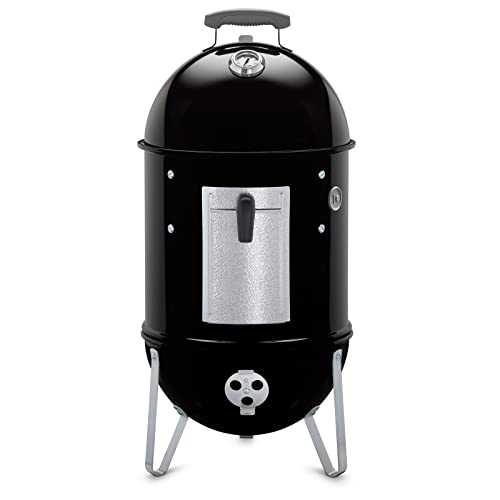
Weber Smokey Mountain Cooker Smoker, 14-Inch — Best Bullet Smoker for Beginners
If the offset is a manual gearbox, the Smokey Mountain is the automatic. The water pan buffers temperature swings, the bullet shape circulates heat kindly, and the vents, once set, hold a low smoking temperature with minimal intervention. The 14-inch size keeps loads family-scale, but for learning charcoal smoking — especially chicken, which forgives nothing about bitter smoke — its clean, steady burn is the best teacher here.
The Smokey Mountain is the bullet smoker that taught generations of barbecue fans low-and-slow cooking, and the 14-inch version keeps the formula intact: charcoal and a water pan at the base, two cooking grates stacked in a porcelain-enameled barrel, and vents that — once set — hold a gentle smoking temperature with a steadiness that surprises first-time owners. Chicken halves, wings and small pork cuts emerge deeply smoked and tender.
Its size is a deliberate trade. Two grates mean a respectable amount of food for a family, but party volumes require batches, and this is a smoker first — direct grilling is a side skill, not its party trick. What you get for accepting that focus is arguably the easiest true charcoal smoking experience in this guide, with a huge community of documented cooks for every cut you might attempt. Small footprint, serious barbecue.
Strengths
- Bullet design is famously steady for low-and-slow charcoal smoking
- Dual grates double the capacity of a small footprint
- Porcelain-enameled Weber build with strong parts support
Trade-offs
- 14-inch size suits small loads — plan batches for parties
- Water pan management is part of the routine
- Grilling over direct heat is secondary to its smoking role
| Format | 14-inch bullet charcoal smoker (per Amazon listing title) |
| Grates | dual cooking grates (per Amazon listing title) |
| Construction | porcelain-enameled (per Amazon listing title) |
Best for: New smokers wanting the easiest path to real low-and-slow charcoal barbecue / Not suited for: High-volume party smoking in a single load.
Check on Amazon — check the current price on Amazon before you decide, as grill pricing shifts through the season.

Dyna-Glo Wide Body Vertical Offset Charcoal Smoker (DGO1890BDC-D) — Best Vertical Smoker for Small Patios
Patios are measured in square feet, and this Dyna-Glo spends them wisely by going up instead of out. Multiple grates in a tall chamber mean a serious quantity of chicken — halves on one level, pieces on another — smoking in the footprint of a chair. The offset box keeps the fire separate, and the wide body swallows full rib racks. Rotating food between levels is part of the craft here, and the capacity is the reward.
The Wide Body Vertical Offset stacks its cooking chamber upward instead of outward, which makes it the capacity-per-footprint champion among charcoal smokers. The offset firebox feeds heat and smoke into a tall chamber where multiple grates hold chickens, ribs and roasts in layers. For a household with a small patio but big barbecue ambitions, that vertical bargain is compelling.
Vertical cooking has its own craft: heat rises, so levels cook at different rates and rotating food between grates becomes part of the rhythm, and door seals matter enough that many owners add gasket material early. In return you can smoke a party’s worth of chicken — halves and pieces across levels — in a corner where a horizontal offset simply would not fit. If your constraint is space rather than appetite, this is the smoker architecture to choose.
Strengths
- Vertical layout stacks lots of food in a modest footprint
- Offset firebox keeps direct heat away from the food
- Wide body takes full rib racks and multiple chickens per level
Trade-offs
- Vertical smokers need door-seal attention to hold temperature
- Heat rises — top and bottom levels cook at different rates
- Assembly and seasoning are a proper first project
| Format | wide body vertical offset charcoal smoker (per Amazon listing title) |
| Fuel | charcoal |
Best for: Small patios needing maximum smoking capacity per square foot / Not suited for: Anyone unwilling to rotate food between levels during a cook.
Check on Amazon — check the current price on Amazon before you decide, as grill pricing shifts through the season.

Kamado Joe Classic Joe Series II Ceramic Charcoal Grill, 18-Inch — Best Kamado Smoker-Grill
The Classic Joe II earns its place among smoker grills by doing the smoking with kamado efficiency: one load of lump, vents set, and the ceramic holds temperature for hours while using a fraction of the fuel an offset burns. It also grills and sears at full kamado heat, which offsets cannot. For the cook who smokes often but also wants one cooker for everything, this is the versatile premium answer.
The Classic Joe Series II is the ceramic kamado benchmark for serious home cooks: a thick ceramic firebox and dome that soak up heat and then radiate it back evenly for hours, mounted in a cart with side shelves that turn it into a complete station. Once stabilised, it holds a low smoking temperature on a single load of lump charcoal with a patience no thin-steel grill can match, yet open the vents and the same cooker sears steaks at temperatures that would warp lesser grills.
Chicken is where many owners fall for it. The enclosed ceramic environment keeps birds moist, the dome height takes upright or spatchcocked chickens comfortably, and finishing with a vent-open blast crisps skin without drying the meat. Temperature control is a discipline of small vent movements and patience — overshoot and ceramic takes time to come back down — but the reward is repeatability that competition cooks trust for practice. It is a premium, heavy, deliberate purchase, and for the cook who will use it weekly it justifies itself every single cook.
Strengths
- Ceramic body holds low temperatures for very long, efficient cooks
- Cart and side shelves create a complete, organised cooking station
- Excels equally at roast chicken, low-and-slow barbecue and high-heat searing
Trade-offs
- Ceramic is heavy — choose its home carefully and avoid impacts
- Premium tier pricing compared with steel kamados and kettles
- 18-inch grate can feel tight for very large parties despite tiered cooking options
| Format | 18-inch ceramic kamado on cart (per Amazon listing title) |
| Included per listing title | cart, side shelves, stainless steel grates |
| Fuel | charcoal (lump recommended by kamado practice) |
Best for: Serious home pitmasters wanting one ceramic cooker for smoking, roasting and searing / Not suited for: Anyone needing to move the grill frequently or working to a tight budget.
Check on Amazon — check the current price on Amazon before you decide, as grill pricing shifts through the season.

Royal Gourmet CC1830S Charcoal Grill and Offset Smoker — Best Budget Smoker-Grill
Every pitmaster started somewhere, and the CC1830S is designed to be that somewhere: a working offset firebox and a listed 783 square inches of total space at a budget tier. The steel is thin and the fire needs attention, and we say so plainly in the full review — but the smoke is real, the technique you learn transfers to any offset, and the main chamber still grills dinner when smoking is not on the menu.
The CC1830S is the budget gateway to offset smoking: a barrel charcoal grill with a side firebox, giving you direct grilling over the main chamber and genuine indirect smoking with the fire in the offset box. The listed 783 square inches of total cooking space includes warming area, and for the tier that is a lot of room — enough for family grilling plus a rack or two smoking gently beside it.
Honesty matters with budget offsets. The steel is thin, so wind and cold will move your temperatures, the fire needs feeding in small splits or charcoal additions, and many owners add simple gasket or latch tweaks to tame air leaks. None of that prevents good barbecue; it just means you are the temperature controller, which is exactly the education offset cooking is famous for. As a first smoker-grill that teaches real fire craft without a serious financial commitment, it earns its popularity.
Strengths
- Grill and offset smoker in one budget-friendly footprint
- Generous total area for the tier, including warming space
- Offset firebox lets you practise true indirect smoking
Trade-offs
- Thin steel needs fire attention and loses heat in wind
- Offset cooking has a learning curve and benefits from sealing tweaks
- Assembly is a bigger job than a kettle
| Total cooking area | 783 sq. in. (per Amazon listing title) |
| Format | barrel charcoal grill with offset smoker (per Amazon listing title) |
| Fuel | charcoal |
Best for: Beginners wanting to learn offset smoking and grilling on a budget / Not suited for: Set-and-forget cooks or very cold, windy locations.
Check on Amazon — check the current price on Amazon before you decide, as grill pricing shifts through the season.
Comparison Table
| Pick | Badge | Key spec | Best for |
|---|---|---|---|
| Oklahoma Joe’s Highland Offset Charcoal Smoker Grill | Best Overall Offset Smoker-Grill | Cooking area: 900 sq. in. (per Amazon listing title) | Enthusiasts wanting a traditional offset for smoking and roasting at scale |
| Oklahoma Joe’s Highland Reverse Flow Offset Charcoal Smoker | Best for Even Temperatures Across the Chamber | Cooking area: 1,093 sq. in. (per Amazon listing title) | High-volume barbecue cooks wanting reverse-flow evenness and maximum space |
| Weber Smokey Mountain Cooker Smoker, 14-Inch | Best Bullet Smoker for Beginners | Format: 14-inch bullet charcoal smoker (per Amazon listing title) | New smokers wanting the easiest path to real low-and-slow charcoal barbecue |
| Dyna-Glo Wide Body Vertical Offset Charcoal Smoker (DGO1890BDC-D) | Best Vertical Smoker for Small Patios | Format: wide body vertical offset charcoal smoker (per Amazon listing title) | Small patios needing maximum smoking capacity per square foot |
| Kamado Joe Classic Joe Series II Ceramic Charcoal Grill, 18-Inch | Best Kamado Smoker-Grill | Format: 18-inch ceramic kamado on cart (per Amazon listing title) | Serious home pitmasters wanting one ceramic cooker for smoking, roasting and searing |
| Royal Gourmet CC1830S Charcoal Grill and Offset Smoker | Best Budget Smoker-Grill | Total cooking area: 783 sq. in. (per Amazon listing title) | Beginners wanting to learn offset smoking and grilling on a budget |
The table compresses the real choice: offsets (Highland, Reverse Flow, CC1830S) for traditional smoke and volume with hands-on fires; the bullet and vertical for steadiness and footprint efficiency; the kamado for fuel economy and all-round cooking. If you will smoke monthly and grill weekly, lean kamado or bullet. If smoking is the main event and you enjoy running a fire, lean offset.
How to Choose a Charcoal Smoker Grill
Decide your tending tolerance first, honestly. Offset smokers need feeding and adjustment roughly every half hour; that rhythm is either the pleasure of the hobby or a deal-breaker, and no review can decide it for you. Bullet smokers and kamados, once stabilised, largely look after themselves for hours. If your smoking happens alongside gardening, games and guests, choose steadiness. If the fire is the entertainment, choose the offset.
Fuel behaviour matters next. Offsets burn charcoal and wood splits and consume the most fuel; bullets run charcoal with wood chunks and are moderate; kamados sip lump charcoal. Over a season of regular smoking those differences are real money and real effort. Then capacity: think in cooks, not square inches. Two chickens and a rack of ribs is a family smoke; four briskets is an event. Buy for your typical cook plus a little headroom — oversized smokers burn oversized fuel loads for small meals.
Finally, judge the seals and the steel. Smoke and heat escape through every gap, and the cookers that hold temperature best are the ones whose doors and lids fit well. Heavy steel and ceramic forgive weather; thin steel asks you to choose your smoking days. None of this makes budget smokers bad — it makes them educational. Many excellent pitmasters learned on a thin-steel offset and upgraded with clear eyes.
Offset, Bullet, Vertical or Kamado: Which Smoker Grill Design Is Right?
Traditional offsets draw heat and smoke sideways from a firebox. The flavour benchmark lives here, capacity is generous, and the fire craft is real. Reverse flow variants add a baffle to even out chamber temperatures — worth it if you cook full chambers often. Bullet smokers stack the fire below a water pan and the food above; the pan’s thermal mass irons out swings, making bullets the beginner-friendly face of charcoal smoking.
Vertical offset cabinets take the bullet’s stacking idea and add a side firebox and wide shelves, trading some steadiness for serious capacity in a small footprint — with the caveat that upper and lower shelves cook at different rates and food rotates between them. Kamados enclose the fire in insulated walls and control it with precision vents; they smoke with the least fuel and the least attention, grill superbly, and cost the most at the ceramic end. There is no wrong answer among these four — only the wrong answer for your patience, patio and typical menu.
Choosing Wood for a Charcoal Smoker Grill
Charcoal provides the heat in every cooker in this guide; wood provides the signature. The choice of wood species shapes flavour more than any rub, and the first rule is moderation — chicken and fish want a whisper of smoke, pork and beef can carry a stronger voice. Fruitwoods such as apple and cherry are the gentle all-rounders: sweet, mild, and flattering to chicken and ribs, with cherry adding a rich colour to the skin and bark. They are the woods to learn on, because they forgive heavy hands.
Oak is the reliable middle: stronger than fruitwood, cleaner than the heavyweights, and the traditional base for brisket and general barbecue. Hickory is bolder and bacon-like, superb on pork in measured amounts and overpowering on chicken when used carelessly. Mesquite is the strongest common smoking wood, best reserved for short, hot grilling where its intensity reads as character rather than bitterness. Whatever the species, the wood must be seasoned and dry; green or damp wood smoulders, and smouldering — not species — is the main source of harsh smoke.
Form matters as much as species. Chunks, roughly fist-sized, suit bullets, kettles and kamados, burning slowly alongside charcoal. Splits — small logs — are the offset’s natural fuel, feeding both heat and smoke in a live fire. Chips burn too fast for long smoking and belong to short grilling smokes, soaked or not. Pellets and pucks belong to other machines entirely. Match the wood to the cooker and the meat, keep the fire clean enough that the smoke runs thin and pale, and the species choice becomes a pleasure rather than a risk.
How to Smoke in Wind, Cold and Rain
Weather is the silent variable in charcoal smoking, and each design in this guide answers it differently. Wind is the most common enemy: it feeds oxygen unevenly, spikes temperatures on one side and strips heat from thin steel. The countermeasures are placement first — a sheltered corner, the firebox shielded from the prevailing wind — and vent discipline second, because a windy day rewards smaller, more frequent adjustments and punishes big ones. Offsets feel wind most; bullets and kamados, with their enclosed fires, feel it least.
Cold is a fuel and patience problem. Every cooker burns more charcoal to hold temperature against winter air, and thin-steel smokers burn dramatically more. Insulated designs — the ceramic kamado above all — treat cold as a minor tax. For steel cookers, plan extra fuel, preheat longer, open the lid less, and consider a windbreak as essential equipment rather than improvisation. The food does not care about the season; only the fire’s budget changes.
Rain adds an electrical-safety and ash dimension: keep the cooker’s vents from funnelling water into the fire, never move a hot smoker under a roof it can scorch, and remember that wet ash turns corrosive — clean the cooker once cool and dry it before covering. Smokers who cook year-round are not tougher than summer smokers; they are simply the ones who learned that weather management is fire management, and planned for both.
Maintaining a Charcoal Smoker Grill — and the Modifications Worth Making
A charcoal smoker asks for a short list of regular care, and repays it with the one thing smoking cannot do without: predictable behaviour. After each cook, once everything is cold, ash comes out — ash holds moisture against steel and quietly corrodes fireboxes and ash pans from the inside. Grates get brushed warm at the end of the cook, while residue is still soft. The water pan in a bullet smoker gets emptied and washed before it becomes a science project. Exterior steel gets a wipe and, on painted surfaces, prompt attention to chips before rust takes hold underneath.
Seasoning is the periodic ritual. The same thin coat of high-heat oil, baked on during a hot empty burn that protects a new smoker, can be renewed when interior surfaces look dry or after a deep clean. Gaskets and seals deserve inspection rather than ritual: a door that leaks smoke at one corner is telling you where heat is escaping, and on offset and vertical smokers that leak is a temperature problem wearing a cosmetic disguise. Hinges, latches and damper pivots all benefit from the occasional drop of oil and the occasional tightened bolt — smokers vibrate gently for hours at a time, and hardware loosens on schedule.
Modifications divide into the wise and the theatrical. Wise: sealing leaks with food-safe gasket material on thin-steel offsets and verticals, adding a quality grate-level thermometer probe port or simply cooking by probe from the start, and fitting a charcoal basket or fire-management aid that matches how you actually burn fuel. Theatrical: anything that promises to turn a smoker into a different machine. The cookers in this guide were chosen because their designs work as sold; modifications should polish a design’s manners, not apologise for its existence.
Keep a simple log alongside the maintenance: dates of cooks, fuel used, gasket or part replacements, and the vent settings that held temperature on good days. Over a season that notebook becomes the smoker’s true manual — the one written for your patio, your weather and your fuel. Smokers are long-lived tools, and the owners who keep them longest are not the ones with the most equipment. They are the ones with the shortest, most consistent care routine.
Chicken on a Smoker Grill: The Cut That Teaches Clean Smoke
Of all the meats a smoker grill cooks, chicken is the strictest teacher. Its mild flesh records every fault in the fire — too much smoke, dirty smoke, a temperature that surged while the skin was rendering — and presents the evidence at the table without mercy. That is precisely why learning to smoke on chicken, cheap and quick compared with brisket, builds better pitmasters faster. A team or a household that can produce clean, juicy, evenly smoked chicken on demand has mastered the fire; everything else is a longer version of the same lesson.
The method that works across every design in this guide shares a skeleton. The bird — whole, halved or in pieces — is salted ahead, dried well, and cooked in moving, gentle heat with the smoke kept thin and pale. Skin is the project within the project: it must render slowly enough to crisp rather than toughen, which means the cook resists the urge to rush the temperature upward at the end, and instead gives the skin a short, deliberate finish — a vent opened on the kamado, a move over the firebox grate on the offset, a final direct pass on the bullet’s base. Each cooker in this guide has its own version of that finish, and learning yours is a rite of passage.
Sauce and glaze, when they appear, arrive late and thin, set over gentle heat rather than baked over fierce heat. Resting is protected time, not dead time. And the verdict is taken honestly, ideally with notes: was the smoke clean, the skin rendered, the meat juicy to the bone? Chicken forgives a learning cook more than brisket does — the cooks are shorter, the ingredients cheaper, the feedback faster. Smoke chicken monthly on any cooker here and the briskets, when they come, will meet a cook who is already trained.
A Note on Smoker Grill Covers, Storage and Off-Season Care
A smoker grill lives outdoors in most households, and its cover is not an accessory but a component. Rain driven into a firebox or a bullet’s seams starts rust exactly where the steel is thinnest and the heat is highest, and a season of that does more damage than a year of cooking. Choose a cover that actually fits your cooker — a flapping, oversized cover chafes finishes and collects water in its folds — and put it on only when the cooker is fully cold and dry. Covering a warm or damp smoker traps the moisture you were trying to exclude, which is the one outcome worse than no cover at all.
Off-season storage rewards twenty deliberate minutes. Ash out, completely. Grates cleaned, dried and lightly oiled. Interior surfaces wiped and, on steel smokers, given a whisper of oil on any bare or worn patches. Dampers left slightly open so air moves and condensation does not settle, and the whole cooker parked where drips from gutters and roofs will not find it. Charcoal goes indoors, sealed and dry, ready to perform in spring instead of disappointing the first cook of the year.
Come spring, the returning ritual is short: inspect seals and hardware, brush the grates, run one hot empty burn to drive off the winter, and cook something forgiving while you relearn your vents. Smokers kept this way do not really age in dog years; they season, in every sense. The cookers in this guide were chosen partly for how well they tolerate real outdoor life — but tolerance is a partnership, and the cover, the ash discipline and the spring burn are the owner’s half of it.
How to Run a Clean Low-and-Slow Charcoal Fire
Start with less fuel than instinct suggests. In an offset, build a small, hot fire in the firebox and let the cooker come up to temperature gradually; in a bullet, use the minion method — a ring of unlit charcoal with a small number of lit coals on top, so the fire spreads slowly; in a kamado, light one spot in the lump and let the vents, barely open, do the rest. In every design the goal is the same: a small fire burning cleanly, not a large fire choked down and smouldering.
Add wood for smoke in modest pieces — chunks in bullets and kamados, small splits in offsets — and wait for the smoke to turn thin and pale before food goes on. Thick white smoke at the start is normal while the cooker heats; food added then will taste of it. Once cooking, adjust one vent at a time, in small steps, and wait ten minutes before judging the result. Keep the lid closed: every look drops temperature and adds oxygen that spikes it afterwards. When the cook ends, close vents fully, let everything cool completely, and only then handle ash — into a metal container, never plastic, and never the same day if there is any doubt about embers.
Common Buying Mistakes
Judging a smoker by total square inches. That figure often counts warming racks. Think in birds, racks and briskets per layer, with space for air to move around the food.
Putting food on under thick white smoke. That smoke is unburned fuel and moisture leaving the cooker. Wait for the thin, pale stage or accept bitter results and blame the wrong thing.
Chasing temperature with constant vent changes. Charcoal systems respond slowly. Adjust, wait, then adjust again. Most ‘unstable smoker’ stories are actually unstable adjusting.
Filling a big smoker for a tiny cook. Large chambers need large fires to run properly. Match the cooker to the load, or use a smaller grill for small smokes.
Skipping the seasoning cook. New smokers carry manufacturing oils. A hot, empty burn with a light coat of cooking oil on interior surfaces seasons the steel and burns off residues before food ever goes in.
Final Recommendation
For most enthusiasts the Oklahoma Joe’s Highland is the recommendation: traditional offset flavour, serious capacity and a price of admission measured in attention rather than only money. Cook full chambers often and the Reverse Flow earns its step up. Beginners and the patience-poor should start with the Smokey Mountain’s steadiness, small patios with the Dyna-Glo Vertical’s footprint, and anyone wanting one cooker for smoking, roasting and searing should save toward the Kamado Joe. The Royal Gourmet remains the budget classroom — imperfect steel, real education.
Oklahoma Joe’s Highland Offset Charcoal Smoker Grill (Best Overall Offset Smoker-Grill) Oklahoma Joe’s Highland Reverse Flow Offset Charcoal Smoker (Best for Even Temperatures Across the Chamber) Weber Smokey Mountain Cooker Smoker, 14-Inch (Best Bullet Smoker for Beginners) are the three we would start with. Check price on Amazon for each, then commit to the one that matches your space and the way you actually cook.
Related reading on this site: Best Charcoal Grills Using Real Charcoal; Best Charcoal Grills; Best Coal Barbecue Grills; Best Charcoal Barbecue Smokers; Best Backyard Charcoal Smokers; Best Charcoal Smokers Under $500.
Frequently Asked Questions
What temperature should a charcoal smoker grill hold for low and slow?
Most barbecue cooks in a broad low-and-slow band rather than at one magic number, adjusting for the cut and the day. What matters more than the exact figure is stability: a cooker that holds its temperature steadily, with clean smoke, will outperform one that swings around a supposedly perfect setting.
Can I grill on a smoker grill, or is it only for smoking?
Every pick here grills as well as smokes, though with different strengths. Offsets sear over the firebox, kamados grill superbly in the main chamber, and bullets grill modestly over their base fire. If grilling is your main weekly activity and smoking the monthly one, weight the kamado and bullet picks more heavily.
Charcoal or wood — what should the fire be?
Charcoal is the reliable heat base in all these cookers. Wood joins it for smoke flavour: chunks mixed into charcoal for bullets and kamados, small splits as a larger share of the fire in offsets. All-wood fires are an advanced offset technique; charcoal-led fires are far easier to keep clean and steady.
Why does my smoked chicken sometimes taste bitter?
Almost always the smoke, not the chicken. Thick white smoke from a smouldering or newly lit fire deposits harsh compounds. Run a smaller, hotter, cleaner fire, wait for thin pale smoke before adding food, and keep vents open enough that smoke flows through rather than stagnating.
How much charcoal does a long smoke use?
It varies sharply by design. Kamados are the most economical, bullets moderate, offsets the hungriest, and weather multiplies everything. As a planning habit, have more fuel on hand than you expect to need — running out mid-cook is a worse problem than leftovers, which can be extinguished and reused.
Do I need to season a new charcoal smoker?
Yes. Wash or wipe down interior surfaces as the maker directs, coat lightly with high-heat cooking oil, and run a hot empty burn. This protects the steel, burns off manufacturing residues and teaches you the cooker’s vent behaviour before food is at stake.


