Disclosure: airfryerkitchensupply.com is reader-supported. When you buy through links on our site, we may earn an affiliate commission at no extra cost to you.
Where to buy
Here is where to buy the best blenders for camping recommended in this guide. Every blender below is sold on Amazon, and each linked model was matched against Amazon’s catalog data before inclusion. Camping blenders live or die on power source and charge, so read the listing for the exact vessel size and charging method before ordering, and check price on Amazon when you buy. Five of the six picks are cordless and USB-C rechargeable; the sixth is a corded travel-jar classic for campers with vehicle power.
- Ninja Blast Portable Blender BC151BK, Cordless, 18 oz — Best Overall. Check the current price on Amazon before you order, because blender pricing and bundle contents change often.
- Ninja Blast Max Portable Blender BC251GY, Cordless, 22 oz — Best Capacity Cordless. Check the current price on Amazon before you order, because blender pricing and bundle contents change often.
- nutribullet Portable Blender NBPB50100K, Cordless, 20 oz — Best Compact. Check the current price on Amazon before you order, because blender pricing and bundle contents change often.
- nutribullet Flip Portable Blender, Cordless, Insulated Cup — Best for Keeping Drinks Cold. Check the current price on Amazon before you order, because blender pricing and bundle contents change often.
- magic bullet Portable Blender MBPB50100, Cordless — Best Budget Cordless. Check the current price on Amazon before you order, because blender pricing and bundle contents change often.
- Hamilton Beach Portable Blender 51172G, 14 oz Travel Jar — Best with Vehicle Power. Check the current price on Amazon before you order, because blender pricing and bundle contents change often.
If you are searching for the best blenders for camping, your real question is about power: there is no wall outlet at a tent site, and a blender that cannot run on a battery is just extra weight. The best blenders for camping are therefore cordless, rechargeable — ideally over USB-C, so a power bank, a car socket or a small solar setup can refill them — and sized for the drinks campers actually make: morning smoothies, protein shakes after a hike, blended coffee drinks, and the occasional campside margarita.
Set expectations honestly before the product names. A cordless personal blender will not crush a pitcher of ice like a countertop machine, and it will not feed six people. What the good ones do is genuinely useful: fresh fruit, protein powder, nut butter, milk and a modest amount of ice become a real smoothie at a picnic table, and the vessel you blend in is the vessel you drink from, so there is nothing to wash but a rinse at the water spigot. For car campers with an inverter, one corded option joins the list for bigger batches.
We verified every pick against Amazon’s catalog data, favoring machines whose listings confirmed cordless operation, vessel size and charging method. Battery endurance varies with load — ice and frozen fruit cost charges — so the guide’s technique section covers how to get the most blends per charge, and the buying guide explains how to match a blender to tent camping, car camping and RV life, which are three different sports.
In this guide
Quick Picks
The short list: the Ninja Blast is the best all-round cordless for most campers. The Blast Max adds capacity, the nutribullet Portable is the most compact, the nutribullet Flip keeps drinks cold in an insulated vessel, the magic bullet Portable is the budget cordless, and the Hamilton Beach travel-jar blender covers car campers with vehicle power.
- Best Overall — Ninja Blast Portable Blender BC151BK, Cordless, 18 oz: A cordless 18 oz portable blender with USB-C charging and a sip lid built into the vessel. It is the benchmark of the category: strong enough for fruit, protein and modest ice, small enough for a pack’s side pocket, and simple enough to use half-awake at a picnic table.
- Best Capacity Cordless — Ninja Blast Max Portable Blender BC251GY, Cordless, 22 oz: A cordless portable with a larger 22 oz Twist & Go vessel and Auto-iQ programs. If the standard Blast’s serving feels small — for a big post-hike shake or a smoothie that is breakfast, not a snack — the Max is the same idea scaled up.
- Best Compact — nutribullet Portable Blender NBPB50100K, Cordless, 20 oz: A cordless 20 oz personal blender with USB-C charging from the brand that popularized personal blending. It packs smaller than the Ninjas while holding a touch more than the standard Blast — a tidy middle answer for campers who pack by volume.
- Best for Keeping Drinks Cold — nutribullet Flip Portable Blender, Cordless, Insulated Cup: A cordless portable blender built around an insulated cup. Blend at the trailhead, and the drink stays cold through the drive, the hike or the slow morning — the pick for campers who blend now and drink over hours.
- Best Budget Cordless — magic bullet Portable Blender MBPB50100, Cordless: The cordless member of the magic bullet family, in silver. It brings the category’s lowest-commitment entry to cordless camping blending: fresh smoothies and shakes at the picnic table without a cord and without a premium price tier.
- Best with Vehicle Power — Hamilton Beach Portable Blender 51172G, 14 oz Travel Jar: A corded personal blender with a 300W peak motor and a 14 oz travel jar you blend in and take along. For car campers and RVers with an inverter or a powered site, it offers stronger, unlimited blending without any battery to manage.
How These Picks Were Chosen
Every pick was verified against Amazon’s catalog: searched by brand and model, matched against the returned listing title, and only then linked. For this category we verified the facts that decide camp usefulness — cordless operation, vessel size and charging method — directly from those listings, and where a listing did not state a figure, we did not invent one.
Selection began with power source, because at a campsite that is the whole question. Five picks are cordless and rechargeable, most over USB-C, so they refill from the power banks and vehicle sockets campers already carry. The sixth is deliberately corded, included for the large share of campers whose vehicle provides power, and labeled as such without apology.
Within the cordless class we ranked on serving size, blend competence on realistic camp ingredients, pack size and the small design decisions — sip lids, removable vessels, insulation — that decide whether a camp gadget gets used daily or left in the box. We print no prices and no fixed ratings in this guide; both change too often to trust, so check price on Amazon when you buy.
The 6 Best Blenders for Camping, Reviewed
Badges match the Quick Picks. Each review states its power source and serving scale first, because at a campsite those two facts decide more than any blending specification.

Ninja Blast Portable Blender BC151BK, Cordless, 18 oz — Best Overall
The Ninja Blast defined the modern camping blender, and it still leads this list because it gets the whole compromise right. The 18 oz vessel is a real serving, the cordless base has enough torque for fresh and soft-frozen fruit, protein powder and nut butter, and USB-C charging means the same cable and power bank that serve your phone serve your blender. Blend, swap to the sip lid, drink — the entire workflow happens in one vessel.
It suits the majority of campers: tent and car campers making one or two drinks at a time, hikers who want a real smoothie at the trailhead, and van travelers without a full inverter setup. It is not a party machine and does not pretend to be; within its serving size, it is the most complete answer here.
Strengths
- USB-C rechargeable from power banks, cars and solar setups
- 18 oz vessel doubles as the drinking cup with its sip lid
- Strong for the class on fruit, powders and modest ice
Trade-offs
- One serving per blend; groups mean sequential blending and charge budgeting
- Heavy frozen loads drain the battery fastest
- Not a countertop replacement for ice-heavy drinks
| Vessel | 18 oz (verified in Amazon title) |
| Power | Cordless, USB-C rechargeable |
| Color | Black, model BC151BK |
In camp conditions, the Blast’s virtues compound. There is no cord to manage on a picnic table, no separate cup to wash, and the recharge math is friendly: a typical phone-sized power bank holds several full recharges, so a long weekend of morning smoothies never threatens the battery if you top up overnight. Frozen fruit works best slightly thawed or in smaller pieces — five minutes out of the cooler while the coffee brews is enough — and with that habit the texture is honestly smoothie-grade, not a compromise drink.
Where it stops is scale and ice ambition. A round of frozen margaritas for six is a countertop job, and pretending otherwise wastes a battery and an evening. Buy the Blast for what camping blending actually is — fresh, personal, outdoors — and it will be the piece of camp kitchen gear you pack first.
Best for: most tent, car and van campers making personal smoothies and shakes / Not suited for: group drinks or heavy ice-crushing at camp
Check on Amazon — check price on Amazon for the current bundle and jar options.
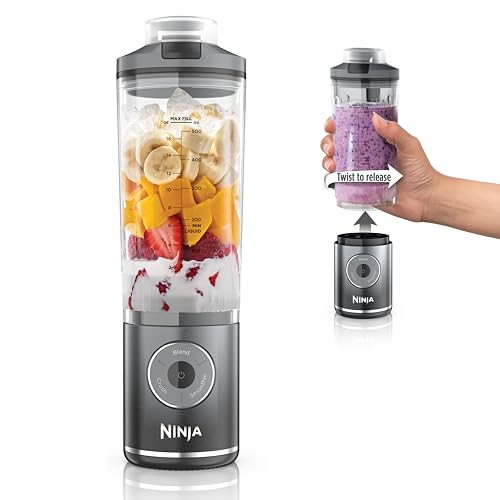
Ninja Blast Max Portable Blender BC251GY, Cordless, 22 oz — Best Capacity Cordless
The Blast Max answers the one complaint owners make about personal cordless blenders: the serving is over too soon. Its 22 oz removable vessel holds a genuinely large shake or a smoothie with room for the add-ins, and Auto-iQ programs run the blend hands-free — press, let it work, drink. The Twist & Go design separates the vessel from the base, which packs more neatly and washes more easily at a camp sink.
Choose the Max if your camp drinks are meals: post-ride recovery shakes with oats and banana, or a breakfast smoothie built to last until lunch. The capacity costs a little pack space and a little charge per blend, both fair trades at this serving size.
Strengths
- 22 oz vessel fits meal-size shakes and smoothies
- Auto-iQ programs give hands-free, consistent blends
- Removable vessel packs and washes easily
Trade-offs
- Bigger and heavier than the standard Blast in a pack
- Larger loads consume charge faster
- Still a personal format — not a group pitcher
| Vessel | 22 oz Twist & Go removable vessel (verified in Amazon title) |
| Power | Cordless portable |
| Programs | Auto-iQ blend programs |
| Color | Grey, model BC251GY |
Capacity changes what a camp blender is for. At 18 oz you make a drink; at 22 oz with programs you make breakfast — greens, frozen berries, oats, protein, milk — and the Auto-iQ cycle handles the thicker load without you hovering. Hikers and riders who treat the morning smoothie as fuel will feel the difference daily.
The charge budgeting is still real: meal-size blends with frozen content are the most expensive cycles a cordless can run, so the power-bank habit from the standard Blast applies doubly here. Plan a nightly top-up and the Max will never strand you; treat the battery as infinite and it eventually will, usually on the morning you wanted it most.
Best for: campers whose smoothie is a meal, and post-activity recovery shakes / Not suited for: ultralight packers counting every ounce
Check on Amazon — check price on Amazon for the current bundle and jar options.

nutribullet Portable Blender NBPB50100K, Cordless, 20 oz — Best Compact
The nutribullet Portable is the space-saver’s pick: a 20 oz vessel, a compact cordless base, USB-C charging, and the straightforward operation the brand is known for. In a camp kitchen box where every item earns its volume, this is the blender most likely to make the cut for solo travelers and couples packing a small car.
Performance sits where the category’s honest middle sits: fresh fruit, greens, protein and nut butter blend smoothly; frozen fruit wants the usual few minutes of thawing or smaller pieces; ice belongs in modest amounts. Within those rules it is a reliable morning machine that disappears into the gear box afterward.
Strengths
- Compact pack size for a full 20 oz serving
- USB-C charging matches the rest of a modern camp kit
- Simple, familiar nutribullet operation
Trade-offs
- Mid-class power; frozen loads need thawing help
- One serving at a time
- Fewer program options than the Ninja Max
| Vessel | 20 oz (verified in Amazon title) |
| Power | Cordless, USB-C rechargeable |
| Color | Black, model NBPB50100K |
Camp gear succeeds by being carried, and the nutribullet Portable is the easiest carry in this guide that still makes a real smoothie. Its blend quality on fresh and lightly frozen ingredients is genuinely good — the small vessel keeps everything in the blade path, the same confinement advantage personal blenders enjoy at home — and the drinking-vessel format keeps the camp sink work to a rinse.
It is the right pick when the choice is between a blender and no blender, which in a packed car or a bikepacking kit is the real choice. Buyers with room to spare and frozen ambitions should step up to the Blast line; buyers counting liters should start here and stop apologizing.
Best for: solo campers, bikepackers and small-car travelers short on space / Not suited for: frozen-drink enthusiasts or group servings
Check on Amazon — check price on Amazon for the current bundle and jar options.

nutribullet Flip Portable Blender, Cordless, Insulated Cup — Best for Keeping Drinks Cold
The Flip solves a problem the other picks ignore: camp smoothies melt. Its insulated vessel keeps a blended drink cold long after blending, which changes how you use it — make the smoothie at dawn before the day’s activity, carry it, and drink it properly cold at the viewpoint or the swim stop. For hot climates and slow mornings, that is not a gimmick; it is the difference between a smoothie and a warm disappointment.
As a blender it follows the family pattern: cordless, personal-size, happiest with fresh and lightly frozen ingredients. The insulation is the headline and the reason to choose it, and it earns that headline honestly.
Strengths
- Insulated vessel keeps blended drinks cold for hours
- Blend-ahead freedom suits activity-first camp days
- Cordless and personal-sized like the rest of the class
Trade-offs
- Insulated vessel is bulkier than a plain cup of the same capacity
- Same frozen-load limits as other personal cordless machines
- One serving per blend
| Vessel | Insulated cup (verified in Amazon title) |
| Power | Cordless portable |
| Finish | Matte Indigo, model NBPB50350IND |
Think of the Flip as a thermos that blends. The use pattern it enables — blend at camp, drink cold at the destination — is how many campers actually want their smoothie, and no amount of power in a plain vessel delivers it, because the drink warms in the vessel regardless of how it was made. Insulation is a feature about time, not temperature at the moment of blending, and for summer camping that time is the whole game.
The trade is bulk: insulation takes wall thickness, so the Flip occupies more pack space per ounce of drink than the plain portables. Campers in cool climates or drinking immediately should save the space. Campers who have poured out one warm smoothie too many will consider it the best-spent volume in the box.
Best for: hot-climate campers and blend-ahead, drink-later routines / Not suited for: cool climates or drink-immediately habits where insulation is dead weight
Check on Amazon — check price on Amazon for the current bundle and jar options.

magic bullet Portable Blender MBPB50100, Cordless — Best Budget Cordless
The magic bullet Portable is for the camper who wants to try the cordless life cheaply — or who wants a second, loaner, kids’-table blender that nobody will mourn if it lives a hard life in the gear box. Its blending is the honest budget version of the class: fresh fruit, protein, milk and nut butter come together fine; frozen loads ask for thawed patience; ice is a garnish, not a workload.
As with its countertop ancestor in our coffee guides, the recommendation is about fit. A household testing whether camp smoothies are a real habit or a holiday fantasy should start here, learn their answer in one season, and upgrade with knowledge if the habit sticks.
Strengths
- Budget entry to cordless camp blending
- Familiar magic bullet simplicity
- A sensible second or loaner unit for group trips
Trade-offs
- Lightest power in the guide; frozen and ice loads are limited
- Basic feature set compared with the Ninja and nutribullet portables
- Battery endurance is the class’s modest end — plan recharges
| Format | Cordless portable blender (verified in Amazon title) |
| Finish | Silver, model MBPB50100 |
| Line | magic bullet personal blender family |
Judge it by mornings, not specifications. A banana, a handful of fresh berries, protein and milk become a smooth drink; a shake after a swim comes together without fuss; the rinse is a rinse. Those are ninety percent of camp blending requests, and this machine covers them at the tier where a family can buy one per teenager and end the sharing negotiations.
The limits deserve the same plainness: do not ask it for frozen-fruit smoothies straight from a hard cooler or for crushed-ice drinks, and do keep the charging cable in the camp box, because its battery is a weekend battery with top-ups, not a week-long one. Inside those lines, it is the right first cordless for a great many campers.
Best for: budget buyers, beginners and families wanting several cheap units / Not suited for: frozen-heavy blending or long off-grid stretches without charging
Check on Amazon — check price on Amazon for the current bundle and jar options.

Hamilton Beach Portable Blender 51172G, 14 oz Travel Jar — Best with Vehicle Power
This pick serves the other half of camping: the car, the campervan and the RV, where 120V power exists through an inverter, a generator or a powered pitch. The Hamilton Beach blends in its own 14 oz travel jar with a 300W peak motor — stronger than the cordless class and unlimited by charge — and the jar goes straight from base to cupholder.
It is honest about its dependency: no vehicle power, no blending, which is why it sits last in a list led by cordless machines. But for road-trip campers whose vehicle is the kitchen, it removes every battery anxiety in this guide and blends frozen fruit more willingly than the cordless picks.
Strengths
- Corded power: no charge management, stronger frozen performance
- Blend-and-go 14 oz travel jar fits vehicle cupholders
- Simple, durable, long-running design
Trade-offs
- Useless away from vehicle or site power — not a tent blender
- 14 oz is the smallest vessel here
- Cord to manage in a camp kitchen
| Motor | 300W peak (verified in Amazon title) |
| Jar | 14 oz travel jar, BPA-free |
| Blades | Stainless steel blades |
Road campers will recognize the workflow: park, plug into the inverter, blend in the jar, cap it, drive. The travel jar is the design’s quiet genius — one vessel to wash, sized for a single serving, and shaped for the road. Frozen fruit from the cooler blends more willingly here than in the cordless class because the motor never has to budget its energy.
The classification matters more than the machine: if your camping is a tent and a backpack, skip this pick entirely and buy cordless. If your camping has wheels and a battery bank, this humble blender may out-serve every cordless on the list, because the best camp appliance is the one whose power source you already carry.
Best for: car campers, campervans and RVers with inverter or site power / Not suited for: tent campers and backpackers without power
Check on Amazon — check price on Amazon for the current bundle and jar options.
Comparison Table
The six picks compressed: badge, the specification that defines camp usefulness, and the camper each suits best.
| Pick | Badge | Key spec | Best for |
|---|---|---|---|
| Ninja Blast Portable Blender BC151BK, Cordless, 18 oz | Best Overall | Cordless, 18 oz vessel, USB-C rechargeable | All-round camp blending |
| Ninja Blast Max Portable Blender BC251GY, Cordless, 22 oz | Best Capacity Cordless | Cordless, 22 oz vessel, Auto-iQ programs | Meal-size camp servings |
| nutribullet Portable Blender NBPB50100K, Cordless, 20 oz | Best Compact | Cordless, 20 oz vessel, USB-C | Compact solo camping |
| nutribullet Flip Portable Blender, Cordless, Insulated Cup | Best for Keeping Drinks Cold | Cordless, insulated vessel, personal format | Cold drinks hours after blending |
| magic bullet Portable Blender MBPB50100, Cordless | Best Budget Cordless | Cordless portable, magic bullet family, silver | Budget cordless entry |
| Hamilton Beach Portable Blender 51172G, 14 oz Travel Jar | Best with Vehicle Power | 300W peak, 14 oz travel jar, corded | Vehicle-powered camping |
Sort by power source before anything: cordless for tents and packs, corded for vehicles with power. Then sort by serving — snack-size, meal-size, or cold-keeping — and the table narrows to one or two honest candidates for almost every camper.
How to Choose a Blender for Camping
Camping is not one activity, and a blender that delights a campervan couple can be dead weight to a backpacker. The four decisions below — camping style, power logistics, serving size and ingredient realism — will place you in the right row of our table.
Match the blender to your style of camping
Backpackers and bikepackers should treat every ounce as rent: the compact cordless picks are the only defensible choices, and even they must earn their place against simply eating the fruit. Tent and car campers have room for the mainstream cordless machines and a power bank. Campervan and RV travelers with inverters can consider the corded pick and its unlimited blending. Festival and group-site campers should think in servings per charge and may honestly be better served by one cordless per couple than by any single machine.
Power logistics: the battery is the appliance
A cordless blender is a battery with a blade attached, so plan its energy like you plan your phone’s. USB-C charging is the standard to want, because it shares cables and power banks with the rest of a modern kit. Know that frozen loads cost the most charge and fresh loads the least, and build the nightly top-up into camp routine — blender on the power bank while dinner cooks. Solar campers should charge the power bank by day and the blender from the bank, not chase direct solar charging. If your trips run longer than your charging, the honest answer is fewer frozen drinks, not a bigger promise from a small battery.
Serving size and the group question
Personal cordless blenders make personal servings: 14 to 22 oz across this guide. That is a feature at a solo tent and a bottleneck at a family site, where sequential blending drains both time and battery. Groups have three sane options — several inexpensive units, one unit with disciplined turns for shakes only, or vehicle power with the corded pick. What groups should not do is buy one premium cordless and expect it to cater; it will end the trip resented and flat.
Be realistic about camp ingredients
Camp blending shines with fresh fruit, bananas, protein powders, oats, nut butters, milk and yogurt — ingredients that travel well and blend easily. It struggles, in every cordless machine, with hard frozen fruit straight from a deep cooler and with real ice-crushing duty. Thaw frozen items briefly, cut them small, and add liquid generously, and the texture gap to home blending mostly closes. Shoppers whose camp fantasy centers on frozen margaritas for the site should route that fantasy through the corded pick and vehicle power, where it belongs.
How to Get the Most Blends per Charge at Camp
A cordless blender’s battery is a budget, and technique is how you spend it well. These habits, in order, will roughly double the useful work you get from any cordless pick in this guide compared with careless use.
- Charge fully the night before you leave, and pack the USB-C cable in the kitchen box, not the electronics pouch — it will be needed where the food is.
- Prep ingredients small: chop fruit, break frozen items into pieces, and let frozen fruit sit out five to ten minutes while other breakfast jobs happen.
- Load liquid first, then soft ingredients, then the hardest items last, so the blades start in fluid and the vortex forms immediately.
- Blend in short, complete cycles rather than many half-hearted bursts; a finished blend costs less total charge than three interrupted ones.
- Add a splash more liquid than you would at home. A slightly thinner camp smoothie blends faster and smoother on battery power, and nobody at a picnic table complains.
- Rinse the vessel immediately with a little water and a fingertip scrub. Dried smoothie in a blade base is the main cause of camp blenders coming home broken or abandoned.
- Top up the battery during the day’s drive or from the power bank at dinner, so the morning never starts on a partial charge.
- Keep the blender out of direct sun and away from cooler meltwater; heat and water are the two quiet killers of camp electronics.
- On the last morning, blend before you pack the power bank away — the order of packing decides whether the trip ends with a smoothie or a shrug.
If you consistently run out of charge, the diagnosis is honest: your camp blending habit is bigger than one personal battery, and the cures are a second inexpensive unit, a larger power bank, or vehicle power — in that order of cost. Technique stretches a battery; it cannot repeal physics, and a guide that pretended otherwise would strand you at the trailhead.
What to Blend at Camp: Recipes That Suit the Machines
The recipes that work outdoors respect the format. The trailhead smoothie — banana, fresh berries, oats, protein, milk — blends easily, travels in the stomach well and needs no ice. The campside coffee shake — cold coffee, milk, cocoa, nut butter — gives the afternoon a lift without a cord. Savory campers can blend a no-cook soup base of soft ingredients for the pot, though anything requiring real pureeing of cooked vegetables belongs to the home kitchen. The drink to avoid planning around is the frozen cocktail for a crowd: it is the one request every personal cordless answers badly, and camp evenings are better spent on drinks that suit the tools. Blend what the battery loves and the trip will taste like the brochure.
Camp Drink Planning: A Weekend Worked Example
Friday to Sunday on one power bank
Picture the standard long weekend. Friday evening: two shakes on arrival, blended from fresh ingredients while the tent goes up — cheap blends, barely denting a full charge. Saturday: breakfast smoothies for two, the day’s most frozen and therefore most expensive blends, followed by a top-up from the power bank while it recharges from the car during a midday drive. Sunday: two more breakfast blends, then home. Total reliance on the bank stays modest, and the blender’s own battery never runs dry because it is topped up nightly as a habit, like a headlamp. The pattern to copy is not the menu; it is the rhythm of blending fresh when possible, frozen at breakfast, and charging whenever the vehicle moves.
When the group is bigger than the battery
Six campers change the honest answer. Rather than one premium unit worked to death, experienced groups bring two budget cordless blenders — the magic bullet Portable in this guide exists for exactly this — or shift blending to the vehicle with the corded pick and an inverter. The menu also adapts: shakes and smoothies scale through turns far better than frozen drinks, which should quietly leave the group menu. Planning the drink list around the power you actually carry is the difference between a camp kitchen that feels luxurious and one that feels like a negotiation.
Camp blending carries one responsibility the home kitchen does not: everything you rinse off the vessel goes into the outdoors. Blend with ingredients you would be comfortable scattering — fruit, oats, protein, milk — and handle rinse water as you handle dishwater at camp, straining and dispersing it well away from water sources, or packing it out where local rules require. Sticky, sugary residues attract animals to a site, which is another practical reason for the immediate-rinse habit this guide keeps recommending: a clean blender in the bear box is campcraft, not fussiness. The machines here are small and sealed enough to make all of this easy; the habit is the camper’s contribution.
Weight accounting, for campers who count: a personal cordless blender with its cable typically weighs about as much as a full water bottle, and displaces a similar volume. Whether that trade earns its place depends on trip length and appetite — on a two-night car camp it is an obvious luxury worth having; on a seven-day through-hike it competes with food itself, and food should win. The honest middle ground many experienced campers choose is the basecamp model: the blender lives in the vehicle or the first night’s camp, serves the trailhead days, and never enters the deep backcountry at all.
Families camping with children will find a second use for these machines that rarely appears in marketing: camp smoothies are the most reliable delivery system ever devised for fruit, yogurt and oats in a child who has opinions about all three. A morning blend at the picnic table also gives small campers a job — choosing ingredients, pressing the button under supervision — that anchors the day’s first hour pleasantly. Keep the blade base out of small hands when it is off the vessel, treat the machine with the same respect as other camp sharps, and let the children own the recipe choices. Many families report the blender earning its pack space on this duty alone, with the adults’ shakes as a bonus.
Winter campers should note one battery truth: cold cells hold less charge, and a cordless blender stored in a freezing tent will deliver fewer blends than the same machine in July. Keep the blender in the sleeping bag’s foot or an insulated pouch overnight on cold trips, and warm the battery with body heat before the morning blend. The drinks themselves trend warm-adjacent in winter — protein shakes and coffee blends rather than frozen smoothies — which are also the cheapest blends a battery can make. Season and menu, once again, should be planned together.
None of this planning needs to be elaborate. A cable in the right box, a battery kept warm, a menu matched to the power you carry — three small decisions made once will quietly govern every blend of every trip that follows them.
Common Buying Mistakes
Packing a corded countertop blender for a tent trip
It happens every season: a full-size blender riding to a site with no power, blending nothing, riding home. If the site has no electricity and your vehicle has no inverter, the blender must be cordless or it must stay home.
Expecting crushed-ice performance from a personal cordless
These machines blend drinks; they do not crush ice like a countertop Total Crushing pitcher. Modest ice in a liquid blend, yes. A vessel of cubes, no. Planning frozen cocktails around a cordless personal blender ends in warm, chunky disappointment.
Forgetting the charging cable’s location
A flat blender with its cable in another bag is a paperweight. The cable lives with the blender, in the kitchen box, every trip. Camp systems fail on logistics far more often than on machinery.
Blending rock-hard frozen fruit straight from the cooler
Deep-cold frozen fruit is the fastest way to stall a small motor and burn a charge achieving nothing. Ten minutes of thawing or smaller pieces turn the same ingredients into an easy blend.
Buying one unit for a group’s whole weekend
Sequential blending for six people drains the battery by Saturday and the goodwill by Friday night. Groups need units per couple, vehicle power, or a menu that does not revolve around the blender.
Final Recommendation
For most campers the answer is the Ninja Blast: cordless, USB-C, honestly capable, and sized for the drinks camping actually involves. Step up to the Blast Max if your smoothie is a meal, choose the nutribullet Portable if pack space rules your life, and pick the Flip if your drinks need to stay cold for hours in summer heat.
Budget campers and families should look at the magic bullet Portable without embarrassment — it covers the fresh-fruit majority of camp blending at a friendly tier — and vehicle-based campers should seriously consider the Hamilton Beach, whose corded strength quietly out-serves batteries wherever an inverter hums. Pack the cable with the blender, thaw the fruit while the coffee brews, and the trailhead smoothie becomes the easiest luxury in camp.
Our top three, again for convenience: Ninja Blast Portable Blender BC151BK, Cordless, 18 oz (Best Overall), Ninja Blast Max Portable Blender BC251GY, Cordless, 22 oz (Best Capacity Cordless), nutribullet Portable Blender NBPB50100K, Cordless, 20 oz (Best Compact). Check price on Amazon for each before you decide, and confirm the exact jar or cup configuration in the listing.
Keep exploring the blender guides on this site: Best 12 Volt Blender Best Battery Operated Blenders Best Blenders For College Best Blenders For Frozen Fruit Smoothies Best Blenders
Frequently Asked Questions
How many blends does a cordless camping blender make per charge?
It depends on the load more than the brand: fresh, liquid blends are cheap, while frozen and thick blends are expensive, and manufacturers’ cycle counts assume friendly conditions. Plan conservatively — a few blends per charge for typical mixed use — and build a nightly top-up from a power bank into your routine. Campers who plan that way never think about the battery; campers who trust the box number eventually blend a warm, half-finished shake.
Can a portable blender crush ice at a campsite?
Modestly, in liquid, and with lowered expectations. A few cubes in a smoothie will incorporate; a vessel of cubes for frozen cocktails will defeat every personal cordless in this guide. If iced drinks are central to your camp life, use the corded pick with vehicle power, or pre-crush expectations along with the ice and choose drinks that suit personal machines.
What is the best way to charge a blender while camping?
USB-C from a power bank is the practical standard: charge the bank from the car while driving or from solar during the day, then charge the blender from the bank in the evening. This two-step routine protects the blender from the variable output of small solar panels and keeps all your devices on one system. Keep cables with the kitchen gear so the routine survives packing.
Are portable blenders worth it for backpacking?
For most backpackers, honestly, no — the weight buys a lot of trail food, and fruit eats perfectly well unblended. The exceptions are hikers with specific nutrition routines, basecamp setups where weight matters less, and bikepackers with frame capacity. Car and van campers, by contrast, get daily value from the same machines. Match the purchase to the pack, not the fantasy.
Can I blend hot drinks in a portable camping blender?
Treat portable vessels like personal cups at home: warm is fine, boiling is not, because sealed vessels and steam pressure are a bad combination. Campers wanting a hot blended coffee should let it cool a few minutes first — or accept the campsite classic, coffee with the fat stirred in imperfectly, as generations have. The cordless picks here are cold and warm drink machines.
How do I clean a blender at a campsite?
Immediately is the whole secret: rinse the vessel and blade base with a little water right after drinking, wipe with a cloth, and let it air dry. A drop of biodegradable soap handles a thorough wash at the camp sink. Dried residue in a blade base is the main killer of camp blenders, and it is entirely prevented by the sixty-second rinse.


