Disclosure: airfryerkitchensupply.com is reader-supported. When you buy through links on our site, we may earn an affiliate commission at no extra cost to you.
Where to buy
Every pick in this guide was verified against Amazon’s own catalog data before it earned a link, and availability for best 12 volt maintenance battery charger for rv changes often enough that live listings are the only honest source. Start with our top pick, the NOCO GENPRO10X2 12V 20A 2-Bank Onboard Charger (check price on Amazon), or compare the full shortlist in the Quick Picks table below. The runner-up most buyers cross-shop is the ProMariner ProSport HD 12A 2-Bank Waterproof Charger (check price on Amazon). Where a model is sold under several listings, choose the listing sold or shipped by the manufacturer or Amazon itself, and confirm the exact model number in the listing title matches the one in our review before you order.
Introduction: What Actually Matters When You Shop for a 12 Volt Maintenance Battery Charger for an RV
An RV changes the battery-maintenance problem in two ways: the batteries are bigger (often a pair of house batteries plus a chassis battery), and the vehicle sits for months between trips while parasitic loads — propane detectors, clocks, control boards, stereo memory — sip current the whole time. The best 12 volt maintenance battery charger for rv use is therefore usually an onboard multi-bank charger: permanently mounted, wired to each battery bank, waterproof enough for a battery compartment, and smart enough to charge, maintain and protect unattended from the day you winterize to the day you de-winterize. Every charger in this guide is a verified onboard or multi-bank unit from the marine and RV world’s established makers, plus one direct-mount NOCO that suits single-battery rigs.
The onboard difference matters. A portable maintainer with clamps works, but clamps corrode, cables get pinched in compartment doors, and the charger itself lives in a damp bay it was not designed for. Onboard chargers bolt down, connect with ring terminals, seal against water (IP67 and IP68 sealing grades appear throughout this guide) and turn storage maintenance into ‘plug the RV into shore power and walk away.’ For travel trailers and motorhomes that spend their lives plugged in at home or in storage, that is the correct architecture, and it is why this guide is built around bank chargers rather than the single-battery units in our general maintenance-charger guide.
Bank math is the first decision. A single house battery needs a 1-bank charger; the common pair of house batteries wired in parallel counts as one bank; separate house and chassis batteries need two banks (or a charger per battery); and boats-influenced rigs with a generator start battery may need three. Each bank should get at least 4 to 5 amps for healthy charging pace on RV-size batteries, and more if the charger must also run 12V loads while plugged in. The picks below span 1 to 2 banks and 2 to 20 total amps, badged by the rigs they fit.
Consider the storage math that justifies this whole category. A motorhome carries two to four batteries worth, together, a significant sum, and unmanaged storage reliably consumes them in two to three seasons. A 2-bank onboard charger costs a fraction of one battery set and routinely doubles or triples storage lifespan — while also eliminating the spring ritual of jump packs, charger cables across the driveway and the suspense of the first start. Few RV accessories pay back this predictably, which is why experienced owners rank the onboard maintainer alongside tires and roof sealing as non-negotiable ownership infrastructure rather than an upgrade.
One clarification for motorhome shoppers, because the terminology misleads: an onboard maintainer like the picks here is not the same as the converter-charger in your power center, and it is not a battery charger in the jump-start sense either. It is a dedicated, per-bank battery manager whose whole career is the health of the batteries it is wired to. That specialization is its virtue — it does one job with a sophistication generalist equipment rarely matches — and it is why rigs can sensibly carry both a converter for living power and a maintainer for storage health without redundancy.
In this guide
Quick Picks
| Pick | Badge | Key spec | Best for |
|---|---|---|---|
| NOCO GENPRO10X2 12V 20A 2-Bank Onboard Charger — Check on Amazon | Best Overall for RVs | 2 banks, 10A per bank (20A total), IP68, lithium capable | motorhomes and trailers with separate house and chassis batteries |
| ProMariner ProSport HD 12A 2-Bank Waterproof Charger — Check on Amazon | Best Value 2-Bank | 2 banks, 12A total distributed on demand, IP67 | RVs and boats wanting proven 2-bank charging for less |
| NOCO GEN5X2 12V 10A 2-Bank Onboard Charger — Check on Amazon | Best Compact 2-Bank | 2 banks, 5A per bank (10A total), IP68 | smaller RVs and trailers with two modest banks and tight mounting space |
| NOCO GENPRO10X1 12V 10A 1-Bank Onboard Charger — Check on Amazon | Best Single-Bank Premium | 1 bank, 10A, IP68, lithium capable | single-bank RVs, and house banks converted to lithium |
| Guest ChargePro 8A 2-Bank Waterproof Onboard Charger — Check on Amazon | Best Budget 2-Bank | 2 banks, 4A per bank (8A total), IP67, 12V/24V systems | budget two-bank maintenance on modest batteries |
| NOCO GENIUS2D 2A Direct-Mount Onboard Charger — Check on Amazon | Best Minimalist Single Battery | 1 bank, 2A, direct-mount onboard design | small trailers, teardrops and pop-ups with one battery |
Short version: the NOCO GENPRO10X2 (20A, 2 banks) is the best all-round RV choice, the ProMariner ProSport HD is the waterproof value in 2-bank charging, the NOCO GEN5X2 is the compact 10A 2-bank alternative, the GENPRO10X1 serves single-bank rigs with premium current, the Guest ChargePro is the light-duty budget 2-bank, and the NOCO GENIUS2D direct-mount unit is the minimalist answer for one battery in a small trailer.
How These Picks Were Chosen
We verified each charger against its manufacturer’s listing and kept only fully automatic multi-stage units designed for permanent onboard mounting (plus the direct-mount GENIUS2D), with independent bank outputs where claimed, waterproof grades stated in the listing, and profiles for the flooded and AGM batteries RVs actually use — with lithium modes on the NOCO GENPRO line for rigs that have converted to LiFePO4 house batteries. We excluded portable clamp chargers (covered in our general maintainer guide), converter-chargers that are part of the RV’s power center, and any unit whose bank outputs were not genuinely independent.
Ratings in spec boxes come only from verified listings. Where a charger distributes current dynamically between banks, we describe the behavior rather than inventing per-bank figures the listing does not state.
One consequence of that verification discipline: if a model in this guide sells out or is replaced by a newer version, the link on the NOCO GENPRO10X2 12V 20A 2-Bank Onboard Charger (check price on Amazon) and its rivals will show the current listing state honestly rather than sending you to a copycat product trading on the same name.
The 6 Best 12 volt maintenance battery charger for rv Options, Reviewed in Detail

1. NOCO GENPRO10X2 12V 20A 2-Bank Onboard Charger — Best Overall for RVs
The GENPRO10X2 is the RV maintainer done right: two independent 10-amp banks in an IP68-sealed onboard unit, with selectable profiles including lithium for LiFePO4 house batteries, thermal compensation and full automatic maintenance. Wire one bank to the house battery, one to the chassis battery, plug the RV in, and both batteries are managed all winter with zero further attention.
Strengths
- True dual-bank independence — house and chassis batteries each get their own charge profile
- 10A per bank charges RV-size batteries at a real pace, not a maintainer’s crawl
- IP68 sealing suits battery compartments and even marine engine rooms
Trade-offs
- Premium price, justified only if you actually have two banks to serve
- Onboard mounting is a small installation project with ring terminals and cable runs
- Overkill for a single-battery trailer
| Banks | 2 |
| Output | 10A per bank, 20A total |
| Sealing | IP68 |
| Chemistries | Lead-acid profiles + lithium (per listing) |
The GENPRO line’s RV case rests on independence. A house bank and a chassis battery live different lives — one deep-cycled by lights and furnace, one shallow-cycled by starting — and a single-output charger with a splitter treats them as one battery and serves both badly. The GENPRO10X2 charges each on its own curve, maintains each at its own float, and its lithium profile means the same charger survives a future house-bank conversion to LiFePO4. Add NOCO’s thermal compensation for unheated storage and this is the charger we would bolt into a motorhome we owned.
Installation planning tip for the GENPRO10X2: mount it where both banks’ leads reach without extension splices, and set each bank’s chemistry profile at install time — the charger remembers, so the lithium house bank and the AGM chassis battery each keep their correct treatment forever, with no seasonal reprogramming. That set-and-forget chemistry split is the feature owners praise most by the second winter.
Best for: motorhomes and trailers with separate house and chassis batteries / Not suited for: single-battery pop-ups where a 1-bank unit is the honest spend
Check on Amazon — check the current price on Amazon before you decide, and confirm the model number in the listing matches this review.

2. ProMariner ProSport HD 12A 2-Bank Waterproof Charger — Best Value 2-Bank
ProMariner’s ProSport HD brings the marine world’s distributed-on-demand charging to RV money: 12 amps shared intelligently across two banks, sending more current to the bank that needs it, in an IP67 waterproof case from a company that has built onboard chargers for decades. For lead-acid house and chassis pairs, it is the value benchmark.
Strengths
- Distributed-on-demand output puts current where the need is
- IP67 waterproofing and a long marine service record
- Gentler price than the premium 2-bank units
Trade-offs
- 12A total means two flat banks charge slower than on a 20A unit
- Lead-acid focus; lithium conversions should look at the GENPRO line
- Distribution logic is automatic — you cannot force a fixed split
| Banks | 2 |
| Output | 12A total, distributed on demand |
| Sealing | IP67 |
Distributed charging is smarter than it sounds: in storage, one bank (usually the house bank with its parasitic loads) always needs more than the other, and the ProSport quietly obliges instead of splitting current evenly out of fairness. ProMariner’s marine heritage shows in the sealing and in documentation written for real installations. For the large majority of RVs still running flooded or AGM batteries, this is all the charger the rig needs, at a price that leaves budget for the batteries themselves.
ProMariner’s distributed charging has a storage quirk worth knowing: because current follows need, the bank with the heavier parasitic load will show more charger activity — that is the system working, not an imbalance to fix. Boaters crossing into RV use will recognize the behavior and the build; RVers crossing into boating can take the same unit with them, which is more than most RV accessories can claim.
Best for: RVs and boats wanting proven 2-bank charging for less / Not suited for: lithium house banks — confirm profile support before pairing
Check on Amazon — check the current price on Amazon before you decide, and confirm the model number in the listing matches this review.

3. NOCO GEN5X2 12V 10A 2-Bank Onboard Charger — Best Compact 2-Bank
The GEN5X2 halves the GENPRO’s output and shrinks the package: two 5-amp banks, IP68 sealing, NOCO’s automatic profiles, in a unit that mounts where bigger chargers cannot. For travel trailers with a house battery and a smaller second bank — or boats with starting and house batteries of modest size — it is the right-sized answer.
Strengths
- Compact IP68 case fits crowded battery bays
- Independent banks with NOCO’s full automatic behavior
- Maintains two banks indefinitely on shore power
Trade-offs
- 5A per bank is maintenance-plus pace; two flat banks take real time
- No lithium headline feature — verify profile needs before buying for LiFePO4
- Those needing faster recovery should step to the GENPRO10X2
| Banks | 2 |
| Output | 5A per bank, 10A total |
| Sealing | IP68 |
Most stored RVs do not need charging speed — they need trustworthy maintenance — and that is the GEN5X2’s brief. Five amps per bank comfortably outruns parasitic loads, restores a bank after a trip within a day, and then floats both banks for months. Its size advantage is real in the cramped front compartments of travel trailers, where the GENPRO’s larger case can be a genuine fitment problem. Choose it when your banks are modest and your mounting space is too.
The GEN5X2 is also the natural choice for the truck camper and small Class C niches, where two real banks live in minimal space and a full-size charger physically cannot go. Measure your compartment before ordering any onboard unit — the 5X2’s compact case was designed for exactly the bays where its bigger siblings fail the tape-measure test.
Best for: smaller RVs and trailers with two modest banks and tight mounting space / Not suited for: big diesel pushers with large battery banks that want 10A per bank
Check on Amazon — check the current price on Amazon before you decide, and confirm the model number in the listing matches this review.

4. NOCO GENPRO10X1 12V 10A 1-Bank Onboard Charger — Best Single-Bank Premium
One bank, done completely: the GENPRO10X1 puts a full 10 amps, selectable chemistry profiles including lithium, and IP68 sealing behind a single battery bank. It is the pick for the single-house-battery trailer whose owner wants premium charging and maintenance — especially the growing number of rigs whose one bank is now a LiFePO4 battery that demands a proper lithium profile.
Strengths
- Full 10A into one bank charges big house batteries briskly
- Lithium profile serves converted house banks correctly
- IP68 build for permanent compartment mounting
Trade-offs
- One bank only — chassis battery needs its own solution
- Premium pricing over basic 1-bank units
- Installation effort is the same as the 2-bank model
| Banks | 1 |
| Output | 10A |
| Sealing | IP68 |
| Chemistries | Lead-acid profiles + lithium (per listing) |
The single-bank case is more common than marketing suggests: many trailers run one house battery and let the tow vehicle handle the rest, and many lithium conversions consolidate into one large LiFePO4 unit. For those rigs the GENPRO10X1’s concentrated 10 amps and correct profiles beat a 2-bank charger with a bank idling. It also suits a motorhome owner who maintains the house bank onboard and keeps the chassis battery on a separate small maintainer — a legitimate architecture this guide’s budget picks can complete.
Single-bank rigs with a lithium conversion should note the GENPRO10X1’s second talent: at 10 amps it is also a respectable trip charger, refilling a house bank from a generator or shore hookup far faster than maintainer-class units. For boondockers who top up opportunistically, that dual role — storage maintainer in winter, real charger in season — justifies the premium over a basic 1-bank box.
Best for: single-bank RVs, and house banks converted to lithium / Not suited for: two-bank rigs — its 2-bank sibling exists for you
Check on Amazon — check the current price on Amazon before you decide, and confirm the model number in the listing matches this review.

5. Guest ChargePro 8A 2-Bank Waterproof Onboard Charger — Best Budget 2-Bank
Guest’s ChargePro is the honest budget entry: two banks at 4 amps each, IP67 waterproofing, and automatic maintenance from a long-standing marine electrical brand, at the lowest price of the 2-bank picks. It also handles 12V/24V system configurations per its listing, a flexibility niche the others do not claim.
Strengths
- Lowest-cost route to independent 2-bank onboard maintenance
- IP67 sealing and a reputable marine brand behind it
- 4A per bank is well matched to storage duty
Trade-offs
- Charging pace is leisurely on big flat banks
- Feature set is basic next to NOCO and ProMariner
- Confirm chemistry profiles match your batteries before purchase
| Banks | 2 |
| Output | 4A per bank, 8A total |
| Sealing | IP67 |
| Systems | 12V / 24V (per listing) |
Storage is a marathon, and 4 amps per bank wins marathons fine: parasitic loads are measured in milliamps, and a bank that ends a trip at 80 percent is full again by morning. The ChargePro’s proposition is that you should not have to pay premium prices for that behavior, and for cost-sensitive rigs with modest batteries it is right. Spend the savings on battery replacement reserves — in RV economics, the charger is rarely the thing that should consume the budget.
Guest’s marine heritage shows in a detail RVers appreciate: the ChargePro tolerates the damp, unconditioned compartments that RV battery bays are, season after season. Budget chargers that live indoors on a workbench are a different species; this one was built for the environment it will actually inhabit, which is precisely why it anchors the budget end of an onboard guide.
Best for: budget two-bank maintenance on modest batteries / Not suited for: fast charging or very large battery banks
Check on Amazon — check the current price on Amazon before you decide, and confirm the model number in the listing matches this review.
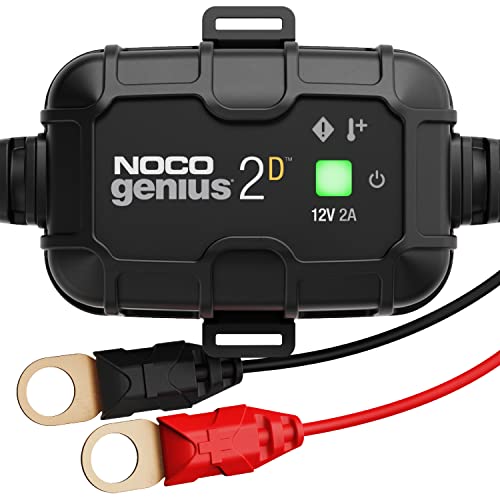
6. NOCO GENIUS2D 2A Direct-Mount Onboard Charger — Best Minimalist Single Battery
The GENIUS2D is a maintainer that lives on the battery: a 2-amp direct-mount onboard unit that bolts beside or onto the battery box and simply keeps it full whenever the trailer is plugged in. For teardrops, pop-ups and small trailers with a single modest battery, it removes every excuse — no clamps to fetch, no charger to store, just a cord to plug in.
Strengths
- Direct-mount design is always installed and ready
- Full NOCO automatic maintenance and protection behavior
- Ideal match for small single batteries and light parasitic loads
Trade-offs
- 2A is maintenance pace only — a flat battery after a boondocking trip takes a long while
- One bank, one battery: no expansion path
- Direct mounting needs a suitable flat spot near the battery
| Banks | 1 |
| Output | 2A |
| Mounting | Direct-mount onboard |
Small trailers die the same death as big ones — a battery left at partial charge in a storage lot — but their owners resist big charger installations. The GENIUS2D’s answer is proportionality: a charger sized and priced to the battery it serves, permanently mounted so using it is effortless. If your rig has one battery and your trips end with shore power available, this little unit plus a yearly battery check is a complete maintenance program.
Small-trailer owners should pair the GENIUS2D with one habit: a spring load test. The maintainer will faithfully report a battery it kept charged, but only a load test reveals a battery whose capacity has faded with age. Five minutes at an auto parts counter each spring turns the maintainer’s good work into a complete program — charge, verify, travel.
Best for: small trailers, teardrops and pop-ups with one battery / Not suited for: any rig whose battery needs real charging speed after trips
Check on Amazon — check the current price on Amazon before you decide, and confirm the model number in the listing matches this review.
Comparison Table
| Pick | Badge | Key spec | Best for |
|---|---|---|---|
| NOCO GENPRO10X2 12V 20A 2-Bank Onboard Charger — Check on Amazon | Best Overall for RVs | 2 banks, 10A per bank (20A total), IP68, lithium capable | motorhomes and trailers with separate house and chassis batteries |
| ProMariner ProSport HD 12A 2-Bank Waterproof Charger — Check on Amazon | Best Value 2-Bank | 2 banks, 12A total distributed on demand, IP67 | RVs and boats wanting proven 2-bank charging for less |
| NOCO GEN5X2 12V 10A 2-Bank Onboard Charger — Check on Amazon | Best Compact 2-Bank | 2 banks, 5A per bank (10A total), IP68 | smaller RVs and trailers with two modest banks and tight mounting space |
| NOCO GENPRO10X1 12V 10A 1-Bank Onboard Charger — Check on Amazon | Best Single-Bank Premium | 1 bank, 10A, IP68, lithium capable | single-bank RVs, and house banks converted to lithium |
| Guest ChargePro 8A 2-Bank Waterproof Onboard Charger — Check on Amazon | Best Budget 2-Bank | 2 banks, 4A per bank (8A total), IP67, 12V/24V systems | budget two-bank maintenance on modest batteries |
| NOCO GENIUS2D 2A Direct-Mount Onboard Charger — Check on Amazon | Best Minimalist Single Battery | 1 bank, 2A, direct-mount onboard design | small trailers, teardrops and pop-ups with one battery |
Read the table as a map, not a ranking: the NOCO GENPRO10X2 12V 20A 2-Bank Onboard Charger leads on overall balance, but the right row for you is the one whose key spec matches the job you actually do most weeks. When two rows look identical, the tie-breaker is support — warranty handling, spare parts availability and how long the brand has sold the same model without changing it.
How to Choose an RV Battery Charger: Banks, Amps and Mounting
Count banks honestly. Batteries wired permanently in parallel are one bank; batteries separated by an isolator, a disconnect or a different job (house versus chassis versus generator start) are separate banks and deserve separate outputs. The most common RV mistake is maintaining the house bank beautifully while the chassis battery dies quietly beside it — motorhome owners should default to 2-bank chargers.
Size amps to the recovery you expect. Pure storage maintenance needs only a few amps per bank, but a charger that must also refill a house bank after travel days earns its keep at 10 amps per bank. Lithium house banks add a hard requirement: a selectable lithium profile, which in this guide means the NOCO GENPRO models. Mounting is the last check — measure the bay, confirm the IP rating suits its dampness, plan cable runs to each bank with ring terminals, and put the charger’s AC plug where your shore cord routine naturally reaches it. A charger that is annoying to plug in will not be plugged in.
Onboard Charger vs the RV’s Built-In Converter: Do You Need Both?
Most RVs already have a converter-charger in the power center, so why add an onboard maintainer? Because many factory converters are crude chargers: single-stage units that hold one voltage, which undercharges in storage or, worse, boils batteries slowly at a fixed high voltage. Modern smart converters are better, but a dedicated multi-bank maintainer still wins on three counts: independent bank management (converters charge everything as one), storage-optimized float behavior, and correct lithium profiles for converted rigs. The pragmatic test: if your stored RV’s batteries need water often, or die young, or your chassis battery is never maintained at all, a dedicated onboard charger from this guide pays for itself in battery life. If your rig has a modern multi-stage converter and one bank, you may already be covered — measure its float voltage before spending.
House, Chassis and Generator Batteries: Mapping an RV’s Electrical Family
A motorhome’s batteries have different jobs and different deaths. The house bank lives deep-cycle: lights, furnace fan, water pump, inverter loads — discharged deeply, recharged often, happiest with a charger that understands cycling. The chassis battery lives a starting battery’s life: short, violent discharges and long sits, dying mainly of neglect and parasitic draw. A generator-start battery, where separate, lives the worst life of all — ignored for months, then asked for a hard start. A multi-bank charger treats each according to its life; a single-output charger treats them as an average that serves none of them well.
Trailers simplify the map — usually one house bank, sometimes two batteries in parallel — but add a twist: the tow vehicle charges the bank on the road through the seven-pin connector, at whatever voltage the truck offers, which is rarely the profile the battery would choose. The onboard maintainer’s job in a trailer is therefore restorative as much as preservative: it takes the bank the road handed it and returns it to a proper full charge and float at home. Understanding which of these lives your batteries lead tells you which pick in this guide is yours.
Solar, Converters and Maintainers: How RV Charging Systems Share the Work
Many RVs now carry three charging sources — the converter, solar panels and a maintainer — and owners reasonably ask whether they conflict. In storage, the cleanest arrangement is one master: either solar with a quality controller that has a proper float stage, or the onboard maintainer on shore power. Two smart chargers on one bank usually coexist without drama (each simply sees the battery reach full sooner), but a crude converter holding a fixed high voltage can fight a maintainer’s float and overcharge quietly — which is why the guide recommends verifying your converter’s behavior before layering devices.
Solar deserves its due as the off-grid maintainer: a modest panel with a temperature-compensated controller maintains batteries beautifully where shore power does not exist, and several owners in storage lots rely on exactly that. The shore-power maintainer in this guide remains the more controlled instrument — it works in a dark barn, through snow-covered-panel weeks, and at a known voltage. Choose by your storage reality: plugged storage favors the maintainer, unplugged sunny storage favors solar, and either beats the third option, which is hoping.
The Spring Commissioning Ritual: Verifying What Winter Maintenance Promised
A maintainer’s work deserves an audit, and spring is the audit season. Begin at the charger: confirm each bank reached and held its maintenance state, and note any bank the charger flagged — that flag is the earliest warning you will ever get about a dying battery, delivered months before the failure would have stranded you. Then test under load: run the furnace fan, lights and water pump from the house bank with shore power disconnected and watch for a bank that sags early, and start the engine on the chassis battery without a boost pack standing by — that is the moment of truth the whole winter was for.
Follow with the physical inspection storage can hide: terminal corrosion that crept under a cable, a flooded cell that drank more water than its siblings (a classic early symptom of a failing cell), any case swelling or heat discoloration. Top up, clean and torque as needed, and log the results with the rig’s records — a battery’s history, kept in a notebook or a phone note, converts future troubleshooting from archaeology into reading.
Owners who run this ritual report a specific peace: the first trip of the year stops being a shakedown cruise for the electrical system and becomes a trip. That is the maintainer’s real product — not voltage, but certainty — and the ritual is how you collect it.
Troubleshooting RV Battery Systems: When the Maintainer Is Not the Problem
When a maintained RV battery still disappoints, work outward from the battery in a fixed order. First, the battery itself: load-test it, because a charger can maintain a battery whose capacity has quietly halved — voltage looks fine until a real load arrives. Second, the connections: RV battery cables live in damp compartments and corrode from the inside out, so flex and inspect them, and clean terminals to bright metal before condemning anything electronic. Third, the loads: measure the rig’s parasitic draw with everything ‘off,’ because a forgotten inverter, a stuck relay or a detector fault can exceed a maintainer’s output and win the winter despite it.
Fourth, the charging sources’ interaction: a converter holding an aggressive voltage can mask a maintainer’s behavior and cook a bank slowly, which is why this guide insists on verifying converter float behavior once. Fifth — and only fifth — suspect the maintainer, and test it on a known-good battery before replacing it. Chargers in this guide fail rarely; batteries, cables and draws fail constantly, and the fixed order finds the truth fastest.
Document what you find in the rig’s records. RV electrical systems accumulate previous owners’ modifications like sediment, and the owner who maps the system once — banks, chargers, draws, test results — owns a different, calmer vehicle from then on.
Insurance, Storage Contracts and the Paper Side of Stored RVs
Two administrative details intersect with battery care more than owners expect. Storage facilities increasingly ask whether rigs are plugged in and what maintains them, and some insurers look kindly on documented battery maintenance when electrical claims arise — a permanently installed, listed onboard charger is a different risk profile from a nest of extension cords and clamp chargers, and it is worth a line in your records. Photograph the installation, keep the manual and receipt with the rig’s file, and note the charger in any storage agreement that asks about electrical connections.
The same documentation pays at resale. An RV sold with a named onboard charger, per-bank wiring and a battery history reads as a maintained RV, because it is one — buyers and dealers both price that signal. The charger you install for winter survival quietly becomes part of the rig’s provenance, which is one more return on the most rational accessory in this guide.
How to Install an Onboard Charger and Winterize RV Batteries
Installation, in outline: with shore power disconnected and battery cables treated with respect, mount the charger on a vertical surface in or near the battery compartment with airflow around it, then run each bank’s leads to its battery — red to positive, black to negative, ring terminals torqued and protected. Route cables away from sharp edges and heat, fuse as the manual directs, and only then connect the charger’s AC cord. Select each bank’s chemistry profile before the first charge. Label the shore-power routine on a card in the compartment: plug in, confirm the charger’s status lights, walk away.
Winterizing is then simple: arrive home, plug in, and let the charger maintain — but do the autumn checks first. Clean terminals, top up flooded cells with distilled water before the final charge (not after), load-test any battery older than four seasons, and confirm the charger reaches its maintenance state on every bank within a day. In spring, unplug, check the status history your charger offers, and test the batteries under load before the first trip rather than at the first campground. Owners who cannot store plugged in should fully charge, disconnect the negative cables (or use the battery disconnect), and recharge monthly with a portable maintainer — a disconnected battery still self-discharges, just more slowly.
Common Buying Mistakes
Maintaining only the house bank. The chassis battery dies unobserved and the motorhome will not start in spring. Two banks, two outputs — or a second small maintainer.
Trusting an old single-stage converter for storage. Fixed-voltage converters quietly boil batteries over a winter. Verify float behavior or use a dedicated maintainer.
Charging a lithium house bank on a lead-acid profile. Converted rigs need a lithium-capable charger like the GENPRO picks; the wrong profile undercharges at best.
Mounting the charger where it cannot breathe or stay dry. Even IP-rated units need sane placement: out of standing water, away from exhaust heat, with cable runs protected.
Storing unplugged with batteries still connected. Parasitic loads flatten an RV battery in weeks. If you cannot plug in, disconnect — and still schedule monthly top-ups.
Final Recommendation
Most RV owners should install the NOCO GENPRO10X2 and be done for a decade: two proper banks, real current, lithium-ready. The ProMariner ProSport HD is the value alternative for lead-acid rigs, the GEN5X2 fits smaller two-bank setups, the GENPRO10X1 concentrates on a single premium bank, the Guest ChargePro covers budget two-bank duty, and the GENIUS2D keeps small trailers alive with minimal fuss. Whichever you choose, the win is the same: batteries that greet you in spring at full charge instead of demanding replacement.
- Best Overall for RVs: NOCO GENPRO10X2 12V 20A 2-Bank Onboard Charger — check price on Amazon
- Best Value 2-Bank: ProMariner ProSport HD 12A 2-Bank Waterproof Charger — check price on Amazon
- Best Compact 2-Bank: NOCO GEN5X2 12V 10A 2-Bank Onboard Charger — check price on Amazon
- Best Single-Bank Premium: NOCO GENPRO10X1 12V 10A 1-Bank Onboard Charger — check price on Amazon
- Best Budget 2-Bank: Guest ChargePro 8A 2-Bank Waterproof Onboard Charger — check price on Amazon
- Best Minimalist Single Battery: NOCO GENIUS2D 2A Direct-Mount Onboard Charger — check price on Amazon
Install the charger before you need it — ideally on a free weekend in season, not by flashlight in November — and let its first winter prove the concept. By the second spring, when the rig starts on the first turn and the house bank reads full, the only remaining question will be why every RV does not ship this way.
A closing word on documentation, because RVs accumulate mystery wiring like no other vehicle: when you install your charger, label each bank’s leads at both ends, photograph the installation, and file the charger’s manual page showing your chosen profiles with the rig’s records. The next electrical question — yours in three years, or a technician’s in six — will be answered by that photograph in minutes instead of hours. Good installations explain themselves; make yours one of them.
If the choice between the picks feels close, decide it the way experienced owners do: by the rig you will own in three years, not only the one in the driveway today. A charger with a spare bank, lithium capability or a few extra amps forgives the next battery upgrade, the next rig and the next storage arrangement, while the minimally sufficient charger must be bought twice. In a category where the whole point is buying once and forgetting, that foresight is the final spec worth weighing.
Put simply: batteries are consumables, but their lifespan is a choice. The charger is how you make that choice once, in advance, instead of every spring at the parts counter.
Choose well, install carefully, and plug in without fail.
Best 12 Volt Maintenance Battery Charger Best Rv Battery Charger Best 12 Volt Battery Charger
Frequently Asked Questions
Can I leave my RV plugged in all winter with an onboard charger?
Yes, with a smart multi-stage charger like every pick in this guide — that is their designed purpose. They charge to full and hold a maintenance float without boiling the batteries. Check on the rig occasionally, confirm status lights, and keep flooded batteries’ water topped up before the storage season, not during.
How many banks does my RV need?
One per electrically separate battery group. A pair of house batteries wired in parallel is one bank. House plus chassis is two. Add a generator-start battery that is isolated, and it is three. When in doubt, count the batteries that would still be connected if you removed any one cable — groups that stay together are one bank.
Will an onboard charger maintain the chassis battery too?
Only if it has a bank wired to it. Most factory converters charge the house side and ignore or barely sip to the chassis battery, which is why motorhome chassis batteries die in storage. A 2-bank charger from this guide, with its second bank on the chassis battery, is the permanent fix.
What size charger does an RV house bank need?
For pure maintenance, a few amps per bank suffice. For a charger that must also recover the bank after trips, 10 amps per bank is the sweet spot for typical one- or two-battery banks. Very large banks (four or more batteries) may want the highest-output unit available or acceptance of longer recovery times.
I converted my RV to lithium house batteries. What changes?
The charger must offer a lithium (LiFePO4) profile — in this guide, the NOCO GENPRO models. Lead-acid profiles undercharge lithium and float behavior differs. Your chassis battery remains lead-acid, which is exactly why independent banks with per-bank chemistry selection matter.
My RV cannot be stored plugged in. What should I do?
Charge everything fully before storage, disconnect the negative cables or open the battery disconnect to stop parasitic loads, and top up monthly with a portable maintainer from our general guide. A fully charged, disconnected lead-acid battery in cool storage loses charge slowly; a connected one in an RV can be flat in weeks.
Best Rv House Battery Best Lithium Battery For Rv Best Battery Charger For Motorhome


