Disclosure: airfryerkitchensupply.com is reader-supported. When you buy through links on our site, we may earn an affiliate commission at no extra cost to you.
Where to buy
Every battery in this guide to the best 12 volt lithium battery was verified against Amazon’s catalog before inclusion, and each links to its Amazon listing so you can check price on Amazon and confirm capacity, group size, and BMS rating before ordering.
- LiTime 12V 100Ah Group 31 LiFePO4 Deep Cycle Battery — check price on Amazon
- Renogy 100Ah LiFePO4 Lithium Battery, 12V Mini Size — check price on Amazon
- power queen 12V 100Ah LiFePO4 Battery Group 31 — check price on Amazon
- Redodo 12V 100Ah LiFePO4 Battery, Group 31 — check price on Amazon
- LiTime 12V 50Ah LiFePO4 Lithium Battery with Bluetooth — check price on Amazon
- ECO-WORTHY 12V 314Ah LiFePO4 Lithium Battery with Bluetooth — check price on Amazon
The 12 volt lithium battery — specifically the LiFePO4, or lithium iron phosphate, chemistry — has quietly become the default house battery for RVs, boats, solar cabins, and backup systems, and the reasons are arithmetic rather than fashion. A lithium battery gives you nearly all of its rated capacity as usable energy, where a lead-acid battery should only be drawn down about halfway. It weighs roughly half as much for the same usable power. It charges faster, holds its voltage steady under load, and its rated cycle life is measured in thousands rather than hundreds. Finding the best 12 volt lithium battery for your system is therefore mostly a matter of matching capacity, physical group size, and BMS current rating to your loads — and of choosing a maker whose specifications you can plan around.
The six batteries below span the realistic range: the proven 100Ah Group 31 all-rounder, a mini-size 100Ah for tight battery boxes, a value-positioned 100Ah from a high-volume maker, an RV-and-marine-focused 100Ah, a compact 50Ah with Bluetooth for smaller systems and trolling duty, and a 314Ah high-capacity unit for serious off-grid storage. Every capacity, BMS rating, cycle figure, and protection feature quoted comes from the manufacturer’s verified Amazon listing; cycle-life figures are the manufacturers’ own ratings, stated as such. We print no prices — check price on Amazon for the current figure, because this category’s pricing moves too fast for print.
In this guide
Quick Picks
- Best Overall — LiTime 12V 100Ah Group 31 LiFePO4. The benchmark 100Ah battery: 100A BMS, IP65 rating, up to 4P4S expansion, and 1280Wh in the standard Group 31 footprint most systems are built around. Check the current price on Amazon
- Best Compact — Renogy 100Ah LiFePO4 Mini. Full 100Ah capacity in a mini-size case with a 100A BMS and IP65 rating, for battery boxes that a Group 31 cannot enter. Check the current price on Amazon
- Best Value — power queen 12V 100Ah LiFePO4 Group 31. A Group 31 100Ah battery with 100A BMS and 4P4S expansion from a maker that competes hard on value in this class. Check the current price on Amazon
- Best for RV and Marine — Redodo 12V 100Ah LiFePO4 Group 31. A 100Ah Group 31 battery with IP65 protection and series/parallel expansion, positioned squarely for RV, marine, and trolling use. Check the current price on Amazon
- Best Small Capacity — LiTime 12V 50Ah LiFePO4 with Bluetooth. A 640Wh battery with a 50A BMS, Bluetooth monitoring, and low-temperature protection for kayaks, fish finders, and small systems. Check the current price on Amazon
- Best High Capacity — ECO-WORTHY 12V 314Ah LiFePO4. A 4019Wh storage battery with a 200A BMS, Bluetooth, and state-of-charge LEDs for off-grid homes and big RV banks. Check the current price on Amazon
How These Picks Were Chosen
We judged these batteries as components in real systems. First, usable capacity and honest specification: amp-hours and watt-hours as listed, with cycle-life claims attributed to the manufacturer, because cycle ratings are test-condition numbers and should be read that way. Second, the BMS — the battery management system — and its continuous current rating, because that number, not the capacity, decides what you can run: a 100A BMS supports roughly a 1200W inverter load at 12V, and undersized BMS ratings are the most common cause of “my lithium battery shuts down” stories. Third, low-temperature protection: LiFePO4 cells must not be charged below freezing, so a BMS that blocks cold charging is a genuine safety feature, and several picks list it explicitly. Fourth, physical fit — group size and mini formats — because batteries live in boxes with fixed dimensions. Fifth, expandability: series and parallel ratings (the “4P4S” language in several listings) decide whether one battery can grow into a bank.
Every battery was cross-checked against Amazon’s own catalog data before inclusion. The figures in the spec boxes come from the verified listing titles. Where a listing does not state a figure, we do not invent one.
The 6 Best 12 Volt Lithium Batteries
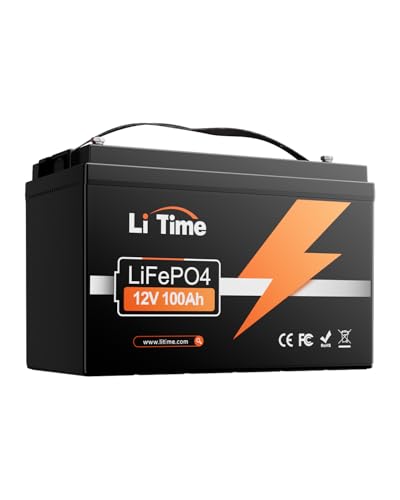
LiTime 12V 100Ah Group 31 LiFePO4 — Best Overall
LiTime’s 100Ah Group 31 is the battery this category is measured against, and it earns the overall badge by being the safest specification to build a system around. The listing states a 100A BMS, an IP65 waterproof rating, support for up to 4P4S configuration — four in parallel, four in series — and 1280Wh of energy, with a manufacturer-rated cycle life of up to 15,000 cycles at 60% depth of discharge. The Group 31 case is the de facto standard footprint for RV and marine battery boxes, so it drops into the space a pair of older batteries vacated, at a fraction of their weight.
Strengths
- Standard Group 31 size fits the battery boxes most RV and marine systems already have
- Up to 4P4S expansion lets one battery grow into a serious bank over time
- IP65 rating suits marine and exposed installations
Trade-offs
- No Bluetooth monitoring in this model — state of charge needs a separate shunt monitor
- 100A BMS caps inverter size at roughly the 1200W class per battery
- The headline cycle figure is at 60% depth of discharge; deeper cycling rates lower, as with all LiFePO4
Key specs (from the verified listing): Capacity: 12V 100Ah, 1280Wh · Size: Group 31 · BMS: 100A · Rating: IP65 waterproof · Expansion: up to 4P4S · Cycle rating: up to 15,000 cycles at 60% DOD (manufacturer figure) · Uses: RV, marine, solar, camper, off-grid
The 4P4S expansion is the spec to plan around even if you buy one battery today. In parallel, each added battery adds capacity and adds BMS current headroom; in series, batteries build 24V or 48V systems if your project ever grows that way. A battery that can grow with the system protects the first purchase — the most common lithium regret is buying a closed battery that cannot be matched later, then replacing the whole bank at the second stage. Buy the battery that your future system would have chosen.
Weight deserves a sentence of its own. A 100Ah lithium battery typically weighs around half what the lead-acid capacity it replaces weighed, and in an RV that difference is payload, fuel, and a battery you can lift out alone for winter storage. Owners consistently name the first lift as the moment the conversion justifies itself.
Best for: RV, marine, and solar systems built around the standard Group 31 footprint / Not suited for: buyers who want built-in Bluetooth monitoring in the battery itself
Check the current price on Amazon
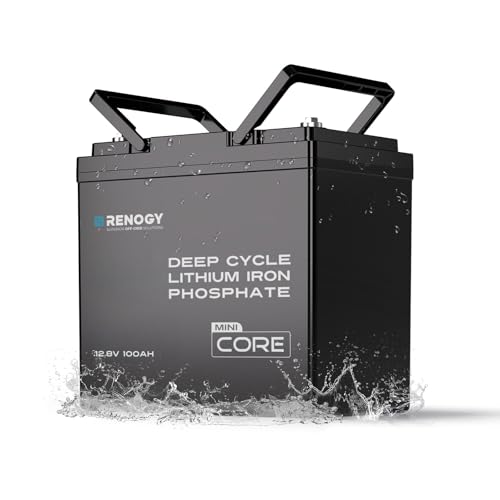
Renogy 100Ah LiFePO4 Lithium Battery, Mini Size — Best Compact
Renogy’s mini-format 100Ah answers a packaging problem: plenty of battery compartments — in smaller RVs, vans, boats, and portable power builds — cannot accept a Group 31 case, and until recently that meant accepting less capacity. This battery keeps the full 100Ah and a 100A BMS, adds an IP65 rating, and shrinks the case to a mini size, from a brand with a broad solar ecosystem behind it. Renogy positions it for RVs, boats, cabins, marine use, and solar off-grid systems, which is exactly the list of places battery space is precious.
Strengths
- Full 100Ah capacity in a mini-size case for tight compartments
- 100A BMS matches the big-case batteries — no power compromise for the size
- Renogy ecosystem suits buyers building a matched solar system
Trade-offs
- Non-standard footprint: measure your box rather than assuming a group size
- Brand-ecosystem batteries make most sense when the rest of the system matches
- Like the overall pick, monitoring is external rather than built into this listing’s headline features
Key specs (from the verified listing): Capacity: 12V 100Ah · Size: mini · BMS: 100A · Rating: IP65 waterproof · Uses: RV, boat, cabin, marine, solar off-grid, backup power
Measure before you fall in love — that is the whole discipline of compact batteries. Battery boxes have internal dimensions, cable bend radii, and hold-down arrangements that spec sheets forget. The mini format’s gift is that it converts previously wasted or impossible spaces into full-capacity storage: the under-seat compartment, the narrow locker, the portable build that travels between a boat and a cabin. If your compartment swallows a Group 31, the standard batteries are the simpler buy; if it does not, this is the battery that saves the project without a capacity sacrifice.
Best for: vans, small RVs, boats, and portable builds with tight battery compartments / Not suited for: standard Group 31 boxes where a full-size battery fits and costs less per amp-hour
Check the current price on Amazon

power queen 12V 100Ah LiFePO4 Battery Group 31 — Best Value
Power Queen built its name in this category by selling the standard specification — 12V, 100Ah, Group 31, 100A BMS, 1280Wh, up to 4P4S expansion, manufacturer-rated up to 15,000 cycles — at the value end of the market, aimed at motorhomes, trailers, camper vans, and solar off-grid systems. That is the correct way to compete in a maturing category: the specification is the product, and this battery matches the benchmark spec line for line while positioning itself as the value choice within it. Check price on Amazon for the current figure, since value positioning is a moving target in this market.
Strengths
- Full benchmark specification — Group 31, 100A BMS, 1280Wh, 4P4S — at a value position
- Expansion support matches the overall pick, so banks can grow
- Broad stated use range across RV, trailer, van, and solar
Trade-offs
- No Bluetooth or display features in this model’s headline specification
- Value brands ask the buyer to lean on the BMS specification rather than ecosystem support
- Cycle figure is a manufacturer rating under stated conditions, as with all picks here
Key specs (from the verified listing): Capacity: 12V 100Ah, 1280Wh · Size: Group 31 · BMS: 100A · Expansion: up to 4P4S · Cycle rating: up to 15,000 cycles (manufacturer figure) · Uses: motorhome, trailer, camper van, solar off-grid
The value question in lithium batteries deserves a straight answer, because buyers reasonably ask what the benchmark brands charge for. In this class, the honest answer is: mostly ecosystem, monitoring features, and support depth — not core capability. The cells, the BMS current rating, and the case standard are the capability, and this battery matches them. Where a buyer runs a single battery or a simple parallel bank with a separate shunt monitor — the most common real-world setup — the value pick delivers the same daily service as the benchmark. Where a buyer wants an integrated app ecosystem or a matched charger and controller family, the ecosystem brands earn their premium. Know which buyer you are.
Best for: budget-conscious RV and solar builds that want the full standard specification / Not suited for: buyers who want built-in monitoring or a single-brand system ecosystem
Check the current price on Amazon

Redodo 12V 100Ah LiFePO4 Battery, Group 31 — Best for RV and Marine
Redodo’s 100Ah Group 31 is specified with vehicle and water life at the center: a 100A BMS, 1280Wh, an IP65 waterproof rating, 4P4S expansion support, a manufacturer-rated 4000+ deep cycles, and a stated 10-year lifespan, for RV, marine, trolling motor, solar, and camping use. The cycle rating is more conservative than some headline figures in this guide, and there is an argument that conservative ratings are a mark of candor — cycle life depends heavily on how deeply and how fast a battery is cycled, and a maker who prints a sober number may be describing your actual usage more honestly.
Strengths
- IP65 rating and vehicle/marine positioning suit exposed, moving installations
- 4P4S expansion supports growing from one battery to a bank
- Conservative, clearly stated cycle and lifespan figures
Trade-offs
- Lower headline cycle rating than some rivals — read the conditions, not just the number
- No Bluetooth monitoring in this model’s listing
- 100A BMS sets the same per-battery inverter ceiling as its peers
Key specs (from the verified listing): Capacity: 12V 100Ah, 1280Wh · Size: Group 31 · BMS: 100A · Rating: IP65 waterproof · Expansion: 4P4S · Cycle rating: 4000+ deep cycles (manufacturer figure) · Lifespan: 10 years (manufacturer figure) · Uses: RV, marine, trolling motor, solar, camping
For RV and marine buyers specifically, the practical checklist matters more than the spec duel: does it fit the box (Group 31, yes), does it tolerate the environment (IP65, yes), can it parallel with a second unit next season (4P4S, yes), and will its BMS feed your inverter (100A, so a roughly 1200W class inverter per battery, more in parallel). The Redodo checks every line without drama, which is why it takes the vehicle badge in a field of very similar batteries. Our companion guide to the Best 12 Volt Lithium Battery For Rv goes deeper on the RV-specific sizing questions.
Best for: RV and marine house banks, trolling setups, and owners who value sober specifications / Not suited for: buyers prioritizing the highest headline cycle figure above all else
Check the current price on Amazon

LiTime 12V 50Ah LiFePO4 with Bluetooth — Best Small Capacity
Not every system needs 100Ah, and oversizing a battery is its own waste. LiTime’s 50Ah is the considered small battery: 640Wh, a 50A BMS, Bluetooth monitoring, low-temperature protection, an IP65 rating, and a manufacturer-rated 4000+ cycles, positioned for trolling motors, fish finders, kayaks, RV and boat auxiliary use. The Bluetooth is the feature that changes daily life at this scale — small systems rarely justify a wired shunt monitor, so an app readout of charge state, voltage, and current turns guesswork into knowledge on a phone you already carry.
Strengths
- Bluetooth monitoring built in — rare and genuinely useful at this size
- Low-temperature protection guards against charging damage in cold conditions
- 50Ah/640Wh is honestly sized for kayaks, fish finders, and small auxiliary systems
Trade-offs
- 50A BMS limits loads to the 600W class — this is not an inverter battery for big appliances
- Half the capacity of the 100Ah picks; a growing system will outgrow it
- Small batteries cost more per amp-hour than the 100Ah class
Key specs (from the verified listing): Capacity: 12V 50Ah, 640Wh · BMS: 50A · Monitoring: Bluetooth · Protection: low-temperature protection, IP65 · Cycle rating: 4000+ deep cycles (manufacturer figure) · Uses: trolling motors, fish finder, RV, boat, kayak, marine
Low-temperature protection deserves emphasis at this size, because small batteries live outdoors — in kayaks, in unheated boat lockers, in ice-fishing and fish-house setups where the battery charges in the cold by design. A small battery without cold protection on a solar maintainer in a northern winter is a battery being slowly charged to death by its own support system. This one refuses the harmful charge and waits for warmth, which is exactly the judgment you are paying a BMS to exercise.
The use case that sells this battery is the kayak and the small boat, where weight is carried by a person, not a vehicle, and every pound is felt at the launch ramp. A 50Ah lithium battery delivers the usable energy of a much heavier lead-acid unit in a package one person manages easily, runs a trolling motor or a day of electronics, and reports its own state to your phone. For a fish finder and lights on a small system, it is not the budget option — it is the correct option, sized to the job.
Best for: kayaks, small boats, fish finders, and compact auxiliary systems / Not suited for: house banks or inverter loads above its 50A BMS class
Check the current price on Amazon

ECO-WORTHY 12V 314Ah LiFePO4 with Bluetooth — Best High Capacity
At the top of the range, the arithmetic changes: instead of paralleling several 100Ah batteries, a single high-capacity unit like ECO-WORTHY’s 314Ah delivers 4019Wh behind a 200A BMS, with Bluetooth monitoring, state-of-charge LEDs on the battery itself, low-temperature protection, and a manufacturer rating of up to 15,000 deep cycles. One battery means one set of connections, one BMS governing the whole bank, and a 200A continuous rating that supports a roughly 2400W inverter class — the territory where an off-grid home or a large RV stops rationing.
Strengths
- 314Ah/4019Wh in a single unit — fewer connections, one governing BMS
- 200A BMS supports serious inverter loads
- Bluetooth plus on-battery SOC LEDs give monitoring with or without a phone
Trade-offs
- A single large battery is heavy and a single point of failure — plan handling and spares thinking accordingly
- Oversized for small systems; capacity you never cycle is money parked
- Low-temperature protection manages cold charging, but cold-weather capacity planning still applies
Key specs (from the verified listing): Capacity: 12V 314Ah, 4019Wh · BMS: 200A · Monitoring: Bluetooth, SOC LEDs · Protection: low-temperature protection · Cycle rating: up to 15,000 deep cycles (manufacturer figure) · Uses: off-grid, RV, solar power system, home backup
The single-big-battery versus parallel-bank debate is a real engineering choice, and this pick represents one side honestly. Parallel banks distribute failure and let you buy capacity in stages; a single large unit simplifies wiring, eliminates balance questions between batteries, and gives one BMS a complete view of the system. For a home backup or a full-time off-grid build where the bank is installed once and expected to serve for years, the single unit’s simplicity is a genuine architecture advantage. For an RV that may grow in stages, the 100Ah building blocks remain the flexible path.
Home backup deserves its own sentence, because it is the use case quietly driving this battery class. A 4019Wh bank behind a right-sized inverter carries a fridge, lights, communications, and device charging through an outage measured in days rather than hours, silently, with no fuel and no fumes — the two things generator backup cannot promise. Paired with even a modest solar array, the system recharges itself each day the sun cooperates. For a home that loses power a few times a year, that is not an enthusiast’s toy; it is the difference between an outage as an inconvenience and an outage as a spoiled freezer and a dark house.
Best for: off-grid homes, home backup, and large RV systems wanting maximum capacity in one unit / Not suited for: small systems, staged budgets, or anyone who cannot manage the unit’s weight
Check the current price on Amazon
Comparison Table
| Pick | Badge | Key spec | Best for |
|---|---|---|---|
| LiTime 12V 100Ah Group 31 | Best Overall | 100Ah, 100A BMS, IP65, 4P4S | Standard RV/marine/solar systems |
| Renogy 100Ah Mini | Best Compact | 100Ah mini size, 100A BMS, IP65 | Tight battery compartments |
| power queen 12V 100Ah | Best Value | Group 31, 100A BMS, 1280Wh, 4P4S | Value-focused standard builds |
| Redodo 12V 100Ah | Best for RV and Marine | Group 31, IP65, 4000+ cycles (mfr) | Vehicle and boat house banks |
| LiTime 12V 50Ah Bluetooth | Best Small Capacity | 50Ah, 640Wh, Bluetooth, low-temp protection | Kayaks and small systems |
| ECO-WORTHY 12V 314Ah | Best High Capacity | 314Ah, 4019Wh, 200A BMS, Bluetooth | Off-grid homes and big banks |
How to Choose a 12 Volt Lithium Battery
Size the capacity from your loads, not from your fears. List what runs on the system in a day, in watt-hours: lights, fridge, pump, fans, devices, the TV from our Best 12 Volt Led Tv guide. Divide by 12 for amp-hours. Then choose a battery — or a bank — whose rated capacity covers that daily figure with room for a cloudy day or a late arrival, remembering that lithium lets you use nearly all of what you bought. Most single-battery RV and cabin systems land at 100Ah; serious off-grid homes land at several hundred.
Check the BMS against your biggest load, because this is where systems actually fail. The BMS continuous rating in amps, times 12 volts, is roughly the wattage it can feed continuously. A 100A BMS serves about a 1200W inverter; a 200A BMS about 2400W. An inverter larger than the BMS behind it will trip the battery’s protection exactly when you run the microwave — not a defect, a design mismatch. Paralleling batteries adds their BMS ratings together, which is one more reason expandable batteries age well.
Confirm the cold plan. LiFePO4 batteries discharge happily in cold weather at reduced capacity, but charging below freezing damages cells, so the BMS must refuse it. Picks here that list low-temperature protection handle this automatically. If your battery will charge in an unheated space in winter — from solar, a vehicle alternator, or shore power — treat low-temperature protection as mandatory, or plan to warm the battery before charging.
Do not overlook the charger’s side of the bargain. A lithium battery charged by a quality lithium-profile charger lives its best life; the same battery floated indefinitely at a lead-acid charger’s habits ages faster than its cycle rating promises. If your converter or solar controller has no lithium profile, upgrading that component can matter more to the battery’s decade than which of these six batteries you chose. Systems fail and succeed as systems.
Finally, decide your monitoring. A battery without Bluetooth needs a shunt-based monitor to report state of charge accurately, because lithium’s flat voltage curve makes a simple voltmeter nearly useless as a fuel gauge. Budget for one or the other. Flying blind on state of charge is how owners conclude, wrongly, that their battery “doesn’t hold charge like it used to.”
LiFePO4 vs Lead-Acid: Where the Money Actually Goes
The comparison that matters is not the purchase price of one battery against another; it is the cost of a decade of usable energy. Start with usable capacity. A 100Ah lead-acid battery should only be drawn to about half its rating if you want it to live, so it delivers roughly 50 usable amp-hours. A 100Ah LiFePO4 battery delivers close to its full 100. On a usable-energy basis, the lithium battery is already twice the battery its label suggests when placed next to lead-acid. Continue with cycle life: lead-acid house batteries are typically rated in the hundreds of cycles at that 50% depth, while the manufacturer ratings in this guide run from 4000 cycles upward. A system that cycles daily can consume a lead-acid bank in two or three seasons and a lithium bank in a decade or more. Divide price by lifetime usable energy and the category’s direction of travel explains itself.
Then count the secondary effects, which owners consistently report as the ones they feel. Lithium charges faster and accepts charge efficiently right up to full, so a short solar window or a brief engine run accomplishes more. Its voltage stays nearly flat across discharge, so lights do not dim and pumps do not weaken as the evening wears on — the flat curve is why a shunt monitor is necessary, but it is also why the system feels stronger all day. It weighs about half as much, which in a vehicle is payload and in a boat is trim. And it does not need watering, venting consideration for hydrogen in the same way, or the gentle treatment lead-acid demands. The honest debits are the purchase price, the cold-charging rule, and the need for lithium-aware charging profiles. For a system used occasionally and kept on a maintainer, lead-acid can still pencil out; for a system cycled regularly, the lithium case is arithmetic, not enthusiasm.
What Do Series and Parallel Actually Mean for Your Bank?
The “4P4S” language in several listings is a promise about how batteries may be combined, and it is worth understanding before you need it. Batteries in parallel — the P — keep the voltage at 12V and add their capacities and their BMS current ratings together: two 100Ah batteries in parallel are a 200Ah bank that can feed roughly 200A. Batteries in series — the S — add voltage: two in series make a 24V system, four make 48V, each keeping the single battery’s amp-hour rating. A battery rated 4P4S may be used in banks of up to four parallel and four series, which covers everything from a single RV battery to a 48V off-grid array built from the same unit.
Two disciplines govern combinations. Combine identical batteries — same model, same age, ideally bought together — because mismatched batteries share work unevenly and age each other. And wire parallel banks so that every battery sees the same cable lengths to the load, taking the bank’s positive feed from one end and the negative from the other, so current shares evenly rather than favoring the nearest battery. These are not refinements; done wrong, they are the difference between a bank that ages together and one that consumes its weakest member and then complains about it.
How Should You Store a Lithium Battery Over Winter?
Store it partly charged, cool, and disconnected. The widely used practice for LiFePO4 storage is a partial state of charge — roughly half — rather than brim-full or empty, in a cool dry place, with the battery disconnected from all loads and chargers so nothing can sip or push against it for months. Check it once mid-storage; a healthy lithium battery self-discharges very slowly, and a battery found empty in spring was usually left connected to a parasitic load, not failed. Before the season, charge fully, let the monitor synchronize at full, and the system starts the year honest. Owners in freezing climates should also remember the asymmetry: storage in the cold is fine, discharging in the cold is fine at reduced capacity — it is charging in the cold that the battery must be protected from, by its BMS or by your discipline.
How to Install and Commission a 12V Lithium Battery
Step 1 — Charge it fully first. Before installation, charge the new battery to full with a lithium-profile charger. Batteries ship partially charged, and starting from a known full state makes commissioning and later troubleshooting honest.
Step 2 — Set the charger profiles to lithium. Every charger in the system — solar controller, converter, alternator charger — must be set to its LiFePO4 profile or the manufacturer’s specified voltages. A lead-acid profile with an equalization stage can stress a lithium battery; disable equalization anywhere it exists.
Step 3 — Install with proper cabling and fusing. Secure the battery against movement, use cables sized for the BMS current, and fit a fuse close to the positive terminal rated for the circuit. Torque the terminals to specification — loose terminals are the leading cause of hot connections and mysterious voltage drops.
Step 4 — Verify under load. Run the system’s biggest load and watch the monitor: voltage should hold steady, current should match expectations, and nothing should warm up at the connections. Check again after the first full discharge-charge cycle.
Step 4b — Label everything. While the system is open and the decisions are fresh, label the battery with its install date and capacity, label each cable’s destination, and write the bank’s total amp-hours where the next person to service it will look. Lithium systems live for a decade; the installer will not remember year one in year seven, and the label is the memory.
Step 5 — Configure the monitor. Set the battery monitor’s capacity to the installed amp-hours and synchronize it at a known full charge. An unconfigured monitor is a random number generator with a confident display.
Why Did My Lithium Battery Shut Down, and What Should I Check?
A lithium battery that “dies” suddenly has almost always protected itself, and the BMS event log — visible in the app on Bluetooth models — usually says why. Work the causes in order of likelihood. Over-current: a load, usually an inverter surge, exceeded the BMS rating; the cure is load discipline, a bigger BMS class, or a parallel battery to share the draw. Low-voltage disconnect: the bank was simply emptied; the cure is a recharge and an honest look at the sizing math, plus a monitor alarm set well before empty so it does not recur. Low-temperature charge protection: the battery refused a cold charge, which is the protection working as designed; warm the battery space and charging resumes. A single weak connection: a loose or corroded terminal creates voltage drop that the BMS reads as a battery problem; torque and clean the connections before condemning anything with a warranty.
Waking a protected battery follows the maker’s procedure — typically applying a charger that can wake a sleeping BMS, or a brief load or charge pulse as the manual directs. What not to do is open the case: the BMS and cells are a sealed system, and the warranty and the safety case both live in that seal. Nearly every shutdown story in this category ends with a setting, a connection, or a load — not a dead battery — and owners who learn the four causes above stop having the stories.
Common Buying Mistakes
Sizing the inverter beyond the BMS. The battery will protect itself by shutting down, and the owner will blame the battery. Match inverter, BMS, and cabling as one decision.
Judging by headline cycle numbers alone. Cycle ratings depend on depth of discharge and test conditions, and makers state them differently. Read the conditions — one pick here rates at 60% depth of discharge — and compare like with like.
Skipping low-temperature protection in a cold climate. One frozen morning’s automatic solar charge can permanently cost a battery capacity. The protection is cheap; the lesson is not.
Leaving chargers on lead-acid profiles. The battery will charge, imperfectly and sometimes harmfully, and the owner will blame lithium. Profiles are a five-minute setting with decade-long consequences.
Comparing batteries by amp-hours alone. Two “100Ah” batteries can differ in BMS rating, low-temperature protection, expansion support, and monitoring — the four things that decide daily life with the battery. The amp-hours get you into the category; the rest of the specification decides whether you stay happy there.
Forgetting the weight is a feature. Owners migrating from lead-acid often plan the same two-person lift and the same reinforced mounting out of habit. A lithium battery at half the weight can go in places and be serviced by people the old bank excluded — plan the installation around the battery you bought, not the one you replaced.
Buying a closed battery for a system that will grow. If a second battery is even a possibility, buy the expandable model first. Matching a discontinued or non-expandable battery later is how banks get replaced whole.
Final Recommendation
Most buyers should start with the LiTime 100Ah Group 31: the standard footprint, expandable, weather-rated, and proven in the largest number of real systems. Tight compartments point to the Renogy Mini, value-focused builds to the power queen, and vehicle-first buyers to the Redodo. Small systems are best served honestly by the LiTime 50Ah with Bluetooth, tight compartments by the Renogy Mini, and serious storage by the ECO-WORTHY 314Ah. Whichever you choose, the loads it will carry are covered across this series — Best 12 Volt Lights For Homes for the lighting plan, Best 12 Volt Led Under Cabinet Lighting for the galley, and Best 12 Volt Led Work Light for the jobs the system makes possible after dark.
Frequently Asked Questions
Can I mix an old and a new lithium battery in one bank?
Manufacturers advise against it, and the advice is sound: batteries of different ages and histories have different capacities and internal resistances, so they share charge and discharge unevenly and the bank performs to its weakest member while aging the strongest. If expansion is likely, buy identical batteries close together in time — one more reason the expandable, continuously available models in this guide are the safer foundation.
How long does a 100Ah lithium battery run an RV?
It depends entirely on the loads, which is why the sizing method in this guide works in watt-hours. As a feel for scale: 100Ah is 1280Wh, and lithium lets you use nearly all of it. A frugal RV day — LED lights, water pump, device charging, some TV — can fit inside that with room to spare; add a big inverter load or electric heating and no single battery is the right answer. Most owners who boondock seriously run two or more in parallel.
Can I replace my lead-acid batteries with lithium directly?
Physically, usually yes — the Group 31 picks fit the same boxes at about half the weight. Electrically, you must set every charger to a lithium profile and confirm your alternator charging arrangement suits lithium, which in vehicles often means a DC-DC charger. The battery swap is easy; the charging system is the actual project.
What does the BMS do, and why does its rating matter?
The battery management system protects the cells from over-charge, over-discharge, over-current, short circuits, and — on equipped models — cold charging. Its continuous amp rating is the ceiling on what the battery can deliver: exceed it and the BMS disconnects to protect the battery. Size it to your largest load, typically the inverter.
Can lithium batteries be charged in freezing weather?
Not safely without protection. Charging LiFePO4 below freezing damages the cells. Batteries with low-temperature protection — several picks here list it — refuse the charge until the battery warms. If your system charges unattended in winter, that protection is not optional.
How long will a LiFePO4 battery last?
Manufacturers rate these batteries in the thousands of cycles — figures in this guide range from 4000+ cycles to up to 15,000 under stated conditions — which for typical RV and cabin use translates to many years, often a decade class of service, as Redodo’s listing states outright. Calendar aging and treatment matter as much as cycle count: cool storage, sane charging, and avoiding permanent full or empty states all extend real life.
Can I charge a 12V lithium battery from my vehicle’s alternator?
Yes, with the right equipment between them. A lithium battery’s low resistance lets it draw very high current from an alternator, which can overheat the alternator and gives you no control over the charge profile. The standard solution is a DC-DC charger sized to the alternator, which limits current, applies a proper lithium profile, and protects both sides. Direct connection is a shortcut this guide does not recommend for any of these batteries.
Is it safe to install a lithium battery inside the living space?
LiFePO4 is the lithium chemistry chosen for occupied spaces precisely because of its stability: it does not vent flammable gases in normal use like charging lead-acid can, and it is far more tolerant of abuse than other lithium chemistries. Install it secured against movement, with fused cabling and ventilation as the maker directs, and it is appropriate for the under-bed and under-seat locations RV builders use routinely. The batteries in this guide are LiFePO4; that chemistry choice is itself the safety decision.
Do I need a special monitor for a lithium battery?
You need some accurate state-of-charge method. Lithium’s voltage barely changes across most of its charge range, so a voltmeter cannot tell 70% from 30%. Either choose a battery with Bluetooth monitoring, like the LiTime 50Ah and ECO-WORTHY 314Ah here, or fit a shunt-based monitor and configure it to your bank’s capacity. Our Best 12 Volt Led Test Light guide covers the basic electrical checks while you are working around the system.


