Disclosure: airfryerkitchensupply.com is reader-supported. When you buy through links on our site, we may earn an affiliate commission at no extra cost to you.
Where to buy
Looking for best 12 volt laptop that you can buy with confidence? Every verified pick in this guide is sold on Amazon, so you can check live availability, delivery options for your area, and the current price on Amazon before you commit. Start with our top choice, the Belker 100W USB-C Universal Laptop Car Charger (Best Overall) — check price on Amazon. If that does not fit your setup, work down the Quick Picks list below: each pick links straight to its Amazon listing where a verified listing exists, and prose-only picks are clearly marked so you know exactly what you are getting with best 12 volt laptop.
Here is the truth that organises everything about best 12 volt laptop searches: there is no mainstream laptop that runs directly on 12 volts. Laptops charge at higher, negotiated voltages — USB-C power delivery climbs well above 12V, and older machines each drank from their own brand-specific adapter. What “12 volt laptop” shopping actually means is powering a laptop from a 12V vehicle system, and that is a real, solvable problem with three honest solutions: a dedicated DC car charger matched to your machine, a high-power USB-C car charger for modern laptops, or an inverter that lets you use the wall adapter you already own. This guide reviews the best verified examples of each route.
Why the distinction matters: the wrong bridge wastes money or worse. A charger with insufficient wattage leaves a big laptop crawling; a mismatched tip can fail to charge or, in careless cases, stress the machine; an undersized inverter trips mid-journey. The right bridge, matched once and kept in the car, turns dead travel time into full batteries — the commute becomes the charge, the road trip becomes the office’s power supply. Every pick below was verified against current catalogue data, with wattage and compatibility stated from the listings themselves.
The six picks divide by machine and by philosophy: a universal 100W all-rounder, a 140W USB-C specialist for flagships, a legacy-friendly universal for older laptops, an ultra-compact glovebox charger, and two inverters for those who prefer their original wall adapters. Read the wattage sections in the buying guide before choosing — five minutes with your laptop’s own adapter label will tell you which third of this guide is yours.
In this guide
Quick Picks
Short on time? These are the six best 12 volt laptop options we would actually spend money on, each chosen for a different job. The badge next to each name is the same badge used in its full review further down, so you can jump straight to the detail.
- Belker 100W USB-C Universal Laptop Car Charger — Best Overall: A universal car charger delivering up to 100W over USB-C with 16 tips for barrel-plug laptops, covering HP, Dell, Asus, Lenovo, Samsung, MacBook, and Chromebooks. One charger for the household’s whole laptop fleet is exactly what car charging should be. Check price on Amazon.
- HKY 140W USB-C Laptop Car Charger PD 3.1 — Best High Power: The heavy lifter: up to 140W over USB-C PD 3.1, enough for a 16-inch MacBook Pro and the hungriest USB-C workstations, from a 12V–24V socket. If your laptop is big, expensive, and always nearly empty, this is your charger. Check price on Amazon.
- KFD 100W Universal Car Charger — Best for Older Laptops: A 100W universal car adapter whose brand list reads like a museum of laptop history — IBM, Toshiba, Sony and all — making it the pick for the older, barrel-plug machines that USB-C chargers have left behind. Check price on Amazon.
- LVSUN 90W Universal Laptop Car Charger — Best Compact: An ultra-small 90W universal car charger with a bonus USB-A port for a phone alongside the laptop. It disappears into a glovebox or laptop bag, which is exactly where a car charger should live until the day it saves one. Check price on Amazon.
- BESTEK 300W Power Inverter — Best Inverter Route: A different philosophy: instead of a dedicated laptop charger, a 300W inverter that turns the car into a 110V outlet, so the laptop’s own wall adapter — and anything else with a plug — works exactly as it does at home. Check price on Amazon.
- FOVAL 150W Car Power Inverter — Best Budget Inverter: The smaller, cheaper inverter: 150W of AC for a laptop’s wall adapter plus dual USB at 3.1A. Enough for one laptop and phones, sized and priced for drivers who want the inverter option without the 300W commitment. Check price on Amazon.
How These Picks Were Chosen
We chose these products by treating the category honestly: since no 12V-native laptop exists to recommend, we selected the best verified ways to power real laptops from a 12V system. Each pick had to state its wattage and compatibility plainly in its listing — universal chargers with named brand coverage, USB-C chargers with real PD ratings, inverters with clear AC capacity — because in this category a vague listing is a useless one.
Coverage was balanced deliberately across the laptop population: modern USB-C flagships, mainstream ultrabooks, older barrel-plug machines, and the inverter-preferring households in between. Wattage ceilings are stated as limits, not marketing, and the reviews repeatedly direct you to your own adapter’s label as the final authority. Every model was cross-checked against current catalogue data before inclusion, and none is described as a “12 volt laptop,” because none is — they are the best answers to what that search really asks.
Two picks anchor this guide and are worth naming here: the Belker 100W USB-C Universal Laptop Car Charger as our leading recommendation, and the HKY 140W USB-C Laptop Car Charger PD 3.1 as the strongest alternative for a different set of needs. The full reasoning for both — and for the four picks behind them — is in the reviews below.
The 6 Best 12 Volt Laptop

Belker 100W USB-C Universal Laptop Car Charger — Best Overall
Start with the honest framing this whole guide depends on: laptops are not 12V devices. They charge at various higher voltages negotiated over USB-C or delivered through brand-specific plugs, and the “12 volt laptop” product that actually exists is the car charger that bridges your vehicle’s 12V socket to your laptop’s expectations. The Belker is the best of those bridges we verified: up to 100W of output, USB-C for modern machines, and 16 tips for the barrel-plug generation, spanning the major brands from HP and Dell to Lenovo, Asus, Samsung, Apple, and Chromebook lines. For most drivers, this one box ends the problem.
Strengths
- Up to 100W covers most ultrabooks and many full-size laptops at full charging speed
- USB-C plus 16 tips spans modern and older laptops in one purchase
- Brand coverage across the major makers suits multi-laptop households
Trade-offs
- Very high-power gaming and workstation laptops may charge slowly or only hold charge under heavy load
- Tips must be matched carefully to the laptop — keep the set together and labelled
- Like all car chargers, it works best with the engine running on longer sessions
| Specification | Detail |
|---|---|
| Output | Up to 100W (100W/90W/65W classes) |
| Connections | USB-C plus 16 tips |
| Input | 12V–24V vehicle socket |
| Coverage | HP, Dell, Asus, Lenovo, Samsung, MacBook, Chromebook and more |
The Belker’s value is fleet logic. A household with a work ultrabook, a partner’s older Dell, and a child’s Chromebook otherwise needs three chargers rattling in three cars; one universal unit per car, with its tips kept in a labelled pouch, quietly solves all of it. Match the tip or USB-C wattage to each machine once, note what works on the pouch, and the system becomes thoughtless. Under heavy gaming loads a 100W ceiling may mean the battery holds rather than gains — a limitation of physics shared by every pick here — but for work, study, streaming, and travel computing, this is full-speed charging from a socket that was designed for a cigarette lighter. That remains a small miracle worth buying properly.
Best for: Multi-laptop households and drivers wanting one charger for everything / Not suited for: High-power gaming laptops used at full load in the car
Check on Amazon — check the current price on Amazon and confirm the listing matches the model described here before ordering.

HKY 140W USB-C Laptop Car Charger PD 3.1 — Best High Power
Some laptops sip; the big creative and workstation machines drink. A 16-inch MacBook Pro or a high-spec Dell XPS under load wants well over 100W to charge at full speed, and lesser car chargers leave it crawling or merely holding on. The HKY PD 3.1 unit is built for that class, delivering up to 140W over USB-C from a 12V–24V vehicle supply. It is a specialist’s pick — pure USB-C, no barrel tips — aimed at owners of modern high-power machines who work from the road and cannot accept a charger that gives up at motorway services. If your laptop’s own wall adapter is a big brick, this is the car charger that respects it.
Strengths
- Up to 140W PD 3.1 matches the fastest USB-C laptop charging classes
- Built for flagship machines — MacBook Pro 16, XPS, Latitude class
- 12V–24V input suits cars and trucks alike
Trade-offs
- USB-C only, so older barrel-plug laptops need a different pick
- Maximum output demands a healthy socket and wiring — cheap splitters need not apply
- Overkill, in size and cost, for a 45W Chromebook
| Specification | Detail |
|---|---|
| Output | Up to 140W (PD 3.1) |
| Connection | USB-C |
| Input | 12V–24V DC |
| Targets | MacBook Pro/Air, Dell XPS/Latitude, and similar |
High-power car charging is an exercise in respecting the chain: socket, wiring, charger, cable, laptop. The HKY handles its link properly, but owners should complete the chain — a quality USB-C cable rated for the wattage, a direct socket connection rather than a bargain splitter, and an engine running during fast-charge sessions so the vehicle battery is a pass-through, not the source. Do that, and the road stops being a battery-management exercise: edit in the passenger seat, render at the services, arrive with a full machine. Road-warrior professionals will not need convincing; everyone else should check their laptop’s wattage first, because most machines are happily served by the cheaper picks around this one.
Best for: Owners of high-power USB-C laptops who work from the road / Not suited for: Barrel-plug laptops or low-power Chromebooks
Check on Amazon — check the current price on Amazon and confirm the listing matches the model described here before ordering.

KFD 100W Universal Car Charger — Best for Older Laptops
The laptops most stranded by the USB-C transition are the ones still doing honest work: the older Lenovo, the family Toshiba, the Acer that runs the workshop software. Their barrel plugs and varied voltages are invisible to modern USB-C chargers. The KFD universal adapter exists for them — 100W of output, 12V–24V input, and a compatibility brief spanning Lenovo and IBM, HP, Dell, Acer, Asus, MSI, Toshiba, LG, Sony, and Samsung. If the laptop you need to power in the car predates the USB-C era, or mixes awkwardly with it, this is the bridge built for your machine.
Strengths
- Legacy brand coverage includes IBM, Toshiba, and Sony-era machines
- 100W output handles full-size older laptops, not just ultrabooks
- 12V–24V input covers cars and trucks
Trade-offs
- Tip-and-voltage matching demands care — verify polarity and rating before first use
- No USB-C fast-charge finesse for modern machines
- Universal adapters reward a methodical first setup, not plug-and-pray
| Specification | Detail |
|---|---|
| Output | 100W universal adapter |
| Input | 12V–24V DC |
| Coverage | Lenovo/IBM, HP, Dell, Acer, Asus, MSI, Toshiba, LG, Sony, Samsung |
| Style | Multi-tip universal car charger |
Universal adapters live or die on setup discipline. Before the first journey: find your laptop’s required voltage and polarity from its original adapter, select the matching tip, and test at home in the driveway with the engine running. Label the winning tip — a dot of paint or a tag — so the choice never has to be remade in a dark car park. Done once, done properly, the KFD turns a stranded older laptop into a fully mobile one, which for many owners resurrects a machine they had written off for travel. That resurrection, at car-charger money, is one of the best-value outcomes in this entire guide.
Best for: Owners of older barrel-plug laptops from any major brand / Not suited for: USB-C-only modern ultrabooks
Check on Amazon — check the current price on Amazon and confirm the listing matches the model described here before ordering.

LVSUN 90W Universal Laptop Car Charger — Best Compact
The best car charger is the one that is in the car. The LVSUN’s ultra-small body is designed around that truth: it takes almost no space in a glovebox, centre console, or laptop sleeve, yet still delivers 90W of universal laptop charging and throws in a USB-A port delivering 5V 2.4A for a phone at the same time. Compatibility covers the mainstream brands such as Asus and HP among others. It will not win a wattage contest against the 140W specialist, and it does not try to; it wins the contest that matters on the day your battery dies at a client’s car park — the contest of being there.
Strengths
- Ultra-small body lives permanently in the car without costing space
- 90W covers the great majority of everyday laptops
- Bonus USB-A port charges a phone alongside the laptop
Trade-offs
- 90W ceiling means flagship machines charge at reduced speed
- Universal tips still need the careful first matching
- Compact body has less thermal headroom for all-day maximum-output sessions
| Specification | Detail |
|---|---|
| Output | 90W laptop charging |
| Extra port | USB-A 5V 2.4A |
| Input | Vehicle socket (cigarette lighter) |
| Style | Ultra-small universal charger |
Treat the LVSUN as insurance you can see. Buy it before you need it, match its tip to your laptop on a quiet afternoon, coil it into the glovebox, and forget it — until the conference, the site visit, or the delayed train replacement bus where it pays for itself in one afternoon. The phone port is a small mercy that prevents the classic two-device triage at 4% battery. Drivers who already know they need sustained maximum wattage should buy the HKY instead; drivers whose need is “sometimes, suddenly, completely” should buy this one and put it where their future self will find it.
Best for: Drivers wanting a permanent glovebox charger for occasional rescues / Not suited for: Daily high-power charging of flagship laptops
Check on Amazon — check the current price on Amazon and confirm the listing matches the model described here before ordering.
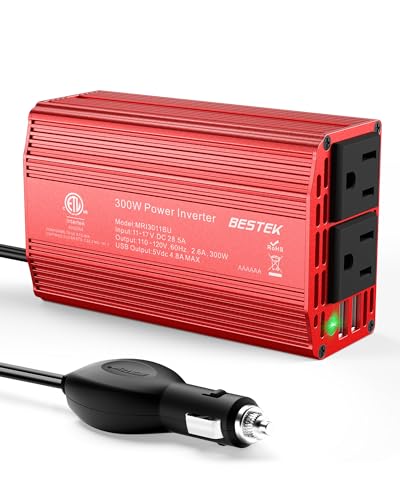
BESTEK 300W Power Inverter — Best Inverter Route
Every other pick in this guide replaces your laptop’s charger; the BESTEK inverter employs it. By converting the car’s DC supply to 110V AC at up to 300W, it lets you plug in the original wall adapter your laptop shipped with — the one guaranteed compatible, at full rated speed — plus a second device, with dual USB ports sharing 4.8A for phones and tablets. The cost of that universality is efficiency: converting DC to AC and back to DC wastes energy as heat, and the inverter itself is a bulkier object than a dedicated charger. For drivers who carry several plug-in devices, or whose laptop has an unusual proprietary adapter, that trade is often the right one.
Strengths
- Works with the laptop’s own guaranteed-compatible wall adapter
- 300W capacity covers laptops plus another modest AC device
- Dual USB ports handle phones and tablets without extra chargers
Trade-offs
- Double conversion wastes energy versus a dedicated DC charger
- Bulkier than a dedicated car charger and needs airflow while running
- 300W is a ceiling, not a suggestion — high-draw appliances stay home
| Specification | Detail |
|---|---|
| Output | 300W AC inverter |
| AC output | 110V outlet |
| USB | Dual USB, 4.8A shared |
| Input | 12V vehicle socket |
The inverter route shines on mixed-device journeys: laptop on its own adapter, a camera battery charger beside it, phones on USB, all from one unit in the footwell. Respect its limits and it is flawless — keep total draw comfortably under the rating, give the casing air, run the engine during long sessions, and never plug in heating appliances, which belong to a different universe of wattage. Households with one car and many gadgets often find the inverter quietly becomes the most borrowed object they own. It is less elegant than a dedicated charger and more capable than any of them; choose by whether your problem is one laptop or everything you carry.
Best for: Mixed-device travellers who want to use original wall adapters / Not suited for: Single-laptop users wanting maximum efficiency and minimum bulk
Check on Amazon — check the current price on Amazon and confirm the listing matches the model described here before ordering.
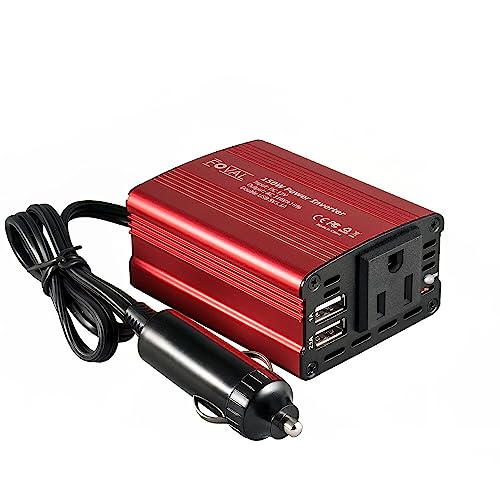
FOVAL 150W Car Power Inverter — Best Budget Inverter
Not every inverter buyer needs 300W. A single laptop on its wall adapter typically sits comfortably within 150W, and the FOVAL serves exactly that brief at a friendlier size and cost: one AC outlet for the laptop brick, dual USB sharing 3.1A for phones, and a body that stows more easily than its bigger sibling. It shares the inverter family’s honesty notes — conversion losses, engine-running discipline for long sessions, and a hard ceiling that excludes hungry appliances — but for the one-laptop traveller it is the proportionate choice. Buy the 300W if your gadget bag is a ecosystem; buy this if it is a laptop and a phone.
Strengths
- 150W is honestly sized for one laptop on its own adapter
- Dual USB covers phones without a second charger
- Smaller and cheaper than the 300W route
Trade-offs
- No headroom for a second AC device of any size
- Same double-conversion losses as any inverter
- Ceiling demands respect — check your adapter’s wattage before relying on it
| Specification | Detail |
|---|---|
| Output | 150W AC inverter |
| AC output | 110V outlet |
| USB | Dual USB, 3.1A shared |
| Input | 12V DC vehicle socket |
The FOVAL’s discipline is matching: read your laptop adapter’s wattage — it is printed on the brick — and confirm it sits comfortably under 150W with margin for the startup moment. Most ultrabooks and mainstream laptops pass easily; gaming bricks do not, and should use a dedicated high-power DC charger from this guide instead. Within its brief, the little inverter is a pleasingly simple object: plug in, plug in, drive, arrive charged. It also makes an excellent second-car or student-car purchase, where budgets are real and the device list is short. Proportion is a virtue in car accessories, and this is the proportionate inverter.
Best for: One-laptop travellers wanting the inverter route on a budget / Not suited for: Multi-device setups or high-wattage gaming laptops
Check on Amazon — check the current price on Amazon and confirm the listing matches the model described here before ordering.
Comparison Table
| Pick | Badge | Key spec | Best for | Amazon |
|---|---|---|---|---|
| Belker 100W USB-C Universal Laptop Car Charger | Best Overall | Up to 100W; USB-C plus 16 tips; wide brand coverage | Multi-laptop households and drivers wanting one charger for everything | Check price |
| HKY 140W USB-C Laptop Car Charger PD 3.1 | Best High Power | Up to 140W USB-C PD 3.1; 12V–24V; MacBook Pro 16 class | Owners of high-power USB-C laptops who work from the road | Check price |
| KFD 100W Universal Car Charger | Best for Older Laptops | 100W universal adapter; broad legacy brand coverage | Owners of older barrel-plug laptops from any major brand | Check price |
| LVSUN 90W Universal Laptop Car Charger | Best Compact | 90W; ultra-small body; bonus USB-A 5V 2.4A port | Drivers wanting a permanent glovebox charger for occasional rescues | Check price |
| BESTEK 300W Power Inverter | Best Inverter Route | 300W inverter; 110V AC outlet; dual USB 4.8A | Mixed-device travellers who want to use original wall adapters | Check price |
| FOVAL 150W Car Power Inverter | Best Budget Inverter | 150W inverter; 110V AC outlet; dual USB 3.1A | One-laptop travellers wanting the inverter route on a budget | Check price |
How to Choose a 12 Volt Laptop Charger
Start at your laptop’s own adapter. Its label states the wattage your machine expects — commonly in the 45W to 100W range for ultrabooks, higher for flagships and gaming machines. Your car solution should meet that figure for full-speed charging; fall short and the laptop charges slowly, or merely holds its battery under load. This single number routes you through the guide: at or under 100W over USB-C, the universal picks serve; above it, the 140W specialist; a barrel plug of any wattage, the legacy universal; a proprietary brick you trust, an inverter.
Next, choose your connection philosophy. Dedicated DC chargers are the efficient route — one conversion, straight from socket to laptop — and the right default for a known machine. Inverters are the universal route — any wall adapter works — at the cost of double-conversion losses and bulk. Households with several laptops usually land on a universal DC charger per car plus, sometimes, an inverter for the odd device out. Whatever you choose, buy the wattage with a little headroom and keep the kit — tips, cable, charger — together in one labelled pouch, because a universal charger missing its tips is a paperweight with a plug.
How do you charge a laptop in a car without draining the battery?
The same rule as every vehicle heater and kettle in this programme: charge while the engine runs. A laptop under charge is a sustained electrical load, and an alternator shrugs off what a parked starter battery resents. On long parked sessions — working from a beauty spot, say — charge in bursts, watch the vehicle’s behaviour, and never let a work deadline talk you into a flat battery in a remote car park. If parked working is your routine, the honest solution is a separate leisure battery or power station, with the car’s starter battery left entirely out of the arrangement.
Efficiency choices help at the margins. A dedicated DC charger wastes less than an inverter route; closing the laptop or sleeping it while charging fills the battery faster than working at full brightness; and a charger matched to the machine’s wattage avoids both the crawl of under-powering and the pointlessness of massive over-specification. None of these tricks replace the engine-running rule — they just make the energy you do spend go further.
What about Chromebooks, tablets, and gaming laptops?
Chromebooks are the easy citizens of this category: modest wattages, USB-C charging on most modern models, and undemanding appetites that every pick here satisfies, usually at full speed. Tablets and large phones ride along happily on the USB ports several picks include. If your “laptop problem” is really a school-run Chromebook problem, buy the compact LVSUN or the universal Belker and stop worrying.
Gaming and workstation laptops are the hard citizens. Their adapters often exceed 150W, their draw under load is serious, and car solutions should be chosen with eyes open: the 140W USB-C specialist covers the USB-C-powered end of that world at or near full speed, while barrel-plug gaming bricks may exceed every socket-powered option and belong on an appropriately rated inverter setup with engine running — or, frankly, on wall power at the destination. We would rather tell you that here than sell you a charger that disappoints at the first render.
How to Set Up Car Laptop Charging Properly, Once
A car charging setup done once, properly, becomes invisible infrastructure. The steps below take fifteen minutes in the driveway and prevent every common failure this category produces.
- Read your laptop adapter’s label and note its wattage and, for barrel plugs, its voltage and tip size; photograph the label for your phone.
- Choose the route from this guide that matches that wattage and plug, with a little headroom rather than a little hope.
- If using a universal charger, select the tip by fit and rating, test-charge in the driveway with the engine running, and confirm the laptop reports charging at a sensible rate.
- Label the winning tip and coil charger, tips, and cable into one pouch that lives in the car — glovebox, seat pocket, or laptop bag, but always the same place.
- Route the cable in the car so it cannot reach pedals or controls, and confirm the passenger can work without the cable crossing the driver’s space.
- Re-check the setup when laptops change: a new machine means a new label to read and, possibly, a new tip to label.
One habit completes the system: plug in at the start of journeys, not at the first low-battery warning. A laptop that charges across every drive rarely reaches crisis, and the charger earns its keep in small, unnoticeable increments rather than dramatic rescues.
Why is there no true 12 volt laptop?
Because laptop engineering never standardised on 12V. Screens, processors, and batteries are designed around higher internal voltages, and charging standards followed: USB-C power delivery negotiates a range of voltages well above 12V to move serious wattage through a small connector, while earlier generations each used proprietary adapters at their own ratings. A vehicle’s 12V is simply the raw material; something must always convert it, which is why this entire product category is converters — DC chargers doing it in one step, inverters doing it in two.
The occasional “12V laptop” listing online is either a charger using the phrase loosely, a small netbook-class device with unusual tolerance, or marketing fog. Treat any such claim the way this guide treats its own picks: ask what voltage the machine actually charges at, what wattage it needs, and what exactly is doing the converting. Those three questions dissolve the fog every time, and they are the same questions that will route you to the right pick above.
Worked examples: matching the charger to the laptop you own
Abstract wattage advice becomes clear with three common machines. A mainstream ultrabook whose wall adapter is rated in the 65W class is the easiest citizen here: the Belker universal or even the compact LVSUN charges it at full speed, and the owner can buy on convenience — tips, size, price — rather than power. A Chromebook sits lower still, and any pick in this guide, including the inverters’ USB ports in a pinch, keeps it happy; the school and family fleet should optimise for having a charger in every car rather than for wattage in one.
A flagship creative laptop — the 16-inch class whose adapter is a serious brick — is the opposite citizen. It wants the HKY 140W’s full PD 3.1 output to charge at its designed speed in a car, and it will accept lesser chargers only as life-support: holding charge while you work, or refilling slowly while it sleeps. Owners of such machines should buy the specialist once and stop negotiating. The third machine, the older barrel-plug workhorse, routes entirely by its label: match voltage and tip with the KFD or Belker, label the winning tip, and the machine’s car life is solved for the rest of its service.
Gaming laptops deserve their own sentence of honesty: many ship with adapters beyond every socket-powered pick in this guide. For those, car charging is a parked, engine-running, inverter-based top-up at best — or simply not the plan, with wall charging at destinations carrying the load. A guide that pretends otherwise would sell you a disappointing box; this one would rather route you to the truth and keep your trust for the purchases where car charging genuinely shines.
Cables and sockets: the unglamorous half of car charging
More car-charging setups fail at the cable and socket than at the charger. USB-C cables are not interchangeable at high wattage: a cable rated only for modest power will silently limit a 140W charger to a fraction of its output, and the laptop will report slow charging with no explanation. Buy one quality cable rated for your charger’s full wattage, keep it with the charger’s pouch, and treat random cables from drawers as phone-only stock. The same discipline applies to the socket: a charger should plug directly into a healthy vehicle socket, not through a bargain splitter shared with two other loads, and a socket that runs hot or intermittent is a vehicle fault to fix, not a charging quirk to tolerate.
Cable routing inside the car is a safety matter dressed as tidiness. The run from socket to laptop should never cross the driver’s controls, never drape where a passenger’s feet will snag it during an exit, and never be long enough to become a lasso in a sudden stop. Short, deliberate runs with the laptop on a seat or a proper mount are the professional pattern — the same pattern, drivers will notice, that this programme’s kettle guides preach for hot water. Vehicles reward short cables and punish long ones, in every category.
Finally, keep the whole kit — charger, correct cable, labelled tips — in one pouch in one place. The number of car chargers that exist but cannot be found at the moment of need is a standing joke among road warriors. A pouch in the glovebox or the laptop bag ends the joke at your expense never again.
One journey, many devices: charging the whole kit bag
The modern travel load is rarely one laptop. It is the laptop, a phone, a tablet, earbuds, a camera, and possibly a colleague’s machine too — all declining toward empty on the same motorway. Plan the car as a small power system. The laptop takes the primary charger matched to its wattage. Phones and tablets take the USB ports that several picks include, or a separate quality USB car charger in a second socket. Earbuds and cameras, the lightweights, sip from anything. The failure mode to avoid is chaining everything through one undersized splitter and discovering at the services that everything charged at a trickle and nothing is ready.
Inverters change the arithmetic for mixed bags: one 300W BESTEK can run a laptop on its own adapter and a camera charger beside it, with USB for phones — a whole kit bag from one unit, at the price of conversion losses this guide has been honest about. Multi-device households often settle on the hybrid this suggests: a dedicated DC charger for the main laptop’s daily efficiency, an inverter in the boot for the journeys when everything travels at once. There is no single right answer, only an honest count of your devices and their wattages.
Whatever the arrangement, charge on the move and arrive ready. The traveller who plugs in at departure and works from full batteries at the destination has understood car power completely; the one who begins charging at the first warning light has bought the same hardware and received half its value. The difference is not equipment. It is the habit this guide keeps recommending in every category: start the journey plugged in.
The complete road-office audit: powering a working day from a car
Professionals who work from cars eventually stop buying gadgets and start auditing systems. The audit is a single page: every device you carry, its adapter wattage, its plug type, and the hours it must run between wall sockets. Laptops head the list — the Belker, HKY, or KFD decision made once from the label — followed by the phone that is also your hotspot, the tablet that is also your notebook, and the small crowd of USB devices that sip rather than drink. Against that list, the car offers its sockets, its alternator’s generosity while driving, and its battery’s strict limits while parked. The audit’s job is to make those two columns agree before a client’s car park tests them.
The audit usually produces the hybrid this guide keeps recommending: one dedicated DC charger matched to the main laptop, riding in the glovebox pouch with its rated cable and labelled tips; one inverter in the boot for the days the whole kit travels; USB charging distributed deliberately rather than through a splitter of hope. It also produces the habit that makes the hardware irrelevant half the time — plug in at departure, work from full batteries, and let the car’s role shrink to topping up. Most “car power problems” are audit problems wearing a hardware costume.
Revisit the audit when anything changes: a new laptop (read its label), a new role (more parked hours mean a power station enters the plan), a new car (socket positions and ratings differ). Fifteen minutes with the list, twice a year, is the entire management cost of a road office that never embarrasses you. The picks in this guide are the components; the audit is the system; professionals buy the system.
Common Buying Mistakes
Buying by plug shape alone. A tip that fits is not a tip that matches. Voltage and wattage must agree with the laptop’s adapter label, or charging fails — or worse. Read the label first, every time.
Expecting full-speed charging from an under-wattage charger. A 65W charger on a 130W laptop holds the battery at best under load. Match the wattage to the machine, or accept the crawl knowingly.
Charging for hours on a parked starter battery. Sustained loads flatten starter batteries. Engine running for real sessions; a separate power source for parked working.
Losing the tips from a universal charger. A universal charger without its tip set is useless. One labelled pouch, one permanent home in the car, no exceptions.
Running a big inverter load through a bargain splitter. High draws demand a direct, healthy socket connection. Splitters and tired sockets are where car-charging setups overheat and fail.
Final Recommendation
For most drivers, the Belker universal is the answer: 100W, USB-C plus tips, and coverage for the whole household fleet in one pouch. Flagship owners should step up to the HKY 140W, older-laptop owners to the KFD, and the preparedness-minded to the glovebox-sized LVSUN. If your household’s problem is devices in general rather than one laptop, the BESTEK or FOVAL inverter will serve everything with a plug. Read your adapter label, match the wattage, keep the kit together — and check price on Amazon before you order.
Revisit the shortlist before you decide: Belker 100W USB-C Universal Laptop Car Charger; HKY 140W USB-C Laptop Car Charger PD 3.1; KFD 100W Universal Car Charger; LVSUN 90W Universal Laptop Car Charger; BESTEK 300W Power Inverter; FOVAL 150W Car Power Inverter. Each link goes to the verified Amazon listing for that pick — check price on Amazon and confirm the model matches the review before ordering.
Keep exploring the same cluster on this site: Best 12 Volt Kettle Best 12 Volt Kettle For Cars Best 12 Volt K Cup Coffee Makers For Boats Best 12 Volt Landscape Lights Led Best 12 Volt Lawn Mower Battery
Frequently Asked Questions
Is there a laptop that runs directly on 12 volts?
No mainstream laptop does. Laptops charge at higher negotiated voltages, so powering one from a car always involves a converter — a dedicated DC car charger, a USB-C car charger, or an inverter with your wall adapter. This guide reviews the best verified options in each route.
What wattage car charger does my laptop need?
Whatever its own wall adapter says. The label on your adapter states the wattage; match it for full-speed charging. Most ultrabooks sit between 45W and 100W, flagships higher, Chromebooks lower.
Is a car charger or an inverter better for a laptop?
A dedicated DC charger is more efficient and compact for a known laptop. An inverter is more universal — it runs your original adapter and other plug-in devices — at the cost of conversion losses and bulk. Many households end up with one of each.
Can I charge a MacBook Pro 16 in a car?
Yes, with a high-power USB-C car charger like the 140W PD 3.1 pick in this guide, a quality rated cable, and the engine running for fast-charge sessions. Lesser chargers will charge it slowly or hold its level under load.
Will car charging damage my laptop or car battery?
A correctly matched charger used with the engine running harms neither. Damage risks come from mismatched tips and voltages on universal chargers — which is why this guide insists on reading the adapter label — and from long parked charging sessions draining the vehicle battery.
Can one charger serve two different laptops?
Yes — that is the universal chargers’ entire purpose. Keep the full tip set together, label each laptop’s tip, and confirm each machine’s wattage sits within the charger’s output.
Can I leave a laptop charging in a parked car?
Briefly, with the windows considered and the vehicle battery healthy — but as a habit, no. Charge while driving, and for long parked working sessions use a separate power station or leisure battery so the starter battery is never the plan.
Why does my laptop say “slow charger” in the car?
The charger or the cable is delivering less wattage than the laptop wants. Match the charger’s output to your adapter’s rating, and use a USB-C cable rated for that full wattage — the cable is the silent culprit more often than the charger.