Disclosure: airfryerkitchensupply.com is reader-supported. When you buy through links on our site, we may earn an affiliate commission at no extra cost to you.
Where to buy
Every pick for the best 12 volt inverter to run coffee maker in this guide is sold through Amazon, where listings show live availability, delivery options and the current price for the exact configuration you choose. Start with our top pick, the GIANDEL 4000W Pure Sine Wave Inverter — check price on Amazon — and compare it against the BELTTT 3000W Pure Sine Wave Inverter — check price on Amazon — before you decide. Prices and stock for vehicle power gear change often, so we never print a fixed price here; the listing you open always shows the live figure.
The search for the best 12 volt inverter to run coffee maker duty runs into physics faster than almost any other vehicle power question. A drip coffee maker is a heating appliance: its hot plate and brew element draw a heavy, sustained AC load, and it wants that power delivered cleanly for the full brew cycle. No lighter-socket inverter can do this job, and any guide that suggests otherwise is setting you up for a blown fuse or a flat battery.
The honest setup has three parts: a pure sine wave inverter in the multi-thousand-watt conversation or a strong 1500W-plus unit matched to your specific brewer, a direct battery connection with serious cables and fusing, and the discipline to brew with the engine running. Get those three right and coffee in a truck cab, at a job site or beside a tent is genuinely reliable. Skip any one of them and the system fails at the worst moment — usually at dawn, in the cold, before the coffee.
Every pick below is a verified, hardwire-capable pure sine wave inverter, sized and ranked for brewing duty specifically. We will also tell you plainly where the limits are: which brewers fit which inverter, why espresso machines are a different and harder problem, and when a 12 volt-native coffee maker or a thermos is honestly the better tool.
A word about expectations before the picks: vehicle coffee done properly is a system purchase disguised as an appliance purchase. The inverter is the visible third of it; the cables, fusing and battery discipline are the invisible two-thirds that decide whether the visible third ever gets to be boring. Every recommendation below assumes that whole system, and the guide’s install and routine sections are not garnish — they are the difference between the owners who brew daily for years and the owners selling a nearly new inverter by spring.
In this guide
Quick Picks
Short on time? These are the six 12 volt inverter to run coffee maker options that survived our checks, each with a clear job to do:
- GIANDEL 4000W Pure Sine Wave Inverter — Best Overall: A 4000W pure sine wave unit with GFCI outlets and dual remotes — headroom for any drip brewer and a second load besides. Check price on Amazon
- BELTTT 3000W Pure Sine Wave Inverter — Best for Full-Size Drip Brewers: 3000W of pure sine wave with a long wired remote and hardwire port, sized squarely for a household drip machine in a vehicle. Check price on Amazon
- Renogy P2 2000W Pure Sine Wave Inverter — Best for Pod Machines and Small Drip Brewers: A trusted 2000W pure sine wave unit that handles pod brewers and compact drip machines with clean, efficient power. Check price on Amazon
- GIANDEL 1500W Pure Sine Wave Inverter — Best Compact Brewing Option: A 1500W pure sine wave inverter with GFCI outlets for the smallest brewers and tight installs. Check price on Amazon
- BELTTT 2000W Pure Sine Wave Inverter — Best Mid-Size Value: 2000W pure sine wave with LCD display and hardwire port — the value route to pod and mid-size drip duty. Check price on Amazon
- LANDERPOW 2000W Pure Sine Wave Inverter — Best for Dual-Use Rigs: A 2000W pure sine wave inverter with remote control that splits its life between the coffee corner and general vehicle power. Check price on Amazon
How These Picks Were Chosen
Brewing duty filters inverters brutally, so our first cut removed everything plug-in, everything modified sine wave and everything too small to sustain a heating element. What remained was verified model by model through Amazon’s catalog data via the Creators API, so the wattage class and configuration behind every link here are the real listing, not a guess.
We ranked survivors on continuous output with headroom, surge handling for the moment the element and pump work together, GFCI-protected outlets for outdoor and job-site use, remote control options for cab installs, and the quality of the wiring hardware story — terminals, hardwire options and documentation. Coffee is a daily ritual load, so reliability and protection outranked raw spec-sheet size.
Finally, we matched each inverter to a realistic brewer class: single-serve pod machines and small drip brewers at the modest end, full-size drip machines in the middle, and we state clearly that home espresso machines with boilers and pumps sit beyond what a single vehicle battery should be asked to do.
We also excluded a tempting category entirely: inverter generators and home backup units pressed into vehicle service. They solve a different problem with different assumptions about ventilation, grounding and duty. Everything here is a true 12 volt vehicle inverter, designed to live on a battery in a moving vehicle — because that is the system your coffee actually depends on.
The 6 Best 12 Volt Inverters to Run a Coffee Maker

GIANDEL 4000W Pure Sine Wave Inverter — Best Overall
If coffee is a non-negotiable daily ritual in your vehicle, the GIANDEL 4000W is the inverter that stops being part of the problem. A full-size drip brewer’s element cycles hard during a brew, and on a marginal inverter that shows up as voltage sag, alarms or a mid-pot shutdown. With 4000W of pure sine wave on tap, the brewer is a moderate load, the inverter runs cool and unstressed, and there is capacity left over for a grinder, a light or a laptop at the same time.
The details suit vehicle life: GFCI outlets for the damp reality of campsites and job sites, compatibility with both lead-acid and LiFePO4 house batteries for RV and overland builds, and dual remote options so the unit can live in a cabinet or under a bed while the switch lives at the counter. This is the pick for a built vehicle — truck with a camper, work rig, RV — where brewing is a system, not an experiment.
Daily service with the GIANDEL 4000W settles into a reassuring pattern: the brewer is simply never the event of the morning. Owners running market stalls, site cabins and RV kitchens report the same discovery — once the inverter stops being the constraint, coffee becomes a utility like water, and attention moves to beans and cups. The unit’s protections also earn their keep outdoors, where damp grass and metal work surfaces make GFCI outlets more than a spec-sheet line. Budget its physical footprint honestly in the build — this class of inverter wants a ventilated cabinet or a dedicated bay, not a squeezed corner — and it will anchor the vehicle’s whole AC life, with coffee merely its most beloved load.
See the GIANDEL 4000W Pure Sine Wave Inverter — view it on Amazon — for the current configuration options and delivery details.
Strengths
- Huge continuous headroom means the brewer never pushes the inverter near its limit
- GFCI outlets suit outdoor, damp and job-site environments
- Dual remote control options make cab and cargo installs practical
Trade-offs
- Demands a serious battery bank or a running engine for sustained brewing
- Physical size and cable requirements make this a planned install
- Far more inverter than a pod machine alone requires
| Output waveform | Pure sine wave |
| Continuous output | 4000W (7000W max surge class) |
| Outlets | GFCI-protected AC outlets |
| Compatibility | LiFePO4 and lead-acid battery systems |
Best for: trucks, RVs and job-site rigs brewing full pots daily / Not suited for: casual users who brew twice a year — a smaller unit or a thermos wins

BELTTT 3000W Pure Sine Wave Inverter — Best for Full-Size Drip Brewers
The BELTTT 3000W is the sweet spot for the most common version of this job: one ordinary household drip coffee maker, used in a truck, van or RV, expected to work every single morning. Three thousand watts of pure sine wave means the brewer’s element is never a negotiation, and the inverter spends the brew cycle in a comfortable part of its range where efficiency is good and heat is manageable.
The 23-foot wired remote is the feature owners praise after install day, because inverters belong near batteries — short cable runs are safer and cheaper — while humans and coffee mugs belong somewhere else entirely. Add the hardwire port for a fixed outlet and a USB port for the phone that is always also charging, and this is the most complete drip-brewer package in the guide.
The BELTTT 3000W’s ownership story is written by its remote. The inverter disappears into a low cabinet near the batteries; the switch and display live at the counter; the morning routine becomes indistinguishable from a kitchen’s. That separation — heavy electricals low and short-cabled, human interface at human height — is what separates a system from a gadget, and it is why this model anchors so many van and truck builds. Under brew loads the fan makes itself known without dominating, and the unit recovers quickly between pots for back-to-back service. For a couple touring, a site worker feeding a crew, or a family that camps with standards, it is the size where capability and install effort shake hands.
See the BELTTT 3000W Pure Sine Wave Inverter — view it on Amazon — for the current configuration options and delivery details.
Strengths
- 3000W continuous swallows a full-size drip brewer with room to spare
- Long wired remote lets the inverter live near the battery and the switch near the user
- Hardwire port supports a clean, permanent AC outlet install
Trade-offs
- Still needs engine-running discipline or a house battery for back-to-back pots
- Installation is a half-day project with heavy cables
- Fan noise is present under brew-level loads
| Output waveform | Pure sine wave |
| Continuous output | 3000W (6000W peak) |
| Outlets | Dual AC plus 20A outlet and hardwire port |
| Remote | 23 ft wired remote |
Best for: owners who want one household drip brewer to just work in the truck or RV / Not suited for: espresso machine owners — boiler plus pump loads are a different league

Renogy P2 2000W Pure Sine Wave Inverter — Best for Pod Machines and Small Drip Brewers
Pod machines changed the vehicle coffee equation. A single-serve brewer heats a small amount of water quickly, which puts it within reach of a quality 2000W inverter where a big drip machine would not be. The Renogy P2 2000W is the unit we point pod and small-drip owners to: clean pure sine wave output that the machine’s pump and control board approve of, and efficiency that respects a battery you also need for starting the vehicle.
The discipline is in the matching. Check your brewer’s wattage label — it is printed on every machine — and keep it comfortably under the inverter’s continuous rating, remembering the inverter also loses a little in conversion. Brew with the engine running, one cup at a time, and let the machine rest between cups on back-to-back rounds. Done that way, this is reliable daily coffee from a mid-size install.
Renogy’s 2000W wins its owners through temperament. Pod machines are electronically fussy — pumps, sensors, control boards — and the P2’s clean, stable output keeps them behaving exactly as they do on a kitchen counter, brew after brew. Efficiency shows up as battery gratitude: over a touring week of daily cups, the careful conversion leaves noticeably more in the bank for the fridge and lights. The single outlet is a fair trade at this size, since the coffee corner is a one-appliance neighborhood by design. Owners stepping up from failed plug-in experiments consistently describe the same relief — the machine simply works, every morning, and the research phase of their coffee life closes.
See the Renogy P2 2000W Pure Sine Wave Inverter — view it on Amazon — for the current configuration options and delivery details.
Strengths
- Pure sine wave output is kind to pod machine electronics and pumps
- High conversion efficiency wastes less battery per cup
- Strong documentation and support from an established power brand
Trade-offs
- 2000W ceiling means checking your specific brewer’s draw first
- Single AC outlet on the unit itself
- No GFCI outlet at this size in the range
| Output waveform | Pure sine wave |
| Continuous output | 2000W |
| AC outlets | 1 plus USB |
| Intended use | RV, truck and off-grid vehicle installs |
Best for: single-serve pod brewers and small drip machines in vans and trucks / Not suited for: the largest drip brewers at full carafe volume plus a second heating load
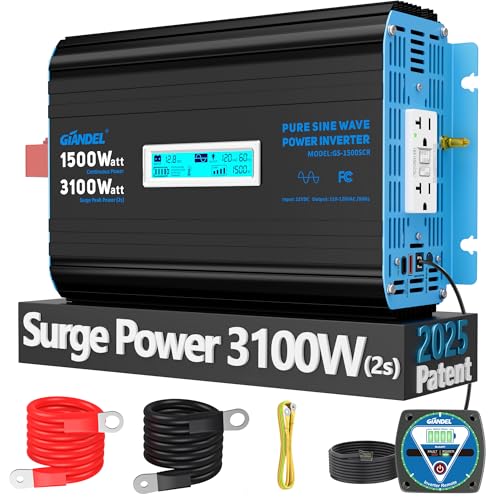
GIANDEL 1500W Pure Sine Wave Inverter — Best Compact Brewing Option
The GIANDEL 1500W answers the smallest honest version of the coffee question: a compact pod brewer or mini drip machine, in a car or small van, without rebuilding the vehicle’s electrical system. Fifteen hundred watts of pure sine wave with GFCI protection is a real brewing setup for the smallest machines — provided you confirm your brewer’s label sits comfortably below the rating and you brew with the engine running.
Think of it as the entry point with clear borders. Inside them — small brewer, short brew cycles, engine on — it is dependable and its compact size fits installs the bigger units cannot. Outside them, it will protect itself with alarms and shutdowns, which is the inverter correctly telling you the match is wrong. Owners who know they will graduate to a full-size brewer should skip straight to the 3000W class.
The GIANDEL 1500W’s owners are minimalists with a non-negotiable: real coffee, small footprint. In a car-based camper or a compact van, its size opens mounting options the big units cannot consider, and its GFCI outlets suit the outdoor table where the brewing actually happens. The ownership discipline is selection — this inverter rewards owners who chose their brewer to fit it, the compact pod machine or mini drip bought with its label checked. Those owners get years of service. The unhappy minority are those who bought the inverter for a brewer it was never sized for; the guide’s matching section exists to keep you out of that group. Sized honestly, it is the smallest complete answer to vehicle coffee.
See the GIANDEL 1500W Pure Sine Wave Inverter — view it on Amazon — for the current configuration options and delivery details.
Strengths
- Smallest hardwired class that can honestly brew anything
- GFCI outlets add outdoor and wet-environment safety
- Dual remote options simplify awkward mounting locations
Trade-offs
- Only suits genuinely small brewers — verify the wattage label first
- Runs near its ceiling during a brew, so ventilation matters
- Engine must be running; battery-only brewing will drain fast
| Output waveform | Pure sine wave |
| Continuous output | 1500W (3100W max) |
| Outlets | GFCI AC outlets |
| USB | USB-C 36W |
Best for: compact pod brewers and mini drip machines in cars and small vans / Not suited for: full-size drip brewers — their elements exceed this class

BELTTT 2000W Pure Sine Wave Inverter — Best Mid-Size Value
The BELTTT 2000W occupies the practical middle: enough clean power for pod machines and mid-size drip brewers, an LCD that tells you exactly what the brew cycle is doing to your battery, and a hardwire port for owners who want a proper fixed outlet at the coffee corner of the vehicle. For a first brewing install on a sensible budget, it is the easiest specification to defend.
Its display quietly becomes the most-used feature. Watching the load figure during a brew teaches you your machine’s real appetite in one morning, and watching voltage teaches you when to start the engine. Buy it sized for the brewer you own today, keep simultaneous extras modest while the element is hot, and it will deliver the daily pot without drama.
The mid-size BELTTT’s character emerges over a season: the display becomes the vehicle’s fuel gauge for electricity. Owners learn their brewer’s appetite in one morning, their battery’s health in one cold snap, and their cables’ quality the first time a loose terminal shows up as sagging voltage under load. That transparency makes it a teaching tool as much as an inverter — the pick for a first serious install, where the owner intends to understand the system they are building. It also moonlights well: between brews it runs the chargers, the small tools and the camp lights of a general-purpose rig, which is how most 2000W units actually spend their lives.
See the BELTTT 2000W Pure Sine Wave Inverter — view it on Amazon — for the current configuration options and delivery details.
Strengths
- LCD display shows voltage and load while the brewer runs
- Hardwire port and dual outlets cover fixed and flexible setups
- Pure sine wave at a value position in the 2000W class
Trade-offs
- Mid-size means mid-size: big brewers plus extras will crowd it
- Value build trades some refinement for capacity per dollar
- Remote is wired, which suits most but not all installs
| Output waveform | Pure sine wave |
| Continuous output | 2000W (4000W surge) |
| Outlets | Dual AC plus 20A outlet, hardwire port, USB |
| Display | LCD voltage and load readout |
Best for: budget-conscious owners matching a pod brewer or mid-size drip machine / Not suited for: anyone who wants maximum headroom for future, bigger loads

LANDERPOW 2000W Pure Sine Wave Inverter — Best for Dual-Use Rigs
Many vehicles do not have a coffee inverter; they have an inverter that also makes coffee. The LANDERPOW 2000W is specced for that dual life: pure sine wave for the brewer in the morning and for laptops and chargers all day, a remote for the under-seat or cabinet mounting that real installs use, and surge capacity that shrugs off the combined start of a pump and a heating element.
It follows the class rules — match the brewer’s label to the rating with headroom, brew with the engine running, wire it with genuinely heavy cable and a fuse at the battery. Owners whose coffee is one job among many, rather than the whole point of the install, will find this the most flexible 2000W option here.
The LANDERPOW’s dual-use design shows its worth on mixed days: coffee at dawn, a tire inflator’s battery charger at noon, the laptop and lights of a working evening. Its remote keeps the unit tucked under a seat or in a locker while control stays at hand, and its surge headroom handles the unglamorous combined starts of real appliances without complaint. Owners should note that generalist units live or die by install quality — with coffee as the heaviest regular load, cable gauge and terminal care are the whole game. Done properly, it is the flexible heart of a vehicle that works and travels in the same week, brewing included.
See the LANDERPOW 2000W Pure Sine Wave Inverter — view it on Amazon — for the current configuration options and delivery details.
Strengths
- Remote control suits under-seat and cabinet mounting
- Clean output for both brewer electronics and laptop-class loads
- Strong surge figure for pump-and-element start moments
Trade-offs
- Same 2000W matching discipline as its class peers
- Generalist layout lacks GFCI outlets for wet sites
- Plan cable costs in — heavy gauge is not optional at this size
| Output waveform | Pure sine wave |
| Continuous output | 2000W (4000W surge) |
| Remote | Remote control included |
| Intended use | RV, truck and camping power |
Best for: owners whose inverter also runs tools, chargers and camp gear between brews / Not suited for: dedicated big-brewer installs that should start at 3000W
Comparison Table
| Pick | Badge | Key spec | Best for |
|---|---|---|---|
| GIANDEL 4000W Pure Sine Wave Inverter | Best Overall | 4000W pure sine wave, GFCI outlets, dual remote | trucks, RVs and job-site rigs brewing full pots daily |
| BELTTT 3000W Pure Sine Wave Inverter | Best for Full-Size Drip Brewers | 3000W pure sine wave, 6000W peak, 23 ft remote | owners who want one household drip brewer to just work in the truck or RV |
| Renogy P2 2000W Pure Sine Wave Inverter | Best for Pod Machines and Small Drip Brewers | 2000W pure sine wave, RV/truck grade | single-serve pod brewers and small drip machines in vans and trucks |
| GIANDEL 1500W Pure Sine Wave Inverter | Best Compact Brewing Option | 1500W pure sine wave, 3100W max, GFCI outlets | compact pod brewers and mini drip machines in cars and small vans |
| BELTTT 2000W Pure Sine Wave Inverter | Best Mid-Size Value | 2000W pure sine wave, 4000W surge, LCD display | budget-conscious owners matching a pod brewer or mid-size drip machine |
| LANDERPOW 2000W Pure Sine Wave Inverter | Best for Dual-Use Rigs | 2000W pure sine wave, 4000W surge, remote control | owners whose inverter also runs tools, chargers and camp gear between brews |
Use the table to shortlist two candidates, then read their full reviews above. When you are ready, check the current price on Amazon for the top pick and compare delivery times across your shortlist.
How to Choose the Best 12 Volt Inverter to Run Coffee Maker Setups in a Vehicle
Read your coffee maker’s wattage label first; it decides everything. The rating is printed on the machine’s base or back panel. Your inverter’s continuous rating — not its peak or surge number — should exceed that figure with real headroom, because the inverter itself consumes power in conversion and a heating element runs at full draw for minutes at a time, not in a brief surge.
Insist on pure sine wave. Brewer pumps, control boards and pod machine electronics are exactly the loads that behave badly on modified sine wave: noisy pumps, confused timers, error codes mid-brew. At brewing wattages the price gap between waveforms is small compared with the cost of the install itself, so there is no sensible saving in the cheaper waveform here.
Budget for the install, not just the inverter. At 1500W and above you need short runs of genuinely heavy cable, a fuse or breaker at the battery, solid terminals and a ventilated mounting location. Undersized cable is the number one cause of ‘my big inverter is weak’ complaints: the inverter is fine, it is starving. If the cable budget surprises you, that is the true cost of vehicle coffee — plan it once and brew for years.
What size inverter does a coffee maker need?
Small pod machines and mini drip brewers are the lightest brewing loads and can pair with a quality 1500W to 2000W pure sine wave inverter, label permitting. Mid-size and full-size drip machines belong on 2000W to 3000W. Anything with a boiler — home espresso machines above all — combines a big element with a pump and pressure system, and is honestly beyond a single starter battery’s sensible duty; commercial-style vehicle espresso is a house-battery and alternator-charging project, not an accessory purchase.
Remember the battery is half the system. Even a perfectly sized inverter is limited by how much energy the battery can give and how fast the alternator can replace it. Brewing with the engine running is not a suggestion for this load class; it is the design assumption. Owners who want engine-off brewing need a separate house battery sized for the job.
How do you brew without flattening the battery?
Brew with the engine running, keep the session to the pot you need, and switch the inverter off afterward — an idling inverter draws power doing nothing. If your inverter has a voltage display, learn its story: a healthy system holds voltage respectably under load with the engine on, and a sagging display is an early warning of a tired battery or tired cables.
For repeated daily brewing — job sites, fleets, market stalls — the grown-up solution is a dual-battery setup: a house battery that takes the brewing abuse, charged from the alternator while driving, isolated so the starter battery is never involved. Every inverter in this guide can anchor such a system, and the coffee will taste exactly the same while the reliability transforms.
What about kettles, grinders and other coffee gear?
The brewer is the headline load, but the coffee ritual has a supporting cast. A kettle is a second heating element of similar appetite — never run it simultaneously with the brewer on anything but the largest installs, and consider sequencing: brew first, kettle second, engine running throughout. A burr grinder, by contrast, is a brief, modest motor load that any pick here handles without noticing, and grinding fresh in a vehicle is one of travel’s genuine luxuries.
Milk frothers, warming plates and second appliances should all be audited the same way: read the label, add nothing simultaneously that pushes the total past the inverter’s comfortable middle, and let heating loads take turns. The system that brews beautifully for years is the one whose owner treats simultaneous heating as the exception, not the routine.
When is a different solution better than an inverter?
Honesty section: for a single driver who wants one cup on a long drive, a thermos filled at home or a café stop beats any install in this guide on cost, simplicity and battery kindness. For backpack-weight camping, a stove-top brewer needs no electricity at all. The inverter case becomes compelling when coffee is daily, plural or professional — crews, couples, market days, touring weeks — where the ritual repeats often enough to amortize the install.
There is also the native 12 volt brewer: slow, small and simple, drawing what a socket can give over a long, patient heat. For one patient cup it is a legitimate tool. The moment the requirement becomes a pot, on a schedule, for more than one person, the hardwired inverter system in this guide is the answer the physics supports.
How do you maintain a coffee inverter system?
Heating loads are the strictest auditors of an electrical install: they hold maximum current for minutes, exposing every loose terminal and undersized cable as heat and voltage sag. The maintenance that keeps a coffee system honest is therefore connection maintenance — a seasonal check that terminals are tight and clean, that cable insulation is unchafed where it passes through panels, and that the fuse holder shows no discoloration from heat it was never meant to carry.
The inverter itself asks for air and cleanliness: its intake clear of the dust and grounds that a coffee corner generates, its fan confirmed running under load, its display — where fitted — read with the same glance you give the fuel gauge. Batteries complete the triangle: a system whose brews get slower and alarms get earlier is usually reporting battery age, and a load test at the parts store is cheaper than a stranded morning.
Keep a small log if the system works for a living — stallholders and site crews learn quickly that a notebook page of brew counts and battery notes predicts failures weeks early. For household rigs the log is mental, but the principle is the same: a coffee system is maintained in minutes per month or repaired in days per year, and the exchange rate favors the minutes.
The battery math every coffee vehicle should do once
A brew cycle is short, which tempts owners to dismiss its cost. Do the arithmetic once and you will respect it forever: a heating load in the thousand-watt class, sustained for the minutes a pot takes, drawn through an inverter with conversion losses, consumes a meaningful slice of a starter battery’s usable capacity — the slice that battery can only afford a few times before starting performance suffers. With the engine running, the alternator carries the load and the arithmetic relaxes; that single fact is the foundation of every routine in this guide.
House-battery systems change the equation by giving the load a battery designed for it: deep-cycle or lithium storage that can be drawn down daily and refilled by driving or solar. If your coffee is daily and engine-off — the market stall, the silent campsite — that system is not an upgrade but the correct architecture, and every inverter here can serve as its AC heart.
Finally, watch the trend, not the day. A battery that brews happily in September and struggles in January is not being betrayed by the inverter; it is aging on schedule. The display-equipped picks make that trend visible months before it becomes a no-start, which is an argument for the display that has nothing to do with coffee.
How to Install and Brew: A Safe Routine
Install once, properly. Mount the inverter on a flat, ventilated surface within a short cable run of the battery. Connect the negative lead first to the battery or chassis point specified in the manual, run the positive through a fuse mounted close to the battery, and use the cable gauge the manual demands for your run length — longer runs need thicker cable, never thinner. Confirm the inverter powers up cleanly with no load before a coffee maker ever plugs in.
Brew with a routine. Start the engine and let it idle a moment. Switch the inverter on, plug in the brewer, and run a water-only cycle first on any new pairing — it proves the match without wasting coffee and shows you the load figure on the display if you have one. Then brew normally, keep other big loads off during the cycle, and let the machine finish before adding anything else.
Afterward, switch the inverter off, let the engine run a few minutes to top the battery back up after a heavy session, and once a month inspect the cable terminals for looseness or corrosion and clear the inverter’s fan intake. Heating loads expose weak connections faster than any other use, so that monthly glance is the cheapest insurance in the whole system.
One refinement for regular brewers: dedicate the circuit. Where the install allows, the coffee corner deserves its own outlet run from the inverter’s hardwire port, labeled and left set up — brewer in place, grinder beside it, cups above. Systems that stay assembled get used daily and maintained naturally; systems that must be rebuilt each morning quietly stop being used, and the inverter becomes expensive ballast.
Common Buying Mistakes
Shopping by the peak number. Surge watts last for a blink; your brewer needs continuous watts for minutes. Match the brewer’s label to the continuous rating or expect alarms mid-pot.
Trying to brew from a lighter socket. Socket circuits are fused for accessories, not heating elements. Every failed vehicle-coffee story that starts with a plug-in inverter ends with a blown fuse or worse.
Undersizing the cables. Thin or long cables starve a big inverter and get warm doing it. The cable and fuse budget is part of the inverter’s real price.
Brewing engine-off on a starter battery. A starter battery is built for seconds of cranking, not minutes of heating. Repeated deep pulls shorten its life and one day the vehicle simply will not start.
Forgetting conversion losses. The inverter itself consumes a share of everything it delivers. A brewer at the very edge of a rating is over the edge in practice — headroom is not caution, it is arithmetic.
Mounting the inverter where the coffee lives. Steam, splashes and grounds are a kitchen’s weather; the inverter belongs in the dry, ventilated space nearby, not under the brewer. Cables travel; water should not.
Final Recommendation
For a built vehicle that brews daily, the GIANDEL 4000W is the best 12 volt inverter to run coffee maker duty without ever thinking about limits again. For the classic one-drip-machine install, the BELTTT 3000W is the right-sized answer with the remote and hardwire options that make it feel factory-fitted.
Pod and small-brewer owners should save money and space: the Renogy P2 2000W for clean, efficient power, the BELTTT 2000W as the value alternative with a display, the LANDERPOW 2000W for dual-use rigs, and the GIANDEL 1500W only for genuinely small machines. Whichever you choose, wire it properly and brew with the engine running — the coffee is the reward for doing the electrical work honestly.
Before you order, do the two-minute homework this guide keeps returning to: read your brewer’s wattage label, and measure the cable run your install really needs. Those two numbers select the inverter class and the cable budget more honestly than any review can — and with them in hand, every pick above will do exactly what this page promises.
Ready to decide? Start with the top pick — check the current price on Amazon — and work down the shortlist from there.
Related guides on this site: Best 12 Volt Inverters For Trucks Best 12 Volt Inverter For Minivan Best 12 Volt Jump Starter Best 12 Volt Jump Box Best 12 Volt Iphone Charger
Frequently Asked Questions
Can a 1000W inverter run a coffee maker?
For almost all drip and pod machines, no — their heating elements sit at or above that figure before conversion losses, so the inverter will alarm or shut down mid-brew. A very small single-cup device might fit, but check its label against the continuous rating with headroom, and expect to brew with the engine running.
Why does my inverter beep and shut off when the coffee maker runs?
That is protection doing its job: the load is exceeding what the inverter, its cables or the battery can deliver, and voltage is sagging. The usual causes are an undersized inverter, thin or long cables, loose terminals, or brewing with the engine off. Fix the weakest link rather than defeating the alarm.
Is a 12 volt coffee maker better than an inverter setup?
For a single cup on the move, a native 12 volt machine is simpler and needs no install — but it is slow, because the socket limits its heating power. An inverter with a household brewer makes a full pot at household speed. Choose based on whether you need a cup eventually or a pot now.
Can I run an espresso machine in my truck?
A home espresso machine is one of the hardest vehicle loads: boiler element, pump and pressure system together, with no tolerance for sagging power. It demands a large pure sine wave inverter, a house battery system and alternator charging. It is buildable as a project, but it is not an accessory purchase, and a starter battery alone should never be asked to do it.
How long can I brew with the engine off?
Treat engine-off brewing on a starter battery as an emergency exception, not a routine. A single small brew may be tolerated by a healthy battery, but repeated sessions will shorten its life and risk a no-start. Brew with the engine running, or fit a house battery for engine-off use.
What cable size do I need for a 3000W inverter?
Short answer: the size the manual specifies for your exact run length, which at this wattage is seriously heavy cable. Longer runs require thicker cable to avoid voltage drop and heat. Never substitute thinner cable to save money — it is the most expensive saving in the whole install.
Can I brew coffee while driving?
The system can, but the humans should not make a ceremony of it: hot liquids and moving vehicles are a poor pairing. Brew at stops, with the vehicle parked and the engine idling, and let driving be for driving. Many touring owners time the brew to the fuel stop or the scenic pullout, where the ritual gets the pause it deserves.
What is the smallest vehicle that can support a coffee inverter?
Any vehicle with a healthy 12 volt system can support the 1500W class and a compact brewer, installed properly — the constraint is rarely the vehicle’s size and usually the alternator’s capacity and the battery’s health. Small cars with small alternators should stay at the compact end of this guide and keep engine-running discipline strict.
Do I need a second battery just for coffee?
For occasional brewing with the engine running, no — a healthy starter battery and honest routines suffice. For daily or engine-off brewing, yes: a house battery is the correct architecture, protecting the starter battery’s one sacred job. The dividing line is frequency, and owners usually know which side of it they live on.


