Disclosure: airfryerkitchensupply.com is reader-supported. When you buy through links on our site, we may earn an affiliate commission at no extra cost to you.
Where to buy
Every pick in this guide to the best 12 volt ice maker was cross-checked against Amazon’s own catalog data before it earned a link, so the model names and listings below match what you will actually find on the product page. Prices move with promotions and seasons, so check price on Amazon for the current figure on any pick instead of trusting a number printed in a guide like this one.
- Dometic CFX5 55L Electric Cooler with Ice Maker — Check on Amazon
- STMHOM 40QT Car Refrigerator with Ice Maker — Check on Amazon
- CheerAmenit 40QT Portable Car Refrigerator with Ice Maker — Check on Amazon
- 12V Mini Portable Ice Maker for Car, Camping & RV — Check on Amazon
- Mini Ice Maker Machine for Car, 12V/DC Dual-Power — Check on Amazon
- BANEBONE Mini Countertop Ice Maker – 12V Car Portable — Check on Amazon
Anyone hunting for the best 12 volt ice maker deserves the truth before the list: this is one of the thinnest categories in 12 volt gear. The familiar countertop ice makers that fill kitchen counters run on household AC power, and most products advertised with ’12V’ in the title are either compact newcomers, or — more usefully — 12 volt refrigerator-freezers with a dedicated ice-making compartment. This guide covers both real forms and labels each one plainly.
That honesty shapes the picks below. At the serious end sit verified cooler-and-ice-maker combinations from Dometic, STMHOM and CheerAmenit: full compressor fridge-freezers that make ice as part of the package and run natively on 12/24V DC. At the portable end sit genuinely small 12V mini ice makers built for a car, RV or campsite, which make modest batches of cubes and ask equally modest power in return.
Every product here was verified against current listing data before earning a link, and each review states exactly what kind of ice maker it is. If you need buckets of ice for a crowd, no 12 volt machine in this guide — or anywhere — replaces an AC countertop unit on shore power or an inverter, and the buying guide below explains how to size that decision before you spend anything.
In this guide
Quick Picks
Six verified options in two honest families: three compressor fridge-freezers with built-in ice making, and three true mini 12V ice makers. Badges match the full reviews, and each quick pick states which family it belongs to.
Dometic CFX5 55L Electric Cooler with Ice Maker — Best Overall
The most complete answer to this search: a flagship 55L fridge-freezer with a genuine built-in ice maker, freezing to -7°F on 12/24V power. Buy the refrigeration flagship, get real ice making included — that is how the serious end of this category works. Check price on Amazon.
STMHOM 40QT Car Refrigerator with Ice Maker — Best Value Combo
The same cooler-plus-ice-maker concept at a value position: 40 quarts, a verified -4°F to 68°F range, and both AC and DC charging in the box. The accessible way to get ice making and real refrigeration in one 12 volt appliance. Check price on Amazon.
CheerAmenit 40QT Portable Car Refrigerator with Ice Maker — Best for Moving Between Dock and Camp
The combo pick that thinks about the last fifty yards: a 40QT fridge-freezer with ice maker, on wheels, with battery protection and dual AC/DC power. For boaters and campers who move the box as much as they run it, the wheels are the feature. Check price on Amazon.
12V Mini Portable Ice Maker for Car, Camping & RV — Best Ultra-Portable Mini
The purest answer to the search: a genuinely tiny 12V ice maker — 830 grams by its verified listing — making batches of eight 20mm cubes. Not a fridge, not a combo: just ice, anywhere a 12 volt socket reaches. Check price on Amazon.
Mini Ice Maker Machine for Car, 12V/DC Dual-Power — Best Dual-Power Desktop Mini
A desktop-format mini that splits its life between the vehicle and the desk: dual-power input, batches of ten cubes, self-cleaning and a low-noise design per its verified listing. The flexible pick for mixed car, RV and office use. Check price on Amazon.
BANEBONE Mini Countertop Ice Maker – 12V Car Portable — Best Budget Mini
The budget route into true 12V ice making, with both the AC adapter and the car cord in the box per its verified listing, a see-through lid and an ice clip included. Small batches, small price of entry, nothing essential missing. Check price on Amazon.
How These Picks Were Chosen
We started by defining the category strictly: a pick had to make ice while running on 12 volt DC power, natively, as sold. That single rule eliminated the long tail of AC countertop machines with ‘car’ in the marketing copy and left the two genuine families you see here — cooler combos with ice compartments, and mini 12V cube makers.
Within the cooler combos, we ranked by the quality of the underlying refrigerator, because the ice maker rides on it: compressor range, capacity and battery behavior decide whether the ice feature is a delight or a gimmick. The Dometic’s verified specification — a 55L dual-zone-class cabinet freezing to -7°F with a built-in ice maker — set the benchmark the others were judged against.
Within the minis, we ranked by honesty and portability: verified cube counts and cycle times from the listings, dual-power flexibility where offered, and size and weight suited to a vehicle rather than a kitchen. Every mini here makes small batches; we credited makers that say so plainly over those that dress a desktop appliance in expedition language.
What Are the 6 Best 12 Volt Ice Maker Options That Actually Exist?

Dometic CFX5 55L Electric Cooler with Ice Maker — Best Overall
The Dometic CFX5 55L earns the top badge by being the most capable 12 volt appliance in this guide in absolute terms: a vacuum-insulated 55-liter fridge-freezer, verified to freeze to -7°F and hold 84 cans, with a built-in ice maker as part of the design rather than an accessory. If ice matters enough to search for, the refrigeration around it here is good enough to anchor any trip.
Strengths
- Built-in ice maker inside a flagship fridge-freezer, one 12V connection
- Freezes to -7°F, so the freezer zone banks ice and food properly
- Vacuum insulation stretches battery runtime between charges
Trade-offs
- Flagship price — you are buying a premium cooler that makes ice
- Size and weight suit vehicles and basecamps, not carrying
- Ice output serves drinks and small needs, not crowd-sized demand
| Capacity | 55L (holds 84 cans, verified listing) |
| Ice making | Built-in ice maker (verified listing) |
| Freezing | Down to -7°F (verified listing) |
| Insulation | Vacuum insulated (verified listing) |
| Power | 12/24V DC, solar compatible |
Judge this pick as the guide’s buying guide advises: the ice maker is one capability of a complete cold system. The same compressor discipline that holds -7°F also makes the ice function dependable in heat that would stall lesser machines, and banking cubes in the freezer zone turns drive time into an ice reserve for the evening.
For RV and van travelers, boaters with a house battery, and anyone whose trips regularly want both serious refrigeration and fresh cubes without an inverter, this is the single-box answer. It costs like flagship refrigeration because it is flagship refrigeration — with the ice maker this search asked for, built in.
Best for: RV, van and boat travelers who want flagship refrigeration plus real ice making on DC power / Not suited for: buyers who need only ice, or high-volume ice for groups and events
Check on Amazon — check price on Amazon for the current listing.

STMHOM 40QT Car Refrigerator with Ice Maker — Best Value Combo
The STMHOM 40QT brings the combo concept down to earth: a 40-quart compressor car refrigerator with a built-in ice maker, a verified temperature range from -4°F to 68°F, and both AC and DC chargers listed in the package. For most travelers, this is the realistic price of entry to ice making on 12 volt power.
Strengths
- Refrigeration and ice making in one 40-quart 12V appliance
- Full freezer-capable range verified from -4°F to 68°F
- AC and DC chargers included for home and vehicle use
Trade-offs
- Less established brand than Dometic, with a shorter track record
- 40 quarts splits between fridge duty and ice hardware
- Ice function suits drinks-scale demand, like every pick here
| Capacity | 40QT |
| Ice making | Built-in ice maker (verified listing) |
| Temperature range | -4°F-68°F (verified listing) |
| Power | 12V DC with AC and DC chargers (verified listing) |
| Use case | Travel, home, camping, outdoor |
The STMHOM’s appeal is completeness at its tier: nothing essential is missing. It pre-chills at home on AC, runs in the vehicle on DC, freezes properly, and makes ice — the full checklist from this guide’s buying section, in one box that a couple or small family can actually load and carry.
Choose it when the Dometic’s flagship pricing is hard to justify but the combo concept is clearly right for your trips. It is the pick most readers of this guide will end up happiest with, because it spends money on the capabilities — compressor, range, chargers, ice — rather than on the badge.
Best for: couples and small families wanting refrigeration plus ice in one value-priced 12V box / Not suited for: maximum-capacity seekers or buyers who prioritize long-established brands
Check on Amazon — check price on Amazon for the current listing.
CheerAmenit 40QT Portable Car Refrigerator with Ice Maker — Best for Moving Between Dock and Camp
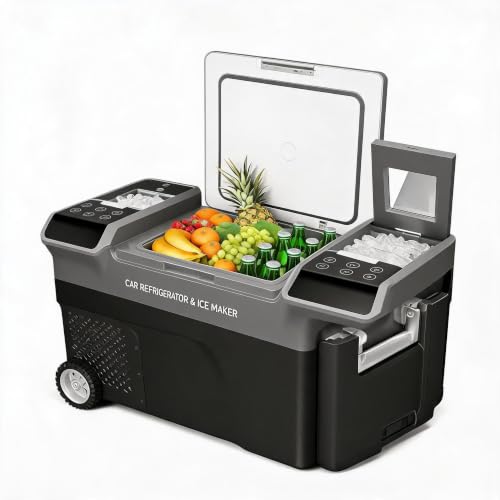
A loaded 40-quart fridge is an awkward carry, and the CheerAmenit is the combo pick designed around that fact: its verified listing leads with wheels alongside the built-in ice maker, 12/24V DC and 110-240V AC power, LED lighting and battery protection. It is built for the dock-to-boat, garage-to-patio, car-to-campsite shuffle.
Strengths
- Wheels make a full 40-quart fridge genuinely movable by one person
- Ice maker plus fridge-freezer in one dual-power appliance
- Battery protection listed for safer vehicle running
Trade-offs
- Wheels and handle add bulk when the box lives permanently in a vehicle
- Brand track record is shorter than the flagship competition
- Like all combos, ice output is drinks-scale rather than event-scale
| Capacity | 40QT |
| Ice making | Built-in ice maker (verified listing) |
| Mobility | Wheels (verified listing) |
| Power | 12/24V DC and 110-240V AC |
| Protection | Battery protection (verified listing) |
Mobility changes how a combo cooler gets used. Boxes that live wherever they are unloaded get used for everything; boxes that are a pain to move get left behind. The CheerAmenit’s wheels invite the patio party, the pontoon afternoon and the tailgate — exactly the social, drinks-forward settings where an ice maker earns its keep most visibly.
The underlying specification keeps it honest as a travel fridge too: dual power for pre-chilling, battery protection for the vehicle, and a full 40 quarts. If your cold storage moves between home, vehicle and water, this is the combo shaped like your life.
Best for: boaters, tailgaters and patio campers who move their fridge-and-ice setup often / Not suited for: permanent vehicle installs where wheels are wasted, or minimalist packers
Check on Amazon — check price on Amazon for the current listing.

12V Mini Portable Ice Maker for Car, Camping & RV — Best Ultra-Portable Mini
This mini maker is what a standalone 12 volt ice maker actually looks like when physics sets the budget: an 830-gram portable unit whose verified listing promises batches of eight hard 20mm cubes in roughly eight to fifteen minutes, aimed at cars, camping and RVs. It is included because it is honest, tiny and genuinely 12 volt.
Strengths
- Featherweight 830g design travels anywhere, even in a day pack’s vehicle kit
- True standalone 12V ice making — no fridge purchase required
- Small batches suit two people’s drinks perfectly
Trade-offs
- Output is small by design: batch banking is essential
- No refrigeration — cubes must be used or moved to a cold box
- New-category product without a long service track record
| Output | 8 pcs 20mm hard ice cubes in 8-15 mins (verified listing) |
| Weight | 830g (verified listing) |
| Power | 12V (verified listing) |
| Use case | Car, camping, RV, patio |
The right way to enjoy this pick is the banking routine from the how-to section: run it during the drive, tip each batch into a small insulated bag inside your cooler, and arrive with an evening’s worth of cubes made from power that was effectively free. Used that way, its tiny output stops mattering — you never actually watch it work.
It also suits solo travelers and couples whose cooler is a simple passive box: the mini adds the one thing a passive box cannot do, which is create new ice mid-trip. As long as the expectation is drinks for a few, this is the most literal fulfillment of the search term in the entire guide.
Best for: solo travelers and couples who want fresh cubes for drinks with minimal kit / Not suited for: groups, cooler-filling duty, or anyone expecting household-machine output
Check on Amazon — check price on Amazon for the current listing.

Mini Ice Maker Machine for Car, 12V/DC Dual-Power — Best Dual-Power Desktop Mini
Where the ultra-portable pick above strips everything away, this Mini Ice Maker Machine keeps the desktop format and adds flexibility: 12V/DC dual-power input, batches of ten cubes in ten to fifteen minutes per its verified listing, self-cleaning and a low-noise brief aimed at offices and RVs as much as cars.
Strengths
- Dual-power input moves between vehicle and indoor use
- Self-cleaning cycle simplifies the hygiene routine
- Ten-cube batches are a step up from the smallest minis
Trade-offs
- Desktop footprint is bulkier than the ultra-portable pick
- Still a batch mini — output serves drinks, not crowds
- Low-noise design still makes ice-maker sounds in a quiet room
| Output | 10 cubes in 10-15 mins (verified listing) |
| Power | 12V/DC dual-power (verified listing) |
| Features | Self-cleaning, low noise (verified listing) |
| Use case | Car, home, office, RV |
Dual power is this pick’s quiet superpower. In the RV or car it runs on 12V; at home or in the office it plugs in as a small countertop unit, which means it earns its storage space all year rather than only on trips. The self-cleaning cycle also matters more than it sounds — the hygiene mistake in this guide’s list is the one mini owners actually make.
Choose it over the ultra-portable pick when the maker will live a double life, or when slightly larger batches and easier cleaning outweigh the last word in smallness. It is the mini for people who will use it weekly, not just on the annual camping trip.
Best for: RV owners, home-office users and regular travelers who want one mini for everywhere / Not suited for: ultralight packers or buyers who need ice volume above all
Check on Amazon — check price on Amazon for the current listing.

BANEBONE Mini Countertop Ice Maker – 12V Car Portable — Best Budget Mini
The BANEBONE mini closes this guide as the budget standalone: a 2.8-pound countertop-format maker whose verified listing includes both an AC adapter and a car cord, a see-through lid so you can watch the batch, and an included ice clip. It makes eight-cube batches and asks very little money or space for the privilege.
Strengths
- Both power cords included — car and home from day one
- See-through lid makes batch-watching and banking easy
- Light 2.8 lb format suits small vehicles and tight RV galleys
Trade-offs
- Batch size is the smallest here alongside the ultra-portable pick
- Budget construction — treat it gently and store it dry
- Output claims should be read as best-case, like all mini makers
| Output | 8 cubes per cycle (verified listing) |
| Power | 120W, AC adapter and car cord included (verified listing) |
| Build | Food-grade aluminum and plastic, see-through lid (verified listing) |
| Weight | 2.8 lbs (verified listing) |
The included-cords detail is what makes this the budget pick rather than merely a cheap one: a mini maker that needs an adapter bought separately is not actually the bargain it appears. With both cords in the box, the BANEBONE works in the car on Saturday and on the counter on Sunday, which is the usage pattern that makes minis worth owning.
Set expectations by the banking rule and it delivers exactly what this category honestly offers: a steady trickle of fresh cubes for a few people’s drinks, made from whatever 12 volt or household power is nearest. For a first step into 12 volt ice making, it is the lowest-risk experiment in this guide.
Best for: budget-first buyers and curious first-timers who want both cords included / Not suited for: heavy daily users who should step up to a combo cooler instead
Check on Amazon — check price on Amazon for the current listing.
Comparison Table
Read the Type column first — it tells you which family each pick belongs to, and the right family matters more than any single specification. Capacity and ice style follow from that choice.
| Pick | Badge | Key spec | Best for | Link |
|---|---|---|---|---|
| Dometic CFX5 55L Electric Cooler with Ice Maker | Best Overall | 55L cooler with built-in ice maker, holds 84 cans, freezes to -7°F | RV, van and boat travelers who want flagship refrigeration plus real ice making on DC power | Check on Amazon |
| STMHOM 40QT Car Refrigerator with Ice Maker | Best Value Combo | 40QT fridge with ice maker, -4°F-68°F, AC and DC chargers included | couples and small families wanting refrigeration plus ice in one value-priced 12V box | Check on Amazon |
| CheerAmenit 40QT Portable Car Refrigerator with Ice Maker | Best for Moving Between Dock and Camp | 40QT fridge with ice maker, wheels, 12/24V DC + 110-240V AC, battery protection | boaters, tailgaters and patio campers who move their fridge-and-ice setup often | Check on Amazon |
| 12V Mini Portable Ice Maker for Car, Camping & RV | Best Ultra-Portable Mini | 830g lightweight, 8 pcs 20mm cubes in 8-15 mins per verified listing | solo travelers and couples who want fresh cubes for drinks with minimal kit | Check on Amazon |
| Mini Ice Maker Machine for Car, 12V/DC Dual-Power | Best Dual-Power Desktop Mini | 10 cubes in 10-15 mins, 12V/DC dual-power, self-cleaning, low noise per listing | RV owners, home-office users and regular travelers who want one mini for everywhere | Check on Amazon |
| BANEBONE Mini Countertop Ice Maker – 12V Car Portable | Best Budget Mini | 8 cubes/6 mins claim, 120W, AC adapter + car cord included per listing | budget-first buyers and curious first-timers who want both cords included | Check on Amazon |
How to Choose a 12 Volt Ice Maker Without Buying the Wrong Machine?
Decide how much ice you actually need, in pounds per day, before looking at any product. A couple of drinks at camp, ice for a small cooler top-up, or cubes for two people’s evening cocktails is mini-maker or cooler-combo territory. Ice for a fishing crew, a party, or filling a large fish box is not — that job belongs to an AC countertop or undercounter machine on shore power, a generator, or a properly sized inverter, and pretending otherwise wastes money.
Next, choose the form. A fridge-freezer with a built-in ice maker — the Dometic, STMHOM and CheerAmenit route — gives you full refrigeration plus ice in one 12 volt appliance, which is why three of the six picks take this form: on real trips, the ice is usually wanted alongside cold food storage anyway. A standalone mini maker gives you only ice, but in a package light enough to move between car, boat and tent, and at a fraction of the power draw.
Finally, plan the water and the power. All ice makers need clean water added by hand at this scale, and cube output falls in hot ambient conditions. Run any of these picks while driving or from an auxiliary battery or power station, use the battery-protection behavior of the cooler combos where fitted, and treat ice making as a daytime, power-plentiful activity rather than an overnight drain.
Why Are True 12 Volt Ice Makers So Rare?
Ice making is energy-hungry in a way refrigeration is not. Holding a box cold takes a modest, cycling compressor; freezing water solid, batch after batch, takes sustained work, and the heat removed from the water has to be dumped into the vehicle or tent air. On a 12 volt budget that physics caps output at small batches — which is why the big-name refrigeration brands mostly fold ice making into a freezer compartment rather than selling a standalone 12 volt ice machine.
The countertop bullet-ice machines that dominate kitchen sales assume a wall outlet and a household power budget. Adapting that format to 12V produces exactly the mini makers in this guide: charming, useful for drinks, and honest only when their small batch sizes are stated up front. Any listing promising countertop-class daily output from a cigarette-lighter socket deserves deep suspicion.
None of this makes the category pointless — it makes it specific. Travelers who want fresh cubes at a remote campsite, in an RV without an inverter, or on a boat’s DC system have real options below. They are simply options sized for glasses, not for crowds, and this guide keeps them labeled that way.
How to Make Ice Efficiently on 12 Volt Power?
Ice from a 12 volt system is a small energy budget spent wisely. These steps get the most cubes from the least battery, whichever pick you own.
- Start with cold water. Filling any ice maker with chilled water from your fridge or cooler shortens every freezing cycle and multiplies daily output for free.
- Make ice while power is plentiful: while driving, while solar is producing, or while connected to shore power — not from a parked vehicle’s starter battery overnight.
- Work in batches and bank the results. Move finished cubes into the freezer zone of a cooler combo, or into an insulated bag inside a fridge, and immediately start the next batch.
- Keep the maker shaded and ventilated. Ice making dumps heat; a maker baking in a hot trunk works longer per batch and produces less per hour.
- Use clean, good-tasting water and run the maker’s self-cleaning routine where fitted, especially after storage, so the first cubes of a trip taste like water rather than the box.
- Stop when the bank is full. A modest stockpile of cubes in the freezer beats a maker running all evening; switch it off and let the 12 volt system rest.
The banking habit in step three is what separates a satisfying 12 volt ice setup from a disappointing one. These machines are batch producers, not on-demand fountains; owners who build a small frozen reserve during the drive arrive at camp with ice for the evening already made and the maker free to rest.
What About Using an Inverter with a Countertop Ice Maker Instead?
It is the obvious workaround, and this guide should address it honestly: a household countertop bullet-ice maker on a suitably sized inverter will out-produce every native 12 volt pick here, because it was designed around a household power budget. If your RV or van already has a substantial inverter and battery bank installed for other reasons, that setup is a legitimate route to real ice volume, and the minis in this guide then serve as the lightweight, take-outside option rather than the main supply.
The costs of the workaround are equally real. The inverter itself consumes power even at idle, the countertop machine is bulky and hates being moved with water in it, and the total draw of sustained ice making on a modest battery bank surprises owners who budgeted for lights and a fridge. Buyers without an existing inverter usually discover that the Dometic-style combo — refrigeration and ice in one native DC appliance — costs less than the inverter, the machine and the battery upgrades combined.
There is also a durability argument. Countertop ice makers are built for a stable kitchen counter, not for corrugation, dust and the thermal swings of a vehicle. The picks in this guide, combos and minis alike, are at least sold for the mobile environment. Travelers who do run a countertop machine on the road successfully tend to treat it as basecamp equipment — set up at camp, on shore power or a large station — rather than as a underway appliance, and that pattern is the workaround at its best.
So the decision tree is simple. Existing big inverter system and a hunger for volume: the countertop route works at camp. Native DC simplicity, modest ice needs, one appliance: the combos in this guide. Ice alone, minimal kit, drinks for a few: the minis. Every branch is respectable; the only failure is buying one branch while expecting another’s results, which is the mistake this entire article exists to prevent.
How Should You Clean and Store a 12 Volt Ice Maker?
Water leaves scale, and scale is the slow enemy of every ice maker ever built. In hard-water regions the minis and combos alike benefit from a periodic cleaning cycle with a manufacturer-approved descaling approach, run more often than instinct suggests — monthly in heavy use, at season’s start and end otherwise. The self-cleaning functions listed on several picks automate the rinse portion of this; they do not repeal the chemistry of mineral water, and owners in hard-water areas should treat them as assistance, not absolution.
Storage is where most small ice makers die, and the protocol is unglamorous: drain every drop the design allows, run a final clean cycle, dry with lids and compartments open for a full day, then store open or vented in a dry place. A maker sealed damp in a warm garage grows the stale, plasticky taint that ruins the next season’s first batches, and no cleaning cycle fully apologizes for a winter of neglect. Five minutes in autumn is the whole premium on this insurance.
For the cooler combos, add the fridge disciplines from this batch’s cooler guides: seals wiped and grit-free, vents clear, interior dry, lid cracked in storage. The ice compartment deserves a specific look — it is the wettest corner of the appliance and the first to grow odors — and a dry, open rest is what keeps a flagship like the Dometic pick tasting like nothing at all, which is the highest compliment ice equipment can earn.
Finally, keep the scoops, clips and cords with the machine. Ice makers are disproportionately orphaned from their accessories in storage, and a maker without its car cord is, for this category’s entire purpose, half a product. One bag or bin per appliance, labeled, is the system that survives garages, moves and lending — the three great dispersers of small equipment.
Common Buying Mistakes
Mistake 1: expecting countertop output from a 12 volt socket. Household bullet-ice machines assume wall power. The verified minis here make small batches — the listings state cubes per cycle in single or low double digits — and the cooler combos make ice as a side function of a freezer. Size your expectations, and your drink plan, to that reality.
Mistake 2: buying an AC ice maker for a DC-only vehicle. If your RV, boat or camp setup has no inverter, an AC-only machine is dead weight however good its reviews. Every pick in this guide runs natively on 12 volt DC as sold; check that first, before any other feature.
Mistake 3: running the maker from a starter battery while parked. Ice making is sustained work, not a cycling fridge load. Make ice while driving or from an auxiliary battery or power station, and let battery-protection settings guard the battery that has to start the engine.
Mistake 4: filling with warm water in a hot vehicle. Warm water plus hot ambient air is the slowest, most power-hungry combination a small maker faces. Cold water, shade and ventilation can change output more than the difference between models.
Mistake 5: ignoring hygiene between trips. A maker stored damp grows stale flavors and worse. Drain it, dry it, and use any self-cleaning cycle before storage and again before the first batch of a new trip.
One underappreciated use for the cooler-combo picks deserves mention: ice as a thermal battery. Cubes made during a drive, while the alternator makes power plentiful, can be banked in the freezer zone and then used to keep a separate passive day cooler cold at the beach, on the boat or at a picnic — extending the 12 volt system’s reach to places the appliance itself never goes. Owners who think of ice as stored energy, made when power is cheap and spent when it is not, get the most from every pick in this guide.
Water quality decides ice quality more than machinery does. These small makers have no filtration worth the name, so fill them with the water you would happily drink straight, and the cubes will taste clean. At camps with questionable tap water, fill from your drinking supply; the volumes involved are small, and the difference in the glass is obvious.
Storage discipline matters with ice makers more than with plain coolers, because water lives inside them. Drain every pick fully before storage, leave lids and compartments open to dry, and run a cleaning cycle at the start of each season. Five minutes of care prevents the stale, plasticky first batch that otherwise greets the first evening of every trip.
Ice safety is worth one plain paragraph. Ice is food: make it from drinking-quality water, handle cubes with a clean scoop or clip rather than hands where possible — the BANEBONE’s included clip is a thoughtful touch — and discard ice that has sat melted and refrozen in a warm cooler. The machines here make the cold part easy; the hygiene part remains, as always, the cook’s job.
Travelers with boats should note that the combo picks solve a specifically marine problem: marina ice is expensive, heavy to carry down a dock, and gone by the second day. A 12/24V fridge-freezer with an ice maker on a house battery quietly deletes that errand from every cruise, which is why the combo format is disproportionately popular with boaters relative to its price.
If you are choosing between two minis, let storage break the tie. These are seasonal, occasional appliances for most owners, and the one that fits the vehicle’s cubby, the RV’s cabinet or the garage shelf you actually have is the one that will be aboard when wanted. The ultra-portable pick’s 830-gram brief is extreme, but every mini here was chosen partly for how little space it asks when the trip is over.
And a last expectation-setting note for gift buyers, because these machines are often bought as presents: a 12 volt ice maker delights the recipient who understands it — the camper, the RVer, the tailgater — and puzzles the one expecting a kitchen appliance. Pair the gift with this guide’s banking routine, written on the card if necessary, and the first trip will go the way you hoped when you bought it.
A realistic day-in-the-life helps calibrate the minis better than any specification. Morning: the maker runs during the drive’s first hour, banking two or three batches into the cooler. Midday: another short session while the vehicle charges at a stop. Evening: the banked cubes cover drinks for the camp, and one final batch tops the reserve. Nobody waited on the machine, nobody watched it, and the ice simply existed — that rhythm, not raw output, is the product the mini makers actually sell.
For the combo picks, the equivalent rhythm is even quieter: the ice compartment simply accumulates as the freezer works, and the owner’s only task is occasionally moving cubes to a bag to free the maker for its next batch. Travelers upgrading from minis to combos consistently cite that disappearance of effort — not the volume — as the upgrade they feel, which is worth knowing before choosing which family your money joins.
One caution applies to every pick in this guide and is worth stating once, plainly: ice makers and low voltage are poor companions. A sagging battery or a long, thin extension lead slows cycles and can stall a batch mid-freeze, producing the half-formed cubes that give small makers a bad name. Feed these machines the strong, direct 12 volt supply their instructions describe, and their verified cycle times become achievable rather than aspirational.
Final Recommendation
If you want one appliance that handles food and ice on 12 volt power, the Dometic CFX5 55L with its built-in ice maker is the best 12 volt ice maker solution in this guide — a flagship fridge-freezer first, with ice as a genuine built-in capability. The STMHOM and CheerAmenit 40QT combos deliver the same concept at friendlier positions in the market, the CheerAmenit adding wheels for dock-and-camp moving. If you want only ice, in the smallest possible package, the three minis split by style: the ultra-light 12V Mini for pure portability, the dual-power desktop Mini for car-and-office flexibility, and the BANEBONE for the budget route with both cords in the box.
Above all, buy the form that matches your ice appetite. Glasses for a few people — any pick here works. Ice for a crowd — take the honest hint from this category’s thinness and put an AC machine on shore power or an inverter instead.
Start with the top picks here: Check on Amazon Check on Amazon Check on Amazon.
Best 12 Volt Ice Chest Best 12 Volt Ice Chests Coolers Best 12 Volt Refrigerator Best 12 Volt Cooler Best 12 Volt Inflator
Frequently Asked Questions
Does a true standalone 12 volt ice maker exist?
Yes, but only at mini scale — three of the picks in this guide are exactly that, verified 12V machines making small batches of cubes for cars, RVs and campsites. Full-size standalone ice making on 12 volt power effectively does not exist from major brands; the serious end of the category is fridge-freezers with built-in ice makers, like the Dometic pick here.
How much ice can a 12 volt ice maker make in a day?
Far less than a household countertop machine, and any exact figure depends on ambient heat and water temperature. The verified mini listings describe output in cubes per cycle — batches of around eight to ten cubes per cycle — so think in terms of drinks for a few people with banked batches, not in terms of filling large coolers.
Is a cooler with an ice maker better than a separate ice maker?
For most travelers, yes: one compressor appliance stores the food, freezes, and makes the ice, all on one 12 volt connection with battery protection. A separate mini maker wins only when you truly need ice alone, in the lightest and smallest package possible, or as a second unit alongside an existing fridge that has no ice function.
Can I run a 12 volt ice maker from a power station?
Yes, and it is the recommended pattern for stationary use. Ice making is sustained work, so a power station or auxiliary battery sized for the session — ideally while solar or driving recharges it — keeps the vehicle’s starter battery out of the equation entirely.
What kind of ice do 12 volt ice makers produce?
The cooler combos produce ice in their dedicated maker compartments, suited to drinks and small cooler top-ups. The minis produce small hard cubes per their verified listings — the ultra-portable pick specifies 20mm cubes. None of them produce the soft chewable nugget style of premium AC machines; if nugget ice is the requirement, that is an AC appliance decision.
Can a 12 volt ice maker replace buying bagged ice?
For a couple or a small group, largely yes — banked batches cover daily drinks and a small amount of cooler duty, and the cooler combos keep food frozen without any ice at all. For events, crews or fish storage, bagged ice or an AC machine remains the practical answer, and this guide’s picks are best seen as freedom from the ice run for everyday travel rather than a wholesale replacement.


