Disclosure: airfryerkitchensupply.com is reader-supported. When you buy through links on our site, we may earn an affiliate commission at no extra cost to you.
Where to buy
Every pick in this guide to the best 12 volt ice chest was cross-checked against Amazon’s own catalog data before it earned a link, so the model names and listings below match what you will actually find on the product page. Prices move with promotions and seasons, so check price on Amazon for the current figure on any pick instead of trusting a number printed in a guide like this one.
- Alpicool C20 Portable Compressor Fridge Freezer 21 Quart — Check on Amazon
- EUHOMY 19QT 12 Volt Refrigerator — Check on Amazon
- Dometic CFX2 37L Electric Cooler — Check on Amazon
- Alpicool C50 Portable Car Freezer 47 Quart — Check on Amazon
- BougeRV 12V Refrigerator 53 Quart Electric Car Cooler — Check on Amazon
- Wagan EL6214 Personal Thermoelectric Cooler/Warmer 14 Liter — Check on Amazon
Finding the best 12 volt ice chest starts with an honest point most listings skip: a true 12 volt ice chest is not a foam box with a plug. It is either a compressor refrigerator that happens to be shaped like a chest, or a thermoelectric cooler that can only chase the temperature outside the vehicle. Those two machines behave very differently on a long drive, and this guide separates them clearly so you know which one you are actually buying.
The compressor models in this roundup — from Alpicool, EUHOMY, Dometic and BougeRV — hold a set temperature in summer heat, can freeze as well as chill, and protect your vehicle battery with low-voltage cutoffs. The one thermoelectric pick, from Wagan, costs less in energy terms and doubles as a warmer, but it cannot freeze and it cannot fight a hot trunk. Both styles have a real use case; the mistake is buying one while expecting the other.
Every model below was verified against the manufacturer’s current Amazon listing data before it earned a link, and the capacities and temperature ranges quoted are the ones from those verified listings. If you mainly need drinks cold for a workday, the smaller picks shine. If you need a week of food kept safe off-grid, skip ahead to the larger compressor chests and the buying guide sections on power draw and battery protection.
In this guide
Quick Picks
Six verified chests, from a 14-liter thermoelectric lunch companion to a 53-quart compressor fridge-freezer. Badges here match the badges in the full reviews, so you can scan this list and then jump straight to the detailed breakdown of any pick.
Alpicool C20 Portable Compressor Fridge Freezer 21 Quart — Best Overall
The C20 hits the size most drivers actually need: a true compressor chest at 21 quarts that pre-chills on household power, runs from the vehicle all day, and still leaves cargo room for everything else. It is the pick we would hand a first-time buyer without a single caveat about cooling power. Check price on Amazon.
EUHOMY 19QT 12 Volt Refrigerator — Best Budget
The budget pick that refuses to be a compromise: a real compressor, a verified -4°F to 68°F range, ECO and MAX modes and three levels of battery protection at 19 quarts. If money is the constraint but freezing still matters, this is where the search ends. Check price on Amazon.
Dometic CFX2 37L Electric Cooler — Best Premium
The premium route to a 12 volt ice chest: 37 liters, freezing to -7°F, three-stage battery protection and app control from the brand that defined vehicle refrigeration. Buy it when the chest will live in the vehicle for years and every trip depends on it. Check price on Amazon.
Alpicool C50 Portable Car Freezer 47 Quart — Best for Families
The family-size step up from our top pick: 47 quarts of compressor space for multi-day provisions, with the same dual-power flexibility as the C20. If the C20’s capacity is your only hesitation, the C50 is your answer. Check price on Amazon.
BougeRV 12V Refrigerator 53 Quart Electric Car Cooler — Best for Trucks and Overlanding
The biggest chest in this guide, built for truck beds and long overland legs: 53 quarts, MAX/ECO modes, a verified 45dB noise figure and three-level battery protection. Choose it when range and capacity matter more than cargo space. Check price on Amazon.
Wagan EL6214 Personal Thermoelectric Cooler/Warmer 14 Liter — Best Thermoelectric Alternative
The honest exception in this guide: a 14-liter thermoelectric cooler-warmer for lunches, drinks and long solo drives. It cannot freeze and it will not fight extreme heat — but for a workday’s food at the lowest running cost and weight, nothing else here is as simple. Check price on Amazon.
How These Picks Were Chosen
We chose these six by starting with what a 12 volt ice chest has to do in the real world: run for hours from a vehicle outlet or auxiliary battery without draining it, hold a food-safe temperature in a hot cabin, and survive being slid around a cargo area. Any model that could not demonstrate compressor cooling or, in the thermoelectric case, honest positioning as a cooler-warmer, was cut.
Capacity was judged in usable terms. Quart and liter figures come from the verified listings, and we favored chests whose shape suits how people actually pack — tall bottles, meal-prep containers and a weekend of groceries — over headline numbers that only work with everything repacked into bags. Dual power input (12/24V DC plus an AC adapter for home use) counted heavily, because pre-chilling at home is the single easiest way to get better performance on the road.
Finally, we weighted battery protection. A chest that flattens a starter battery at a trailhead is worse than no chest at all, so models with multi-level low-voltage cutoff ranked above otherwise similar rivals. Noise mattered for anyone sleeping near the vehicle, and app control counted as a convenience, never as a substitute for sound basic cooling.
What Are the 6 Best 12 Volt Ice Chest Options?

Alpicool C20 Portable Compressor Fridge Freezer 21 Quart — Best Overall
The Alpicool C20 is the chest that made 12 volt compressor cooling mainstream, and it still earns the top badge here because it balances the three things that matter — real refrigeration, a footprint that fits ordinary vehicles, and dual power — better than anything else at its size. At 21 quarts it swallows a weekend of food and drinks for two without eating the whole trunk.
Strengths
- True compressor cooling that chills and freezes regardless of cabin heat
- Runs on 12/24V DC in the vehicle and 110V AC at home for easy pre-chilling
- 21-quart size fits behind seats and in small cargo areas where bigger chests cannot
Trade-offs
- Single zone, so fridge and freezer goods share one temperature
- 21 quarts is tight for a family of four on a long weekend
- Basic control layout compared with app-connected premium rivals
| Capacity | 21 Quart (20 Liter) |
| Cooling | Compressor fridge freezer |
| Power | 12/24V DC and 110V AC |
| Use case | Car and home |
What sells the C20 is predictability. Set it before you leave, load it cold, and it simply holds temperature while cheaper thermoelectric boxes drift with the weather. The compressor format also means the rated capacity is honest food space rather than space shared with melting ice, so the 21 quarts go further than the same figure on a passive cooler. For commuters, couples and solo campers, that is exactly the right amount of fridge.
It is also the easiest pick here to live with day to day. The dual-power design means it can earn its keep as a drinks fridge at home between trips, and its modest size keeps the loaded weight manageable for one person to carry to a picnic table. If your trips grow, it remains useful as a second chest long after you buy a bigger one — which is more than can be said for most first purchases in this category.
Best for: drivers and couples who want one dependable compressor chest for weekends, commutes and road trips / Not suited for: families provisioning a long trip from a single box, or anyone who needs fridge and freezer zones at once

Check on Amazon — check price on Amazon for the current listing.

EUHOMY 19QT 12 Volt Refrigerator — Best Budget
Budget 12 volt chests usually ask you to give something up — freezing, battery protection, or the AC adapter. The EUHOMY 19QT gives up none of them. Its verified specification reads like a checklist of the features this guide tells you to demand, wrapped in a compact 19-quart box aimed squarely at solo travelers and couples.
Strengths
- Compressor range verified from -4°F to 68°F, so it genuinely freezes
- ECO mode for gentle overnight draw and MAX mode for fast pull-down
- Three-level battery protection guards a starter battery properly
Trade-offs
- 19 quarts is the smallest compressor capacity in this roundup
- Compact shape suits drinks and fresh food better than bulky frozen goods
- Less premium feel than the Dometic at this size class
| Capacity | 19QT |
| Temperature range | -4°F~68°F (verified listing) |
| Modes | ECO and MAX |
| Battery protection | 3-level |
| Power | 12V and 100-240V AC |
The ECO and MAX pairing is the feature owners actually use. MAX drags a warm load down to temperature quickly after a grocery stop; ECO then sips power through the night at camp. Combined with the three-level battery cutoff, the EUHOMY is unusually safe to leave running — the exact scenario where bargain chests usually cause trouble.
Choose it for one or two people and it will not feel small: drinks, sandwich supplies, fresh ingredients for a few days and a few frozen items fit with room to spare once you pack in meal order. It is also a sensible second chest for owners of big dual-zone boxes who want a small daily driver for the work vehicle.
Best for: solo travelers, couples and budget-first buyers who still need true freezing / Not suited for: groups, long family trips, or anyone who regularly carries tall bulk items
Check on Amazon — check price on Amazon for the current listing.

Dometic CFX2 37L Electric Cooler — Best Premium
Dometic built its name on vehicle refrigeration for people who cannot afford a failure — expedition drivers, marine users and full-time travelers — and the CFX2 37L carries that DNA into a mid-size chest. The verified specification tells the story: 37 liters, room for 48 cans, freezing down to -7°F, three-stage battery protection and app control.
Strengths
- Deepest verified freeze in this roundup, down to -7°F
- Three-stage battery protection for confident overnight running
- App control lets you check and adjust temperature without opening the lid
Trade-offs
- Premium positioning — the value picks undercut it substantially
- 37L is mid-size: generous for two, a squeeze as a family’s only fridge
- App features are a convenience, not a substitute for correct setup
| Capacity | 37L (holds 48 cans, verified listing) |
| Freezing | Down to -7°F (verified listing) |
| Battery protection | 3-stage |
| Control | App control |
| Power | 12/24V DC |
The CFX2 earns its premium in the details that show up on rough trips: a lid and seal that keep cold in on corrugated roads, a compressor that does not flinch in serious heat, and battery protection granular enough to trust with a single-vehicle setup. The app sounds like a gimmick until the first night you adjust the temperature from the tent instead of climbing into a cold vehicle at midnight.
Pick the Dometic when the chest is infrastructure rather than an accessory — the van build, the work truck, the boat-adjacent tow vehicle that goes out every weekend. Cheaper chests cool food; this one is the pick for people who plan trips around the certainty that food will still be cold on day four.
Best for: serious travelers, van and overland builds, and buyers who want the longest-lived chest / Not suited for: occasional users whose trips are short and infrequent enough that a value pick does the same job
Check on Amazon — check price on Amazon for the current listing.

Alpicool C50 Portable Car Freezer 47 Quart — Best for Families
The Alpicool C50 answers the most common complaint about compact 12 volt chests — not enough room — with 47 quarts of compressor-cooled space aimed at RVs, trucks and family camping. It keeps the formula that makes the C20 our overall pick and simply scales it to crew size.
Strengths
- 47 quarts holds several days of food for a family or small crew
- Compressor cooling freezes as well as chills, unlike big thermoelectric boxes
- Dual DC and AC power for home pre-chilling before long trips
Trade-offs
- Loaded weight demands two hands or a short carry
- Single temperature zone across a large cavity
- Takes a serious share of cargo floor in smaller vehicles
| Capacity | 47 Quart |
| Cooling | Compressor car fridge freezer |
| Power | 12/24V DC and 100-240V AC |
| Use case | RV, truck, camping, outdoor |
At this size the chest stops being a drinks accessory and becomes the trip’s kitchen. A family can load a long weekend without the daily ice run, hunters and anglers get a proper freezer for the trip home, and basecamp cooks can stage ingredients in meal order. The compressor format matters more as size grows, because a big thermoelectric box in summer heat is just a big lukewarm box.
Plan the vehicle space honestly: measure the cargo area, account for the lid opening arc, and keep the vents clear once luggage piles in around it. Do that, and the C50 delivers the set-and-forget refrigeration that changes how a family trip feels — cold drinks on day three, safe fresh food, and no cooler-water sandwiches ever again.
Best for: families, RV and truck campers, and crews provisioning multi-day trips / Not suited for: small cars with tight cargo areas or solo travelers who will never fill it
Check on Amazon — check price on Amazon for the current listing.

BougeRV 12V Refrigerator 53 Quart Electric Car Cooler — Best for Trucks and Overlanding
The BougeRV 53 Quart is the expedition pick: the largest capacity in this roundup, a verified operating range from -4°F to 50°F, and the kind of battery protection overlanders need when the nearest jump start is a day away. Its verified 45dB noise rating also makes it the easiest big chest to sleep near.
Strengths
- Largest capacity here at 53 quarts for extended provisioning
- MAX/ECO modes balance fast cooling against overnight power draw
- Verified 45dB rating suits camper and sleeper setups
Trade-offs
- Size and loaded weight are a two-person carry to a campsite table
- Single zone at a size where dual-zone rivals start to tempt
- Overkill for day trips and short weekends
| Capacity | 53 Quart |
| Temperature range | -4~50°F (verified listing) |
| Modes | MAX and ECO |
| Noise | 45dB (verified listing) |
| Battery protection | 3-level |
| Power | 12/24V DC |
Overlanding exposes weak chests quickly: corrugations shake seals, heat soaks the vehicle at every stop, and the battery has to start the truck tomorrow. The BougeRV’s combination of capacity, battery protection levels and ECO running is built for exactly that pattern — run MAX while driving and charging, drop to ECO at camp, and let the cutoff guard the starter battery overnight.
The noise figure deserves emphasis. Plenty of large chests cool well and still get banished from sleeper builds because the compressor drones through the floor. A verified 45dB target puts the BougeRV in the live-with-it class, which is why it anchors truck and camper setups in this guide rather than the slightly cheaper big boxes.
Best for: overlanders, truck campers and long-range travelers provisioning for many days / Not suited for: compact vehicles, short trips, or anyone who must carry the loaded chest any distance
Check on Amazon — check price on Amazon for the current listing.
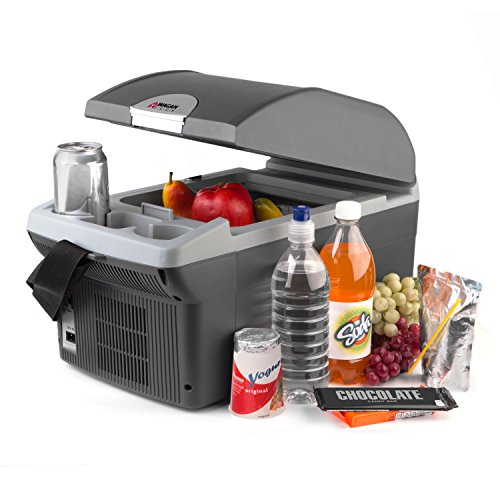
Wagan EL6214 Personal Thermoelectric Cooler/Warmer 14 Liter — Best Thermoelectric Alternative
Every roundup needs one pick that exists to keep buyers honest, and the Wagan EL6214 is it. This 14-liter thermoelectric box cools below the surrounding air and can switch to warming, which makes it genuinely useful for drivers who carry lunch daily — as long as nobody mistakes it for a refrigerator.
Strengths
- Cools and warms, so one box covers lunches in both seasons
- Light, simple and easy to move between vehicles
- Thermoelectric design has no compressor to worry about on rough rides
Trade-offs
- Cannot freeze and cannot hold fridge temperatures in a hot cabin
- 14 liters is personal-scale only
- Cooling performance falls as ambient temperature climbs
| Capacity | 14 Liter |
| Cooling | Thermoelectric cooler/warmer |
| Power | 12/24V DC |
| Use case | Car, RV, camping |
Judge the Wagan by the job it is actually for. A delivery driver, sales rep or commuter who wants sandwiches and drinks kept properly cool from morning to evening — and maybe soup kept warm in winter — gets exactly that, in a box that rides on a seat and sips power compared with a compressor working hard. It is also a kind first powered cooler for teenagers’ cars and spare vehicles.
The failure mode is expectation. Load it with a weekend of raw meat in July, park in the sun, and it will disappoint you while a compressor chest would not. This guide includes it, clearly labeled, because for the light-duty job it does, paying compressor money is its own kind of mistake.
Best for: daily drivers, lunch carriers and light-duty users who value warming as much as cooling / Not suited for: camping refrigeration, frozen food, hot-climate trips, or food that must stay at a set temperature
Check on Amazon — check price on Amazon for the current listing.
Comparison Table
The table below lines up all six chests by the spec that decides most purchases — capacity — alongside the job each one does best. Cooling style matters as much as size, so read the full reviews before treating the biggest number as the winner.
| Pick | Badge | Key spec | Best for | Link |
|---|---|---|---|---|
| Alpicool C20 Portable Compressor Fridge Freezer 21 Quart | Best Overall | 21 Quart (20 Liter), compressor, 12/24V DC + 110V AC | drivers and couples who want one dependable compressor chest for weekends, commutes and road trips | Check on Amazon |
| EUHOMY 19QT 12 Volt Refrigerator | Best Budget | 19QT, -4°F~68°F, ECO/MAX modes, 3-level battery protection | solo travelers, couples and budget-first buyers who still need true freezing | Check on Amazon |
| Dometic CFX2 37L Electric Cooler | Best Premium | 37L, holds 48 cans, freezes to -7°F, app control, 3-stage battery protection | serious travelers, van and overland builds, and buyers who want the longest-lived chest | Check on Amazon |
| Alpicool C50 Portable Car Freezer 47 Quart | Best for Families | 47 Quart, compressor, 12/24V DC + 100-240V AC | families, RV and truck campers, and crews provisioning multi-day trips | Check on Amazon |
| BougeRV 12V Refrigerator 53 Quart Electric Car Cooler | Best for Trucks and Overlanding | 53 Quart, MAX/ECO mode, -4~50°F, 45dB, 3-level battery protection | overlanders, truck campers and long-range travelers provisioning for many days | Check on Amazon |
| Wagan EL6214 Personal Thermoelectric Cooler/Warmer 14 Liter | Best Thermoelectric Alternative | 14 Liter, thermoelectric cooler/warmer, 12/24V DC | daily drivers, lunch carriers and light-duty users who value warming as much as cooling | Check on Amazon |
How to Choose the Best 12 Volt Ice Chest for Your Vehicle?
Start with cooling technology, because it decides everything else. A compressor chest works like a small household fridge: it reaches and holds the temperature you set, down to freezer levels on every compressor pick in this guide, and it sips power once the box is cold because the compressor cycles instead of running flat out. A thermoelectric chest moves heat with a solid-state plate; it is light, simple and can warm as well as cool, but its floor is tied to ambient temperature, so on a very hot day the inside is simply less hot rather than genuinely cold.
Next, size the chest to the trip, not the vehicle. Around 19 to 21 quarts covers one or two people for a weekend of drinks and fresh food. The mid-30s to high-40s quart range is the family and overlanding sweet spot, swallowing several days of provisions without dominating the cargo floor. Go past 50 quarts only if you feed a crew, hunt, or run a basecamp; the box gets heavy fast once loaded, and a half-empty large chest wastes both space and power.
Then check the power story end to end. Confirm the chest runs on 12/24V DC for vehicles and, ideally, ships with an AC adapter so you can pre-chill on household power. Look for selectable battery-protection levels and set them honestly: the highest protection setting for a starter battery you depend on, a lower setting only when the chest runs from a dedicated auxiliary or lithium power station that can afford the deeper draw.
What Size 12 Volt Ice Chest Do You Actually Need?
Think in meals and bottles rather than abstract volume. A 14 to 21 quart chest handles a driver’s lunches, a dozen drinks and snacks, and fits behind a seat or in a footwell-adjacent cargo corner. That is the right scale for commuters, delivery drivers, rideshare drivers who pack their own food, and anyone whose ‘camping’ is really a long day trip with a cold dinner waiting in the car.
From roughly 28 to 47 quarts, a chest becomes a genuine grocery and camping fridge: several days of fresh ingredients for two to four people, room for frozen items in the freezer-capable models, and enough depth for upright bottles. At 48 quarts and above you are provisioning a family, a fishing trip or a small crew, and dual-zone designs — covered in depth in our companion roundup of larger coolers — start to beat a single big cavity because fridge and freezer goods stop compromising on one temperature.
Whatever size you choose, leave the chest a few inches of breathing room on the vent side in the vehicle, keep it out of direct sun where you can, and pre-chill both the box and its contents at home. Those three habits do more for real-world temperature holding than any single feature on a spec sheet.
How to Set Up and Run a 12 Volt Ice Chest on the Road?
Setup is simple, but the order matters if you want the chest cold when the food goes in and the battery alive when you turn the key. Work through these steps the first time and they become a two-minute routine afterward.
- Pre-chill at home: plug the chest into household power with its AC adapter, set your target temperature, and let it run empty for at least an hour — longer for the big boxes — while you pack food that is already refrigerated or frozen.
- Load cold food into the cold chest, grouping freezer items together and filling gaps with drinks or a towel so cold air is not wasted on empty space every time the lid opens.
- Position the chest in the vehicle with its vents unobstructed, out of direct sun if possible, and secure it so it cannot slide or tip on rough roads.
- Connect the DC cord directly to a healthy 12V outlet or auxiliary battery, choose the battery-protection level that matches that power source, and confirm the display shows the compressor running.
- Set the final temperature for the load — fridge range for fresh food and drinks, freezer range only for goods that must stay frozen — and check the vehicle battery state at every long stop.
- At camp or at home, switch back to AC power or a power station rather than idling the vehicle, and wipe the seal and interior dry before storage so the chest is ready for the next trip.
One habit separates happy owners from frustrated ones: treat the first hour as sacred. Every lid opening during the initial pull-down dumps the cold air the compressor just made, so load once, close the lid, and let the box work. After that, normal use barely moves the temperature on any compressor pick in this guide.
Can You Run a 12 Volt Ice Chest from Solar or a Power Station?
Yes, and for stationary camping it is the best way to run one. A compressor chest’s modest average draw pairs naturally with a portable power station, and a solar panel sized for your latitude and season can keep the station ahead of the chest indefinitely in fair weather. The pattern that works is boring and reliable: chest pre-chilled, station charged by driving or solar during the day, ECO-style running overnight, and the battery-protection cutoff set as the final safety net rather than the plan.
Sizing the station is a trip-length question rather than a chest question. A weekend needs a modest station for most of the picks here; a week needs either a large station, daily driving, or solar input — and experienced travelers combine at least two of the three so one cloudy day or one lazy morning never becomes a food-safety problem. The chests with selectable protection levels and ECO modes, which is most of this guide, stretch every watt-hour noticeably further than basic models in this setup.
Solar direct-to-chest arrangements exist, but the station-in-the-middle pattern is more forgiving: the station buffers clouds, runs the chest through the night, and gives you USB and AC outlets for the rest of camp as a bonus. If your trips are evolving toward longer off-grid stays, buy the chest for the vehicle first and grow the power system around it — the chest will not need replacing when the power grows.
One practical warning belongs here: keep the chest itself out of the sun you are harvesting. A chest baking in direct sunlight while its panel charges nearby is working against its own power supply. Shade the box, face the panel, and the same sunshine that heats the day ends up keeping dinner cold — which is the quiet magic trick that makes travelers fall for this setup permanently.
How Long Will a 12 Volt Ice Chest Hold Temperature Without Power?
Unplugged, a compressor chest becomes a well-insulated passive cooler, and a good one holds safe temperatures for many hours — longer when it starts cold, full and unopened, shorter when it starts half-empty in a hot vehicle. The insulation that makes the compressor efficient in the first place does this work, and the premium pick’s construction is the extreme case: the same walls that save battery while running save temperature while parked.
Owners can stack the odds deliberately. Freeze water bottles as thermal ballast before any day that includes long unpowered stretches; they occupy the gaps that would otherwise hold warm air, they melt into drinking water rather than cooler soup, and they cost the compressor little to freeze during the drive. Keep the lid closed during the unpowered window — a closed chest is a vault, an opened one is a bucket being emptied.
The thermoelectric pick plays by different physics and this guide will not blur them: unplugged, it is a thin-walled box that warms quickly. Its duty is powered duty, at the seat or the campsite hookup, and judging it by unpowered holding would be as unfair as judging the compressor chests by warming soup. Each technology’s honest envelope is stated in its review, and this section simply extends the compressor envelope to the unplugged case.
For planned unpowered stretches — a workday in a parked vehicle, a ferry crossing, a trailhead wait — the practical ceiling is set less by the chest than by the discipline around it. Park in shade, pre-chill hard, load frozen ballast, and open once. Travelers who do those four things routinely trust a compressor chest across a full working day; travelers who do none of them blame a perfectly good appliance by lunchtime.
Common Buying Mistakes
Mistake 1: expecting thermoelectric cooling to freeze. A thermoelectric chest cools relative to the air around it. In a hot vehicle it keeps drinks pleasantly cool and sandwiches safe for a day, but it will not hold ice cream or safely freeze raw meat. If your trip needs true freezing, buy a compressor model and skip the disappointment.
Mistake 2: ignoring battery protection settings. Compressor chests ship with selectable low-voltage cutoffs for a reason. Left on the most permissive setting and plugged into a starter battery overnight, even an efficient chest can leave you jump-starting the vehicle at dawn. Match the setting to the battery, every time.
Mistake 3: buying capacity by headline number alone. Two chests with similar quart ratings can pack very differently depending on wall thickness, lid shape and whether the compressor hump eats a corner. Think about the tallest bottle and the largest container you actually carry, and choose the shape that swallows them.
Mistake 4: blocking the vents. Soft luggage piled against the vent side forces the compressor to work harder, run longer and draw more power for worse cooling. Leave an air gap, especially in summer, and your food and your battery both benefit.
Mistake 5: loading warm food into a warm chest on DC power. Pulling a full load down from room temperature is the hardest job the compressor does, and doing it from the vehicle battery is the fastest way to drain it. Pre-chill on AC at home and the road portion becomes easy maintenance instead of hard labor.
A note on noise, because it decides whether a chest can live in a camper or van conversion: compressor chests are not silent, but the better ones — the BougeRV lists a 45dB figure in its verified specification — settle into a low hum that most sleepers tune out once the box reaches temperature and the compressor cycles gently. Thermoelectric models trade the compressor hum for a constant fan sound. If you sleep beside the chest, place it on a mat rather than a hard floor panel, which transmits vibration straight into the vehicle body.
Lid discipline deserves its own paragraph because it is free performance. Every opening exchanges the chest’s cold, dense air for warm cabin air, and the compressor pays for each exchange. Pack in the order you will eat, keep the most-grabbed drinks in one corner, and consider a small day bag for items you open hourly. On multi-day trips this habit alone can be the difference between a chest that sips power and one that works hard all weekend.
Finally, think about where the chest lives between trips. A compressor chest stored with its lid cracked open stays fresh; stored sealed and damp, it grows the smell every owner knows. Wipe the seal, dry the interior, and store the cords inside the box so the whole kit — chest, DC lead and AC adapter — travels as one grab-and-go unit on the next trip.
Winter use flips several assumptions in this guide and deserves its own note. A compressor chest in a cold vehicle works gently — the ambient air does half its job — but drinks and produce can freeze if the box sits in an unheated cargo area overnight in serious cold, because the chest’s job is holding a set point, not warming. The thermoelectric Wagan, with its warming mode, oddly becomes the winter specialist for lunches and for keeping liquids liquid, which is one more reason it earns its clearly-labeled place here.
Cord management is the smallest upgrade with the largest daily payoff. The DC lead should reach the outlet without tension, route where it cannot be pinched by seats or cargo, and coil for storage without tight kinks. A chest that loses power at midnight because its cord was half-seated by a sliding cooler is a failure of setup, not of the appliance — and it is the most common real-world failure owners report in this category.
If you carry medication that must stay refrigerated, treat the chest as medical equipment: choose a compressor pick with battery protection, keep a small thermometer beside the medication, and never let the chest be the car’s only battery consumer overnight without a protection setting you have tested. The picks here are consumer appliances, not medical devices, but with those habits they serve this duty reliably for many travelers — and the thermometer habit improves every other use in this guide too.
Resale and hand-me-down value in this category is quietly strong for the compressor picks, because a working compressor chest is obviously working — it either gets cold or it does not — and buyers trust that test. Owners who keep the box, both cords and the manual together find these chests easy to pass on when a bigger dual-zone model eventually takes over the vehicle, which softens the true cost of starting with the right size today.
One last scenario belongs in this guide because it converts more skeptics than any other: the power outage. A compressor chest on a vehicle battery or a small power station keeps the most valuable food — the medication, the baby supplies, the expensive proteins — safely cold through an outage that empties a household fridge’s grace period. Owners who bought for camping discover this second duty exactly once, and describe it the same way every time: the night the chest paid for itself.
Final Recommendation
For most drivers, the Alpicool C20 is the best 12 volt ice chest to buy first: genuine compressor cooling, a footprint that fits almost any vehicle, and dual power for home pre-chilling. Step up to the Alpicool C50 or the BougeRV 53-quart if you provision for a family or a crew, choose the Dometic CFX2 37L if you want the premium build and app control, take the EUHOMY 19QT for the tightest budget that still buys a real compressor, and pick the Wagan only with clear eyes — as a light-duty cooler-warmer, it is honest value; as a fridge substitute, it is not.
Whichever chest you choose, set the battery protection correctly on day one and pre-chill before every trip. Those two habits, more than any badge in this guide, decide whether a 12 volt chest feels like a luxury or a liability. Readers comparing the larger dual-zone end of this category should also see our companion guides linked below.
Start with the top picks here: Check on Amazon Check on Amazon Check on Amazon.
Best 12 Volt Ice Chests Coolers Best 12 Volt Ice Maker Best 12 Volt Inflator Best 12 Volt Refrigerator Best 12 Volt Cooler
Frequently Asked Questions
Can a 12 volt ice chest really freeze food?
Yes — every compressor model in this guide can. The EUHOMY, Dometic and BougeRV picks list freezer-capable low temperatures in their verified specifications, and the Alpicool chests are sold as fridge-freezers. The thermoelectric Wagan cannot freeze; it only cools relative to the surrounding air, which is why this guide labels it a cooler-warmer rather than a fridge.
Will a 12 volt ice chest drain my car battery?
It can if you let it, which is why battery protection matters. The EUHOMY, Dometic and BougeRV picks include multi-level low-voltage cutoff that stops the compressor before the battery falls too far. Use the most protective setting on a starter battery, run the chest while driving where possible, and switch to AC or a power station for long stationary stops.
What is the difference between a 12 volt ice chest and a normal cooler with ice?
Ice gives you a melting, warming box and soggy packaging; a powered chest holds one set temperature indefinitely while power lasts, needs no ice runs, and leaves all its volume for food. The trade-off is cost, weight and dependence on a power source — which is why sizing and battery planning get so much attention in the buying guide above.
How long can I run a 12 volt chest from a power station?
That depends on the station’s capacity, the ambient temperature and how cold you set the box, so any single number would be a guess. Compressor chests draw modest power once cold, especially in ECO-style modes like the EUHOMY and BougeRV offer, and pre-chilling plus good vent space stretches runtime further than any other habit.
Should I buy a thermoelectric or compressor chest?
Buy thermoelectric only for light duty: drinks and lunches on day drives, or warming food, where its low draw, light weight and simplicity win. For multi-day trips, hot climates, frozen food or medication that must stay properly cold, a compressor chest is the only honest answer, and every other pick in this guide is one.
Can I use a 12 volt ice chest at home too?
Yes, if it ships with an AC adapter — the Alpicool, EUHOMY and BougeRV picks all list AC input alongside 12/24V DC. Owners commonly use them as an overflow fridge for drinks, a garage backup during outages, or a pre-chill station the night before a trip, which is exactly the routine the setup section recommends.


