Disclosure: airfryerkitchensupply.com is reader-supported. When you buy through links on our site, we may earn an affiliate commission at no extra cost to you.
Where to buy
Looking for the best 12 volt house heater? This shortlist is the fastest route through the guide: every heater below was confirmed against current catalog data before inclusion, and Amazon is the sensible channel for this category: diesel air heaters and 12V electric heaters are niche products that local stores rarely stock in any variety. Read the listing’s fuel, voltage, and installation requirements carefully before ordering — these are real heating appliances, not space-heater toys, and the installation details matter.
- Best Overall: LF Bros 5KW Diesel Heater — check price on Amazon
- Best for Larger Spaces: VEVOR 8KW Diesel Heater (10L Tank) — check price on Amazon
- Best Smart Controls: Hcalory TB MAX2 8KW Diesel Heater — check price on Amazon
- Best Portable All-in-One: VEVOR 8KW Diesel Heater All in One — check price on Amazon
- Best for Small Spaces: LF Bros 2KW Diesel Heater — check price on Amazon
- Best Electric-Only (Spot Heat): H100C 12V 300W Electric Heater (Direct Wired) — check price on Amazon
Read this before the shortlist, because it shapes everything: a 12V electric heater can only produce a few hundred watts of heat — physics and wire sizes demand it — so genuine house-scale heat from a 12V system comes from diesel air heaters, which burn a small amount of fuel and use 12V power for their fan, pump, and controls. This guide is honest about that split and ranks both types for what they truly do.
The search for the best 12 volt house heater collides with an electrical fact that no marketing can repeal: heat takes watts, and a 12V circuit delivers them grudgingly. A typical 12V electric heater makes around 300 watts — enough to warm your hands or defog a cab, roughly a fifth of an ordinary household space heater. Anyone promising to heat a house with a plug-in 12V electric element is selling disappointment, and this guide will not pretend otherwise.
What actually works — and works remarkably well — is the diesel air heater. These compact units, long standard in trucks, boats, and RVs, burn diesel at a sip to produce 2kW to 8kW of real heat while drawing their electrical power from 12V. Installed with the exhaust routed safely outside, a 5kW or 8kW diesel heater genuinely heats a workshop, cabin, garage, greenhouse, or a home’s key rooms during an outage, running from a battery bank that solar or a vehicle can sustain. Five of the six picks here are diesel heaters, chosen across sizes and budgets.
The sixth pick is the best honest electric option — a direct-wired 300W unit — included for readers whose need is truly small: a pump house that must not freeze, a pet shelter, a tiny insulated space. The reviews grade each heater against its real job, and the guide sections explain sizing, safe installation, and fuel and power budgeting in plain terms. Safety is treated as a first-class topic throughout, because combustion heating indoors demands it.
In this guide
Quick Picks
The LF Bros 5KW is the balanced default for most spaces. Step up to an 8KW VEVOR or Hcalory for larger or colder spaces, down to the LF Bros 2KW for small ones, and treat the 300W electric pick as spot heat only.
- Best Overall — LF Bros 5KW Diesel Heater: A 5KW all-in-one diesel air heater running on 12V/24V/110V with remote control, digital display, and a 5L tank — the mainstream size for cabins, workshops, and rooms.
- Best for Larger Spaces — VEVOR 8KW Diesel Heater (10L Tank): An 8KW DC12-24V diesel air heater with a 10L tank, remote control, and color display — maximum heat and runtime for big or cold spaces.
- Best Smart Controls — Hcalory TB MAX2 8KW Diesel Heater: An 8KW all-in-one with a 7.9L tank, app control, auto start-stop, altitude mode, and carbon self-cleaning — the feature-rich flagship option.
- Best Portable All-in-One — VEVOR 8KW Diesel Heater All in One: An 8KW all-in-one DC12-24V unit with remote, LCD switch, low-noise design, and pre-heating — the movable heat source for RVs, campers, and rotating jobs.
- Best for Small Spaces — LF Bros 2KW Diesel Heater: A compact 2KW 12V diesel heater with timer and LCD display — correctly sized heat for vans, small cabins, boats, and single small rooms.
- Best Electric-Only (Spot Heat) — H100C 12V 300W Electric Heater (Direct Wired): A direct-wired 300W, 25A 12V electric heater — honest spot heat for a pump house, pet shelter, or cab, with no fuel and no exhaust. Not a house heater.
How These Picks Were Chosen
Honesty about heat output was the first filter: every pick’s kilowatt class had to be confirmed in its own listing, and we excluded the flood of novelty plug-in ‘heaters’ whose real output is a warm breeze. Diesel air heaters dominate because they are the only 12V-powered products that produce house-relevant heat — a fact the article states openly rather than burying.
Sizing range was the second criterion. A useful guide needs the small-space answer (2KW), the mainstream answer (5KW), and the large or cold-climate answer (8KW), because an oversized heater short-cycles and an undersized one runs flat-out and still loses. The picks deliberately span that range across LF Bros, VEVOR, and Hcalory — the three brands that dominate this category’s real market.
Finally, we weighed installation reality: all-in-one versus split designs, included tanks and controls, app or remote operation, and the availability of the exhaust and intake hardware that safe installation requires. Every model had to be confirmable in current catalog data with its headline specifications intact.
The 6 Best 12 Volt House Heaters

LF Bros 5KW Diesel Heater — Best Overall
The LF Bros 5KW is the center of this market for good reason: 5KW is the size that heats a cabin, a workshop, a garage, or a couple of rooms without the short-cycling of an oversized unit, and this confirmed model adds the flexibility of running from 12V, 24V, or 110V power with a remote control, digital display, foldable handle, and a 5L fuel tank in an all-in-one case.
It suits the broadest range of buyers — off-grid cabins, home workshops, greenhouse and outbuilding heat, and outage backup for key rooms. If your space is a large, poorly insulated barn or a whole house in a cold climate, step up to the 8KW picks; if it is a small van or tiny room, the 2KW below is the better-mannered choice.
Strengths
- 5KW output is the versatile middle size for most real spaces
- Triple voltage input (12V/24V/110V) suits battery, vehicle, and mains setups
- All-in-one format with tank and remote simplifies installation
Trade-offs
- Still requires proper exhaust routing outside — no diesel heater is a drop-in appliance
- 5L tank means regular refills during multi-day cold snaps
- Combustion heat demands a carbon monoxide alarm in the heated space, without exception
| Specification | Detail |
|---|---|
| Heat output class | 5KW |
| Power input | 12V / 24V / 110V |
| Fuel tank | 5L |
| Controls | Remote control, digital display |
What owners consistently discover is how little fuel this class uses: diesel air heaters sip rather than gulp, because they are heating air directly at high efficiency rather than idling an engine. Paired with a modest battery bank, the 12V draw of the fan and pump is small enough for solar or vehicle charging to sustain through an outage — the exact scenario where a house heater earns its keep.
LF Bros has become one of the category’s reference brands through tidy all-in-one packaging and controls that ordinary humans can operate. Install it with the exhaust sealed and routed outside, the intake drawing clean air, and a CO alarm on the wall, and it delivers the kind of steady, dry heat that makes a cold building feel civilized.
Ownership settles into a comfortable rhythm: diesel in the tank, the battery bank topped by whatever charging you already own, and heat on the remote’s say-so. Owners heating cabins through a season learn its voice — the startup sequence, the fan’s working note — the way you learn any appliance that serves daily. Keep the exhaust termination clear of snow and nests, run it monthly in the off-season, and the LF Bros simply becomes how the building stays warm.
Best for: Cabins, workshops, garages, and key-room home backup heat / Not suited for: Whole-house primary heating in cold climates, or any install without outside exhaust
Check on Amazon — check price on Amazon before you buy, because specifications and included accessories can change between production runs.
VEVOR 8KW Diesel Heater (10L Tank) — Best for Larger Spaces
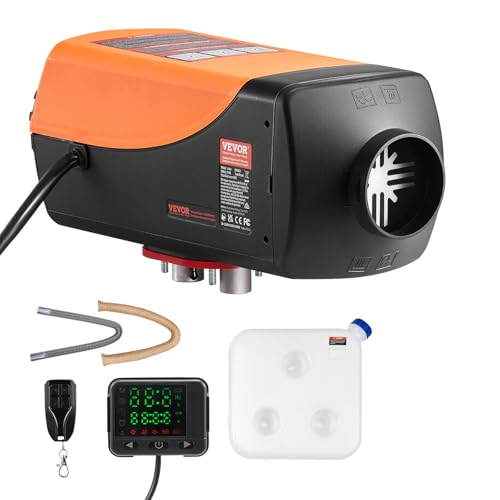
When 5KW is not enough — a large workshop, a poorly insulated outbuilding, a boat or RV in serious winter — this VEVOR’s confirmed specification steps up: 8KW of heat, a 10L fuel tank for extended runtime, DC12-24V power, remote control, and a color digital display. It is the heavy artillery of this guide, sized for spaces that defeat smaller heaters.
Choose it for large or cold spaces and long runtimes between refuels. In a small, well-insulated room it will short-cycle and cook the occupants in waves — match the heater to the space, and if your space is modest, the LF Bros 5KW is the wiser buy.
Strengths
- 8KW output heats large, drafty, or very cold spaces smaller units cannot
- 10L tank roughly doubles runtime between refills versus 5L models
- Remote and display make a permanently installed unit easy to live with
Trade-offs
- Oversized for small rooms — short-cycling wastes fuel and comfort
- Larger unit needs more installation space and planning
- Same non-negotiable exhaust and CO-alarm requirements as every diesel heater
| Specification | Detail |
|---|---|
| Heat output class | 8KW |
| Power input | DC 12-24V |
| Fuel tank | 10L |
| Controls | Remote control, color digital display |
The 10L tank is the unsung headline here. In outage or off-grid use, runtime is logistics: a heater that runs through the coldest night and the following day on one fill is a different tool from one demanding a midnight refuel in a storm. Combined with 8KW of output, this VEVOR is the pick for buildings, not just rooms.
VEVOR’s diesel heaters have become the category’s volume standard, with broad parts availability and a large owner community documenting installs. Follow their collective wisdom on exhaust routing and fuel-line priming, and the unit rewards you with serious, sustainable heat.
The big VEVOR’s ownership dividend is logistics: the 10L tank turns refueling from a chore into an occasional errand, which matters most exactly when conditions are worst. Its scale also makes it the pick most worth installing thoughtfully the first time — a permanent, tidy installation with proper exhaust work — because it will serve for years in that spot. Owners of large cold buildings consistently describe the same conversion: rooms that were written off all winter come back into use.
Best for: Large workshops, outbuildings, boats, and cold-climate spaces / Not suited for: Small insulated rooms, where a 2KW or 5KW unit behaves better
Check on Amazon — check price on Amazon before you buy, because specifications and included accessories can change between production runs.

Hcalory TB MAX2 8KW Diesel Heater — Best Smart Controls
Hcalory’s TB MAX2 is the technologist’s diesel heater: a confirmed 8KW all-in-one with a 7.9L tank, app control, automatic start-stop, altitude mode, dual noise reduction, and a carbon self-cleaning function aimed at the soot buildup that is this category’s main maintenance chore. For a heater installed in a cabin or home space you live with daily, those controls are not garnish — they are the ownership experience.
It suits buyers who will install once and live with the heater as an appliance: thermostat-managed warmth, phone control, and self-maintenance. Budget-focused buyers get the same heat class from the VEVOR above for less; the Hcalory charges for intelligence.
Strengths
- App control and auto start-stop deliver true thermostat-style living
- Carbon self-cleaning attacks the category’s main maintenance burden
- Altitude mode keeps combustion correct in mountain installations
Trade-offs
- Feature richness is wasted on occasional emergency-only use
- App dependence is a minus for buyers who prefer purely manual controls
- Premium tier within the diesel heater market
| Specification | Detail |
|---|---|
| Heat output class | 8KW |
| Fuel tank | 7.9L, all-in-one |
| Power input | 12V / 24V / 110V |
| Controls | App control, auto start-stop, altitude mode |
Auto start-stop is the feature that changes diesel heating from an event into a utility: set a temperature and the heater manages itself, sipping fuel and holding the space steady instead of blasting and coasting. In a cabin or a home’s main living area, that steadiness is the difference between ‘heater’ and ‘heating system.’
The self-cleaning function deserves its headline too. Carbon buildup in the burner is what eventually sidelines hard-used diesel heaters, and a unit that periodically cleans itself extends the interval between real services. Combined with altitude compensation, the TB MAX2 is engineered for owners who heat seriously and often.
Living with the TB MAX2 is the closest this category comes to central heating manners: set the temperature in the app, let auto start-stop hold it, and glance at status from the couch or from town. The self-cleaning cycle removes the chore owners of lesser units calendar for mid-season, and altitude compensation means a heater moved from valley home to mountain cabin does not need re-jetting wisdom you do not have. It is the heater for people who intend to forget it exists — the highest compliment heating equipment can earn.
Best for: Cabins and home spaces heated daily, where controls and self-maintenance matter / Not suited for: Occasional emergency use, where the simpler picks do the same job
Check on Amazon — check price on Amazon before you buy, because specifications and included accessories can change between production runs.
VEVOR 8KW Diesel Heater All in One — Best Portable All-in-One
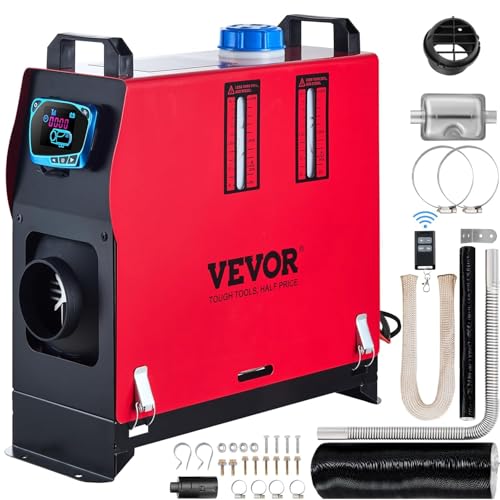
This VEVOR packages 8KW into a self-contained all-in-one case — confirmed with remote control, an LCD switch, low-noise positioning, and a pre-heating function — making it the guide’s movable option: one unit that can warm the camper this weekend, the garage next week, and stand outage duty at home between times, wherever a safe exhaust path exists.
It suits owners whose heating needs move: RV and camper users, market and event setups, and households wanting outage heat without a permanent install. Buyers building a fixed cabin system may prefer a split installation or the smarter Hcalory; portability is this unit’s argument.
Strengths
- All-in-one case moves between vehicles, buildings, and duties
- 8KW output covers large spaces despite the portable format
- Pre-heating function is genuinely useful in deep cold starts
Trade-offs
- Portable does not mean casual — exhaust must still exit safely outside, every time
- All-in-one units are heavier to move than their spec sheets suggest
- Fewer smart controls than the Hcalory flagship
| Specification | Detail |
|---|---|
| Heat output class | 8KW |
| Format | All-in-one |
| Power input | DC 12-24V |
| Controls | Remote control, LCD switch |
| Features | Pre-heating function, low-noise design |
The all-in-one format collapses the installation to its essentials: position the unit, route the exhaust out, connect 12V power, and heat. For renters, seasonal users, and anyone whose ‘installation’ is a different building each month, that simplicity is decisive — and the 8KW output means the simplicity costs nothing in capability.
Respect the format’s one rule: the exhaust discipline travels with the unit. Every new location needs the same care — exhaust sealed and outside, intake unobstructed, CO alarm present in the occupied space. Portable heat, permanent standards.
The portable VEVOR’s ownership pattern is seasonal choreography: it winters where the need is, summers in storage, and stands ready between. Its pre-heating function earns particular loyalty in deep cold, where lesser units struggle to light. The discipline it demands is procedural rather than technical — every new location gets the full exhaust and CO-alarm ritual, without the complacency that familiarity breeds. Portable heat, permanent standards, every single time.
Best for: RVers, campers, and households wanting movable outage heat / Not suited for: Fixed whole-season cabin installs wanting thermostat automation
Check on Amazon — check price on Amazon before you buy, because specifications and included accessories can change between production runs.

LF Bros 2KW Diesel Heater — Best for Small Spaces
Small spaces punish oversized heaters: an 8KW unit in a van or tiny cabin blasts, shuts off, blasts again, and never settles. The LF Bros 2KW exists for those spaces — a confirmed compact 12V diesel heater with timer and LCD display, sized for sedans, micro cars, small trucks, panel vans, and by extension the small rooms, boats, and cabins of this guide’s readers.
Choose it when your space is genuinely small and insulated. In a drafty workshop it will run constantly and still lose ground — that is not a defect, it is sizing, and the 5KW pick above is the correct tool there.
Strengths
- Right-sized output runs steadily instead of short-cycling in small spaces
- Compact format fits vans, boats, and tight installations
- Timer and display cover the controls small-space living needs
Trade-offs
- 2KW cannot heat large or poorly insulated spaces — physics, not a flaw
- Small fuel arrangements mean attentive refilling in long cold spells
- Same exhaust and CO safety requirements as its bigger siblings
| Specification | Detail |
|---|---|
| Heat output class | 2KW |
| Power input | 12V |
| Controls | Timer, LCD display |
| Format | Compact design |
Steady, modest heat beats heroic, intermittent heat for both comfort and fuel economy, and that is the 2KW’s whole case. In a small cabin or boat cabin it can hold a pleasant temperature for hours on a whisper of diesel, running from a battery a small solar panel can maintain.
It is also the gentlest introduction to diesel heating in this guide: less installation mass, less output to manage, and the same safety disciplines learned at a forgiving scale. Small space, right tool.
The 2KW’s owners are the category’s quiet satisfied: van-lifers, boat owners, and tiny-cabin keepers whose spaces it holds at a steady, civilized temperature on a whisper of fuel. Its timer suits the rhythms of small-space life — warmth before waking, warmth on return — and its modest battery draw pairs with the smallest solar setups in this guide’s world. It is proof that in heating, as in tailoring, fit beats size.
Best for: Vans, boats, tiny cabins, and single small insulated rooms / Not suited for: Workshops, garages, or any large or drafty space
Check on Amazon — check price on Amazon before you buy, because specifications and included accessories can change between production runs.

H100C 12V 300W Electric Heater (Direct Wired) — Best Electric-Only (Spot Heat)
This pick is included with a warning label, deliberately: the H100C is a confirmed 300W, 25-amp, direct-wired 12V electric heater, and 300 watts is 300 watts — about a fifth of a household space heater’s output. It will not heat your house. What it will do is keep a small, insulated enclosure above freezing, warm a cab, or take the chill off a tiny space, with no fuel, no exhaust, and no combustion at all.
Choose it for freeze protection and spot warmth where diesel is impractical — a well pump house, a chicken coop corner, a pet shelter, a boat cabin’s small hours. Choose any diesel pick above the moment the words ‘room’ or ‘house’ honestly describe the space.
Strengths
- No fuel, no exhaust, no combustion — the simplest heat there is
- Direct-wired 25A design delivers its full 300W reliably, unlike plug-in novelties
- Ideal for freeze protection in small insulated enclosures
Trade-offs
- 300W cannot heat a room, let alone a house — included for spot duty only
- 25A continuous draw is a serious load for a battery bank without charging support
- Requires proper direct wiring with correct gauge cable and fusing
| Specification | Detail |
|---|---|
| Heat output | 300W electric |
| Power input | 12V DC, 25A |
| Installation | Direct wired (not plug-in) |
| Intended use | Vehicle cabs, UTVs, RVs, small enclosures |
The mathematics deserve one clear paragraph, because this category is full of fantasy listings. Heat output is watts, and watts at 12 volts demand heavy current: this unit’s honest 25-amp draw is what real 300W heat looks like. Claims of house-heating from a cigarette-lighter plug — a circuit fused far below this current — are arithmetically impossible, and this guide’s insistence on a direct-wired unit is how you can tell the honest electric option from the toys.
Used within its limits, it is a genuinely useful device: silent, instant, and maintenance-free freeze insurance for the small spaces that actually match its output. Respect the wiring — correct gauge, a proper fuse, clean connections — because 25 amps forgives nothing.
The H100C’s ownership is the simplest here: wire it correctly once — proper gauge, proper fuse, clean connections — and it asks for nothing, emits nothing, and simply warms its small appointed space whenever power is applied. Its ideal owners are protecting something specific: pipes that must not freeze, animals that must not chill, a cab that must defog. Bought for that job, it is perfect. Bought for a room, it is a misunderstanding this guide has tried hard to prevent.
Best for: Freeze protection and spot heat in small insulated enclosures / Not suited for: Heating any room or house — choose a diesel pick instead
Check on Amazon — check price on Amazon before you buy, because specifications and included accessories can change between production runs.
Comparison Table
The table’s honest message: match kilowatts to the space, and treat the single electric pick as a different tool for a different job. Diesel sizes run 2KW (small), 5KW (mainstream), 8KW (large) — pick the smallest that wins against your worst cold night.
| Pick | Badge | Key spec | Best for |
|---|---|---|---|
| LF Bros 5KW Diesel Heater | Best Overall | 5KW diesel, 12V/24V/110V, 5L tank, remote | Cabins, workshops, garages, and key-room home backup heat |
| VEVOR 8KW Diesel Heater (10L Tank) | Best for Larger Spaces | 8KW diesel, DC12-24V, 10L tank | Large workshops, outbuildings, boats, and cold-climate spaces |
| Hcalory TB MAX2 8KW Diesel Heater | Best Smart Controls | 8KW diesel, 7.9L tank, app control, auto start-stop | Cabins and home spaces heated daily, where controls and self-maintenance matter |
| VEVOR 8KW Diesel Heater All in One | Best Portable All-in-One | 8KW diesel, all-in-one, DC12-24V, remote | RVers, campers, and households wanting movable outage heat |
| LF Bros 2KW Diesel Heater | Best for Small Spaces | 2KW diesel, 12V, timer, compact | Vans, boats, tiny cabins, and single small insulated rooms |
| H100C 12V 300W Electric Heater (Direct Wired) | Best Electric-Only (Spot Heat) | 300W electric, 12V, 25A, direct wired | Freeze protection and spot heat in small insulated enclosures |
Can a 12V Electric Heater Actually Heat a House?
No — and understanding why protects your wallet. A household space heater produces about 1,500 watts. At 12 volts, 1,500 watts means 125 amps of current: cables like jumper leads, a battery bank drained in well under an hour per 100Ah, and fusing no vehicle circuit possesses. That is why real 12V electric heaters top out around 300 watts, direct-wired, and why their honest role is spot heat and freeze protection.
Diesel air heaters escape this trap by separating the energy source from the electricity: the fuel carries the energy, and 12V merely runs the fan, fuel pump, and controls — a modest draw a battery bank and small solar setup can sustain for days. When a listing implies a plug-in 12V heater will warm a room, it is the single most reliable tell of a junk product in this entire category.
- 1,500W at 12V = ~125A: impractical for any normal 12V system
- Real 12V electric heat tops out near 300W, direct-wired
- Diesel heaters: fuel provides energy, 12V provides control and airflow
- Judge every heater claim by its watts first and its marketing second
How Do You Size a Diesel Air Heater for a Space?
Start from the space, not the product page. Small, well-insulated spaces — vans, boat cabins, tiny cabins, a single small room — suit 2KW. The mainstream of cabins, workshops, garages, and a home’s core rooms suits 5KW, which is why it is this guide’s default. Large, drafty, or very cold spaces — big workshops, outbuildings, larger boats and RVs in winter — need 8KW to win against the coldest nights.
Insulation moves you between classes more than floor area does: a well-insulated small house space may be a 2KW job, while a leaky barn half its size defeats 5KW. When in doubt between two sizes for a lived-in space, choose the smaller that can hold temperature on your worst night — it will run steadier, quieter, and more economically across the whole season than an oversized unit cycling on and off.
What Does Safe Installation of a Diesel Heater Require?
Three things are non-negotiable. First, the exhaust must be routed outside through a sealed, heat-appropriate path, with joints clamped and the outlet positioned so fumes cannot drift back through windows, vents, or the heater’s own intake. Second, the combustion intake must draw clean outside air, never air from a fuel-storage area. Third, a working carbon monoxide alarm must live in every occupied space the heater serves — tested, in date, and treated as the life-safety device it is.
Add the ordinary disciplines: fuel lines routed away from the exhaust’s heat, the unit mounted on a non-combustible surface with clearances respected, and 12V wiring of proper gauge with a fuse at the battery. None of this is advanced work, but all of it is mandatory work. A diesel heater installed casually is a hazard; installed properly, it is one of the most reliable heat sources a home or cabin can have.
- Exhaust outside, sealed, and clear of windows and intakes
- Combustion air from outside, never from fuel storage areas
- Carbon monoxide alarm in the heated space — always, no exceptions
- Correct-gauge fused wiring and heat-aware fuel line routing
Diesel Heater vs Propane vs Electric: Choosing Your Off-Grid Heat
Each off-grid heat source carries a different bargain. Electric heat is clean and silent but, as this guide’s physics section shows, a 12V system cannot feed it at house scale — it belongs to grid power and generators. Propane heaters are simple and powerful, and vented propane furnaces are legitimate house equipment; but portable propane heat carries moisture as a combustion byproduct, demands fuel in pressurized bottles that are awkward to store in quantity, and unvented units have no place in sleeping spaces. Diesel air heaters sit in the sweet spot this guide is built on: fuel that stores safely in ordinary containers for long periods, sip-level consumption, dry heated air, and a 12V appetite small enough for battery-and-solar life.
The deciding factors are usually logistics rather than heat itself. If your property already runs diesel equipment, the heater drinks from an existing supply. If your outages are measured in days, diesel’s energy density means a modest fuel store outlasts any battery-only strategy by an order of magnitude. And if the heated space is lived in daily, the diesel unit’s thermostat-and-remote manners — especially in the smarter picks here — feel like a heating system rather than an appliance. Choose the fuel your life already stocks, and the heater becomes part of the household instead of a guest in it.
How to Budget Fuel and Battery for a Week of Diesel Heat
Planning a week of off-grid heat is two budgets, not one. The fuel budget is the easy half: diesel air heaters modulate, so consumption follows how hard the space fights — a well-insulated cabin on a 5KW unit’s low settings sips, while a drafty workshop at full output drinks. The honest planning method is to assume your coldest night’s consumption for every night, multiply across the week, and store that with margin; diesel keeps well, and surplus fuel is next season’s head start rather than waste.
The electrical budget is where weeks are won or lost. The heater’s draw is modest but continuous — fan, pump, controls, plus a startup surge for the glow plug — and it shares the battery bank with lights, refrigeration, and devices. Add the heater’s daily amp-hours to your outage plan’s ledger (the home backup guide’s load math applies directly), and size charging — solar by day, a vehicle or generator run as backup — to refill the total. Households that do this arithmetic once, in daylight, heat through week-long outages without drama; households that discover it on night three learn why this section exists.
What Does a Season of Diesel Heating Actually Look Like? A Practical Diary
Abstract specifications become clear when followed through a season. In autumn, the heater’s work is shoulder-season kindness: taking the chill off a workshop for evening projects, keeping a cabin’s pipes confident through the first frosts, running an hour here and there on the 5KW unit’s lowest settings while the fuel gauge barely acknowledges the effort. This is also the season to commission properly — the test runs, the exhaust inspection, the CO alarm check — because the heater that is proven in October is trusted in January.
Deep winter is the heater’s examination. In a cabin or a home’s core rooms, a correctly sized unit settles into its rhythm: stronger output through the coldest nights, modulation through the days, the fuel store declining at the planned rate and the battery bank breathing in and out with the solar days. Owners learn their building’s true appetite in this season — which is why the guide’s sizing advice leans on the worst night rather than the average one. The installations that struggle in January were almost always sized or sealed in optimism the previous autumn.
Spring closes the loop with maintenance while the lessons are fresh: fuel system checked, intake and exhaust terminations inspected, the unit run one last time and stored with its tank and lines in the condition the manual blesses. A heater maintained in this rhythm does not age the way neglected equipment does — it simply accumulates seasons. That, more than any single specification, is what the owners of the picks in this guide are actually buying.
- Autumn: commission, test, and prove the installation before it matters
- Winter: size and fuel planning are judged — plan for the worst night
- Spring: maintain while the season’s lessons are fresh
- Monthly off-season runs keep the heater ready for its first cold call
How to Install a 12V Diesel Air Heater (Overview)
This overview covers the shape of a proper installation; your specific unit’s manual governs the details, and local codes govern anything connected to a dwelling. If any step exceeds your confidence — particularly exhaust penetration through a wall — hiring an installer for that portion is money well spent.
- Choose the location: non-combustible mounting surface, clearances per the manual, exhaust path to outside as short and straight as practical.
- Mount the heater securely and fit the exhaust pipe with clamps and heat shielding where it passes near anything combustible, sealing the wall penetration.
- Route the combustion air intake to clean outside air, positioned so it cannot ingest exhaust fumes or road spray.
- Install the fuel tank and line, keeping fuel runs away from the hot exhaust, then prime the pump per the manual until fuel reaches the heater.
- Wire 12V power with the correct gauge cable and a fuse close to the battery, confirming polarity before the first start.
- Commission the heater outdoors or with doors open for its first run, checking every exhaust joint for leaks, then fit and test the carbon monoxide alarm in the heated space.
Run the heater monthly, even in summer, for a short cycle — diesel heaters that sit for seasons are the ones that refuse to start in the first cold snap. Keep the fuel fresh, the intake and exhaust terminations clear of nests and snow, and the CO alarm’s test button on your seasonal checklist alongside smoke detectors.
Common Buying Mistakes
The gravest mistakes in this category are safety shortcuts; the rest are sizing and expectation errors that this guide’s honesty is designed to prevent.
- Believing a plug-in 12V electric heater can warm a room or house
- Running any combustion heater without a carbon monoxide alarm in the space
- Routing exhaust where fumes can re-enter through windows, vents, or the intake
- Oversizing the heater and living with short-cycling, noise, and wasted fuel
- Skipping the monthly test run, then discovering a no-start during a cold snap
- Powering the heater from undersized wiring or an unfused battery connection
Final Recommendation
For most readers, the LF Bros 5KW is the answer: real, house-relevant heat at the versatile middle size, from a 12V-friendly system. Go to the VEVOR 8KW for large or cold spaces, the Hcalory TB MAX2 for daily-lived smart control, the portable VEVOR all-in-one for movable duty, and the LF Bros 2KW for genuinely small spaces. Keep the H100C electric in its honest lane — freeze protection and spot warmth — and it will serve well there.
Above all: size it right, install the exhaust properly, and put a carbon monoxide alarm on the wall. Heat you can trust is heat installed with respect.
The shortlist, one more time, in the order we would buy them for the uses described:
- Best Overall: LF Bros 5KW Diesel Heater — check price on Amazon
- Best for Larger Spaces: VEVOR 8KW Diesel Heater (10L Tank) — check price on Amazon
- Best Smart Controls: Hcalory TB MAX2 8KW Diesel Heater — check price on Amazon
- Best Portable All-in-One: VEVOR 8KW Diesel Heater All in One — check price on Amazon
- Best for Small Spaces: LF Bros 2KW Diesel Heater — check price on Amazon
- Best Electric-Only (Spot Heat): H100C 12V 300W Electric Heater (Direct Wired) — check price on Amazon
Keep researching within this category here: Best 12 Volt Home Backup Best 12 Volt House Power Inverter Best 12 Volt High Amp Battery Best 12 Volt High Volume Air Compressor Best 12 Volt Hydraulic Power Unit
Frequently Asked Questions
Can a 12V heater really heat a house?
A 12V electric heater cannot — physics limits it to around 300 watts, a fraction of a household space heater. A diesel air heater powered electrically by 12V genuinely can heat cabins, workshops, and a home’s key rooms, because diesel fuel supplies the energy while 12V runs the fan and controls. That distinction is the foundation of this guide: five diesel picks for real heat, one electric pick honestly labeled for spot duty and freeze protection.
How much diesel does a 5KW air heater use?
These heaters are notably frugal — they burn fuel at a sip rather than an engine’s gulp, because they heat air directly at high efficiency and modulate once the space is warm. Exact consumption varies with output setting and how hard the space fights back, which is why runtime planning should assume the coldest night, not the average one. The larger tanks in this guide (7.9–10L) exist precisely to stretch refills across multi-day cold or outage periods.
Is a diesel heater safe to use in a house or cabin?
Installed correctly, yes — this is mature technology from the trucking, marine, and RV worlds. Correctly means: exhaust sealed and routed outside, combustion air drawn from outside, clearances respected, and a working carbon monoxide alarm in the heated space. Installed casually — exhaust shortcuts, no CO alarm — it is dangerous, as any combustion appliance is. The installation section of this guide treats those requirements as non-negotiable.
How much battery does a diesel heater need?
The heater’s electrical draw — fan, pump, glow plug at startup — is modest compared with its heat output, but startup draws are the peak to plan for. In practice, a healthy 12V battery bank sized for the heater plus your other outage loads, with solar or vehicle charging to sustain it, runs these heaters for days. The electric H100C pick is the exception: at 25 amps continuous, it needs real charging support for anything beyond short runs.
What size diesel heater do I need for a workshop or garage?
For a typical one- or two-car workshop or garage, the 5KW class is the mainstream answer and this guide’s default. A large, tall, or poorly insulated shop in a cold climate steps up to 8KW; a small, well-insulated one-car space may be content with less. Insulation quality moves the answer more than floor area — seal the drafts first and the smaller heater often wins.
Can I run a diesel air heater from solar and batteries during an outage?
Yes, and it is one of the strongest outage strategies available: the heater’s 12V draw is small enough for a modest battery bank, and daytime solar refills what the night consumed, while diesel fuel — stored safely in quantity — carries the actual heating energy for days. Pair it with the backup systems in our home backup guide and you have heat and power that can outlast most outages in comfort.


