Disclosure: airfryerkitchensupply.com is reader-supported. When you buy through links on our site, we may earn an affiliate commission at no extra cost to you.
Where to buy
Looking for the best 12 volt home backup? This shortlist is the fastest route through the guide: home backup equipment is heavy, expensive to ship back, and needed most on the worst day of the year — so buying through Amazon, where every model below was confirmed against current catalog data, gives you a clear listing of capacity and output, delivery to your door, and a workable returns path. Check the watt-hour figure on the listing once more before ordering; manufacturers sell several similar-looking sizes under one product family name.
- Best Overall: EcoFlow DELTA 2 Max — check price on Amazon
- Best Expandable System: EcoFlow DELTA Pro — check price on Amazon
- Best Value Essentials: Jackery Explorer 1000 v2 — check price on Amazon
- Best Fast Charging: Anker SOLIX C1000 Gen 2 — check price on Amazon
- Best Capacity Density: BLUETTI Elite 200 V2 — check price on Amazon
- Best for Longer Outages: Jackery Explorer 2000 v2 — check price on Amazon
A note on the phrase ’12 volt’ in this category: the systems below are built around battery power with 12V DC outputs for vehicle-style accessories, and several can be expanded with additional 12V battery capacity. What matters for home backup is the pairing of stored energy (watt-hours) and inverter output (watts) — the guide below explains both before you spend anything.
The best 12 volt home backup is the system that keeps your refrigerator cold, your lights on, your phones charged, and your internet alive through an outage — without a gasoline generator’s noise, fumes, and fuel runs. Modern battery backup stations have quietly become the sensible default for most homes: they sit charged in a closet, switch on in milliseconds when the grid drops, and recharge from the wall, from solar panels, or from a vehicle’s 12V system between outages.
This guide ranks six confirmed systems by the two numbers that decide real backup performance: capacity in watt-hours, which is your runtime, and AC output in watts, which decides what you can run at once. The picks span from a fast-charging 1kWh-class station for essentials, through 2kWh systems that carry a home office and fridge comfortably, up to an expandable 3.6kWh flagship that can grow toward whole-home coverage.
Every pick uses lithium iron phosphate (LiFePO4) cells, the chemistry that made home battery backup practical: long cycle life, strong safety characteristics, and none of the maintenance of the lead-acid banks that used to be the only option. Specifications quoted here come from each maker’s confirmed listing — no invented figures, and no prices, because your decision should rest on capacity and output rather than a number that changes with the next sale.
In this guide
Quick Picks
The EcoFlow DELTA 2 Max is the balanced default for most homes. Choose the DELTA Pro for expandability, the Jackery 1000 v2 for value at the essentials tier, and the Anker SOLIX C1000 Gen 2 if recharge speed is your obsession.
- Best Overall — EcoFlow DELTA 2 Max: 2,048Wh of LiFePO4 storage with 2,400W output and one-hour-class charging — the size most homes actually need, from EcoFlow’s mature ecosystem.
- Best Expandable System — EcoFlow DELTA Pro: 3,600Wh and 3,600W out of the box, expandable to 25kWh per its listing — the station that grows from essentials backup toward whole-home coverage.
- Best Value Essentials — Jackery Explorer 1000 v2: 1,024Wh with 1,500W output, fast charging, and 10ms UPS switching — the essentials tier done properly, at the friendliest scale in this guide.
- Best Fast Charging — Anker SOLIX C1000 Gen 2: 1,024Wh with a strong 2,000W output and a full charge in 49 minutes per its listing — the highest output in the 1kWh class here.
- Best Capacity Density — BLUETTI Elite 200 V2: 2,080Wh and 2,600W in a compact footprint, with power-lifting headroom for resistive loads — BLUETTI’s dense, capable 2kWh contender.
- Best for Longer Outages — Jackery Explorer 2000 v2: 2,042Wh with 2,200W output and USB-C PD fast charging — Jackery’s full-size answer for homes that measure outages in days, not hours.
How These Picks Were Chosen
Capacity and output came first: each candidate had to offer at least roughly a kilowatt-hour of storage or a genuinely expandable path beyond it, plus enough AC output to run a refrigerator, lights, and electronics simultaneously — the real-world core of home backup. All six picks clear that bar with room to spare, and all use LiFePO4 chemistry, which we treated as a requirement rather than a preference for equipment that lives in a home for a decade.
Recharge speed was the second filter, because a backup system that takes a day to refill is only useful for the first outage. Every pick here recharges in about an hour class from a wall outlet per its listing, and all accept solar input for extended or off-grid outages. UPS-style switchover was the third consideration: several picks switch in around ten milliseconds, fast enough to keep computers and network gear alive through the transition.
Finally, each model had to be verifiable in current catalog data with its headline specifications intact, from a maker with an established support presence. Home backup is a trust purchase — the day you need it is not the day to discover a specification was invented.
The 6 Best 12 Volt Home Backup Systems

EcoFlow DELTA 2 Max — Best Overall
The DELTA 2 Max hits the sweet spot of home backup: 2,048Wh runs a refrigerator, lighting, network gear, and device charging through a typical overnight outage, while 2,400W of output starts and runs demanding loads like a microwave or a power tool without drama. Its listing confirms LiFePO4 cells and full charging in about an hour, which means it is ready again before a second outage arrives.
It suits the majority of households — apartment to family home — that want serious backup without committing to a whole-home installation. If you know you will expand toward running well pumps or multiple large appliances, start with the DELTA Pro below instead of outgrowing this unit.
Strengths
- Balanced 2,048Wh / 2,400W pairing covers the realistic essentials with headroom
- Fast wall charging restores full capacity between outages
- LiFePO4 chemistry supports years of regular cycling, not just emergency standby
Trade-offs
- Heavy enough that ‘portable’ means planned moves, not casual carrying
- Whole-home loads like central air conditioning are beyond this class
- Expansion is more limited than the DELTA Pro ecosystem
| Specification | Detail |
|---|---|
| Capacity | 2,048Wh |
| AC output | 2,400W |
| Chemistry | LiFePO4 |
| Charging | Full charge in about 1 hour (manufacturer listing) |
What makes this class of station so effective is load discipline: it will not run everything in your house, but it runs the right things for a long time. A modern refrigerator averages a modest draw across the day, LED lighting is nearly free, and network equipment sips power — a 2kWh station shepherding those loads is an all-night guardian rather than a brief gesture.
EcoFlow’s app control and ecosystem of extra batteries and solar panels add flexibility as your needs grow. For most buyers, this is the purchase that converts outage anxiety into a shrug — and that is exactly what home backup is for.
Ownership is where the DELTA 2 Max quietly shines: it is light enough — in backup terms — to move between the fridge’s corner and a camping trip, its app makes checking charge state a glance rather than a trip to the closet, and EcoFlow’s accessory shelf means the solar panel or extra battery you want next year exists. Owners who run one drill and then keep it charged consistently describe the same experience: outages stopped being events. That is the entire product, delivered.
Best for: Most households wanting refrigerator, lights, network, and devices through typical outages / Not suited for: Whole-home backup including central HVAC or electric range loads
Check on Amazon — check price on Amazon before you buy, because specifications and included accessories can change between production runs.
EcoFlow DELTA Pro — Best Expandable System
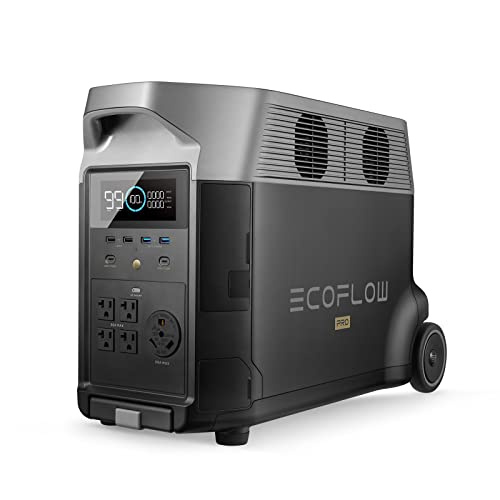
The DELTA Pro is the heavyweight of this guide: a confirmed 3,600Wh capacity and 3,600W of 120V output, expandable — per its listing — up to 25kWh with additional batteries. That expansion path is the point: start with serious essentials coverage, then grow toward well pumps, freezers, and longer autonomy without replacing the core unit.
It suits larger homes, rural properties with longer outages, and anyone planning a phased build toward substantial backup. Apartment dwellers and light users will find it more machine than they need — and more weight than they want to move.
Strengths
- Highest base capacity and output in this guide
- Expansion to 25kWh supports a genuine whole-home strategy over time
- Strong output handles demanding appliances that smaller stations cannot start
Trade-offs
- Size and weight demand a permanent home rather than closet portability
- The ecosystem investment grows with every expansion battery
- Oversized for apartments and short, mild outages
| Specification | Detail |
|---|---|
| Capacity | 3,600Wh |
| AC output | 3,600W, 120V |
| Expansion | Expandable up to 25kWh (manufacturer listing) |
| Charging | Fast charge (manufacturer listing) |
The DELTA Pro’s real advantage is architectural: it is a platform, not just a product. Paired with extra batteries and, where needed, home integration hardware, it scales from ‘the fridge and lights stay on’ to multi-day autonomy for critical circuits. Rural owners who lose power for days, not hours, are its natural audience.
Even standalone, 3.6kWh changes the outage experience — a freezer, a fridge, medical devices, communications, and work equipment all ride through together. Buy it when your outage history, not your imagination, says you need this much.
Plan the DELTA Pro’s home before it arrives: it is furniture-scale equipment that wants a ventilated, permanent station near the loads it serves, ideally where future expansion batteries will join it. Owners building toward whole-home coverage should think in circuits from day one — which loads, on which panel, through which transfer equipment, installed by a licensed electrician where the home’s wiring is involved. Treated as infrastructure from the start, it rewards the planning; treated as a big portable, its size will annoy you.
Best for: Larger homes and rural properties planning expandable, long-duration backup / Not suited for: Small apartments or buyers who only need phones and lights for a few hours
Check on Amazon — check price on Amazon before you buy, because specifications and included accessories can change between production runs.

Jackery Explorer 1000 v2 — Best Value Essentials
The Explorer 1000 v2 proves how far the 1kWh class has come: a confirmed 1,024Wh of LiFePO4 storage, 1,500W of output with 3,000W peak for motor starts, fast charging, and 10-millisecond UPS switching that keeps a computer or router from even noticing an outage. For apartments and smaller homes, this is frequently all the backup that makes sense.
It suits renters, condo owners, and anyone whose outage plan is fridge-plus-lights-plus-connectivity. Households wanting to run a microwave and a fridge and a freezer simultaneously should step up to the 2kWh picks.
Strengths
- UPS-grade 10ms switchover protects computers and network gear seamlessly
- Fast charging means it is ready again quickly after any outage
- Manageable size for apartments, closets, and renters
Trade-offs
- 1,024Wh limits multi-appliance runtime during long outages
- Not expandable the way larger ecosystems are
- High-draw cooking appliances will drain it quickly
| Specification | Detail |
|---|---|
| Capacity | 1,024Wh |
| AC output | 1,500W (3,000W peak) |
| Switchover | 10ms UPS (manufacturer listing) |
| Charging | 50-minute fast charge (manufacturer listing) |
The discipline this station teaches is prioritization: plug in the refrigerator, the router, a lamp, and the chargers, and it will carry a home through most real outages, which in most regions are measured in hours. Its fast recharge is a genuine strategic advantage in storm sequences where power flickers back for an hour between failures.
Jackery’s long presence in portable power and the v2’s LiFePO4 upgrade make it a low-regret purchase. It is also the pick here most likely to earn its keep outside emergencies — camping, tailgating, and job-site power all come free with the same box.
The Explorer 1000 v2’s ownership charm is its lack of drama: it fits a closet shelf, deploys in minutes, and its UPS behavior means the home office never learns an outage happened. Renters particularly value that nothing about it requires installation, permission, or a landlord’s opinion. Keep it charged, run it occasionally so the household remembers how, and it will quietly be the most appreciated appliance you own on exactly the nights everything else fails.
Best for: Apartments and smaller homes covering essentials with UPS protection / Not suited for: Long outages with multiple large appliances running at once
Check on Amazon — check price on Amazon before you buy, because specifications and included accessories can change between production runs.
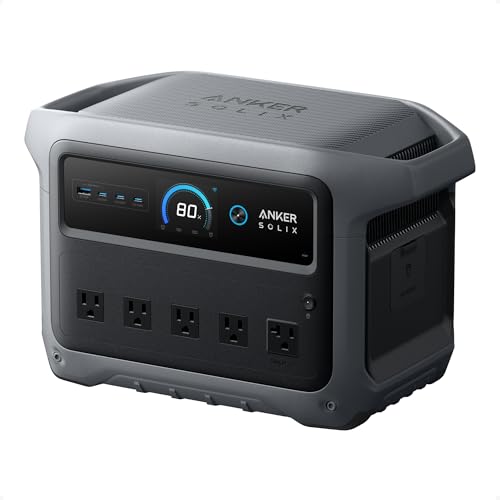
Anker SOLIX C1000 Gen 2 — Best Fast Charging
Anker’s SOLIX C1000 Gen 2 squeezes unusual muscle from the 1kWh class: a confirmed 2,000W of output — the highest here at this size — with 3,000W peak for starting surges, and a full recharge in 49 minutes. That combination suits homes where the outage pattern is short, frequent interruptions rather than rare multi-day events.
Choose it if you want one compact station that can briefly run almost any single household appliance. If your priority is maximum hours of runtime rather than output and recharge speed, the 2kWh picks above are the better allocation of the same budget.
Strengths
- 2,000W output runs demanding single appliances other 1kWh units cannot
- 49-minute full recharge is the fastest turnaround in this guide
- Anker’s build quality and support reputation
Trade-offs
- Runtime is capped by 1,024Wh no matter how strong the inverter is
- Running near maximum output drains the battery in well under an hour
- Expansion options are modest beside the EcoFlow flagships
| Specification | Detail |
|---|---|
| Capacity | 1,024Wh |
| AC output | 2,000W (3,000W peak) |
| Charging | Full charge in 49 minutes (manufacturer listing) |
| Chemistry | LiFePO4 |
Think of the C1000 Gen 2 as a sprinter with a quick refill: it can microwave a meal, run a coffee maker, or power tools briefly, then recharge from a short window of restored grid power faster than anything else here. In rolling-outage conditions, that recharge speed is a strategic feature, not a spec-sheet flourish.
For steady essentials — fridge, lights, network — its runtime matches the Jackery’s class while adding appliance headroom. Anker’s fit, finish, and app polish round out a station that feels engineered rather than assembled.
Living with the C1000 Gen 2 means recalibrating what ‘charging’ feels like: a station that refills in under an hour changes outage tactics, because a brief grid flicker at midday fully restores your night. Owners in rolling-blackout regions exploit this ruthlessly. Its strong output also makes it the household’s universal donor — the appliance that would not run on lesser stations, from the microwave to the power tool, runs here, briefly and capably, as long as you respect the 1,024Wh fuel gauge.
Best for: Homes with short, frequent outages that value output and rapid recharge / Not suited for: Multi-day autonomy without solar input or expansion
Check on Amazon — check price on Amazon before you buy, because specifications and included accessories can change between production runs.

BLUETTI Elite 200 V2 — Best Capacity Density
BLUETTI’s Elite 200 V2 packs a confirmed 2,080Wh and 2,600W of output into a notably compact case for its class, adding a power-lifting mode rated to 3,900W for resistive appliances that would otherwise trip a smaller inverter. For homes where storage space is real but backup ambitions are not small, that density is the whole argument.
It suits households cross-shopping the DELTA 2 Max who want a little more output and BLUETTI’s take on fast charging and app control. If maximum expansion is your plan, EcoFlow’s Pro platform remains the growth pick.
Strengths
- Strong 2,600W output with power-lifting headroom for tough loads
- 2,080Wh capacity in a space-efficient footprint
- Fast charging restores most capacity in under an hour
Trade-offs
- Power-lifting mode suits resistive loads, not sensitive electronics at full tilt
- BLUETTI’s accessory ecosystem differs from EcoFlow’s — mixing brands is awkward
- Still a heavy lift for frequent moving
| Specification | Detail |
|---|---|
| Capacity | 2,080Wh |
| AC output | 2,600W across 4 outlets |
| Power lifting | 3,900W (manufacturer listing) |
| Charging | 0–80% in about 50 minutes (manufacturer listing) |
BLUETTI has built its following on exactly this formula: generous capacity, honest LiFePO4 longevity, and charging speeds that respect the reality of storm windows. The Elite 200 V2’s four AC outlets and strong output make it a natural ‘one box by the fridge’ solution that also covers a home office across the room on an extension lead during an outage.
As with every 2kWh station, its best self appears with disciplined loads. Ask it to be a silent guardian for essentials and it excels; ask it to be a whole-house generator and physics will correct you within the hour.
BLUETTI ownership suits the methodical: the Elite 200 V2’s density means it tucks into spaces its rivals cannot, and its fast partial charging fits the rhythm of storm warnings — top it to 80% quickly when the forecast turns, and let it finish while you secure the house. Its power-lifting mode is a tool to use knowingly, for resistive loads like kettles and heaters in short bursts, not a license to treat 2,600W as 3,900W for everything. Understood that way, it is a deeply capable 2kWh citizen.
Best for: Space-conscious homes wanting 2kWh capacity and strong appliance output / Not suited for: Buyers planning the largest multi-battery expansion systems
Check on Amazon — check price on Amazon before you buy, because specifications and included accessories can change between production runs.

Jackery Explorer 2000 v2 — Best for Longer Outages
The Explorer 2000 v2 doubles the essentials formula: a confirmed 2,042Wh and 2,200W of output in Jackery’s straightforward, appliance-like package. For a fridge, freezer, lights, network, and a CPAP or medical device, this is the class that turns a day-long outage from a crisis into an inconvenience.
It suits families in outage-prone regions who want a single trusted box rather than an ecosystem project. If you plan to keep expanding capacity year after year, the DELTA Pro’s platform is the better foundation.
Strengths
- 2,042Wh sustains the essential loads through long outages
- 2,200W output covers fridge, freezer, and tools without juggling
- Jackery’s simple, approachable controls and support
Trade-offs
- Large and heavy — assign it a permanent spot
- Solar panels are optional extras, not included at this configuration
- Less expansion headroom than the DELTA Pro platform
| Specification | Detail |
|---|---|
| Capacity | 2,042Wh |
| AC output | 2,200W |
| USB | USB-C PD 100W fast charging (manufacturer listing) |
| Chemistry | LiFePO4 |
Runtime is a strategy, and 2kWh buys strategy: you can run the refrigerator continuously, cycle the freezer, keep the house lit and connected, and still hold a reserve for the second night. Owners in hurricane, ice-storm, and wildfire-shutoff country buy exactly this margin.
Jackery’s design language — clear display, simple ports, no fuss — suits a household where anyone might need to deploy the backup at 2 a.m. That usability, as much as the watt-hours, is why this class of Jackery anchors so many outage plans.
The Explorer 2000 v2 asks for one decision — where it lives — and then asks for nothing: no installation, no ecosystem planning, just a charged box that covers a family’s essentials through long outages. Families who deploy it for the first real storm tend to reorganize their outage plan around it permanently, adding panels the following season. Its simplicity is not a lack of features; it is a feature, aimed at households where the backup operator at 2 a.m. might be anyone.
Best for: Families in outage-prone areas wanting one substantial, simple station / Not suited for: Renters with minimal storage or buyers building an expanding system
Check on Amazon — check price on Amazon before you buy, because specifications and included accessories can change between production runs.
Comparison Table
Capacity decides how long; output decides how much at once. Match both to your outage plan — the guide sections below show how to estimate your real numbers before choosing.
| Pick | Badge | Key spec | Best for |
|---|---|---|---|
| EcoFlow DELTA 2 Max | Best Overall | 2,048Wh, 2,400W AC output, LiFePO4 | Most households wanting refrigerator, lights, network, and devices through typical outages |
| EcoFlow DELTA Pro | Best Expandable System | 3,600Wh, 3,600W output, expandable to 25kWh | Larger homes and rural properties planning expandable, long-duration backup |
| Jackery Explorer 1000 v2 | Best Value Essentials | 1,024Wh, 1,500W output, 10ms UPS | Apartments and smaller homes covering essentials with UPS protection |
| Anker SOLIX C1000 Gen 2 | Best Fast Charging | 1,024Wh, 2,000W output, 49-min full charge | Homes with short, frequent outages that value output and rapid recharge |
| BLUETTI Elite 200 V2 | Best Capacity Density | 2,080Wh, 2,600W output, 3,900W power lifting | Space-conscious homes wanting 2kWh capacity and strong appliance output |
| Jackery Explorer 2000 v2 | Best for Longer Outages | 2,042Wh, 2,200W AC output, LiFePO4 | Families in outage-prone areas wanting one substantial, simple station |
How Much Capacity Does a Home Backup Actually Need?
Do the math with your real loads. A modern refrigerator uses roughly 1–1.5kWh across a full day of cycling. LED lighting for a home is a few hundred watt-hours per evening. A router and modem draw so little they are nearly free, and phones and laptops are rounding errors. Add those honestly and most homes discover their critical-load day costs between 1.5 and 3kWh — which is why this guide’s picks cluster at 1–3.6kWh.
The loads that break budgets are heating and cooling: space heaters, kettles, hair dryers, and air conditioners consume a kilowatt or more continuously. A battery station can run them briefly — warming a room, boiling water — but no portable station replaces a heating system through a winter night. Plan battery backup for refrigeration, light, communication, medical devices, and work equipment, and treat heat as a separate problem.
- List critical loads and their watts; multiply by hours to get watt-hours
- Refrigeration + light + network ≈ 1.5–3kWh per day for most homes
- Resistive heating loads drain any portable station quickly — use sparingly
- Hold a reserve: plan to use 80% of rated capacity, not all of it
What Does the ’12 Volt’ Part of Home Backup Mean?
Every station here carries 12V DC outputs — the vehicle standard — alongside its AC outlets, and that is more useful than it first appears. Twelve-volt outputs run car accessories, CPAP machines with DC converters (far more efficient than AC conversion), LED strip lighting, and portable fridges without inverter losses. Several systems also recharge from a vehicle’s 12V outlet, turning a running car into a slow but real refilling source during long outages.
For larger DIY systems, 12V is also the classic battery-bank voltage: stations and expansion batteries in this ecosystem can pair with 12V solar charge setups and vehicle alternators. When you shop, confirm which 12V features a given model actually offers — DC output ports, car charging input, and solar input range — because they vary more between models than the headline AC numbers do.
Solar Recharging: When Does It Change the Calculation?
For outages measured in hours, solar is a bonus. For outages measured in days, solar is the difference between a battery and a power system: panels refill the station each day, stretching finite watt-hours across an indefinite outage at a reduced but sustainable level of service. Every pick here accepts solar input, and pairing even a modest panel with a 2kWh station transforms its long-outage usefulness.
Be realistic about yield: a panel produces its rated watts only in strong, direct sun, and winter or storm conditions cut that deeply. Size solar for your critical loads’ daily consumption, keep panels deployable where they will actually see the sky, and treat solar as life support for essentials — not as a license to run the whole house from a battery.
- Match daily solar harvest to daily critical-load consumption
- Even one panel meaningfully extends multi-day outage coverage
- Store panels where you can deploy them quickly and safely
- Wall charging remains the fastest refill whenever the grid flickers back
What Should a Home Backup Plan Actually Cover? A Room-by-Room Walkthrough
Start in the kitchen, because refrigeration is the load that turns an outage from inconvenience into expense: a fridge (and a separate freezer, if you own one) is the first claim on any station in this guide, and keeping doors closed stretches its runtime dramatically. Move to the network corner next — modem and router draw so little that excluding them is never worth it — then to lighting, where a few LED lamps on the station replace a house full of candles and flashlights. Add phone and laptop charging, which together cost less than the fridge’s hourly appetite, and you have the core plan that every pick here executes well.
The second tier is comfort and health: a CPAP or other medical device (calculate its draw carefully, and prefer DC conversion where offered, because skipping the inverter’s losses can add hours), a fan in summer, the control power for a gas furnace or boiler in winter — note that gas heating appliances need electricity only for blowers and controls, a modest draw that a 2kWh station handles beautifully — and a television or radio for information and sanity. The third tier is where honesty enters: electric space heating, cooking ranges, kettles used freely, air conditioning, and laundry are loads that portable stations serve briefly at best. A mature backup plan names its tiers before the outage, so nobody is negotiating with physics in the dark.
Write the plan down, with the rotation schedule for the freezer and the order in which loads get shed as the battery falls, and tape it to the station. The households that ride out long outages comfortably are not the ones with the biggest batteries; they are the ones whose plan was decided in daylight.
Battery Backup vs Gas Generator: An Honest Comparison
The generator’s case is runtime and raw power per dollar: with fuel on hand, a mid-size generator runs for days and carries loads — including large ones — that no portable station in this guide attempts. Its costs are everything else: noise that fills the house and the street, exhaust that absolutely forbids indoor or garage operation, fuel that must be bought, stored, rotated, and fetched mid-storm, engines that demand maintenance and refuse to start precisely when neglected, and a hard rule against running in rain or snow without shelter. For rural properties with multi-day outages and big loads, those costs are worth paying, and this guide’s DELTA Pro expansion path exists for people who would rather pay them in batteries instead.
The station’s case is everything the generator is not: silent, indoor-safe, instant, maintenance-free, and deployable by anyone in the household at 3 a.m. in pajamas. Its cost is finite energy — when the watt-hours are gone, only solar, a vehicle, or the returning grid refills them. Most households, examining their real outage history honestly, discover their outages are hours-long and their critical loads are modest, which is why stations have become the default first purchase. The genuinely resilient homes often end with both: a station for silent essentials and instant coverage, and a generator — or a much-expanded battery system — for the rare multi-day event. Buy the station first; let your outage history, not your anxiety, argue for the second purchase.
How to Connect a Backup Station to Your Home Safely
There are three honest ways power flows from a station to a home, in ascending order of capability and professional involvement. The first is extension cords: station in a central spot, cords to the fridge, the network gear, and a lamp or two. It is inelegant, entirely effective for the essentials plan this guide teaches, and requires nothing but care — cords rated for the load, no daisy-chaining of power strips into absurdity, and doors that still close without crushing insulation. Most households’ first real outage runs exactly this way, and many never need more.
The second way is a manual transfer switch or an inlet box installed by a licensed electrician: the station (or a larger system) plugs into a dedicated inlet, and selected circuits transfer from grid to backup with a mechanical interlock that makes backfeeding impossible. This is the correct permanent architecture for homes that lose power often, and it is professional work in every jurisdiction — the interlock is a life-safety device for the line workers restoring your street, not a formality. The third way, whole-home automatic systems, belongs to the largest installations and professional design; the DELTA Pro’s expansion path points toward it, but the design conversation belongs with an electrician, not a product page.
One rule governs all three: never, under any circumstances, connect a power source to your home through a male-to-male ‘suicide cord’ into a wall outlet or dryer socket. It endangers your household, your neighbors, and utility crews, and it is illegal in most places for exactly those reasons. The gap between a cord-to-the-fridge setup and a proper transfer switch is a few hundred dollars of electrician time — the best-spent money in any serious backup plan.
- Extension cords to named essentials: the simple, safe starting point
- Transfer switch / inlet with interlock: the correct permanent solution — electrician required
- Never backfeed through an outlet or dryer socket, ever
- Label transferred circuits so anyone in the household can run the plan
Keeping the Plan Alive: The Quarterly Backup Ritual
A backup system decays in only one way — neglect — and the antidote is a ritual small enough to actually happen. Once a quarter, on the same weekend you test smoke alarms, do four things: confirm the station’s charge is at its storage level and top it up; run one real load from it for fifteen minutes, ideally the refrigerator, so the household hears and sees the plan work; glance over cables, panels, and the printed load plan taped to the unit, updating it if the household’s devices have changed; and check that solar panels still deploy where you think they do, because gardens grow and fences move. Fifteen minutes, four times a year, is the entire maintenance contract for the systems in this guide — and it is the difference between a backup plan and a box of good intentions discovered during the storm.
How to Set Up a Home Backup Station Before an Outage
The time to learn your backup system is a calm weekend, not a dark hallway during a storm. A short setup routine now means anyone in the household can deploy it under pressure.
- Charge the station fully and note where it will live — dry, ventilated, and within cable reach of the refrigerator.
- Label the critical circuits and cords: fridge, network gear, a lighting point, phone charging, and any medical device.
- Do a drill: unplug the chosen loads from the wall, run them from the station for an hour, and watch the display’s runtime estimate.
- Record which loads you will rotate (freezer on for an hour, then off) versus run continuously, and tape the plan to the station.
- Store solar panels and cables with the station, and set a calendar reminder to top up the charge every few months.
- After any real outage, recharge promptly — a backup stored empty is a backup that does not exist.
Keep the station’s firmware and app updated during calm weather, and resist the temptation to borrow it for projects that leave it discharged in the garage. The entire value of the system is that it is full, present, and familiar on the one night a year everything else goes dark.
Common Buying Mistakes
The most common home backup failure is arithmetic: a station bought by output watts alone, asked to run heating loads, and empty before midnight.
- Sizing by watts (output) instead of watt-hours (runtime)
- Planning to run space heaters or electric cooking as primary outage loads
- Storing the station discharged or letting it sit uncharged for years
- Never doing a practice run, then fumbling with cords during a real outage
- Ignoring 12V DC outputs that run key devices far more efficiently
- Buying capacity for the whole house when critical-load discipline costs far less
Final Recommendation
If you buy one station, make it the EcoFlow DELTA 2 Max: its 2,048Wh and 2,400W pairing fits the largest number of real homes. Choose the DELTA Pro when expansion toward whole-home coverage is a genuine plan, the BLUETTI Elite 200 V2 for dense 2kWh value, and the Jackery Explorer 2000 v2 for simple long-outage coverage. At the essentials tier, the Jackery 1000 v2’s UPS switching and the Anker C1000 Gen 2’s output and recharge speed are both excellent — pick by whether seamless switchover or appliance muscle matters more to you.
Whatever you choose, do the load math, run one practice drill, and keep it charged. Backup power is a habit as much as a product.
The shortlist, one more time, in the order we would buy them for the uses described:
- Best Overall: EcoFlow DELTA 2 Max — check price on Amazon
- Best Expandable System: EcoFlow DELTA Pro — check price on Amazon
- Best Value Essentials: Jackery Explorer 1000 v2 — check price on Amazon
- Best Fast Charging: Anker SOLIX C1000 Gen 2 — check price on Amazon
- Best Capacity Density: BLUETTI Elite 200 V2 — check price on Amazon
- Best for Longer Outages: Jackery Explorer 2000 v2 — check price on Amazon
Keep researching within this category here: Best 12 Volt High Amp Battery Best 12 Volt House Power Inverter Best 12 Volt House Heater Best 12 Volt High Volume Air Compressor Best 12 Volt Hydraulic Power Unit
Frequently Asked Questions
How long will a 2,048Wh station run a refrigerator?
A modern refrigerator cycles its compressor, averaging roughly 1–1.5kWh per day. A 2,048Wh station devoted mostly to the fridge, with lights and network gear alongside, typically covers a full day of outage — longer if you open the doors sparingly and the kitchen stays cool. Older or larger refrigerators draw more, which is why the practice drill in this guide matters: your own display will give you the honest number for your fridge.
Can a battery station replace a generator entirely?
For refrigeration, light, communication, medical devices, and work equipment — yes, for most homes and most outages. For heating, air conditioning, electric cooking, or well pumps over many days, a generator or a much larger expandable system (like the DELTA Pro path in this guide) is still the realistic answer. Many households end up happiest with a station for silent indoor essentials and no generator at all, because their outage history never demands more.
What does UPS or 10ms switching mean, and do I need it?
It means the station detects a grid failure and switches to battery so quickly — around ten milliseconds on the picks that advertise it — that computers, routers, and similar electronics never reboot. If your outage plan includes a home office, network storage, or medical electronics that dislike interruptions, it is worth having. For fridge-and-lights duty alone, ordinary switchover is fine.
How should I store a backup station between outages?
Charged, dry, and indoors. LiFePO4 stations hold charge well, but a top-up every few months keeps the battery management system calibrated and the unit ready. Store solar panels and cables with it, and avoid garages that bake in summer heat if a closet is available — moderate temperatures are kindest to any battery chemistry.
Can I recharge these stations from my car?
Yes — the stations in this class accept 12V car charging, which refills them slowly from a running vehicle. It is far slower than wall charging, so treat it as a life-extending trickle during long outages rather than a primary plan. Solar input, where you have panels and daylight, is the stronger off-grid refill.
Is LiFePO4 safe to keep inside a home?
Lithium iron phosphate is the most thermally stable of the common lithium chemistries and is the standard choice for home energy storage products for exactly that reason. As with any large battery, follow the maker’s guidance: keep it ventilated, dry, undamaged, and away from heat sources, and never use a unit with a swollen or damaged case.