Disclosure: airfryerkitchensupply.com is reader-supported. When you buy through links on our site, we may earn an affiliate commission at no extra cost to you.
Where to buy
Choosing the best 12 volt heater for camper life is really choosing how your camper makes heat — fuel or electrons — and this roundup makes that choice honestly before it recommends anything. Five of the six picks are diesel air heaters that run their fans and pumps on 12 volts while diesel does the heating; one is an electric unit for the narrow job electric does well. Every model was verified against live retailer data before earning a link, so use the links to check the current price on Amazon and confirm the kit contents before you order.
- VEVOR 8KW Diesel Heater All-in-One with 1.9 Gal Tank — Best Overall: check price on Amazon.
- VEVOR 8KW Diesel Heater with Bluetooth and Altitude Adjustment — Best for Permanent Install: check price on Amazon.
- LF Bros 5KW Diesel Heater with Plateau Mode — Best for Small Campers: check price on Amazon.
- ICECOSMOS Diesel Heater, 4 Air Outlet Ducts — Best for Tents and Larger Spaces: check price on Amazon.
- VEVOR 8KW Diesel Heater with CO Alarm — Best for Safety Features: check price on Amazon.
- CYDZSW 12V 500W Electric Heater — Best Electric Option: check price on Amazon.
The best 12 volt heater for camper use has a secret hidden in its name: the 12 volts is not what heats you. In every serious camper heating system, the battery runs a fan, a fuel pump and a control board — a modest electrical load — while diesel fuel, carrying vastly more energy per litre than any battery carries per kilogram, does the actual heating. That division of labour is why a camper can sleep warm for a week on one tank and one battery, and it is why five of this roundup’s six picks are diesel air heaters wearing a 12 volt label honestly. The sixth pick is electric, included for the specific jobs where electricity wins, and reviewed without pretending it can do the diesel picks’ overnight work.
Campers ask more of a heater than any other vehicle in this series. A truck cab needs heat for a commute; a camper needs heat for living — evenings of cooking and reading, nights of sleeping, mornings of frost on the inside of the windows, wet boots that must dry, pipes and batteries that must not freeze. The duty is measured in thousands of hours across a heater’s life, at campsites, trailheads, ski car parks and high desert pull-outs, often at altitude, always in a space where people sleep a short distance from the appliance. Reliability, safety and fuel economy outrank raw output in that service, and the rankings below reflect it.
Sizing runs opposite to instinct. A camper is a small, increasingly well-insulated box, and the heater classes sold for vehicles — 5KW and 8KW designations — are generous for it. An oversized heater short-cycles: blasts, shuts off, cools, blasts again, sooting itself and swinging the temperature. A right-sized heater settles into a long, quiet, even burn. Most single campers and vans live best in the 5KW class; larger, draughtier or high-altitude rigs justify the 8KW class; and the all-in-one portables in this roundup serve renters, tent campers and anyone whose installation must be removable. The reviews name which is which, camper by camper.
Safety is the section too many heater guides rush, and this one does not. A diesel heater in a sleeping space demands three things: an installation with its exhaust entirely outside and its intake breathing outside air, a working carbon monoxide alarm in the sleeping area, and operating habits that respect the appliance’s start-up and shut-down cycles. Every pick below was chosen partly on the strength of its safety story, the buying guide gives the full discipline, and the how-to walks the installation end to end. Warm campers are safe campers first — the heat is the easy part.
In this guide
Quick Picks
Diesel leads because campers sleep in their heating, and sleeping heat must sip electricity. The picks split by installation style — all-in-one portable, permanent install, multi-outlet — with one electric unit for engine-running duty. Badges match the full reviews below.
- VEVOR 8KW Diesel Heater All-in-One with 1.9 Gal Tank — Best Overall. The easiest path to real camper heat: heater, tank and controls in one portable unit — set it outside or in a locker, duct the warmth in, and sleep warm tonight. Check price on Amazon.
- VEVOR 8KW Diesel Heater with Bluetooth and Altitude Adjustment — Best for Permanent Install. The builder’s VEVOR: a full installation kit with automatic altitude adjustment — the feature that keeps diesel heaters burning clean where campers actually go. Check price on Amazon.
- LF Bros 5KW Diesel Heater with Plateau Mode — Best for Small Campers. The right-sized heater for compact campers: 5KW of steady heat, altitude compensation, and a timer that runs the night shift for you. Check price on Amazon.
- ICECOSMOS Diesel Heater, 4 Air Outlet Ducts — Best for Tents and Larger Spaces. The distributor: four hot-air outlets let one heater warm a camper’s zones — or a whole tent — at once, with mains power as a driveway bonus. Check price on Amazon.
- VEVOR 8KW Diesel Heater with CO Alarm — Best for Safety Features. The safety-led pick: a full-power diesel heater with a carbon monoxide alarm built in — the feature sleeping campers should weight first. Check price on Amazon.
- CYDZSW 12V 500W Electric Heater — Best Electric Option. The electric exception, kept honest: instant heat for engine-running warm-ups and short boosts — and a clear warning that overnight sleeping heat is diesel’s job. Check price on Amazon.
How These Picks Were Chosen
Every heater here was verified against the retailer’s own product data before inclusion — brand, model, heat class, control features and kit format confirmed against a real, current listing. Diesel heater listings are a jungle of cloned units and inflated claims, so verification concentrated on the identifiers that separate real products: a named maker, a coherent model line, and features — altitude adjustment, CO alarm, tank format — stated consistently in the manufacturer’s own listing. Where a figure is the manufacturer’s designation, such as the kilowatt class, the spec boxes say so.
Ranking rewarded the camper virtues in order: safety features and installation sanity first, then steadiness of heat at low output (the setting campers actually live at), electrical appetite, fuel economy, control quality — timers and thermostats matter enormously at 3am — and finally headroom for extreme weather. Portability was judged as its own virtue for the all-in-one picks rather than a defect, because a heater that can move between a camper, a tent and a workshop serves a real constituency.
No fixed prices and no fixed star ratings appear in this article. Diesel heater pricing is fiercely competitive and moves constantly, and a printed figure would mislead within weeks; check the current price on Amazon when you shop. What does not move is the guidance that decides satisfaction — sizing, installation, safety and fuel discipline — and that is where this article spends its words.
We also applied one exclusion worth stating: no heater without a credible path to safe installation in a sleeping space appears here, whatever its price or output. Campers are not cabs; the standard is higher, and this list is written to it.
The 6 Best 12 Volt Heater for Camper Picks, by Camper Type

VEVOR 8KW Diesel Heater All-in-One with 1.9 Gal Tank — Best Overall
The all-in-one format is why this VEVOR leads the roundup. Traditional diesel heaters arrive as a kit of parts — heater, separate tank, pump, lines — demanding a permanent installation project. This unit integrates the tank and heater into one portable appliance: position it, connect 12 volt power, route its hot-air duct into the camper and its exhaust safely outside, and a camper that had no heating has heating. For owners who cannot or will not cut their camper apart, that difference is everything.
The 1.9 gallon integrated tank is sized for real trips — days of typical camper duty between fills rather than hours — and Bluetooth app control means the heat is adjusted from the bunk. In the 8KW class it has output headroom for larger campers and severe weather, while spending most nights, like all its class, turned well down.
Strengths
- Minimal installation — no separate tank or fuel plumbing
- Portable between camper, tent, garage and workshop
- Generous integrated tank and app control
Trade-offs
- Portable format still demands disciplined exhaust routing — every time it is set up
- 8KW class is more than small campers need at full tilt
- Takes locker or ground space a built-in kit would not
| Specification | Detail |
|---|---|
| Format | All-in-one portable unit with integrated fuel tank |
| Tank | 1.9 gallon per manufacturer listing |
| Heat class | 8KW per manufacturer designation |
| Power | DC 12V/24V for fan, pump and controls |
| Control | Bluetooth app per listing |
The all-in-one’s deepest virtue is reversibility. Renters, owners of new campers under warranty, tent campers, ice-fishing parties, and anyone whose heating need is seasonal can deploy it when wanted and store it when not, with no holes drilled and no resale explanations owed. It is also the natural first diesel heater: it teaches an owner their true heat demand — how many nights, at what settings, in what weather — before they commit to a permanent installation sized by experience rather than guesswork.
The standing caution is procedural, and it is serious: a portable heater’s exhaust must be routed outside, away from openings, every single setup, with the same care as a permanent install — portability must never become an excuse for a casual exhaust. Used with that discipline, this is the most accessible serious heat in the camper world, and the pick we would hand to the widest range of owners. Check the current price on Amazon; the all-in-one format frequently undercuts the true cost of a kit plus installation hours.
Best for: most camper owners wanting serious heat without a permanent installation project / Not suited for: owners who want a fully integrated, invisible, factory-style system
Check on Amazon to see the current price and size or configuration options.
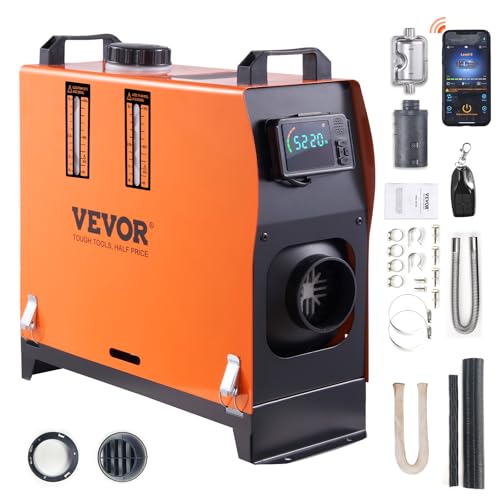
VEVOR 8KW Diesel Heater with Bluetooth and Altitude Adjustment — Best for Permanent Install
Where the all-in-one is convenience, this kit-format VEVOR is commitment — and its headline feature justifies the commitment for mountain campers. Automatic altitude adjustment compensates the fuel-air mixture as elevation rises, which is the difference between a heater that burns clean at a high trailhead and one that soots, smokes and sulks exactly where the nights are coldest. Campers go uphill for a living; their heaters should be rated for the trip.
As a permanent installation it disappears into the camper: heater under a seat or in a locker, tank plumbed once, ducts run to where warmth is wanted, controller on the wall. Nothing to set up at each camp, nothing to store, nothing to forget — the system is simply part of the vehicle, ready every night of the year.
Strengths
- Altitude adjustment for reliable mountain performance
- Permanent install — zero setup at each camp
- Bluetooth control and full kit format
Trade-offs
- Installation is a genuine project with drilling and plumbing
- 8KW headroom exceeds small campers’ needs
- Fixed in one vehicle — no portability
| Specification | Detail |
|---|---|
| Format | Kit heater for permanent installation |
| Heat class | 8KW per manufacturer designation |
| Altitude | Automatic altitude adjustment per listing |
| Control | Bluetooth app per listing |
Permanent installation repays its effort in a currency portable owners never quite receive: thoughtlessness. The warm camper becomes the default state of the vehicle rather than an arrangement, and over a hundred nights a year that default is worth every hour of the install weekend. The altitude feature compounds the value for the campers who roam highest — ski tours, alpine starts, high plateaus — where uncompensated heaters are a known failure pattern and a compensated one is simply a heater that works where it is parked.
Sizing counsel repeats the introduction’s: in a small, tight camper this heater will live at its lowest settings, which modern units handle well, but a 5KW sibling may run sweeter still. In a larger van, a draughty classic, or a genuinely cold climate, the headroom is the point. Either way, the installation discipline in the how-to section is the product as much as the heater is — budget the weekend, use the right exhaust and intake practice, and the system will serve for years.
Best for: owners installing once, properly — especially mountain and high-altitude campers / Not suited for: renters, minimalists, or anyone who cannot modify their camper
Check on Amazon to see the current price and size or configuration options.

LF Bros 5KW Diesel Heater with Plateau Mode — Best for Small Campers
Compact campers — teardrops, small vans, truck campers, pop-ups — are where the 5KW class proves the sizing sermon from the introduction. The LF Bros pairs that right-sized output with a plateau mode for altitude and a timer controller, which is precisely the feature set a small camper’s owner would specify if the industry asked them: steady heat, mountain manners, and warmth scheduled around sleep instead of interrupting it.
Its listing also cites a layered safety design and freeze-resistant wiring — the vocabulary of a maker thinking about where these heaters actually live: under bunks in cold-soaked campers, starting on frozen mornings, in vehicles that sit outside all winter. Small details, correctly aimed.
Strengths
- Output matched to small camper volumes — steadier low running
- Plateau mode for altitude reliability
- Timer controller suits overnight routines
Trade-offs
- Less reserve for very large or very cold installations
- Kit installation still required
- Support network thinner than the biggest brands
| Specification | Detail |
|---|---|
| Heat class | 5KW per manufacturer designation |
| Altitude | Plateau mode per listing |
| Control | Timer controller per listing |
| Power | 110V/12V per manufacturer listing |
Steady is the word owners use. A 5KW heater in a small camper reaches temperature and then settles — long, low, quiet burning that holds the cabin even, sips fuel, and asks little of the battery beyond its fan and pump. Compare the oversized alternative’s rhythm of blast and silence and the comfort difference is not subtle, especially for the light sleeper whose bed is two metres from the outlet. Right-sizing is the cheapest comfort upgrade in camper heating, and this pick is its embodiment.
The timer deserves its own praise, because overnight heating is a scheduling problem as much as a heating one: warm at bedtime, low through the deep night, a boost before the alarm. A controller that runs that programme unattended converts the heater from an appliance you manage into a climate you inhabit. For the compact camper — especially one that climbs — the LF Bros is the most precisely matched heater in this roundup.
Best for: compact campers, vans and truck campers — especially at altitude / Not suited for: large motorhomes or extreme-cold installations needing maximum headroom
Check on Amazon to see the current price and size or configuration options.

ICECOSMOS Diesel Heater, 4 Air Outlet Ducts — Best for Tents and Larger Spaces
Most diesel heaters have one mouth; the ICECOSMOS has four, and that changes what a single heater can do. Ducted to a camper’s sleeping area, living space and bathroom — or out to a tent’s corners — its output arrives where people are rather than pooling at the heater. For larger campers, family tents and annexe setups, distribution is worth more than raw output, because comfort is local: warm feet and a warm pillow beat a hot locker every time.
Its dual-power listing — 12 volt on the road, mains voltage at home or on a powered pitch — adds a practical flexibility the pure-12V picks lack: pre-heating and drying the camper on the driveway, or running the system on a campsite hook-up while the battery rests.
Strengths
- Four outlets distribute heat across zones
- Suits tents and larger spaces as well as campers
- Mains-power option for home and hook-up use
Trade-offs
- More ducting to plan, route and store
- Larger installation footprint than single-outlet units
- Overkill for a solo compact camper
| Specification | Detail |
|---|---|
| Outlets | 4 air outlet ducts per listing |
| Capacity | 15000 BTU per manufacturer listing |
| Power | 12V and 110–120V per listing |
| Use | RV, tent camping and garage per manufacturer listing |
Tent campers should pay this pick special attention, because it solves their version of the problem elegantly: the heater sits outside the tent — combustion, exhaust and fuel where they belong — while its ducts carry only warm air inside. That arrangement is the safe, established way to heat a tent, and four outlets mean a family tent warms evenly instead of developing a tropical zone beside a freezing one. The same architecture serves camper-plus-awning households, where the annexe is where everyone actually sits.
In a conventional camper the four outlets buy zoning: gentle heat to the bed end all night, stronger heat to the living end in the evening, a duct to the washroom that makes winter mornings civilised and keeps pipes kind. No other pick here offers that choreography. If your heated space has rooms — or a tent — this is your heater; if it has one room and two occupants, the simpler picks above will serve you with less to install.
Best for: larger campers, family tents, awnings and multi-zone heating / Not suited for: solo compact campers needing the simplest possible install
Check on Amazon to see the current price and size or configuration options.

VEVOR 8KW Diesel Heater with CO Alarm — Best for Safety Features
Every heater in this roundup can be installed safely, but this VEVOR is the one that brings part of the safety system with it: an integrated carbon monoxide alarm, in the manufacturer’s own listing, alongside its 8KW-class output and app control. For buyers whose first question about sleeping beside a combustion appliance is the right question — what watches the air while I sleep? — this is the pick that answers it in the product rather than in the accessories aisle.
To be precise about what the alarm does and does not do: it detects; it does not prevent. Prevention remains installation — exhaust sealed and outside, intake breathing fresh air, fuel lines sound. The alarm is the second layer, the one that wakes you if the first layer ever fails, and in a sleeping space that layering is exactly how safety is built. This guide still recommends an independent alarm in the sleeping area as well; redundancy is cheap and sleep is priceless.
Strengths
- Integrated CO alarm — safety designed in, not bolted on
- Full 8KW-class output with app and remote control
- 12V/24V flexibility across vehicle systems
Trade-offs
- Integrated alarm supplements — never replaces — correct installation
- 8KW class is generous for the smallest campers
- Feature-rich units carry feature-rich manuals; read it
| Specification | Detail |
|---|---|
| Heat class | 8KW per manufacturer designation |
| Safety | CO alarm per manufacturer listing |
| Control | Bluetooth app, remote and display per listing |
| Power | DC 12V/24V |
There is a type of buyer this pick exists for, and roundups underserve them: the cautious. The parent heating a camper with children aboard, the solo traveller who sleeps deeply, the owner whose camper is small and tightly sealed — for them, the alarm is not a feature among features, it is the permission slip that lets them enjoy diesel heat at all. A heater that grants that permission while also delivering the class’s full output and modern controls earns its badge without argument.
In all other respects it is a complete modern diesel heater: app-adjusted from the bunk, remote in hand, display for the glance across the cabin. Pair it with the installation discipline in this guide and an independent alarm for belt and braces, and it is as safe as camper heating gets — which, done properly, is very safe indeed, as decades of year-round full-timers attest.
Best for: families and cautious sleepers who want detection built into the heater itself / Not suited for: buyers who would treat any built-in alarm as a substitute for correct installation
Check on Amazon to see the current price and size or configuration options.

CYDZSW 12V 500W Electric Heater — Best Electric Option
An electric pick in a diesel-led guide needs its justification stated, and the CYDZSW’s is genuine. Not every camper may burn fuel — some sites restrict it, some owners will not install it, some campers need heat only in short, supervised bursts: warming the cab while driving between sites, drying condensation on a damp morning, taking the edge off while cooking. For those duties a 500 watt-class electric heater with four outlets is instant, clean, silent about exhaust, and trivially simple compared with a diesel installation.
And then the honesty this guide is built on: at roughly 40 amps, this heater spends a serious battery in a couple of hours, so as overnight sleeping heat it fails by arithmetic no brand can fix. It is in this roundup as the best electric option for electric-appropriate work — and as the standing illustration of why the other five picks burn diesel.
Strengths
- Instant heat with no fuel, exhaust or installation project
- Four outlets spread warmth for cab warm-ups
- Simple, portable, and permitted everywhere
Trade-offs
- Battery appetite forbids overnight use
- Output assists a camper; it does not heat one in deep cold
- Best with the engine running and charging
| Specification | Detail |
|---|---|
| Heat source | Electric — converts battery charge directly to heat |
| Class | 500W per model designation |
| Outlets | 4 per listing |
| Use | Cab and camping per manufacturer listing |
Used as directed — in bursts, engine running or battery plentiful — the CYDZSW is a likeable tool. It is the heater of the lunch stop and the ski-day changeover: twenty minutes that turn a cold-soaked cab into a civilised changing room, a blast that clears a condensation-drowned windscreen from inside, a supplement that takes the chill off the evening while the main system — or the sleeping bags — do the heavy work. Campers who understand it as a kettle rather than a furnace rate it highly.
The misuse pattern is equally predictable, and this review exists to interrupt it: the buyer who installs it as the camper’s only heat, runs it at bedtime, and wakes at 3am to cold air and a battery too flat to start anything. If your camper plan is overnight warmth, buy diesel and let this unit be the accessory it is. If your plan is bursts and boosts, it is the most convenient heater on this page, and its four outlets make those bursts count.
Best for: engine-running warm-ups, condensation clearing and short supervised boosts / Not suited for: overnight sleeping heat under any battery a camper can carry
Check on Amazon to see the current price and size or configuration options.
Comparison Table
| Pick | Badge | Key spec | Best for |
|---|---|---|---|
| VEVOR 8KW Diesel Heater All-in-One with 1.9 Gal Tank | Best Overall | 8KW-class all-in-one diesel heater, built-in 1.9 gal tank, Bluetooth | most camper owners wanting serious heat without a permanent installation project |
| VEVOR 8KW Diesel Heater with Bluetooth and Altitude Adjustment | Best for Permanent Install | 8KW-class kit heater, Bluetooth, automatic altitude adjustment | owners installing once, properly — especially mountain and high-altitude campers |
| LF Bros 5KW Diesel Heater with Plateau Mode | Best for Small Campers | 5KW diesel heater, plateau mode, timer controller | compact campers, vans and truck campers — especially at altitude |
| ICECOSMOS Diesel Heater, 4 Air Outlet Ducts | Best for Tents and Larger Spaces | Diesel heater with 4 duct outlets, 12V and mains capable | larger campers, family tents, awnings and multi-zone heating |
| VEVOR 8KW Diesel Heater with CO Alarm | Best for Safety Features | 8KW-class diesel heater with integrated CO alarm, app control | families and cautious sleepers who want detection built into the heater itself |
| CYDZSW 12V 500W Electric Heater | Best Electric Option | 500W-class electric heater, 4 outlets | engine-running warm-ups, condensation clearing and short supervised boosts |
How to Choose the Best 12 Volt Heater for Camper Life — Size, Fuel and Fit
Choose the fuel first, because it chooses everything else. If the camper must be warm overnight — the defining camper requirement — the answer is diesel, and the rest of the decision is sizing and format. If the need is genuinely only bursts with the engine running, electric is simpler and the CYDZSW class suffices. Buyers who blur this line buy twice: once hopefully, once correctly. The price difference between the classes is smaller than the cost of the wrong winter, so decide by duty, not by ticket.
Size by volume and insulation, not by ambition. A compact, insulated camper thrives on the 5KW class and is actively less comfortable on more. A large, draughty or extreme-climate rig earns the 8KW class. Remember that the kilowatt figures are manufacturers’ class designations for comparing within the category, not laboratory promises — use them as relative sizes, and weight steady low-output behaviour, which is where your nights are actually spent, above headline maximums you will use on the coldest hour of the year.
- Overnight sleeping heat: diesel, always.
- Compact camper: 5KW class, timer control, altitude mode if you climb.
- Large or cold-climate rig: 8KW class with headroom to spare.
- No modifications allowed: all-in-one portable format.
- Multiple rooms or a tent: multi-outlet distribution.
- Bursts and boosts only: the electric pick, engine running.
Then choose the format by your relationship with the camper. Owners keeping the vehicle for years should install permanently and never think about heating again. Owners experimenting, renting or running several shelters should go all-in-one portable and accept the setup ritual. And every owner, of every format, should budget the unglamorous companions in the same order: exhaust and intake materials done properly, a CO alarm, and fuel storage that respects both the law and the campsite.
How Much Battery Does a Camper Heater Really Need?
Less than newcomers fear — if the heater is diesel. A diesel heater’s electrical life has two phases: a start-up of a few minutes at a higher draw while its glow plug works, then hours of modest running draw for fan and pump. Across a full night that totals a small fraction of a 100 amp-hour battery — small enough that the fridge, not the heater, is usually the load that sizes a camper’s battery. This is the arithmetic that makes diesel the camper standard: the fuel tank is the energy store, and it is enormous compared with any battery.
Electric heating inverts the picture completely. Heat from a battery is the battery, converted: a 500 watt heater draws around 40 amps, so even a large lithium battery’s usable charge buys roughly two hours. There is no clever model, no premium brand and no future firmware that changes this; it is the physics that the diesel picks exist to sidestep. Any camper heating plan that begins with a battery and an electric element ends, by the second night, with a diesel heater — this guide simply saves you the first purchase.
The practical battery guidance follows: for diesel-based campers, size the battery for the whole camper’s loads — fridge, lights, pump, devices, heater’s modest share — using the pairing method in this site’s truck camper guide, and spend the surplus on comfort rather than on heater anxiety. The heater, properly chosen, is the least of your battery’s problems, and that is precisely the point of it.
How to Install a Diesel Heater in a Camper Safely
The installation decides whether a diesel heater is the best purchase in your camper or a story you tell carefully. This sequence is the standard shape of a safe install; the heater’s own manual governs its specific clearances and fittings, and any step beyond your competence belongs to a professional installer.
- Plan the whole system before drilling: heater position low and central to its ducts, hot-air outlets where people live, exhaust route running to the outside with a gentle downward slope, intake positioned to breathe outside air, fuel tank and pump placed per the manual, and the CO alarm sited in the sleeping area.
- Mount the heater on its plate with the specified clearances from walls, bedding and stored gear. Nothing combustible lives near the heater or its hot-air outlet — ever, including the towel you were about to drape there.
- Fit the exhaust with sealed joints, its silencer, and a termination point that cannot blow fumes back through windows, vents or door seals — and never into an awning or tent space where people sit or sleep. The intake gets its own clean outside path, kept clear of the exhaust’s output.
- Plumb the fuel: tank vented and secured, filter in line, pump mounted at the manual’s specified angle, hoses clipped clear of the exhaust and of chafe points. Prime the system and inspect every joint dry-eyed before the first firing.
- Wire to the camper’s house battery — fused as the manual specifies, never to a starting battery — and mount the controller where it can be reached from the bed. Test the CO alarm and fit a second, independent one if the heater does not carry its own.
- Commission outdoors in daylight with the camper open: run a full cycle from cold start to shutdown, check for exhaust leaks with a CO alarm held near joints, smell for fuel, listen for abnormal pump or fan noise, and confirm the shutdown purge completes on its own.
- Live with it attentively for the first trips: re-check joints and mounts after the first journeys, keep the intake and exhaust mouths clear of mud, snow and stored gear, and service the heater on schedule — a clean heater is an efficient, safe heater.
Installed with that discipline, a diesel heater becomes the most trusted appliance in the camper — the thing that makes January a season rather than a sentence. The steps are not bureaucracy; they are the difference between the heaters in this roundup as their makers intended them and the cautionary tales told in campsite bars.
Common Buying Mistakes
Buying electric for overnight heat
The arithmetic is undefeated: a battery holds a couple of hours of electric heat, not a night of it. Overnight warmth in a camper is diesel’s job, and every winter proves it to a new class of hopeful buyers.
Oversizing the heater
An 8KW unit in a tiny camper short-cycles, swings the temperature and soots itself toward an early service. Match the class to the volume; steady and small beats mighty and moody.
Routing the exhaust ‘nearly’ outside
Exhaust must terminate fully outside, clear of openings, with sealed joints — ‘mostly outside’ is how carbon monoxide enters sleeping spaces. This is the one step in camper ownership where nearly is not a grade.
Sleeping without a CO alarm
Whatever the heater’s own features, a sleeping space with a combustion appliance gets a tested carbon monoxide alarm. It is the cheapest item in the entire heating system and the only one whose failure mode is silence.
Cutting the heater’s power to stop it
Diesel heaters run a cool-down purge after shutdown for a reason. Switching one off at the battery mid-cycle cooks its internals and shortens its life. Use the controller; let the machine finish its own routine.
Final Recommendation
The best 12 volt heater for camper life, for most owners, is the VEVOR all-in-one: serious diesel heat with the tank built in, minimal installation, and the freedom to move it between camper, tent and workshop. Owners installing permanently should take the kit-format VEVOR with altitude adjustment; small-camper owners the right-sized LF Bros; families and tent campers the four-outlet ICECOSMOS; the cautious the CO-alarm VEVOR; and everyone should understand the electric CYDZSW as the burst-duty specialist it is, not the overnight answer it cannot be.
Whichever you choose, choose the installation and the alarm with the same care as the heater. Camper heating done properly is invisible — a warm box in a cold landscape, night after night, with nothing to think about but the view. That invisibility is the real product, and every pick above can deliver it in the hands of an owner who respects the discipline.
One last buying note, offered because this category rewards it: order your heater before the season, and if the kit allows it, bench-test the unit outside the camper before installation day — fuel it, power it, run a full cycle on the driveway. A heater proven on the bench turns installation into pure fitting, with no fault-finding crouched in a locker; and a fault found on the bench is a returns label, while the same fault found after installation is a weekend. Every experienced installer does this. First-time owners should steal the habit.
For the truck-mounted version of this life, the companion guide Best 12 Volt Heater And Battery For Truck Camper covers heater-and-battery pairing in depth. The wider cold-weather set is in Best 12 Volt Heater, Best 12 Volt Heater Defroster and, for the people inside the camper, Best 12 Volt Heated Blanket For Camping and Best 12 Volt Heated Glove Liners.
Short on time? Start with these three: VEVOR 8KW Diesel Heater All-in-One with 1.9 Gal Tank, VEVOR 8KW Diesel Heater with Bluetooth and Altitude Adjustment, LF Bros 5KW Diesel Heater with Plateau Mode. Each link goes to the live listing so you can check the current price on Amazon and confirm the size or configuration before you buy.
Frequently Asked Questions
Can a 12 volt electric heater keep a camper warm overnight?
No — not from any battery a camper can carry. Electric heat converts charge to warmth one-for-one, and a typical electric heater consumes a large battery’s usable charge in about two hours. Overnight camper heat is diesel’s job precisely because diesel stores the energy instead. Electric heaters in campers are for warm-ups and boosts, ideally with the engine running.
How much diesel does a camper heater use?
Remarkably little — these heaters sip fuel, with consumption rising and falling with output. Across a typical night at the low, steady settings campers actually use, the draw on a tank is measured in fractions of a litre rather than litres, which is why a modest tank lasts many nights. Your manual’s figures for your model and settings are the ones to plan a long trip around.
Is it safe to sleep with a diesel heater running in a camper?
With the three layers this guide insists on — correct installation with the exhaust fully outside and the intake breathing outside air, a tested carbon monoxide alarm in the sleeping space, and proper operating habits including letting the heater complete its shutdown cycle — diesel air heaters are the established heating method for countless full-time campers. Without those layers, no combustion appliance belongs in a sleeping space.
What size diesel heater does my camper need?
Match the class to the volume and insulation. Compact, well-insulated campers are happiest in the 5KW class, which runs steadier and quieter at the low outputs where nights are spent. Larger, draughtier or very cold-climate rigs justify the 8KW class. When torn between the two, remember that a heater can always be turned down smoothly only within limits — chronic short-cycling is the oversized heater’s tell, and it argues for the smaller class.
Can I heat a tent with a diesel heater?
Yes, and it is the best way to heat one — provided the heater itself stays outside the tent, with only its warm-air ducts entering, exactly as the four-outlet pick in this roundup is designed to do. Combustion, exhaust and fuel never share air with sleeping people; warm air alone crosses the tent wall. Add a CO alarm inside the tent as the second layer, and family winter camping changes character entirely.
Does a diesel heater need a big battery?
No — its electrical appetite is modest: a brief higher draw at start-up, then a low running draw for the fan and pump. The battery in a diesel-heated camper is sized by the whole camper’s loads, with the fridge usually first among them. That modest appetite is the core reason diesel owns camper heating, and the battery section above shows the arithmetic.


