Disclosure: airfryerkitchensupply.com is reader-supported. When you buy through links on our site, we may earn an affiliate commission at no extra cost to you.
Where to buy
For the best 12 volt fridge, every linked model below was verified against Amazon’s own catalog data before this guide was written, so each is a real, currently listed 12-volt refrigerator. Five are compressor models that can refrigerate and freeze; one is an honestly labeled thermoelectric cooler for lighter duty. Use the links in this box, in the reviews, and in the comparison table to check live availability.
- BougeRV 12V Refrigerator 23 Quart — Check the current price on Amazon
- Alpicool C20 Portable Fridge Freezer 21 Quart — Check the current price on Amazon
- Dometic CFX2 28L Electric Cooler — Check the current price on Amazon
- SetPower 12V Refrigerator 48QT Dual Zone — Check the current price on Amazon
- EUHOMY 19QT 12 Volt Refrigerator — Check the current price on Amazon
- Wagan EL6214 Personal Thermoelectric Cooler/Warmer 14L — Check the current price on Amazon
The best 12 volt fridge turns any vehicle into a place where real food travels well: milk that stays milk, leftovers that stay safe, medication that stays in range, and drinks that are cold because a compressor made them cold — not because they are floating in meltwater. The category splits sharply in two, and this guide keeps the split honest: compressor fridges, which hold a set temperature almost regardless of the weather, and thermoelectric coolers, which cool a limited amount below the surrounding air and cost less. Both appear below, clearly labeled, because each has buyers it serves well.
A 12-volt fridge earns its place over an ice chest in three situations: trips longer than a weekend, where ice runs become a chore and a cost; loads that cannot get wet or freeze accidentally, from produce to insulin; and vehicles that double as workplaces — trucks, vans, boats, and RVs where the fridge runs daily rather than occasionally. If your trips are short and your food is sturdy, ice is honestly fine, and the buying guide below says so plainly. If you are reading this because ice has failed you once too often, the six verified picks split cleanly by size, zones, and budget tier.
Sizes here run from a 14-liter personal cooler to a 48-quart dual-zone fridge freezer, because ‘best’ in this category is mostly a question of fit: fit in the vehicle, fit for the number of people, and fit for the power system behind it. Every compressor pick includes battery protection and runs on household power for pre-cooling, and each review states plainly who should skip it — the surest sign a pick is being described honestly.
In this guide
Quick Picks
Six verified 12-volt fridges and coolers, from a personal thermoelectric box to a family dual-zone unit:
- BougeRV 12V Refrigerator 23 Quart — Best Overall: A 23-quart compressor fridge with the widest stated range here — down to minus 8 degrees — quick pull-down, and both DC and AC power, sized for a couple’s weekend or a solo week. Check the current price on Amazon.
- Alpicool C20 Portable Fridge Freezer 21 Quart — Best Budget Compressor Fridge: The value entry into real compressor refrigeration: 21 quarts that refrigerate and freeze, on DC or AC power, from the highest-volume budget brand in the category. Check the current price on Amazon.
- Dometic CFX2 28L Electric Cooler — Best Premium Compact: Dometic’s compact CFX2: 28 liters, a minus 7 degree floor, app control, and three-stage battery protection — the premium answer for one or two travelers. Check the current price on Amazon.
- SetPower 12V Refrigerator 48QT Dual Zone — Best Dual Zone Value: Forty-eight quarts split into two independently controlled zones, with a minus 4 degree floor and a warranty the listing states at three years — dual-zone flexibility in the value tier. Check the current price on Amazon.
- EUHOMY 19QT 12 Volt Refrigerator — Best for Small Cars: A 19-quart compressor fridge with a full freezing range and proper battery protection, small enough for the cars and corners the big boxes cannot use. Check the current price on Amazon.
- Wagan EL6214 Personal Thermoelectric Cooler/Warmer 14L — Best Thermoelectric for Light Duty: An honest thermoelectric: 14 liters that cool below the surrounding air or warm food when asked, for commutes and day trips — included with its limits stated plainly. Check the current price on Amazon.
How These Picks Were Chosen
Picks were verified in Amazon’s catalog data through the Creators API, matched by brand and model against the manufacturer’s own listing titles, and then sorted by the questions buyers actually ask: compressor or thermoelectric, what capacity, how many zones, and which budget tier. Any model whose listing could not be matched confidently was excluded rather than guessed at, and the single thermoelectric pick is labeled as such everywhere it appears — including in its badge — because confusing the two technologies is the category’s most expensive misunderstanding.
We weighted temperature honesty first: a compressor fridge should state a range and hold it, and the stated ranges here run from minus 8 degrees to typical fridge temperatures. Battery protection was the second filter, because a fridge that flattens a starter battery fails its owner in the worst way. Capacity, zones, and brand track record followed. Prices were not a ranking input — they change too often — so tiers are described qualitatively as budget, mid-range, and premium throughout.
The 6 Best 12 Volt Fridges, Reviewed
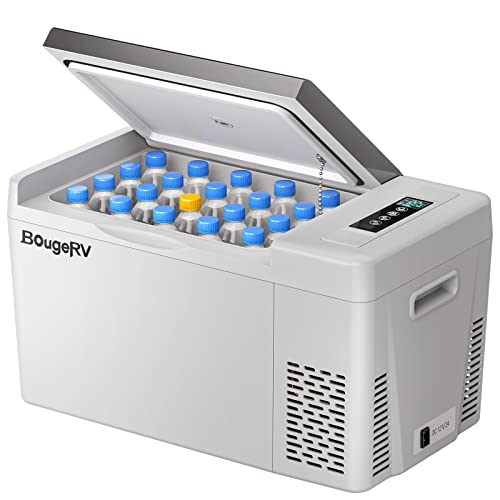
BougeRV 12V Refrigerator 23 Quart — Best Overall
The BougeRV 23 Quart is the fridge we would hand to most people asking this question, because it gets the fundamentals right in the size most vehicles can actually carry. Its stated range runs from minus 8 to 50 degrees Fahrenheit — the widest here — so the same box is a drinks fridge at 38 degrees, a freezer at 0, or anything between, and BougeRV states it can pull down to 32 degrees in about 15 minutes, which makes it forgiving of imperfect pre-cooling. Twenty-three quarts holds a weekend for two or a working week of lunches for one.
Strengths
- Widest stated range here: minus 8 to 50 degrees F
- Fast pull-down makes it forgiving of warm starts
- Runs on vehicle DC and household AC power
Trade-offs
- Single zone — one temperature for everything
- 23 quarts is tight for families on long trips
- No built-in battery for unplugged running
| Specification | Detail |
|---|---|
| Capacity | 23 quart |
| Temperature range | -8 to 50 degrees F (per API listing) |
| Power | 12/24V DC, 110V AC (per API listing) |
Daily-life details are well judged: it runs on 12/24V DC in the vehicle and 110V AC at home, so it can pre-cool on the counter and live in the car during the week — many owners use it as a permanent overflow and lunch fridge that only occasionally travels. The honest limits are capacity and zones: one compartment, one temperature, and a family of four will outgrow it for anything beyond a weekend. Within its size class, though, it is the most complete answer here, and its mid-range positioning keeps it reachable.
Best for: Most drivers who want one fridge for commuting, weekends, and road trips / Not suited for: Families needing a week of capacity or two temperature zones
Check on Amazon to see the current listing, configuration options, and delivery details for this model.

Alpicool C20 Portable Fridge Freezer 21 Quart — Best Budget Compressor Fridge
The Alpicool C20 is where most people should start if the budget matters, because it delivers the category’s defining capability — a real compressor that refrigerates and freezes on 12 volts — in the value tier, at a genuinely useful 21-quart size. Alpicool sells these boxes in enormous numbers, which cuts both ways: the design is thoroughly proven by sheer exposure, and the finish is functional rather than refined. For a first fridge, that is the right trade.
Strengths
- Real compressor refrigeration and freezing in the value tier
- Useful 21-quart size for couples and solo travelers
- AC and DC power for home pre-cooling and vehicle use
Trade-offs
- Basic finish and controls
- Single zone only
- Brand support is thinner than premium rivals
| Specification | Detail |
|---|---|
| Capacity | 21 quart (20 liter) |
| Power | 12/24V DC and 110V AC (per API listing) |
| Type | Compressor fridge freezer (per API listing) |
In use, the C20 does the unglamorous things correctly: it pre-cools on household power, switches to the vehicle socket for the road, and holds its set temperature through a driving day without drama. Twenty-one quarts suits a couple’s weekend or a solo traveler’s week of fresh food. What you give up against the mid-range picks is polish — simpler controls, a more basic interior, and less refinement in the details — plus the dual-zone flexibility this size class rarely offers anyway. If it turns out 12-volt refrigeration changes your travel life, you will know exactly what to upgrade later; many owners simply never need to.
Best for: First-time 12V fridge buyers and budget-conscious campers / Not suited for: Buyers who want premium fit, finish, and app features
Check on Amazon to see the current listing, configuration options, and delivery details for this model.

Dometic CFX2 28L Electric Cooler — Best Premium Compact
The Dometic CFX2 28L is the compact pick for buyers who travel often enough that build quality compounds. Its stated floor of minus 7 degrees Fahrenheit gives it true freezer capability with headroom for hot vehicles, the three-stage battery protection is the most configurable here, and app control lets you set and check temperature from the driver’s seat or the tent. Dometic describes the capacity as holding 36 cans — call it a long weekend for two, or a week for one, in fresh or frozen form.
Strengths
- Freezes to minus 7 degrees F with headroom for hot days
- Three-stage battery protection and app control
- Premium build, insulation, and support network
Trade-offs
- Premium price tier
- 28 liters is compact for families
- Single zone at this size
| Specification | Detail |
|---|---|
| Capacity | 28 liter (holds 36 cans, per API listing) |
| Temperature range | Freezes to -7 degrees F (per API listing) |
| Power | 12/24V (per API listing) |
| Protection | 3-stage battery protection, app control |
What the premium buys is the stuff that matters in year three: insulation that still seals, a compressor that still cycles quietly, hardware that tolerates dust, vibration, and being moved twice a week. The CFX2 line is built for that life. The trade-offs are price tier and size discipline — 28 liters is a compact box, and families should look at the dual-zone and larger picks instead. For the solo traveler, the couple, or the professional whose vehicle is an office, this is the fridge most likely to still be earning its place in five years.
Best for: Frequent travelers who want premium build in a compact footprint / Not suited for: Occasional users, for whom the premium tier buys little
Check on Amazon to see the current listing, configuration options, and delivery details for this model.

SetPower 12V Refrigerator 48QT Dual Zone — Best Dual Zone Value
Dual-zone refrigeration is the single biggest quality-of-life step in this category, and the SetPower 48QT is its value-tier expression: two compartments with independent control across a stated minus 4 to 68 degree range, so ice cream stays frozen on one side while produce and drinks sit at a gentle 38 on the other. Forty-eight quarts is family scale — a week of mixed food for three or four — and the listing’s stated three-year warranty is a meaningful signal in a tier where support is often the first thing cut.
Strengths
- Two independently controlled zones, fridge and freezer at once
- Full minus 4 to 68 degree stated range
- Warranty stated at three years in the listing
Trade-offs
- Large footprint; needs a planned vehicle spot
- Finish behind premium brands
- Overkill for solo, fridge-only use
| Specification | Detail |
|---|---|
| Capacity | 48 quart, dual zone |
| Temperature range | -4 to 68 degrees F (per API listing) |
| Control | Independent dual-zone control (per API listing) |
SetPower has built a following among RV and van owners precisely on this formula: dual zones, honest ranges, and pricing a tier below the premium brands. The compromises are the expected ones — a big box that needs a planned home in the vehicle, finish a step behind Dometic, and a brand history measured in years rather than decades. For mixed family loads, though, the second zone changes what you can carry at all, and no single-zone pick at any price can substitute for it. Measure your cargo space, and if it fits, this is the family answer.
Best for: Families and mixed loads: fridge on one side, freezer on the other / Not suited for: Small vehicles, or solo travelers who will not use the second zone
Check on Amazon to see the current listing, configuration options, and delivery details for this model.

EUHOMY 19QT 12 Volt Refrigerator — Best for Small Cars
Small vehicles are where 12-volt fridges usually fail to fit, and the EUHOMY 19QT exists for exactly that problem: a compact compressor box that still offers the full minus 4 to 68 degree range, ECO and MAX modes, and three-level battery protection. Nineteen quarts is a deliberate size — a solo traveler’s fresh food for most of a week, a couple’s weekend drinks and ingredients, or a permanent medical and lunch fridge behind a seat — and it asks little of the vehicle’s space or power system in return.
Strengths
- Full compressor range in a small-car footprint
- ECO/MAX modes and 3-level battery protection
- Easy on vehicle space and power alike
Trade-offs
- 19 quarts fills fast for groups
- Value-tier finish
- Single zone only
| Specification | Detail |
|---|---|
| Capacity | 19 quart |
| Temperature range | -4 to 68 degrees F (per API listing) |
| Power | 12V and 100-240V (per API listing) |
| Modes | ECO / MAX, 3-level battery protection |
EUHOMY’s formula across its line is to include the features that matter (modes, protection, dual power) and skip the ones that inflate cost, and the 19QT follows it faithfully. Expect competent, unglamorous execution rather than premium touches. The capacity ceiling is the honest limitation: this fridge rewards people who pack deliberately and punishes bulk buyers. If your constraint is the car rather than the budget, it is the pick that respects the constraint instead of arguing with it.
Best for: Compact cars, solo commuters, and behind-the-seat installations / Not suited for: Groups, or anyone freezing bulk quantities
Check on Amazon to see the current listing, configuration options, and delivery details for this model.
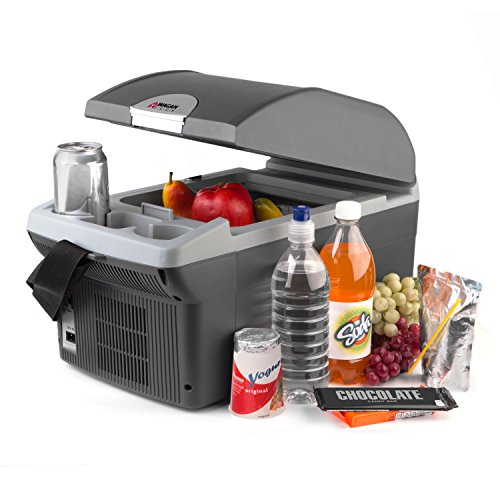
Wagan EL6214 Personal Thermoelectric Cooler/Warmer 14L — Best Thermoelectric for Light Duty
The Wagan EL6214 is in this guide under a different badge on purpose, because it is a different kind of appliance. Thermoelectric cooling moves heat with a solid-state plate: no compressor, very little noise, low power draw, and a cooling ability tied to the weather — it cools a set amount below the surrounding air. On a mild day that means properly cold drinks and a safe lunch. In a sun-baked car it means cool-ish drinks, and it will never freeze anything, ever. Wagan is commendably plain about this, and so are we.
Strengths
- Cools and warms in one simple, quiet box
- Low power draw suits daily commuting
- Budget-tier positioning from a long-running model line
Trade-offs
- Cannot freeze; cooling depends on ambient temperature
- Not suitable for multi-day fresh-food storage in heat
- 14 liters is personal-scale only
| Specification | Detail |
|---|---|
| Capacity | 14 liter |
| Type | Thermoelectric cooler/warmer (per API listing) |
| Power | 12/24V DC (per API listing) |
Within those limits, the EL6214 is genuinely useful and has been a commuter staple for years: 14 liters for drinks, lunch, and snacks, a warming mode that keeps takeout or a casserole warm on the drive home, and 12/24V operation that sips power compared with a compressor. It is the right purchase for daily drivers whose food is out for hours, not days, and who would rather spend in the budget tier. It is the wrong purchase for camping weekends, frozen food, or medication with strict ranges — for those, every other pick in this guide exists.
Best for: Daily drivers who want cool drinks and lunches, and warm food on the way home / Not suited for: Freezing, hot-weather fresh-food safety, or multi-day trips
Check on Amazon to see the current listing, configuration options, and delivery details for this model.
Comparison Table
The six picks at a glance — note the type column in the key specs, because compressor and thermoelectric are different appliances:
| Pick | Badge | Key spec | Best for |
|---|---|---|---|
| BougeRV 12V Refrigerator 23 Quart | Best Overall | 23 quart, -8 to 50 degrees F, fast cool to 32F in 15 minutes (per listing), 12/24V DC and 110V AC | Most drivers who want one fridge for commuting, weekends, and road trips |
| Alpicool C20 Portable Fridge Freezer 21 Quart | Best Budget Compressor Fridge | 21 quart (20 liter), compressor fridge freezer, 12/24V DC and 110V AC | First-time 12V fridge buyers and budget-conscious campers |
| Dometic CFX2 28L Electric Cooler | Best Premium Compact | 28 liter, freezes to -7 degrees F, holds 36 cans, 3-stage battery protection, app control | Frequent travelers who want premium build in a compact footprint |
| SetPower 12V Refrigerator 48QT Dual Zone | Best Dual Zone Value | 48 quart dual zone, independent control, -4 to 68 degrees F, 3-year warranty (per listing) | Families and mixed loads: fridge on one side, freezer on the other |
| EUHOMY 19QT 12 Volt Refrigerator | Best for Small Cars | 19 quart, -4 to 68 degrees F, ECO/MAX modes, 3-level battery protection | Compact cars, solo commuters, and behind-the-seat installations |
| Wagan EL6214 Personal Thermoelectric Cooler/Warmer 14L | Best Thermoelectric for Light Duty | 14 liter thermoelectric cooler/warmer, 12/24V DC — cools below ambient, does not freeze | Daily drivers who want cool drinks and lunches, and warm food on the way home |
If you take one idea from this table, take this: match the technology to the job first, then the size to the vehicle, then the badge to your budget. A compressor fridge one size smaller than you wanted will still refrigerate; a thermoelectric box of any size will not freeze.
How to Choose the Best 12 Volt Fridge: Compressor or Thermoelectric?
The technology decision comes before every other decision, because it defines what the appliance can do. A compressor fridge works like your kitchen refrigerator in miniature: it holds a set temperature — 38 degrees for fresh food, 0 or below for freezing — across a wide range of weather, at the cost of more weight, more power draw while cycling, and a higher price tier. A thermoelectric cooler has no compressor; it cools a limited amount below the air around it, so its interior temperature floats with the weather. On a 70-degree day it is a fine drinks cooler. On a 100-degree day in a parked car, it cannot keep fresh food safely cold, and it can never freeze.
Choose a compressor if any of these are true: the food must stay safe for more than a day, anything must stay frozen, the vehicle parks in summer heat, or the fridge carries medication or other temperature-critical items. Choose thermoelectric only for day-use drinks and lunches in mild conditions, where its low draw, quiet running, and budget positioning are real advantages. The price gap between the two has narrowed enough that most buyers who hesitate should buy the compressor — it is cheaper than replacing one load of spoiled food, let alone a ruined trip.
Size and zones come next. As a working guide: under 20 quarts serves one person or a couple’s drinks; 21 to 30 quarts covers a couple’s weekend of fresh food; 37 to 48 quarts feeds a family or a long solo trip; beyond that you are in spare-fridge territory. Dual zones matter when fresh and frozen travel together regularly; otherwise a single zone set to fridge temperature, with a small insulated bag for frozen items on short legs, serves most people well.
How Do You Power a 12 Volt Fridge Without Draining the Battery?
Every compressor pick here includes battery protection, and understanding it turns power anxiety into a routine. The protection monitors the supply voltage and cuts the fridge off at a threshold you select. The conservative threshold is for a starter battery: it stops early, preserving enough charge to start the engine, at the cost of the fridge warming slowly during long stops. The deeper thresholds are for auxiliary batteries and power stations, where a full discharge is acceptable and expected.
Daily consumption varies enormously with conditions — a fridge holding 38 degrees in mild weather sips power, while the same box freezing in desert heat works several times harder — so plan with margin. The robust patterns are simple: pre-cool on household power so the vehicle system only maintains temperature; run the fridge while driving, when the alternator makes power abundant; and for parked days, use a power station or auxiliary battery sized for the trip. Solar can extend any of these in camp.
One habit separates happy owners from frustrated ones: check the protection setting whenever the fridge changes vehicles or power sources. A fridge moved from a dual-battery truck to a single-battery car, still set to run deep, is the classic cause of the classic dead-battery story. Ten seconds with the manual prevents it entirely.
What Temperature Should a 12 Volt Fridge Be Set To?
Fresh food belongs between about 35 and 40 degrees Fahrenheit, with 38 degrees the working target most owners settle on: cold enough for safety and shelf life, warm enough that produce does not freeze against the cold walls. Leafy greens, herbs, and soft fruit are the usual casualties of an over-cold fridge zone, and in a small single-zone box the coldest spot sits near the cooling plate — pack delicate items away from it, and sturdy items like drinks and hard cheese where the cold bites hardest. A fridge thermometer, checked on the first trips, teaches you your own box’s cold and warm spots better than any manual.
Freezing duty wants 0 degrees Fahrenheit, the standard storage temperature, and most compressor picks here will hold it easily in mild weather. In a hot vehicle, resist the instinct to set the box far below its target ‘to help it along’: an extreme setting makes the compressor run nearly continuously, spending battery for little gain in interior temperature, while shade, ventilation, and pre-cooling do the real work. Set the temperature the food requires, give the box a fair environment, and let the compressor cycle as it was designed to.
Mixed loads in a single zone are the everyday compromise, and they have a workable pattern: run the box at fridge temperature for the fresh majority, keep frozen items in a small insulated bag inside the box for the first day or two of a trip, and eat the frozen food early in the itinerary. Owners who find themselves performing that compromise on every trip are the exact buyers dual-zone models exist for — the SetPower in this guide is the honest upgrade path, and recognizing the pattern early saves a season of improvisation.
How Long Will a 12 Volt Fridge Last, and What Wears Out First?
A compressor fridge from an established maker should be thought of as a five-to-ten-year appliance, and the components that age first are rarely the compressor. Seals and latches take the daily abuse of travel; power cables and plugs suffer the chafing and heat of vehicle life; and control electronics dislike voltage abuse and moisture. This is why the premium picks in this guide justify themselves to frequent travelers: the Dometic’s hardware, insulation, and support network are aimed precisely at the parts that actually wear, and parts availability in year six matters more than any feature list in year one.
Owners control most of the lifespan variables. Run the fridge on clean power with the battery protection set correctly, and the electronics live an easy life. Keep the vents clear and the interior dry in storage, and the compressor and seals age slowly. Secure the box so it cannot slide or tip, because the impacts of travel do more cumulative damage than the miles themselves. A fridge treated this way typically outlasts the vehicle it was bought for, which is why so many owners’ second 12-volt fridge is the same brand as their first.
When performance does fade, diagnose in the cheap order: power supply and plug first, then ventilation and ambient heat, then seals, and only then the refrigeration system itself. Most ‘dead fridge’ stories end at one of the first two steps. The exception is a box that has lost its charge or suffered compressor failure after long service — at that point, replacement with a current model, whose efficiency will likely beat the old one’s, is usually the rational end of a good appliance’s life.
How Does a 12 Volt Fridge Change Road-Trip Food, Really?
The change is easiest to see in a single day. Breakfast stops being whatever the first exit offers, because yogurt, fruit, and milk are in the car at the right temperature. Lunch becomes a park and a sandwich you made, at a trailhead instead of a counter. The grocery stop mid-trip becomes practical — real ingredients for a rental kitchen, leftovers that survive to become tomorrow’s lunch, the local specialty that would never have survived a cooler of meltwater. None of this is luxury; it is the ordinary food life of home, extended into a vehicle, and it is why owners describe the fridge as the purchase that changed how they travel rather than merely what they carry.
The second change is economic in a quiet way. Road food is expensive per unit of nutrition, and a fridge shifts the balance toward groceries — bought at grocery prices, eaten at picnic tables — without any sense of deprivation, because the food is genuinely better. Families notice it first and largest; solo travelers notice it in the quality of what they eat at the end of long driving days, when the alternative was whatever was still open. The fridge does not demand cooking, meal planning, or virtue. It simply makes the good option the easy option, which is the only kind of improvement that survives contact with a real itinerary.
The third change is the one nobody predicts: the fridge gets used at home. It becomes the overflow for holiday groceries, the drinks fridge for a gathering, the safe place for a cake or a case of something that must stay cold during a power cut — every pick here runs on household power, and owners discover that a portable fridge is a spare fridge that happens to travel. When you evaluate the purchase, count those home weeks honestly. For many households they are half the value, and they are the reason the mid-size picks in this guide so rarely appear on the secondhand market.
Who Should Buy a 12 Volt Fridge — and Who Should Wait?
Buy now if ice has become a recurring cost in your travel — in money, in spoiled food, in trips planned around store stops — or if your vehicle doubles as a workplace where lunch and medication need real refrigeration daily. Those patterns repay a compressor fridge quickly and predictably, and the six picks here cover them from the Alpicool C20’s value entry to the Dometic’s premium compact. Buy the size your typical trip needs, set the battery protection correctly on day one, and the appliance will disappear into your routine in the best possible way.
Wait if your trips are short, infrequent, and well served by a good cooler, or if you have not yet decided how the fridge will be powered beyond the starter battery on long parked stretches. A fridge is a system — box, power, and habits — and buying the box first and improvising the rest is how capable fridges earn unfair reputations. Sort the power plan, measure the vehicle, and then buy with confidence; the category is mature, the picks are stable, and a season of cooler use while you plan costs far less than a fridge bought in haste and used in frustration.
A Note on Reading 12 Volt Fridge Specifications Honestly
Specifications in this category reward a skeptical eye, and three habits protect buyers. First, treat capacity as approximate: quarts are measured differently across brands, and a box’s usable space depends on its interior shape and where the compressor housing intrudes — two ’23-quart’ fridges can pack quite differently. Second, read temperature ranges as claims about capability in reasonable conditions, not guarantees in a sealed car at noon in August; the picks here were chosen partly because their makers state ranges plainly, which is itself a signal. Third, distinguish features that change daily life — battery protection, dual power, zones — from features that decorate a listing. A fridge is a simple appliance asked to do one thing reliably for years, and the specification sheet that matters is the short one: technology, range, capacity, protection, power. Everything in this guide was filtered through that short sheet first.
How to Set Up and Use a 12 Volt Fridge Day to Day
A short routine covers setup, daily use, and storage for any compressor fridge in this guide:
- Pre-cool before the first load. Run the fridge on household power for a few hours — the BougeRV’s fast pull-down shortens this, but cold walls and a cold interior always help — then load food that is already refrigerated.
- Set temperature by load, not by habit. Around 38 degrees Fahrenheit for fresh food, 0 degrees for freezing. Mixed loads in a single zone belong at fridge temperature, with frozen items accepted as a short-trip compromise.
- Place it for airflow and shade. Keep the vents clear, keep the box out of direct sun where you can, and secure it so it cannot slide or tip when the vehicle moves.
- Set battery protection for the battery in use. Conservative on a starter battery, deeper on an auxiliary battery or power station — and re-check after moving the fridge between vehicles.
- Open with a plan. Cold air falls out of a top-opening box far less than a front door, but long lid-open rummaging still costs temperature. Pack by day and by meal so openings stay short.
- Store it dry and ajar. After a trip, empty, wipe with mild soap and water, dry fully, and store with the lid cracked open so the interior stays fresh for the next trip.
If the fridge will live in the vehicle permanently — as many commuter fridges do — check the power plug and cable monthly for heat discoloration or looseness, since a poor 12-volt connection is the most common cause of intermittent cooling complaints.
Common Buying Mistakes
Buying thermoelectric for a compressor’s job
The most expensive mistake in this category is expecting a thermoelectric cooler to refrigerate in summer heat or freeze anything at all. Read the stated temperature range: if it is expressed as ‘cools X degrees below ambient,’ it is thermoelectric, and its limits are physics, not quality. Match the technology to the job first.
Choosing capacity by the biggest trip of the year
A fridge sized for the annual family expedition spends fifty weeks being too big for the car. Size for your typical trip and rent, borrow, or supplement with an ice chest for the exceptional one — or choose a dual-zone mid-size that flexes both ways.
Leaving battery protection at the wrong setting
The default setting may assume an auxiliary battery you do not have. On a starter battery, set protection conservatively on day one; a fridge that protects its food but strands its owner has failed at its job.
Skipping the pre-cool
Loading a warm fridge with cold food in a hot car forces hours of hard running and can push food through unsafe temperatures on the way down. Pre-cooling at home costs nothing and makes the vehicle leg a maintenance task the fridge handles easily.
Final Recommendation
Start with the BougeRV 23 Quart unless your needs point elsewhere: it is the best-balanced fridge here for the way most people actually travel. Budget buyers should take the Alpicool C20 and its proven value formula; frequent travelers who keep gear for years should step up to the Dometic CFX2 28L; families carrying fresh and frozen together should go straight to the SetPower 48QT dual zone; small-car owners should look at the EUHOMY 19QT; and daily commuters with modest needs can honestly choose the Wagan thermoelectric and pocket the difference.
Whatever you pick, the ownership habits matter as much as the badge: pre-cool, set the battery protection deliberately, and keep the vents clear. Do those three things and a 12-volt fridge becomes invisible infrastructure — cold food, anywhere, without thinking about ice again. Buyers whose loads are mostly frozen, or who need two true temperatures at expedition scale, will find the dedicated freezer and fridge-freezer guides below worth the detour.
Start with the BougeRV 12V Refrigerator 23 Quart if its badge matches your use: Check the current price on Amazon.
Start with the Alpicool C20 Portable Fridge Freezer 21 Quart if its badge matches your use: Check the current price on Amazon.
Start with the Dometic CFX2 28L Electric Cooler if its badge matches your use: Check the current price on Amazon.
Best 12 Volt Freezer Best 12 Volt Fridge For Camping Best 12 Volt Fridge For Truckers Best 12 Volt Fridge Freezer Best 12 Volt Food Warmer
Frequently Asked Questions
What size 12 volt fridge do I actually need?
Match it to people and days. Under 20 quarts serves one person or a couple’s drinks and lunches. The 21-to-30-quart range covers a couple’s weekend of fresh food. Families or week-long solo trips belong in the 37-to-48-quart range, ideally dual zone. Bigger than that is spare-fridge territory — useful at home between trips, bulky on the road.
Can a 12 volt fridge also work as a freezer?
Compressor models can: most picks here state ranges reaching minus 4 degrees or lower, so the same box refrigerates at 38 degrees or freezes at 0. A single zone does one temperature at a time, so mixed loads need either a compromise setting or a dual-zone model like the SetPower 48QT. Thermoelectric coolers can never freeze — that is the category’s bright line.
Will a 12 volt fridge drain my car battery overnight?
Not if you use the battery protection correctly. Set to its conservative level, the fridge cuts out while the starter battery still holds enough charge to start the engine. For repeated parked days, though, the right answer is an auxiliary battery or portable power station — protection is a safety net, not a power source.
How cold does a 12 volt fridge get compared with a home fridge?
A compressor 12-volt fridge holds the same temperatures as a home unit — around 38 degrees for fresh food, 0 for freezing — because it uses the same technology in miniature. The difference is insulation and capacity, not temperature. Thermoelectric coolers are the exception: they cool relative to the weather and cannot promise a fixed temperature.
Can I leave a 12 volt fridge running in my car all the time?
Many owners do, especially commuters using one as a lunch and drinks fridge. Keep battery protection conservative, check the plug and cable periodically, and expect the fridge to cycle off during long parked stretches in hot weather as protection does its job. For a permanent installation, a dedicated auxiliary battery is the cleaner long-term setup.
Is a dual-zone fridge worth it over a single zone?
If fresh and frozen food travel together on most trips, yes — no single-zone compromise matches having 38 degrees and 0 degrees at once. If your loads are almost always all-fresh or all-frozen, a single zone gives you more usable space for the same money and one less decision to manage. Be honest about your typical load, not your most complicated one.


